Power TOYOTA PRIUS PRIME 2023 User Guide
[x] Cancel search | Manufacturer: TOYOTA, Model Year: 2023, Model line: PRIUS PRIME, Model: TOYOTA PRIUS PRIME 2023Pages: 680, PDF Size: 14.97 MB
Page 68 of 680
681-3. Emergency assistance
■Enhanced Roadside Assis-
tance
Enhanced Roadside Assistance
adds GPS data to the already
included warranty-based Toyota
roadside service.
Subscribers can press the
“SOS” button to reach a Safety
Connect response-center agent,
who can help with a wide range
of needs, such as: towing, flat
tire, fuel delivery, etc. For a
description of the Enhanced
Roadside Assistance services
and their limitations, please see
the Safety Connect Terms and
Conditions, which are available
at Toyota.com in the United
States, Toyotapr.com in Puerto
Rico and Toyota.ca in Canada.
Important! Read this informa-
tion before using Safety Con-
nect.
■Exposure to radio fre-
quency signals
The Safety Connect system
installed in your vehicle is a low-
power radio transmitter and
receiver. It receives and also
sends out radio frequency (RF)
signals.
In August 1996, the Federal
Communications Commission
(FCC) adopted RF exposure
guidelines with safety levels for mobile wireless phones. Those
guidelines are consistent with
the safety standards previously
set by the following U.S. and
international standards bodies.
ANSI (American National
Standards Institute) C95.1
[1992]
NCRP (National Council on
Radiation Protection and
Measurement) Report 86
[1986]
ICNIRP (International Com-
mission on Non-Ionizing Radi-
ation Protection) [1996]
Those standards were based on
comprehensive and periodic
evaluations of the relevant sci-
entific literature. Over 120 scien-
tists, engineers, and physicians
from universities, and govern-
ment health agencies and
industries reviewed the avail-
able body of research to
develop the ANSI Standard
(C95.1).
The design of Safety Connect
complies with the FCC guide-
lines in addition to those stan-
dards.
■Free/Open Source Soft-
ware Information
This product contains
Free/Open Source Software
(FOSS). The license information
and/or the source code of such
FOSS can be found at the fol-
lowing URL.
Safety information for
Safety Connect
Page 70 of 680
701-4. Theft deterrent system
1-4.Theft deterrent system
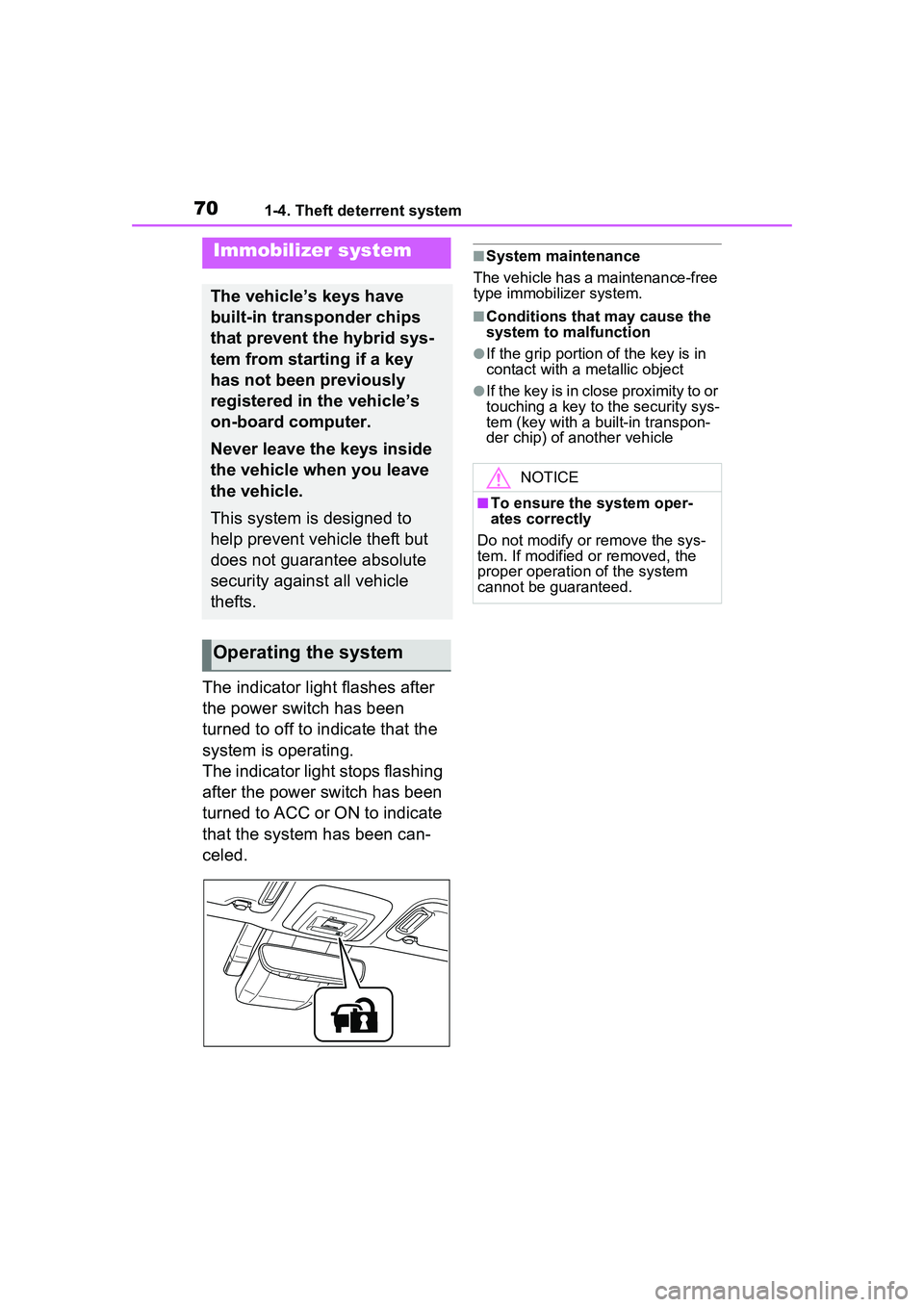
The indicator light flashes after
the power switch has been
turned to off to indicate that the
system is operating.
The indicator light stops flashing
after the power switch has been
turned to ACC or ON to indicate
that the system has been can-
celed.
■System maintenance
The vehicle has a maintenance-free
type immobilizer system.
■Conditions that may cause the
system to malfunction
●If the grip portion of the key is in
contact with a metallic object
●If the key is in close proximity to or
touching a key to the security sys-
tem (key with a built-in transpon-
der chip) of another vehicle
Immobilizer system
The vehicle’s keys have
built-in transponder chips
that prevent the hybrid sys-
tem from starting if a key
has not been previously
registered in the vehicle’s
on-board computer.
Never leave the keys inside
the vehicle when you leave
the vehicle.
This system is designed to
help prevent vehicle theft but
does not guarantee absolute
security against all vehicle
thefts.
Operating the system
NOTICE
■To ensure the system oper-
ates correctly
Do not modify or remove the sys-
tem. If modified or removed, the
proper operation of the system
cannot be guaranteed.
Page 71 of 680
71
2
2
Plug-in hybrid system
Plug-in hybrid system
2-1. Plug-in hybrid systemPlug-in hybrid system fea-tures ............................. 72
Plug-in hybrid system pre- cautions ........................ 83
Plug-in Hybrid Electric Vehi- cle driving tips .............. 88
EV driving range ............ 90
2-2. Charging Charging equipment....... 94
AC charging cable.......... 97
Locking and unlocking AC charging connector.... 102
Power sources that can be used .......................... 106
Charging methods....... 108
Charging tips ............... 110
Things to know before charging .................... 113
How to charge ............. 116
Using the charging sched- ule function ................ 123
Using the “My Room Mode” .................................. 134
Solar charging system 136
When charging cannot be carried out ................. 139
Page 72 of 680
722-1. Plug-in hybrid system
2-1.Plug-in hybrid system
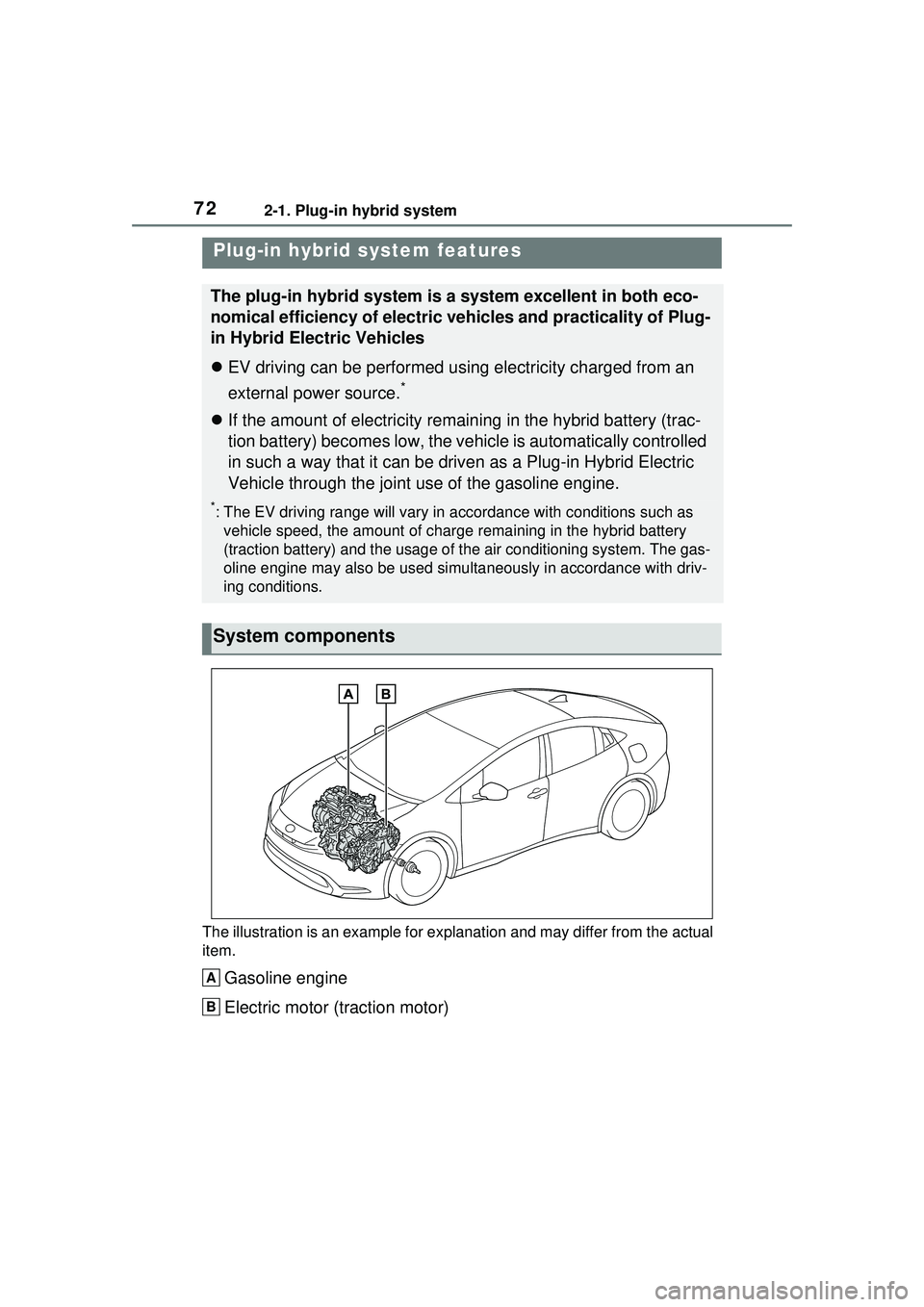
The illustration is an example for explanation and may differ from the actual
item.
Gasoline engine
Electric motor (traction motor)
Plug-in hybrid system features
The plug-in hybrid system is a system excellent in both eco-
nomical efficiency of electric vehicles and practicality of Plug-
in Hybrid Electric Vehicles
EV driving can be performed using electricity charged from an
external power source.
*
If the amount of electricity remaining in the hybrid battery (trac-
tion battery) becomes low, the ve hicle is automatically controlled
in such a way that it can be driven as a Plug-in Hybrid Electric
Vehicle through the joint use of the gasoline engine.
*: The EV driving range will vary in a ccordance with conditions such as
vehicle speed, the amount of charge remaining in the hybrid battery
(traction battery) and the usage of the air conditioning system. The gas-
oline engine may also be used simultaneously in accordance with driv-
ing conditions.
System components
A
B
Page 73 of 680
732-1. Plug-in hybrid system
2
Plug-in hybrid system
The plug-in hybrid system oper-
ates in the following modes.
The meter display can be used to
check which mode the plug-in
hybrid system is currently being
driven in. (P.150)
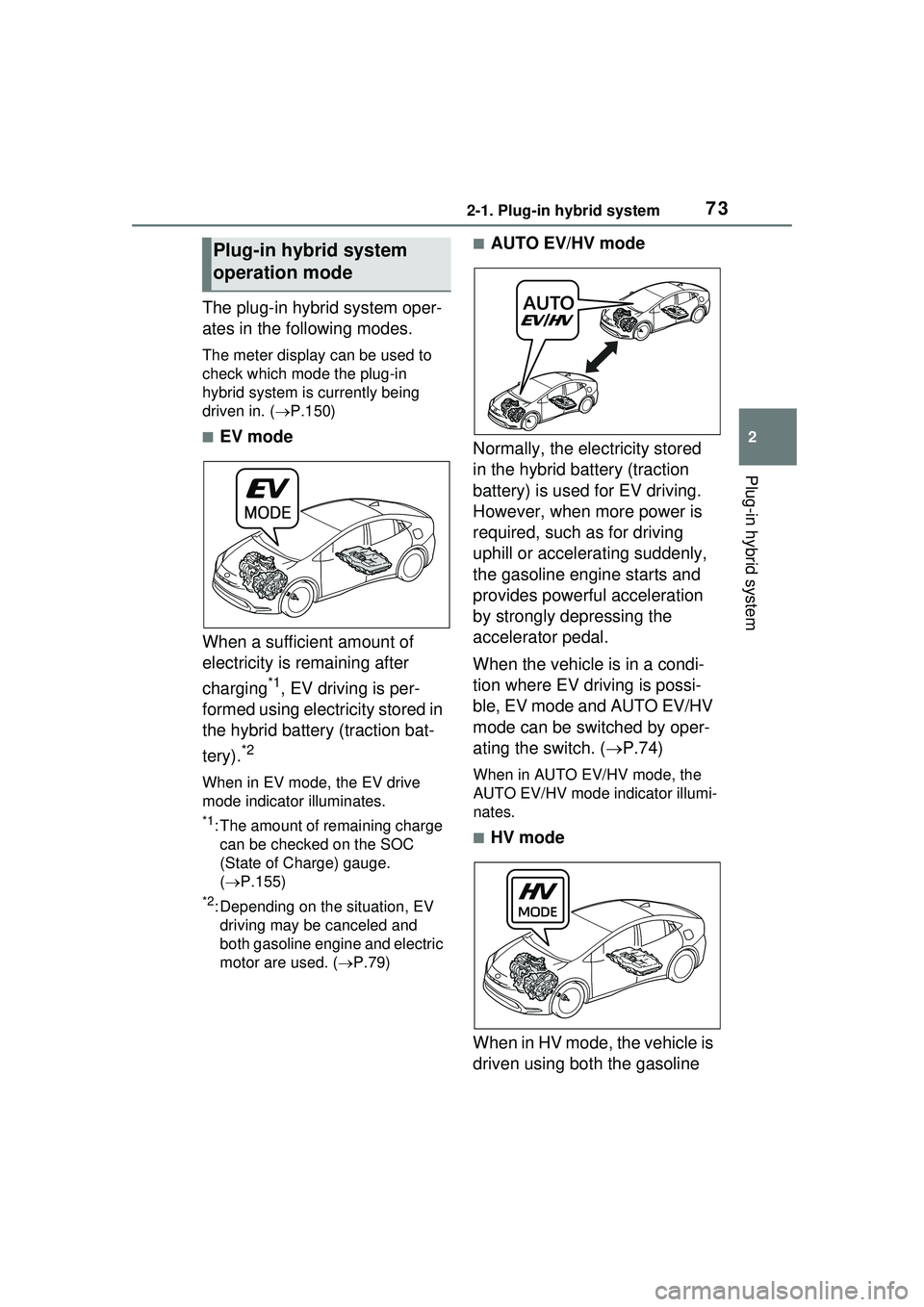
■EV mode
When a sufficient amount of
electricity is remaining after
charging
*1, EV driving is per-
formed using electricity stored in
the hybrid battery (traction bat-
tery).
*2
When in EV mode, the EV drive
mode indicator illuminates.
*1: The amount of remaining charge can be checked on the SOC
(State of Charge) gauge.
( P.155)
*2: Depending on the situation, EV
driving may be canceled and
both gasoline engine and electric
motor are used. ( P.79)
■AUTO EV/HV mode
Normally, the electricity stored
in the hybrid battery (traction
battery) is used for EV driving.
However, when more power is
required, such as for driving
uphill or accelerating suddenly,
the gasoline engine starts and
provides powerful acceleration
by strongly depressing the
accelerator pedal.
When the vehicle is in a condi-
tion where EV driving is possi-
ble, EV mode and AUTO EV/HV
mode can be switched by oper-
ating the switch. ( P.74)
When in AUTO EV/HV mode, the
AUTO EV/HV mode indicator illumi-
nates.
■HV mode
When in HV mode, the vehicle is
driven using both the gasoline
Plug-in hybrid system
operation mode
Page 74 of 680
742-1. Plug-in hybrid system
engine and electric motor.
(P.77)
• If electricity needed for EV driving in EV mode or AUTO
EV/HV mode is not remaining,
the operation mode will be
automatically switched to HV
mode.
• The operation mode can be switched to HV mode at any
timing by operating the switch
to keep electricity for EV driv-
ing etc. ( P.74).
* Switching
to HV mode when driving on a
highway or when driving uphill
is recommended in order to
conserve battery power.
When in HV mode, the HV drive
mode indicator illuminates.
*: The EV driving range may reduce even after switching to HV mode.
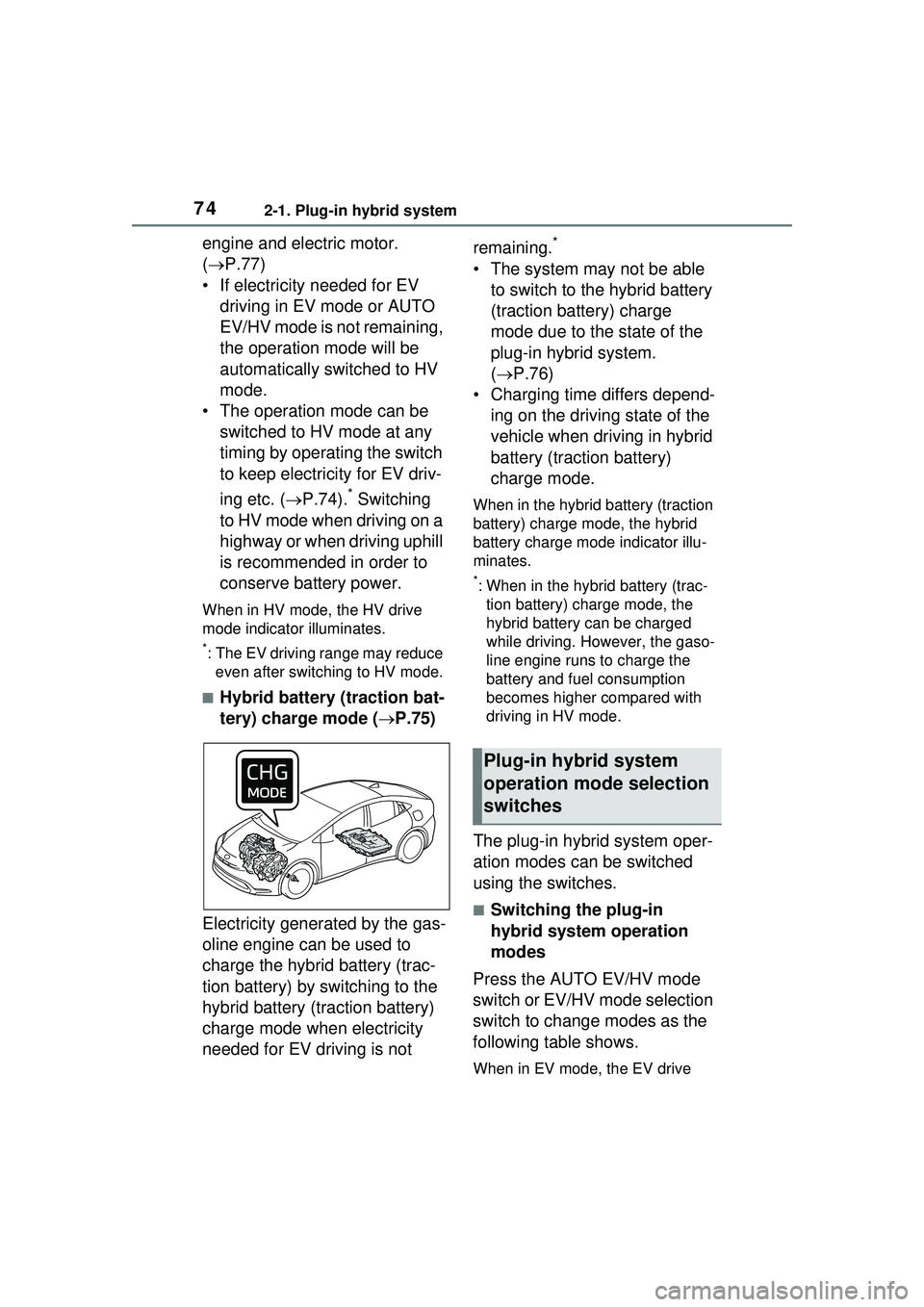
■Hybrid battery (traction bat-
tery) charge mode ( P.75)
Electricity generated by the gas-
oline engine can be used to
charge the hybrid battery (trac-
tion battery) by switching to the
hybrid battery (traction battery)
charge mode when electricity
needed for EV driving is not remaining.
*
• The system may not be able
to switch to the hybrid battery
(traction battery) charge
mode due to the state of the
plug-in hybrid system.
( P.76)
• Charging time differs depend- ing on the driving state of the
vehicle when driving in hybrid
battery (traction battery)
charge mode.
When in the hybrid battery (traction
battery) charge mode, the hybrid
battery charge mode indicator illu-
minates.
*: When in the hybrid battery (trac-tion battery) charge mode, the
hybrid battery can be charged
while driving. However, the gaso-
line engine runs to charge the
battery and fuel consumption
becomes higher compared with
driving in HV mode.
The plug-in hybrid system oper-
ation modes can be switched
using the switches.
■Switching the plug-in
hybrid system operation
modes
Press the AUTO EV/HV mode
switch or EV/HV mode selection
switch to change modes as the
following table shows.
When in EV mode, the EV drive
Plug-in hybrid system
operation mode selection
switches
Page 76 of 680
762-1. Plug-in hybrid system
from an external power source.
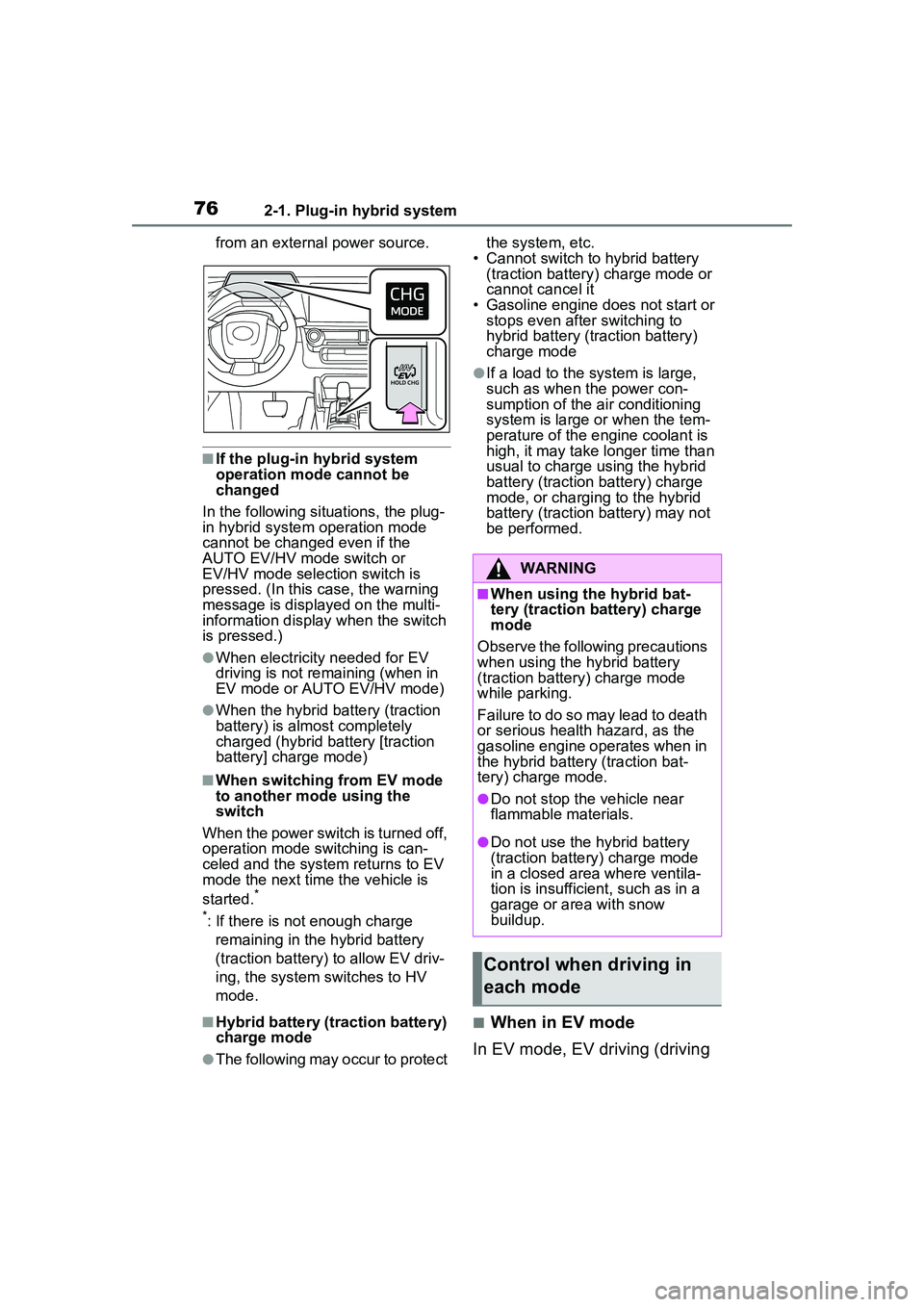
■If the plug-in hybrid system
operation mode cannot be
changed
In the following situations, the plug-
in hybrid system operation mode
cannot be changed even if the
AUTO EV/HV mode switch or
EV/HV mode selection switch is
pressed. (In this case, the warning
message is displayed on the multi-
information displa y when the switch
is pressed.)
●When electricity needed for EV
driving is not remaining (when in
EV mode or AUTO EV/HV mode)
●When the hybrid battery (traction
battery) is almost completely
charged (hybrid battery [traction
battery] charge mode)
■When switching from EV mode
to another mode using the
switch
When the power switch is turned off,
operation mode switching is can-
celed and the system returns to EV
mode the next time the vehicle is
started.
*
*
: If there is not enough charge remaining in the hybrid battery
(traction battery) to allow EV driv-
ing, the system switches to HV
mode.
■Hybrid battery (traction battery)
charge mode
●The following may occur to protect the system, etc.
• Cannot switch to hybrid battery (traction battery) charge mode or
cannot cancel it
• Gasoline engine does not start or stops even after switching to
hybrid battery (traction battery)
charge mode
●If a load to the system is large,
such as when the power con-
sumption of the air conditioning
system is large or when the tem-
perature of the engine coolant is
high, it may take longer time than
usual to charge using the hybrid
battery (traction battery) charge
mode, or charging to the hybrid
battery (traction battery) may not
be performed.
■When in EV mode
In EV mode, EV driving (driving
WARNING
■When using the hybrid bat-
tery (traction battery) charge
mode
Observe the following precautions
when using the hybrid battery
(traction battery) charge mode
while parking.
Failure to do so may lead to death
or serious health hazard, as the
gasoline engine operates when in
the hybrid battery (traction bat-
tery) charge mode.
●Do not stop the vehicle near
flammable materials.
●Do not use the hybrid battery
(traction battery) charge mode
in a closed area where ventila-
tion is insufficient, such as in a
garage or area with snow
buildup.
Control when driving in
each mode
Page 77 of 680
772-1. Plug-in hybrid system
2
Plug-in hybrid system
using only the electric motor)* is
possible. However, depending
on the situation, EV driving may
be canceled and both gasoline
engine and electric motor are
used ( P.79). Also, if a little
electricity is remaining in the
hybrid battery (traction battery),
HV mode is automatically
selected. To drive in EV mode
long, observe the followings.
Avoid sudden acceleration
and sudden deceleration, and
be sure to drive smoothly. If
you repeatedly accelerate,
the hybrid battery (traction
battery) charge will deplete
quickly. Also, EV driving may
be canceled by rapid acceler-
ation or vehicle speed.
Restrain your speed as much
as possible. The distance that
can be driven in EV mode will
reduce considerably at high
speeds.
*: The EV driving range can be
checked using the meter.
( P.155)
■When in AUTO EV/HV mode
Only the electric motor is used
for EV driving
* during normal
driving, but when the accelera-
tor pedal is strongly depressed,
the gasoline engine starts.
( P.79)
Also, when the hybrid battery
(traction battery) level is low, the
mode switches to HV mode automatically the same as in EV
mode.
AUTO EV/HV mode is suitable
for driving conditions when more
power is required, such as for
driving uphill or accelerating
suddenly. However, because
the gasoline engine will start
more easily, it is recommended
to drive in EV mode usually.
*: The EV driving range can be
checked using the meter.
( P.155)
■When in HV mode
The vehicle can be used in the
same way as a standard Plug-in
Hybrid Electric Vehicle
In HV mode, controls are pri-
marily carried out as follows in
accordance with the driving con-
ditions.
The gasoline engine stops
*
when the vehicle is stopped.
During start off, the electric
motor (traction motor) drives
the vehicle.
During normal driving, the
gasoline engine and electric
motor (traction motor) are
controlled effectively, and the
vehicle is driven with optimum
fuel efficiency. Also, when
necessary, the electric motor
(traction motor) operates as
an electrical generator to
charge the hybrid battery
(traction battery).
Page 79 of 680
792-1. Plug-in hybrid system
2
Plug-in hybrid system
■Gasoline engine operation in
EV mode or AUTO EV/HV mode
Even if there is a sufficient amount
of electricity remain ing in the hybrid
battery (traction battery) and EV
driving range ( P.155) is being dis-
played on the meter, EV driving
(driving using only the electric
motor) may be canceled and both
gasoline engine and electric motor
are used depending on the situation
(EV driving will be returned to auto-
matically after EV driving becomes
possible again).
EV driving may be canceled auto-
matically in the following circum-
stances
*1:
●When vehicle speed is more than
approximately 84 mph (135 km/h).
●When power is needed temporar-
ily, for example when the acceler-
ator pedal is depressed firmly or
when accelerating suddenly.
*2
●When the temperature of the
hybrid system is high.
The vehicle has been left in the
sun, driven on a h ill, driven at high
speeds, etc.
●When the temperature of the
hybrid system is low.
●When the heater is switched on
when the outside temperature is
below about 14°F (-10°C).
●When the windshield defogger
switch is pressed. ( P.434)
●When the system determines that
the gasoline engine needs to be
started.
*1: The gasoline engine may also
operate in circumstances other
than those listed above, depend-
ing on conditions.
*2: When driving in AUTO EV/HV mode. Even in EV mode, the gas-
oline engine may start, depend-
ing on the condition of the hybrid
battery (traction battery).
■If “Engine Started to Protect
System EV driving unavailable”
is displayed on the multi-infor-
mation display
EV driving may be canceled in order
to protect the hybrid system, etc.
In this case, perform driving with the
gasoline engine until EV driving will
be returned to automatically.
Depending on the conditions, driv-
ing that combines the use of the
gasoline engine may continue for a
short while. However, this is not a
malfunction.
■Conditions in which the gaso-
line engine may not stop
The gasoline engine starts and
stops automatically . However, it
may not stop automatically in the
following conditions
*:
●During gasoline engine warm-up
●During hybrid battery (traction bat-
tery) charging
●When the temperature of the
hybrid battery (traction battery) is
high or low
●When the windshield defogger
switch is pressed. ( P.434)
*: Depending on the circumstances,
the gasoline engine may also not
stop automatically in situations
other than those above.
■Sounds and vibrations specific
to a Plug-in Hybrid Electric
Vehicle
Because there is no engine sound
or vibration, it is easy to mistake the
Plug-in Hybrid Electric Vehicle for
being off when it is actually still run-
ning, as indicated by the “READY”
indicator being illuminated. For
safety, make sure to always shift the
shift position to P and apply the
parking brake when parked.
The following sounds or vibrations
may occur when the hybrid system
is operating and are not a malfunc-
tion.
Page 80 of 680
802-1. Plug-in hybrid system
●Motor sounds may be heard from
the engine compartment.
●Sounds may be heard from the
hybrid battery (traction battery)
when the hybrid system starts or
stops.
●Relay operating sounds such as a
snap or soft clank will be emitted
from the hybrid battery (traction
battery), under the rear seats or
under the floor, when the hybrid
system is started or stopped.
●Sounds from the hybrid system
may be heard when the back door
is open.
●Sounds may be heard from the
transmission when the gasoline
engine starts or stops, when driv-
ing at low speeds, or during idling.
●Engine sounds may be heard
when accelerating sharply.
●Sounds may be heard due to
regenerative braking when the
brake pedal is depressed or as
the accelerator pedal is released.
●Vibration may be felt when the
gasoline engine starts or stops.
●Sounds may be heard from near
the hybrid battery (traction battery)
in accordance with the operation
of the air conditioning system or
battery cooler. ( P.109)
■Maintenance, repair, recycling,
and disposal
Contact your Toyota dealer regard-
ing maintenance, repair, recycling
and disposal. Do not dispose of the
vehicle yourself.
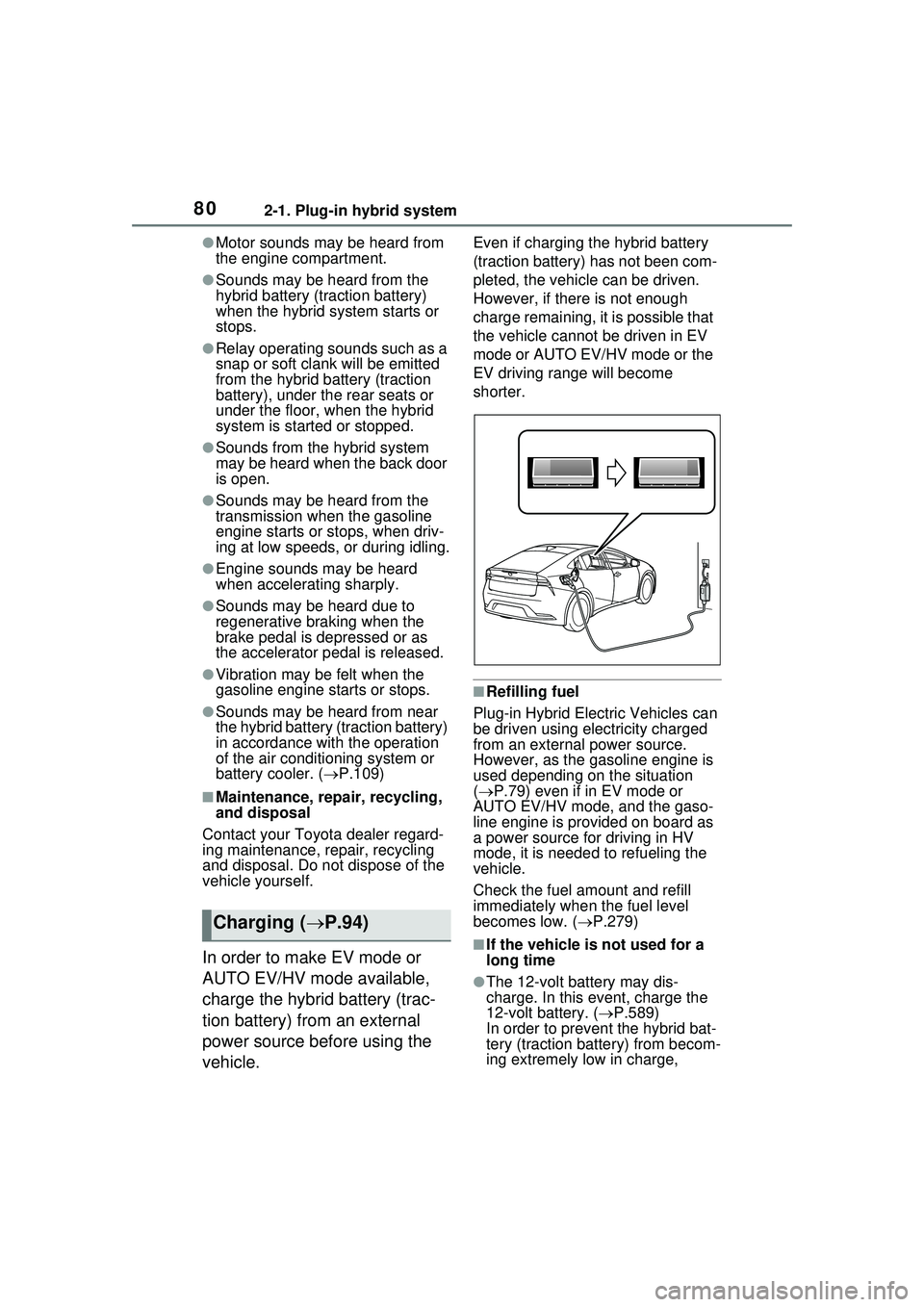
In order to make EV mode or
AUTO EV/HV mode available,
charge the hybrid battery (trac-
tion battery) from an external
power source before using the
vehicle.
Even if charging the hybrid battery
(traction battery) has not been com-
pleted, the vehicle can be driven.
However, if there is not enough
charge remaining, it is possible that
the vehicle cannot be driven in EV
mode or AUTO EV/HV mode or the
EV driving range will become
shorter.
■Refilling fuel
Plug-in Hybrid Electric Vehicles can
be driven using electricity charged
from an external power source.
However, as the gasoline engine is
used depending on the situation
( P.79) even if in EV mode or
AUTO EV/HV mode, and the gaso-
line engine is provided on board as
a power source for driving in HV
mode, it is needed to refueling the
vehicle.
Check the fuel amount and refill
immediately when the fuel level
becomes low. ( P.279)
■If the vehicle is not used for a
long time
●The 12-volt battery may dis-
charge. In this event, charge the
12-volt battery. ( P.589)
In order to prevent the hybrid bat-
tery (traction batt ery) from becom-
ing extremely low in charge,
Charging ( P.94)