battery TOYOTA PRIUS PRIME 2023 Owner's Manual
[x] Cancel search | Manufacturer: TOYOTA, Model Year: 2023, Model line: PRIUS PRIME, Model: TOYOTA PRIUS PRIME 2023Pages: 680, PDF Size: 14.97 MB
Page 90 of 680
902-1. Plug-in hybrid system
Carrying heavy luggage will lead
to poor fuel economy. Avoid car-
rying unnecessary luggage.
Installing a large roof rack will
also cause poor fuel economy.
Since the gasoline engine starts
up and cuts out automatically,
warming up is not necessary.The value displayed on the SOC
(State of Charge) gauge
(P.155) is estimated from the
following information.
The amount of hybrid battery
(traction battery) charge cur-
rently remaining
The electricity consumption
(the estimated distance that
EV driving is possible per unit
of electrical energy) based on
the recorded value
Past air conditioning system
electricity consumption
amount
The electricity consumption var-
ies depending on how the vehi-
cle is driven. The vehicle
Luggage
Warming up before driv-
ing
EV driving range
The EV driving range dis-
played on the meter shows
the reference distance that
EV driving (driving using
only the electric motor) is
possible, and the actual dis-
tance that can be driven
may differ from that dis-
played.
Even if the EV driving range is
displayed, EV driving may be
canceled and both gasoline
engine and electric motor are
used depending on the situa-
tion. ( P.79)
Displayed value
Page 91 of 680
912-1. Plug-in hybrid system
2
Plug-in hybrid system
automatically records the elec-
tricity consumption when being
charged and uses the electricity
consumption for estimating the
EV driving range. Therefore, the
EV driving range displayed
when the hybrid battery (traction
battery) is fully charged may dif-
fer from the previous EV driving
range depending on how the
vehicle was driven.
The EV driving range may
change significantly with each
charging until the electricity con-
sumption based on the recorded
value is stable (for approxi-
mately the first month or two).
However, this does not indicate
a malfunction.
When the air conditioning sys-
tem is turned on, the EV driving
range (with using the air condi-
tioning system) is estimated
based on the past air condition-
ing electricity consumption
amount considering that the
electricity consumption may
become higher.
The distance that EV driving is
possible varies significantly
depending on how the vehicle is
driven, road conditions, the
weather, the outside tempera-
ture, usage conditions of electri-
cal components and the number of occupants.
The distance that EV driving is
possible can be extended if the
following is performed:
■When starting off, depress
the accelerator pedal
smoothly to accelerate
As a guide, accelerate up to
approximately 12mph (20 km/h)
in the first 5 seconds.
Electrical and fuel efficiency can
be improved just by using the
ECO Accelerator Guidance dis-
played on the multi-information
display and taking care to start
off gently. ( P.163)
When the driving mode is set to
Eco drive mode, depressing the
accelerator pedal generates
smooth torque that makes it easier
to operate the accelerator gently.
At the same time, the air condition-
ing control is switched to eco air
conditioning mode ( P.437) to
reduce the strength of the air condi-
tioning operation.
■Maintain sufficient vehicle-
to-vehicle distance and do
not accelerate or decelerate
unnecessarily
Try to maintain a fixed speed
while driving. Driving at a short
vehicle-to-vehicle distance will
result in repeating wasteful
acceleration and deceleration,
which will worsen the electrical
and fuel efficiency.
Tips for extending the EV
driving range
Page 92 of 680
922-1. Plug-in hybrid system
■Release the accelerator
pedal early before stopping
the vehicle, such as at a
traffic light
The regenerative brake will
operate to convert the kinetic
energy of the vehicle into electri-
cal energy, which will charge the
hybrid battery (traction battery).
The regeneration status can be
checked from the Hybrid Sys-
tem Indicator. ( P.158)
When the brake pedal is
depressed lightly during decel-
eration, the regeneration
amount increases, enabling
more electrical energy to be
recovered.
If the brake pedal is depressed too
strongly, the recovered amount
indicator will reach the maximum
level and the upper limit of the
recoverable en ergy will be
exceeded. Therefore, be sure to
operate the brake pedal early.
■Use the air conditioning
system appropriately, and
also utilize the heated steer-
ing wheel (if equipped) and
seat heaters (if equipped)
In EV mode, the vehicle is
cooled and heated by electrical
energy. (Except in extremely
cold temperatures of approxi-
mately 14°F [-10°C] or less.)
Preventing excessive cooling or
heating of the vehicle will reduce
power consumption and
improve electrical efficiency. When eco air conditioning mode
is used, the air conditioning con-
trol is switched automatically to
a lower setting. (
P.437)
The heated steering wheel and
seat heaters are efficient heat-
ing device that directly warm the
body using less electric power.
When used together with the air
conditioning system, a low tem-
perature setting can be used to
improve electrical and fuel effi-
ciency.
■Check the tire pressure
If the tire pressure is lower than
the specified value, it will
worsen the electrical and fuel
efficiency.
A pressure level 7 psi (50 kPa, 0.5
kgf/cm
2 or bar) lower than the spec-
ified value will cause a worsening of
several percentage points.
■When driving on highways,
use the EV/HV mode selec-
tion switch to drive in HV
mode
The power consumption will
increase significantly if the vehi-
cle is driven in EV mode on
highways.
■Do not load unnecessary
objects in the vehicle
Driving with objects weighing
220 lb. (100 kg) in the vehicle
will worsen the electrical and
fuel efficiency by approximately
3%.
Air resistance also greatly
Page 96 of 680
962-2. Charging
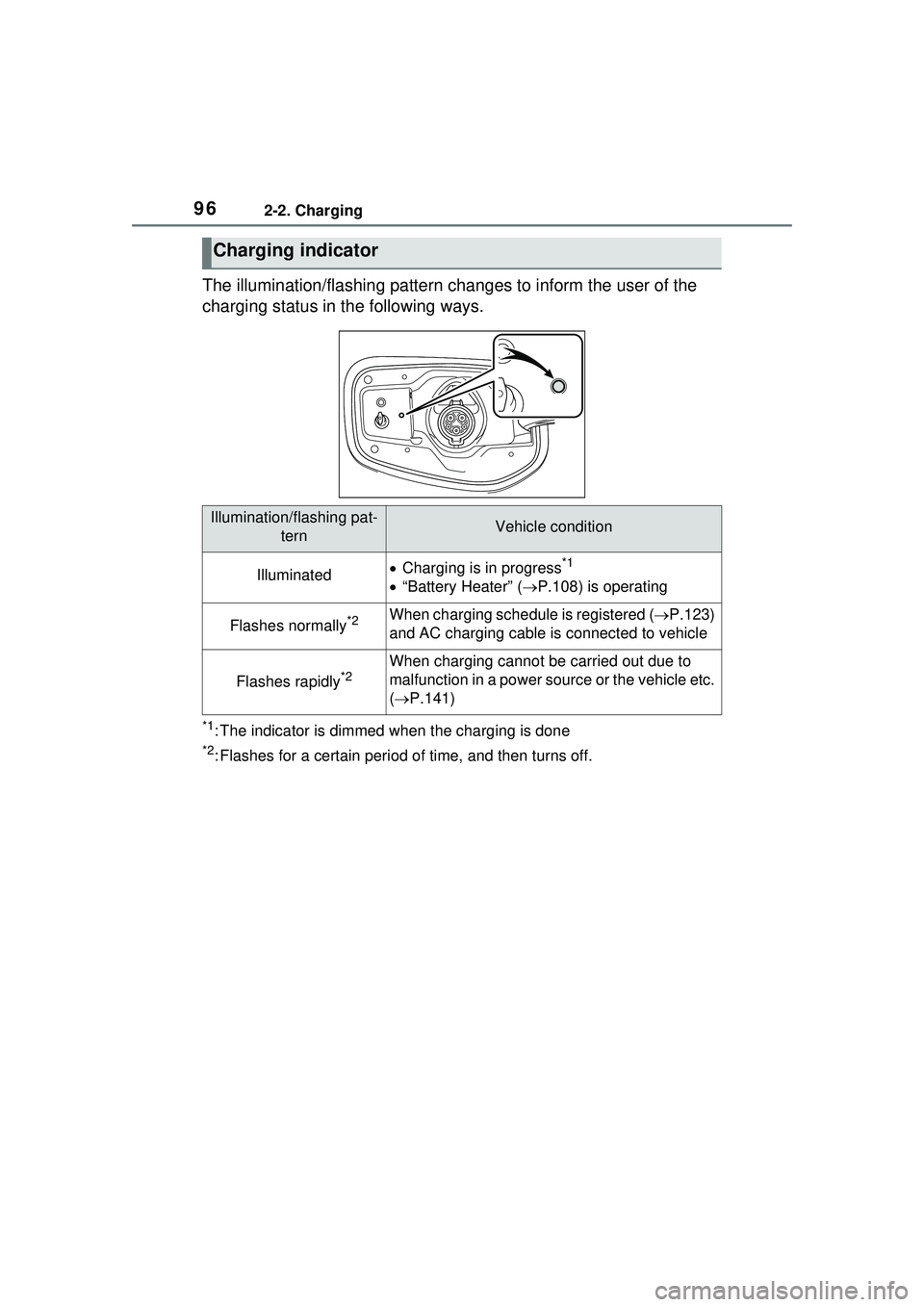
The illumination/flashing pattern changes to inform the user of the
charging status in the following ways.
*1: The indicator is dimmed when the charging is done
*2: Flashes for a certain period of time, and then turns off.
Charging indicator
Illumination/flashing pat-ternVehicle condition
IlluminatedCharging is in progress*1
“Battery Heater” ( P.108) is operating
Flashes normally*2When charging schedule is registered ( P.123)
and AC charging cable is connected to vehicle
Flashes rapidly*2When charging cannot be carried out due to
malfunction in a power sour ce or the vehicle etc.
( P.141)
Page 108 of 680
1082-2. Charging
■AC charging (P.116)
This is a charging method used
when charging from an AC out-
let with the AC charging cable or
charging that use an AC char-
ger.
By setting charging schedule, it is
also possible to charge at the
desired date and time. ( P.123)
■Using the hybrid battery
(traction battery) charge
mode ( P.75)
The plug-in hybrid system can
be switched to hybrid battery
(traction battery) charge mode
to charge the hybrid battery
(traction battery) using electricity
generated by gasoline engine
operation.
The maximum charge amount in
the hybrid battery (traction battery)
charge mode is approximately 80%
of the fully charged capacity for the
charging from an external power
source.
■Solar charging system (if
equipped) ( P.136)
In certain conditions, when the vehicle is parked, the hybrid bat-
tery (traction battery) can be
charged by using electricity gen-
erated by the solar panel
equipped to the roof of the vehi-
cle.
This vehicle is equipped with
several functions that are linked
with charging.
■“My Room Mode” (
P.134)
When the AC charging cable is
connected to the vehicle, electri-
cal components such as the air
conditioning system or audio
system can be used using the
external power source
*.
*: The power of the hybrid battery (traction battery) may be used
depending on the situation.
■“Battery Heater”
When the outside temperature
is low and the AC charging
cable is connected to the vehi-
cle, this function automatically
warms the hybrid battery (trac-
tion battery) until it reaches or
exceeds a certain temperature.
“Battery Heater” will operate
when the “Battery Heater” of the
“Charging Settings” on the multi-
information display is on.
( P.169)
By setting charging schedule,
“Battery Heater” operates
according to the charging
Charging methods
The following methods can
be used to charge the
hybrid battery (traction bat-
tery).
Types of charging meth-
odsCharging-linked functions
Page 109 of 680
1092-2. Charging
2
Plug-in hybrid system
start time. (P.123)
■Hybrid battery (traction bat-
tery) warming control
(Alaska and Canada only)
This control operates after the
AC charging cable remains con-
nected to the vehicle for 3 days
and “Battery Heater” automati-
cally stops. It automatically insu-
lates the hybrid battery (traction
battery) in extremely low tem-
peratures.
This control stops 31 days
after the AC charging cable is
connected, even if it is still
connected to the vehicle.
When this control operates,
charging schedule settings
are ignored and charging
starts.
■“Battery Cooler”
When the hybrid battery (trac-
tion battery) is hot and the AC
charging cable is connected to
the vehicle, this function cools
the hybrid battery (traction bat-
tery) before charging is carried
out.
“Battery Cooler” will operate
when the “Battery Cooler” of
the “Charging Settings” on the
multi-information display is
on. ( P.169)
When the charging voltage is
120 V, the function does not
operate.
■Traction battery heating and
cooling system (“Battery
Heater” and “Battery Cooler”)
●The system operates when the
hybrid battery (traction battery) is
below or above a certain tempera-
ture.
●The system may operate when
charging is not being performed.
●When the charging schedule is
used ( P.123), this function will
operate according to the charging
schedule.
■“Battery Heater”
●When “Battery Heater” is operat-
ing, the charging indicator illumi-
nates.
●When the AC charging cable is
removed from the vehicle or
remains connected to the vehicle
for approximately 3 days, the sys-
tem automatically stops.
●When “Battery Heater” is operat-
ing during charging, the charging
time may be longer than normal.
●When the shift position is changed
to any position other than P while
“Battery Heater” is operating, the
hybrid battery (traction battery)
heating operation stops.
●“Battery Heater” may operate
even when the hybrid battery
(traction battery) is fully charged
depending on the temperature of
the hybrid battery (traction bat-
tery).
• The remaining charge of the hybrid battery (traction battery)
decreases when “Battery Heater”
operates. The charging operation
may start again to charge the
hybrid battery (traction battery).
• “Charging Stopped Due to Pulled Charging Connector” may be
shown when the charging connec-
tor is removed while recharging.
( P.143)
Page 110 of 680
1102-2. Charging
■“Battery Cooler”
●The charging indicator is illumi-
nated while “Battery Cooler” is on
standby or operating.
●“Battery Cooler” is implemented
for a maximum of approximately
30 minutes.
●When there is a small amount of
remaining charge in the hybrid
battery (traction battery), even if
the hybrid battery (traction battery)
is hot, “Battery Cooler” may not be
implemented.
●When the hybrid battery (traction
battery) is almost completely
charged, “Battery Cooler” may not
be implemented.
●When the following operations are
performed while “Battery Cooler”
is operating, the hybrid battery
(traction battery) cooling operation
stops.
• The hood is opened
• The power switch is turned to any mode other than off
• “Charge Now” is implemented ( P.124)
●“Battery Cooler” uses the power of
the hybrid battery (traction battery)
and external power source.
• While “Battery Cooler” is operat- ing, the remaining charge of the
hybrid battery ma y not increase
the same amount as during nor-
mal charging.
• The operation of “Battery Cooler”
is recognized as charging by a
charger. The charger that calcu-
lates the fee according to charging
time causes a charging fee.
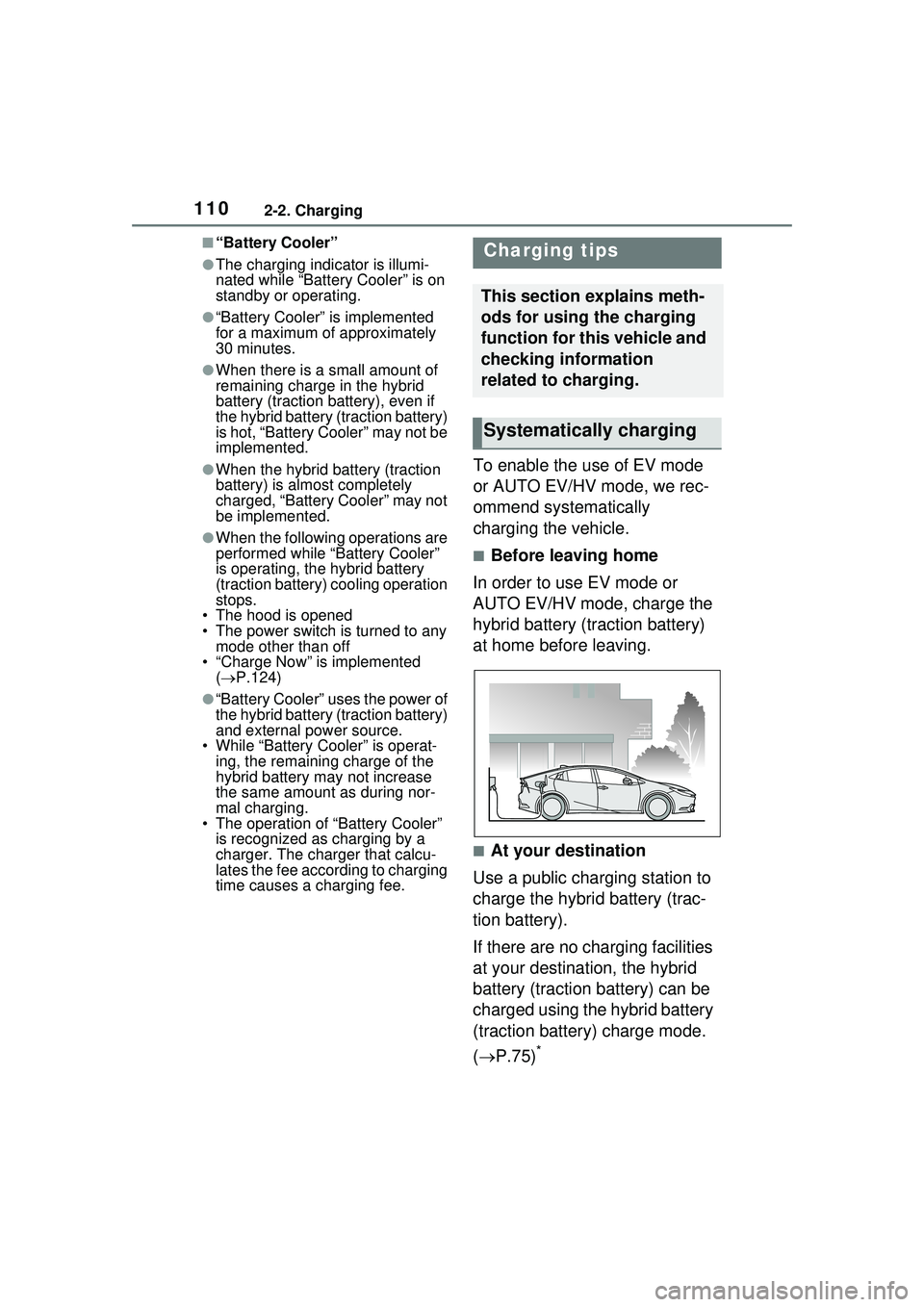
To enable the use of EV mode
or AUTO EV/HV mode, we rec-
ommend systematically
charging the vehicle.
■Before leaving home
In order to use EV mode or
AUTO EV/HV mode, charge the
hybrid battery (traction battery)
at home before leaving.
■At your destination
Use a public charging station to
charge the hybrid battery (trac-
tion battery).
If there are no charging facilities
at your destination, the hybrid
battery (traction battery) can be
charged using the hybrid battery
(traction battery) charge mode.
( P.75)
*
Charging tips
This section explains meth-
ods for using the charging
function for this vehicle and
checking information
related to charging.
Systematically charging
Page 111 of 680

1112-2. Charging
2
Plug-in hybrid system
*: When using the hybrid battery (traction battery) charge mode
while parked, make sure that no
flammable objects are near the
vehicle and the vehicle is parked
in a well-ventilated area. ( P.76)
■While parking (vehicles
with solar charging system)
Solar charging is performed to
charge the hybrid battery (trac-
tion battery) when the neces-
sary conditions such as parking
are met. ( P.136)
■After returning home
In order to drive the next time,
charge the hybrid battery (trac-
tion battery).
Settings the charging schedule
allows you to charge the hybrid bat-
tery (traction battery) at the desired
time such as late at night or early in
the morning. Furthermore, the
charging schedule can be set to automatically charge the hybrid bat-
tery (traction battery) every day or
at the same time on certain days.
(
P.123)
Vehicles with solar charging sys-
tem: When the hybrid battery (trac-
tion battery) is fully charged,
charging the battery via the solar
charging system is not performed.
If you are not planning on driving
the vehicle for a few days, refrain-
ing from charging the vehicle until
right before you plan on using it will
allow the solar charging system to
be used effectively.
Information related to charging
is displayed and can be checked
on the multi-information display.
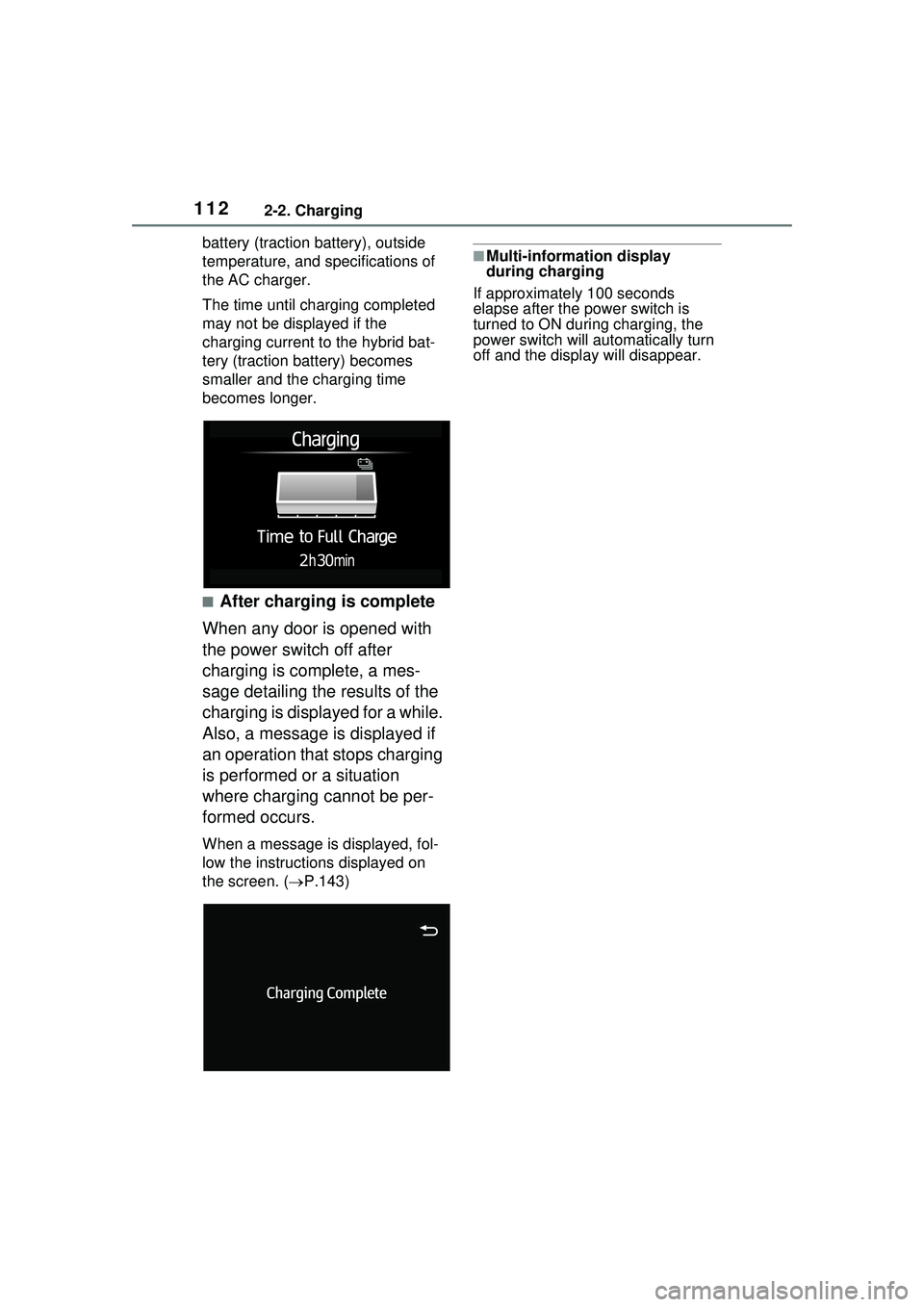
■While charging
When any door is opened during
charging with the power switch
off, the current charging condi-
tion and approximate time
remaining until charging is com-
plete are displayed for a certain
period of time.
The actual charging time may differ
depending on conditions such as
the remaining capacity of the hybrid
Checking information
related to charging
Page 112 of 680
1122-2. Charging
battery (traction battery), outside
temperature, and specifications of
the AC charger.
The time until charging completed
may not be displayed if the
charging current to the hybrid bat-
tery (traction battery) becomes
smaller and the charging time
becomes longer.
■After charging is complete
When any door is opened with
the power switch off after
charging is complete, a mes-
sage detailing the results of the
charging is displayed for a while.
Also, a message is displayed if
an operation that stops charging
is performed or a situation
where charging cannot be per-
formed occurs.
When a message is displayed, fol-
low the instructions displayed on
the screen. ( P.143)
■Multi-information display
during charging
If approximately 100 seconds
elapse after the power switch is
turned to ON during charging, the
power switch will automatically turn
off and the display will disappear.
Page 113 of 680
1132-2. Charging
2
Plug-in hybrid system
■Safety functions
●The hybrid system will not start
while the AC charging cable is
attached to the vehicle, even if the
power switch is operated.
●If the AC charging cable is con-
nected while the “READY” indica-
tor is illuminated, the hybrid
system will stop automatically and
driving will not be possible.
■During charging
●The charging starting time may
differ depending on the state of
the vehicle, but this does not indi-
cate a malfunction.
●Cooling fan sounds may be heard
from near the luggage compart-
ment.
●During charging, sounds may be
heard from near the hybrid battery
(traction battery) in accordance
with the operation of the air condi-
tioning system or “Battery Cooler”.
●During and after charging, the lug-
gage compartment and its sur-
rounding area in which the
onboard traction battery charger is
installed may get warm.
●The surface of the CCID
(Charging Circuit Interrupting
Device) may become hot, but this
does not indicate a malfunction.
●Depending on radio wave condi-
tions, interference may be heard
on the radio.
■When charging using a public
charging facility
When charging using a public charging facility, check the setting of
the charging schedule function.
●When the charging schedule is
registered, temporarily turn off the
function or turn “Charge Now” on.
(
P.128, 132)
●When the charging schedule is set
to on, charging will not start even
if the AC charging cable is con-
nected. Also, charging fee may
occur due to connection of the AC
charging cable.
■Using a DC Charger
DC Chargers cannot be used with
this vehicle.
■Capacity reduction of the
hybrid battery (traction battery)
The capacity of the hybrid battery
(traction battery) will decline gradu-
ally when the hybrid battery (traction
battery) is in use. The rate at which
it declines will diff er in accordance
with environmental conditions and
the way in which the vehicle is used.
Observing the following can help
suppress battery capacity decline.
●Avoid parking the vehicle in areas
with a high temperature under
direct sunlight when the hybrid
battery (traction battery) is fully
charged.
●Avoid accelerating and decelerat-
ing frequently and suddenly when
EV driving.
●Avoid frequent driving near the top
speed for EV driving. ( P.79)
●Leave a low level of charge in the
hybrid battery (traction battery)
when leaving the vehicle undriven
for a long period of time.
After confirming that EV mode or
AUTO EV/HV mode has switched
to HV mode, turn the power switch
off.
●Use the charging schedule func-
tion as much as possible in order
to fully charge t he hybrid battery
(traction battery) immediately
before starting off. ( P.123)
Things to know before
charging
Make sure to read the fol-
lowing precautions before
charging the hybrid battery
(traction battery).