AUX TOYOTA PRIUS PRIME 2023 Owners Manual
[x] Cancel search | Manufacturer: TOYOTA, Model Year: 2023, Model line: PRIUS PRIME, Model: TOYOTA PRIUS PRIME 2023Pages: 680, PDF Size: 14.97 MB
Page 136 of 680
1362-2. Charging
the power consumption inside the
vehicle is improved.
• To continue using “My Room
Mode”, turn off the power of sys-
tems such as the air conditioning
system and audio system to
increase the remaining charge of
the hybrid battery (traction bat-
tery).
*: The power balance status during
“My Room Mode” can be checked
from the remaining charge dis-
play screen for the hybrid battery
(traction battery) displayed on the
multi-informat ion display.
( P.134)
*: If equipped
This system generates solar
power with the solar panel
equipped to the roof of the vehi-
cle (solar roof).
The hybrid battery (traction
battery) is charged while park-
ing.
The electrical consumption of
the hybrid battery (traction
battery) is reduced during
WARNING
■Cautions for using “My Room
Mode”
Make sure to ob serve the follow-
ing precautions.
Failure to do so may result in seri-
ous health problems or even
death.
●Do not leave children, people
who need assistance, or pets
inside the vehicle. The system
may turn off automatically and
the interior temperature may
become high or low, resulting in
heat stroke, dehydration or
hypothermia. Devices such as
the wipers can also be used,
which may lead to mistaken
operation and an accident.
●Check the safety around the
vehicle carefully before use.
Solar charging sys-
tem*
A system that provides
power to the hybrid battery
(traction battery) and auxil-
iary systems by performing
solar charging via the large
solar panel (solar roof)
equipped on the vehicle
roof.
Even when a parking lot does
not have charging equipment
and in the event of a disaster,
it is possible to charge
* the
hybrid battery (traction bat-
tery) without any special oper-
ations as long as sunlight is
available.
*: The charging amount via the solar charging system differs
depending on conditions, such
as season and weather.
Solar charging system
operation
Page 137 of 680
1372-2. Charging
2
Plug-in hybrid system
driving.
The electrical consumption of
the hybrid battery (traction
battery) is suppressed
increasing EV driving dis-
tance by supplementing
power consumption for the
auxiliary systems using solar
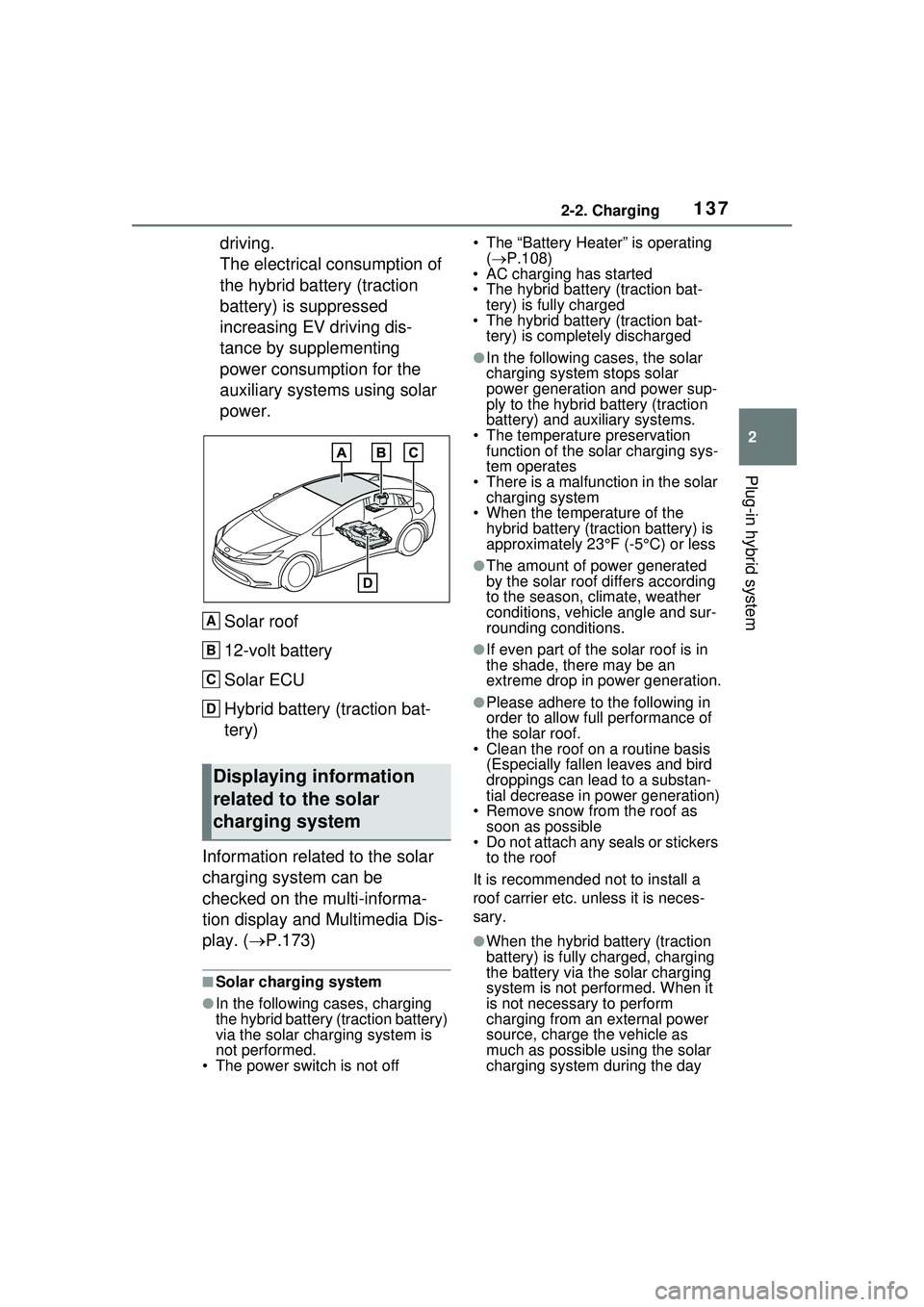
power.Solar roof
12-volt battery
Solar ECU
Hybrid battery (traction bat-
tery)
Information related to the solar
charging system can be
checked on the multi-informa-
tion display and Multimedia Dis-
play. ( P.173)
■Solar charging system
●In the following cases, charging
the hybrid battery (traction battery)
via the solar charging system is
not performed.
• The power switch is not off • The “Battery Heater” is operating
( P.108)
• AC charging has started
• The hybrid battery (traction bat-
tery) is fully charged
• The hybrid battery (traction bat-
tery) is completely discharged
●In the following cases, the solar
charging system stops solar
power generation and power sup-
ply to the hybrid battery (traction
battery) and auxiliary systems.
• The temperature preservation function of the solar charging sys-
tem operates
• There is a malfun ction in the solar
charging system
• When the temperature of the hybrid battery (traction battery) is
approximately 23°F (-5°C) or less
●The amount of power generated
by the solar roof differs according
to the season, climate, weather
conditions, vehicle angle and sur-
rounding conditions.
●If even part of the solar roof is in
the shade, there may be an
extreme drop in power generation.
●Please adhere to the following in
order to allow full performance of
the solar roof.
• Clean the roof on a routine basis
(Especially fallen leaves and bird
droppings can lead to a substan-
tial decrease in power generation)
• Remove snow from the roof as soon as possible
• Do not attach any seals or stickers
to the roof
It is recommended not to install a
roof carrier etc. unless it is neces-
sary.
●When the hybrid battery (traction
battery) is fully charged, charging
the battery via the solar charging
system is not performed. When it
is not necessary to perform
charging from an external power
source, charge the vehicle as
much as possible using the solar
charging system during the day
Displaying information
related to the solar
charging system
A
B
C
D
Page 147 of 680
1472-2. Charging
2
Plug-in hybrid system
■If “Charging Stopped High Energy Use See Owner’s Manual”
is shown
■If “Charging System Malfunction See Owner’s Manual” is
shown
■If “The Traction Battery Temp is low System put priority on
charging to preserve battery condition” is shown (Alaska and
Canada only)
Likely causeCorrection procedure
Power is being consumed by electri-
cal components of vehicle
Check the following items, and then
carry out charging again.
If the headlights and audio are
turned on, turn them off.
Turn the power switch off.
If charging cannot be carried out,
even after performing the above, the
auxiliary battery may not be suffi-
ciently charged. Operate the hybrid
system for approximately 15 minutes
or more to charge the 12-volt battery.
Likely causeCorrection procedure
Malfunction occurred in charging
systemHave the vehicle inspected by your
Toyota dealer.
Likely causeCorrection procedure
The Hybrid battery (traction battery)
warming control was operated
( P.109)
When the hybrid battery (traction
battery) warming control operates,
the charging schedule is not used
and charging is performed.
This is a control to protect the hybrid
battery (traction battery), and not a
malfunction.
Page 501 of 680
5017-3. Do-it-yourself maintenance
7
Maintenance and care
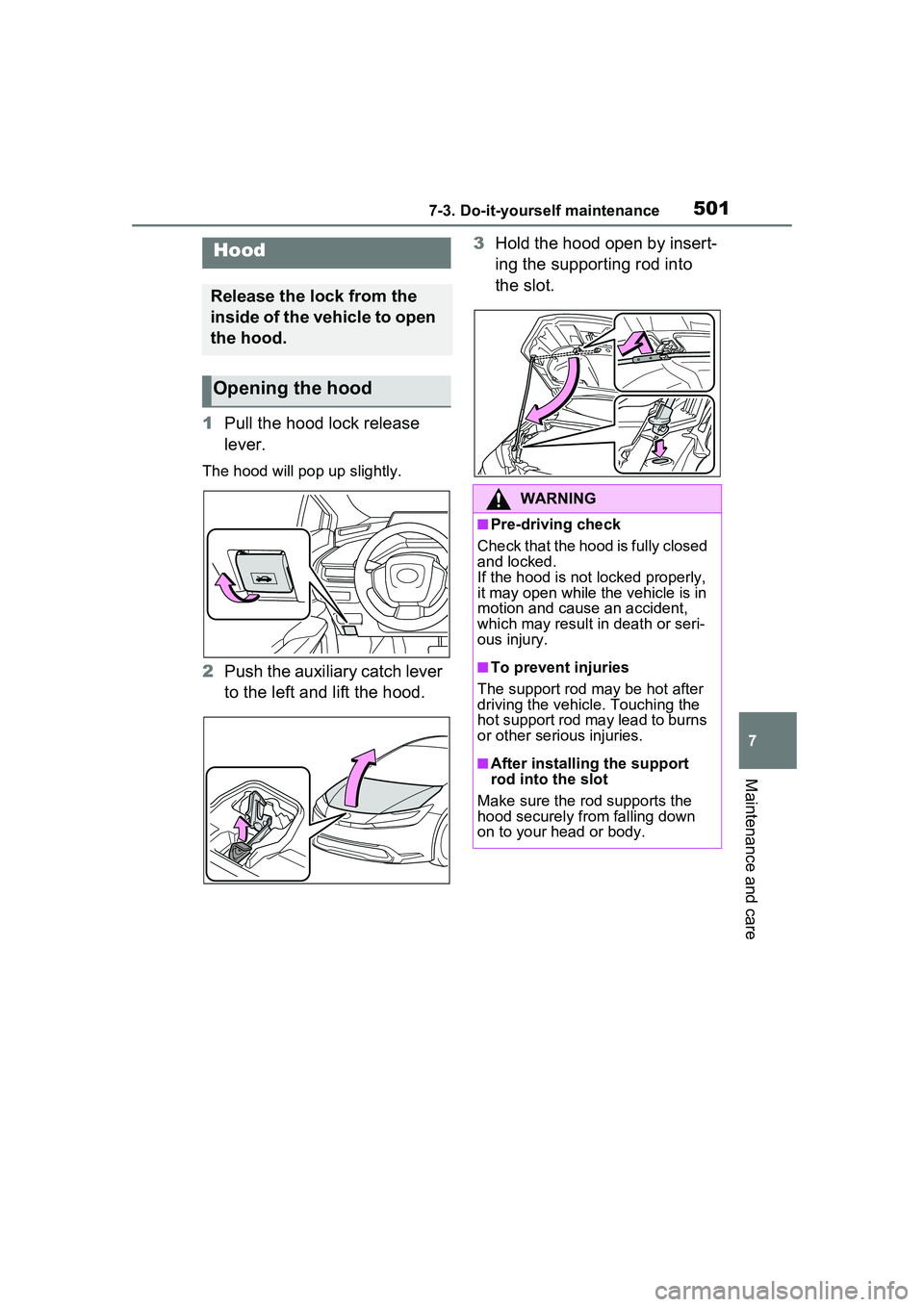
1Pull the hood lock release
lever.
The hood will pop up slightly.
2Push the auxiliary catch lever
to the left and lift the hood. 3
Hold the hood open by insert-
ing the supporting rod into
the slot.
Hood
Release the lock from the
inside of the vehicle to open
the hood.
Opening the hood
WARNING
■Pre-driving check
Check that the hood is fully closed
and locked.
If the hood is not locked properly,
it may open while the vehicle is in
motion and cause an accident,
which may result in death or seri-
ous injury.
■To prevent injuries
The support rod may be hot after
driving the vehicle. Touching the
hot support rod may lead to burns
or other serious injuries.
■After installing the support
rod into the slot
Make sure the rod supports the
hood securely fr om falling down
on to your head or body.
Page 639 of 680
63910-1. For owners
10
For owners
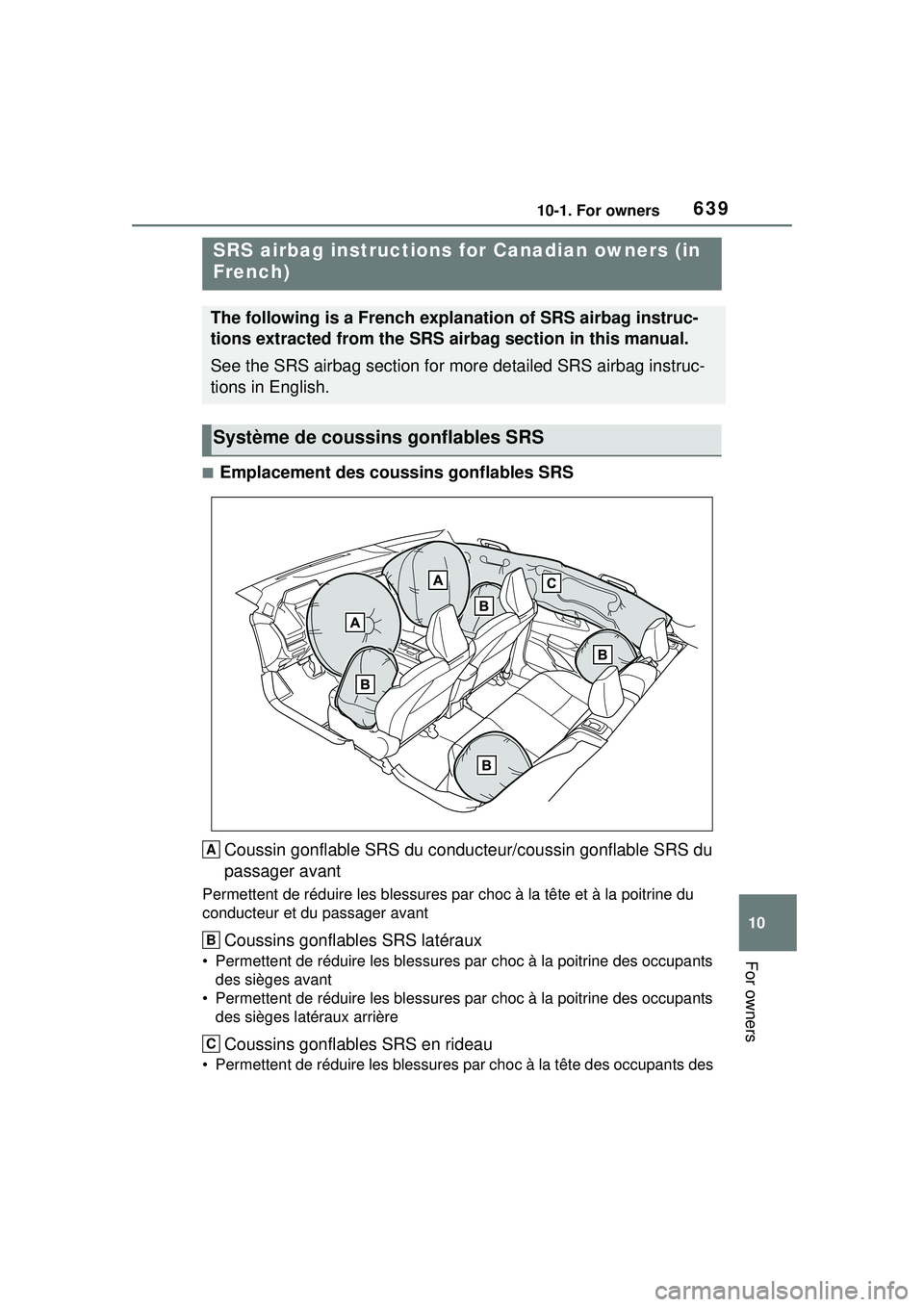
■Emplacement des coussins gonflables SRSCoussin gonflable SRS du conducteur/coussin gonflable SRS du
passager avant
Permettent de réduire les blessures par choc à la tête et à la poitrine du
conducteur et du passager avant
Coussins gonflables SRS latéraux
• Permettent de réduire les blessures pa r choc à la poitrine des occupants
des sièges avant
• Permettent de réduire les blessures pa r choc à la poitrine des occupants
des sièges latéraux arrière
Coussins gonflables SRS en rideau
• Permettent de réduire les blessures pa r choc à la tête des occupants des
SRS airbag instructions for Canadian owners (in
French)
The following is a French explanation of SRS airbag instruc-
tions extracted from the SRS airbag section in this manual.
See the SRS airbag section for more detailed SRS airbag instruc-
tions in English.
Système de coussi ns gonflables SRS
A
B
C
Page 640 of 680
64010-1. For owners
sièges avant et latéraux arrière
• Peuvent permettre d’éviter que les occupants soient éjectés du véhicule en cas de tonneaux
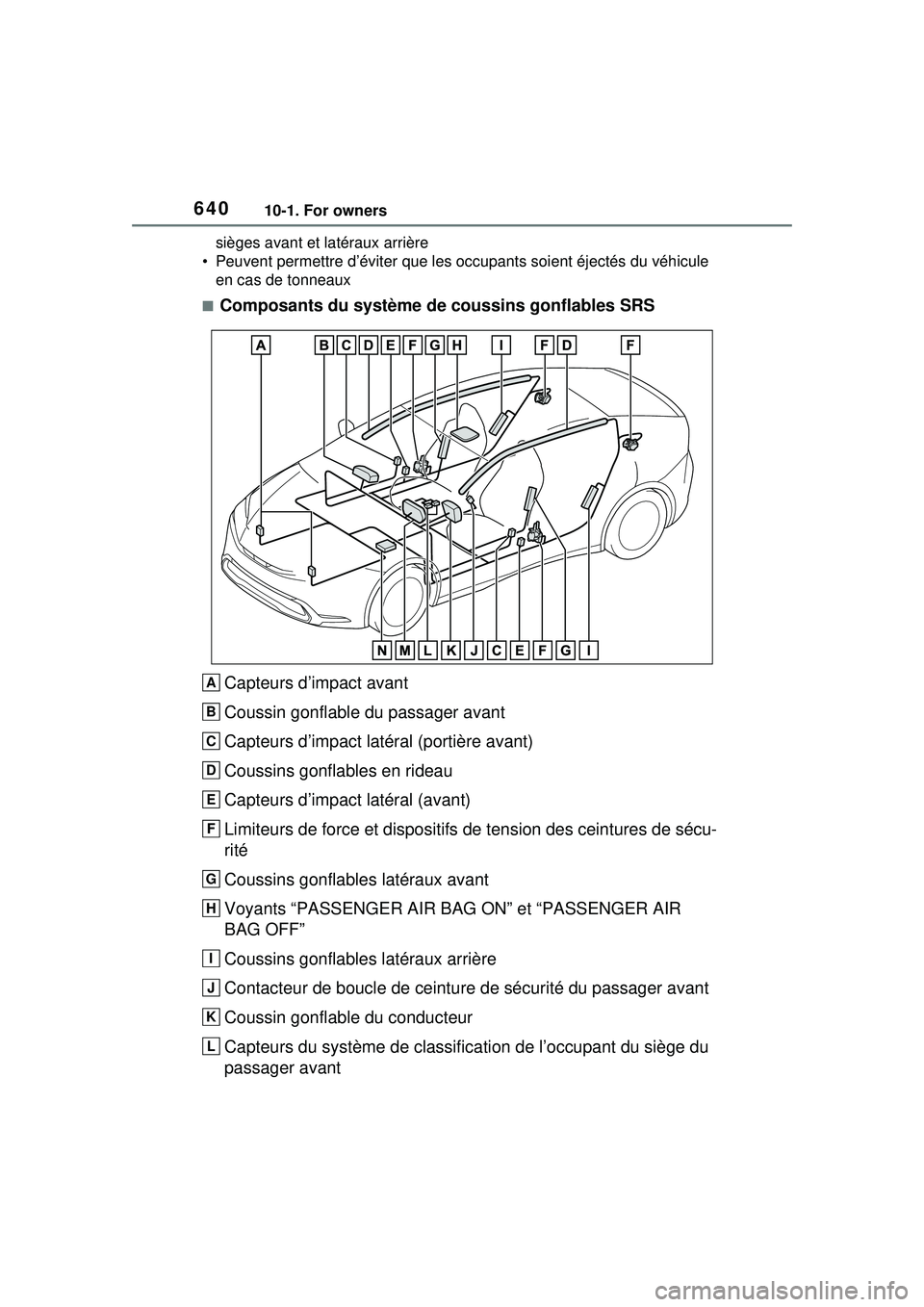
■Composants du système de coussins gonflables SRS
Capteurs d’impact avant
Coussin gonflable du passager avant
Capteurs d’impact latéral (portière avant)
Coussins gonflables en rideau
Capteurs d’impact latéral (avant)
Limiteurs de force et dispositifs de tension des ceintures de sécu-
rité
Coussins gonflables latéraux avant
Voyants “PASSENGER AIR BAG ON” et “PASSENGER AIR
BAG OFF”
Coussins gonflables latéraux arrière
Contacteur de boucle de ceinture de sécurité du passager avant
Coussin gonflable du conducteur
Capteurs du système de classification de l’occupant du siège du
passager avant
A
B
C
D
E
F
G
H
I
J
K
L
Page 641 of 680
64110-1. For owners
10
For owners
Lampe témoin SRS
Module de capteur de coussin gonflable
Votre véhicule est doté de COUSSINS GONFLABLES ÉVOLUÉS
dont la conception s’appuie sur les normes de sécurité des véhicules
à moteur américains (FMVSS208). Le module de capteur de coussin
gonflable (ECU) contrôle le déploiement des coussins gonflables en
fonction des informations obtenues des capteurs et d’autres élé-
ments affichés dans le diagramme des composants du système ci-
dessus. Ces informations comprennent des données relatives à la
gravité de l’accident et aux occupants. Au moment du déploiement
des coussins gonflables, une réaction chimique se produit dans les
gonfleurs de coussin gonflable et les coussins gonflables se remplis-
sent rapidement d’un gaz non toxique pour aider à limiter le mouve-
ment des occupants.M
N
AVERTISSEMENT
■Précautions relatives aux
coussins gonflables SRS
Observez les précautions suiva-
ntes. Négliger de le faire pourrait
occasionner des blessures
graves, voire mortelles.
●Le conducteur et tous les pas-
sagers doivent porter leur cein-
ture de sécurité de la manière
appropriée.
Les coussins gonflables SRS
sont des dispos itifs supplémen-
taires qui doivent être utilisés
avec les ceintures de sécurité.
●Le coussin gonflable SRS du
conducteur se déploie avec une
force considérable et peut occa-
sionner des blessures graves,
voire mortelles, notamment lor-
sque le conducteur se trouve
très près du coussin gonflable.
La National Highway Traffic
Safety Administration (NHTSA),
aux États-Unis, fait les recom-
mandations suivantes :
La zone à risque du coussin gon-
flable du conducteur couvre
2 à 3 in. (50 à 75 mm) de la zone
de déploiement du coussin gon-
flable. Pour assurer une marge de
sécurité suffisante, restez à 10 in.
(250 mm) du coussin gonflable.
Cette distance est mesurée du
centre du volant à votre sternum.
Si votre position de conduite actu-
elle vous place à moins de 10 in.
(250 mm) du coussin gonflable du
conducteur, vous pouvez changer
votre position de plusieurs
manières :
Page 643 of 680
64310-1. For owners
10
For owners
AVERTISSEMENT
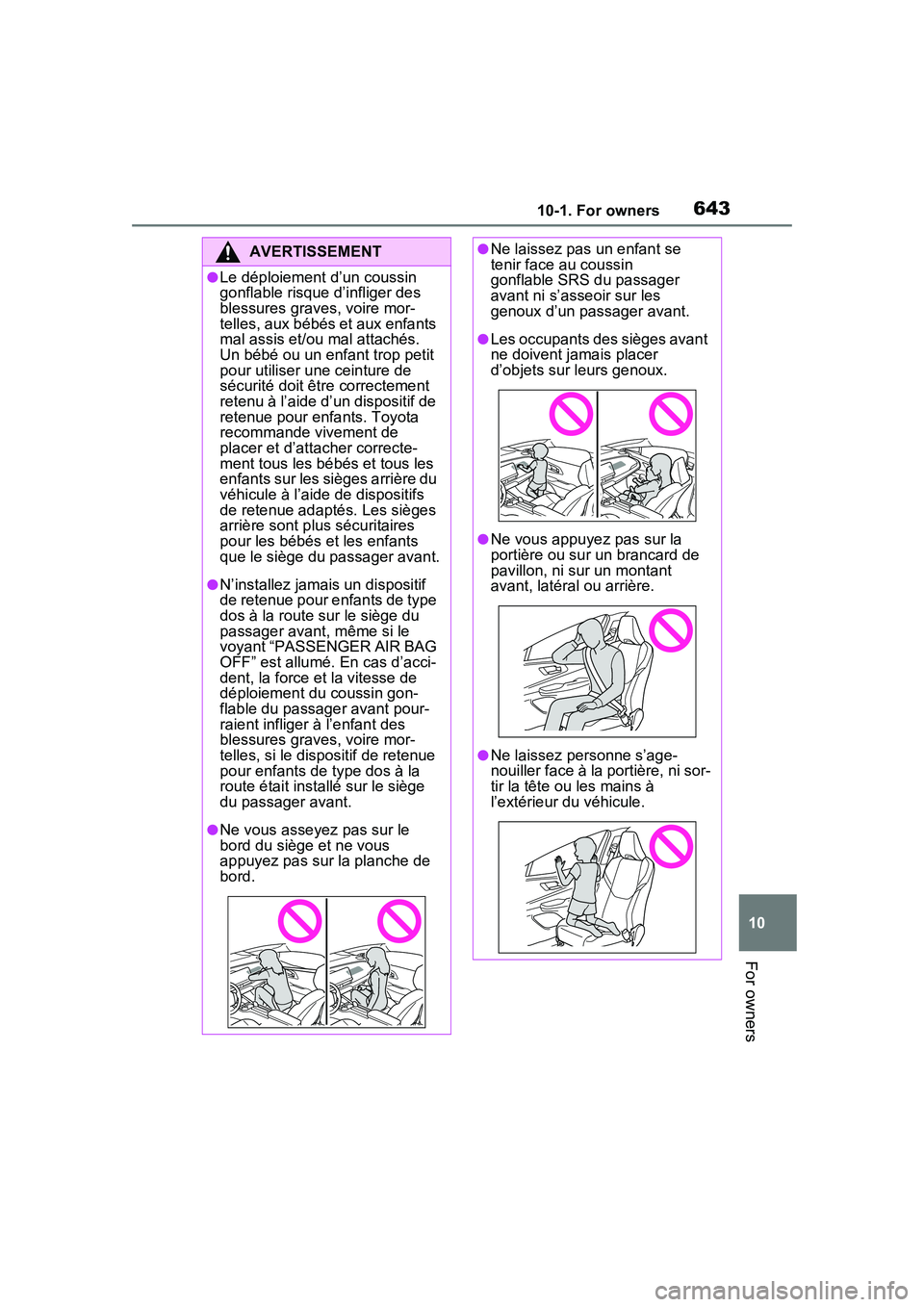
●Le déploiement d’un coussin
gonflable risque d’infliger des
blessures graves, voire mor-
telles, aux bébés et aux enfants
mal assis et/ou mal attachés.
Un bébé ou un enfant trop petit
pour utiliser une ceinture de
sécurité doit être correctement
retenu à l’aide d’un dispositif de
retenue pour enfants. Toyota
recommande vivement de
placer et d’attacher correcte-
ment tous les bébés et tous les
enfants sur les sièges arrière du
véhicule à l’aide de dispositifs
de retenue adaptés. Les sièges
arrière sont plus sécuritaires
pour les bébés et les enfants
que le siège du passager avant.
●N’installez jamais un dispositif
de retenue pour enfants de type
dos à la route sur le siège du
passager avant, même si le
voyant “PASSENGER AIR BAG
OFF” est allumé. En cas d’acci-
dent, la force et la vitesse de
déploiement du coussin gon-
flable du passager avant pour-
raient infliger à l’enfant des
blessures graves, voire mor-
telles, si le dispositif de retenue
pour enfants de type dos à la
route était installé sur le siège
du passager avant.
●Ne vous asseyez pas sur le
bord du siège et ne vous
appuyez pas sur la planche de
bord.
●Ne laissez pas un enfant se
tenir face au coussin
gonflable SRS du passager
avant ni s’asseoir sur les
genoux d’un passager avant.
●Les occupants des sièges avant
ne doivent jamais placer
d’objets sur leurs genoux.
●Ne vous appuyez pas sur la
portière ou sur un brancard de
pavillon, ni sur un montant
avant, latéral ou arrière.
●Ne laissez personne s’age-
nouiller face à la portière, ni sor-
tir la tête ou les mains à
l’extérieur du véhicule.
Page 645 of 680
64510-1. For owners
10
For owners
AVERTISSEMENT
■Modification et mise au rebut
des composants du système
de coussins gonflables SRS
Ne mettez pas votre véhicule au
rebut et n’effectuez aucune des
modifications suivantes sans
d’abord consulter votre conces-
sionnaire Toyota. Les coussins
gonflables SRS pourraient
fonctionner de manière incor-
recte ou se déployer accidentelle-
ment, ce qui serait susceptible
d’occasionner des blessures
graves, voire mortelles.
●Retrait, installation, démontage
ou réparation des coussins
gonflables SRS
●Réparation, retrait ou modifica-
tion des pièces suivantes ou de
leurs parties environnantes
• Volant
• Tableau de bord
• Planche de bord
• Sièges
• Capitonnage des sièges
• Montants avant
• Montants latéraux
• Montants arrière
• Brancards de pavillon
• Panneaux des portières avant
• Garnitures des portières avant
• Haut-parleurs des portières avant
●Modifications des panneaux des
portières avant (comme les per-
forer)
●Réparation ou modification des
pièces suivantes ou de leurs
parties environnantes
• Aile avant
• Pare-chocs avant
• Parties latérales de l’intérieur du véhicule
●Installation des parties ou
accessoires suivants
• Barres safari ou barres kangou- rou
• Lames de déneigement
• Treuils
• Porte-bagages de toit
●Modifications de la suspension
du véhicule
●Installation d’appareils électro-
niques tels qu’un émetteur-
récepteur radio (émetteur de
fréquences radio) ou un lecteur
de CD
●Modifications à votre véhicule
pour une personne aux capac-
ités physiques réduites
Page 652 of 680
652Alphabetical Index
sification system ................... 44
Points to remember ................ 51
Riding with children ................ 50
Types of child restraint system installation method ............... 53
Using an anchor bracket ........ 62
Child safety ............................... 50 12-volt battery precautions . 511, 592
Airbag precautions ................. 40
Back door precautions ......... 191
Charging precautions ........... 115
Child restraint system............. 53
Heated steering wheel precau- tions.................................... 443
How your child should wear the seat belt................................ 32
Power window lock switch.... 229
Power window precautions .. 228
Rear door child-protector lock ........................................... 189
Removed key battery precau- tions.................................... 539
Seat belt extender precautions ............................................. 32
Seat belt precautions ............. 31
Seat heater precautions ....... 443
Window lock switch .............. 229
Cleaning .......................... 486, 490 Aluminum wheels ................. 486
Exterior ................................. 486
Interior .................................. 490
Radar sensor........................ 355
Seat belts ............................. 490
Condenser .............................. 508
Console box ............................ 451
Coolant Checking .............................. 507
Preparing and checking before winter.................................. 429
Warning light ........................ 556
Cooling system ...................... 507 Hybrid system overheating ...594
Coussins gonflables Emplacement des coussins gonflables SRS...................639
Modification et mise au rebut des coussins gonflables ............645
Précautions générales relatives aux coussins gonflables .....641
Précautions relatives aux couss- ins gonflables en rideau .....641
Précautions relatives aux couss- ins gonflables latéraux et en
rideau .................................641
Précautions relatives aux couss- ins gonflables latéraux........641
Précautions relatives aux couss- ins gonflables pour vos enfants...........................................641
Cruise control Cruise control .......................342
Dynamic radar cruise control 331
Cup holders.............................451
Current fuel economy ............163
Curtain shield airbags ..............35
Customizable features ...........618
Custom mode..........................422
D
Daytime running light system270 Replacing exterior lights .......543
Deck board ..............................454
Deck under tray ......................455
Defogger Outside rear view mirrors .....436
Rear window.........................436
Windshield ............................435
Digital Rear-view Mirror .........217
Dimensions .............................600
Dinghy towing .........................250
Display Cruise control .......................342
Driving information ...............163