roof TOYOTA PRIUS PRIME 2023 Owners Manual
[x] Cancel search | Manufacturer: TOYOTA, Model Year: 2023, Model line: PRIUS PRIME, Model: TOYOTA PRIUS PRIME 2023Pages: 680, PDF Size: 14.97 MB
Page 39 of 680
391-1. For safe use
1
For safety and security
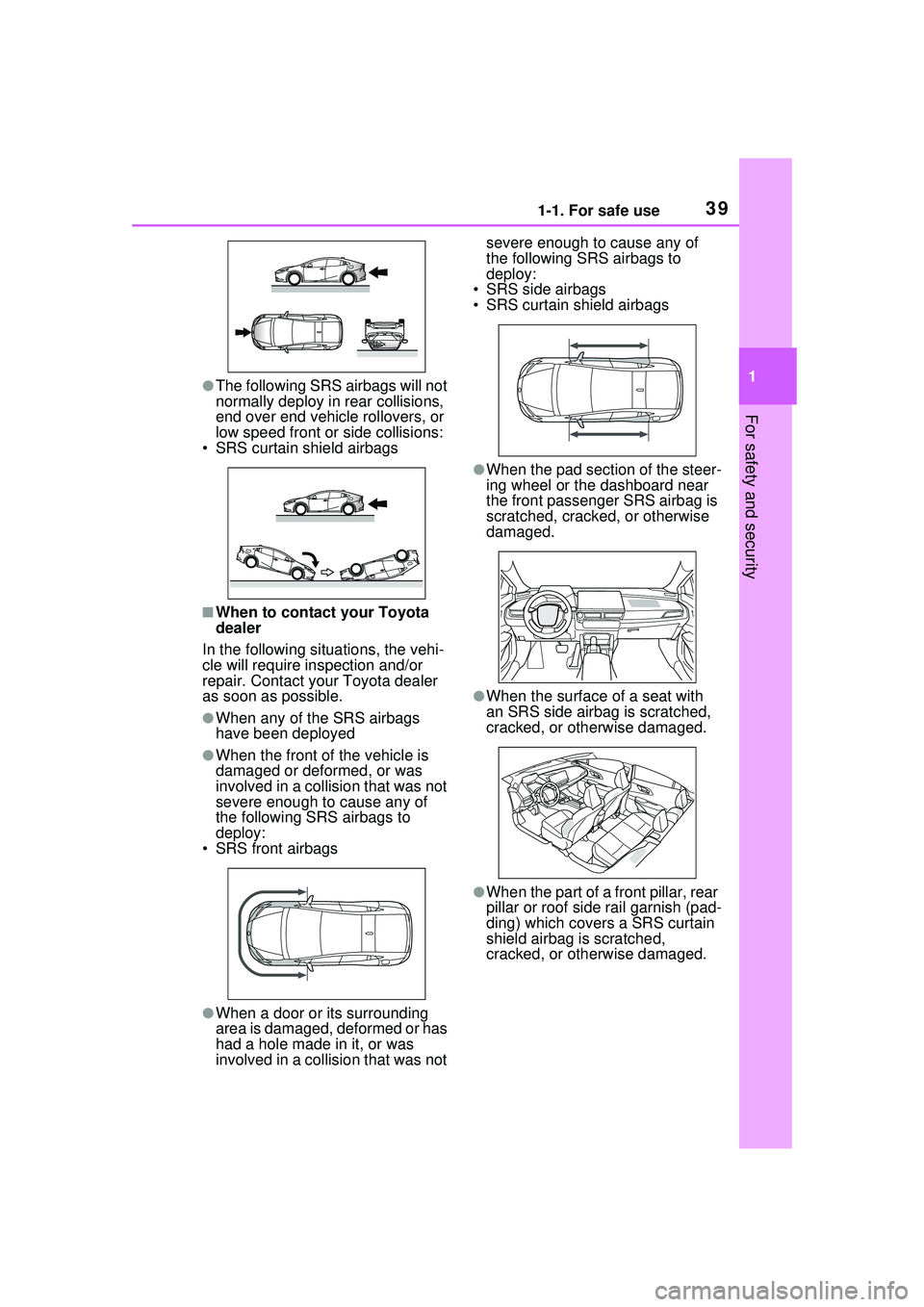
●The following SRS airbags will not
normally deploy in rear collisions,
end over end vehicle rollovers, or
low speed front or side collisions:
• SRS curtain shield airbags
■When to contact your Toyota
dealer
In the following situations, the vehi-
cle will require inspection and/or
repair. Contact your Toyota dealer
as soon as possible.
●When any of the SRS airbags
have been deployed
●When the front of the vehicle is
damaged or deformed, or was
involved in a collision that was not
severe enough to cause any of
the following SRS airbags to
deploy:
• SRS front airbags
●When a door or its surrounding
area is damaged, deformed or has
had a hole made in it, or was
involved in a collision that was not severe enough to cause any of
the following SRS airbags to
deploy:
• SRS side airbags
• SRS curtain shield airbags
●When the pad section of the steer-
ing wheel or the dashboard near
the front passenger SRS airbag is
scratched, cracked, or otherwise
damaged.
●When the surface of a seat with
an SRS side airbag is scratched,
cracked, or otherwise damaged.
●When the part of a front pillar, rear
pillar or roof side rail garnish (pad-
ding) which covers a SRS curtain
shield airbag is scratched,
cracked, or otherwise damaged.
Page 41 of 680
411-1. For safe use
1
For safety and security
WARNING
●The SRS front passenger air-
bag deploys with considerable
force, and can cause death or
serious injury, especially if the
front passenger is very close to
the airbag. The front passenger
seat should be positioned as far
possible from the airbag with
the seatback adjusted so that
the passenger is sat upright.
●Improperly seated and/or
restrained infants and children
can be killed or seriously injured
by a deploying airbag. An infant
or child who is too small to use
a seat belt should be properly
secured using a child restraint
system. Toyota strongly recom-
mends that all infants and chil-
dren be placed in the rear seats
of the vehicle and properly
restrained. The rear seats are
safer for infants and children
than the front passenger seat.
( P.51)
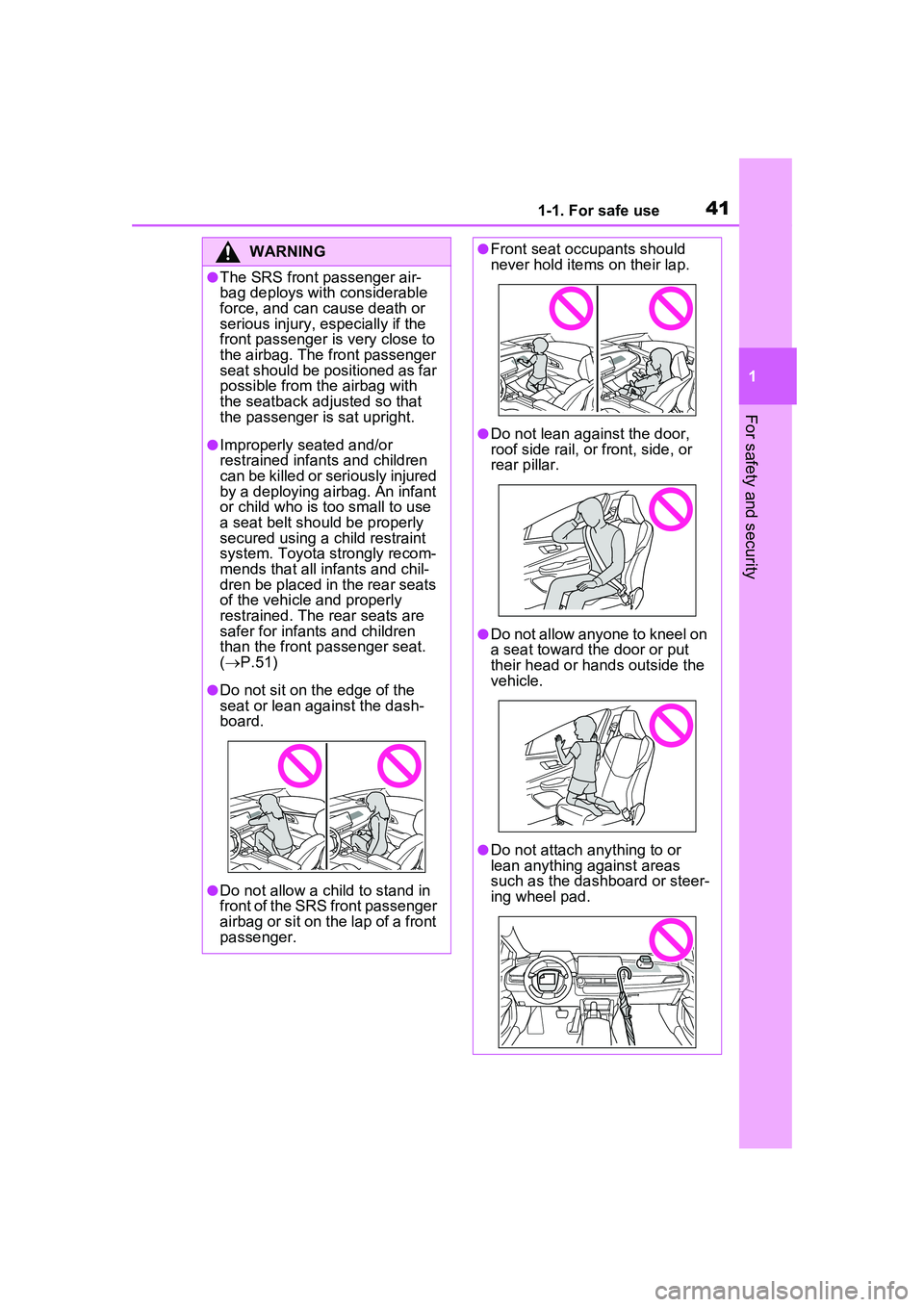
●Do not sit on the edge of the
seat or lean against the dash-
board.
●Do not allow a child to stand in
front of the SRS front passenger
airbag or sit on the lap of a front
passenger.
●Front seat occupants should
never hold items on their lap.
●Do not lean against the door,
roof side rail, or front, side, or
rear pillar.
●Do not allow anyone to kneel on
a seat toward the door or put
their head or hands outside the
vehicle.
●Do not attach anything to or
lean anything against areas
such as the dashboard or steer-
ing wheel pad.
Page 42 of 680
421-1. For safe use
WARNING
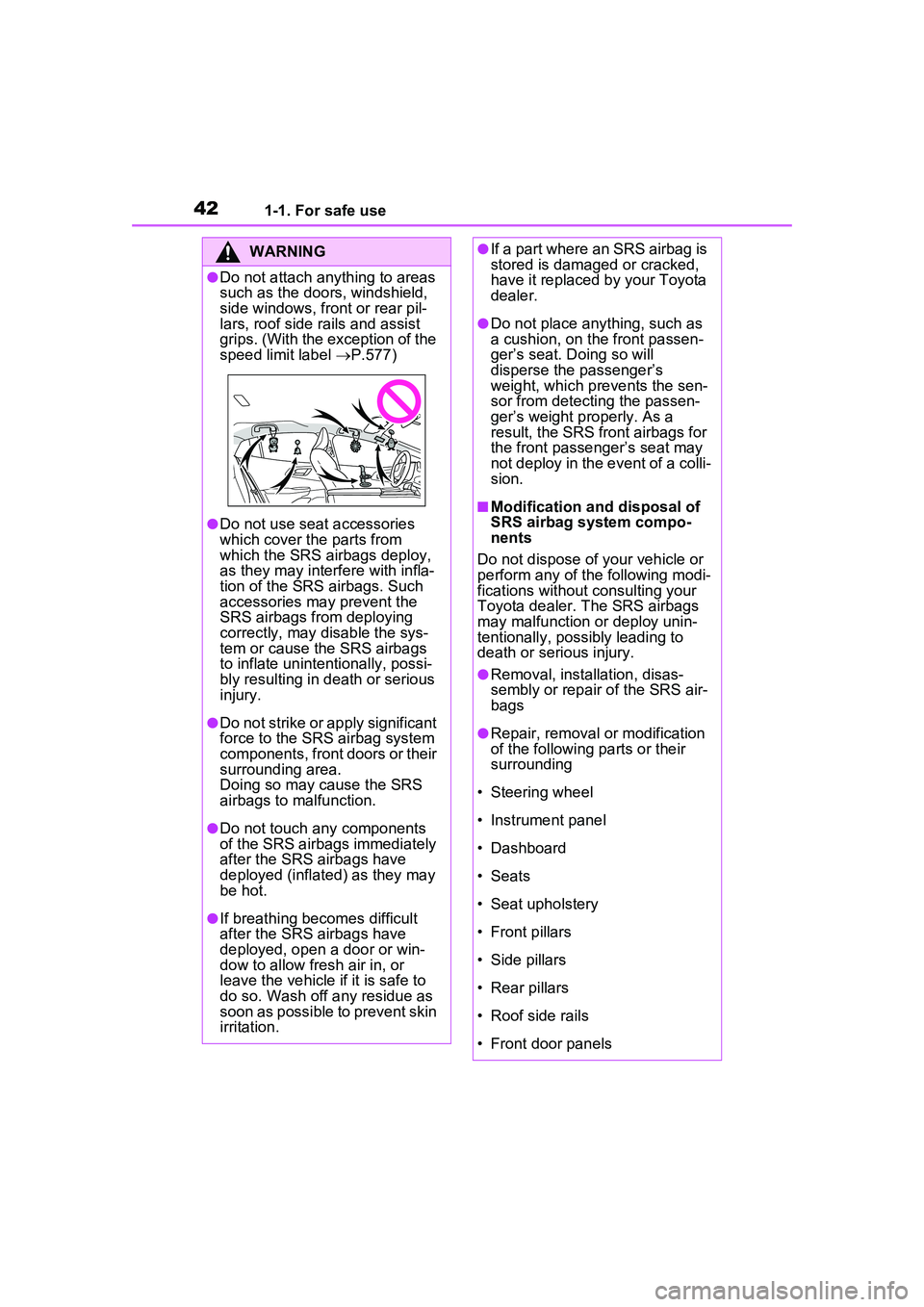
●Do not attach anything to areas
such as the doors, windshield,
side windows, front or rear pil-
lars, roof side rails and assist
grips. (With the exception of the
speed limit label P.577)
●Do not use seat accessories
which cover the parts from
which the SRS airbags deploy,
as they may inte rfere with infla-
tion of the SRS airbags. Such
accessories may prevent the
SRS airbags from deploying
correctly, may disable the sys-
tem or cause the SRS airbags
to inflate unintentionally, possi-
bly resulting in death or serious
injury.
●Do not strike or apply significant
force to the SRS airbag system
components, front doors or their
surrounding area.
Doing so may cause the SRS
airbags to malfunction.
●Do not touch any components
of the SRS airbags immediately
after the SRS airbags have
deployed (inflated) as they may
be hot.
●If breathing becomes difficult
after the SRS airbags have
deployed, open a door or win-
dow to allow fresh air in, or
leave the vehicle if it is safe to
do so. Wash off any residue as
soon as possible to prevent skin
irritation.
●If a part where an SRS airbag is
stored is damaged or cracked,
have it replaced by your Toyota
dealer.
●Do not place anything, such as
a cushion, on the front passen-
ger’s seat. Doing so will
disperse the passenger’s
weight, which prevents the sen-
sor from detecting the passen-
ger’s weight properly. As a
result, the SRS front airbags for
the front passenger’s seat may
not deploy in the event of a colli-
sion.
■Modification and disposal of
SRS airbag system compo-
nents
Do not dispose of your vehicle or
perform any of the following modi-
fications without consulting your
Toyota dealer. The SRS airbags
may malfunction or deploy unin-
tentionally, possibly leading to
death or serious injury.
●Removal, installation, disas-
sembly or repair of the SRS air-
bags
●Repair, removal or modification
of the following parts or their
surrounding
• Steering wheel
• Instrument panel
• Dashboard
• Seats
• Seat upholstery
• Front pillars
• Side pillars
• Rear pillars
• Roof side rails
• Front door panels
Page 43 of 680
431-1. For safe use
1
For safety and security
WARNING
• Front door trim
• Front door speakers
●Modifications to the front door
panels (such as making holes in
them)
●Repair or modification of the fol-
lowing parts or their surrounding
• Front fender
• Front bumper
• Sides of the vehicle interior
●Installation of the following parts
or accessories
• Bull bars or kangaroo bars
• Snow plows
• Winches
• Roof luggage carriers
●Modifications to the vehicle’s
suspension
●Installation of electronic devices
such as mobile two-way radios
(RF-transmitter) and CD players
●Modifications to your vehicle for
a person with a physical disabil-
ity
Page 55 of 680
551-2. Child safety
1
For safety and security
A child restraint system for a
small child or baby must itself be
properly restrained on the seat
with the lap portion of the
lap/shoulder belt.
■Installing child restraint
system using a seat belt
(child restraint lock func-
tion belt)
Install the child restraint system
in accordance to the operation
WARNING
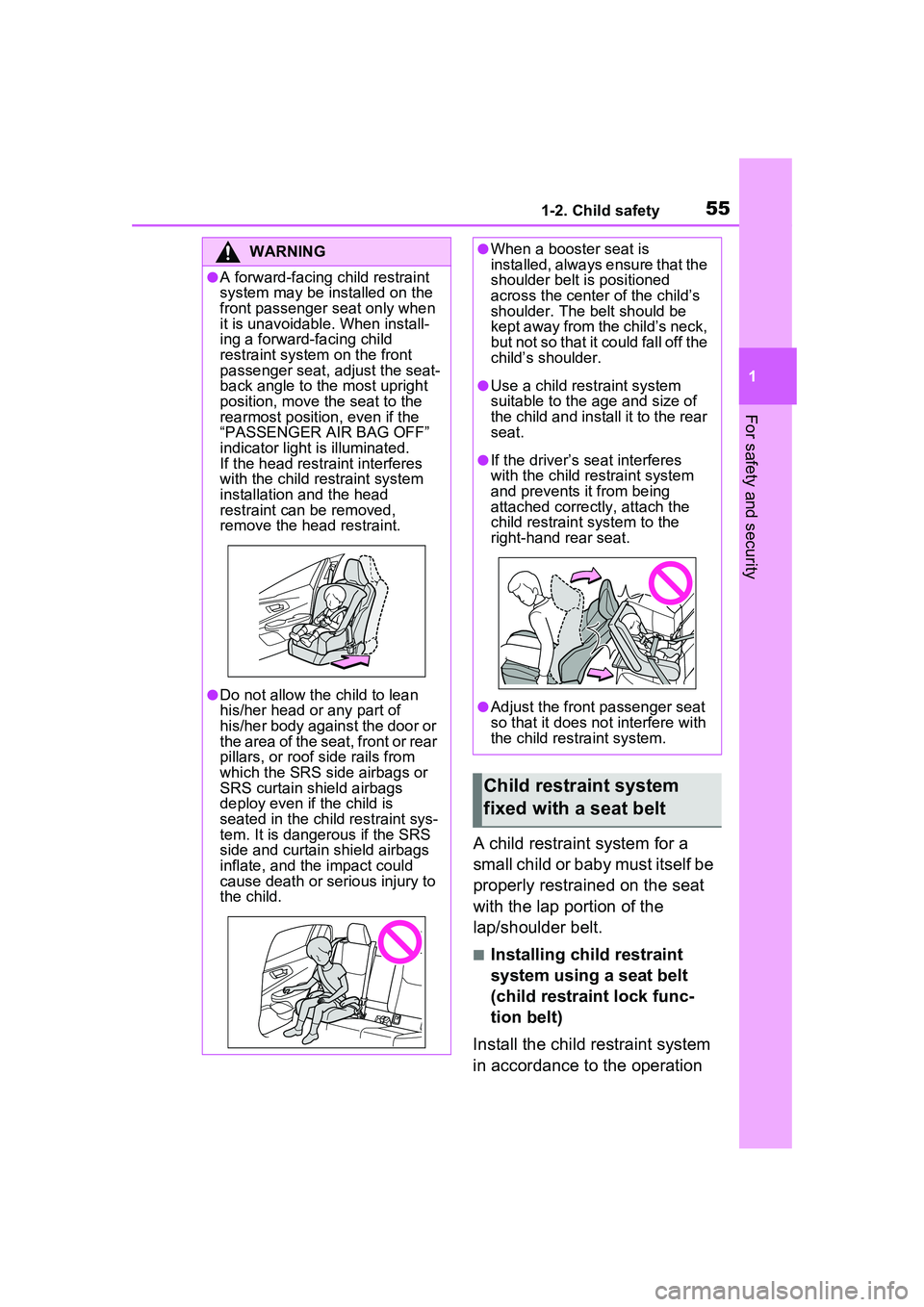
●A forward-facing child restraint
system may be installed on the
front passenger seat only when
it is unavoidable. When install-
ing a forward-facing child
restraint system on the front
passenger seat, adjust the seat-
back angle to the most upright
position, move the seat to the
rearmost position, even if the
“PASSENGER AIR BAG OFF”
indicator light is illuminated.
If the head restraint interferes
with the child restraint system
installation and the head
restraint can be removed,
remove the head restraint.
●Do not allow the child to lean
his/her head or any part of
his/her body against the door or
the area of the seat, front or rear
pillars, or roof side rails from
which the SRS side airbags or
SRS curtain shield airbags
deploy even if the child is
seated in the child restraint sys-
tem. It is dangerous if the SRS
side and curtain shield airbags
inflate, and the impact could
cause death or serious injury to
the child.
●When a booster seat is
installed, always ensure that the
shoulder belt is positioned
across the center of the child’s
shoulder. The belt should be
kept away from the child’s neck,
but not so that it could fall off the
child’s shoulder.
●Use a child restraint system
suitable to the age and size of
the child and install it to the rear
seat.
●If the driver’s seat interferes
with the child restraint system
and prevents it from being
attached correctly, attach the
child restraint system to the
right-hand rear seat.
●Adjust the front passenger seat
so that it does not interfere with
the child restraint system.
Child restraint system
fixed with a seat belt
Page 90 of 680
902-1. Plug-in hybrid system
Carrying heavy luggage will lead
to poor fuel economy. Avoid car-
rying unnecessary luggage.
Installing a large roof rack will
also cause poor fuel economy.
Since the gasoline engine starts
up and cuts out automatically,
warming up is not necessary.The value displayed on the SOC
(State of Charge) gauge
(P.155) is estimated from the
following information.
The amount of hybrid battery
(traction battery) charge cur-
rently remaining
The electricity consumption
(the estimated distance that
EV driving is possible per unit
of electrical energy) based on
the recorded value
Past air conditioning system
electricity consumption
amount
The electricity consumption var-
ies depending on how the vehi-
cle is driven. The vehicle
Luggage
Warming up before driv-
ing
EV driving range
The EV driving range dis-
played on the meter shows
the reference distance that
EV driving (driving using
only the electric motor) is
possible, and the actual dis-
tance that can be driven
may differ from that dis-
played.
Even if the EV driving range is
displayed, EV driving may be
canceled and both gasoline
engine and electric motor are
used depending on the situa-
tion. ( P.79)
Displayed value
Page 93 of 680
932-1. Plug-in hybrid system
2
Plug-in hybrid system
affects electrical and fuel effi-
ciency. Remove any exterior
accessories such as a roof lug-
gage carrier when they are not
being used.
The running resistance of snow
tires is high and they will worsen
electrical and fuel efficiency.
Replace them with standard
tires as soon as they are no lon-
ger needed.
■Know your vehicle’s electri-
cal and fuel efficiency
If you know your vehicle’s daily
electrical and fuel efficiency, you
will understand the benefits of
Eco drive.
Use the Power Consump-
tion/Fuel Economy, ECO Accel-
erator Guidance/“Eco Score”
and other data displayed on the
multi-information display.
The following indicate that
charging has been carried out
properly.
The charging indicator of the
charging port turns off
“Charging Complete” is dis-
played on the multi-informa-
tion display when a door is
opened with the power switch
off ( P.112)
Regardless of the type of power
source or whether the charging schedule function is used,
charging is completed if the
above can be confirmed.
Charging-related messages:
P.143
Display when charging is
completed
Page 106 of 680
1062-2. Charging
Connect to an AC 120 V out-
let (NEMA 5-15R) with a
Ground-Fault Circuit-Inter-
rupter (GFCI) and a circuit
breaker. Use of a 15A individ-
ual circuit is strongly recom-
mended to ensure AC
charging cable will operate
properly.
When charging outdoors,
make sure to connect to a
weatherproof outlet that is
certified for outdoor use.
Checking Ground-Fault Cir-
cuit-Interrupter (GFCI) opera-
tion before its use is
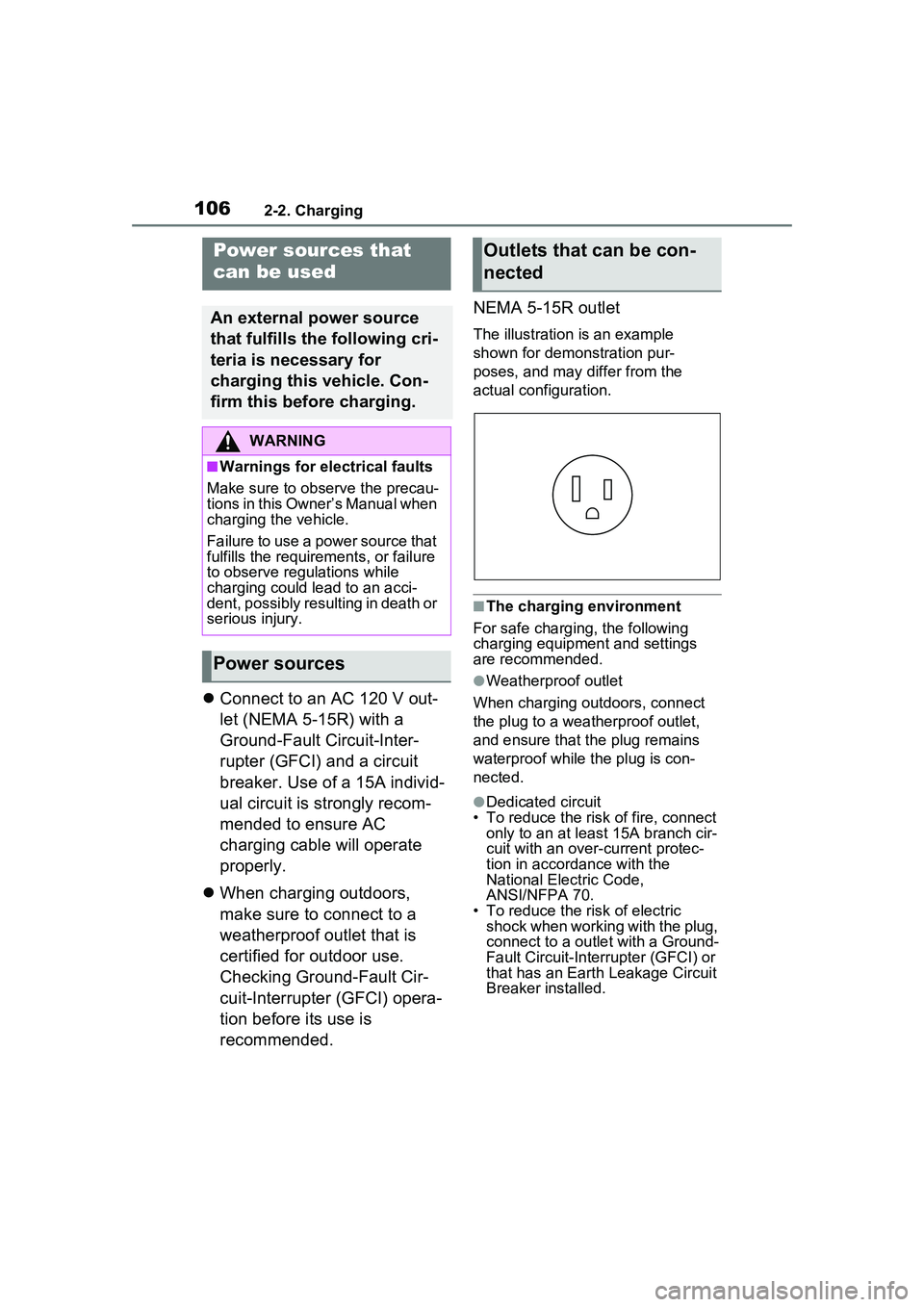
recommended. NEMA 5-15R outlet
The illustration is an example
shown for demonstration pur-
poses, and may differ from the
actual configuration.
■The charging environment
For safe charging, the following
charging equipment and settings
are recommended.
●Weatherproof outlet
When charging outdoors, connect
the plug to a weatherproof outlet,
and ensure that the plug remains
waterproof while the plug is con-
nected.
●Dedicated circuit
• To reduce the risk of fire, connect
only to an at least 15A branch cir-
cuit with an over-current protec-
tion in accordance with the
National Electric Code,
ANSI/NFPA 70.
• To reduce the risk of electric
shock when working with the plug,
connect to a outlet with a Ground-
Fault Circuit-Interr upter (GFCI) or
that has an Earth Leakage Circuit
Breaker installed.
Power sources that
can be used
An external power source
that fulfills the following cri-
teria is necessary for
charging this vehicle. Con-
firm this before charging.
WARNING
■Warnings for electrical faults
Make sure to observe the precau-
tions in this Owner’s Manual when
charging the vehicle.
Failure to use a power source that
fulfills the requirements, or failure
to observe regulations while
charging could lead to an acci-
dent, possibly resulting in death or
serious injury.
Power sources
Outlets that can be con-
nected
Page 108 of 680
1082-2. Charging
■AC charging (P.116)
This is a charging method used
when charging from an AC out-
let with the AC charging cable or
charging that use an AC char-
ger.
By setting charging schedule, it is
also possible to charge at the
desired date and time. ( P.123)
■Using the hybrid battery
(traction battery) charge
mode ( P.75)
The plug-in hybrid system can
be switched to hybrid battery
(traction battery) charge mode
to charge the hybrid battery
(traction battery) using electricity
generated by gasoline engine
operation.
The maximum charge amount in
the hybrid battery (traction battery)
charge mode is approximately 80%
of the fully charged capacity for the
charging from an external power
source.
■Solar charging system (if
equipped) ( P.136)
In certain conditions, when the vehicle is parked, the hybrid bat-
tery (traction battery) can be
charged by using electricity gen-
erated by the solar panel
equipped to the roof of the vehi-
cle.
This vehicle is equipped with
several functions that are linked
with charging.
■“My Room Mode” (
P.134)
When the AC charging cable is
connected to the vehicle, electri-
cal components such as the air
conditioning system or audio
system can be used using the
external power source
*.
*: The power of the hybrid battery (traction battery) may be used
depending on the situation.
■“Battery Heater”
When the outside temperature
is low and the AC charging
cable is connected to the vehi-
cle, this function automatically
warms the hybrid battery (trac-
tion battery) until it reaches or
exceeds a certain temperature.
“Battery Heater” will operate
when the “Battery Heater” of the
“Charging Settings” on the multi-
information display is on.
( P.169)
By setting charging schedule,
“Battery Heater” operates
according to the charging
Charging methods
The following methods can
be used to charge the
hybrid battery (traction bat-
tery).
Types of charging meth-
odsCharging-linked functions
Page 120 of 680
1202-2. Charging
2Touch “Vehicle customize” on
the sub menu.
3 Touch “Charging”.
4 Touch “Charging current”.
5 Touch “8A”, and touch “OK”.
WARNING
■When charging
Observe the following precau-
tions.
Failure to do so may cause an
unexpected accident, resulting in
death or serious injury.
●Connect to a power source suit-
able for charging. ( P.106)
●Check that the AC charging
cable, plug and outlet are free of
foreign matter.
●Before charging, check that the
AC charging inlet is not
deformed, damaged or cor-
roded, and check that the inlet
is free of foreign matter such as
dirt, snow and ice.
If there is dirt or dust in these
areas, remove completely
before inserting the charging
connector.
●Only use outlets where the plug
can be securely inserted.
●Do not bundle or wind the AC
charging cable while charging,
as doing so may result in over-
heating.
●Do not touch the terminals of
the charging connector and AC
charging inlet with a sharp metal
objects (needles etc.) or hands,
or short them with foreign
objects.
●When charging outdoors, make
sure to connect to a weather-
proof outlet for outdoor use.
Ensure the weatherproof outlet
cover closes co mpletely. If the
weatherproof outlet cover can-
not be closed, install a weather-
proof outlet cover that will close.
●In order to stop charging at the
charging station, follow the
instructions of the charger.
●If any heat, smoke, odors, noise
or other abnormalities are
noticed during charging, stop
charging immediately.
●Do not insert the plug if the out-
let is submerged in water or
snow.
●When charging while it is raining
or snowing, do not connect or
disconnect the plug if your
hands are wet. Also, do not get
the plug or outlet wet.
●Do not charge the vehicle
during a lightning storm.
●Prevent the AC charging cable
from being caught in the door or
back door.
●Do not let the wheels on the AC
charging cable, plug, charging
connector and CCID (Charging
Circuit Interrupting Device).
●Firmly insert the plug into the
outlet.
●Do not use an extension cord
and converting adaptor.
●Close the hood before using the
charging system. The cooling
fan may start operating sud-
denly. Touching or getting close
to rotating parts such as the fan
may cause your hands or
clothes (especially a necktie or
scarf) to become caught and
result in a serious injury.