air condition TOYOTA PRIUS V 2012 Owners Manual (in English)
[x] Cancel search | Manufacturer: TOYOTA, Model Year: 2012, Model line: PRIUS V, Model: TOYOTA PRIUS V 2012Pages: 564, PDF Size: 10.45 MB
Page 1 of 564

TABLE OF CONTENTS
1
PRIUS v_U (OM47674U)
1Before driving
Information on the hybrid system and adjusting and op-
erating features such as door locks, mirrors, and steer-
ing column
2When drivingDriving, stopping and safe-driving information
3Interior
featuresAir conditioning and audio systems, as well as other in-
terior features for a comfortable driving experience
4Maintenance
and careCleaning and protecting your vehicle, performing do-it-
yourself maintenance, and maintenance information
5When trouble
arisesWhat to do if the vehicle needs to be towed, gets a flat
tire, or is involved in an accident
6Vehicle
specificationsDetailed vehicle information
7For ownersReporting safety defects for U.S. owners, and seat belt
and SRS airbag instructions for Canadian owners
IndexAlphabetical listing of information contained in this
manual
Page 4 of 564

TABLE OF CONTENTSIndex
4
PRIUS v_U (OM47674U)
3-1. Using the air conditioningsystem a nd defogger
Automatic air conditioning system .............................. 278
Using the steering wheel climate remote control
switches ........................... 291
Rear window and outside rear view mirror defogger
switch ............................... 293
3-2. Using the audio system Audio system types ............ 294
3-3. Using the interior lights Interior lights list ................. 299
• Interior lights .................... 300
• Personal lights ................. 301 3-4. Using the storage features
List of storage features ....... 303
• Glove boxes ..................... 305
• Console box ..................... 306
• Cup holders ...................... 307
• Bottle holders ................... 309
• Auxiliary boxes ................. 310
• Door pockets .................... 311
• Card holder ....................... 311
3-5. Other interior features Sun visors ........................... 312
Vanity mirrors ..................... 313
Clock................................... 314
Power outlets ...................... 315
Seat heaters ....................... 317
Armrest ............................... 319
Panoramic roof shades....... 320
Floor mats........................... 324
Luggage compartment features ............................ 326
Garage door opener ........... 330
Safety Connect ................... 338
3Interior features
Page 5 of 564

1
2
3
4
5
6
7
5
PRIUS v_U (OM47674U)
4-1. Maintenance and careCleaning and protecting the vehicle exterior............ 346
Cleaning and protecting the vehicle interior............. 350
4-2. Maintenance Maintenance requirements ..................... 353
General maintenance.......... 356
Emission inspection and maintenance (I/M)
programs........................... 360
4-3. Do-it-yourself maintenance Do-it-yourself service precautions ....................... 361
Hood ................................... 364
Positioning a floor jack ........ 367
Engine compartment ........... 370
12-volt battery ..................... 382
Tires .................................... 387
Tire inflation pressure ......... 396
Wheels ................................ 400
Air conditioning filter............ 403
Electronic key battery.......... 406
Checking and replacing fuses ................................. 408
Light bulbs........................... 419 5-1. Essential information
Emergency flashers............ 434
If your vehicle needs to be towed................................ 435
If you think something is wrong ............................... 441
5-2. Steps to take in an emergency If a warning light turns on or a warning buzzer sounds .... 442
If you have a flat tire ........... 460
If the hybrid system will not start .................................. 474
If you lose your keys........... 476
If the electronic key does not operate properly ......... 477
If the 12-volt battery is discharged........................ 479
If your vehicle overheats .... 485
If the vehicle becomes stuck ................................. 489
If your vehicle has to be stopped in an
emergency ....................... 491
4Maintenance and care5When trouble arises
Page 18 of 564
18
PRIUS v_U (OM47674U)
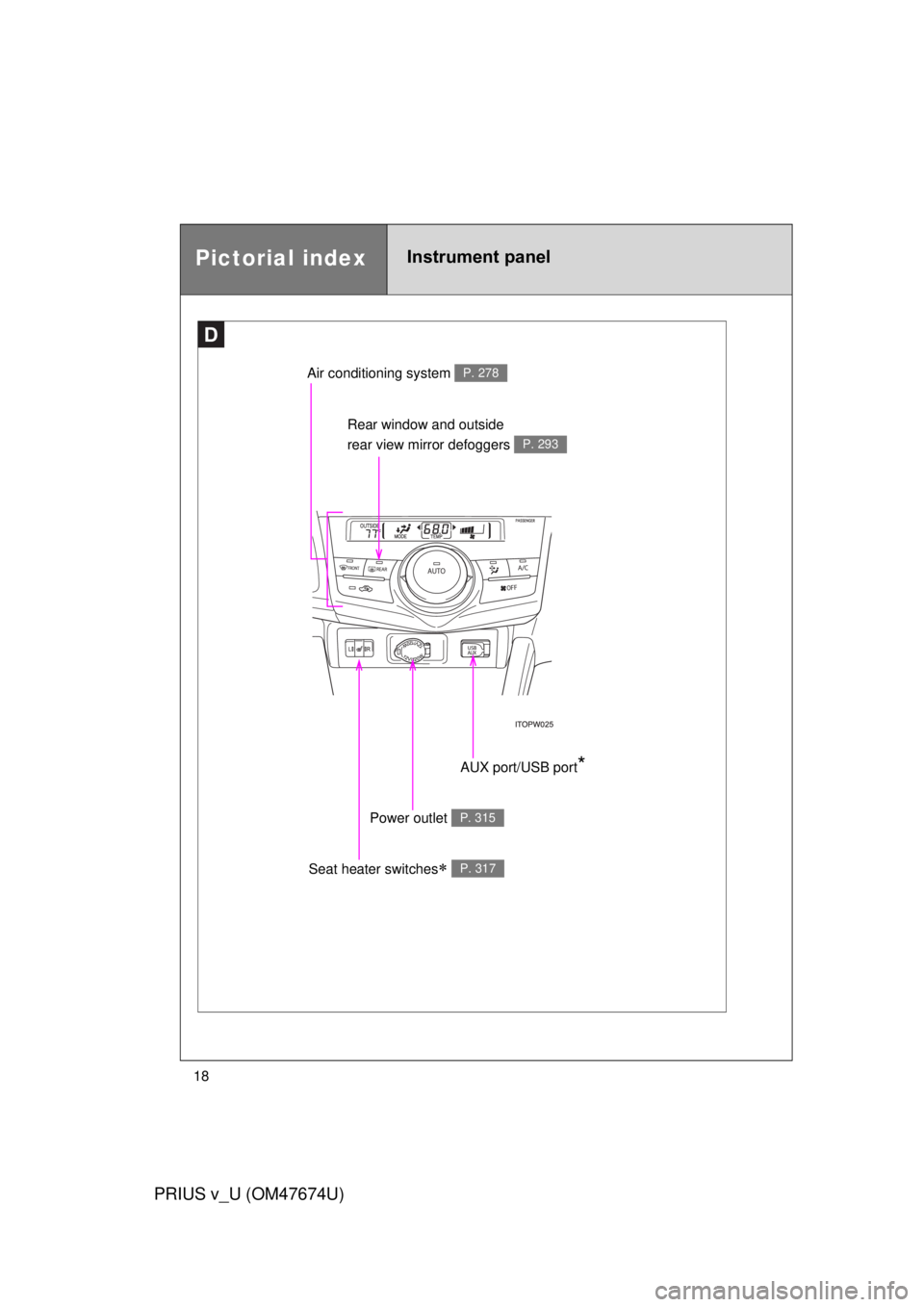
AUX port/USB port*
Power outlet P. 315
Seat heater switches P. 317
Air conditioning system P. 278
Rear window and outside
rear view mirror defoggers
P. 293
Pictorial indexInstrument panel
D
Page 32 of 564

32 1-1. Hybrid system
PRIUS v_U (OM47674U)
■Sounds and vibrations specific to a hybrid vehicle
There may be no engine sounds or vibration even though the vehicle is able
to move. For safety, apply the parking brake and make sure to shift the shift
position to P when parked.
The following sounds or vibrations may occur when the hybrid system is
operating and are not a malfunction:
● The brake system operation sound heard from the front of the vehicle
when the driver’s door is opened.
● Motor sounds may be heard from the engine compartment.
● Sounds may be heard from the hybrid battery (traction battery) when the
hybrid system starts or stops.
● Sounds may be heard from the transmission when the gasoline engine
starts or stops, when driving at low speeds, or during idling.
● Engine sounds may be heard when accelerating sharply.
● Sounds may be heard due to regenerative braking when the brake pedal
is depressed and accelerator is loosened.
● Other sounds, such as motors and mechanical noises, may be heard
from the brake system when the brake pedal is depressed.
● Vibration may be felt when the gasoline engine starts or stops.
● Cooling fan sounds may be heard from the air intake vent. (
P. 35)
● The operation sound of the air conditioning system (air conditioning com-
pressor, blower motor).
Page 34 of 564
34
1-1. Hybrid system
PRIUS v_U (OM47674U)
Hybrid system precautions
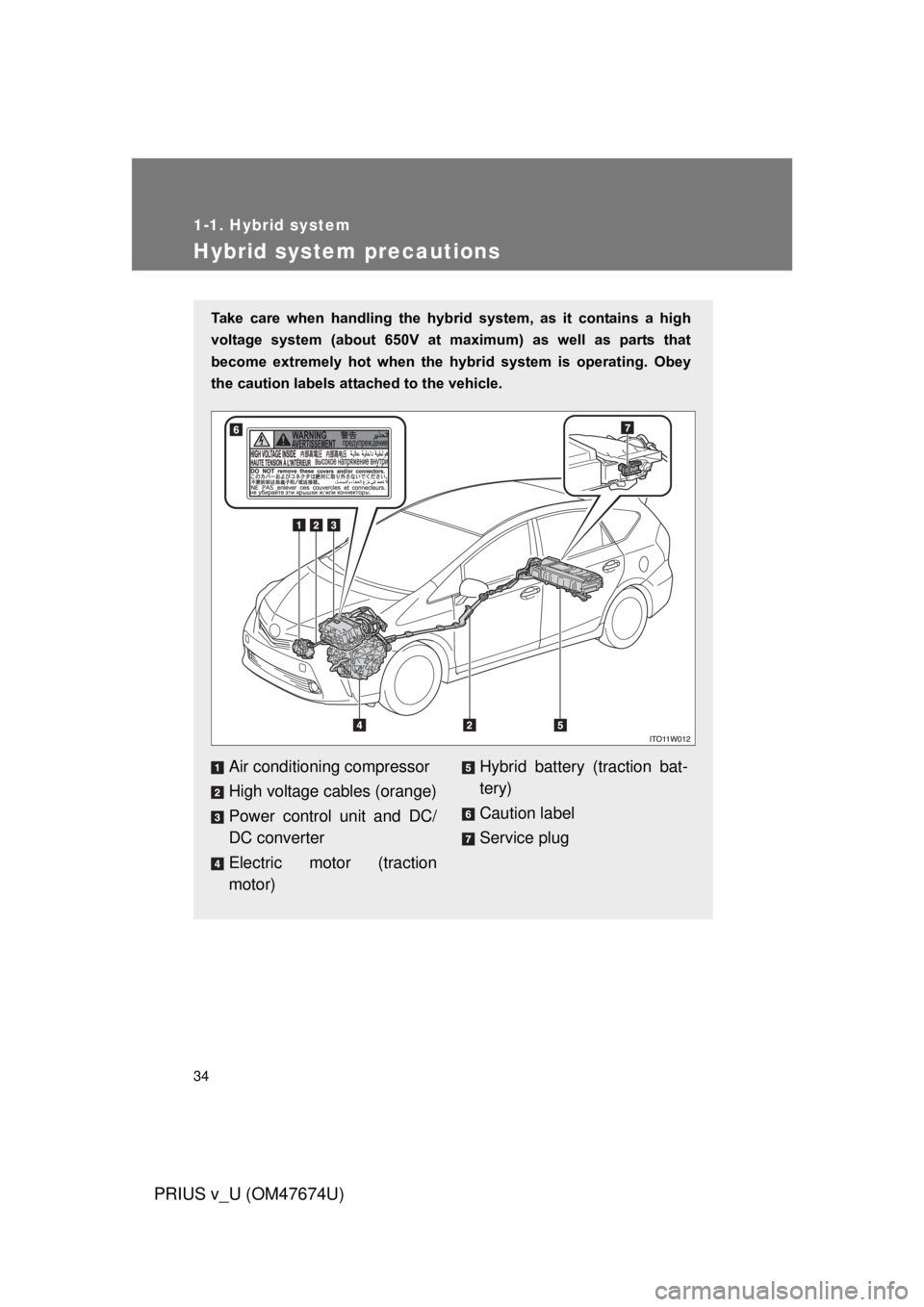
Take care when handling the hybrid system, as it contains a high
voltage system (about 650V at maximum) as well as parts that
become extremely hot when the hybrid system is operating. Obey
the caution labels attached to the vehicle.
Air conditioning compressor
High voltage cables (orange)
Power control unit and DC/
DC converter
Electric motor (traction
motor)Hybrid battery (traction bat-
tery)
Caution label
Service plug
/
Page 50 of 564
50
1-1. Hybrid system
PRIUS v_U (OM47674U)
Hybrid vehicle driving tips
For economical and ecological driving, pay attention to the following
points:
■ Using Eco drive mode
When using Eco drive mode, the torque corresponding to the accelera-
tor pedal depression amount can be generated more smoothly than it is
in normal conditions. In addition, the operation of the air conditioning
system (heating/cooling) will be minimized, improving the fuel econ-
omy. ( P. 185)
■Use of Hybrid System Indicator
Eco-friendly driving is possible by keeping the indicate of Hybrid Sys-
tem Indicator within Eco area or Charge area. ( P. 201)
■When braking the vehicle
Make sure to operate the brakes gently and in good time. A greater
amount of electrical energy can be retained when slowing down.
■Delays
Repeated acceleration and deceleration, as well as long waits at traffic
lights, will lead to bad fuel consumption. Check traffic reports before
leaving and avoid delays as much as possible. When encountering a
delay, gently release the brake pedal to allow the vehicle to move for-
ward slightly while avoiding overuse of the accelerator pedal. Doing so
can help control excessive gasoline consumption.
■Highway driving
Control your speed and keep at a constant speed. Also, before stop-
ping at a toll booth or similar, allow plenty of time to release the acceler-
ator and gently apply the brakes. A greater amount of electrical energy
can be retained when slowing down.
Page 51 of 564
51
1-1. Hybrid system
1
Before driving
PRIUS v_U (OM47674U)
■
Air conditioning on/off
Switch the air conditioning ( ) to off when it is not needed. Doing
so can help control excessive gasoline consumption.
In summer: In high temperatures, use the recirculated air mode. Doing
so will help to reduce the burden on the air conditioner and reduce fuel
consumption as well.
In winter: Because the gasoline engine will not automatically cut out
until the gasoline engine and the interior of the vehicle are warm, it will
consume fuel. Also, fuel consumption can be improved by avoiding
overuse of the heater.
■Checking tire inflation pressure
Make sure to check the tire inflation pressure frequently. Improper tire
inflation pressure can cause poor fuel consumption.
Also, as snow tires can cause large amounts of friction, their use on dry
roads can lead to poor fuel consumption. Use a tire that is appropriate
for the season.
■Luggage
Carrying heavy luggage can lead to poor fuel consumption. Avoid car-
rying unnecessary luggage. Installing a large roof rack can also cause
poor fuel consumption.
■Warming up before driving
Since the gasoline engine starts up and cuts out automatically when
cold, warming up the engine is unnecessary. Moreover, frequently driv-
ing short distances will cause the engine to repeatedly warm up, which
can lead to poor fuel consumption.
Page 62 of 564

62 1-3. Opening, closing and locking the doors
PRIUS v_U (OM47674U)
■Conditions affecting operation
The smart key system, wireless remote control and immobilizer system use
weak radio waves. In the following situations, the communication between
the electronic key and the vehicle may be affected, preventing the smart key
system, wireless remote control and immobilizer system from operating
properly. (Ways of coping: P. 477)
● When the electronic key battery is depleted
● Near a TV tower, electric power plant, gas station, radio station, large dis-
play, airport or other facility that generates strong radio waves or electri-
cal noise
● When carrying a portable radio, ce llular phone, cordless phone or other
wireless communication devices
● When the electronic key is in contact with, or is covered by the following
metallic objects
• Cards to which aluminum foil is attached
• Cigarette boxes that have aluminum foil inside
• Metallic wallets or bags
• Coins
• Hand warmers made of metal
• Media such as CDs and DVDs
● When other wireless key (that emit radio waves) is being used nearby
● When carrying the electronic key together with the following devices that
emit radio waves
• Another vehicle’s electronic key or a wireless key that emits radio
waves
• Personal computers or personal digital assistants (PDAs)
• Digital audio players
• Portable game systems
● If window tint with a metallic content or metallic objects are attached to
the rear window
Page 125 of 564

125
1-8. Safety information
1
Before driving
PRIUS v_U (OM47674U)
■
SRS airbag deployment conditions (SRS front airbags)
● The SRS front airbags will deploy in the event of an impact that exceeds
the set threshold level (the level of force corresponding to an approxi-
mately 12 - 18 mph [20 - 30 km/h] frontal collision with a fixed wall that
does not move or deform).
However, this threshold velocity will be considerably higher if the vehicle
strikes an object, such as a parked vehicle and sign pole, which can move
or deform on impact, or if the vehicle is involved in an underride collision
(e.g. a collision in which the front of the vehicle “underrides”, or goes
under, the bed of a truck, etc.).
● It is possible that in some collisions where the forward deceleration of the
vehicle is very close to the designed threshold level, the SRS front air-
bags and the seat belt pretensioners may not activate together.
● The SRS front airbags for the front passenger will not activate if there is
no passenger sitting in the front passenger seat. However, the SRS front
airbags for the front passenger may deploy if luggage is put in the seat,
or the seat belt is fastened, even if the seat is unoccupied. ( P. 135)
■ SRS airbag deployment conditions (S RS side and curtain shield air-
bags)
The SRS side and curtain shield airbags will deploy in the event of an impact
that exceeds the set threshold level (the level of force corresponding to the
impact force produced by an approximately 3300 lb. [1500 kg] vehicle collid-
ing with the vehicle cabin from a direction perpendicular to the vehicle orien-
tation at an approximate speed of 12 - 18 mph [20 - 30 km/h]).