inflation TOYOTA PRIUS V 2013 Owners Manual (in English)
[x] Cancel search | Manufacturer: TOYOTA, Model Year: 2013, Model line: PRIUS V, Model: TOYOTA PRIUS V 2013Pages: 568, PDF Size: 10.58 MB
Page 5 of 568

1
2
3
4
5
6
7
5
PRIUS v_OM_OM47820U_(U)
4-1. Maintenance and careCleaning and protecting the vehicle exterior............ 350
Cleaning and protecting the vehicle interior............. 354
4-2. Maintenance Maintenance requirements ..................... 357
General maintenance.......... 360
Emission inspection and maintenance (I/M)
programs........................... 364
4-3. Do-it-yourself maintenance Do-it-yourself service precautions ....................... 365
Hood ................................... 368
Positioning a floor jack ........ 371
Engine compartment ........... 374
12-volt battery ..................... 386
Tires .................................... 391
Tire inflation pressure ......... 400
Wheels ................................ 404
Air conditioning filter............ 407
Electronic key battery.......... 409
Checking and replacing fuses ................................. 411
Light bulbs........................... 422 5-1. Essential information
Emergency flashers............ 438
If your vehicle needs to be towed................................ 439
If you think something is wrong ............................... 445
5-2. Steps to take in an emergency
If a warning light turns on or a warning buzzer
sounds.............................. 446
If you have a flat tire ........... 464
If the hybrid system will not start ............................ 478
If you lose your keys........... 480
If the electronic key does not operate properly ......... 481
If the 12-volt battery is discharged........................ 483
If your vehicle overheats .... 489
If the vehicle becomes stuck ................................. 493
If your vehicle has to be stopped in an
emergency ....................... 495
4Maintenance and care5When trouble arises
Page 9 of 568
9
PRIUS v_OM_OM47820U_(U)
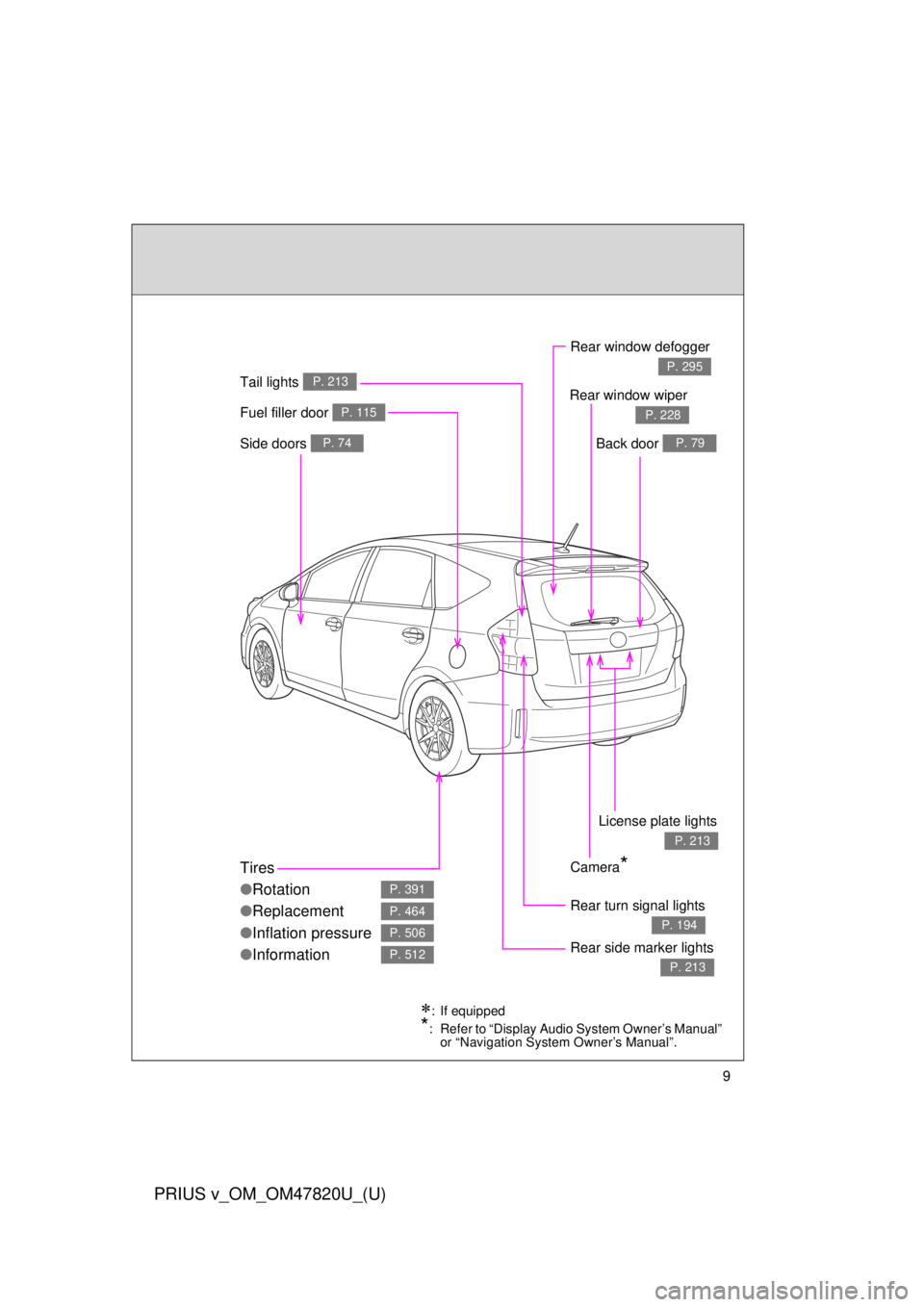
Fuel filler door P. 115
Rear turn signal lights
P. 194
Rear window defogger
P. 295
Tires
●Rotation
● Replacement
● Inflation pressure
● Information
P. 391
P. 464
P. 506
P. 512Rear side marker lights
P. 213
Tail lights P. 213
Camera*
Side doors P. 74Back door P. 79
Rear window wiper
P. 228
License plate lights
P. 213
: If equipped
*: Refer to “Display Audio System Owner’s Manual”
or “Navigation System Owner’s Manual”.
Page 53 of 568
53
1-1. Hybrid system
1
Before driving
PRIUS v_OM_OM47820U_(U)
■
Air conditioning on/off
Switch the air conditioning ( ) to off when it is not needed.
Doing so can help control excessive gasoline consumption.
In summer: In high temperatures, use the recirculated air mode.
Doing so will help to reduce t he burden on the air conditioner
and reduce fuel consumption as well.
In winter: Because the gasoline engine will not automatically cut
out until the gasoline engine and the interior of the vehicle are
warm, it will consume fuel. Also, fuel consumption can be
improved by avoiding overuse of the heater.
■ Checking tire inflation pressure
Make sure to check the tire inflation pressure frequently.
Improper tire inflation pressure can cause poor fuel consump-
tion.
Also, as snow tires can cause lar ge amounts of friction, their use
on dry roads can lead to poor fuel consumption. Use a tire that is
appropriate for the season.
■ Luggage
Carrying heavy luggage can lead to poor fuel consumption.
Avoid carrying unnecessary luggage. Installing a large roof rack
can also cause poor fuel consumption.
■ Warming up before driving
Since the gasoline engine starts up and cuts out automatically
when cold, warming up the engine is unnecessary. Moreover,
frequently driving s hort distances will ca use the engine to
repeatedly warm up, which can lead to poor fuel consumption.
Page 132 of 568

132 1-8. Safety information
PRIUS v_OM_OM47820U_(U)
CAUTION
■SRS airbag precautions
Observe the following precautions regarding the SRS airbags.
Failure to do so may cause death or serious injury.
● The driver and all passengers in the vehicle must wear their seat belts
properly.
The SRS airbags are supplemental devices to be used with the seat belts.
● The SRS driver airbag deploys with considerable force, and can cause
death or serious injury especially if the driver is very close to the airbag.
The National Highway Traffic Safety Administration (NHTSA) advises:
Since the risk zone for the driver’s airbag is the first 2 - 3 in. (50 - 75 mm)
of inflation, placing yourself 10 in. (250 mm) from your driver airbag pro-
vides you with a clear margin of safety. This distance is measured from the
center of the steering wheel to your breastbone. If you sit less than 10 in.
(250 mm) away now, you can change your driving position in several
ways:
• Move your seat to the rear as far as you can while still reaching the pedals comfortably.
• Slightly recline the back of the seat. Although vehicle designs vary, many drivers can achieve the 10 in.
(250 mm) distance, even with the driver seat all the way forward, sim-
ply by reclining the back of the seat somewhat. If reclining the back of
your seat makes it hard to see the road, raise yourself by using a firm,
non-slippery cushion, or raise the seat if your vehicle has that feature\
.
• If your steering wheel is adjustable, tilt it downward. This points the air- bag toward your chest instead of your head and neck.
The seat should be adjusted as recommended by NHTSA above, while still
maintaining control of the foot pedals, steering wheel, and your view of the
instrument panel controls.
Page 136 of 568

136 1-8. Safety information
PRIUS v_OM_OM47820U_(U)
CAUTION
■SRS airbag precautions
● Do not use seat accessories which cover the parts where the SRS side
airbags inflate as they may interfere with inflation of the airbags. Such
accessories may prevent the side airbags from activating correctly, disable
the system or cause the side airbags to inflate accidentally, resulting in
death or serious injury.
● Do not strike or apply significant levels of force to the area of the SRS air-
bag components.
Doing so can cause the SRS airbags to malfunction.
● Do not touch any of the component parts immediately after the SRS air-
bags have deployed (inflated) as they may be hot.
● If breathing becomes difficult after the SRS airbags have deployed, open a
door or window to allow fresh air in, or leave the vehicle if it is safe to do
so. Wash off any residue as soon as possible to prevent skin irritation.
● If the areas where the SRS airbags are stored, such as the steering wheel
pad and front and rear pillar garnishes, are damaged or cracked, have
them replaced by your Toyota dealer.
● Do not place anything, such as a cushion, on the front passenger’s seat.
Doing so will disperse the passenger’s weight, which prevents the sensor
from detecting the passenger’s weight properly. As a result, the SRS front
airbags for the front passenger may not deploy in the event of a collision.
Page 147 of 568

147
1-8. Safety information
1
Before driving
PRIUS v_OM_OM47820U_(U)
CAUTION
■
Child restraint precautions
● Never install a rear-facing child restraint system on the front passenger
seat even if the “AIR BAG OFF” indicator light is illuminated. In the event
of an accident, the force of the rapid inflation of the front passenger airbag
can cause death or serious injury to the child if the rear-facing child
restraint system is installed on the front passenger seat.
● A forward-facing child restraint system may be installed on the front pas-
senger seat only when it is unavoidable. A child restraint system that
requires a top tether strap should not be used in the front passenger seat
since there is no top tether strap anchor for the front passenger seat.
Adjust the seatback as upright as possible and always move the seat as
far back as possible even if the “AIR BAG OFF” indicator light is illumi-
nated, because the front passenger airbag could inflate with considerable
speed and force. Otherwise, the child may be killed or seriously injured.
● Do not use the seat belt extender when installing a child restraint system
on the front or rear passenger seat. If installing a child restraint system
with the seat belt extender connected to the seat belt, the seat belt will not
securely hold the child restraint system, which could cause death or seri-
ous injury to the child or other passengers in the event of a sudden stop,
sudden swerve or accident.
● Do not allow the child to lean his/her head or any part of his/her body
against the door or the area of the seat , front and rear pillars or roof side
rails from which the SRS side airbags or SRS curtain shield airbags deploy
even if the child is seated in the child restraint system. It is dangerous if
the SRS side airbags and curtain shield airbags inflate, and the impact
could cause death or serious injury to the child.
● Make sure you have complied with all installation instructions provided by
the child restraint manufacturer and that the system is properly secured. If
it is not secured properly, it may cause death or serious injury to the child
in the event of a sudden stop, sudden swerve or accident.
Page 255 of 568

255
2-4. Using other
driving systems
PRIUS v_OM_OM47820U_(U)
2
When driving
CAUTION
■Replacing tires
Make sure that all tires are of the specified size and of the same brand, tread
pattern and total load capacity. In addition, make sure that the tires are
inflated to the recommended tire inflation pressure level.
The ABS and VSC systems will not function correctly if different tires are
installed on the vehicle.
Contact your Toyota dealer for further information when replacing tires or
wheels.
■ Handling of tires and the suspension
Using tires with any kind of problem or modifying the suspension will affect
the driving assist systems, and may cause a system to malfunction.
Page 349 of 568
Maintenance and care4
349
PRIUS v_OM_OM47820U_(U)
4-1. Maintenance and careCleaning and protecting the vehicle exterior ......... 350
Cleaning and protecting the vehicle interior .......... 354
4-2. Maintenance Maintenance requirements .................. 357
General maintenance....... 360
Emission inspection and maintenance (I/M)
programs ........................ 364
4-3. Do-it-yourself maintenance Do-it-yourself service precautions .................... 365
Hood ................................ 368
Positioning a floor jack ..... 371
Engine compartment ........ 374
12-volt battery .................. 386
Tires ................................. 391
Tire inflation pressure ...... 400
Wheels ............................. 404
Air conditioning filter......... 407
Electronic key battery....... 409
Checking and replacing fuses .............................. 411
Light bulbs........................ 422
Page 363 of 568

363
4-2. Maintenance
PRIUS v_OM_OM47820U_(U)
4
Maintenance and care
Vehicle exterior
ItemsCheck points
Doors • Do the doors operate smoothly?
Engine hood • Does the engine hood lock sys-
tem work properly?
Fluid leaks • There should not be any signs of
fluid leakage after the vehicle has
been parked.
Tires • Is the tire inflation pressure cor-
rect?
• The tires should not be dam- aged or excessively worn.
• Have the tires been rotated according to the maintenance
schedule?
• The wheel nuts should not be loose.
CAUTION
■ If the hybrid system is operating
Turn the hybrid system off and ensure that there is adequate ventilation
before performing maintenance checks.
Page 366 of 568
366 4-3. Do-it-yourself maintenance
PRIUS v_OM_OM47820U_(U)
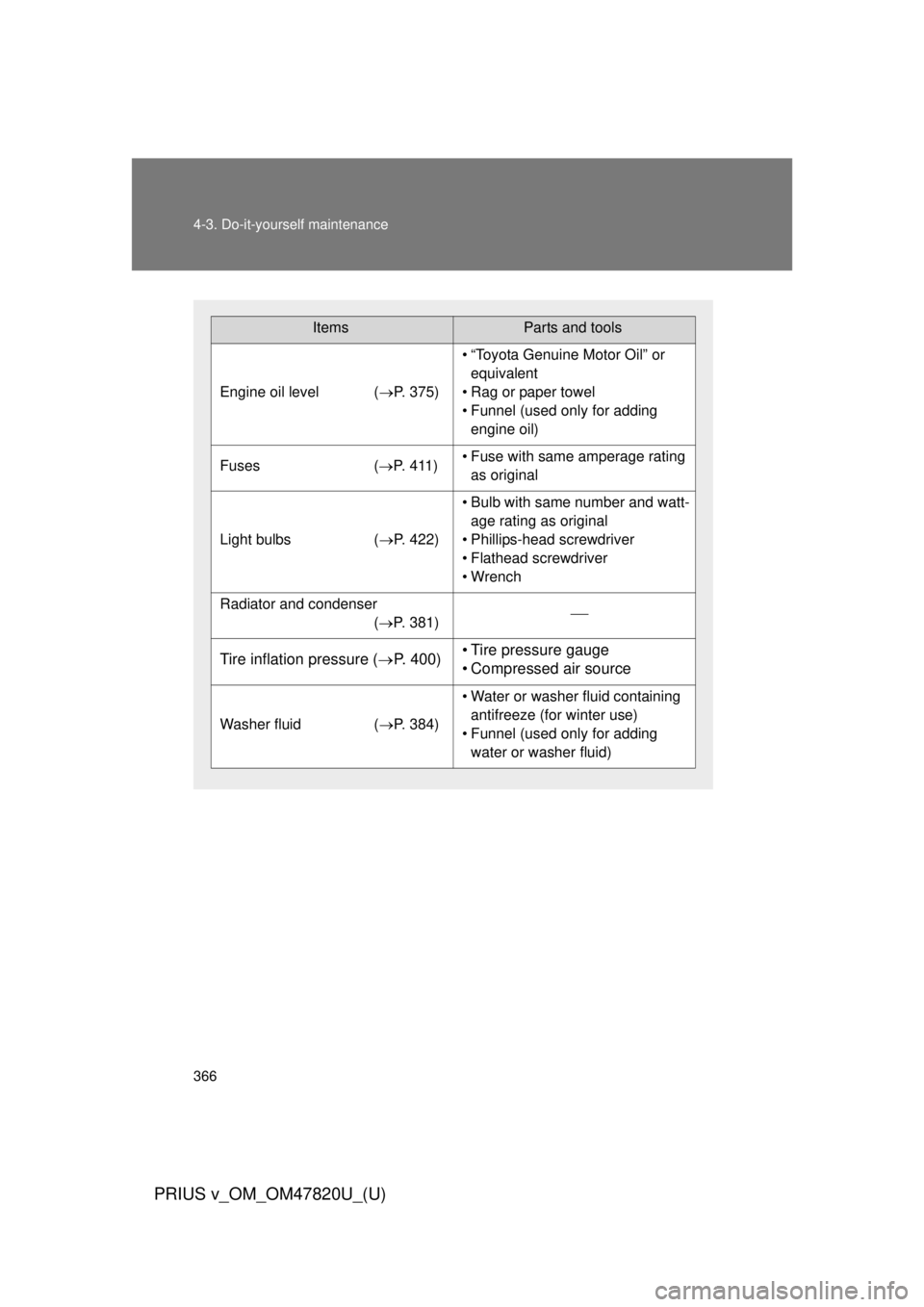
ItemsParts and tools
Engine oil level (P. 375)
• “Toyota Genuine Motor Oil” or
equivalent
• Rag or paper towel
• Funnel (used only for adding engine oil)
Fuses (P. 411)• Fuse with same amperage rating
as original
Light bulbs (P. 422)
• Bulb with same number and watt-
age rating as original
• Phillips-head screwdriver
• Flathead screwdriver
• Wrench
Radiator and condenser (P. 381)
Tire inflation pressure ( P. 400)• Tire pressure gauge
• Compressed air source
Washer fluid ( P. 384)
• Water or washer fluid containing
antifreeze (for winter use)
• Funnel (used only for adding water or washer fluid)