ECU TOYOTA PRIUS V 2018 User Guide
[x] Cancel search | Manufacturer: TOYOTA, Model Year: 2018, Model line: PRIUS V, Model: TOYOTA PRIUS V 2018Pages: 607, PDF Size: 41.96 MB
Page 42 of 607
401-1. For safe use
PRIUS v_OM_OM47B78U_(U)
WARNING
■Using a seat belt extender
●Do not wear the seat belt extender if you can fasten the seat belt without
the extender.
● Do not use the seat belt extender when installing a child restraint system
because the belt will not securely hold the child restraint system, increas-
ing the risk of death or serious injury in the event of an accident.
● The personalized extender may not be safe on another vehicle, when
used by another person, or at a diff erent seating position other than the
one originally intended.
NOTICE
■ When using a seat belt extender
When releasing the seat belt, press on the buckle release button on the
extender, not on the seat belt.
This helps prevent damage to the vehicle interior and the extender itself.
Page 43 of 607
411-1. For safe use
PRIUS v_OM_OM47B78U_(U)
1
For safety and security
SRS airbags
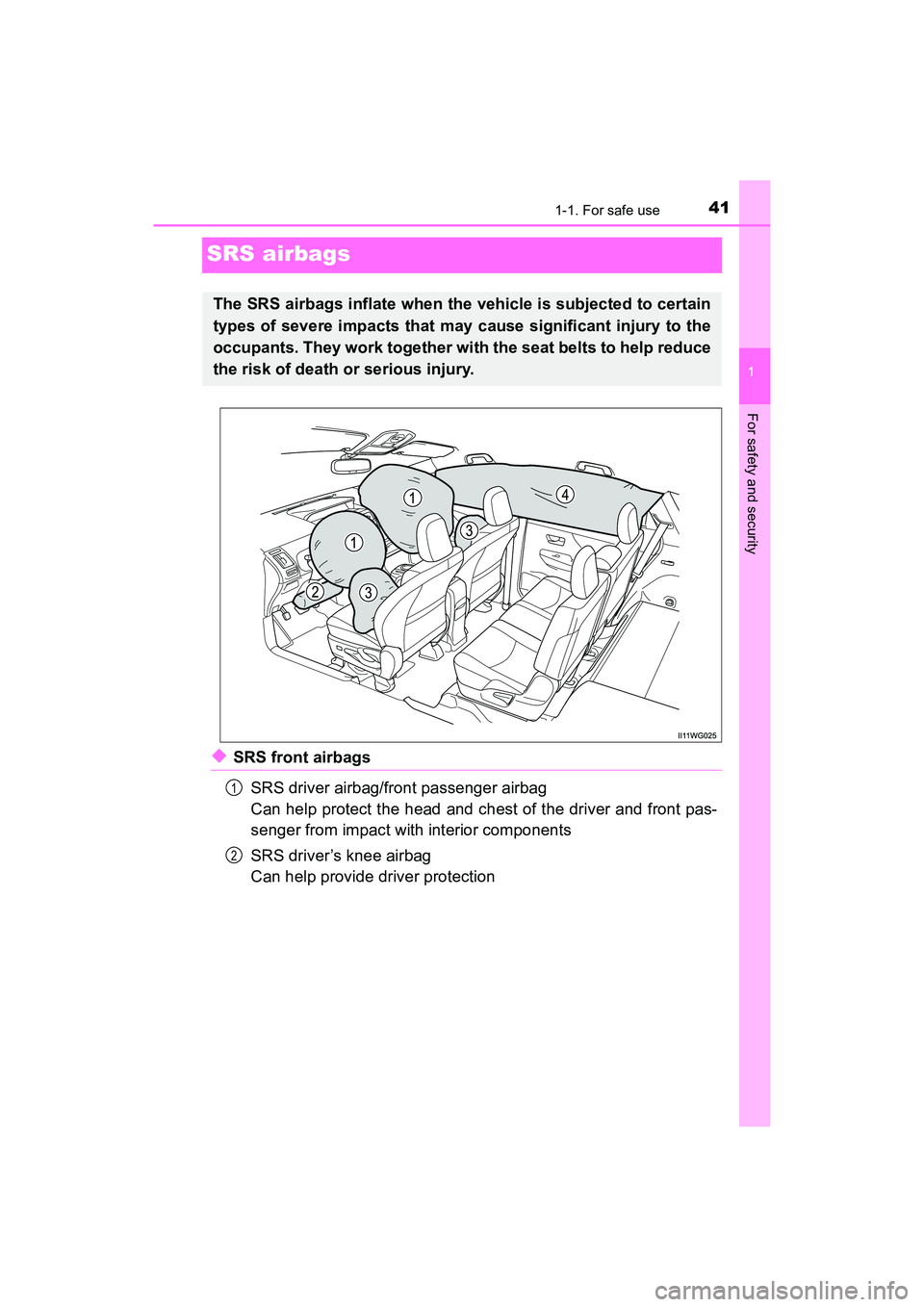
◆SRS front airbagsSRS driver airbag/front passenger airbag
Can help protect the head and chest of the driver and front pas-
senger from impact with interior components
SRS driver’s knee airbag
Can help provide driver protection
The SRS airbags inflate when the vehicle is subjected to certain
types of severe impacts that may cause significant injury to the
occupants. They work together with the seat belts to help reduce
the risk of death or serious injury.
1
2
Page 45 of 607
431-1. For safe use
PRIUS v_OM_OM47B78U_(U)
1
For safety and security
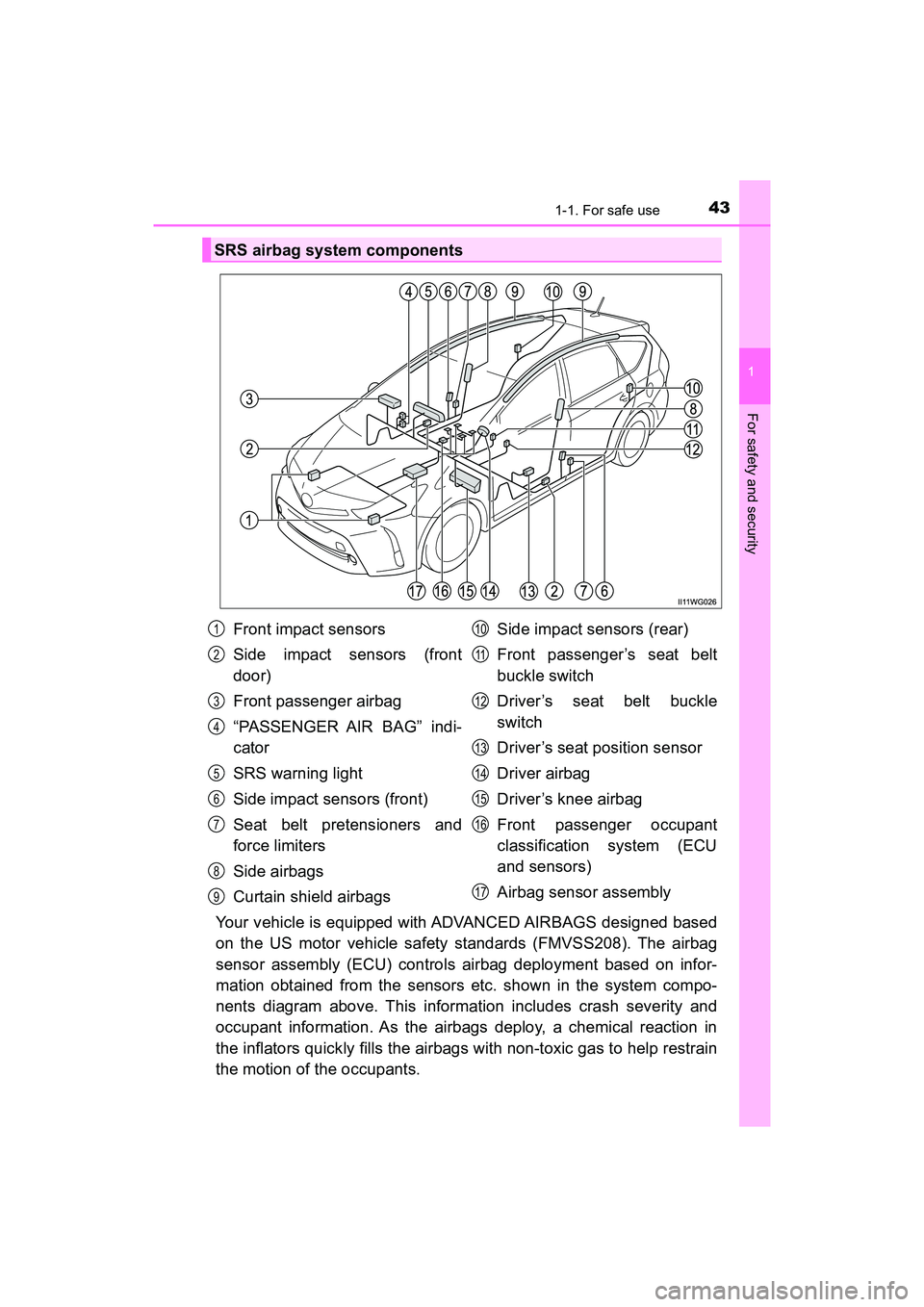
Your vehicle is equipped with ADVANCED AIRBAGS designed based
on the US motor vehicle safety standards (FMVSS208). The airbag
sensor assembly (ECU) controls airbag deployment based on infor-
mation obtained from the sensors etc. shown in the system compo-
nents diagram above. This information includes crash severity and
occupant information. As the airbags deploy, a chemical reaction in
the inflators quickly fills the airbags with non-toxic gas to help restrain
the motion of the occupants.
SRS airbag system components
Front impact sensors
Side impact sensors (front
door)
Front passenger airbag
“PASSENGER AIR BAG” indi-
cator
SRS warning light
Side impact sensors (front)
Seat belt pretensioners and
force limiters
Side airbags
Curtain shield airbagsSide impact sensors (rear)
Front passenger’s seat belt
buckle switch
Driver ’s seat belt buckle
switch
Driver’s seat position sensor
Driver airbag
Driver’s knee airbag
Front passenger occupant
classification system (ECU
and sensors)
Airbag sensor assembly1
2
3
4
5
6
7
8
9
10
11
12
13
14
15
16
17
Page 47 of 607
451-1. For safe use
PRIUS v_OM_OM47B78U_(U)
1
For safety and security
WARNING
■SRS airbag precautions
●The SRS front passenger airbag also deploys with considerable force, and
can cause death or serious injury especially if the front passenger is very
close to the airbag. The front passenger seat should be as far from the air-
bag as possible with the seatback adjusted, so the front passenger sits
upright.
● Improperly seated and/or restrained in fants and children can be killed or
seriously injured by a deploying airbag. An infant or child who is too small
to use a seat belt should be properly secured using a child restraint sys-
tem. Toyota strongly recommends that all infants and children be placed in
the rear seats of the vehicle and proper ly restrained. The rear seats are
safer for infants and children than the front passenger seat.
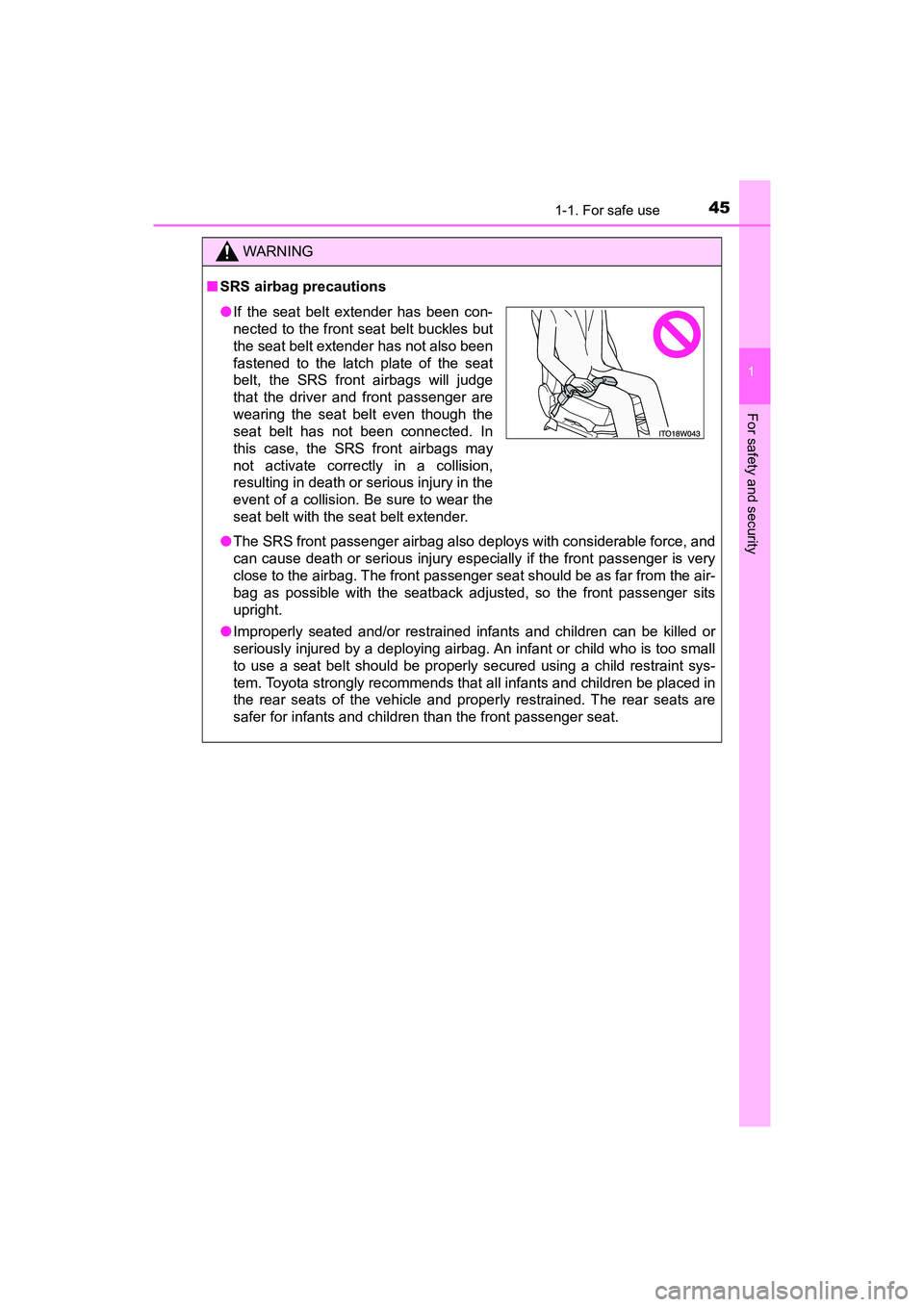
● If the seat belt extender has been con-
nected to the front seat belt buckles but
the seat belt extender has not also been
fastened to the latch plate of the seat
belt, the SRS front airbags will judge
that the driver and front passenger are
wearing the seat belt even though the
seat belt has not been connected. In
this case, the SRS front airbags may
not activate correctly in a collision,
resulting in death or serious injury in the
event of a collision. Be sure to wear the
seat belt with the seat belt extender.
Page 49 of 607
471-1. For safe use
PRIUS v_OM_OM47B78U_(U)
1
For safety and security
WARNING
■SRS airbag precautions
●Do not hang coat hangers or hard objects on the coat hooks. All of these
items could become projectiles and may cause death or serious injury,
should the SRS curtain shield airbags deploy.
● If a vinyl cover is put on the area where the SRS knee airbag will deploy,
be sure to remove it.
● Do not use seat accessories which cover the parts where the SRS side
airbags inflate as they may interfere with inflation of the airbags. Such
accessories may prevent the side airbags from activating correctly, disable
the system or cause the side airbags to inflate accidentally, resulting in
death or serious injury.
● Do not strike or apply significant levels of force to the area of the SRS air-
bag components.
Doing so can cause the SRS airbags to malfunction.
● Do not touch any of the component parts immediately after the SRS air-
bags have deployed (inflated) as they may be hot.
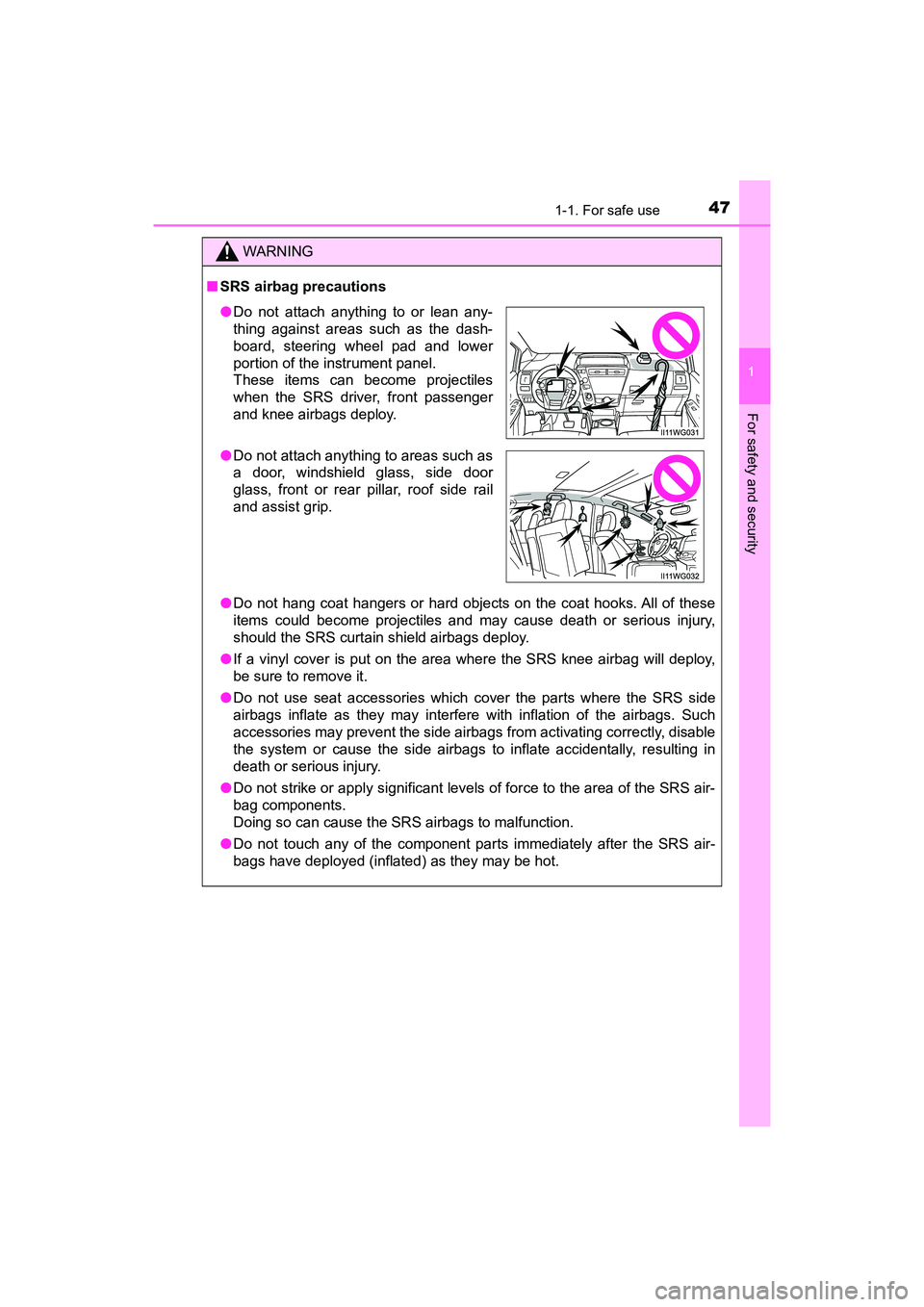
●Do not attach anything to or lean any-
thing against areas such as the dash-
board, steering wheel pad and lower
portion of the instrument panel.
These items can become projectiles
when the SRS driver, front passenger
and knee airbags deploy.
● Do not attach anything to areas such as
a door, windshield glass, side door
glass, front or rear pillar, roof side rail
and assist grip.
Page 51 of 607
491-1. For safe use
PRIUS v_OM_OM47B78U_(U)
1
For safety and security
■If the SRS airbags deploy (inflate)
●Slight abrasions, burns, bruising etc., may be sustained from SRS airbags,
due to the extremely high speed deployment (inflation) by hot gases.
● A loud noise and white powder will be emitted.
● Parts of the airbag module (steering wheel hub, airbag cover and inflator) as
well as the front seats, parts of the fr ont and rear pillars, and roof side rails,
may be hot for several minutes. The airbag itself may also be hot.
● The windshield may crack.
■ SRS airbag deployment conditions (SRS front airbags)
●The SRS front airbags will deploy in the event of an impact that exceeds the
set threshold level (the level of force corresponding to an approximately 12 -
18 mph [20 - 30 km/h] frontal collision with a fixed wall that does not move or
deform).
However, this threshold velocity will be considerably higher in the following
situations:
• If the vehicle strikes an object, such as a parked vehicle or sign pole,
which can move or deform on impact
• If the vehicle is involved in an underride collision, such as a collision in which the front of the vehicle “underrides”, or goes under, the bed of a
truck
● Depending on the type of collision, it is possible that only the seat belt pre-
tensioners will activate.
● The SRS front airbags for the front passenger will not activate if there is no
passenger sitting in the front passenger seat. However, the SRS front air-
bags for the front passenger may deploy if luggage is put in the seat, even if
the seat is unoccupied. ( P. 5 3 )
■ SRS airbag deployment conditions (S RS side and curtain shield airbags)
● The SRS side and curtain shield airbags will deploy in the event of an
impact that exceeds the set threshold level (the level of force corresponding
to the impact force produced by an approximately 3300 lb. [1500 kg] vehicle
colliding with the vehicle cabin from a direction perpendicular to the vehicle
orientation at an approximate speed of 12 - 18 mph [20 - 30 km/h]).
● The SRS side and curtain shield airbags may also deploy in the event of a
severe frontal collision.
Page 53 of 607
511-1. For safe use
PRIUS v_OM_OM47B78U_(U)
1
For safety and security
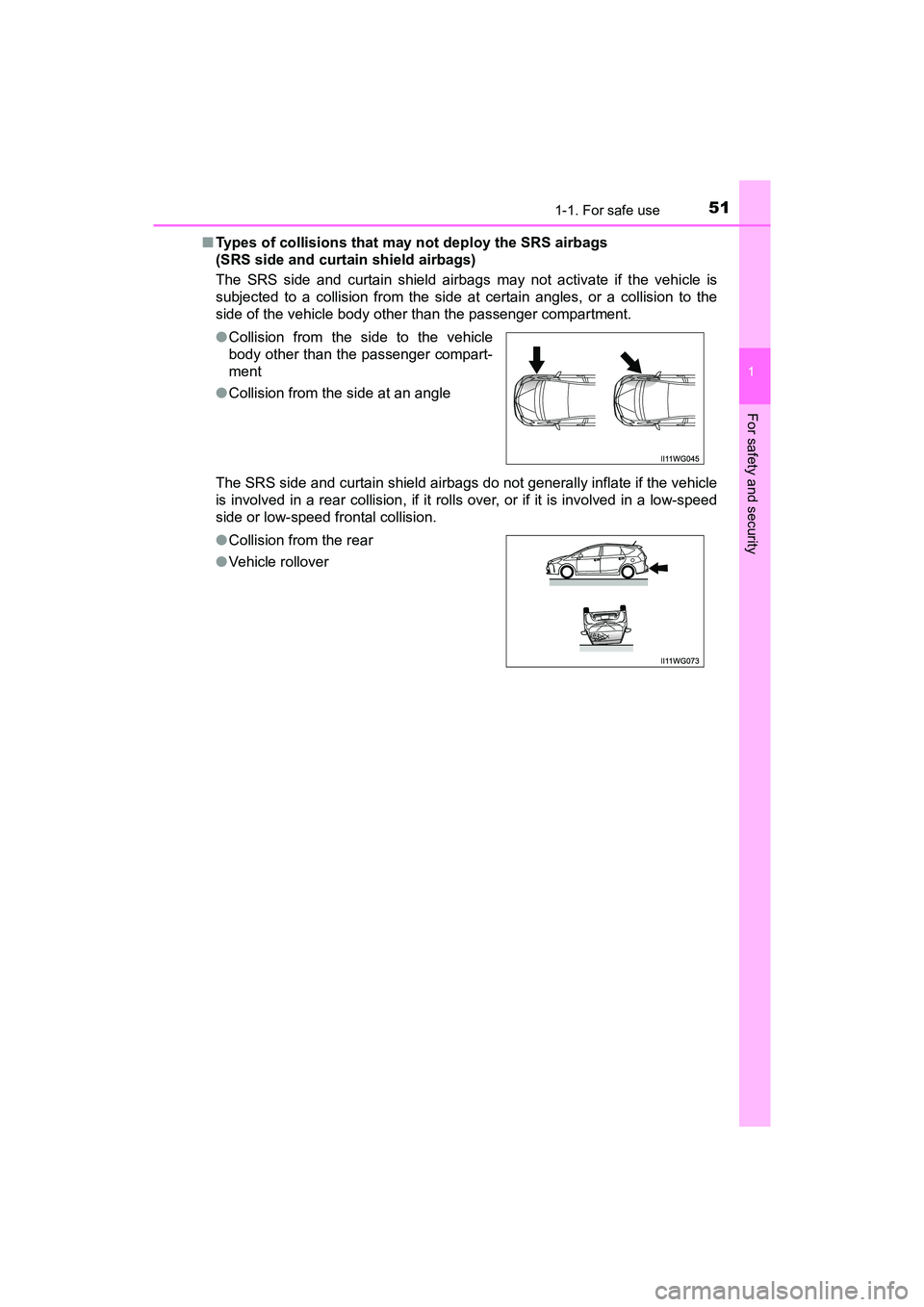
■Types of collisions that m ay not deploy the SRS airbags
(SRS side and curtain shield airbags)
The SRS side and curtain shield airbags may not activate if the vehicle is
subjected to a collision from the side at certain angles, or a collision to the
side of the vehicle body other than the passenger compartment.
The SRS side and curtain shield airbags do not generally inflate if the vehicle
is involved in a rear collision, if it ro lls over, or if it is involved in a low-speed
side or low-speed frontal collision. ● Collision from the side to the vehicle
body other than the passenger compart-
ment
● Collision from the side at an angle
● Collision from the rear
● Vehicle rollover
Page 55 of 607
531-1. For safe use
PRIUS v_OM_OM47B78U_(U)
1
For safety and security
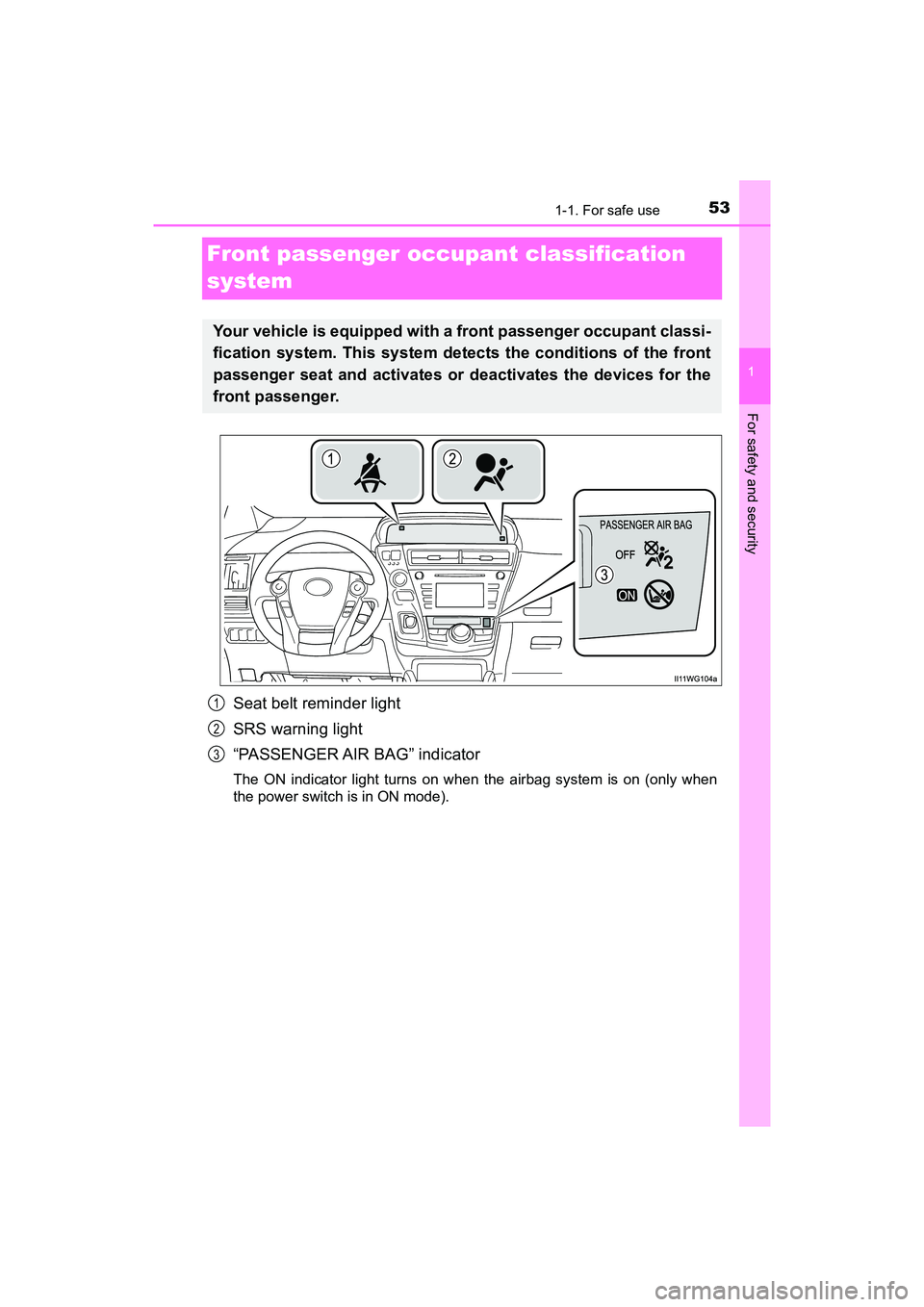
Front passenger occupant classification
system
Seat belt reminder light
SRS warning light
“PASSENGER AIR BAG” indicator
The ON indicator light turns on when the airbag system is on (only when
the power switch is in ON mode).
Your vehicle is equipped with a front passenger occupant classi-
fication system. This system detects the conditions of the front
passenger seat and activates or deactivates the devices for the
front passenger.
1
2
3
Page 57 of 607
551-1. For safe use
PRIUS v_OM_OM47B78U_(U)
1
For safety and security
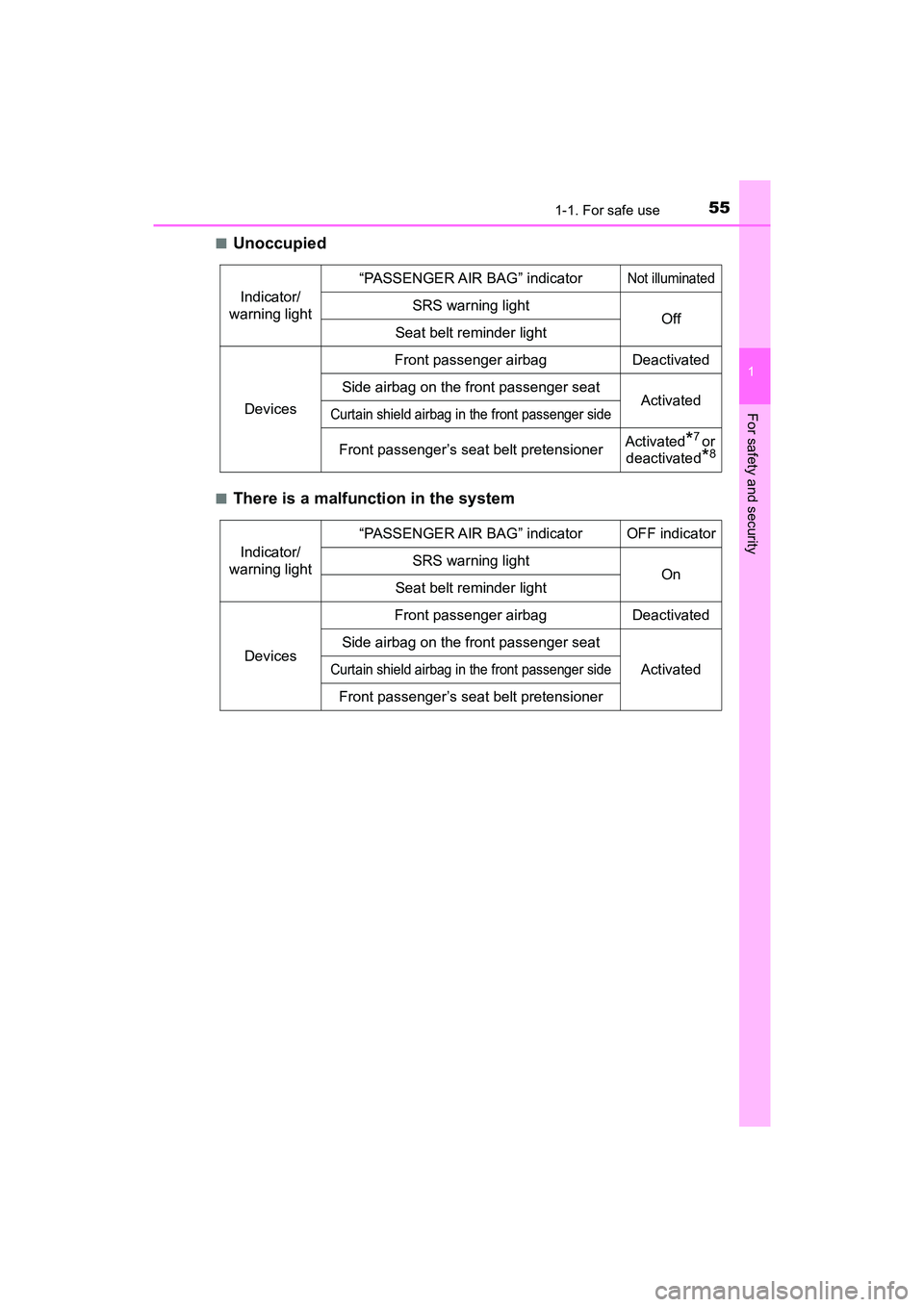
■Unoccupied
■There is a malfunction in the system
Indicator/
warning light
“PASSENGER AIR BAG” indicatorNot illuminated
SRS warning lightOffSeat belt reminder light
Devices
Front passenger airbagDeactivated
Side airbag on the front passenger seatActivatedCurtain shield airbag in the front passenger side
Front passenger’s seat belt pretensionerActivated*7 or
deactivated
*8
Indicator/
warning light
“PASSENGER AIR BAG” indicatorOFF indicator
SRS warning lightOnSeat belt reminder light
Devices
Front passenger airbagDeactivated
Side airbag on the front passenger seat
ActivatedCurtain shield airbag in the front passenger side
Front passenger’s seat belt pretensioner
Page 59 of 607
571-1. For safe use
PRIUS v_OM_OM47B78U_(U)
1
For safety and security
WARNING
■Front passenger occupant classification system precautions
●Do not recline the front passenger seatback so far that it touches a rear
seat. This may cause “OFF” of the “PASSENGER AIR BAG” indicator to
be illuminated, which indicates that the SRS airbags for the front passen-
ger will not activate in the event of a severe accident. If the seatback
touches the rear seat, return the seatback to a position where it does not
touch the rear seat. Keep the front passenger seatback as upright as pos-
sible when the vehicle is moving. Reclining the seatback excessively may
lessen the effectiveness of the seat belt system.
● If an adult sits in the front passenger seat, “ON” of the “PASSENGER AIR
BAG” indicator is illuminated. If “OFF” of the “PASSENGER AIR BAG” indi-
cator is illuminated, ask the passenger to sit up straight, well back in the
seat, feet on the floor, and with the seat belt worn correctly. If “OFF” of the
“PASSENGER AIR BAG” indicator still remains illuminated, either ask the
passenger to move to the rear seat, or if that is not possible, move the
front passenger seat fully rearward.
● When it is unavoidable to install a forward-facing child restraint system on
the front passenger seat, install the child restraint system on the front pas-
senger seat in the proper order. ( P. 63)
● Do not modify or remove the front seats.
● Do not kick the front passenger seat or subject it to severe impact. Other-
wise, the SRS warning light may come on to indicate a malfunction of the
front passenger occupant classification system. In this case, contact your
Toyota dealer immediately.
● Child restraint systems installed on the rear seat should not contact the
front seatbacks.
● Do not use a seat accessory, such as a cushion and seat cover, that cov-
ers the seat cushion surface.
● Do not modify or replace the upholstery of the front seat.