heating TOYOTA PROACE 2017 User Guide
[x] Cancel search | Manufacturer: TOYOTA, Model Year: 2017, Model line: PROACE, Model: TOYOTA PROACE 2017Pages: 516, PDF Size: 91.65 MB
Page 134 of 516
134
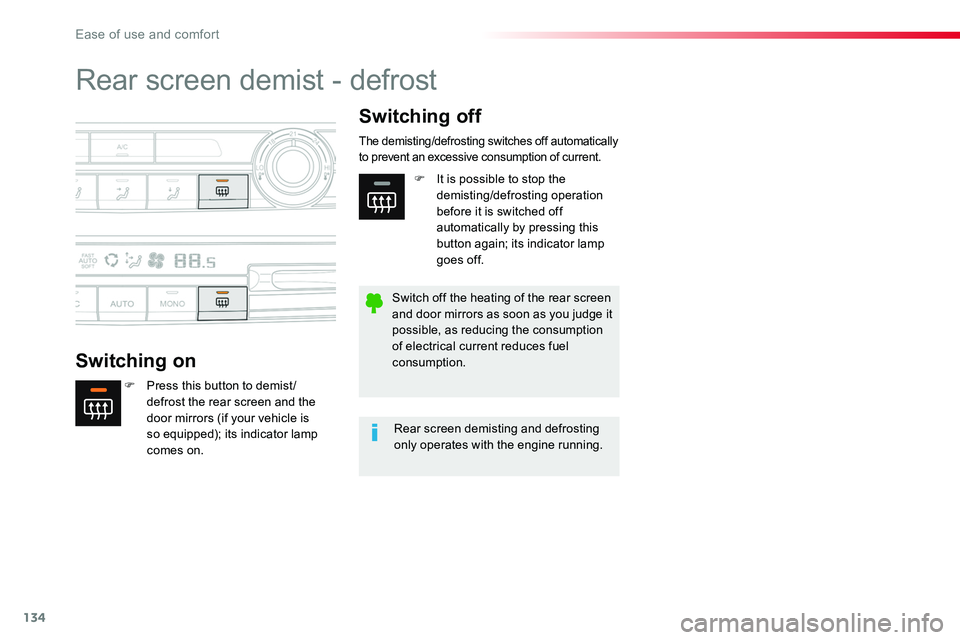
Rear screen demist - defrost
Switching on
Switching off
F Press this button to demist /defrost the rear screen and the door mirrors (if your vehicle is
so equipped); its indicator lamp comes on.
The demisting/defrosting switches off automatically to prevent an excessive consumption of current.
Rear screen demisting and defrosting
only operates with the engine running.
Switch off the heating of the rear screen and door mirrors as soon as you judge it possible, as reducing the consumption of electrical current reduces fuel consumption.
F It is possible to stop the demisting/defrosting operation before it is switched off automatically by pressing this button again; its indicator lamp goes off.
Ease of use and comfort
Page 135 of 516
135
In order for these systems to be fully effective, follow the operation and maintenance guidelines below:F To obtain an even air distribution, take care not to obstruct the exterior air intake grilles located at the base of the windscreen, the nozzles, the vents and the air outlets, as well as the air extractor located at the rear.F Do not cover the sunshine sensor, located at the top of the windscreen; this is used for regulation of the air conditioning system.F Operate the air conditioning system for at least 5 to 10 minutes, once or twice a month to keep it in per fect working order.F Ensure that the passenger compartment filter is in good condition and have the filter elements replaced regularly. We recommend the use of a combined passenger compartment filter. Thanks to its special active additive, it contributes to the purification of the air breathed by the occupants and the cleanliness of the passenger compartment (reduction of allergic symptoms, bad odours and greasy deposits).F To ensure correct operation of the air conditioning system, you are also advised to have it checked regularly as recommended in the maintenance and warranty guide.F If the system does not produce cold air, switch it off and contact an authorized Toyota dealer or repairer, or another duly qualified and equipped professional.
Recommendations for heating, ventilation and air conditioning
If after an extended stop in sunshine, the interior temperature is very high, first ventilate the passenger compartment for a few moments.Put the air flow control at a setting high enough to quickly change the air in the passenger compartment.
The air conditioning system does not contain chlorine and does not present any danger to the ozone layer.
The condensation created by the air conditioning results in a discharge of water under the vehicle which is perfectly normal.
When towing the maximum load on a steep gradient in high temperatures, switching off the air conditioning increases the available engine power and so improves the towing ability.
Stop & Start
The heating and air conditioning systems only work when the engine is running.To maintain a comfortable temperature in the passenger compartment, you can temporarily deactivate the Stop & Start system.
For more information on Stop & Star t, refer to the corresponding section.
Air vents
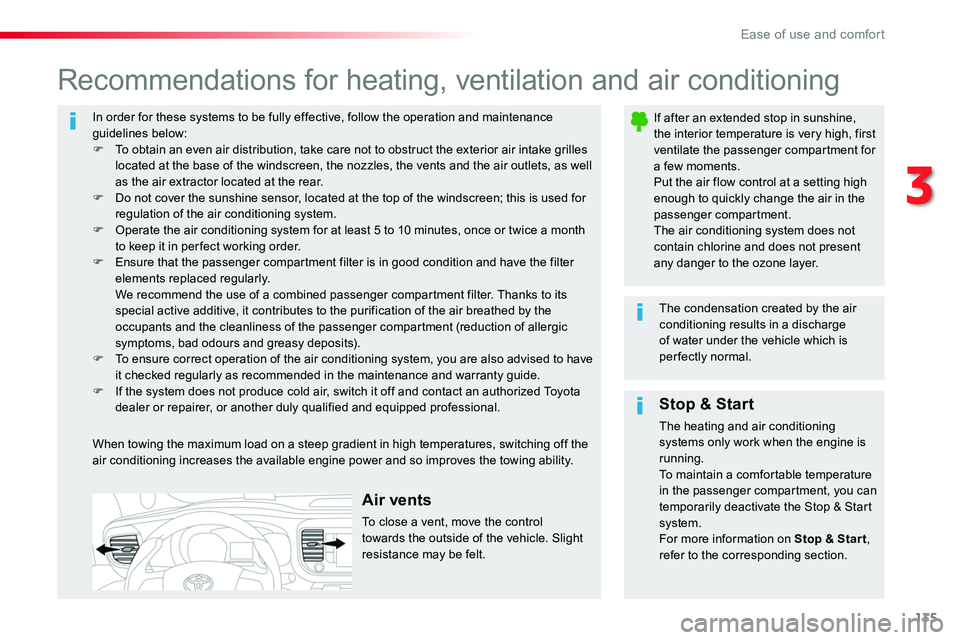
To close a vent, move the control towards the outside of the vehicle. Slight resistance may be felt.
3
Ease of use and comfort
Page 136 of 516
136
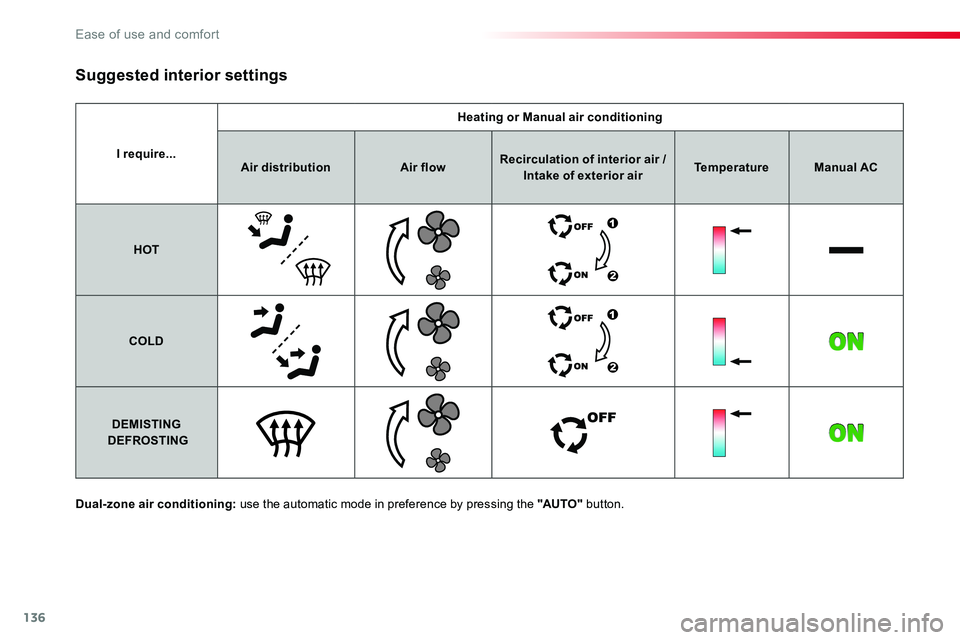
I require...
Heating or Manual air conditioning
Air distributionAir flowRecirculation of interior air / Intake of exterior airTemperatureManual AC
HOT
COLD
DEMISTING DEFROSTING
Suggested interior settings
Dual-zone air conditioning: use the automatic mode in preference by pressing the "AUTO" button.
Ease of use and comfort
Page 137 of 516
137
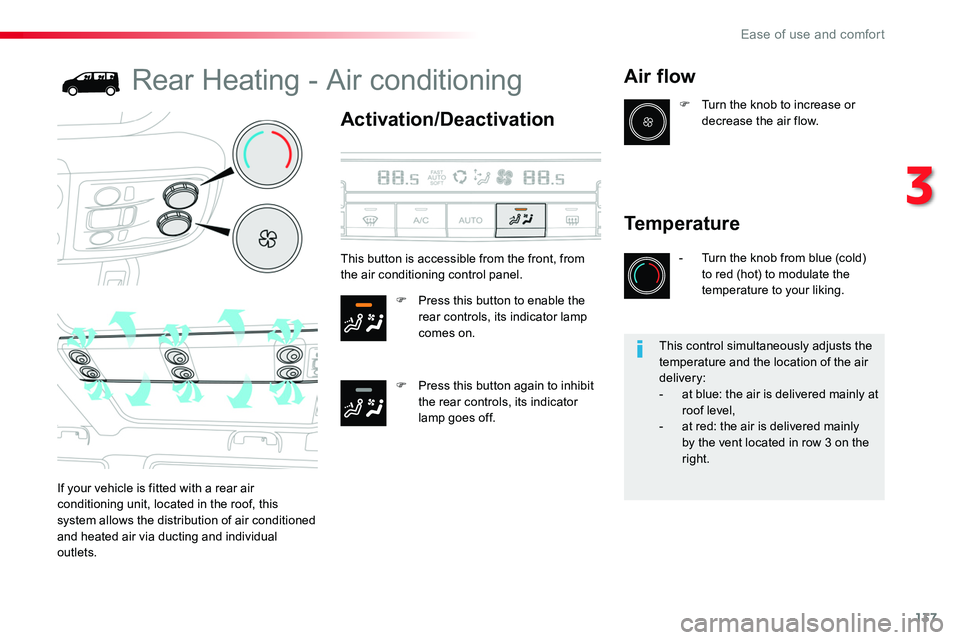
Rear Heating - Air conditioning
Activation/Deactivation
F Press this button to enable the rear controls, its indicator lamp comes on.
F Press this button again to inhibit the rear controls, its indicator lamp goes off.
Air flow
If your vehicle is fitted with a rear air conditioning unit, located in the roof, this system allows the distribution of air conditioned
and heated air via ducting and individual outlets.
F Turn the knob to increase or decrease the air flow.
Temperature
- Turn the knob from blue (cold) to red (hot) to modulate the temperature to your liking.
This button is accessible from the front, from the air conditioning control panel.
This control simultaneously adjusts the temperature and the location of the air delivery:- at blue: the air is delivered mainly at roof level,- at red: the air is delivered mainly by the vent located in row 3 on the right.
3
Ease of use and comfort
Page 138 of 516
138
Heating
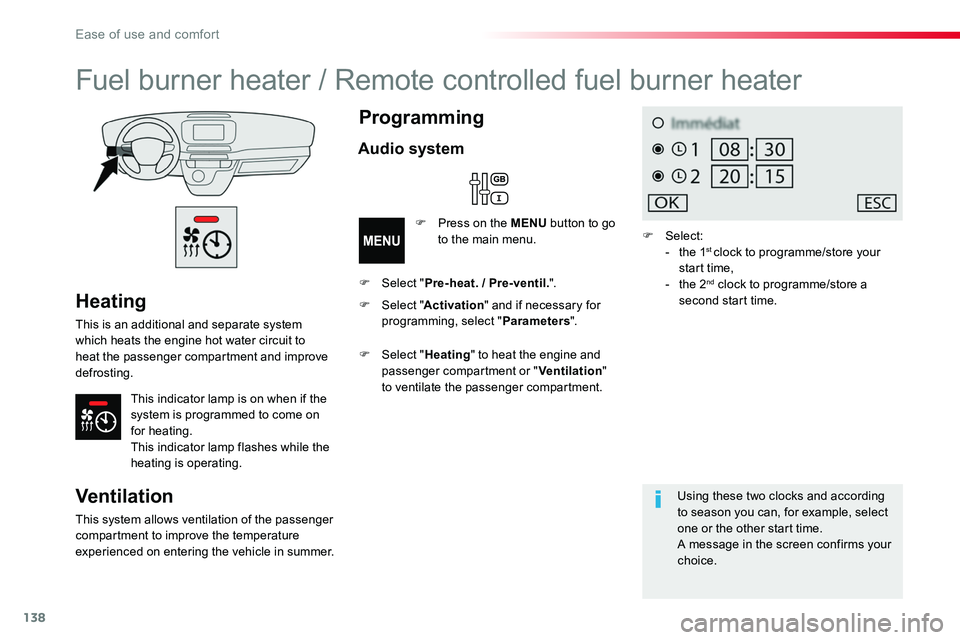
This is an additional and separate system which heats the engine hot water circuit to heat the passenger compartment and improve defrosting.
This indicator lamp is on when if the system is programmed to come on for heating.This indicator lamp flashes while the heating is operating.
Fuel burner heater / Remote controlled fuel burner heater
Ventilation
This system allows ventilation of the passenger
compartment to improve the temperature experienced on entering the vehicle in summer.
Programming
Audio system
F Press on the MENU button to go to the main menu.
F Select "Pre-heat. / Pre-ventil.".
F Select "Heating" to heat the engine and passenger compartment or "Ventilation" to ventilate the passenger compartment.
F Select:- the 1st clock to programme/store your start time,- the 2nd clock to programme/store a second start time.
Using these two clocks and according to season you can, for example, select one or the other start time.
A message in the screen confirms your choice.
F Select "Activation" and if necessary for programming, select "Parameters".
Ease of use and comfort
Page 139 of 516
139
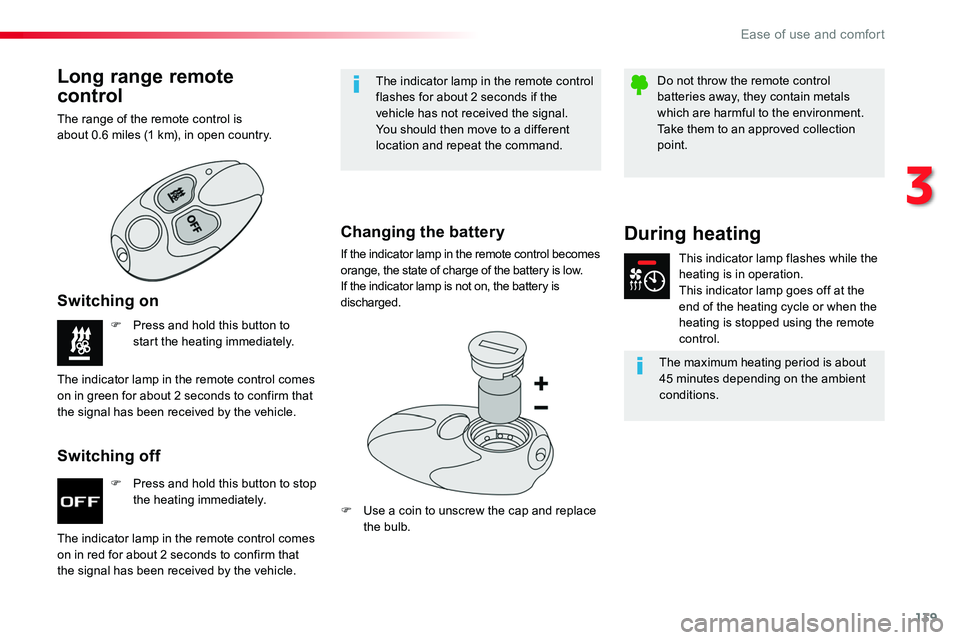
F Press and hold this button to stop the heating immediately.
F Press and hold this button to start the heating immediately.
The indicator lamp in the remote control comes on in red for about 2 seconds to confirm that the signal has been received by the vehicle.
The indicator lamp in the remote control comes on in green for about 2 seconds to confirm that the signal has been received by the vehicle.
Switching off
Switching on
Long range remote
control
The range of the remote control is about 0.6 miles (1 km), in open country.
The indicator lamp in the remote control flashes for about 2 seconds if the vehicle has not received the signal.You should then move to a different location and repeat the command.
Changing the battery
If the indicator lamp in the remote control becomes orange, the state of charge of the battery is low.If the indicator lamp is not on, the battery is discharged.
F Use a coin to unscrew the cap and replace the bulb.
During heating
This indicator lamp flashes while the heating is in operation.This indicator lamp goes off at the end of the heating cycle or when the heating is stopped using the remote control.
The maximum heating period is about 45 minutes depending on the ambient conditions.
Do not throw the remote control batteries away, they contain metals which are harmful to the environment.Take them to an approved collection point.
3
Ease of use and comfort
Page 140 of 516
140
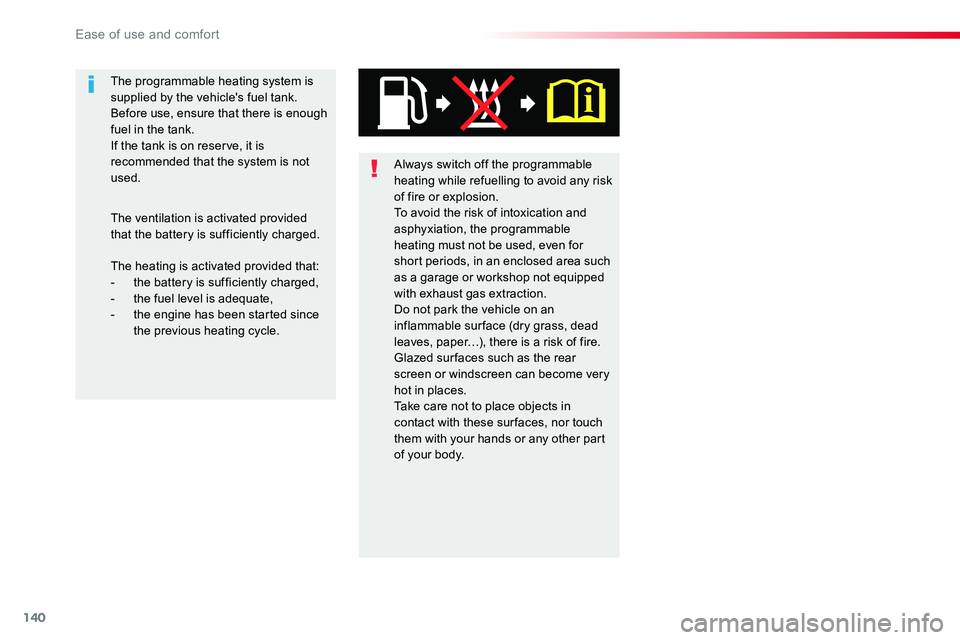
Always switch off the programmable heating while refuelling to avoid any risk of fire or explosion.To avoid the risk of intoxication and asphyxiation, the programmable heating must not be used, even for short periods, in an enclosed area such as a garage or workshop not equipped with exhaust gas extraction.Do not park the vehicle on an inflammable sur face (dry grass, dead leaves, paper…), there is a risk of fire.Glazed sur faces such as the rear screen or windscreen can become very hot in places.Take care not to place objects in contact with these sur faces, nor touch them with your hands or any other part of your body.
The heating is activated provided that:- the battery is sufficiently charged,- the fuel level is adequate,- the engine has been started since the previous heating cycle.
The programmable heating system is supplied by the vehicle's fuel tank.Before use, ensure that there is enough fuel in the tank.If the tank is on reserve, it is recommended that the system is not used.
The ventilation is activated provided that the battery is sufficiently charged.
Ease of use and comfort
Page 159 of 516
159
* Depending on the country of sale.
Heated windscreen and
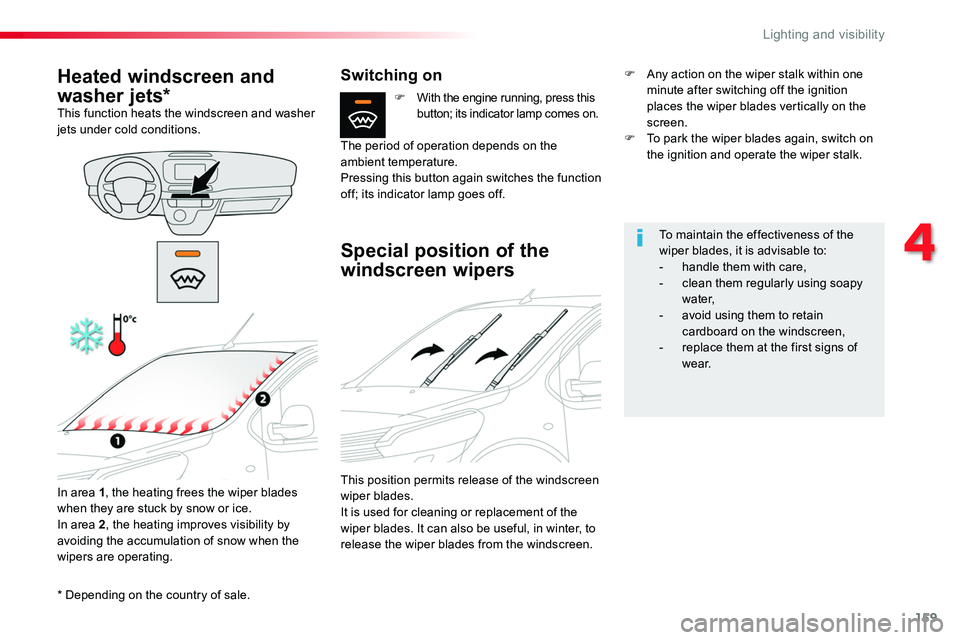
washer jets*This function heats the windscreen and washer jets under cold conditions.
In area 1, the heating frees the wiper blades when they are stuck by snow or ice.In area 2, the heating improves visibility by
avoiding the accumulation of snow when the wipers are operating.
Switching on
F With the engine running, press this button; its indicator lamp comes on.
The period of operation depends on the ambient temperature.Pressing this button again switches the function off; its indicator lamp goes off.
Special position of the
windscreen wipers
This position permits release of the windscreen wiper blades.It is used for cleaning or replacement of the wiper blades. It can also be useful, in winter, to release the wiper blades from the windscreen.
To maintain the effectiveness of the wiper blades, it is advisable to:- handle them with care,- clean them regularly using soapy water,- avoid using them to retain cardboard on the windscreen,- replace them at the first signs of w e a r.
F Any action on the wiper stalk within one minute after switching off the ignition places the wiper blades vertically on the screen.F To park the wiper blades again, switch on the ignition and operate the wiper stalk.
4
Lighting and visibility
Page 196 of 516
196
Driving recommendations
Observe the driving regulations and remain vigilant whatever the traffic conditions.Pay close attention to the traffic and keep your hands on the wheel so that you are ready to react at any time to any eventuality.On a long journey, a break every two hours is strongly recommended.In difficult weather, drive smoothly, anticipate
the need to brake and increase the distance from other vehicles.
Never drive with the parking brake applied - Risk of overheating and damage to the braking system!Risk of fire!As the exhaust system of your vehicle is very hot, even several minutes after switching off the engine, do not park or run the engine over areas where inflammable substances and materials are present: grass, leaves, etc.
Never leave a vehicle unsupervised with the engine running. If you have to leave your vehicle with the engine running, apply the parking brake and put the gearbox into neutral or position N or P, depending on the type of gearbox.
Driving on flooded roads
We strongly advise against driving on flooded
roads, as this could cause serious damage to the engine or gearbox, as well as to the electrical systems of your vehicle.
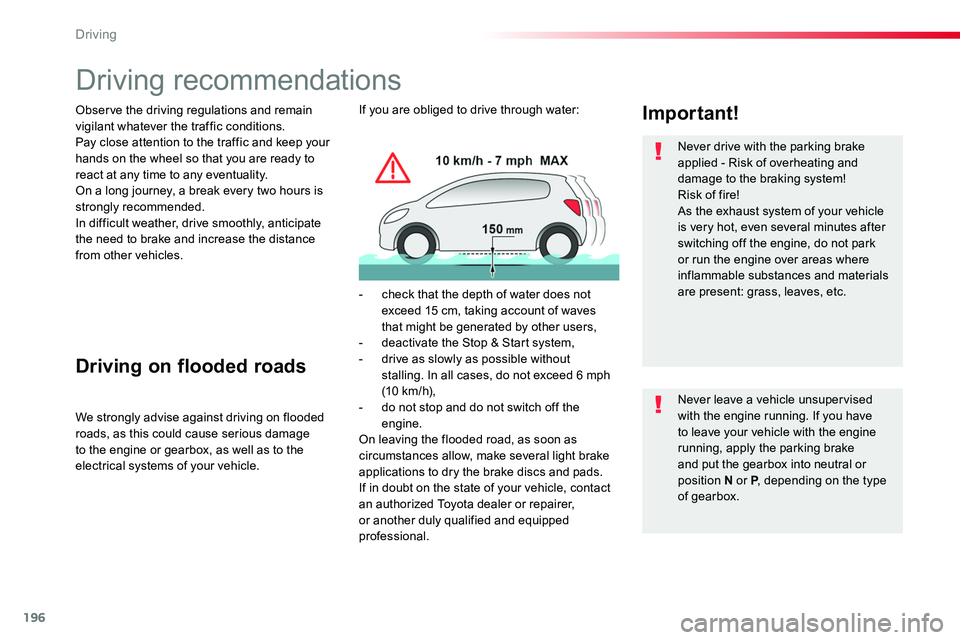
Important!If you are obliged to drive through water:
- check that the depth of water does not exceed 15 cm, taking account of waves that might be generated by other users,- deactivate the Stop & Start system,- drive as slowly as possible without stalling. In all cases, do not exceed 6 mph (10 km/h),- do not stop and do not switch off the engine.On leaving the flooded road, as soon as circumstances allow, make several light brake applications to dry the brake discs and pads.If in doubt on the state of your vehicle, contact an authorized Toyota dealer or repairer, or another duly qualified and equipped professional.
Driving
Page 198 of 516
198
When towing
Distribution of loads
F Distribute the load in the trailer so that the heaviest items are as close as possible to the axle and the nose weight approaches the maximum permitted without exceeding it.Air density decreases with altitude, thus reducing engine performance. Above 1 000 metres, the maximum towed load must be reduced by 10 % for every 1 000 metres of altitude.
Side wind
F Take into account the increased sensitivity to side wind.
Cooling
Towing a trailer on a slope increases the temperature of the coolant.As the fan is electrically controlled, its cooling capacity is not dependent on the engine speed.F To lower the engine speed, reduce your speed.The maximum towed load on a long incline depends on the gradient and the ambient temperature.In all cases, keep a check on the coolant temperature.
F If the warning lamp and the STOP warning lamp come on, stop the vehicle and switch off the engine as soon as possible.
Braking
Towing a trailer increases the braking distance.To avoid overheating of the brakes, the use of engine braking is recommended.
Ty r e s
F Check the tyre pressures of the towing vehicle and of the trailer, observing the recommended pressures.
Lighting
F Check the electrical lighting and signalling on the trailer and the headlamp beam height of your vehicle.
For more information on Weights, refer to the corresponding section.
The rear parking sensors will be deactivated automatically to avoid the audible signal if a genuine Toyota towbar is used.
If the ambient temperature is high, it is recommended that the engine be allowed to idle for 1 to 2 minutes after the vehicle comes to a stop, to facilitate its cooling.
For more information on Adjusting the headlamp beam height, refer to the corresponding section.
Driving