ECU TOYOTA PROACE 2017 Owner's Manual
[x] Cancel search | Manufacturer: TOYOTA, Model Year: 2017, Model line: PROACE, Model: TOYOTA PROACE 2017Pages: 516, PDF Size: 91.65 MB
Page 193 of 516
193
Child seatsInstalling a booster
cushion
Recommendations
The legislation on carrying a child on the front passenger seat is specific to each country. Refer to the legislation in force in the country in which you are driving.Deactivate the passenger front airbag when a rear ward facing child seat is installed on the front passenger seat. Otherwise, the child would risk being seriously injured or killed if the airbag were deployed.
For optimum installation of the forward facing child seat, ensure that the back of the child seat is as close as possible to the backrest of the vehicle's seat, or in contact if possible.The head restraint must be removed before installing a child seat with a backrest on the passenger seat.Ensure that the head restraint is stowed or attached securely so that it is not thrown around the vehicle in the event of sharp braking.Refit the head restraint as soon as the child seat is removed.
The incorrect installation of a child seat in a vehicle compromises the child's protection in the event of an accident.Check that there is no seat belt or seat belt buckle under the child seat as this could destabilise it.Remember to fasten the seat belts or the child seat harnesses keeping the slack in relation to the child's body to a minimum, even for short journeys.For the installation of a child seat using a seat belt, ensure that this is well tensioned on the child seat and that it is holding the child seat firmly against the seat of your vehicle. If your front passenger seat is adjustable, move it forward if necessary.At the rear seats, always leave sufficient space between the front seat and:- a rear ward facing child seat,- the feet of a child seated in a for ward facing child seat.For this, move the front seat for ward and if necessary straighten its backrest.
Children at the front
The chest part of the seat belt must be positioned on the child's shoulder without touching the neck.Ensure that the lap part of the seat belt passes correctly over the child's thighs.Toyota recommends the use of a booster seat which has a back, fitted with a seat belt guide at shoulder level.
As a safety precaution, do not leave:- one or more children alone and unsupervised in a vehicle,- a child or an animal in a vehicle which is exposed to the sun, with the windows closed,- the keys within reach of children inside the vehicle.To prevent accidental opening of the doors, use the child lock.Take care not to open the rear windows by more than one third.To protect young children from the rays of the sun, fit side blinds on the rear windows.
5
Safety
Page 197 of 516
197
To assure the durability of your vehicle and your safety, remember that certain precautions, described hereafter, should be taken when driving your vehicle:
Load the vehicle correctly
With a load carried, the vehicle must remain within the maximum authorised weight, the Gross Vehicle Weight.To avoid upsetting the balance of the vehicle, the load should be centred and the heaviest part placed on the floor in front of the rear wheels.
Manoeuve cautiously, at
low speed
The dimensions of your vehicle differ from those of a light vehicle, in width, in height, as well as in length, and some obstacles will be more difficult to notice.Manoeuvre slowly.Before turning, check that there are no obstacles at mid-height along the sides.Before reversing, check that there are no obstacles, particularly at high level behind the vehicle.Be aware of the external dimensions, if ladders are fitted.
It is inadvisable to place heavy loads on a roof rack.Loading the roof rack also requires you not to exceed the maximum load on the roof rack anchorages. Observe the maximum authorised weight, available from Toyota dealers.Loads must be securely lashed down.Cargo that is not properly secured inside the vehicle can adversely affect the handling of the vehicle and create the risk of accident.If your vehicle is fitted with a drop-side back, the height and width of the load must remain within the overall dimensions of the vehicle.
Drive the vehicle in a
prudent and efficient way
Take corners gently.Anticipate the need to brake as the stopping distance is increased, particularly on wet or icy roads.Be aware of the effect of side winds on the vehicle.Effective eco-driving saves fuel; accelerate progressively, anticipate the need to slow down and adapt your speed to suit the situation.Indicate changes of direction well in advance
so that you are seen by other road users.
Take care
The tyres must be inflated to at least the pressures indicated on the label, even over-inflated by 0.2 to 0.3 bar for long journeys.After ensuring that no obstacle might prevent closing, guide the movement of the door at the right speed until it closes.
6
Driving
Page 231 of 516
231
MEM
On sharp acceleration, as when descending a steep hill, the speed limiter will not be able to prevent the vehicle from exceeding the programmed speed.The limiter is temporarily deactivated and the displayed programmed speed flashes.An audible signal accompanies the flashing of the programmed speed when exceeding the speed is not due to an action by the driver.
Flashing of the dashes indicates a fault with the speed limiter.Have it checked by an authorized Toyota dealer or repairer, or another duly qualified and equipped professional.
Operating faultTemporarily exceeding the
programmed speed
Switching off
F Press firmly on the accelerator pedal, going beyond the point of resistance, to exceed the programmed speed limit.The speed limiter is deactivated temporarily and the displayed programmed speed flashes.An audible signal accompanies the flashing of the programmed speed when exceeding the speed is not due to an action by the driver (steep hill...).As soon as the vehicle's speed returns to the programmed value, the limiter operates again: the display of the programmed speed becomes steady again.
F Turn thumbwheel 1 to the "0" position. The display of speed limiter information
disappears.
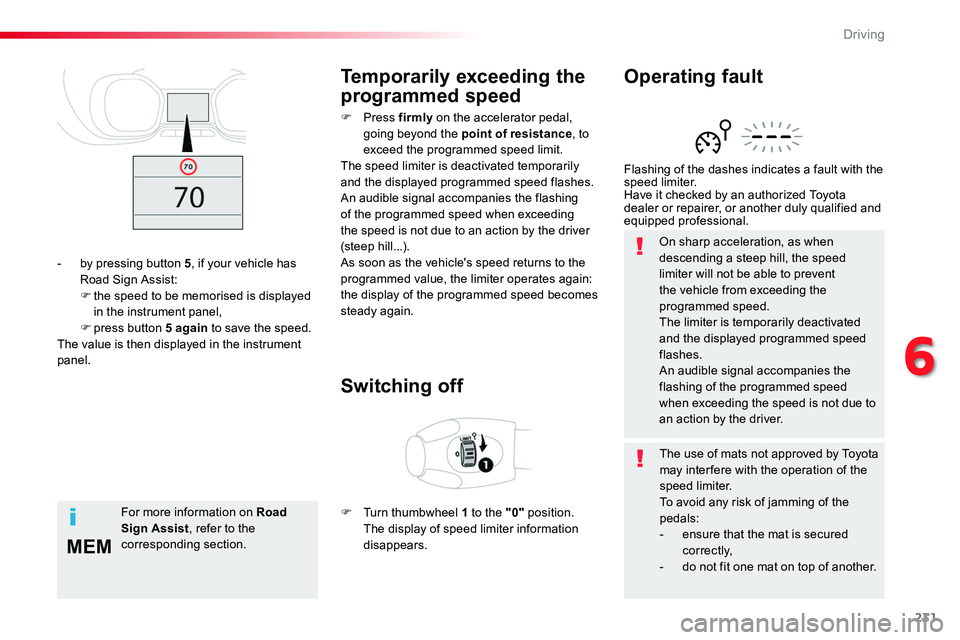
- by pressing button 5, if your vehicle has Road Sign Assist:F the speed to be memorised is displayed in the instrument panel,F press button 5 again to save the speed.The value is then displayed in the instrument panel.
For more information on Road Sign Assist, refer to the corresponding section.
The use of mats not approved by Toyota may inter fere with the operation of the speed limiter.To avoid any risk of jamming of the pedals:- ensure that the mat is secured c o r r e c t l y,- do not fit one mat on top of another.
6
Driving
Page 235 of 516
235
Exceeding the programmed
speed
If the programmed speed is exceeded, the displayed speed flashes.Once the vehicle returns to the programmed speed, the display becomes steady again.
Switching off
F Turn thumbwheel 1 to the "0" position. The display of information related to the cruise control disappears.
Flashing of the dashes indicates a fault with the cruise control.Have it checked by an authorized Toyota
dealer or repairer, or another duly qualified and equipped professional.
Operating faultWhen the cruise control is switched on, be careful if you maintain the pressure on one of the programmed speed changing buttons: this may result in a very rapid change in the speed of your vehicle.Do not use the cruise control on slippery roads or in heavy traffic.
On a steep descent, the cruise control will not be able to prevent the vehicle from exceeding the programmed speed.On steep climbs or when towing, the programmed speed may not be achieved or maintained.
The use of mats not approved by Toyota may inter fere with the operation of the cruise control.To avoid any risk of jamming of the pedals:- ensure that the mat is secured c o r r e c t l y,- never fit one mat on top of another.
6
Driving
Page 242 of 516
242
In the event of a fault with the adaptive cruise control, you are alerted by an audible signal and display of the message message "Driving aid functions fault".Have the system checked by an authorized Toyota dealer or repairer, or another duly qualified and equipped professional.
Operating faultThe adaptive cruise control operates by day and at night, in fog or moderate rainfall.
When the cruise control is working, take care if making a maintained press on one of the cruise control programmed speed modification buttons: this can lead to a very quick change in the speed of your vehicle.Do not use the adaptive cruise control on slippery sur faces or in heavy traffic.
When descending a steep hill, the cruise control may not be able to prevent the vehicle from exceeding the programmed speed.When ascending a steep hill or when towing, it might not be possible to achieve or maintain the programmed speed.
The use of mats not approved by Toyota may inter fere with the operation of the adaptive cruise control.To avoid any risk of jamming the pedals:- ensure that mats are secured c o r r e c t l y,- never fit one mat on top of another.It is recommended that you always keep
your feet close to the pedals.
If the difference between the programmed speed setting and the speed of the vehicle in front is too great, the speed cannot be adjusted: the cruise control is automatically deactivated.
The system does not act on the braking system, but works only with engine braking.The regulation range is limited: there will no longer be any adjustment of speed if the difference between the programmed speed setting and the speed of the vehicle in front becomes too high.
The adaptive cruise control cannot in any circumstances replace the observation of speed limits, nor the need for the vigilance on the part of the driver.
Driving
Page 271 of 516
271
Accessories
A wide range of accessories and genuine parts is available from the Toyota dealer network.These accessories and parts are all suitable for your vehicle and benefit from Toyota's recommendation and warranty.
"Comfort"
Door deflectors, cigarette lighter, boot dividers, coat hanger fixed to head restraint, front and rear parking sensors, styling mudflaps, boot management system, ...
"Transport solutions"
Boot liners, roof bars, bicycle carrier on roof bars, ski carrier, roof box, towbar harness, ....Tow bar, which must be fitted by an authorized Toyota dealer or repairer, or another duly qualified and equipped professional.
"Styling"
Wheel trims, wheel caps, door sills, gear lever knobs, ...
"Security and safety"
Anti-theft alarm, window engraving, wheel security bolts, child seats, breathalyzer, first aid kit, warning triangle, high visibility jacket, stolen
vehicle tracking system, fleet management unit, snow chains, tyre snow socks, front foglamps kit, ...
"Protection"
Mats*, seat covers compatible with lateral airbags, mud flaps, side protection rubbing strips, bumper protectors, loading area protection (on wood or plastic), rear sill finishers, rear mat, ....
The fitting of electrical equipment or accessories which are not recommended by Toyota may result in a failure of your vehicle's electronic system and excessive electrical consumption.Contact a Toyota dealer for information on the range of recommended equipment and accessories.
Installation of radio communication transmitters
Before installing any after-market radio communication transmitter, you can contact a Toyota dealer for the specification of transmitters which can be fitted (frequency, maximum power, aerial position, specific installation requirements), in line with the Vehicle Electromagnetic Compatibility Directive (2004/104/EC).
Depending on the legislation in force in the country, certain safety equipment may be compulsory: high visibility safety vests, warning triangles, breathalyzers, spare bulbs, spare fuses,
fire extinguisher, first aid kit, mud flaps at the rear of the vehicle.* To avoid any risk of jamming of the pedals:- ensure that the mat is positioned and secured correctly,- never fit one mat on top of another.
7
Practical information
Page 273 of 516
273
Roof bars / Roof rack
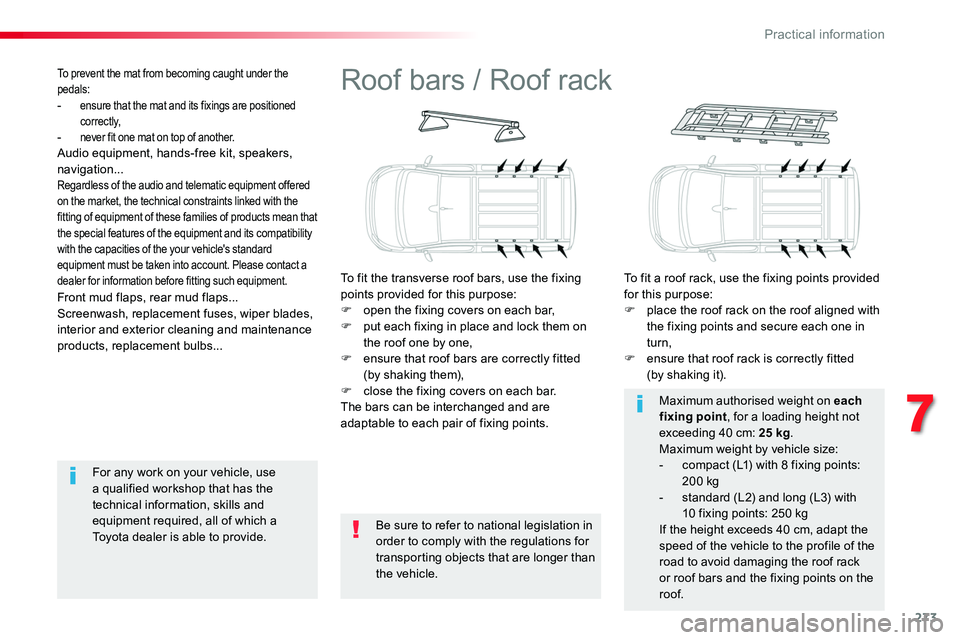
To fit the transverse roof bars, use the fixing points provided for this purpose:F open the fixing covers on each bar,F put each fixing in place and lock them on the roof one by one,F ensure that roof bars are correctly fitted (by shaking them),F close the fixing covers on each bar.The bars can be interchanged and are adaptable to each pair of fixing points.
To fit a roof rack, use the fixing points provided for this purpose:F place the roof rack on the roof aligned with the fixing points and secure each one in turn,F ensure that roof rack is correctly fitted (by shaking it).
Be sure to refer to national legislation in order to comply with the regulations for transporting objects that are longer than the vehicle.
Maximum authorised weight on each fixing point, for a loading height not exceeding 40 cm: 25 kg.Maximum weight by vehicle size:- compact (L1) with 8 fixing points: 200 kg- standard (L2) and long (L3) with 10 fixing points: 250 kgIf the height exceeds 40 cm, adapt the
speed of the vehicle to the profile of the road to avoid damaging the roof rack or roof bars and the fixing points on the roof.
Front mud flaps, rear mud flaps...Screenwash, replacement fuses, wiper blades, interior and exterior cleaning and maintenance products, replacement bulbs...
To prevent the mat from becoming caught under the pedals:- ensure that the mat and its fixings are positioned c o r r e c t l y,- never fit one mat on top of another.Audio equipment, hands-free kit, speakers, navigation...Regardless of the audio and telematic equipment offered on the market, the technical constraints linked with the fitting of equipment of these families of products mean that the special features of the equipment and its compatibility with the capacities of the your vehicle's standard equipment must be taken into account. Please contact a dealer for information before fitting such equipment.
For any work on your vehicle, use a qualified workshop that has the technical information, skills and equipment required, all of which a Toyota dealer is able to provide.
7
Practical information
Page 287 of 516
287
Warning triangle (stowing)
Before leaving your vehicle to set up and install the triangle, switch on the hazard warning lamps and put on your
high visibility vest.
This safety equipment should be used in addition to the hazard warning lamps.Its presence in the vehicle is mandatory.
Placing the triangle in the
road
Refer to the manufacturer's instructions on unfolding and assembly supplied with the triangle.
F Place the triangle behind the vehicle, as required by the legislation in force in your c o unt r y.
The triangle is available as an accessory; contact an authorized Toyota dealer or repairer, or another duly qualified and equipped professional.
Tool box
Access
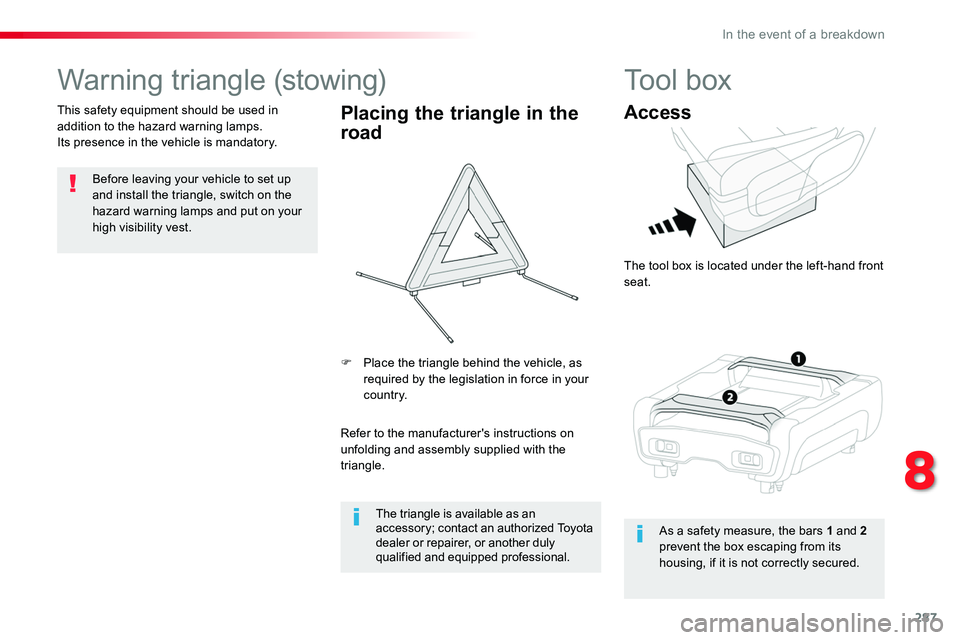
The tool box is located under the left-hand front seat.
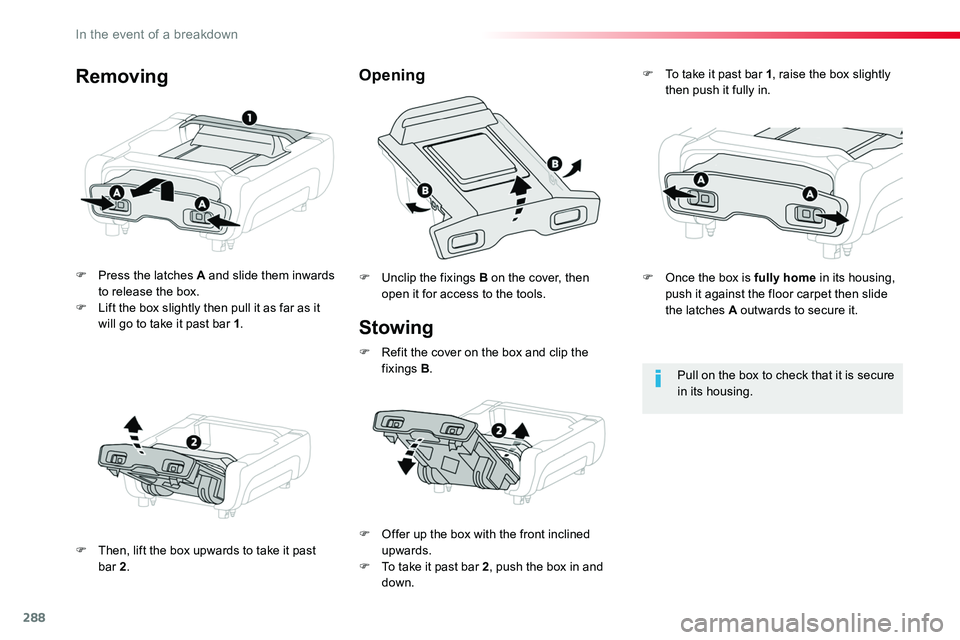
As a safety measure, the bars 1 and 2
prevent the box escaping from its housing, if it is not correctly secured.
8
In the event of a breakdown
Page 288 of 516
288
Stowing
F Press the latches A and slide them inwards to release the box.F Lift the box slightly then pull it as far as it will go to take it past bar 1.
F Then, lift the box upwards to take it past bar 2.
F Unclip the fixings B on the cover, then open it for access to the tools.
OpeningRemoving
Pull on the box to check that it is secure in its housing.
F Offer up the box with the front inclined upwards.F To take it past bar 2, push the box in and down.
F To take it past bar 1, raise the box slightly then push it fully in.
F Refit the cover on the box and clip the fixings B.
F Once the box is fully home in its housing, push it against the floor carpet then slide the latches A outwards to secure it.
In the event of a breakdown
Page 289 of 516
289
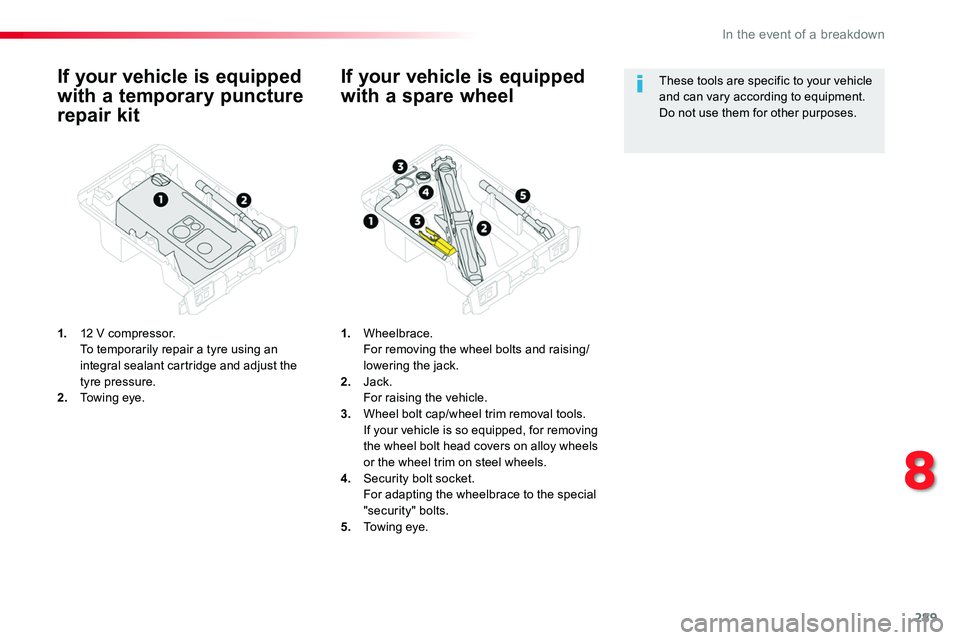
If your vehicle is equipped
with a temporary puncture
repair kit
1. 12 V compressor. To temporarily repair a tyre using an integral sealant cartridge and adjust the tyre pressure.2. Towing eye.
If your vehicle is equipped
with a spare wheel
1. Wheelbrace. For removing the wheel bolts and raising/lowering the jack.2. Jack. For raising the vehicle.3. Wheel bolt cap/wheel trim removal tools. If your vehicle is so equipped, for removing the wheel bolt head covers on alloy wheels or the wheel trim on steel wheels.4. Security bolt socket. For adapting the wheelbrace to the special "security" bolts.5. Towing eye.
These tools are specific to your vehicle and can vary according to equipment. Do not use them for other purposes.
8
In the event of a breakdown