warning TOYOTA PROACE 2017 Manual PDF
[x] Cancel search | Manufacturer: TOYOTA, Model Year: 2017, Model line: PROACE, Model: TOYOTA PROACE 2017Pages: 516, PDF Size: 91.65 MB
Page 257 of 516
257
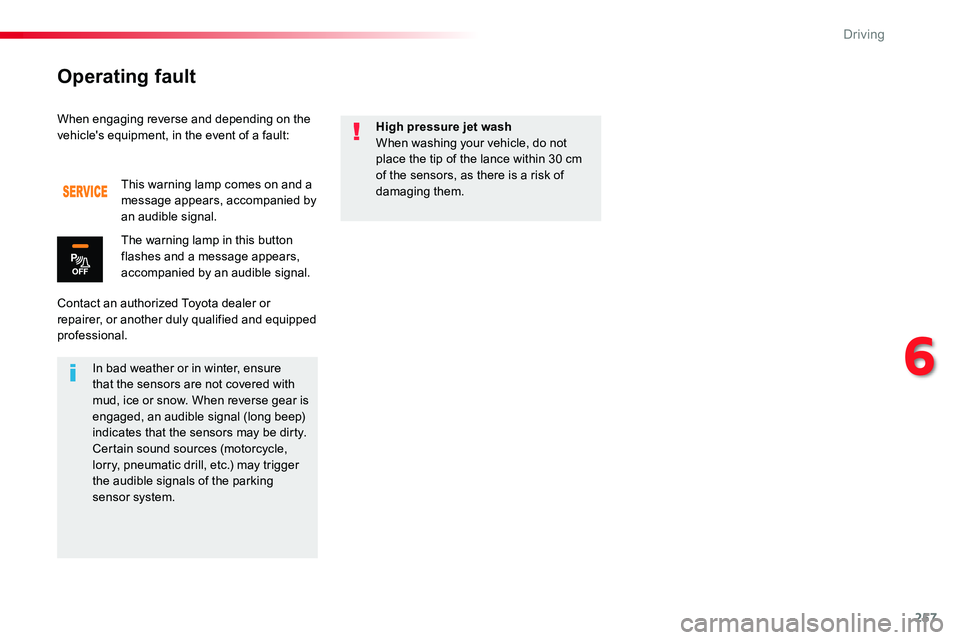
When engaging reverse and depending on the vehicle's equipment, in the event of a fault:
Contact an authorized Toyota dealer or repairer, or another duly qualified and equipped professional.
This warning lamp comes on and a message appears, accompanied by an audible signal.
The warning lamp in this button flashes and a message appears, accompanied by an audible signal.
In bad weather or in winter, ensure that the sensors are not covered with mud, ice or snow. When reverse gear is engaged, an audible signal (long beep)
indicates that the sensors may be dirty.Certain sound sources (motorcycle, lorry, pneumatic drill, etc.) may trigger the audible signals of the parking sensor system.
High pressure jet washWhen washing your vehicle, do not place the tip of the lance within 30 cm of the sensors, as there is a risk of damaging them.
Operating fault
6
Driving
Page 262 of 516
262
Tyre Pressure Warning System (TPWS)
The system monitors the pressures in the four tyres, once the vehicle is moving.It compares the information given by the four wheel speed sensors with reference values, which must be reinitialised ever y time the tyre pressures are adjusted or a wheel changed.The system triggers an alert as soon as it detects a drop in the inflation pressure of one or more tyres.
The Tyre Pressure Warning System (TPWS) does not replace the need for vigilance on the part of the driver.This system does not avoid the need to check the tyre pressures (including the spare wheel) every month as well as before a long journey.Driving with under-inflated tyres impairs road holding, extends braking distances and causes premature tyre wear, particularly under arduous conditions (high loading, high speed, long journey).
System which automatically checks the pressures of the tyres while driving.
The tyre pressures defined for your vehicle can be found on the tyre pressure label.For more information on the Identification markings, refer to the corresponding section.Tyre pressures should be checked when the tyres are "cold" (vehicle stopped for 1 hour or after a journey of less than 6 miles (10 km) at moderate speeds).Other wise (when hot), add 0.3 bar to the pressures shown on the label.
Driving with under-inflated tyres
increases fuel consumption.Snow chains
The system does not have to be reinitialised after fitting or removing snow chains.
Spare wheel
The steel spare wheel does not have an tyre pressure warning sensor.
Driving
Page 263 of 516
263
Tyre Pressure WarningReinitialisation
Before reinitialising the system, ensure that the pressures of the four tyres are correct for the use of the vehicle and in line with the recommendations on the tyre pressure label.The tyre pressure warning can only be relied on if the reinitialisation of the system has been done with the pressures in the four tyres correctly adjusted.The tyre pressure warning system does not give a warning if a pressure is incorrect at the time of reinitialisation.
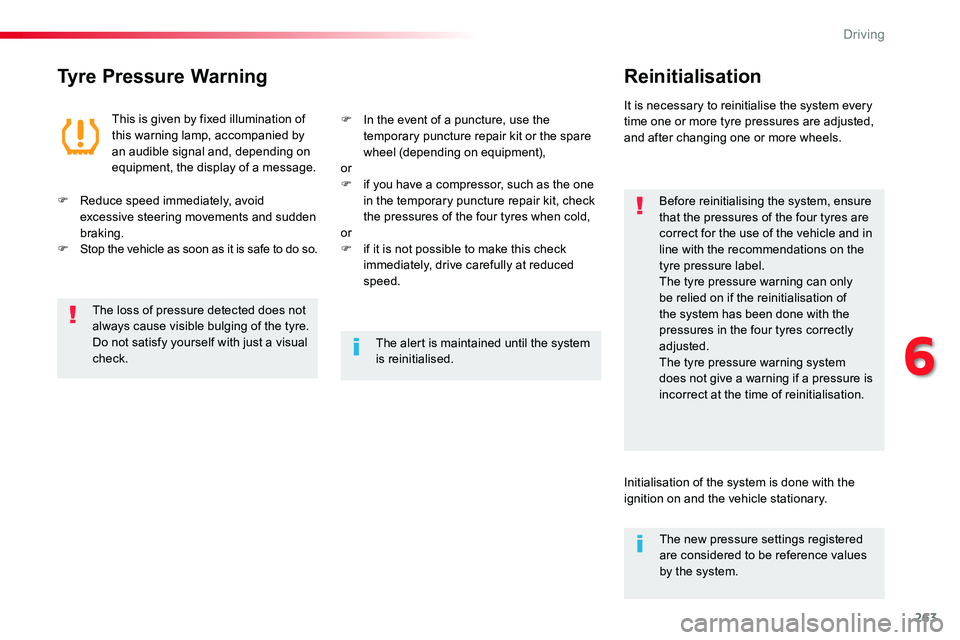
This is given by fixed illumination of this warning lamp, accompanied by an audible signal and, depending on equipment, the display of a message.
It is necessary to reinitialise the system every time one or more tyre pressures are adjusted, and after changing one or more wheels.
F Reduce speed immediately, avoid excessive steering movements and sudden braking.F Stop the vehicle as soon as it is safe to do so.
F In the event of a puncture, use the temporary puncture repair kit or the spare wheel (depending on equipment),orF if you have a compressor, such as the one in the temporary puncture repair kit, check the pressures of the four tyres when cold,
orF if it is not possible to make this check immediately, drive carefully at reduced speed.
The loss of pressure detected does not always cause visible bulging of the tyre. Do not satisfy yourself with just a visual check.The alert is maintained until the system is reinitialised.
Initialisation of the system is done with the ignition on and the vehicle stationary.
The new pressure settings registered are considered to be reference values by the system.
6
Driving
Page 264 of 516
264
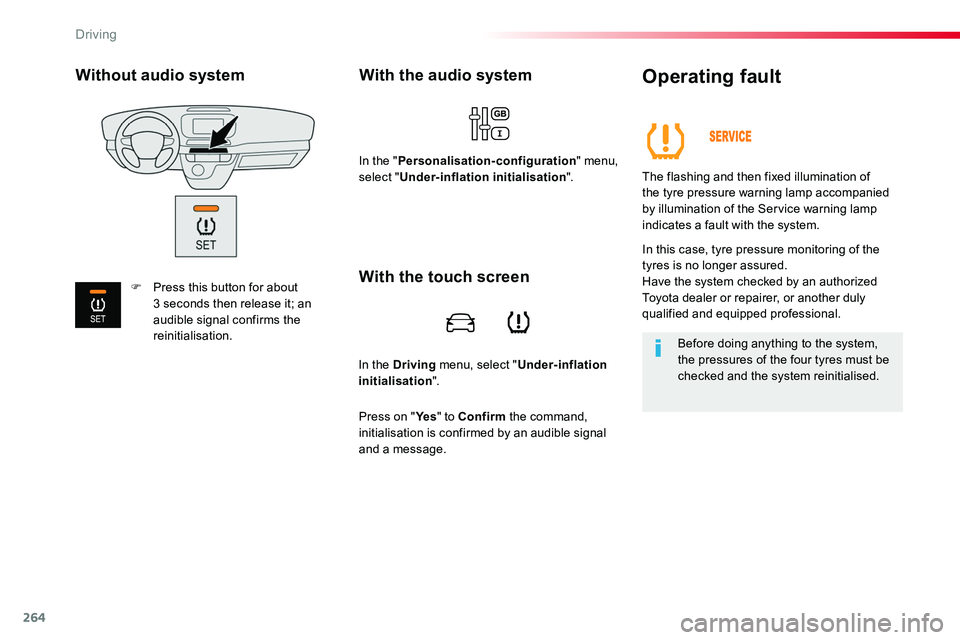
In the Driving menu, select "Under-inflation initialisation".
With the audio system
In the "Personalisation-configuration" menu, select "Under-inflation initialisation".
Operating fault
The flashing and then fixed illumination of the tyre pressure warning lamp accompanied by illumination of the Service warning lamp
indicates a fault with the system.
In this case, tyre pressure monitoring of the tyres is no longer assured.Have the system checked by an authorized Toyota dealer or repairer, or another duly qualified and equipped professional.
Before doing anything to the system, the pressures of the four tyres must be checked and the system reinitialised.
With the touch screen
Press on "Ye s" to Confirm the command, initialisation is confirmed by an audible signal and a message.
Without audio system
F Press this button for about 3 seconds then release it; an audible signal confirms the reinitialisation.
Driving
Page 266 of 516
266
Low fuel level
When the low fuel level in the tank is reached, this warning lamp comes on in the instrument panel, accompanied by an audible warning and a message.
Fuel supply cut-off
Your vehicle is equipped with a safety device which cuts off the fuel supply in the event of a collision.
When it first comes on, less than 8 litres of fuel remain in the tank.You must refuel as soon as possible to avoid running out.
If you have put in the wrong fuel for your vehicle, you must have the tank drained and refilled with the correct fuel before you star t the engine.
Your vehicle is fitted with a catalytic converter, a device which helps to reduce the level of harmful emissions in the exhaust gases.
Diesel misfuel
prevention
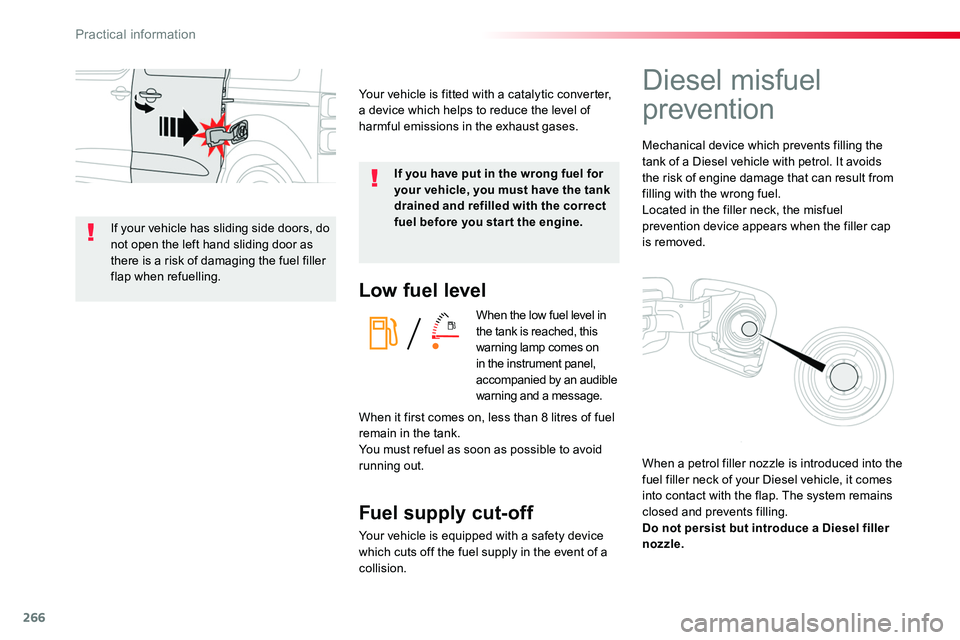
Mechanical device which prevents filling the tank of a Diesel vehicle with petrol. It avoids the risk of engine damage that can result from filling with the wrong fuel.Located in the filler neck, the misfuel prevention device appears when the filler cap is removed.
When a petrol filler nozzle is introduced into the fuel filler neck of your Diesel vehicle, it comes into contact with the flap. The system remains closed and prevents filling.Do not persist but introduce a Diesel filler nozzle.
If your vehicle has sliding side doors, do not open the left hand sliding door as there is a risk of damaging the fuel filler flap when refuelling.
Practical information
Page 271 of 516
271
Accessories
A wide range of accessories and genuine parts is available from the Toyota dealer network.These accessories and parts are all suitable for your vehicle and benefit from Toyota's recommendation and warranty.
"Comfort"
Door deflectors, cigarette lighter, boot dividers, coat hanger fixed to head restraint, front and rear parking sensors, styling mudflaps, boot management system, ...
"Transport solutions"
Boot liners, roof bars, bicycle carrier on roof bars, ski carrier, roof box, towbar harness, ....Tow bar, which must be fitted by an authorized Toyota dealer or repairer, or another duly qualified and equipped professional.
"Styling"
Wheel trims, wheel caps, door sills, gear lever knobs, ...
"Security and safety"
Anti-theft alarm, window engraving, wheel security bolts, child seats, breathalyzer, first aid kit, warning triangle, high visibility jacket, stolen
vehicle tracking system, fleet management unit, snow chains, tyre snow socks, front foglamps kit, ...
"Protection"
Mats*, seat covers compatible with lateral airbags, mud flaps, side protection rubbing strips, bumper protectors, loading area protection (on wood or plastic), rear sill finishers, rear mat, ....
The fitting of electrical equipment or accessories which are not recommended by Toyota may result in a failure of your vehicle's electronic system and excessive electrical consumption.Contact a Toyota dealer for information on the range of recommended equipment and accessories.
Installation of radio communication transmitters
Before installing any after-market radio communication transmitter, you can contact a Toyota dealer for the specification of transmitters which can be fitted (frequency, maximum power, aerial position, specific installation requirements), in line with the Vehicle Electromagnetic Compatibility Directive (2004/104/EC).
Depending on the legislation in force in the country, certain safety equipment may be compulsory: high visibility safety vests, warning triangles, breathalyzers, spare bulbs, spare fuses,
fire extinguisher, first aid kit, mud flaps at the rear of the vehicle.* To avoid any risk of jamming of the pedals:- ensure that the mat is positioned and secured correctly,- never fit one mat on top of another.
7
Practical information
Page 272 of 516
272
By visiting a Toyota dealer, you can also obtain products for cleaning and maintenance (exterior and interior) - including ecological products in the Toyota range, topping-up products (screenwash...), touch-up pens and paint aerosols for the exact colour of your vehicle, refills (cartridge for the temporary puncture repair kit...), ...
"Multimedia"
Smartphone support, table support or semi-integral navigation support, range of audio systems and portable navigation systems, driving recorder, Bluetooth hands-free kit, DVD player, multimedia support, driving aids, vehicle tracking system, ...
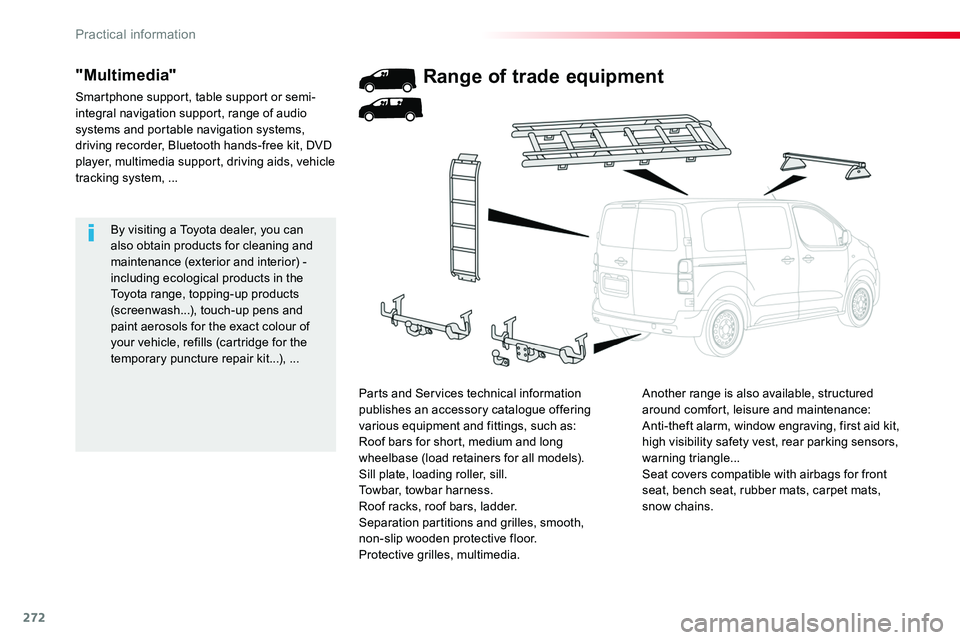
Range of trade equipment
Another range is also available, structured around comfort, leisure and maintenance:Anti-theft alarm, window engraving, first aid kit, high visibility safety vest, rear parking sensors, warning triangle...Seat covers compatible with airbags for front seat, bench seat, rubber mats, carpet mats, snow chains.
Parts and Services technical information publishes an accessory catalogue offering various equipment and fittings, such as:Roof bars for short, medium and long wheelbase (load retainers for all models).Sill plate, loading roller, sill.Towbar, towbar harness.Roof racks, roof bars, ladder.Separation partitions and grilles, smooth,
non-slip wooden protective floor.Protective grilles, multimedia.
Practical information
Page 280 of 516
280
Changing the coolant
The coolant does not have to be replaced at routine services.
Fluid specification
The coolant must conform to the manufacturer's recommendations.
The check and top-up must be done with the engine cold.A low coolant level presents the risk of serious damage to your engine.
If the ambient temperature is high, it
is recommended that the engine be allowed to idle for 1 to 2 minutes after the vehicle comes to a stop, to facilitate its cooling.
Avoid prolonged contact of used oil or fluids with the skin.Most of these fluids are harmful to health or indeed very corrosive.
Do not discard used oil or fluids into sewers or onto the ground.Take used oil to an authorized Toyota dealer or repairer, or another duly qualified and equipped professional (France) or to an authorised waste disposal site.
Used products
To p p i n g - u p
This additive must be topped-up by an authorized Toyota dealer or repairer, or another duly qualified and equipped professional without delay.
Diesel additive level
(Diesel engine with
particle filter)
A low additive level is indicated by illumination of this warning lamp, accompanied by an audible warning and a message in the instrument panel screen.
Fluid specification
For optimum cleaning and to avoid freezing, this fluid must not be topped up with or replaced with plain water.
Screenwash and headlamp
wash fluid
In the case of vehicles fitted with headlamp washers, the low fluid level is indicated by an audible signal and a message in the instrument panel screen.Top up the reservoir when you next stop the vehicle.
In wintry conditions, the use of an ethyl alcohol or methanol base fluid is recommended.
Practical information
Page 281 of 516
281
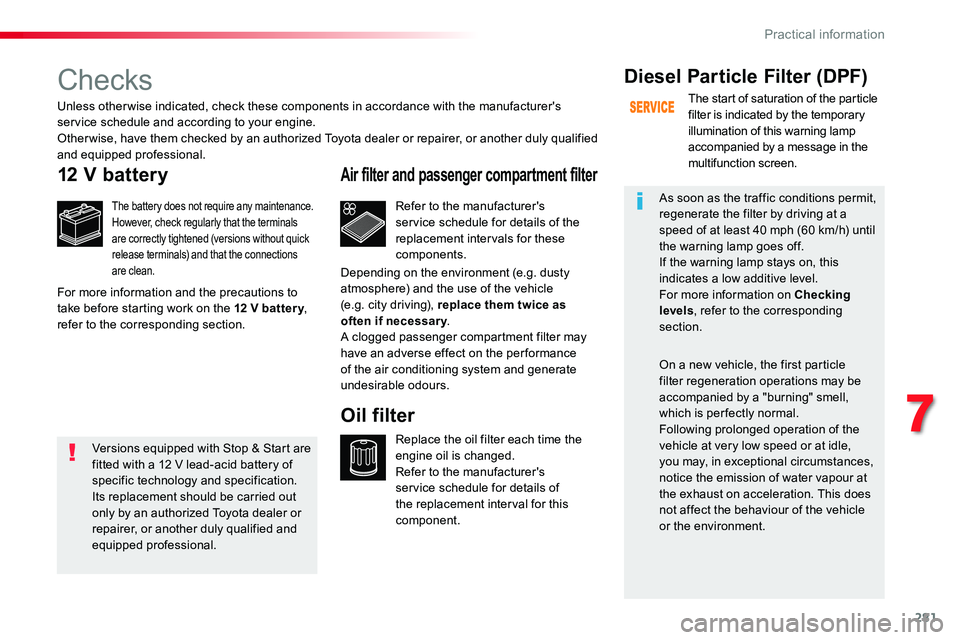
Checks
12 V battery
The battery does not require any maintenance.However, check regularly that the terminals are correctly tightened (versions without quick release terminals) and that the connections are clean.
Refer to the manufacturer's service schedule for details of the replacement intervals for these components.
Air filter and passenger compartment filter
Replace the oil filter each time the engine oil is changed.Refer to the manufacturer's service schedule for details of the replacement interval for this component.
Oil filter
Diesel Particle Filter (DPF)
The start of saturation of the particle filter is indicated by the temporary illumination of this warning lamp accompanied by a message in the multifunction screen.
As soon as the traffic conditions permit, regenerate the filter by driving at a speed of at least 40 mph (60 km/h) until the warning lamp goes off.If the warning lamp stays on, this indicates a low additive level.For more information on Checking levels, refer to the corresponding section.
On a new vehicle, the first particle filter regeneration operations may be accompanied by a "burning" smell, which is per fectly normal.Following prolonged operation of the
vehicle at very low speed or at idle, you may, in exceptional circumstances, notice the emission of water vapour at the exhaust on acceleration. This does not affect the behaviour of the vehicle or the environment.
Unless otherwise indicated, check these components in accordance with the manufacturer's service schedule and according to your engine.Other wise, have them checked by an authorized Toyota dealer or repairer, or another duly qualified and equipped professional.
For more information and the precautions to take before starting work on the 12 V batter y, refer to the corresponding section.
Depending on the environment (e.g. dusty atmosphere) and the use of the vehicle (e.g. city driving), replace them twice as often if necessar y.A clogged passenger compartment filter may have an adverse effect on the per formance of the air conditioning system and generate undesirable odours.
Versions equipped with Stop & Start are fitted with a 12 V lead-acid battery of specific technology and specification.Its replacement should be carried out only by an authorized Toyota dealer or repairer, or another duly qualified and equipped professional.
7
Practical information
Page 283 of 516
283
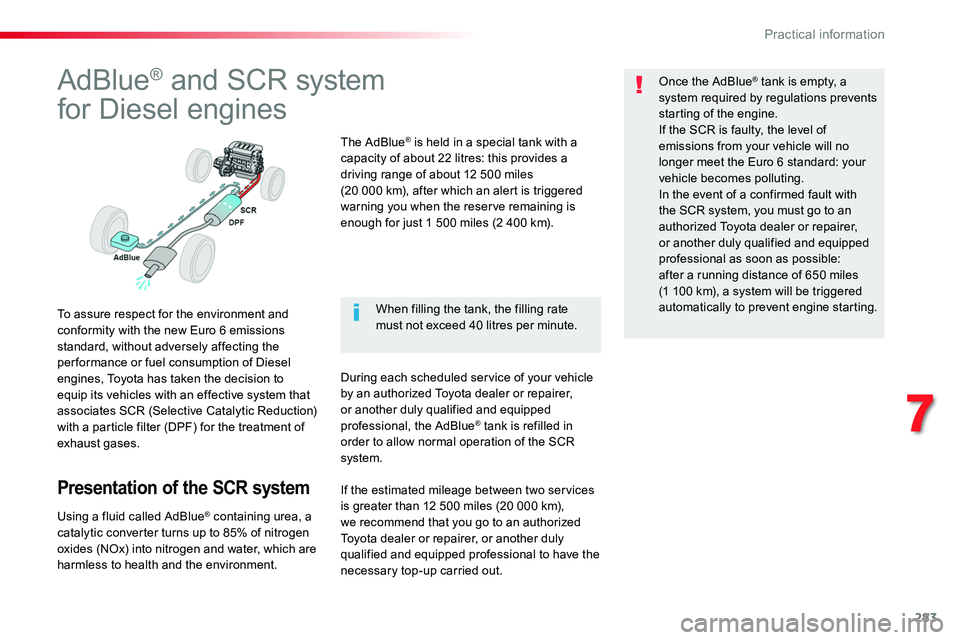
AdBlue® and SCR system
for Diesel engines
To assure respect for the environment and conformity with the new Euro 6 emissions standard, without adversely affecting the per formance or fuel consumption of Diesel engines, Toyota has taken the decision to equip its vehicles with an effective system that associates SCR (Selective Catalytic Reduction) with a particle filter (DPF) for the treatment of exhaust gases.
Presentation of the SCR system
Using a fluid called AdBlue® containing urea, a catalytic converter turns up to 85% of nitrogen
oxides (NOx) into nitrogen and water, which are harmless to health and the environment.
The AdBlue® is held in a special tank with a capacity of about 22 litres: this provides a driving range of about 12 500 miles (20 000 km), after which an alert is triggered warning you when the reserve remaining is enough for just 1 500 miles (2 400 km).
During each scheduled service of your vehicle by an authorized Toyota dealer or repairer, or another duly qualified and equipped professional, the AdBlue® tank is refilled in order to allow normal operation of the SCR system.
Once the AdBlue® tank is empty, a system required by regulations prevents starting of the engine.If the SCR is faulty, the level of emissions from your vehicle will no longer meet the Euro 6 standard: your vehicle becomes polluting.In the event of a confirmed fault with the SCR system, you must go to an authorized Toyota dealer or repairer, or another duly qualified and equipped professional as soon as possible: after a running distance of 650 miles (1 100 km), a system will be triggered automatically to prevent engine starting.When filling the tank, the filling rate must not exceed 40 litres per minute.
If the estimated mileage between two services is greater than 12 500 miles (20 000 km), we recommend that you go to an authorized Toyota dealer or repairer, or another duly qualified and equipped professional to have the necessary top-up carried out.
7
Practical information