air condition TOYOTA PROACE 2018 User Guide
[x] Cancel search | Manufacturer: TOYOTA, Model Year: 2018, Model line: PROACE, Model: TOYOTA PROACE 2018Pages: 516, PDF Size: 90.91 MB
Page 129 of 516
129
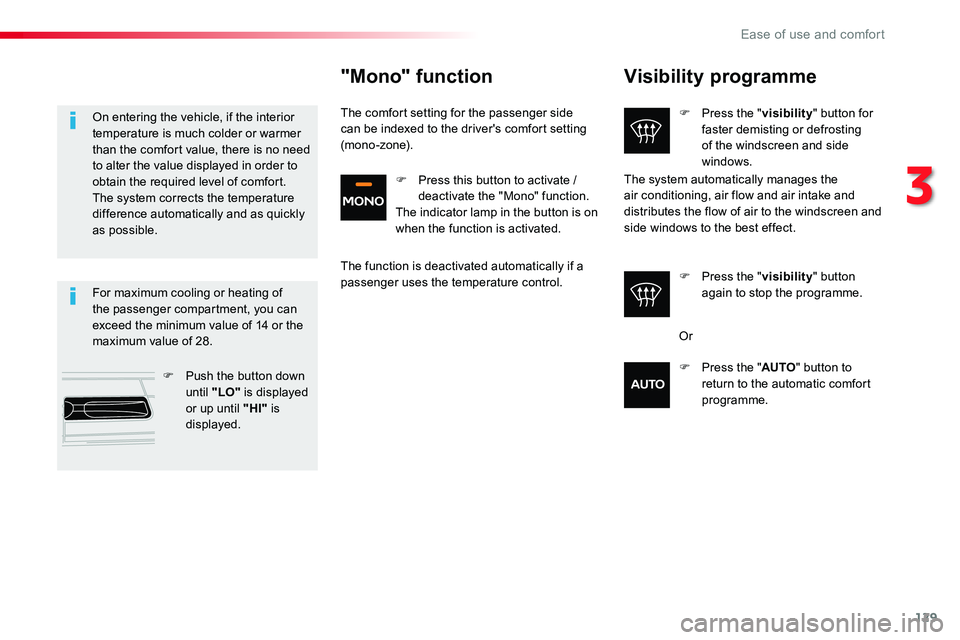
Visibility programme
F Press the "visibility" button for faster demisting or defrosting of the windscreen and side windows.
F Press the "visibility" button again to stop the programme.
The system automatically manages the air conditioning, air flow and air intake and distributes the flow of air to the windscreen and
side windows to the best effect.
For maximum cooling or heating of the passenger compartment, you can exceed the minimum value of 14 or the maximum value of 28.
F Push the button down until "LO" is displayed or up until "HI" is displayed.
On entering the vehicle, if the interior temperature is much colder or warmer than the comfort value, there is no need to alter the value displayed in order to obtain the required level of comfort. The system corrects the temperature difference automatically and as quickly as possible.
"Mono" function
The comfort setting for the passenger side can be indexed to the driver's comfort setting (mono-zone).
The function is deactivated automatically if a passenger uses the temperature control.
Or
F Press the "AUTO" button to return to the automatic comfort programme.
F Press this button to activate / deactivate the "Mono" function.The indicator lamp in the button is on when the function is activated.
3
Ease of use and comfort
Page 130 of 516
130
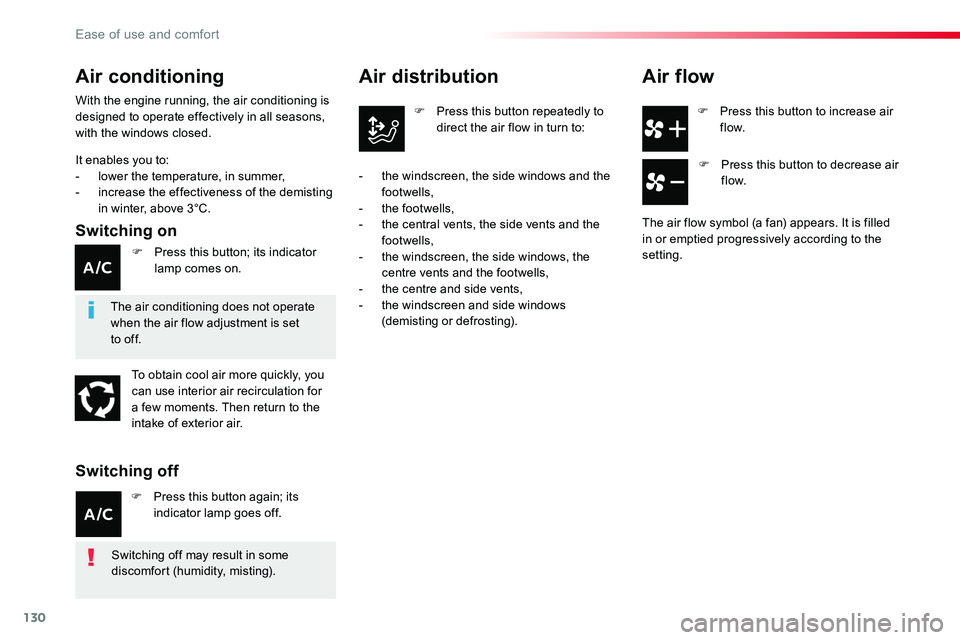
F Press this button to increase air f low.
Air distribution
F Press this button repeatedly to direct the air flow in turn to:
- the windscreen, the side windows and the footwells,- the footwells,
- the central vents, the side vents and the footwells,- the windscreen, the side windows, the centre vents and the footwells,- the centre and side vents,- the windscreen and side windows (demisting or defrosting).
Air flow
F Press this button to decrease air f low.
The air flow symbol (a fan) appears. It is filled in or emptied progressively according to the setting.
Air conditioning
It enables you to:- lower the temperature, in summer,- increase the effectiveness of the demisting in winter, above 3°C.
Switching on
With the engine running, the air conditioning is designed to operate effectively in all seasons, with the windows closed.
The air conditioning does not operate when the air flow adjustment is set to off.
To obtain cool air more quickly, you can use interior air recirculation for a few moments. Then return to the intake of exterior air.
F Press this button; its indicator lamp comes on.
F Press this button again; its indicator lamp goes off.
Switching off
Switching off may result in some discomfort (humidity, misting).
Ease of use and comfort
Page 132 of 516
132
Front demist - defrost
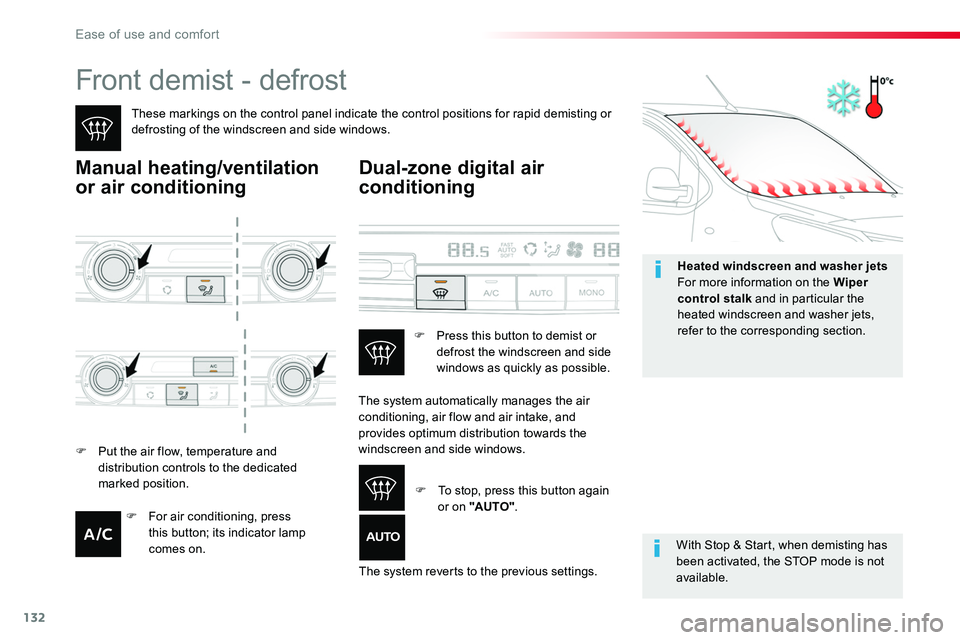
These markings on the control panel indicate the control positions for rapid demisting or defrosting of the windscreen and side windows.
Manual heating/ventilation
or air conditioning
With Stop & Start, when demisting has been activated, the STOP mode is not available.
Dual-zone digital air
conditioning
F Put the air flow, temperature and distribution controls to the dedicated marked position.
The system automatically manages the air conditioning, air flow and air intake, and
provides optimum distribution towards the windscreen and side windows.
The system reverts to the previous settings.
F Press this button to demist or defrost the windscreen and side windows as quickly as possible.
F To stop, press this button again or on "AUTO".F For air conditioning, press this button; its indicator lamp comes on.
Heated windscreen and washer jetsFor more information on the Wiper control stalk and in particular the heated windscreen and washer jets, refer to the corresponding section.
Ease of use and comfort
Page 135 of 516
135
In order for these systems to be fully effective, follow the operation and maintenance guidelines below:F To obtain an even air distribution, take care not to obstruct the exterior air intake grilles located at the base of the windscreen, the nozzles, the vents and the air outlets, as well as the air extractor located at the rear.F Do not cover the sunshine sensor, located at the top of the windscreen; this is used for regulation of the air conditioning system.F Operate the air conditioning system for at least 5 to 10 minutes, once or twice a month to keep it in per fect working order.F Ensure that the passenger compartment filter is in good condition and have the filter elements replaced regularly. We recommend the use of a combined passenger compartment filter. Thanks to its special active additive, it contributes to the purification of the air breathed by the occupants and the cleanliness of the passenger compartment (reduction of allergic symptoms, bad odours and greasy deposits).F To ensure correct operation of the air conditioning system, you are also advised to have it checked regularly as recommended in the maintenance and warranty guide.F If the system does not produce cold air, switch it off and contact an authorized Toyota dealer or repairer, or another duly qualified and equipped professional.
Recommendations for heating, ventilation and air conditioning
If after an extended stop in sunshine, the interior temperature is very high, first ventilate the passenger compartment for a few moments.Put the air flow control at a setting high enough to quickly change the air in the passenger compartment.
The air conditioning system does not contain chlorine and does not present any danger to the ozone layer.
The condensation created by the air conditioning results in a discharge of water under the vehicle which is per fectly normal.
When towing the maximum load on a steep gradient in high temperatures, switching off the air conditioning increases the available engine power and so improves the towing ability.
Stop & Start
The heating and air conditioning systems only work when the engine is running.To maintain a comfortable temperature in the passenger compartment, you can temporarily deactivate the Stop & Start system.
For more information on Stop & Star t, refer to the corresponding section.
Air vents
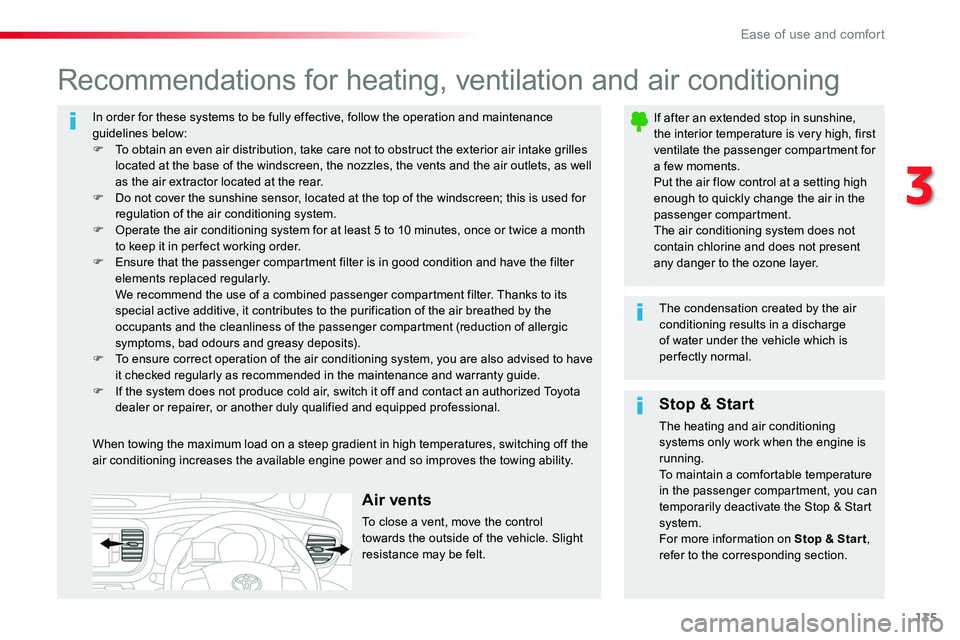
To close a vent, move the control towards the outside of the vehicle. Slight resistance may be felt.
3
Ease of use and comfort
Page 136 of 516
136
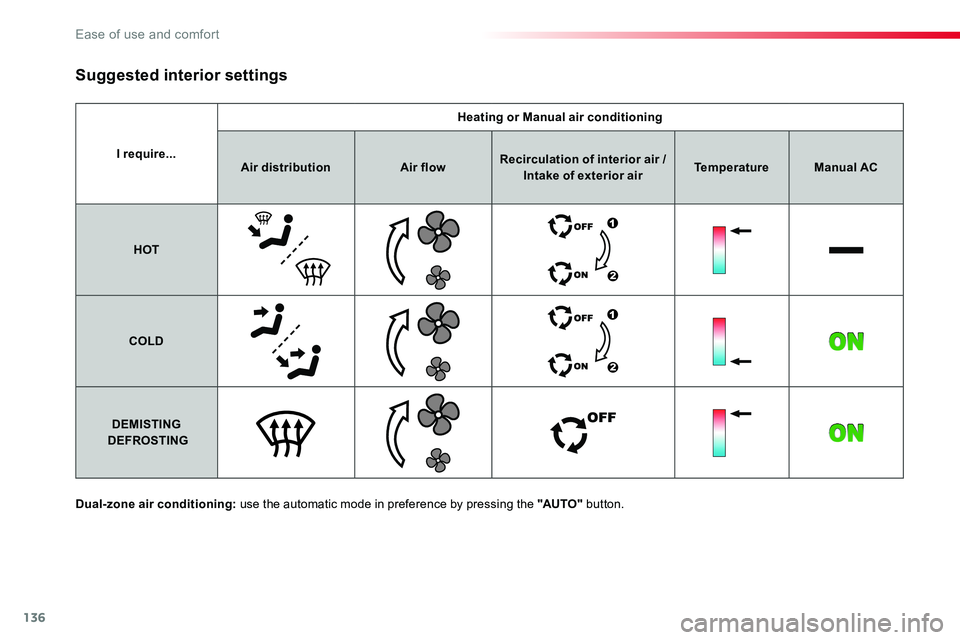
I require...
Heating or Manual air conditioning
Air distributionAir flowRecirculation of interior air / Intake of exterior airTemperatureManual AC
HOT
COLD
DEMISTING DEFROSTING
Suggested interior settings
Dual-zone air conditioning: use the automatic mode in preference by pressing the "AUTO" button.
Ease of use and comfort
Page 137 of 516
137
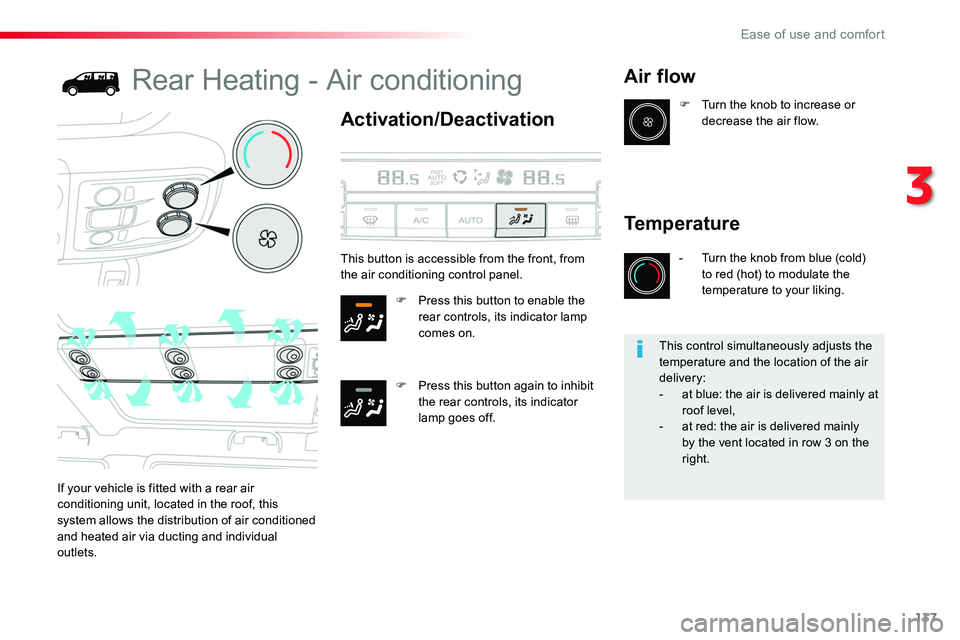
Rear Heating - Air conditioning
Activation/Deactivation
F Press this button to enable the rear controls, its indicator lamp comes on.
F Press this button again to inhibit the rear controls, its indicator lamp goes off.
Air flow
If your vehicle is fitted with a rear air conditioning unit, located in the roof, this system allows the distribution of air conditioned
and heated air via ducting and individual outlets.
F Turn the knob to increase or decrease the air flow.
Temperature
- Turn the knob from blue (cold) to red (hot) to modulate the temperature to your liking.
This button is accessible from the front, from the air conditioning control panel.
This control simultaneously adjusts the temperature and the location of the air delivery:- at blue: the air is delivered mainly at roof level,- at red: the air is delivered mainly by the vent located in row 3 on the right.
3
Ease of use and comfort
Page 148 of 516
148
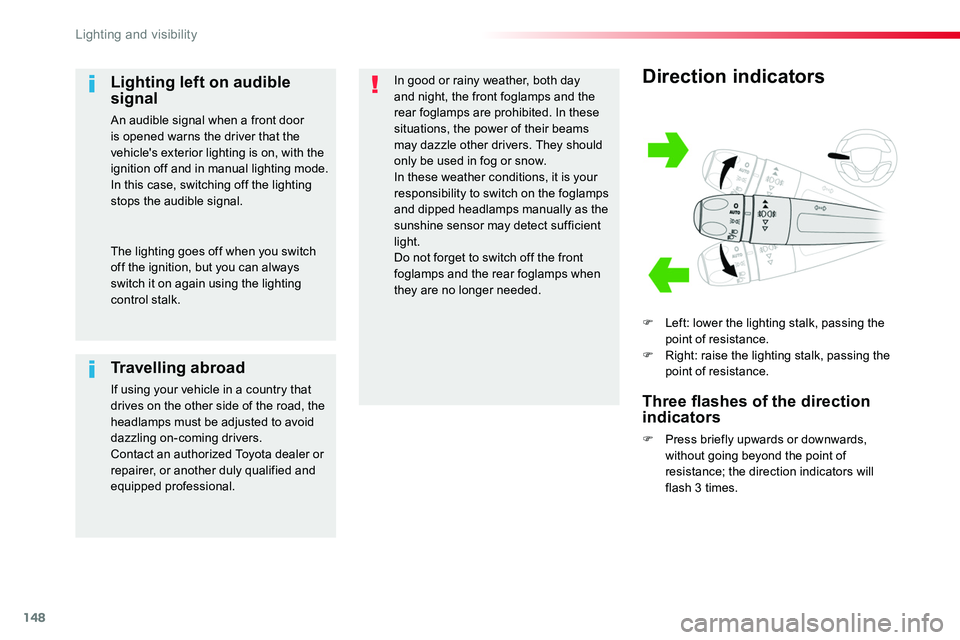
Direction indicators
F Left: lower the lighting stalk, passing the point of resistance.F Right: raise the lighting stalk, passing the point of resistance.
Three flashes of the direction indicators
F Press briefly upwards or downwards, without going beyond the point of resistance; the direction indicators will flash 3 times.
In good or rainy weather, both day and night, the front foglamps and the rear foglamps are prohibited. In these situations, the power of their beams may dazzle other drivers. They should only be used in fog or snow.In these weather conditions, it is your responsibility to switch on the foglamps and dipped headlamps manually as the sunshine sensor may detect sufficient light.Do not forget to switch off the front foglamps and the rear foglamps when they are no longer needed.
Lighting left on audible signal
An audible signal when a front door is opened warns the driver that the vehicle's exterior lighting is on, with the ignition off and in manual lighting mode.In this case, switching off the lighting stops the audible signal.
Travelling abroad
If using your vehicle in a country that drives on the other side of the road, the headlamps must be adjusted to avoid dazzling on-coming drivers.Contact an authorized Toyota dealer or repairer, or another duly qualified and equipped professional.
The lighting goes off when you switch off the ignition, but you can always switch it on again using the lighting control stalk.
Lighting and visibility
Page 158 of 516
158
If a significant accumulation of snow or ice is present, or when using a bicycle carrier on the boot, deactivate the automatic rear wiper.
This function is activated by default.
Reverse gear
When reverse gear is engaged, the rear wiper will come into operation automatically if the windscreen wipers are operating.
In the vehicle settings menu, activate/deactivate "Rear wiper in reverse".
With the audio system
In the "Personalisation-configuration" menu, activate/deactivate "Rear wipe in reverse gear".
With the touch screen
Activation / Deactivation
Activation or deactivation of the function is done in the vehicle configuration menu.
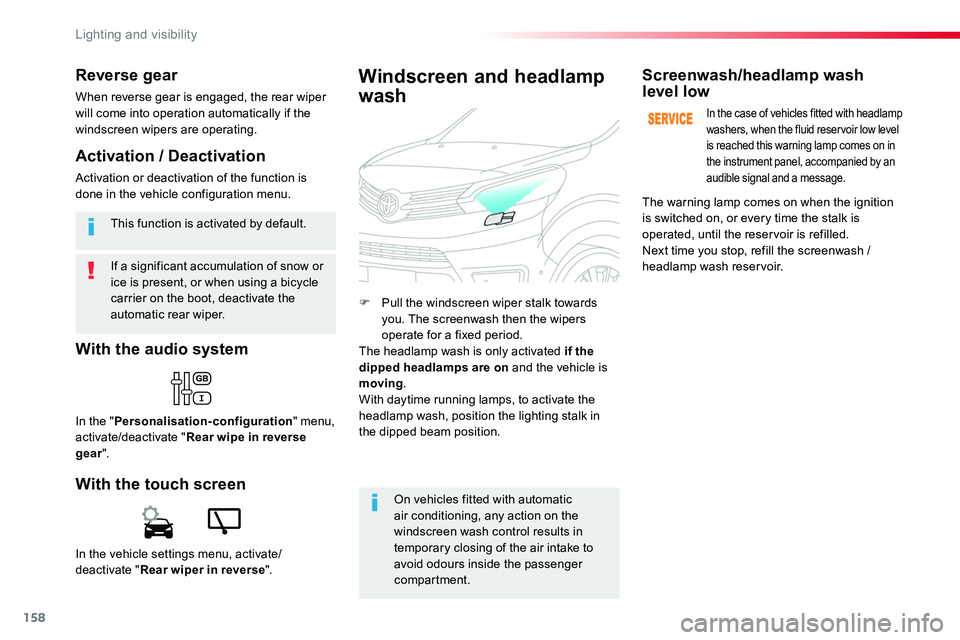
F Pull the windscreen wiper stalk towards you. The screenwash then the wipers operate for a fixed period.The headlamp wash is only activated if the dipped headlamps are on and the vehicle is moving.With daytime running lamps, to activate the headlamp wash, position the lighting stalk in
the dipped beam position.
Windscreen and headlamp
wash
On vehicles fitted with automatic air conditioning, any action on the windscreen wash control results in temporary closing of the air intake to avoid odours inside the passenger compartment.
Screenwash/headlamp wash level low
In the case of vehicles fitted with headlamp washers, when the fluid reservoir low level is reached this warning lamp comes on in the instrument panel, accompanied by an audible signal and a message.
The warning lamp comes on when the ignition is switched on, or every time the stalk is operated, until the reservoir is refilled.Next time you stop, refill the screenwash / headlamp wash reservoir.
Lighting and visibility
Page 163 of 516
163
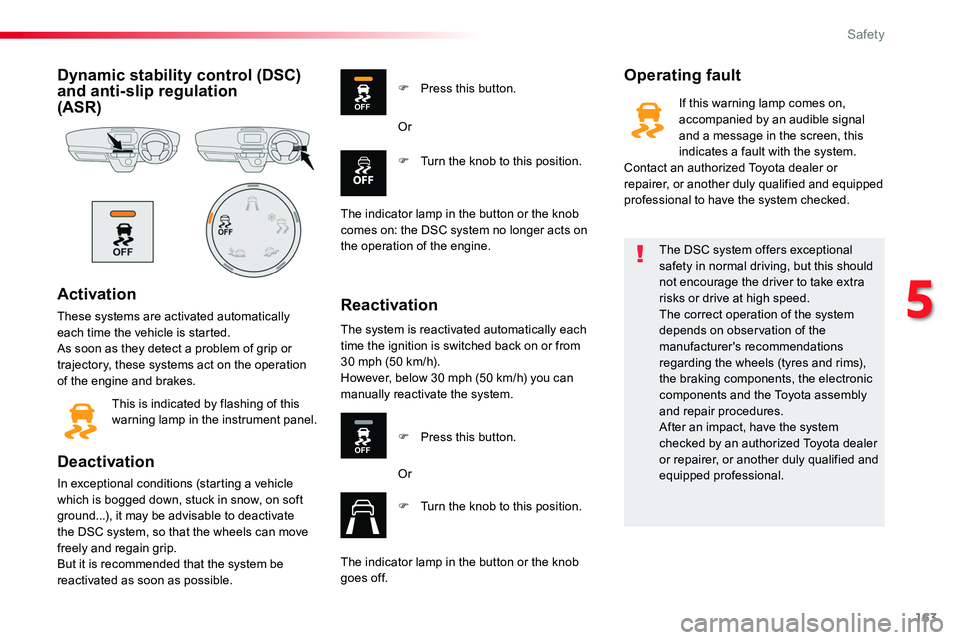
Dynamic stability control (DSC) and anti-slip regulation (ASR)
Activation
These systems are activated automatically each time the vehicle is started.As soon as they detect a problem of grip or trajectory, these systems act on the operation of the engine and brakes.
This is indicated by flashing of this warning lamp in the instrument panel.
Deactivation
In exceptional conditions (starting a vehicle which is bogged down, stuck in snow, on soft ground...), it may be advisable to deactivate the DSC system, so that the wheels can move freely and regain grip.But it is recommended that the system be reactivated as soon as possible.
Operating fault
Reactivation
F Press this button.
F Turn the knob to this position.
Or
The indicator lamp in the button or the knob
comes on: the DSC system no longer acts on the operation of the engine.
The system is reactivated automatically each time the ignition is switched back on or from 30 mph (50 km/h).However, below 30 mph (50 km/h) you can manually reactivate the system.
F Press this button.
Or
F Turn the knob to this position.
The indicator lamp in the button or the knob goes off.
The DSC system offers exceptional safety in normal driving, but this should not encourage the driver to take extra risks or drive at high speed.The correct operation of the system depends on observation of the manufacturer's recommendations regarding the wheels (tyres and rims), the braking components, the electronic components and the Toyota assembly and repair procedures.After an impact, have the system checked by an authorized Toyota dealer or repairer, or another duly qualified and equipped professional.
If this warning lamp comes on, accompanied by an audible signal and a message in the screen, this indicates a fault with the system.Contact an authorized Toyota dealer or repairer, or another duly qualified and equipped professional to have the system checked.
5
Safety
Page 170 of 516
170
Airbags
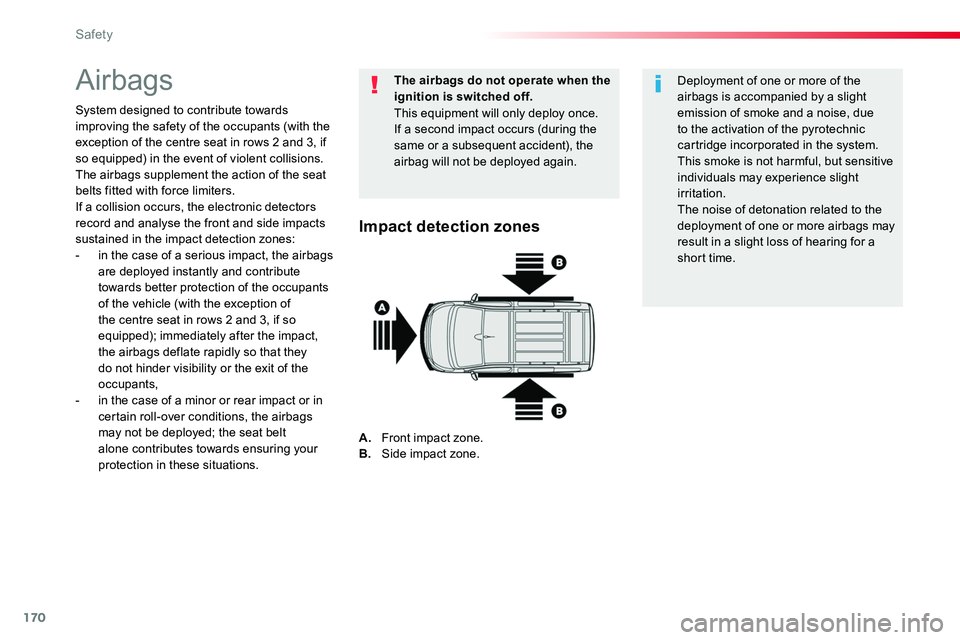
System designed to contribute towards improving the safety of the occupants (with the exception of the centre seat in rows 2 and 3, if so equipped) in the event of violent collisions. The airbags supplement the action of the seat belts fitted with force limiters.If a collision occurs, the electronic detectors record and analyse the front and side impacts sustained in the impact detection zones:- in the case of a serious impact, the airbags are deployed instantly and contribute towards better protection of the occupants of the vehicle (with the exception of the centre seat in rows 2 and 3, if so equipped); immediately after the impact, the airbags deflate rapidly so that they do not hinder visibility or the exit of the occupants,- in the case of a minor or rear impact or in certain roll-over conditions, the airbags may not be deployed; the seat belt alone contributes towards ensuring your protection in these situations.
The airbags do not operate when the ignition is switched off.
This equipment will only deploy once. If a second impact occurs (during the same or a subsequent accident), the airbag will not be deployed again.
Deployment of one or more of the airbags is accompanied by a slight emission of smoke and a noise, due to the activation of the pyrotechnic cartridge incorporated in the system.This smoke is not harmful, but sensitive individuals may experience slight irritation.The noise of detonation related to the
deployment of one or more airbags may result in a slight loss of hearing for a short time.
Impact detection zones
A. Front impact zone.B. Side impact zone.
Safety