fuel system TOYOTA PROACE 2018 User Guide
[x] Cancel search | Manufacturer: TOYOTA, Model Year: 2018, Model line: PROACE, Model: TOYOTA PROACE 2018Pages: 516, PDF Size: 90.91 MB
Page 81 of 516
81
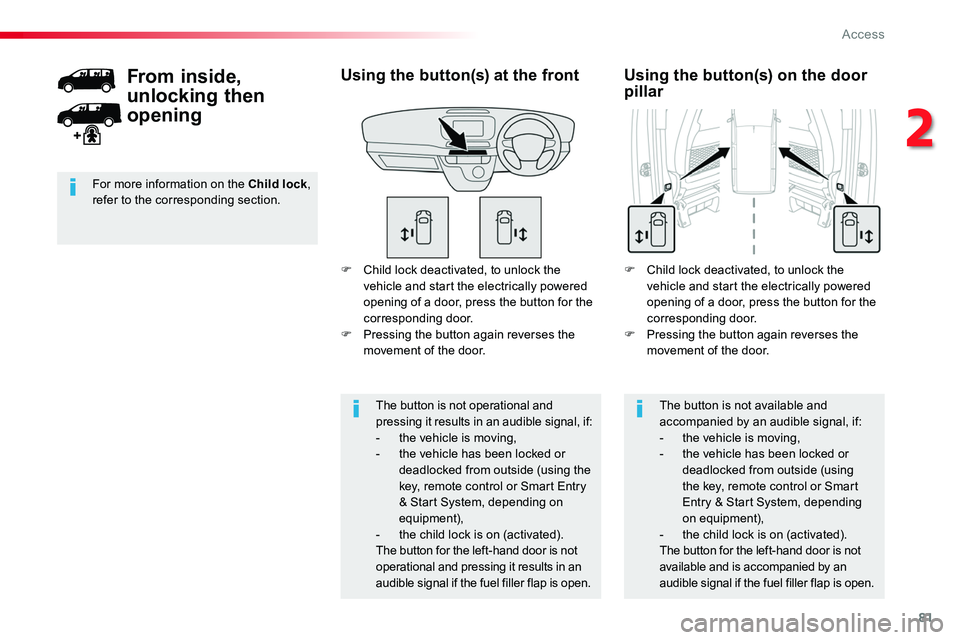
F Child lock deactivated, to unlock the vehicle and start the electrically powered opening of a door, press the button for the corresponding door.F Pressing the button again reverses the movement of the door.
The button is not operational and pressing it results in an audible signal, if:
- the vehicle is moving,- the vehicle has been locked or deadlocked from outside (using the key, remote control or Smart Entry & Start System, depending on equipment),- the child lock is on (activated).The button for the left-hand door is not operational and pressing it results in an audible signal if the fuel filler flap is open.
The button is not available and accompanied by an audible signal, if:
- the vehicle is moving,- the vehicle has been locked or deadlocked from outside (using the key, remote control or Smart Entry & Start System, depending on equipment),- the child lock is on (activated).The button for the left-hand door is not available and is accompanied by an audible signal if the fuel filler flap is open.
Using the button(s) at the frontFrom inside,
unlocking then
opening
Using the button(s) on the door pillar
F Child lock deactivated, to unlock the vehicle and start the electrically powered opening of a door, press the button for the corresponding door.F Pressing the button again reverses the movement of the door.
For more information on the Child lock, refer to the corresponding section.
2
Access
Page 85 of 516
85
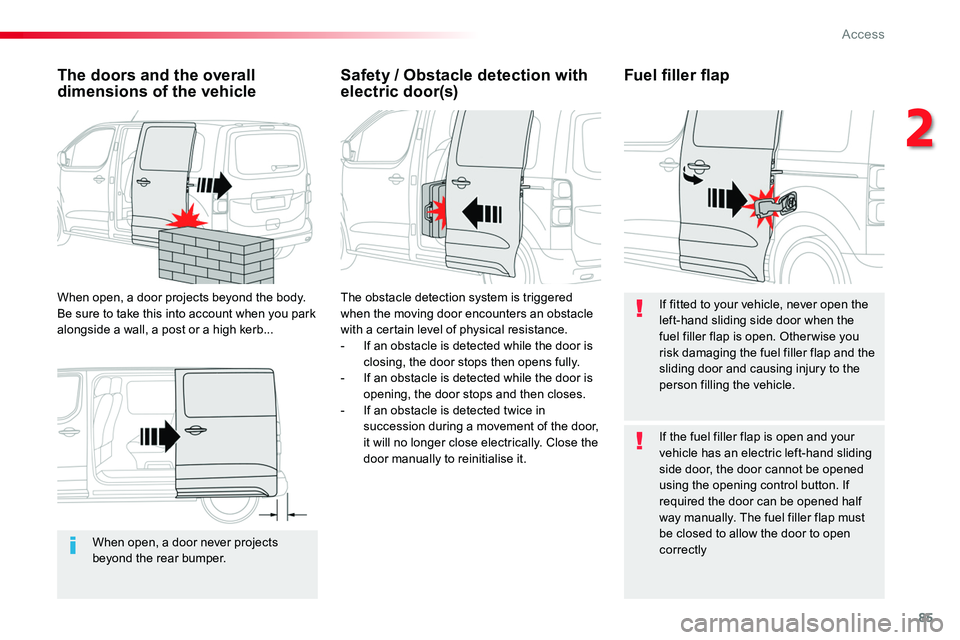
When open, a door never projects beyond the rear bumper.
The doors and the overall dimensions of the vehicle
When open, a door projects beyond the body. Be sure to take this into account when you park alongside a wall, a post or a high kerb...
Safety / Obstacle detection with electric door(s)Fuel filler flap
The obstacle detection system is triggered when the moving door encounters an obstacle with a certain level of physical resistance.- If an obstacle is detected while the door is closing, the door stops then opens fully.- If an obstacle is detected while the door is opening, the door stops and then closes.- If an obstacle is detected twice in succession during a movement of the door, it will no longer close electrically. Close the door manually to reinitialise it.
If fitted to your vehicle, never open the left-hand sliding side door when the fuel filler flap is open. Other wise you risk damaging the fuel filler flap and the sliding door and causing injury to the person filling the vehicle.
If the fuel filler flap is open and your vehicle has an electric left-hand sliding side door, the door cannot be opened using the opening control button. If required the door can be opened half way manually. The fuel filler flap must be closed to allow the door to open correctly
2
Access
Page 95 of 516
95
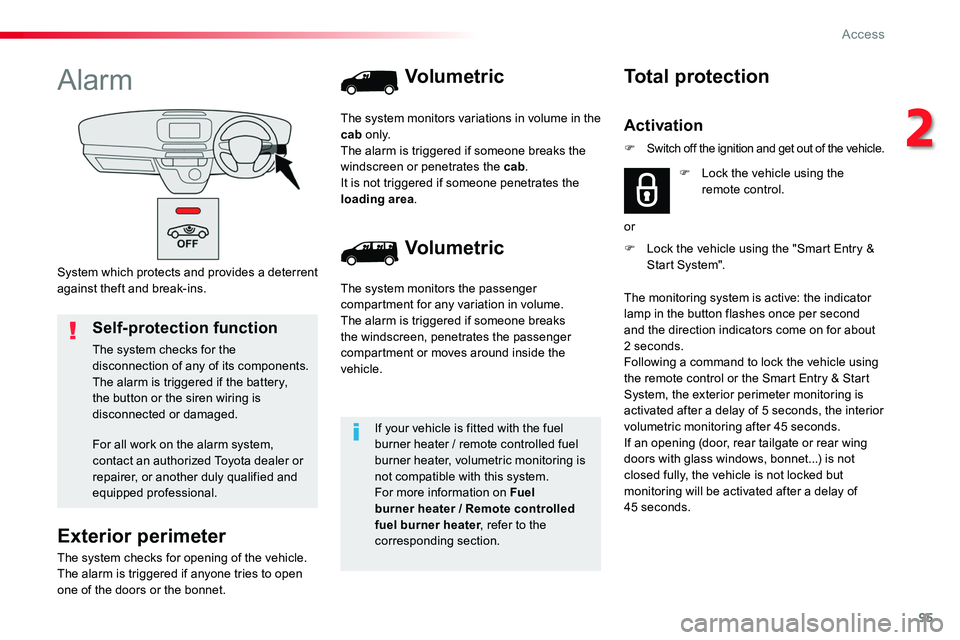
System which protects and provides a deterrent against theft and break-ins.
Alarm
Exterior perimeter
The system checks for opening of the vehicle.The alarm is triggered if anyone tries to open one of the doors or the bonnet.
Self-protection function
The system checks for the disconnection of any of its components.The alarm is triggered if the battery, the button or the siren wiring is disconnected or damaged.
For all work on the alarm system, contact an authorized Toyota dealer or repairer, or another duly qualified and equipped professional.
Volumetric
Volumetric
The system monitors the passenger compartment for any variation in volume.The alarm is triggered if someone breaks the windscreen, penetrates the passenger compartment or moves around inside the vehicle.
The system monitors variations in volume in the cab o n l y.The alarm is triggered if someone breaks the windscreen or penetrates the cab.It is not triggered if someone penetrates the loading area.
If your vehicle is fitted with the fuel burner heater / remote controlled fuel burner heater, volumetric monitoring is not compatible with this system.For more information on Fuel burner heater / Remote controlled fuel burner heater, refer to the corresponding section.
F Lock the vehicle using the "Smart Entry & Start System".
Total protection
Activation
F Lock the vehicle using the remote control.
or
The monitoring system is active: the indicator lamp in the button flashes once per second and the direction indicators come on for about 2 seconds.Following a command to lock the vehicle using the remote control or the Smart Entry & Start System, the exterior perimeter monitoring is activated after a delay of 5 seconds, the interior volumetric monitoring after 45 seconds.If an opening (door, rear tailgate or rear wing doors with glass windows, bonnet...) is not closed fully, the vehicle is not locked but monitoring will be activated after a delay of 45 seconds.
F Switch off the ignition and get out of the vehicle.
2
Access
Page 138 of 516
138
Heating
This is an additional and separate system which heats the engine hot water circuit to heat the passenger compartment and improve defrosting.
This indicator lamp is on when if the system is programmed to come on for heating.This indicator lamp flashes while the heating is operating.
Fuel burner heater / Remote controlled fuel burner heater
Ventilation
This system allows ventilation of the passenger
compartment to improve the temperature experienced on entering the vehicle in summer.
Programming
Audio system
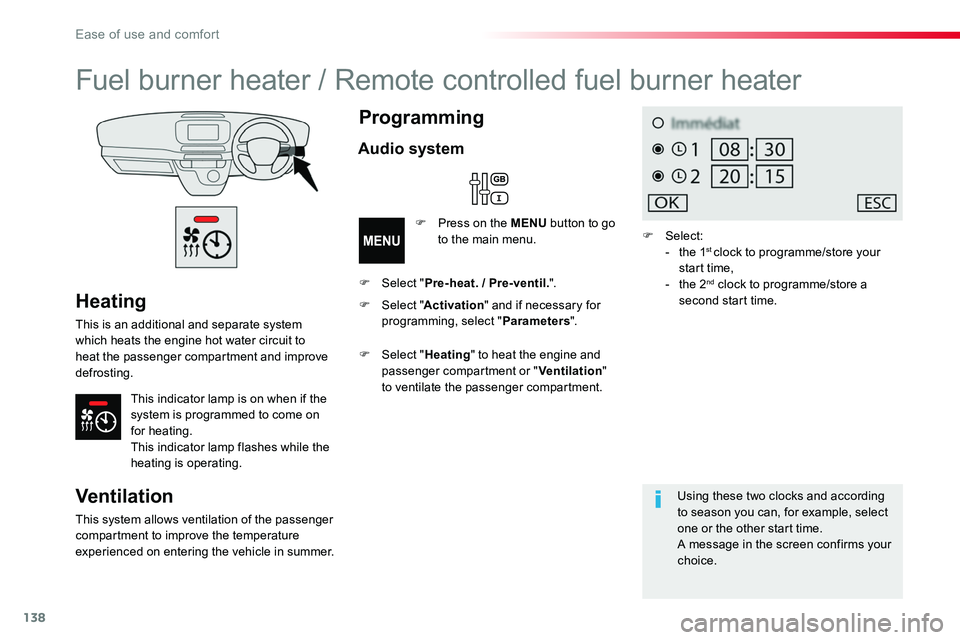
F Press on the MENU button to go to the main menu.
F Select "Pre-heat. / Pre-ventil.".
F Select "Heating" to heat the engine and passenger compartment or "Ventilation" to ventilate the passenger compartment.
F Select:- the 1st clock to programme/store your start time,- the 2nd clock to programme/store a second start time.
Using these two clocks and according to season you can, for example, select one or the other start time.
A message in the screen confirms your choice.
F Select "Activation" and if necessary for programming, select "Parameters".
Ease of use and comfort
Page 140 of 516
140
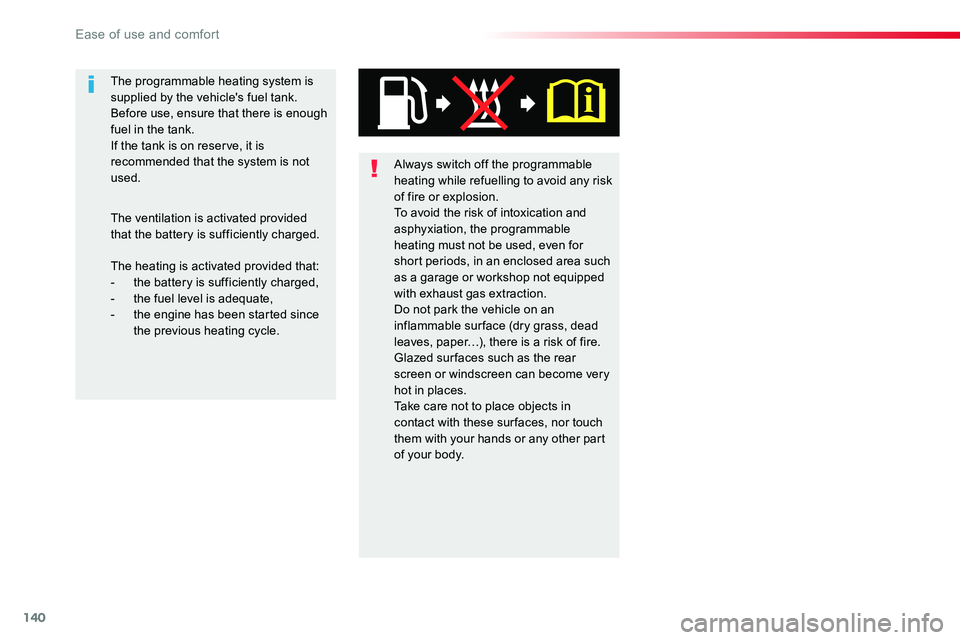
Always switch off the programmable heating while refuelling to avoid any risk of fire or explosion.To avoid the risk of intoxication and asphyxiation, the programmable heating must not be used, even for short periods, in an enclosed area such as a garage or workshop not equipped with exhaust gas extraction.Do not park the vehicle on an inflammable sur face (dry grass, dead leaves, paper…), there is a risk of fire.Glazed sur faces such as the rear screen or windscreen can become very hot in places.Take care not to place objects in contact with these sur faces, nor touch them with your hands or any other part of your body.
The heating is activated provided that:- the battery is sufficiently charged,- the fuel level is adequate,- the engine has been started since the previous heating cycle.
The programmable heating system is supplied by the vehicle's fuel tank.Before use, ensure that there is enough fuel in the tank.If the tank is on reserve, it is recommended that the system is not used.
The ventilation is activated provided that the battery is sufficiently charged.
Ease of use and comfort
Page 165 of 516
165
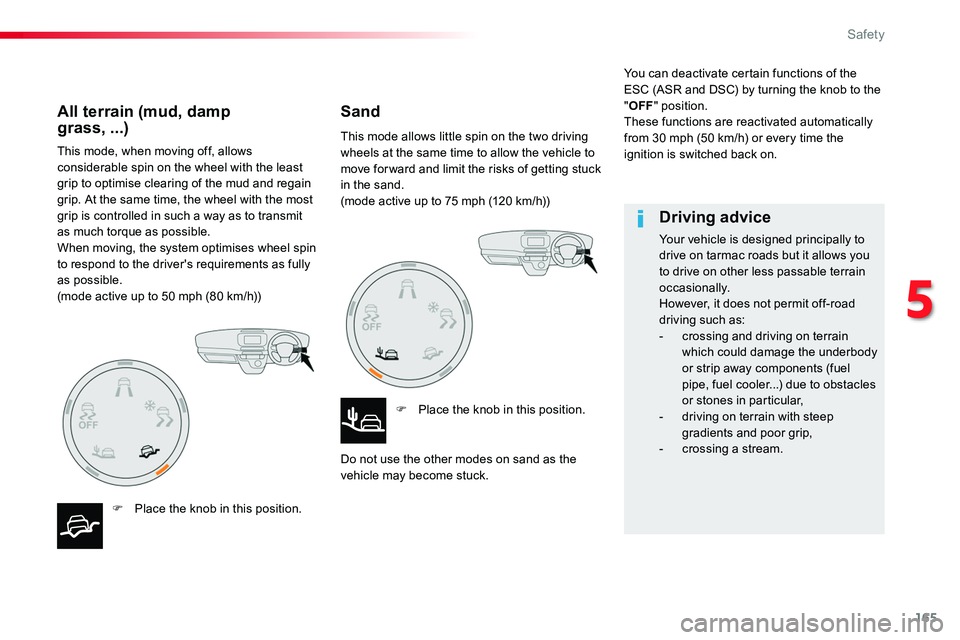
This mode, when moving off, allows considerable spin on the wheel with the least grip to optimise clearing of the mud and regain grip. At the same time, the wheel with the most grip is controlled in such a way as to transmit
as much torque as possible.When moving, the system optimises wheel spin to respond to the driver's requirements as fully as possible.(mode active up to 50 mph (80 km/h))
F Place the knob in this position.
This mode allows little spin on the two driving wheels at the same time to allow the vehicle to move for ward and limit the risks of getting stuck in the sand.(mode active up to 75 mph (120 km/h))
F Place the knob in this position.
Do not use the other modes on sand as the vehicle may become stuck.
You can deactivate certain functions of the ESC (ASR and DSC) by turning the knob to the "OFF" position.These functions are reactivated automatically from 30 mph (50 km/h) or every time the ignition is switched back on.
All terrain (mud, damp grass, ...)Sand
Driving advice
Your vehicle is designed principally to drive on tarmac roads but it allows you to drive on other less passable terrain occasionally.However, it does not permit off-road driving such as:- crossing and driving on terrain which could damage the underbody or strip away components (fuel pipe, fuel cooler...) due to obstacles or stones in particular,- driving on terrain with steep gradients and poor grip,- crossing a stream.
5
Safety
Page 208 of 516
208
Gear efficiency indicator
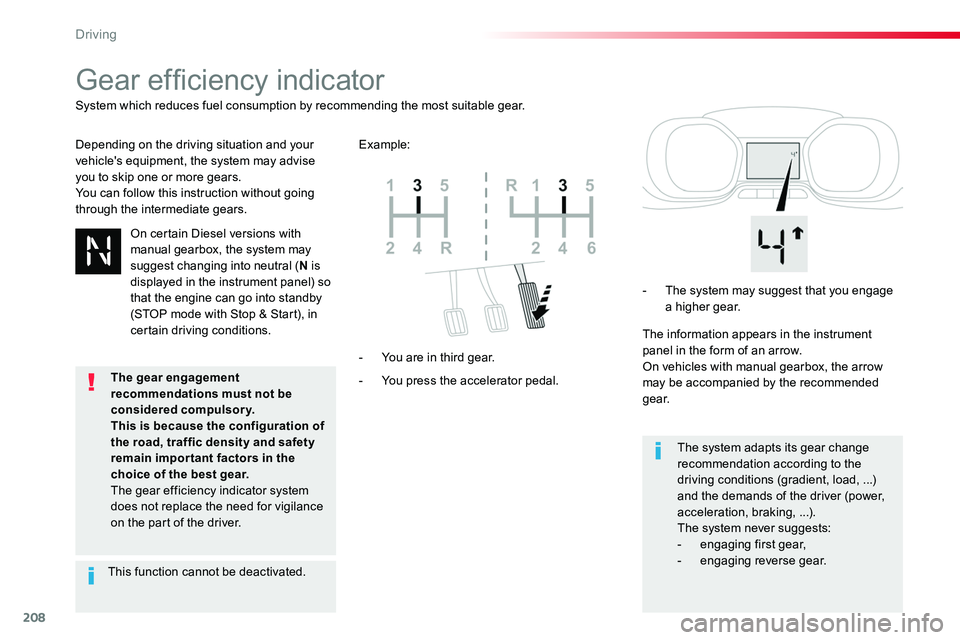
Depending on the driving situation and your vehicle's equipment, the system may advise you to skip one or more gears.You can follow this instruction without going through the intermediate gears.
- You press the accelerator pedal.
- You are in third gear.
- The system may suggest that you engage a higher gear.
The information appears in the instrument panel in the form of an arrow.On vehicles with manual gearbox, the arrow may be accompanied by the recommended g e a r.
The system adapts its gear change recommendation according to the driving conditions (gradient, load, ...) and the demands of the driver (power, acceleration, braking, ...).The system never suggests:
- engaging first gear,- engaging reverse gear.
System which reduces fuel consumption by recommending the most suitable gear.
Example:
On certain Diesel versions with manual gearbox, the system may suggest changing into neutral (N is displayed in the instrument panel) so that the engine can go into standby (STOP mode with Stop & Start), in certain driving conditions.
This function cannot be deactivated.
The gear engagement recommendations must not be considered compulsory.This is because the configuration of
the road, traffic density and safety remain impor tant factors in the choice of the best gear.The gear efficiency indicator system does not replace the need for vigilance on the part of the driver.
Driving
Page 218 of 516
218
Stop & StartGoing into engine
STOP mode
If your vehicle has a manual gearbox, its speed must be below 12 mph (20 km/h) or stationary (depending on engine); the "ECO" indicator lamp comes on in the instrument panel and the engine goes into standby automatically when you place the gear lever in
neutral and you release the clutch pedal.
For your comfort, during parking manoeuvres, STOP mode is not available for a few seconds after coming out of reverse gear.Stop & Start does not affect the functionality of the vehicle, such as for example, braking, power steering...A slight delay between the vehicle stopping and the engine cutting out may be noticed.
If your vehicle is fitted with Stop & Start, a time counter calculates the time spent in
STOP mode during a journey.It resets to zero every time the ignition is switched on.
Stop & Start time counter
The Stop & Start system puts the engine temporarily into standby - STOP mode - during stops in the traffic (red lights, traffic jams, or other...). The engine restarts automatically - START mode - as soon as you want to move off. The restart takes place instantly, quickly and silently.Per fect for urban use, the Stop & Start system reduces fuel consumption and exhaust emissions as well as the noise level when stationary.
If your vehicle has an automatic gearbox and the vehicle is stationary, the "ECO" indicator lamp comes on and the engine goes into standby automatically when you press the brake pedal or place the gear selector in position N.
If your vehicle has an electronic gearbox and the vehicle's speed is below 5 mph (8 km/h), the "ECO" indicator lamp comes on and the engine goes into standby automatically when you press the brake pedal or place the gear selector in position N.
(minutes / seconds or hours / minutes)
Never refuel with the engine in STOP mode; you must switch off the ignition with the button.
Driving
Page 262 of 516
262
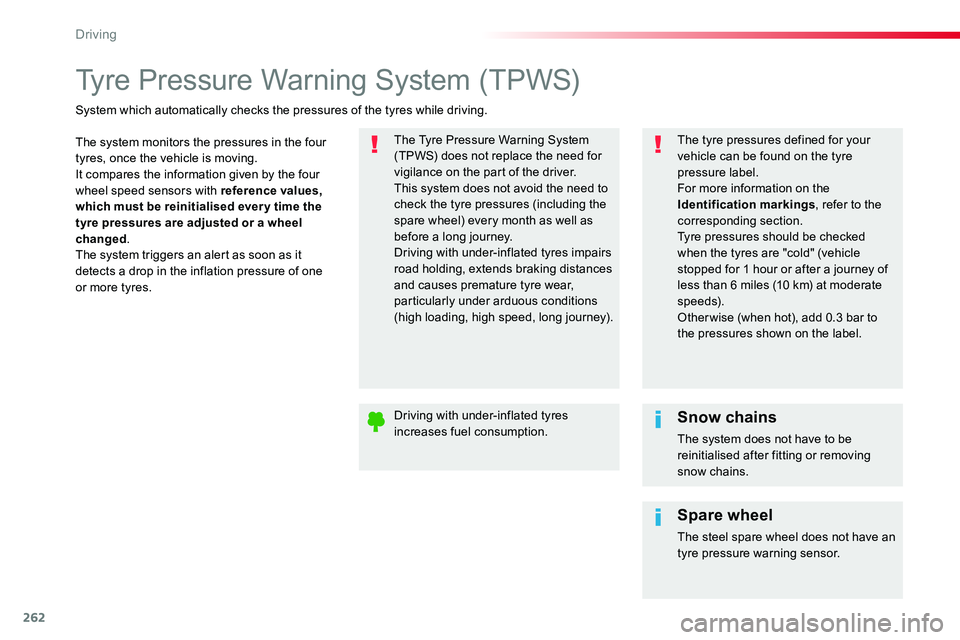
Tyre Pressure Warning System (TPWS)
The system monitors the pressures in the four tyres, once the vehicle is moving.It compares the information given by the four wheel speed sensors with reference values, which must be reinitialised ever y time the tyre pressures are adjusted or a wheel changed.The system triggers an alert as soon as it detects a drop in the inflation pressure of one or more tyres.
The Tyre Pressure Warning System (TPWS) does not replace the need for vigilance on the part of the driver.This system does not avoid the need to check the tyre pressures (including the spare wheel) every month as well as before a long journey.Driving with under-inflated tyres impairs road holding, extends braking distances and causes premature tyre wear, particularly under arduous conditions (high loading, high speed, long journey).
System which automatically checks the pressures of the tyres while driving.
The tyre pressures defined for your vehicle can be found on the tyre pressure label.For more information on the Identification markings, refer to the corresponding section.Tyre pressures should be checked when the tyres are "cold" (vehicle stopped for 1 hour or after a journey of less than 6 miles (10 km) at moderate speeds).Other wise (when hot), add 0.3 bar to the pressures shown on the label.
Driving with under-inflated tyres
increases fuel consumption.Snow chains
The system does not have to be reinitialised after fitting or removing snow chains.
Spare wheel
The steel spare wheel does not have an tyre pressure warning sensor.
Driving
Page 265 of 516
265
Fuel tank
Opening
If your vehicle is fitted with Stop & Start, never refuel with the engine in STOP mode; you must switch off the ignition using the key, or the START/STOP
button if your vehicle has Smart Entry & Start System.
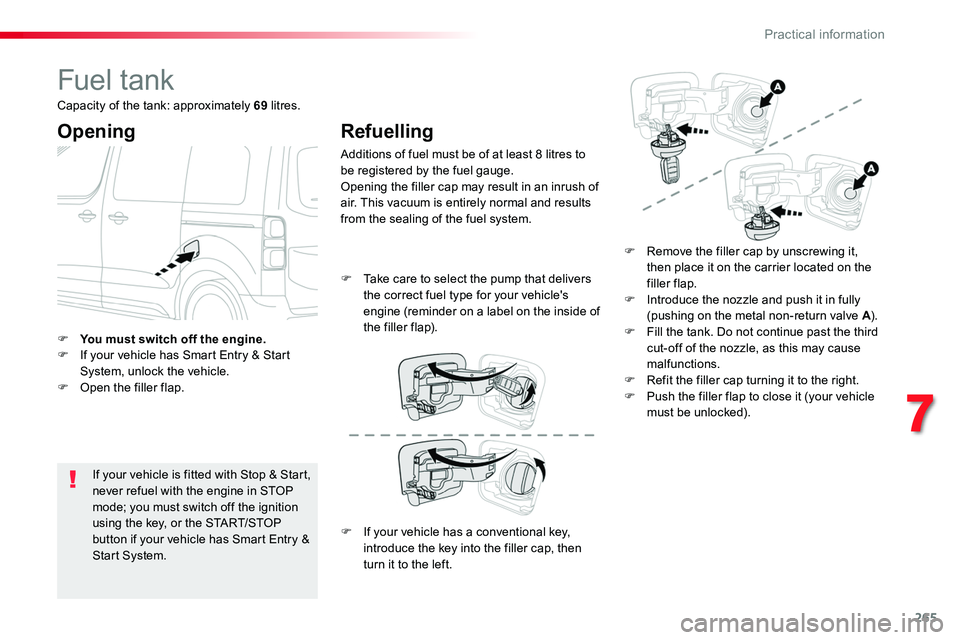
F You must switch off the engine.F If your vehicle has Smart Entry & Start System, unlock the vehicle.F Open the filler flap.
Refuelling
Additions of fuel must be of at least 8 litres to be registered by the fuel gauge.Opening the filler cap may result in an inrush of air. This vacuum is entirely normal and results from the sealing of the fuel system.
F Remove the filler cap by unscrewing it, then place it on the carrier located on the filler flap.F Introduce the nozzle and push it in fully (pushing on the metal non-return valve A).F Fill the tank. Do not continue past the third cut-off of the nozzle, as this may cause malfunctions.F Refit the filler cap turning it to the right.F Push the filler flap to close it (your vehicle must be unlocked).
F Take care to select the pump that delivers the correct fuel type for your vehicle's engine (reminder on a label on the inside of the filler flap).
Capacity of the tank: approximately 69 litres.
F If your vehicle has a conventional key, introduce the key into the filler cap, then turn it to the left.
7
Practical information