warning TOYOTA PROACE 2018 Workshop Manual
[x] Cancel search | Manufacturer: TOYOTA, Model Year: 2018, Model line: PROACE, Model: TOYOTA PROACE 2018Pages: 516, PDF Size: 90.91 MB
Page 198 of 516
198
When towing
Distribution of loads
F Distribute the load in the trailer so that the heaviest items are as close as possible to the axle and the nose weight approaches the maximum permitted without exceeding it.Air density decreases with altitude, thus reducing engine per formance. Above 1 000 metres, the maximum towed load must be reduced by 10 % for every 1 000 metres of altitude.
Side wind
F Take into account the increased sensitivity to side wind.
Cooling
Towing a trailer on a slope increases the temperature of the coolant.As the fan is electrically controlled, its cooling capacity is not dependent on the engine speed.F To lower the engine speed, reduce your speed.The maximum towed load on a long incline depends on the gradient and the ambient temperature.In all cases, keep a check on the coolant temperature.
F If the warning lamp and the STOP warning lamp come on, stop the vehicle and switch off the engine as soon as possible.
Braking
Towing a trailer increases the braking distance.To avoid overheating of the brakes, the use of engine braking is recommended.
Ty r e s
F Check the tyre pressures of the towing vehicle and of the trailer, observing the recommended pressures.
Lighting
F Check the electrical lighting and signalling on the trailer and the headlamp beam height of your vehicle.
For more information on Weights, refer to the corresponding section.
The rear parking sensors will be deactivated automatically to avoid the audible signal if a genuine Toyota towbar is used.
If the ambient temperature is high, it is recommended that the engine be allowed to idle for 1 to 2 minutes after the vehicle comes to a stop, to facilitate its cooling.
For more information on Adjusting the headlamp beam height, refer to the corresponding section.
Driving
Page 200 of 516
200
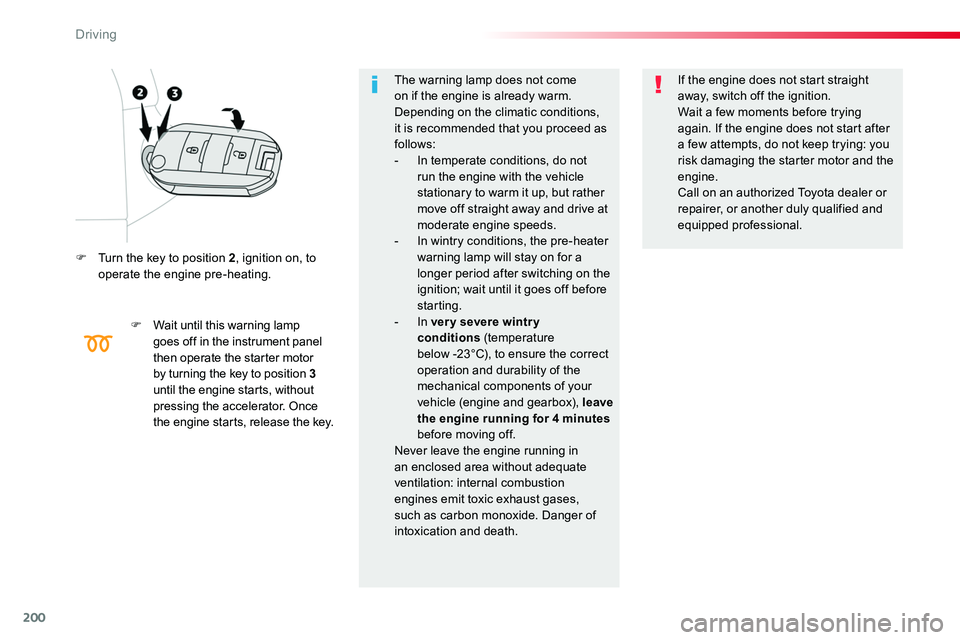
F Turn the key to position 2, ignition on, to operate the engine pre-heating.
F Wait until this warning lamp goes off in the instrument panel then operate the starter motor by turning the key to position 3 until the engine starts, without pressing the accelerator. Once the engine starts, release the key.
The warning lamp does not come on if the engine is already warm. Depending on the climatic conditions, it is recommended that you proceed as follows:- In temperate conditions, do not run the engine with the vehicle stationary to warm it up, but rather move off straight away and drive at
moderate engine speeds.- In wintry conditions, the pre-heater warning lamp will stay on for a longer period after switching on the ignition; wait until it goes off before starting.- In ver y severe wintr y conditions (temperature below -23°C), to ensure the correct operation and durability of the mechanical components of your vehicle (engine and gearbox), leave the engine running for 4 minutes before moving off.Never leave the engine running in an enclosed area without adequate ventilation: internal combustion engines emit toxic exhaust gases, such as carbon monoxide. Danger of intoxication and death.
If the engine does not start straight away, switch off the ignition.Wait a few moments before trying again. If the engine does not start after a few attempts, do not keep trying: you risk damaging the starter motor and the engine.Call on an authorized Toyota dealer or repairer, or another duly qualified and
equipped professional.
Driving
Page 202 of 516
202
For Diesel vehicles, in sub-zero temperatures the engine will not start until the pre-heater warning lamp has gone off.If this warning lamp comes on after pressing the "START/STOP" button, press down on the brake or clutch pedal until the warning lamp goes off, without pressing the "START/STOP" button again, until the engine starts and runs.
Starting
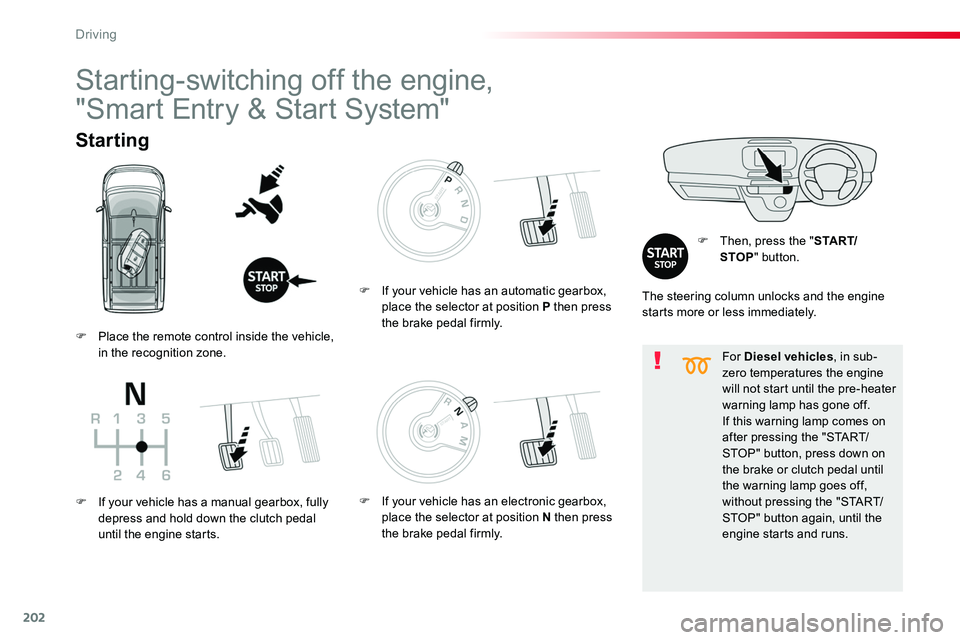
F Then, press the "S TA R T/STOP" button.
Starting-switching off the engine,
"Smart Entry & Start System"
The steering column unlocks and the engine starts more or less immediately.
F Place the remote control inside the vehicle, in the recognition zone.
F If your vehicle has a manual gearbox, fully depress and hold down the clutch pedal until the engine starts.
F If your vehicle has an automatic gearbox, place the selector at position P then press the brake pedal firmly.
F If your vehicle has an electronic gearbox, place the selector at position N then press the brake pedal firmly.
Driving
Page 205 of 516
205
Parking brake
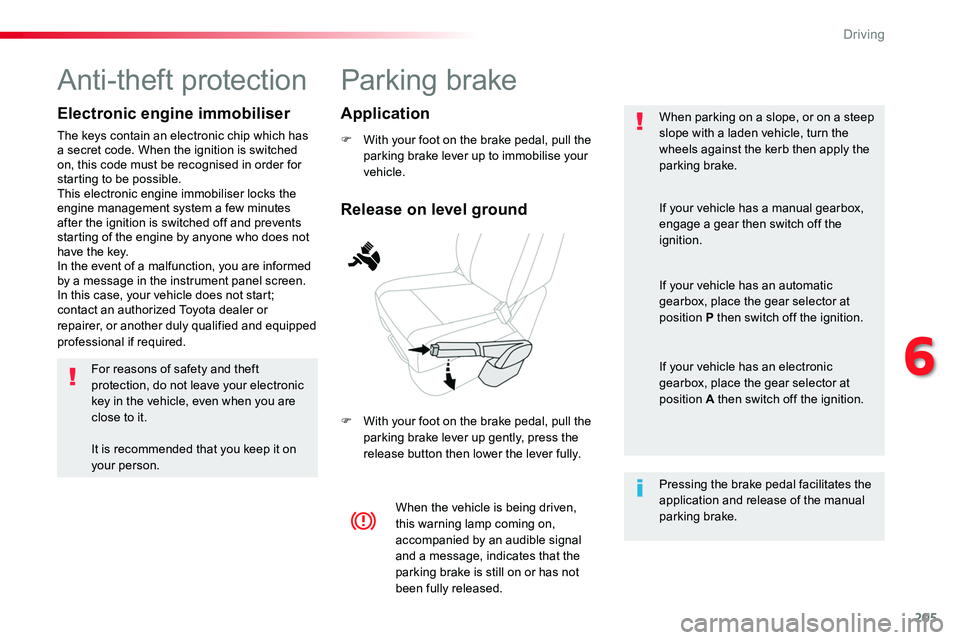
F With your foot on the brake pedal, pull the parking brake lever up to immobilise your vehicle.
F With your foot on the brake pedal, pull the parking brake lever up gently, press the release button then lower the lever fully.
When parking on a slope, or on a steep slope with a laden vehicle, turn the wheels against the kerb then apply the parking brake.
When the vehicle is being driven, this warning lamp coming on, accompanied by an audible signal and a message, indicates that the parking brake is still on or has not
been fully released.
Pressing the brake pedal facilitates the application and release of the manual parking brake.
If your vehicle has a manual gearbox,
engage a gear then switch off the ignition.
If your vehicle has an automatic gearbox, place the gear selector at position P then switch off the ignition.
If your vehicle has an electronic gearbox, place the gear selector at position A then switch off the ignition.
Release on level ground
Application
Anti-theft protection
Electronic engine immobiliser
The keys contain an electronic chip which has a secret code. When the ignition is switched on, this code must be recognised in order for starting to be possible.This electronic engine immobiliser locks the engine management system a few minutes after the ignition is switched off and prevents starting of the engine by anyone who does not have the key.In the event of a malfunction, you are informed by a message in the instrument panel screen.In this case, your vehicle does not start; contact an authorized Toyota dealer or repairer, or another duly qualified and equipped professional if required.
For reasons of safety and theft protection, do not leave your electronic key in the vehicle, even when you are close to it.
It is recommended that you keep it on your person.
6
Driving
Page 206 of 516
206
Hill start assist control (HAC)
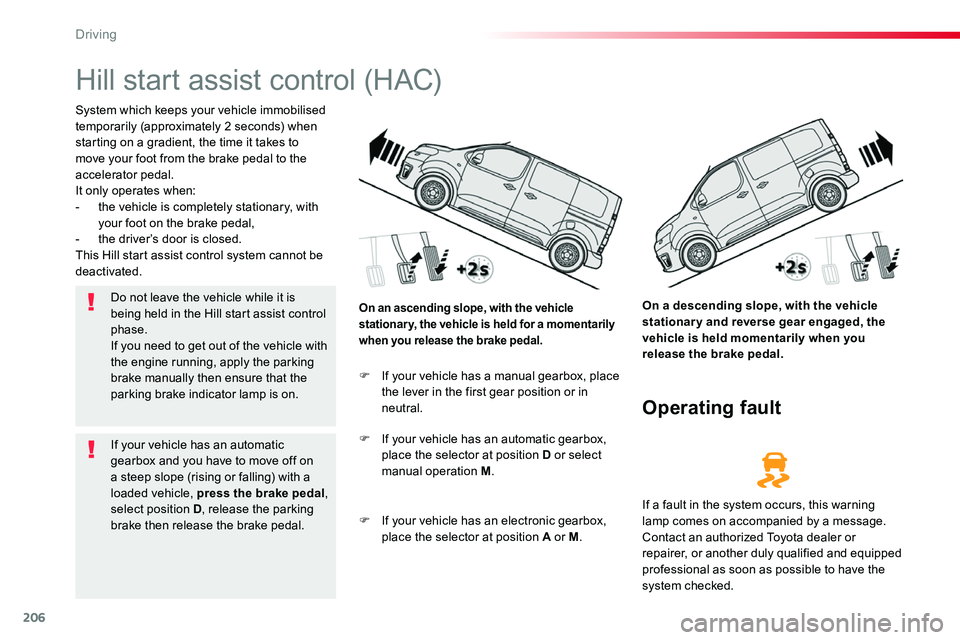
System which keeps your vehicle immobilised temporarily (approximately 2 seconds) when starting on a gradient, the time it takes to move your foot from the brake pedal to the accelerator pedal.It only operates when:- the vehicle is completely stationary, with your foot on the brake pedal,- the driver’s door is closed.This Hill start assist control system cannot be deactivated.
On a descending slope, with the vehicle stationary and reverse gear engaged, the vehicle is held momentarily when you release the brake pedal.
On an ascending slope, with the vehicle stationary, the vehicle is held for a momentarily when you release the brake pedal.
Operating fault
F If your vehicle has a manual gearbox, place the lever in the first gear position or in neutral.
F If your vehicle has an automatic gearbox, place the selector at position D or select manual operation M.
F If your vehicle has an electronic gearbox,
place the selector at position A or M.
If a fault in the system occurs, this warning lamp comes on accompanied by a message. Contact an authorized Toyota dealer or repairer, or another duly qualified and equipped professional as soon as possible to have the
system checked.
Do not leave the vehicle while it is being held in the Hill start assist control phase.If you need to get out of the vehicle with the engine running, apply the parking brake manually then ensure that the parking brake indicator lamp is on.
If your vehicle has an automatic gearbox and you have to move off on a steep slope (rising or falling) with a loaded vehicle, press the brake pedal, select position D, release the parking brake then release the brake pedal.
Driving
Page 215 of 516
215
Automatic operation
F After starting the engine, select position A for automatic gear changes
The gearbox operates in auto-active mode, without any action on the part of the driver. It continuously selects the most suitable gear for:- the style of driving,- the profile of the road.
AUTO and the gear engaged are displayed in the instrument panel.
For optimum acceleration, for example when overtaking another
vehicle, press the accelerator pedal firmly past the point of resistance.
Display in the instrument panel
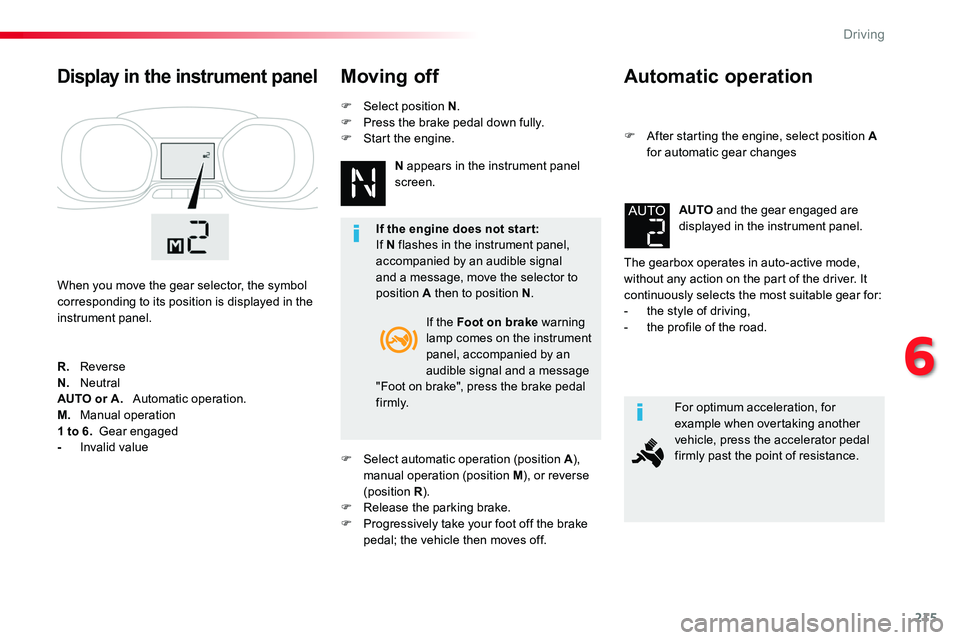
When you move the gear selector, the symbol corresponding to its position is displayed in the instrument panel.
Moving off
If the Foot on brake warning lamp comes on the instrument panel, accompanied by an audible signal and a message "Foot on brake", press the brake pedal f i r m l y.
R. ReverseN. NeutralAUTO or A. Automatic operation.M. Manual operation
1 to 6. Gear engaged- Invalid value
If the engine does not star t:If N flashes in the instrument panel, accompanied by an audible signal and a message, move the selector to position A then to position N.
F Select automatic operation (position A), manual operation (position M), or reverse (position R).F Release the parking brake.F Progressively take your foot off the brake
pedal; the vehicle then moves off.
N appears in the instrument panel screen.
F Select position N.F Press the brake pedal down fully.F Start the engine.
6
Driving
Page 219 of 516
219
Going into engine
START mode
START mode is invoked automatically in certain temporary conditions (examples: battery charge, engine temperature, braking assistance, air conditioning setting) to assure correct operation of the system and mainly when:- you open the driver's door,
- you open a sliding side door,- you unfasten the driver's seat belt,- the speed of the vehicle exceeds 15 mph (25 km/h) or 2 mph (3 km/h) (depending on the engine) with a manual gearbox,- the speed of the vehicle exceeds 2 mph (3 km/h) with an automatic gearbox,
Special cases: START invoked automatically
In this case the "ECO" warning lamp flashes for a few seconds, then goes off.
This operation is perfectly normal.
If your vehicle has a manual gearbox, the "ECO" indicator lamp goes off in the instrument panel and the engine restarts automatically when you fully depress the clutch pedal.
If your vehicle has an automatic gearbox, the "ECO" lamp goes off in the instrument panel and the engine restarts automatically when:- you release the brake pedal with the gear selector in position D or M,- you are in position N with the brake pedal released and you move the gear selector to position D or M,- you engage reverse.
If your vehicle has an electronic gearbox, the "ECO" lamp goes off in the instrument panel and the engine restarts automatically when:- you release the brake pedal with the gear selector in position A or M,- you are in position N with the brake pedal released and you move the gear selector to position A or M,- you enegage reverse.
Special cases: STOP mode not available
STOP mode is not invoked in certain temporary conditions (examples: battery charge, engine temperature, braking assistance, ambient temperature) to assure correct operation of the system and mainly when:- the vehicle is on a steep slope (rising or falling),
- the driver's door is open,- a sliding side door is open,- the driver's seat belt is not fastened,- the vehicle has not exceeded 6 mph (10 km/h) since the last engine start by the driver,- the electric parking brake is applied or being applied,- the engine is needed to maintain a comfortable temperature in the passenger compartment,- demisting is active.
In this case, the "ECO" warning lamp flashes for a few seconds then goes off.
This operation is perfectly normal.
6
Driving
Page 221 of 516
221
Operating fault
Depending on your vehicle's equipment:
Have it checked by an authorized Toyota dealer or repairer, or another duly qualified and equipped professional.In the event of a fault in STOP mode, the vehicle may stall.All of the instrument panel warning lamps come on.Depending on version, an alert message may also be displayed, asking you to place the gear lever in position N and put your foot on the brake pedal.With the vehicle stationary, you must switch off the ignition and then start the engine again.
The Stop & Start system requires a 12 V battery with a special specification and technology.
The warning lamp in this button flashes and a message appears,
accompanied by an audible signal.
In the event of a fault with the system, this warning lamp flashes in the instrument panel.All work on this type of battery must be done by an authorized Toyota dealer or repairer, or another duly qualified and equipped professional.For more information on the 12 V batter y, refer to the corresponding section.
6
Driving
Page 239 of 516
239
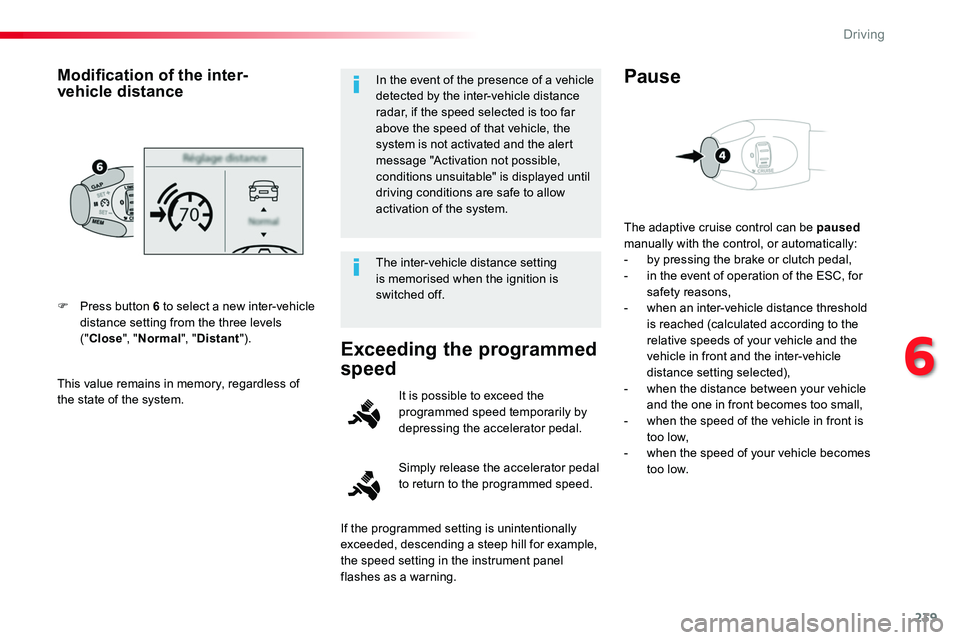
This value remains in memory, regardless of the state of the system.
F Press button 6 to select a new inter-vehicle distance setting from the three levels ("Close", "Normal", "Distant").
Modification of the inter-vehicle distanceIn the event of the presence of a vehicle detected by the inter-vehicle distance radar, if the speed selected is too far above the speed of that vehicle, the system is not activated and the alert message "Activation not possible, conditions unsuitable" is displayed until driving conditions are safe to allow activation of the system.
The inter-vehicle distance setting is memorised when the ignition is switched off.
Exceeding the programmed
speed
Simply release the accelerator pedal to return to the programmed speed.
It is possible to exceed the programmed speed temporarily by depressing the accelerator pedal.
The adaptive cruise control can be paused manually with the control, or automatically:- by pressing the brake or clutch pedal,- in the event of operation of the ESC, for safety reasons,- when an inter-vehicle distance threshold is reached (calculated according to the relative speeds of your vehicle and the vehicle in front and the inter-vehicle distance setting selected),- when the distance between your vehicle and the one in front becomes too small,- when the speed of the vehicle in front is too low,- when the speed of your vehicle becomes too low.
Pause
If the programmed setting is unintentionally exceeded, descending a steep hill for example, the speed setting in the instrument panel flashes as a warning.
6
Driving
Page 243 of 516
243
Forward collision warning and Autonomous
emergency braking system with Pedestrian
Detection
Conditions for operation
The Autonomous emergency braking system operates:- between 3 and 87 mph (5 and 140 km/h), in the case of a moving vehicle,- at a speed below 50 mph (80 km/h), in the case of a stationary vehicle,- at a speed below 36 mph (60 km/h), in the case of a pedestrian,- if the passenger seat belts are fastened,- if the vehicle is not accelerating sharply,- if the vehicle is not in a tight corner.v
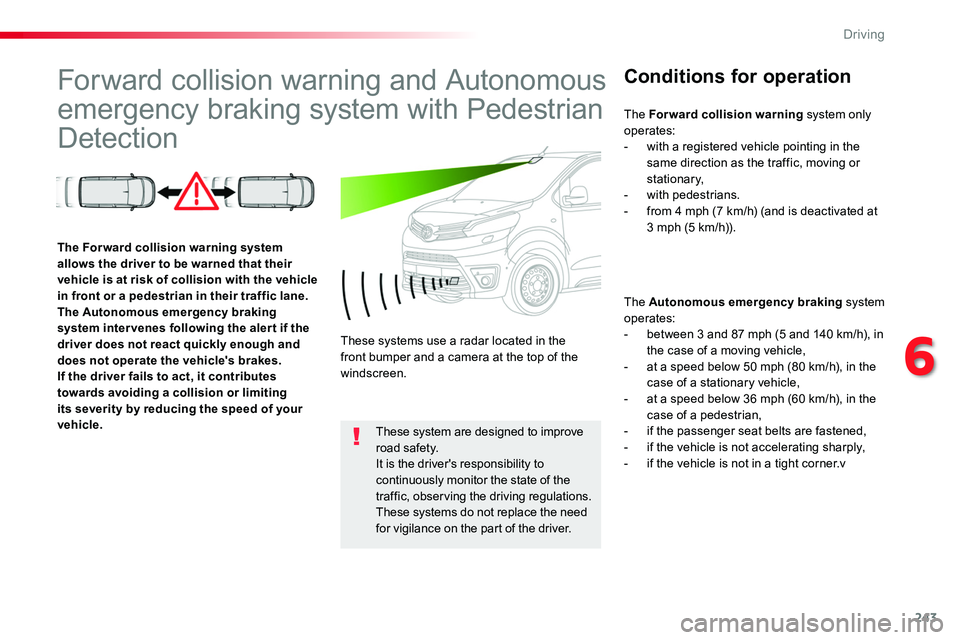
The Forward collision warning system allows the driver to be warned that their vehicle is at risk of collision with the vehicle in front or a pedestrian in their traffic lane.The Autonomous emergency braking system inter venes following the aler t if the driver does not react quickly enough and does not operate the vehicle's brakes.If the driver fails to act, it contributes towards avoiding a collision or limiting its severity by reducing the speed of your vehicle.
These systems use a radar located in the front bumper and a camera at the top of the windscreen.
These system are designed to improve road safety.It is the driver's responsibility to continuously monitor the state of the traffic, observing the driving regulations.These systems do not replace the need for vigilance on the part of the driver.
The Forward collision warning system only operates:- with a registered vehicle pointing in the same direction as the traffic, moving or stationary,- with pedestrians.- from 4 mph (7 km/h) (and is deactivated at 3 mph (5 km/h)).
6
Driving