seats TOYOTA PROACE 2021 User Guide
[x] Cancel search | Manufacturer: TOYOTA, Model Year: 2021, Model line: PROACE, Model: TOYOTA PROACE 2021Pages: 360, PDF Size: 70.79 MB
Page 74 of 360
74
► Check that nothing is obstructing the rails.
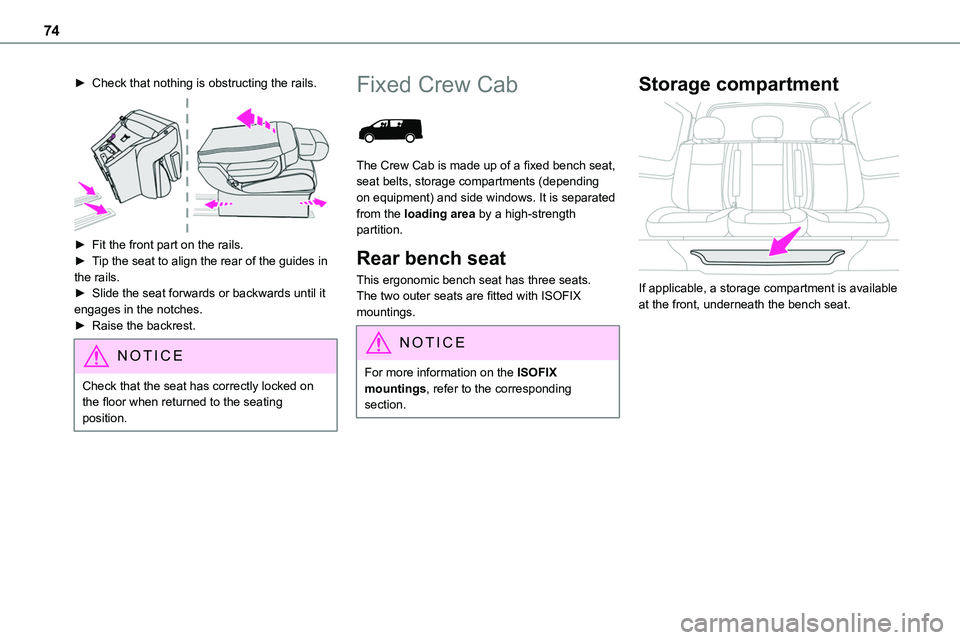
► Fit the front part on the rails.► Tip the seat to align the rear of the guides in the rails.► Slide the seat forwards or backwards until it engages in the notches.► Raise the backrest.
NOTIC E
Check that the seat has correctly locked on the floor when returned to the seating position.
Fixed Crew Cab
The Crew Cab is made up of a fixed bench seat, seat belts, storage compartments (depending on equipment) and side windows. It is separated from the loading area by a high-strength
partition.
Rear bench seat
This ergonomic bench seat has three seats.The two outer seats are fitted with ISOFIX mountings.
NOTIC E
For more information on the ISOFIX mountings, refer to the corresponding section.
Storage compartment
If applicable, a storage compartment is available at the front, underneath the bench seat.
Page 75 of 360
75
Ease of use and comfort
3
Under seat cushion storage
wells
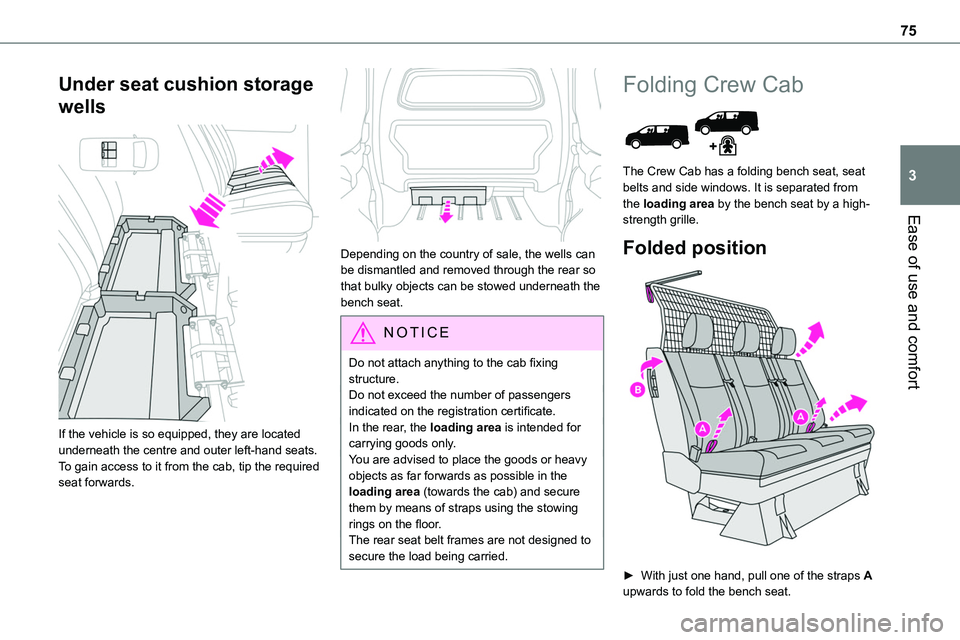
If the vehicle is so equipped, they are located underneath the centre and outer left-hand seats.To gain access to it from the cab, tip the required seat forwards.
Depending on the country of sale, the wells can be dismantled and removed through the rear so that bulky objects can be stowed underneath the bench seat.
NOTIC E
Do not attach anything to the cab fixing structure.Do not exceed the number of passengers indicated on the registration certificate.In the rear, the loading area is intended for carrying goods only.You are advised to place the goods or heavy objects as far forwards as possible in the loading area (towards the cab) and secure them by means of straps using the stowing rings on the floor.The rear seat belt frames are not designed to secure the load being carried.
Folding Crew Cab
The Crew Cab has a folding bench seat, seat belts and side windows. It is separated from the loading area by the bench seat by a high-strength grille.
Folded position
► With just one hand, pull one of the straps A
upwards to fold the bench seat.
Page 78 of 360
78
Upper glove box
This is located in the dashboard, behind the steering wheel.
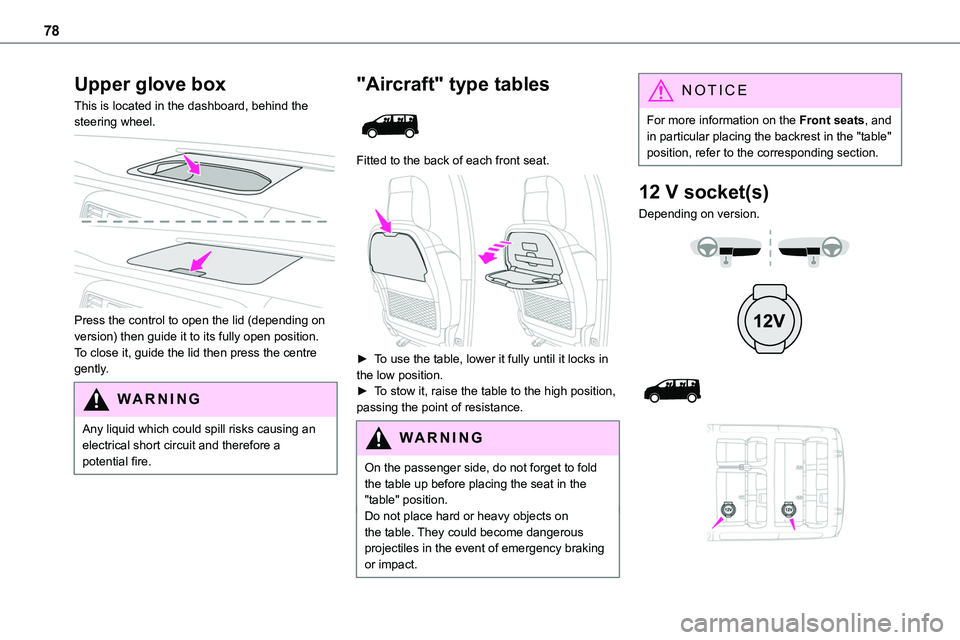
Press the control to open the lid (depending on version) then guide it to its fully open position.To close it, guide the lid then press the centre gently.
WARNI NG
Any liquid which could spill risks causing an electrical short circuit and therefore a potential fire.
"Aircraft" type tables
Fitted to the back of each front seat.
► To use the table, lower it fully until it locks in the low position.► To stow it, raise the table to the high position, passing the point of resistance.
WARNI NG
On the passenger side, do not forget to fold the table up before placing the seat in the "table" position.Do not place hard or heavy objects on the table. They could become dangerous projectiles in the event of emergency braking or impact.
NOTIC E
For more information on the Front seats, and in particular placing the backrest in the "table" position, refer to the corresponding section.
12 V socket(s)
Depending on version.
Page 81 of 360
81
Ease of use and comfort
3
Use the stowing rings on the rear floor to secure loads.As a safety precaution in case of sharp braking, we recommend placing heavy objects as far forwards as possible (i.e. near the cab).We recommend using the stowing rings on the floor to firmly secure the load.
Load retaining partition
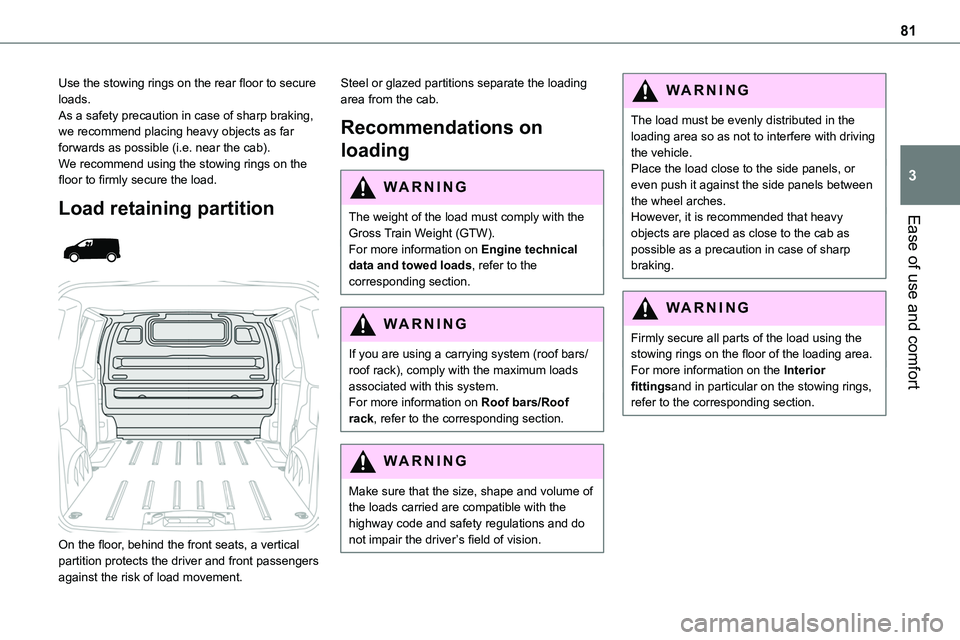
On the floor, behind the front seats, a vertical partition protects the driver and front passengers against the risk of load movement.
Steel or glazed partitions separate the loading area from the cab.
Recommendations on
loading
WARNI NG
The weight of the load must comply with the
Gross Train Weight (GTW).For more information on Engine technical data and towed loads, refer to the corresponding section.
WARNI NG
If you are using a carrying system (roof bars/roof rack), comply with the maximum loads associated with this system.For more information on Roof bars/Roof rack, refer to the corresponding section.
WARNI NG
Make sure that the size, shape and volume of the loads carried are compatible with the highway code and safety regulations and do not impair the driver’s field of vision.
WARNI NG
The load must be evenly distributed in the loading area so as not to interfere with driving the vehicle.Place the load close to the side panels, or even push it against the side panels between the wheel arches.However, it is recommended that heavy
objects are placed as close to the cab as possible as a precaution in case of sharp braking.
WARNI NG
Firmly secure all parts of the load using the stowing rings on the floor of the loading area.For more information on the Interior fittingsand in particular on the stowing rings, refer to the corresponding section.
Page 82 of 360
82
WARNI NG
To avoid the risk of injury or accident, the load must be made stable so that it cannot slide, tip over, fall or be thrown. To do this, use only retaining straps that conform to current standards (DIN for example).For more information on putting straps in place, refer to the manufacturer’s user guide.
There must not be any empty space between the components of the load.To prevent the load sliding, there must not be any empty space between the load and the panels of the vehicle.As well as the straps, optimise the stability of the load with stable handling equipment (wedges, rigid blocks of wood or padding).
WARNI NG
When washing your vehicle, never clean the inside directly using a water jet.
Seating area fittings
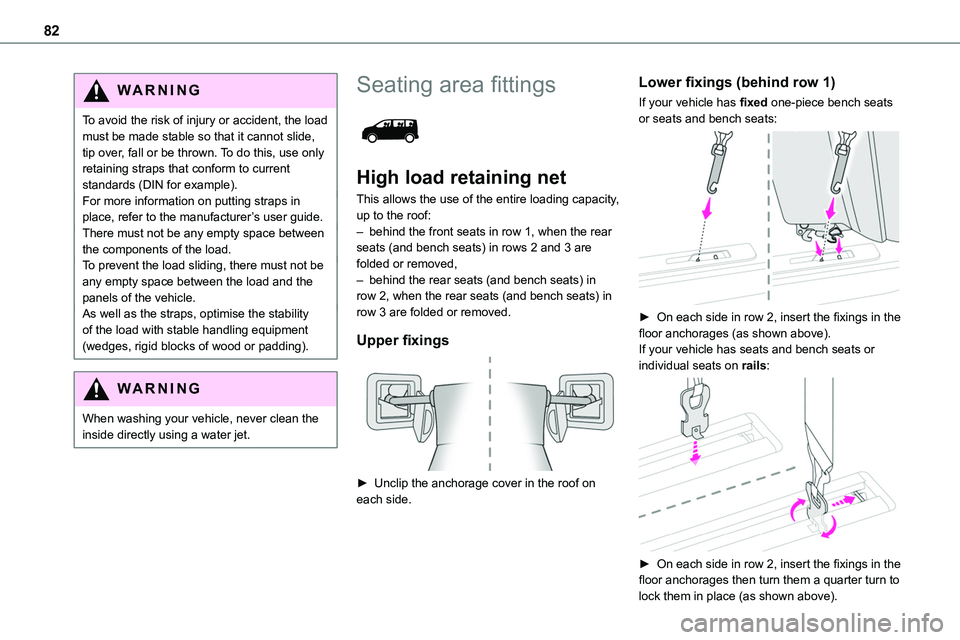
High load retaining net
This allows the use of the entire loading capacity, up to the roof:
– behind the front seats in row 1, when the rear seats (and bench seats) in rows 2 and 3 are folded or removed,– behind the rear seats (and bench seats) in row 2, when the rear seats (and bench seats) in row 3 are folded or removed.
Upper fixings
► Unclip the anchorage cover in the roof on each side.
Lower fixings (behind row 1)
If your vehicle has fixed one-piece bench seats or seats and bench seats:
► On each side in row 2, insert the fixings in the floor anchorages (as shown above).If your vehicle has seats and bench seats or individual seats on rails:
► On each side in row 2, insert the fixings in the floor anchorages then turn them a quarter turn to lock them in place (as shown above).
Page 83 of 360
83
Ease of use and comfort
3
Place them as close as possible to the end of the rail.
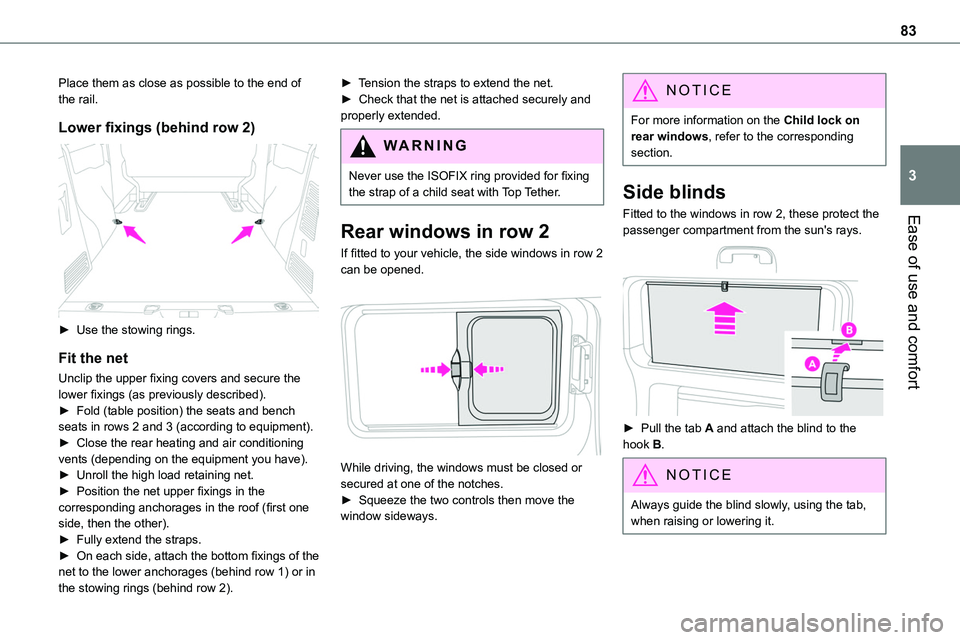
Lower fixings (behind row 2)
► Use the stowing rings.
Fit the net
Unclip the upper fixing covers and secure the lower fixings (as previously described).► Fold (table position) the seats and bench seats in rows 2 and 3 (according to equipment).► Close the rear heating and air conditioning vents (depending on the equipment you have).► Unroll the high load retaining net.► Position the net upper fixings in the corresponding anchorages in the roof (first one side, then the other).
► Fully extend the straps.► On each side, attach the bottom fixings of the net to the lower anchorages (behind row 1) or in the stowing rings (behind row 2).
► Tension the straps to extend the net.► Check that the net is attached securely and properly extended.
WARNI NG
Never use the ISOFIX ring provided for fixing the strap of a child seat with Top Tether.
Rear windows in row 2
If fitted to your vehicle, the side windows in row 2 can be opened.
While driving, the windows must be closed or secured at one of the notches.► Squeeze the two controls then move the window sideways.
NOTIC E
For more information on the Child lock on rear windows, refer to the corresponding section.
Side blinds
Fitted to the windows in row 2, these protect the
passenger compartment from the sun's rays.
► Pull the tab A and attach the blind to the hook B.
NOTIC E
Always guide the blind slowly, using the tab, when raising or lowering it.
Page 87 of 360
87
Ease of use and comfort
3
WARNI NG
Be careful of passengers' feet when manoeuvring the assembly.
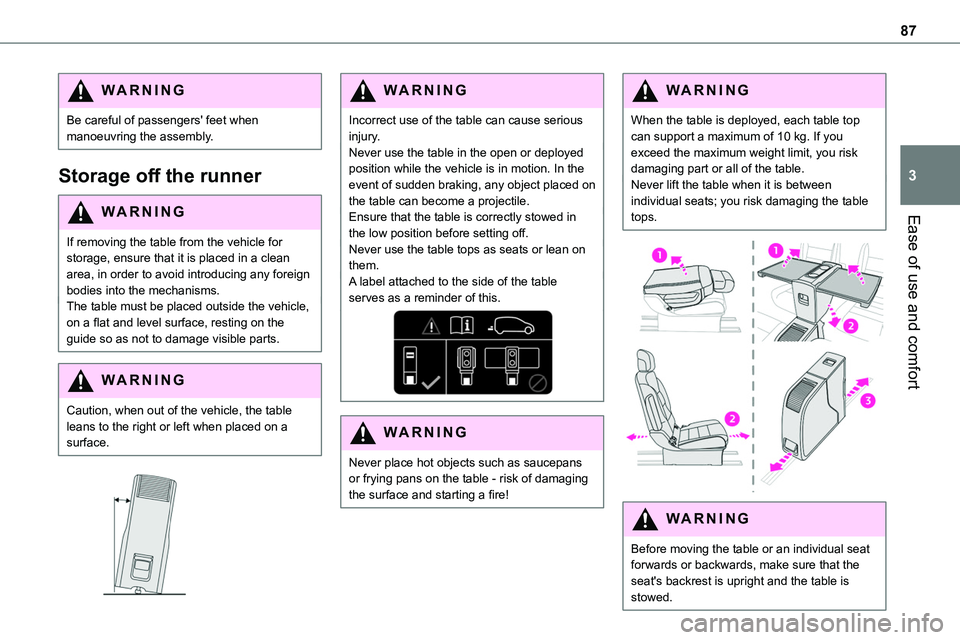
Storage off the runner
WARNI NG
If removing the table from the vehicle for storage, ensure that it is placed in a clean area, in order to avoid introducing any foreign bodies into the mechanisms.The table must be placed outside the vehicle, on a flat and level surface, resting on the guide so as not to damage visible parts.
WARNI NG
Caution, when out of the vehicle, the table leans to the right or left when placed on a surface.
WARNI NG
Incorrect use of the table can cause serious injury.Never use the table in the open or deployed position while the vehicle is in motion. In the event of sudden braking, any object placed on the table can become a projectile.Ensure that the table is correctly stowed in
the low position before setting off.Never use the table tops as seats or lean on them.A label attached to the side of the table serves as a reminder of this.
WARNI NG
Never place hot objects such as saucepans or frying pans on the table - risk of damaging the surface and starting a fire!
WARNI NG
When the table is deployed, each table top can support a maximum of 10 kg. If you exceed the maximum weight limit, you risk damaging part or all of the table.Never lift the table when it is between individual seats; you risk damaging the table tops.
WARNI NG
Before moving the table or an individual seat forwards or backwards, make sure that the seat's backrest is upright and the table is stowed.
Page 105 of 360
105
Lighting and visibility
4
Pause
If the situation requires a change of headlamp beam, the driver can take over at any time.► A "headlamp flash" pauses the function and the lighting system switches to "automatic illumination of lamps" mode:– If the "AUTO" and "Dipped beam" indicator lamps were on, the system changes to main beam.
– If the "AUTO" and "Main beam" indicator lamps were on, the system changes to dipped beam.► To reactivate the function, once again switch the headlamps manually between dipped and main beam.
NOTIC E
Flashing the headlamps does not deactivate the system.The state of the system is stored when the ignition is switched off.
NOTIC E
The system may suffer interference or not work correctly:– under conditions of poor visibility (snow,
heavy rain, etc.),– if the windscreen in front of the camera is dirty, misted or obscured (for example, by a sticker, etc.),
– if the vehicle is facing highly reflective signs.When the system detects thick fog, it temporarily deactivates the function.The system is not able to detect:– road users that do not have their own lighting, such as pedestrians,– vehicles whose lighting is obscured (for example: vehicles running behind a safety
barrier on a motorway),– vehicles at the top or bottom of a steep slope, on winding roads, on crossroads.
WARNI NG
Clean the windscreen regularly, particularly the area in front of the camera.The internal surface of the windscreen can also become misted around the camera. In humid and cold weather, demist the windscreen regularly.Do not allow snow to accumulate on the bonnet or roof of the vehicle as this could obstruct the detection camera.
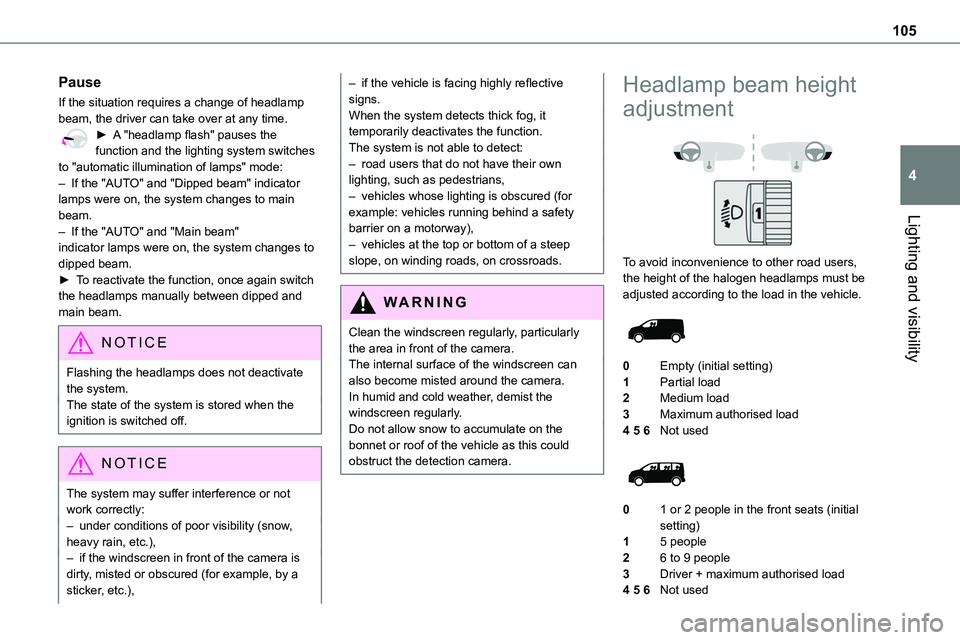
Headlamp beam height
adjustment
To avoid inconvenience to other road users, the height of the halogen headlamps must be adjusted according to the load in the vehicle.
0Empty (initial setting)
1Partial load
2Medium load
3Maximum authorised load
4 5 6Not used
01 or 2 people in the front seats (initial setting)
15 people
26 to 9 people
3Driver + maximum authorised load
4 5 6Not used
Page 119 of 360
11 9
Safety
5
is accompanied by a slight discharge of harmless smoke and a noise, due to the activation of the pyrotechnic cartridge incorporated in the system.In all cases, the airbag warning lamp comes on.Following an impact, have the seat belt system checked, and if necessary replaced, by any authorized Toyota retailer or Toyota
authorized repairer, or any reliable repairer.
Front seat belts
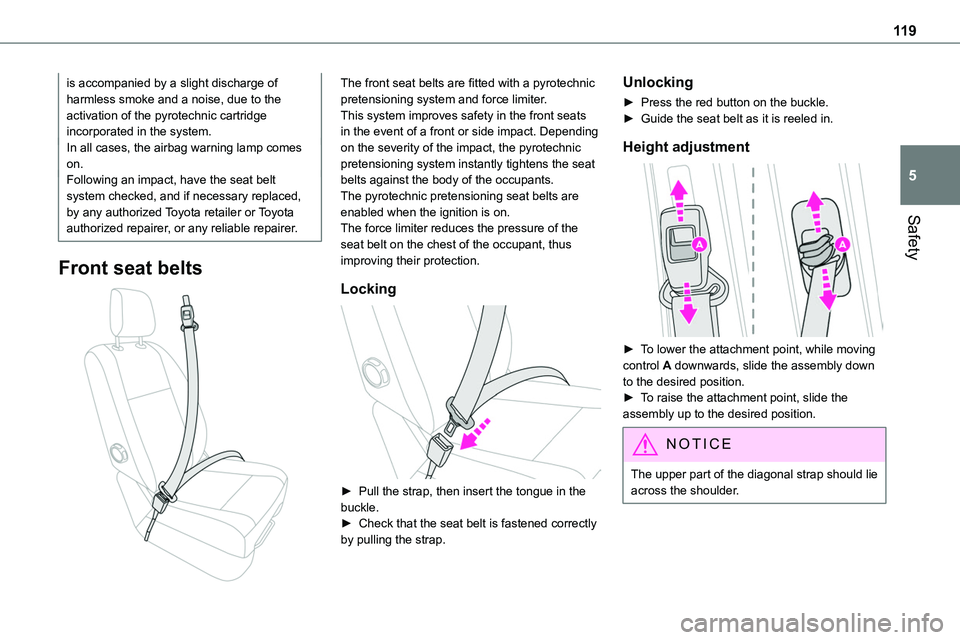
The front seat belts are fitted with a pyrotechnic pretensioning system and force limiter.This system improves safety in the front seats in the event of a front or side impact. Depending on the severity of the impact, the pyrotechnic pretensioning system instantly tightens the seat belts against the body of the occupants.The pyrotechnic pretensioning seat belts are enabled when the ignition is on.
The force limiter reduces the pressure of the seat belt on the chest of the occupant, thus improving their protection.
Locking
► Pull the strap, then insert the tongue in the buckle.► Check that the seat belt is fastened correctly
by pulling the strap.
Unlocking
► Press the red button on the buckle.► Guide the seat belt as it is reeled in.
Height adjustment
► To lower the attachment point, while moving control A downwards, slide the assembly down to the desired position.► To raise the attachment point, slide the assembly up to the desired position.
NOTIC E
The upper part of the diagonal strap should lie across the shoulder.
Page 120 of 360
120
Two-seat front bench seat
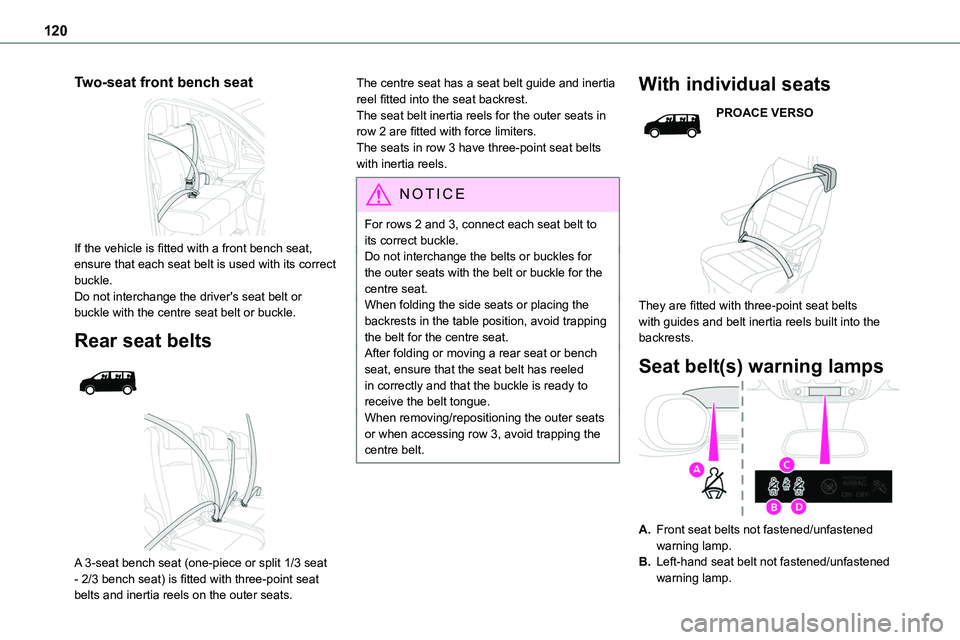
If the vehicle is fitted with a front bench seat, ensure that each seat belt is used with its correct buckle.Do not interchange the driver's seat belt or buckle with the centre seat belt or buckle.
Rear seat belts
A 3-seat bench seat (one-piece or split 1/3 seat - 2/3 bench seat) is fitted with three-point seat
belts and inertia reels on the outer seats.
The centre seat has a seat belt guide and inertia reel fitted into the seat backrest.The seat belt inertia reels for the outer seats in row 2 are fitted with force limiters.The seats in row 3 have three-point seat belts with inertia reels.
NOTIC E
For rows 2 and 3, connect each seat belt to its correct buckle.Do not interchange the belts or buckles for the outer seats with the belt or buckle for the centre seat.When folding the side seats or placing the backrests in the table position, avoid trapping the belt for the centre seat.After folding or moving a rear seat or bench seat, ensure that the seat belt has reeled in correctly and that the buckle is ready to receive the belt tongue.When removing/repositioning the outer seats or when accessing row 3, avoid trapping the centre belt.
With individual seats
PROACE VERSO
They are fitted with three-point seat belts with guides and belt inertia reels built into the backrests.
Seat belt(s) warning lamps
A.Front seat belts not fastened/unfastened warning lamp.
B.Left-hand seat belt not fastened/unfastened warning lamp.