height adjustment TOYOTA PROACE 2023 Owners Manual
[x] Cancel search | Manufacturer: TOYOTA, Model Year: 2023, Model line: PROACE, Model: TOYOTA PROACE 2023Pages: 360, PDF Size: 70.22 MB
Page 2 of 360
2
■Overview
Overview 4Labels 6
■Eco-driving
1Instruments
Instrument Panel 10Warning and indicator lamps 12Indicators 18Lighting dimmer 24Trip computer 24Touch screen 26Remotely operable functions (Electric) 28Setting the date and time 29
2Access
Electronic key with remote control function and built-in key, 30Unlocking/Complete or selective unlocking 32Back-up procedures 36Central locking 39Electric sliding side door(s) 40General recommendations for the sliding side doors 42Hands-free sliding side door(s) 44Side-hinged rear doors 46Tailgate 47Tailgate rear screen 48Alarm 48Electric windows 50
3Ease of use and comfort
Front seats 522-seat front bench seat 54
Steering wheel adjustment 56Mirrors 56Smart Cargo 58Precautions for the seats and bench seats 62Fixed one-piece bench seat 63Fixed rear seat and bench seat 65Rear seat and bench seat on rails 67Individual rear seat(s) on rails 69Crew Cab, fixed 72Crew Cab, folding 73Interior fittings 74Loading area fittings 78Seating area fittings 80Panoramic sunroof 82Retractable sliding table 82Heating and Ventilation 86Heating 87Manual air conditioning 87Dual-zone automatic air conditioning 88Front demisting - defrosting 91Rear screen and/or door mirror demisting/de-icing 91Rear heating - air conditioning 92Additional heating/ventilation system 92A/C preconditioning (Electric) 96Courtesy lamp(s) 96
4Lighting and visibility
Lighting control lever 99Direction indicators 100Daytime running lamps/Sidelamps 101Automatic illumination of headlamps 101Guide-me-home and welcome lighting 101Automatic lighting systems - General recommendations 102Automatic headlamp dipping 103
Headlamp beam height adjustment 104Interior ambient lighting 104Wiper control lever 105Automatic wipers 106Changing a wiper blade 108
5Safety
General safety recommendations 109Hazard warning lamps 11 0Emergency or assistance 11 0Horn 11 2Pedestrian horn (Electric) 11 2Vehicle stability control (VSC) 11 2Toyota Traction Select 11 5Seat belts 11 6Airbags 120Child seats 123Deactivating the front passenger airbag 125ISOFIX and i-Size child seats 131i-Size child seats 143Manual child lock 146Electric child lock 146Child lock on rear windows 147
6Driving
Driving recommendations 148Starting/switching off the engine 150Manual parking brake 155Electric parking brake 155Hill start assist 1586-speed manual gearbox 159Gear efficiency indicator 159Automatic gearbox 160Drive selector (Electric) 164Driving modes (Electric) 165Stop & Start 166
Page 5 of 360
5
Overview
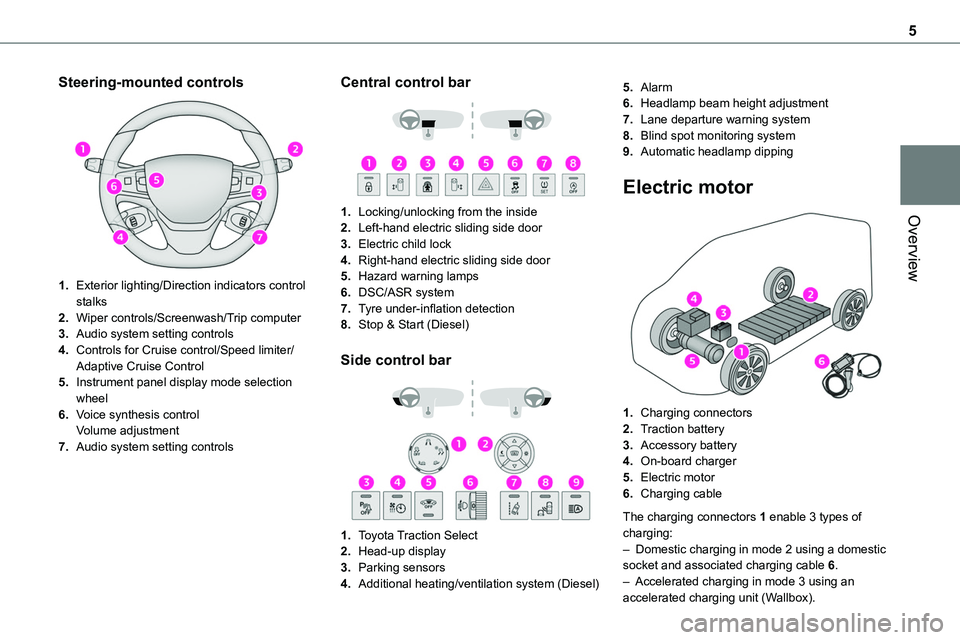
Steering-mounted controls
1.Exterior lighting/Direction indicators control stalks
2.Wiper controls/Screenwash/Trip computer
3.Audio system setting controls
4.Controls for Cruise control/Speed limiter/Adaptive Cruise Control
5.Instrument panel display mode selection wheel
6.Voice synthesis controlVolume adjustment
7.Audio system setting controls
Central control bar
1.Locking/unlocking from the inside
2.Left-hand electric sliding side door
3.Electric child lock
4.Right-hand electric sliding side door
5.Hazard warning lamps
6.DSC/ASR system
7.Tyre under-inflation detection
8.Stop & Start (Diesel)
Side control bar
1.Toyota Traction Select
2.Head-up display
3.Parking sensors
4.Additional heating/ventilation system (Diesel)
5.Alarm
6.Headlamp beam height adjustment
7.Lane departure warning system
8.Blind spot monitoring system
9.Automatic headlamp dipping
Electric motor
1.Charging connectors
2.Traction battery
3.Accessory battery
4.On-board charger
5.Electric motor
6.Charging cable
The charging connectors 1 enable 3 types of charging:– Domestic charging in mode 2 using a domestic socket and associated charging cable 6.– Accelerated charging in mode 3 using an accelerated charging unit (Wallbox).
Page 52 of 360
52
Correct driving position
Before taking to the road and to make the most of the ergonomic layout of the instruments and controls, carry out these adjustments in the following order:– head restraint height.– seat backrest angle.– seat cushion height.
– longitudinal seat position.– steering wheel height and reach.– rear view mirror and door mirrors.
WARNI NG
Once these adjustments have been made, check that the instrument panel can be viewed correctly from your driving position.
Manually-adjusted front
seats
NOTIC E
For more information on the Seat belts, refer to the corresponding section.
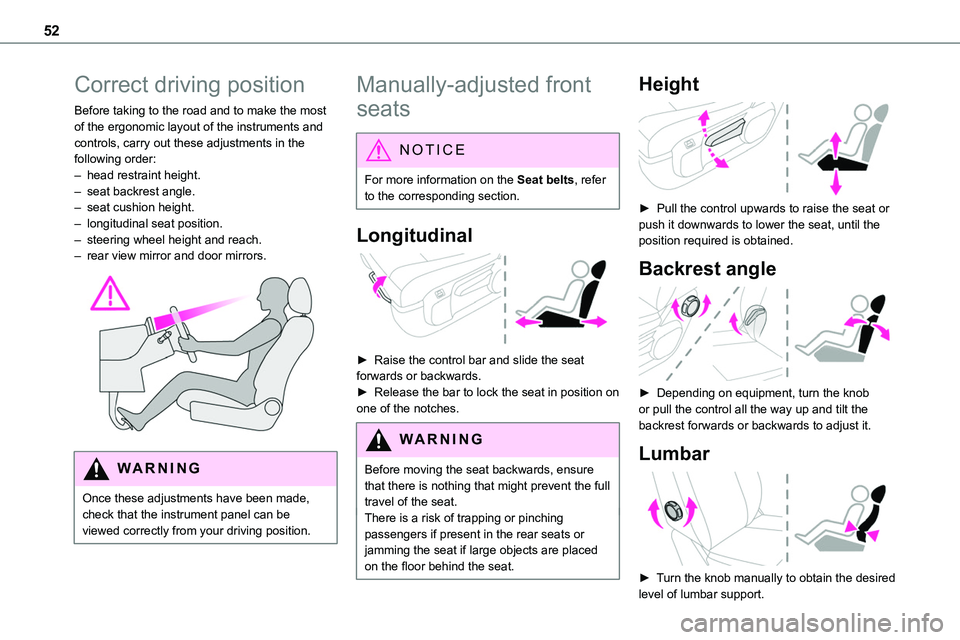
Longitudinal
► Raise the control bar and slide the seat forwards or backwards.► Release the bar to lock the seat in position on one of the notches.
WARNI NG
Before moving the seat backwards, ensure that there is nothing that might prevent the full travel of the seat.There is a risk of trapping or pinching
passengers if present in the rear seats or jamming the seat if large objects are placed on the floor behind the seat.
Height
► Pull the control upwards to raise the seat or
push it downwards to lower the seat, until the position required is obtained.
Backrest angle
► Depending on equipment, turn the knob or pull the control all the way up and tilt the backrest forwards or backwards to adjust it.
Lumbar
► Turn the knob manually to obtain the desired
level of lumbar support.
Page 53 of 360
53
Ease of use and comfort
3
Table position of the driver's
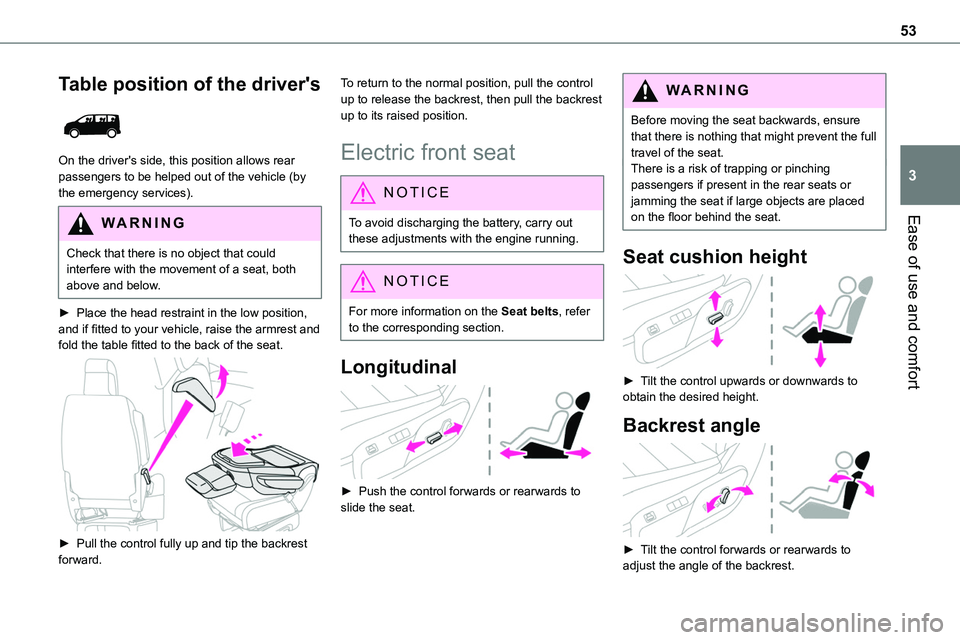
On the driver's side, this position allows rear passengers to be helped out of the vehicle (by the emergency services).
WARNI NG
Check that there is no object that could interfere with the movement of a seat, both above and below.
► Place the head restraint in the low position, and if fitted to your vehicle, raise the armrest and fold the table fitted to the back of the seat.
► Pull the control fully up and tip the backrest forward.
To return to the normal position, pull the control up to release the backrest, then pull the backrest up to its raised position.
Electric front seat
NOTIC E
To avoid discharging the battery, carry out these adjustments with the engine running.
NOTIC E
For more information on the Seat belts, refer to the corresponding section.
Longitudinal
► Push the control forwards or rearwards to slide the seat.
WARNI NG
Before moving the seat backwards, ensure that there is nothing that might prevent the full travel of the seat.There is a risk of trapping or pinching passengers if present in the rear seats or jamming the seat if large objects are placed on the floor behind the seat.
Seat cushion height
► Tilt the control upwards or downwards to obtain the desired height.
Backrest angle
► Tilt the control forwards or rearwards to adjust the angle of the backrest.
Page 54 of 360
54
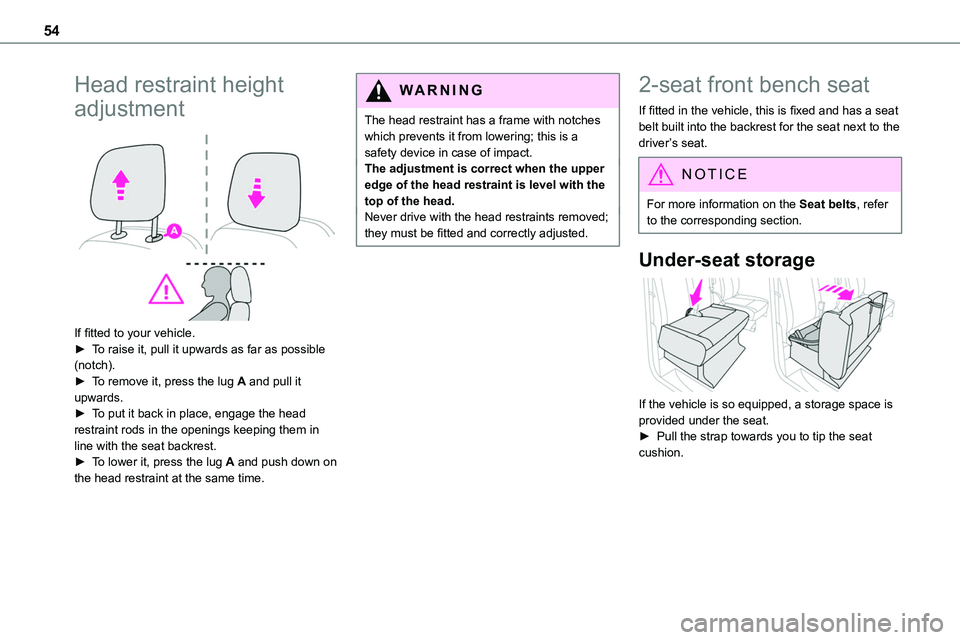
Head restraint height
adjustment
If fitted to your vehicle.► To raise it, pull it upwards as far as possible (notch).► To remove it, press the lug A and pull it upwards.► To put it back in place, engage the head restraint rods in the openings keeping them in line with the seat backrest.► To lower it, press the lug A and push down on the head restraint at the same time.
WARNI NG
The head restraint has a frame with notches which prevents it from lowering; this is a safety device in case of impact.The adjustment is correct when the upper edge of the head restraint is level with the top of the head.Never drive with the head restraints removed;
they must be fitted and correctly adjusted.
2-seat front bench seat
If fitted in the vehicle, this is fixed and has a seat belt built into the backrest for the seat next to the driver’s seat.
NOTIC E
For more information on the Seat belts, refer to the corresponding section.
Under-seat storage
If the vehicle is so equipped, a storage space is provided under the seat.► Pull the strap towards you to tip the seat cushion.
Page 56 of 360
56
This function provides lumbar massage; it only operates when the engine is running as well as in STOP mode of the Stop & Start system.
Activation/Deactivation
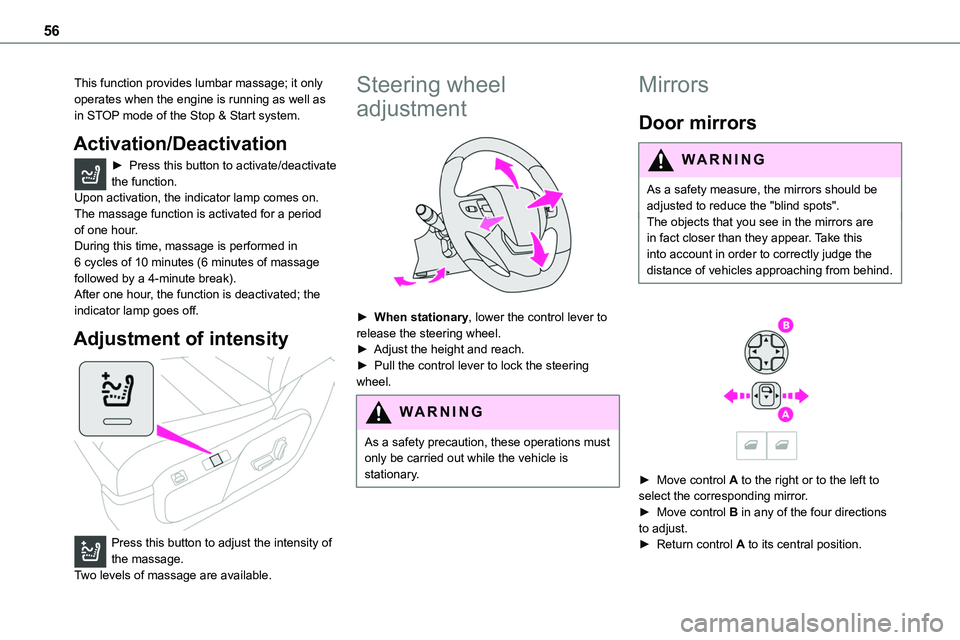
► Press this button to activate/deactivate the function.Upon activation, the indicator lamp comes on. The massage function is activated for a period
of one hour.During this time, massage is performed in 6 cycles of 10 minutes (6 minutes of massage followed by a 4-minute break).After one hour, the function is deactivated; the indicator lamp goes off.
Adjustment of intensity
Press this button to adjust the intensity of the massage.Two levels of massage are available.
Steering wheel
adjustment
► When stationary, lower the control lever to release the steering wheel.► Adjust the height and reach.► Pull the control lever to lock the steering wheel.
WARNI NG
As a safety precaution, these operations must only be carried out while the vehicle is stationary.
Mirrors
Door mirrors
WARNI NG
As a safety measure, the mirrors should be adjusted to reduce the "blind spots".The objects that you see in the mirrors are
in fact closer than they appear. Take this into account in order to correctly judge the distance of vehicles approaching from behind.
► Move control A to the right or to the left to select the corresponding mirror.► Move control B in any of the four directions to adjust.
► Return control A to its central position.
Page 104 of 360
104
– if the vehicle is facing highly reflective signs.When the system detects thick fog, it temporarily deactivates the function.The system is not able to detect:– road users that do not have their own lighting, such as pedestrians,– vehicles whose lighting is obscured (for example: vehicles running behind a safety
barrier on a motorway),– vehicles at the top or bottom of a steep slope, on winding roads, on crossroads.
WARNI NG
Clean the windscreen regularly, particularly the area in front of the camera.The internal surface of the windscreen can also become misted around the camera. In humid and cold weather, demist the windscreen regularly.Do not allow snow to accumulate on the bonnet or roof of the vehicle as this could obstruct the detection camera.
Headlamp beam height
adjustment
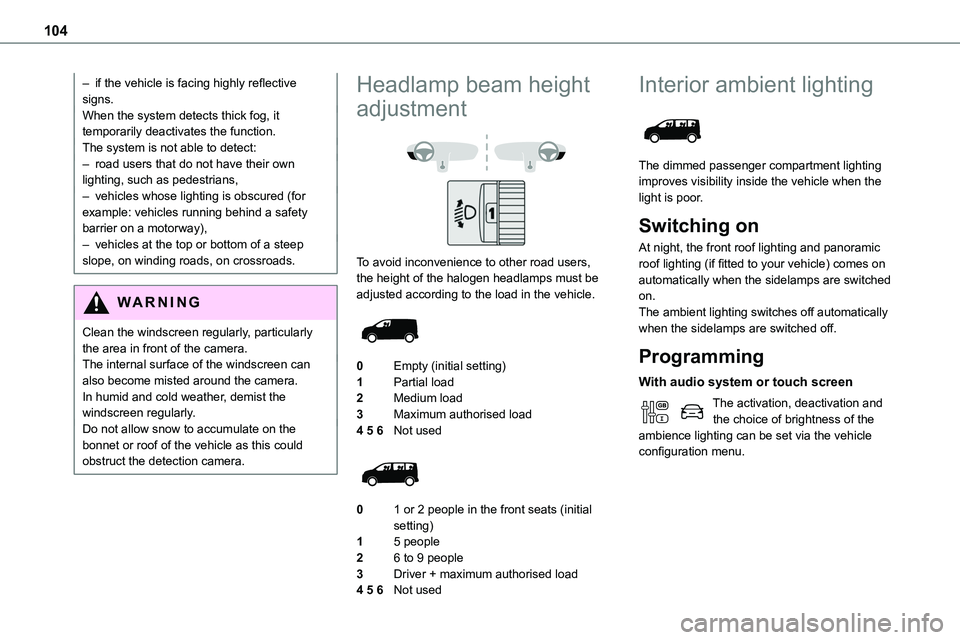
To avoid inconvenience to other road users, the height of the halogen headlamps must be adjusted according to the load in the vehicle.
0Empty (initial setting)
1Partial load
2Medium load
3Maximum authorised load
4 5 6Not used
01 or 2 people in the front seats (initial setting)
15 people
26 to 9 people
3Driver + maximum authorised load
4 5 6Not used
Interior ambient lighting
The dimmed passenger compartment lighting improves visibility inside the vehicle when the light is poor.
Switching on
At night, the front roof lighting and panoramic roof lighting (if fitted to your vehicle) comes on automatically when the sidelamps are switched on.The ambient lighting switches off automatically when the sidelamps are switched off.
Programming
With audio system or touch screen
The activation, deactivation and the choice of brightness of the ambience lighting can be set via the vehicle configuration menu.
Page 117 of 360
11 7
Safety
5
is accompanied by a slight discharge of harmless smoke and a noise, due to the activation of the pyrotechnic cartridge incorporated in the system.In all cases, the airbag warning lamp comes on.Following an impact, have the seat belt system checked, and if necessary replaced, by any authorized Toyota retailer or Toyota
authorized repairer, or any reliable repairer.
Front seat belts
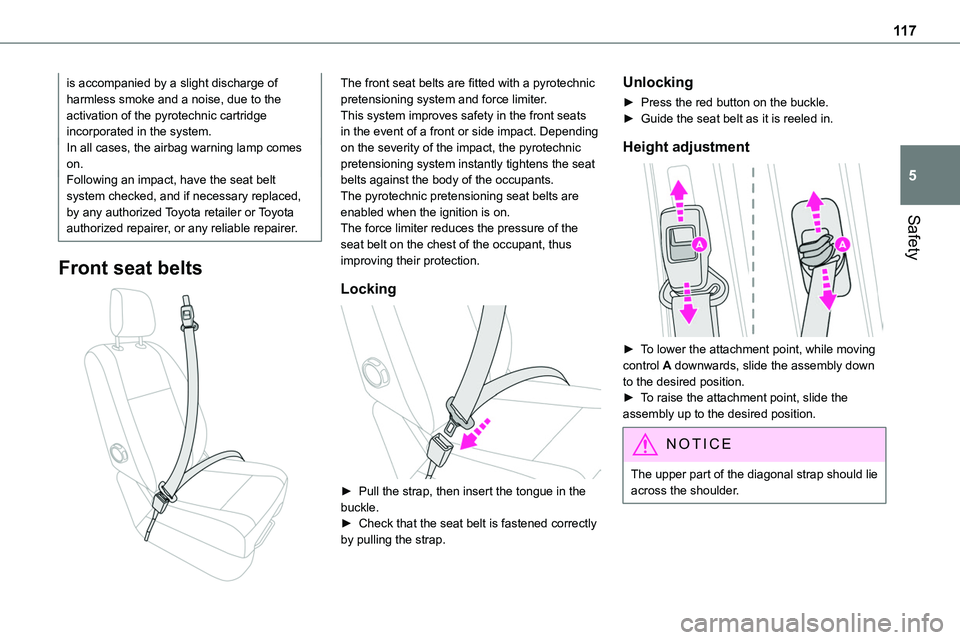
The front seat belts are fitted with a pyrotechnic pretensioning system and force limiter.This system improves safety in the front seats in the event of a front or side impact. Depending on the severity of the impact, the pyrotechnic pretensioning system instantly tightens the seat belts against the body of the occupants.The pyrotechnic pretensioning seat belts are enabled when the ignition is on.
The force limiter reduces the pressure of the seat belt on the chest of the occupant, thus improving their protection.
Locking
► Pull the strap, then insert the tongue in the buckle.► Check that the seat belt is fastened correctly
by pulling the strap.
Unlocking
► Press the red button on the buckle.► Guide the seat belt as it is reeled in.
Height adjustment
► To lower the attachment point, while moving control A downwards, slide the assembly down to the desired position.► To raise the attachment point, slide the assembly up to the desired position.
NOTIC E
The upper part of the diagonal strap should lie across the shoulder.
Page 129 of 360
129
Safety
5
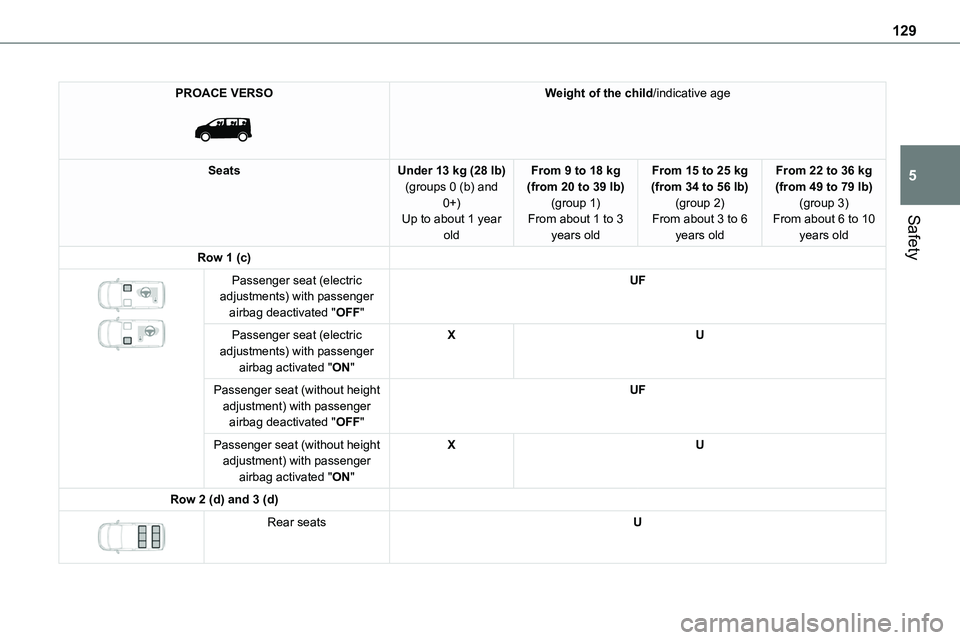
PROACE VERSO
Weight of the child/indicative age
SeatsUnder 13 kg (28 lb)(groups 0 (b) and 0+)Up to about 1 year
old
From 9 to 18 kg (from 20 to 39 lb)(group 1)From about 1 to 3
years old
From 15 to 25 kg (from 34 to 56 lb)(group 2)From about 3 to 6
years old
From 22 to 36 kg (from 49 to 79 lb)(group 3)From about 6 to 10
years old
Row 1 (c)
Passenger seat (electric adjustments) with passenger airbag deactivated "OFF"
UF
Passenger seat (electric adjustments) with passenger airbag activated "ON"
XU
Passenger seat (without height adjustment) with passenger airbag deactivated "OFF"
UF
Passenger seat (without height adjustment) with passenger airbag activated "ON"
XU
Row 2 (d) and 3 (d)
Rear seatsU
Page 148 of 360
148
Driving recommendations
► Observe the driving regulations and remain vigilant whatever the traffic conditions.► Monitor your environment and keep your hands on the wheel to be able to react to anything that may happen any time.► Drive smoothly, anticipate the need for braking and maintain a longer safety distance,
especially in bad weather.► Stop the vehicle to carry out operations that require close attention (such as adjustments).► During long trips, take a break every two hours.To ensure the durability of the vehicle and for safety reasons, remember that certain precautionary measures must be taken when driving the vehicle:
Manoeuvre cautiously, at low speed
Manoeuvre slowly.Before turning, check that there are no obstacles at mid-height along the sides.Before reversing, check that there are no obstacles, particularly at high level behind the vehicle.Be aware of the external dimensions, if ladders are fitted.
Drive the vehicle carefully
Take corners gently.Anticipate the need to brake as the stopping distance is increased, particularly on wet or icy roads.
Be aware of the effect of side winds on the vehicle.
Maintenance
Inflate to the minimum pressure indicated on the label, or even over-inflate by 0.2 to 0.3 bar for long journeys.
Important!
WARNI NG
Never leave the engine running in a closed space without sufficient ventilation. Internal combustion engines emit toxic exhaust gases such as carbon monoxide. Danger of poisoning and death!
WARNI NG
In very severe wintry conditions (temperature below -23°C), let the engine run for 4 minutes before moving off, to ensure the correct operation and durability of the mechanical components of your vehicle (engine and gearbox).
WARNI NG
Never drive with the parking brake applied. Risk of overheating and damaging the braking system!
WARNI NG
Do not park the vehicle or leave the engine running on a flammable surface (e.g. dry grass, dead leaves).The vehicle exhaust system is very hot, even several minutes after the engine stops. Risk of fire!
WARNI NG
Never drive on surfaces covered with vegetation (tall grass, accumulation of dead leaves, crops, debris) such as a field, a country lane overgrown with bushes or a grassy verge.This vegetation could come into contact with the vehicle's exhaust system or other systems which are very hot. Risk of fire!
WARNI NG
Make sure you do not leave any item in the passenger compartment which could act like a magnifying glass under the effect of the sun's rays and cause a fire - risk of fire or damage to interior surface!