fuel TOYOTA PROACE VERSO 2017 User Guide
[x] Cancel search | Manufacturer: TOYOTA, Model Year: 2017, Model line: PROACE VERSO, Model: TOYOTA PROACE VERSO 2017Pages: 504, PDF Size: 81.64 MB
Page 38 of 504
38
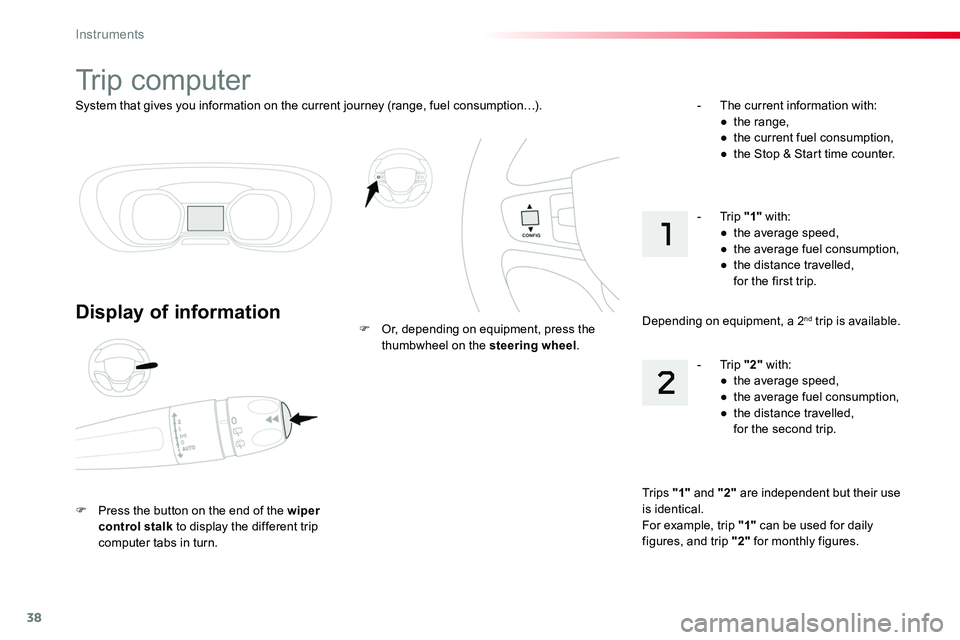
System that gives you information on the current journey (range, fuel consumption…).
Tr i p c o m p u t e r
Display of information
F Press the button on the end of the wiper control stalk to display the different trip computer tabs in turn.
F Or, depending on equipment, press the thumbwheel on the steering wheel.
- The current information with:● the range,● the current fuel consumption,● the Stop & Start time counter.
Tr i p s "1" and "2" are independent but their use is identical.For example, trip "1" can be used for daily figures, and trip "2" for monthly figures.
- Trip "2" with:● the average speed,● the average fuel consumption,● the distance travelled, for the second trip.
- Trip "1" with:● the average speed,● the average fuel consumption,● the distance travelled, for the first trip.
Depending on equipment, a 2nd trip is available.
Instruments
Page 40 of 504
40
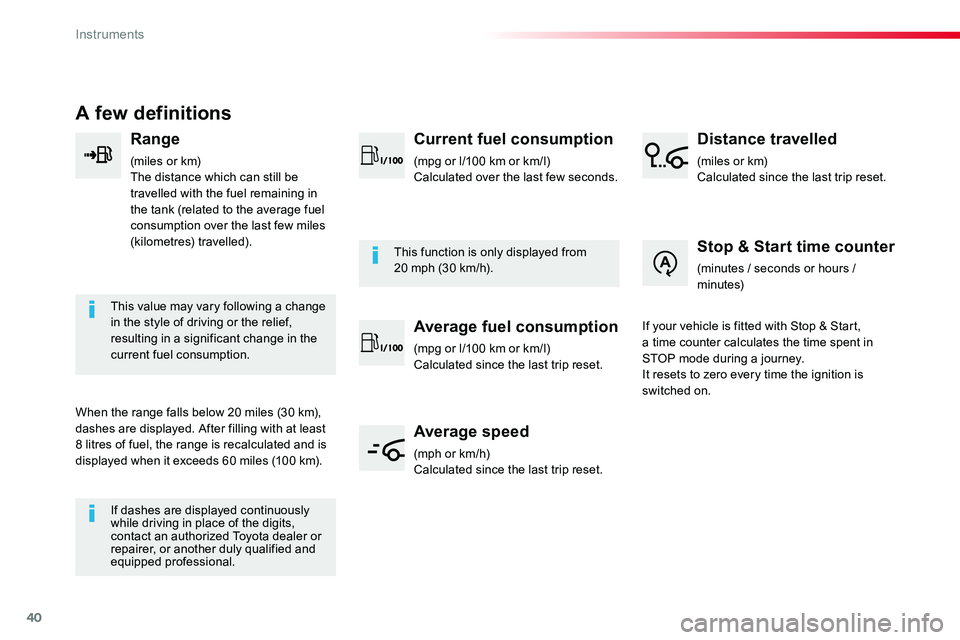
A few definitions
Range
(miles or km)The distance which can still be travelled with the fuel remaining in the tank (related to the average fuel consumption over the last few miles (kilometres) travelled).
This value may vary following a change in the style of driving or the relief, resulting in a significant change in the current fuel consumption.
When the range falls below 20 miles (30 km), dashes are displayed. After filling with at least 8 litres of fuel, the range is recalculated and is displayed when it exceeds 60 miles (100 km).
If dashes are displayed continuously while driving in place of the digits, contact an authorized Toyota dealer or repairer, or another duly qualified and equipped professional.
This function is only displayed from 20 mph (30 km/h).
Current fuel consumption
(mpg or l/100 km or km/l)Calculated over the last few seconds.
Average fuel consumption
(mpg or l/100 km or km/l)Calculated since the last trip reset.
Average speed
(mph or km/h)Calculated since the last trip reset.
Distance travelled
(miles or km)Calculated since the last trip reset.
Stop & Start time counter
(minutes / seconds or hours / minutes)
If your vehicle is fitted with Stop & Start, a time counter calculates the time spent in STOP mode during a journey.It resets to zero every time the ignition is switched on.
Instruments
Page 45 of 504
45
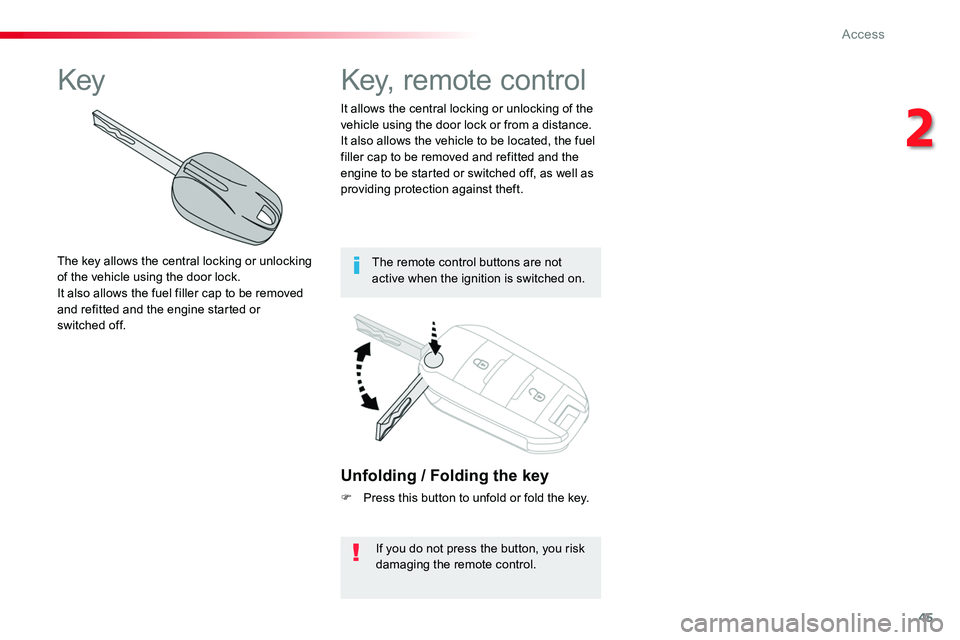
Unfolding / Folding the key
F Press this button to unfold or fold the key.
If you do not press the button, you risk damaging the remote control.
It allows the central locking or unlocking of the vehicle using the door lock or from a distance.It also allows the vehicle to be located, the fuel filler cap to be removed and refitted and the engine to be started or switched off, as well as providing protection against theft.
Key, remote control
The remote control buttons are not active when the ignition is switched on.
Key
The key allows the central locking or unlocking of the vehicle using the door lock.It also allows the fuel filler cap to be removed and refitted and the engine started or switched off.
2
Access
Page 69 of 504
69
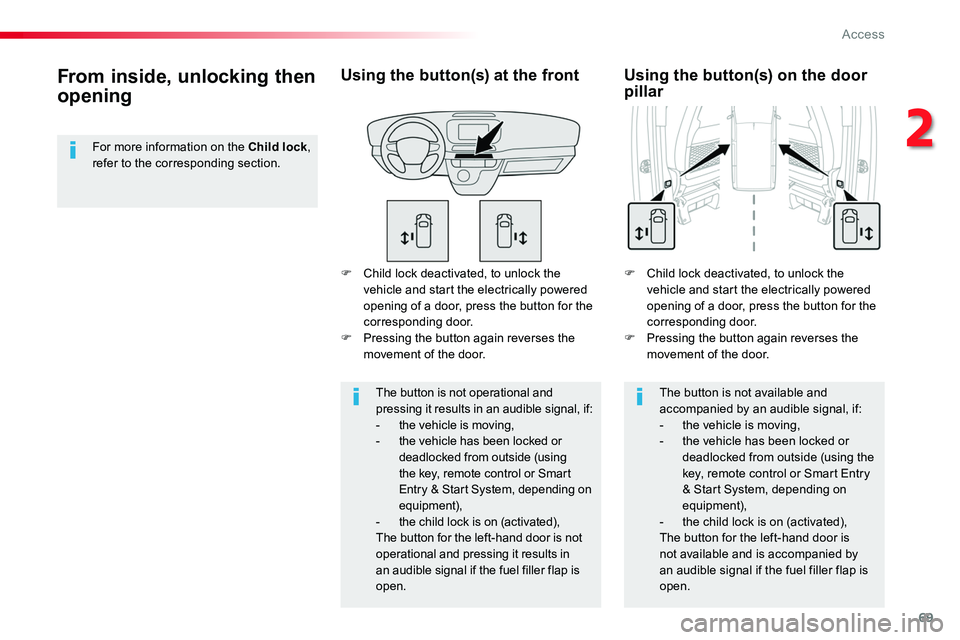
F Child lock deactivated, to unlock the vehicle and start the electrically powered opening of a door, press the button for the corresponding door.F Pressing the button again reverses the movement of the door.
The button is not operational and pressing it results in an audible signal, if:- the vehicle is moving,- the vehicle has been locked or deadlocked from outside (using the key, remote control or Smart Entry & Start System, depending on equipment),- the child lock is on (activated),
The button for the left-hand door is not operational and pressing it results in an audible signal if the fuel filler flap is open.
The button is not available and accompanied by an audible signal, if:- the vehicle is moving,- the vehicle has been locked or deadlocked from outside (using the key, remote control or Smart Entry & Start System, depending on equipment),- the child lock is on (activated),
The button for the left-hand door is not available and is accompanied by an audible signal if the fuel filler flap is open.
Using the button(s) at the frontFrom inside, unlocking then
opening
Using the button(s) on the door pillar
F Child lock deactivated, to unlock the vehicle and start the electrically powered opening of a door, press the button for the corresponding door.F Pressing the button again reverses the movement of the door.
For more information on the Child lock, refer to the corresponding section.
2
Access
Page 73 of 504
73
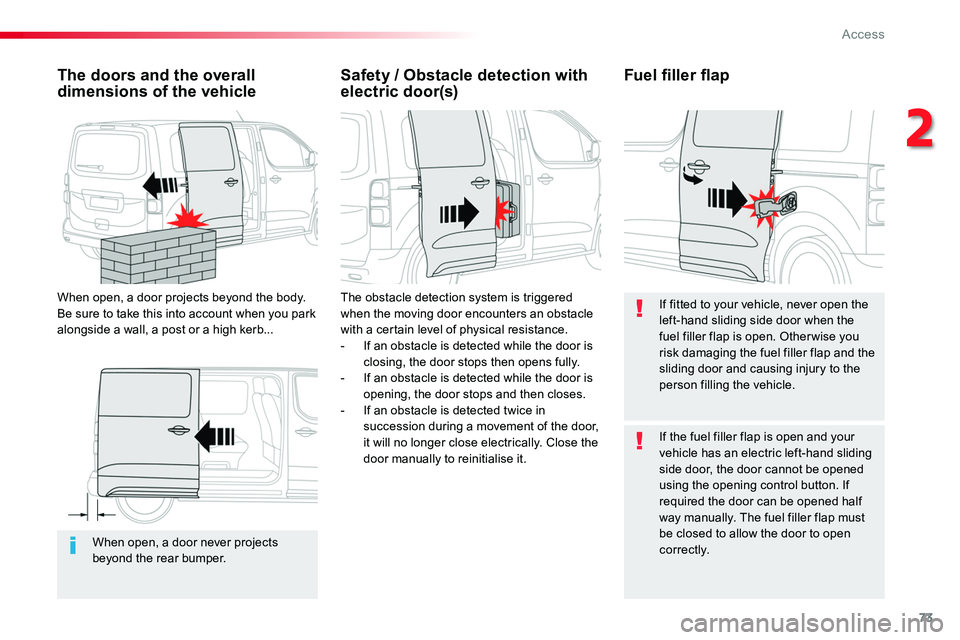
When open, a door never projects beyond the rear bumper.
The doors and the overall dimensions of the vehicle
When open, a door projects beyond the body. Be sure to take this into account when you park alongside a wall, a post or a high kerb...
Safety / Obstacle detection with electric door(s)Fuel filler flap
The obstacle detection system is triggered when the moving door encounters an obstacle with a certain level of physical resistance.- If an obstacle is detected while the door is closing, the door stops then opens fully.- If an obstacle is detected while the door is opening, the door stops and then closes.- If an obstacle is detected twice in succession during a movement of the door, it will no longer close electrically. Close the door manually to reinitialise it.
If fitted to your vehicle, never open the left-hand sliding side door when the fuel filler flap is open. Otherwise you risk damaging the fuel filler flap and the sliding door and causing injury to the person filling the vehicle.
If the fuel filler flap is open and your vehicle has an electric left-hand sliding side door, the door cannot be opened using the opening control button. If required the door can be opened half way manually. The fuel filler flap must be closed to allow the door to open c o r r e c t l y.
2
Access
Page 83 of 504
83
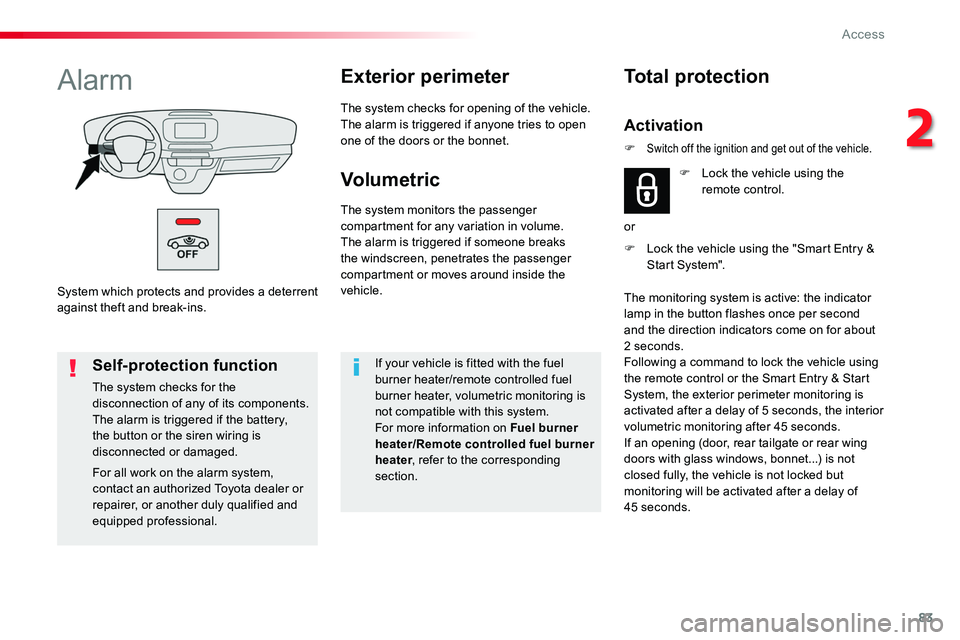
System which protects and provides a deterrent against theft and break-ins.
AlarmExterior perimeter
The system checks for opening of the vehicle.The alarm is triggered if anyone tries to open one of the doors or the bonnet.
Self-protection function
The system checks for the disconnection of any of its components.The alarm is triggered if the battery, the button or the siren wiring is disconnected or damaged.
For all work on the alarm system, contact an authorized Toyota dealer or repairer, or another duly qualified and equipped professional.
Volumetric
The system monitors the passenger compartment for any variation in volume.The alarm is triggered if someone breaks the windscreen, penetrates the passenger compartment or moves around inside the vehicle.
If your vehicle is fitted with the fuel burner heater/remote controlled fuel burner heater, volumetric monitoring is not compatible with this system.For more information on Fuel burner heater/Remote controlled fuel burner heater, refer to the corresponding section.
F Lock the vehicle using the "Smart Entry & Start System".
Total protection
Activation
F Lock the vehicle using the remote control.
or
The monitoring system is active: the indicator lamp in the button flashes once per second and the direction indicators come on for about 2 seconds.Following a command to lock the vehicle using the remote control or the Smart Entry & Start System, the exterior perimeter monitoring is activated after a delay of 5 seconds, the interior volumetric monitoring after 45 seconds.If an opening (door, rear tailgate or rear wing doors with glass windows, bonnet...) is not closed fully, the vehicle is not locked but monitoring will be activated after a delay of 45 seconds.
F Switch off the ignition and get out of the vehicle.
2
Access
Page 132 of 504
132
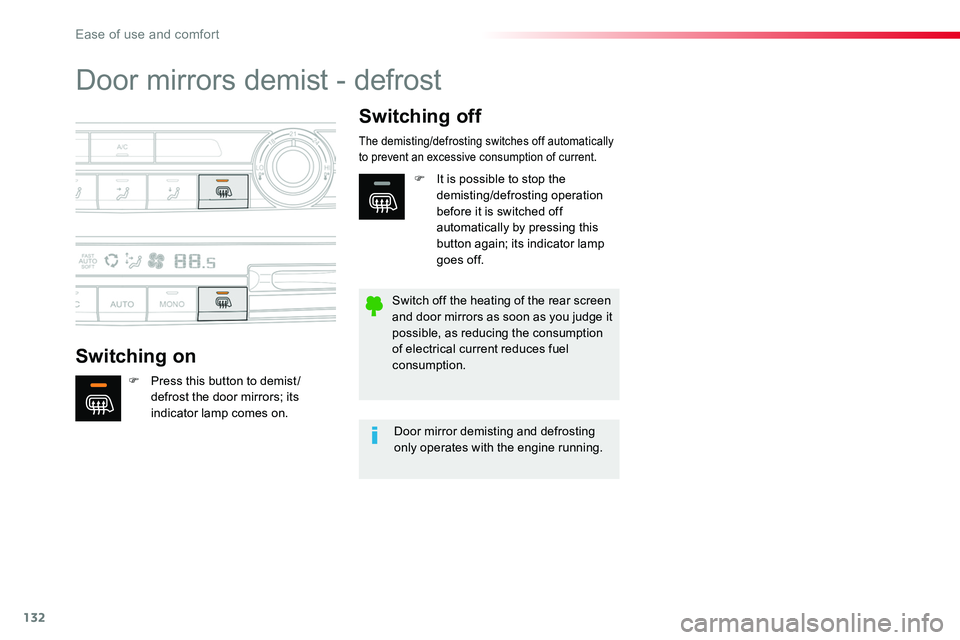
Door mirrors demist - defrost
Switching on
Switching off
F Press this button to demist /defrost the door mirrors; its indicator lamp comes on.
The demisting/defrosting switches off automatically to prevent an excessive consumption of current.
Door mirror demisting and defrosting only operates with the engine running.
Switch off the heating of the rear screen and door mirrors as soon as you judge it possible, as reducing the consumption of electrical current reduces fuel consumption.
F It is possible to stop the demisting/defrosting operation before it is switched off automatically by pressing this button again; its indicator lamp goes off.
Ease of use and comfort
Page 133 of 504
133
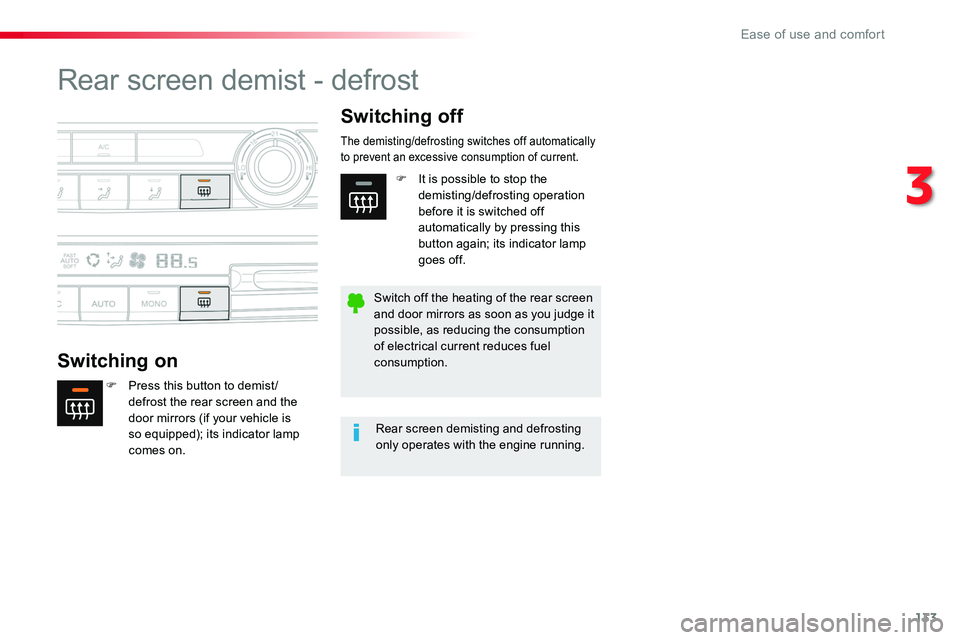
Rear screen demist - defrost
Switching on
Switching off
F Press this button to demist /defrost the rear screen and the door mirrors (if your vehicle is
so equipped); its indicator lamp comes on.
The demisting/defrosting switches off automatically to prevent an excessive consumption of current.
Rear screen demisting and defrosting
only operates with the engine running.
Switch off the heating of the rear screen and door mirrors as soon as you judge it possible, as reducing the consumption of electrical current reduces fuel consumption.
F It is possible to stop the demisting/defrosting operation before it is switched off automatically by pressing this button again; its indicator lamp goes off.
3
Ease of use and comfort
Page 137 of 504
137
Heating
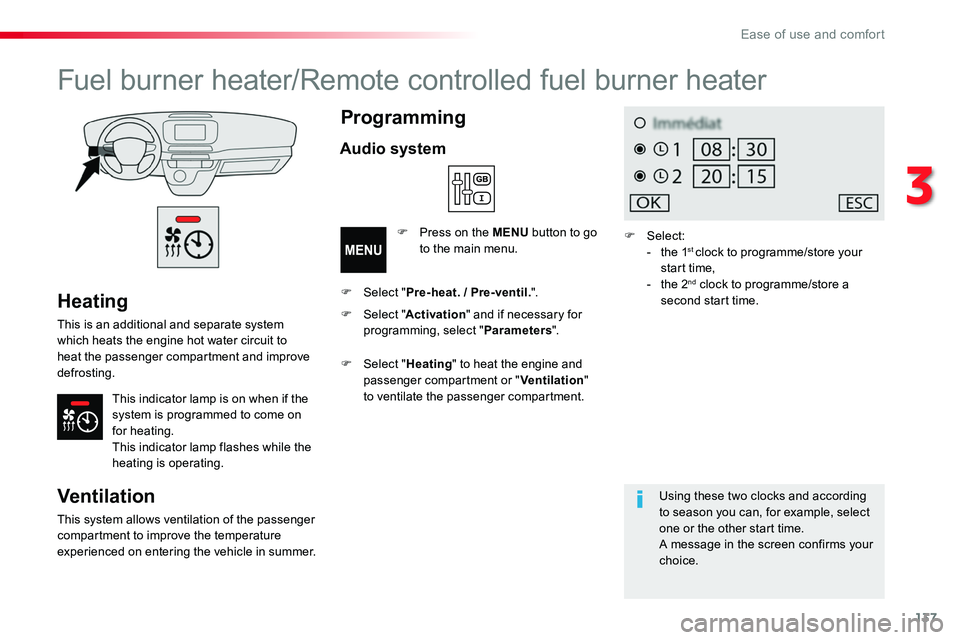
This is an additional and separate system which heats the engine hot water circuit to heat the passenger compartment and improve defrosting.
This indicator lamp is on when if the system is programmed to come on for heating.This indicator lamp flashes while the heating is operating.
Fuel burner heater/Remote controlled fuel burner heater
Ventilation
This system allows ventilation of the passenger
compartment to improve the temperature experienced on entering the vehicle in summer.
Programming
Audio system
F Press on the MENU button to go to the main menu.
F Select "Pre-heat. / Pre-ventil.".
F Select "Heating" to heat the engine and passenger compartment or "Ventilation" to ventilate the passenger compartment.
F Select:- the 1st clock to programme/store your start time,- the 2nd clock to programme/store a second start time.
Using these two clocks and according to season you can, for example, select one or the other start time.
A message in the screen confirms your choice.
F Select "Activation" and if necessary for programming, select "Parameters".
3
Ease of use and comfort
Page 139 of 504
139
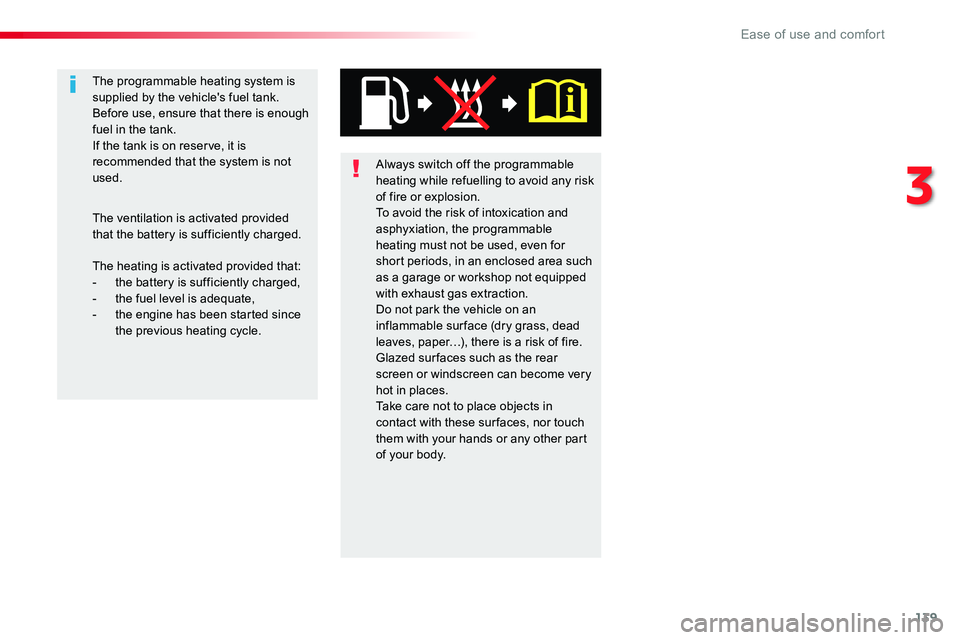
Always switch off the programmable heating while refuelling to avoid any risk of fire or explosion.To avoid the risk of intoxication and asphyxiation, the programmable heating must not be used, even for short periods, in an enclosed area such as a garage or workshop not equipped with exhaust gas extraction.Do not park the vehicle on an inflammable sur face (dry grass, dead leaves, paper…), there is a risk of fire.Glazed sur faces such as the rear screen or windscreen can become very hot in places.Take care not to place objects in contact with these sur faces, nor touch them with your hands or any other part of your body.
The heating is activated provided that:- the battery is sufficiently charged,- the fuel level is adequate,- the engine has been started since the previous heating cycle.
The programmable heating system is supplied by the vehicle's fuel tank.Before use, ensure that there is enough fuel in the tank.If the tank is on reserve, it is recommended that the system is not used.
The ventilation is activated provided that the battery is sufficiently charged.
3
Ease of use and comfort