bonnet TOYOTA PROACE VERSO 2017 Owners Manual
[x] Cancel search | Manufacturer: TOYOTA, Model Year: 2017, Model line: PROACE VERSO, Model: TOYOTA PROACE VERSO 2017Pages: 504, PDF Size: 81.64 MB
Page 4 of 504
4
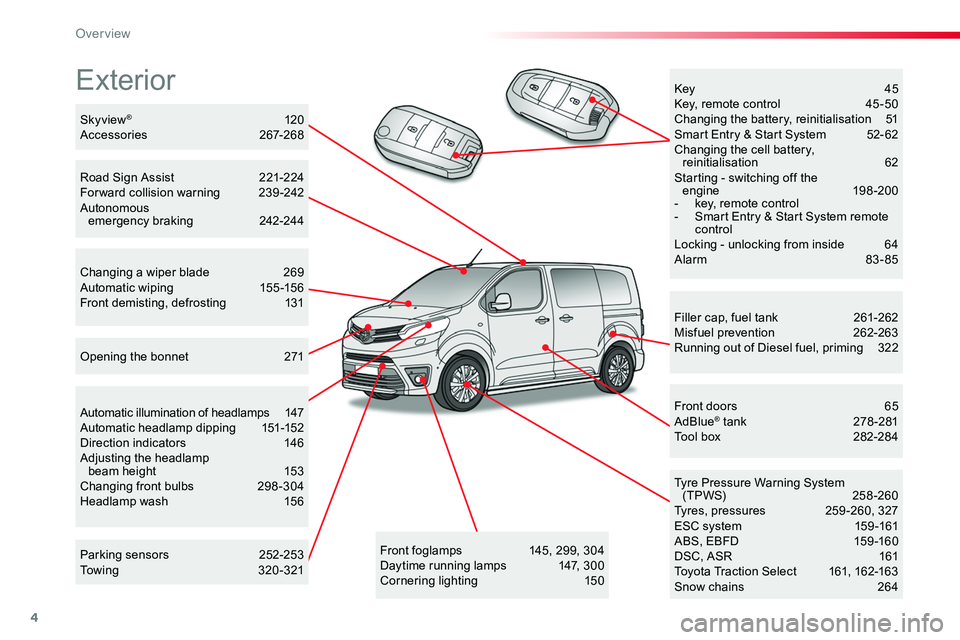
Exterior
Filler cap, fuel tank 261-262Misfuel prevention 262-263Running out of Diesel fuel, priming 322
Tyre Pressure Warning System (TPWS) 258-260Tyres, pressures 259 -260, 327ESC system 159 -161ABS, EBFD 159 -160DSC, ASR 161Toyota Traction Select 161, 162-163Snow chains 264
Front doors 65AdBlue® tank 278-281Tool box 282-284
Automatic illumination of headlamps 147Automatic headlamp dipping 151-152Direction indicators 146Adjusting the headlamp beam height 153Changing front bulbs 298-304Headlamp wash 156
Skyview® 120Accessories 267-268
Opening the bonnet 271
Key 45Key, remote control 45 -50Changing the battery, reinitialisation 51Smart Entry & Start System 52- 62Changing the cell battery, reinitialisation 62Starting - switching off the engine 198-200- key, remote control- Smart Entry & Start System remote controlLocking - unlocking from inside 64Alarm 83-85
Road Sign Assist 221-224For ward collision warning 239 -242Autonomous emergency braking 242-244
Changing a wiper blade 269Automatic wiping 155-156Front demisting, defrosting 131
Front foglamps 145, 299, 304Daytime running lamps 147, 300Cornering lighting 150
Parking sensors 252-253Towing 320-321
Over view
Page 6 of 504
6
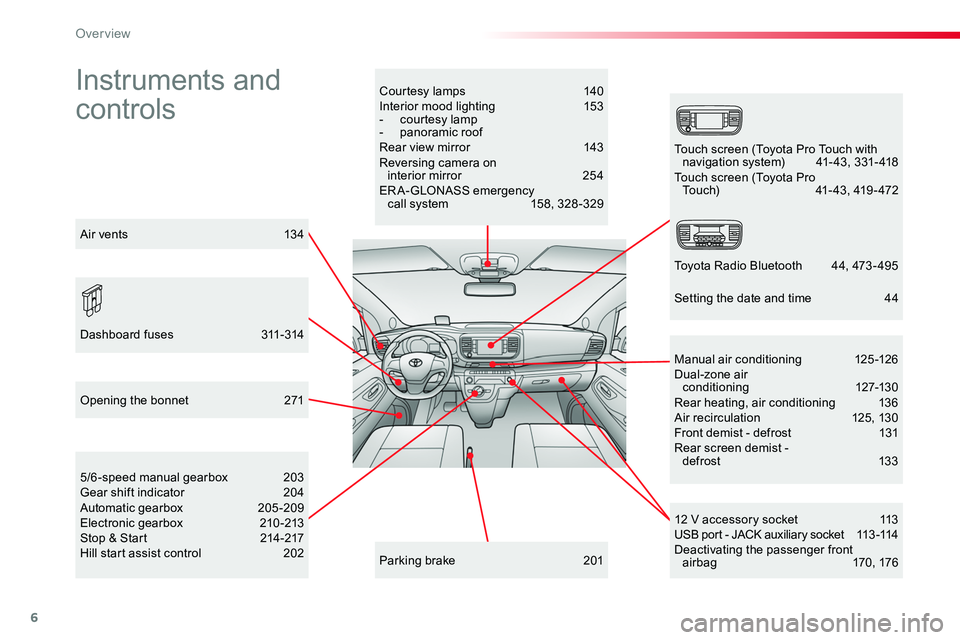
Instruments and
controls
Courtesy lamps 140Interior mood lighting 153- courtesy lamp- panoramic roofRear view mirror 143Reversing camera on interior mirror 254ERA-GLONASS emergency call system 158, 328 -329
12 V accessory socket 113USB port - JACK auxiliary socket 113 -114Deactivating the passenger front a i r b a g 170, 176
5/6-speed manual gearbox 203Gear shift indicator 204Automatic gearbox 205-209Electronic gearbox 210-213Stop & Start 214-217Hill start assist control 202
Manual air conditioning 125-126Dual-zone air conditioning 127-130Rear heating, air conditioning 136Air recirculation 125, 130Front demist - defrost 131Rear screen demist - def rost 13 3
Parking brake 201
Opening the bonnet 271
Dashboard fuses 311-314
Touch screen (Toyota Pro Touch with navigation system) 41- 43, 331- 418Touch screen (Toyota Pro To u c h) 41- 4 3 , 419 - 47 2
Toyota Radio Bluetooth 44, 473 - 495
Air vents 134
Setting the date and time 44
Over view
Page 9 of 504
9
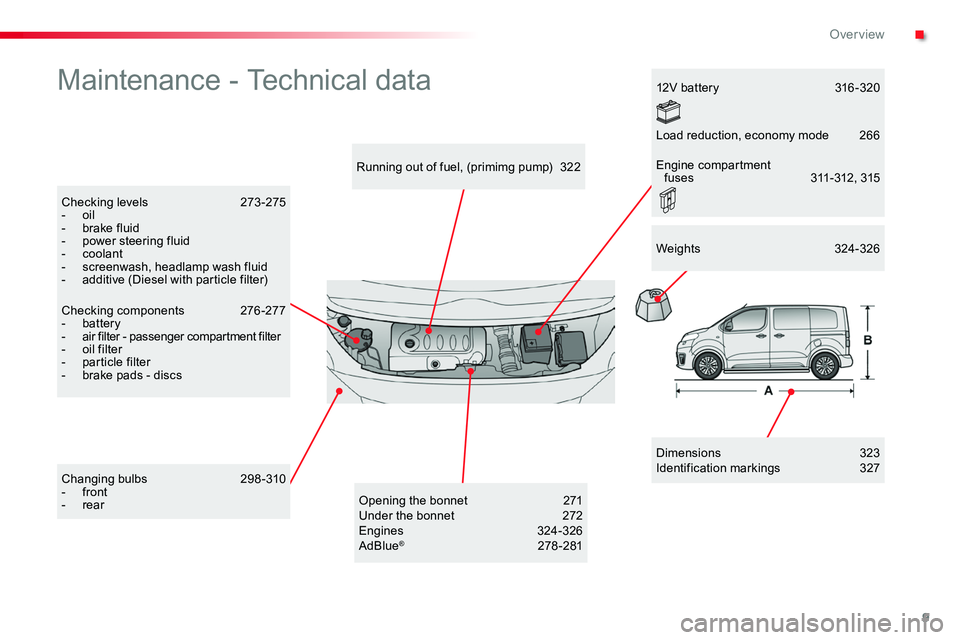
Maintenance - Technical data
Dimensions 323Identification markings 327
Running out of fuel, (primimg pump) 322
Checking levels 273 -275- oil- brake fluid- power steering fluid- coolant- screenwash, headlamp wash fluid- additive (Diesel with particle filter)
Checking components 276-277- battery- air filter - passenger compartment filter- oil filter- particle filter- brake pads - discs
Changing bulbs 298-310- front- rear
12V battery 316 -320
Opening the bonnet 271Under the bonnet 272Engines 324-326AdBlue® 278 -281
Weights 324-326
Load reduction, economy mode 266
Engine compartment fuses 311- 312, 315
.
Over view
Page 83 of 504
83
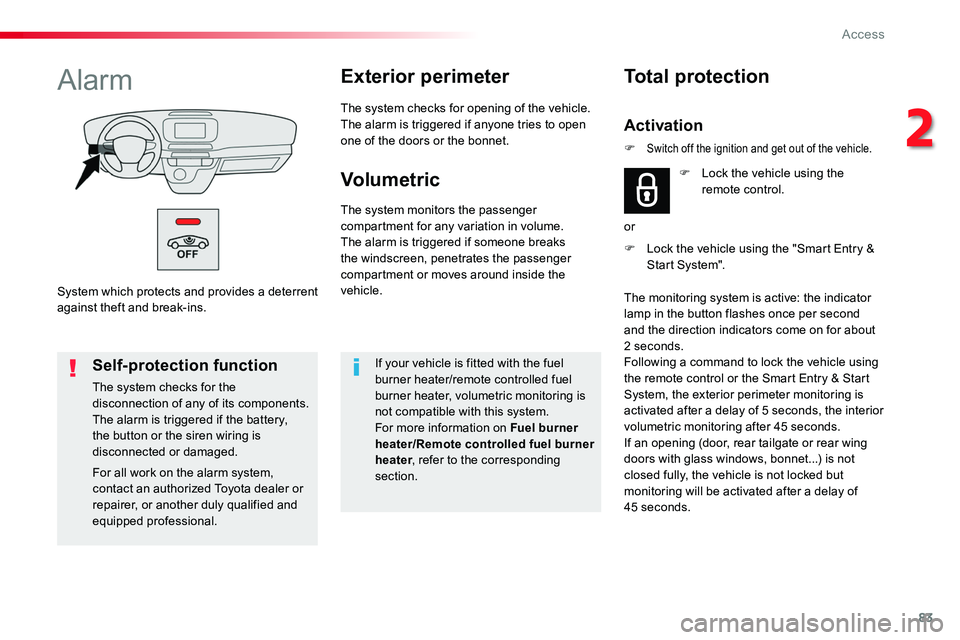
System which protects and provides a deterrent against theft and break-ins.
AlarmExterior perimeter
The system checks for opening of the vehicle.The alarm is triggered if anyone tries to open one of the doors or the bonnet.
Self-protection function
The system checks for the disconnection of any of its components.The alarm is triggered if the battery, the button or the siren wiring is disconnected or damaged.
For all work on the alarm system, contact an authorized Toyota dealer or repairer, or another duly qualified and equipped professional.
Volumetric
The system monitors the passenger compartment for any variation in volume.The alarm is triggered if someone breaks the windscreen, penetrates the passenger compartment or moves around inside the vehicle.
If your vehicle is fitted with the fuel burner heater/remote controlled fuel burner heater, volumetric monitoring is not compatible with this system.For more information on Fuel burner heater/Remote controlled fuel burner heater, refer to the corresponding section.
F Lock the vehicle using the "Smart Entry & Start System".
Total protection
Activation
F Lock the vehicle using the remote control.
or
The monitoring system is active: the indicator lamp in the button flashes once per second and the direction indicators come on for about 2 seconds.Following a command to lock the vehicle using the remote control or the Smart Entry & Start System, the exterior perimeter monitoring is activated after a delay of 5 seconds, the interior volumetric monitoring after 45 seconds.If an opening (door, rear tailgate or rear wing doors with glass windows, bonnet...) is not closed fully, the vehicle is not locked but monitoring will be activated after a delay of 45 seconds.
F Switch off the ignition and get out of the vehicle.
2
Access
Page 213 of 504
213
With the ignition on, the flashing of A or AUTO, accompanied by an audible signal and a message, indicates a malfunction of the gearbox.
Operating fault
Have it checked by an authorized Toyota dealer or repairer, or another duly qualified and equipped professional.
Stopping the vehicle
Before switching off the engine, you can:- move to position N to engage neutral,or- leave the gear engaged; in this case, it will not be possible to move the vehicle.In both cases, you must apply the parking brake to immobilise the vehicle.
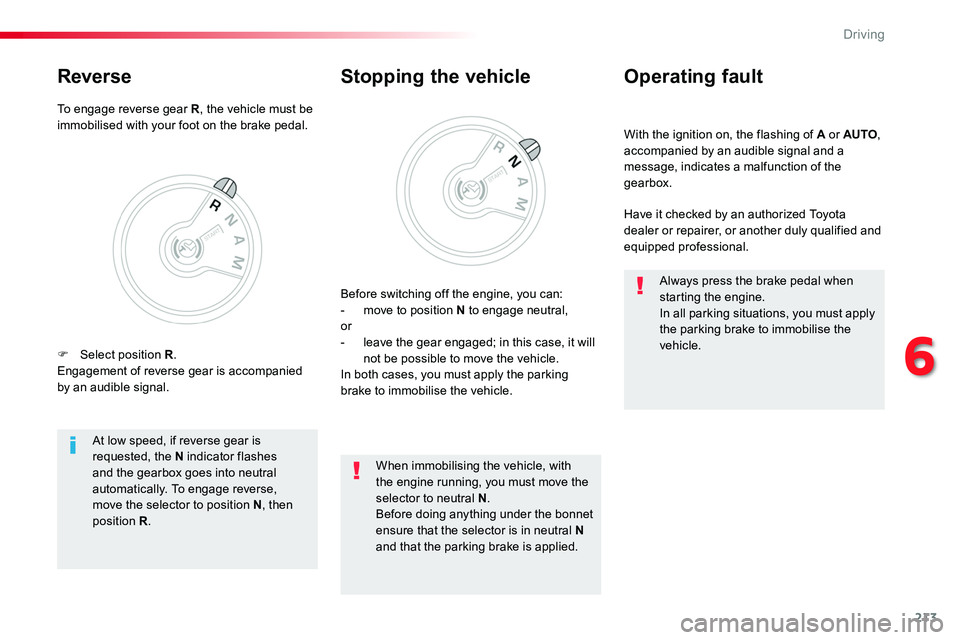
At low speed, if reverse gear is requested, the N indicator flashes and the gearbox goes into neutral automatically. To engage reverse, move the selector to position N, then position R.
When immobilising the vehicle, with the engine running, you must move the selector to neutral N.Before doing anything under the bonnet ensure that the selector is in neutral N
and that the parking brake is applied.
Always press the brake pedal when starting the engine.In all parking situations, you must apply the parking brake to immobilise the vehicle.
To engage reverse gear R, the vehicle must be immobilised with your foot on the brake pedal.
Reverse
F Select position R.Engagement of reverse gear is accompanied by an audible signal.
6
Driving
Page 216 of 504
216
Deactivation / Activation
With the audio system
F Press the button, its indicator lamp comes on, the system is deactivated.
F Press this button, the indicator lamp goes off, the system is activated.
To deactivate the system:
With the touch screen
In the Driving menu, activate/deactivate "Stop & Star t system".
The system is reactivated automatically every time the engine is started by the driver.
If the system has been deactivated in STOP mode, the engine restarts immediately.
Opening the bonnetBefore doing anything under the bonnet, deactivate the Stop & Start system to avoid the risk of injury related to an automatic change to S TA R T m o d e .
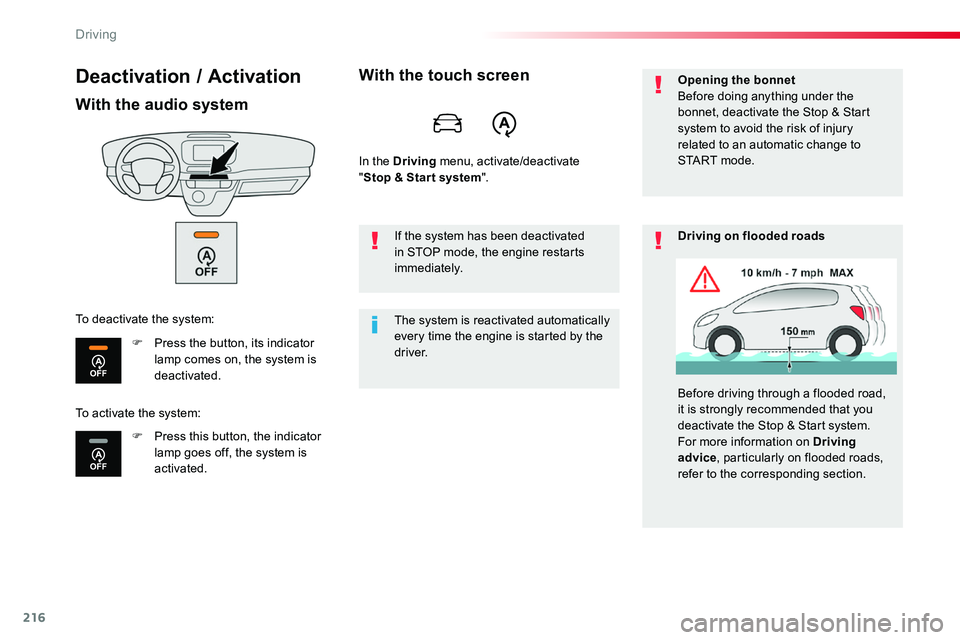
Driving on flooded roads
Before driving through a flooded road, it is strongly recommended that you deactivate the Stop & Start system.For more information on Driving advice, particularly on flooded roads, refer to the corresponding section.
To activate the system:
Driving
Page 244 of 504
244
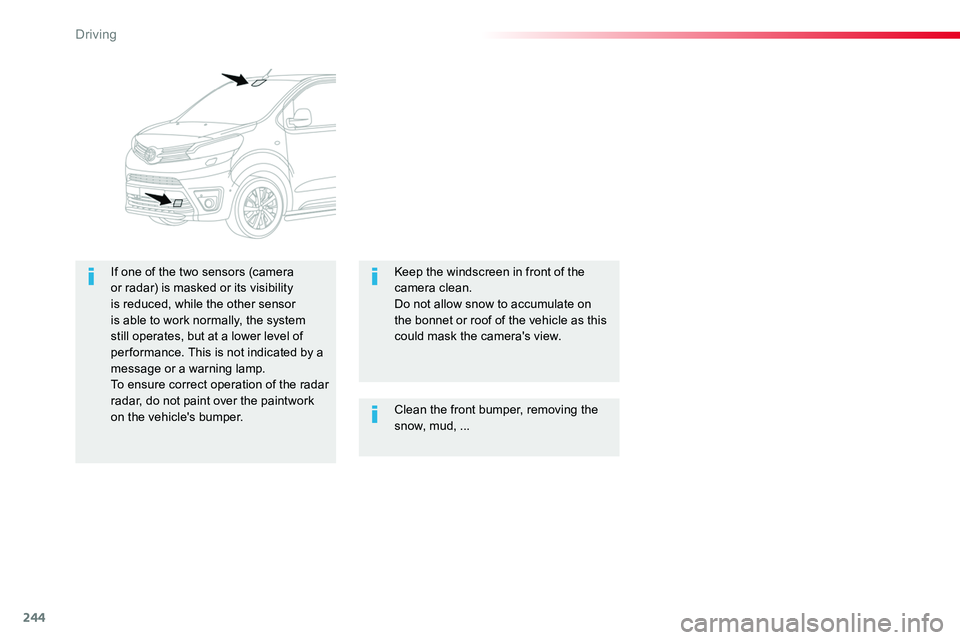
Clean the front bumper, removing the snow, mud, ...
If one of the two sensors (camera or radar) is masked or its visibility is reduced, while the other sensor is able to work normally, the system still operates, but at a lower level of per formance. This is not indicated by a message or a warning lamp.To ensure correct operation of the radar radar, do not paint over the paintwork on the vehicle's bumper.
Keep the windscreen in front of the camera clean.Do not allow snow to accumulate on the bonnet or roof of the vehicle as this could mask the camera's view.
Driving
Page 271 of 504
271
BonnetOpening
Closing
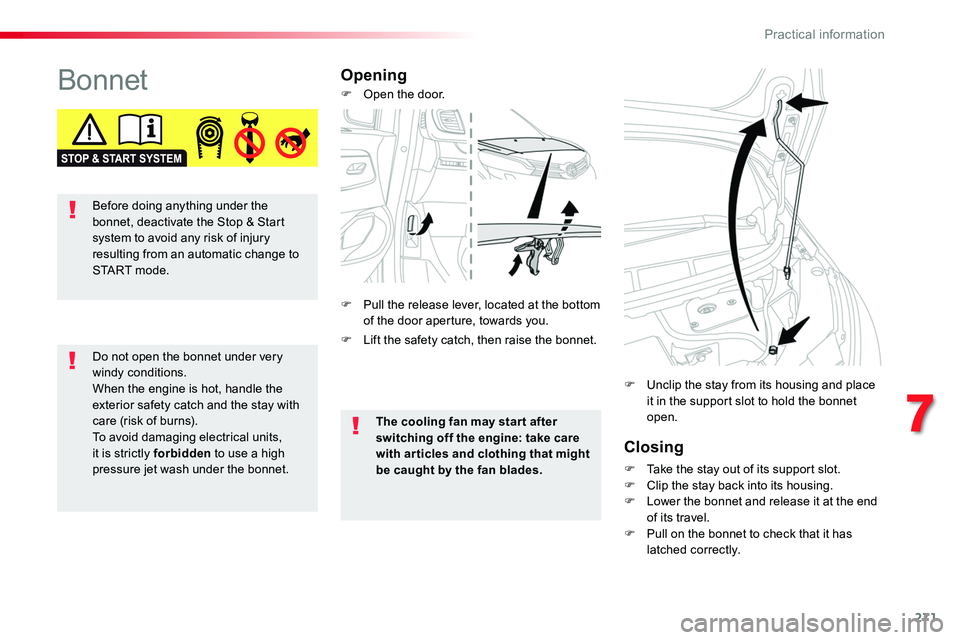
F Take the stay out of its support slot.F Clip the stay back into its housing.F Lower the bonnet and release it at the end of its travel.F Pull on the bonnet to check that it has latched correctly.
F Unclip the stay from its housing and place it in the support slot to hold the bonnet open.
Do not open the bonnet under very windy conditions.When the engine is hot, handle the exterior safety catch and the stay with care (risk of burns).To avoid damaging electrical units, it is strictly forbidden to use a high pressure jet wash under the bonnet.
The cooling fan may star t after switching off the engine: take care with articles and clothing that might be caught by the fan blades.
F Lift the safety catch, then raise the bonnet.
F Open the door.
F Pull the release lever, located at the bottom of the door aperture, towards you.
Before doing anything under the bonnet, deactivate the Stop & Start
system to avoid any risk of injury resulting from an automatic change to S TA R T m o d e .
7
Practical information
Page 273 of 504
273
Checking levels
Take care when working under the bonnet, as certain areas of the engine may be extremely hot (risk of burns) and the cooling fan could start at any time (even with the ignition off).
Engine oil level
The check is carried out either when the ignition is switched on using the oil level indicator in the instrument panel for vehicles so equipped, or using the dipstick.
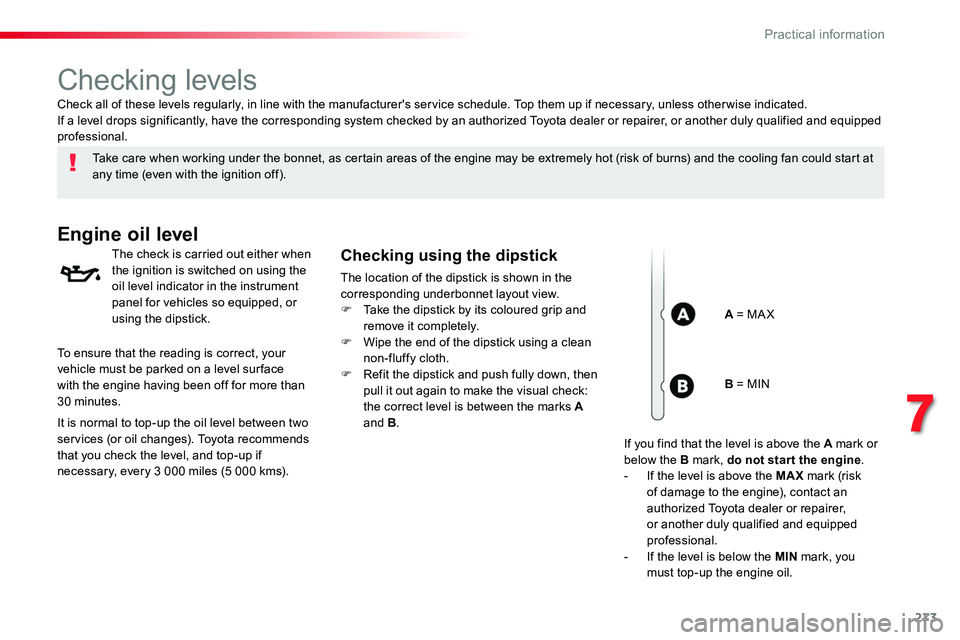
Checking using the dipstick
The location of the dipstick is shown in the corresponding underbonnet layout view.F Take the dipstick by its coloured grip and remove it completely.F Wipe the end of the dipstick using a clean non-fluffy cloth.F Refit the dipstick and push fully down, then pull it out again to make the visual check: the correct level is between the marks A and B.
Check all of these levels regularly, in line with the manufacturer's service schedule. Top them up if necessary, unless other wise indicated.If a level drops significantly, have the corresponding system checked by an authorized Toyota dealer or repairer, or another duly qualified and equipped professional.
A = MA X
To ensure that the reading is correct, your vehicle must be parked on a level sur face with the engine having been off for more than 30 minutes.
It is normal to top-up the oil level between two services (or oil changes). Toyota recommends that you check the level, and top-up if necessary, every 3 000 miles (5 000 kms).
B = MIN
If you find that the level is above the A mark or below the B mark, do not star t the engine.- If the level is above the MAX mark (risk of damage to the engine), contact an authorized Toyota dealer or repairer, or another duly qualified and equipped professional.- If the level is below the MIN mark, you must top-up the engine oil.
7
Practical information
Page 274 of 504
274
Oil grade
Before topping-up the oil or changing the oil, check that the oil is the correct grade for your engine and conforms to the manufacturer's recommendations.
Topping-up the engine oil level
The location of the oil filler cap is shown in the corresponding underbonnet layout view.F Unscrew the oil filler cap to reveal the filler aperture.F Add oil in small quantities, avoiding any spills on engine components (risk of fire).F Wait a few minutes before checking the level again using the dipstick.F Add more oil if necessary.F After checking the level, carefully refit the oil filler cap and the dipstick in its tube.
After topping-up the oil, the check when switching on the ignition with the oil level indicator in the instrument panel is not valid during the 30 minutes after topping up.
Engine oil change
Refer to the manufacturer's service schedule for details of the interval for this operation.In order to maintain the reliability of the engine and emission control system, never use additives in the engine oil.
The brake fluid level should be close to the "MA X" mark. If it is not, check the brake pad wear.
Brake fluid level
Changing the fluid
Refer to the manufacturer's service schedule for details of the interval for this operation.
Fluid specification
The brake fluid must conform to the manufacturer's recommendations.
Coolant level
The coolant level should be close to the "MA X" mark but should never exceed it.
In addition, as the cooling system is pressurised, wait at least one hour after switching off the engine before carrying out any work.To avoid any risk of scalding, unscrew the cap by two turns to allow the pressure to drop. When the pressure has dropped, remove the cap and top up the level.
The cooling fan may star t after switching
off the engine: take care with ar ticles and clothing that might be caught by the fan blades.
When the engine is warm, the temperature of the coolant is regulated by the fan.
Check the coolant level regularly, according to the use made of your vehicle (every 3 000 miles or 5 000 kms / 3 months); if necessary, top-up using coolant recommended by the manufacturer.Topping-up the coolant between services is normal.
Power steering fluid level
The power steering fluid level should be close to the "MA X" mark. With the engine cold, unscrew the cap to check the level.
Practical information