engine TOYOTA PROACE VERSO 2020 Workshop Manual
[x] Cancel search | Manufacturer: TOYOTA, Model Year: 2020, Model line: PROACE VERSO, Model: TOYOTA PROACE VERSO 2020Pages: 418, PDF Size: 39.32 MB
Page 137 of 418
137
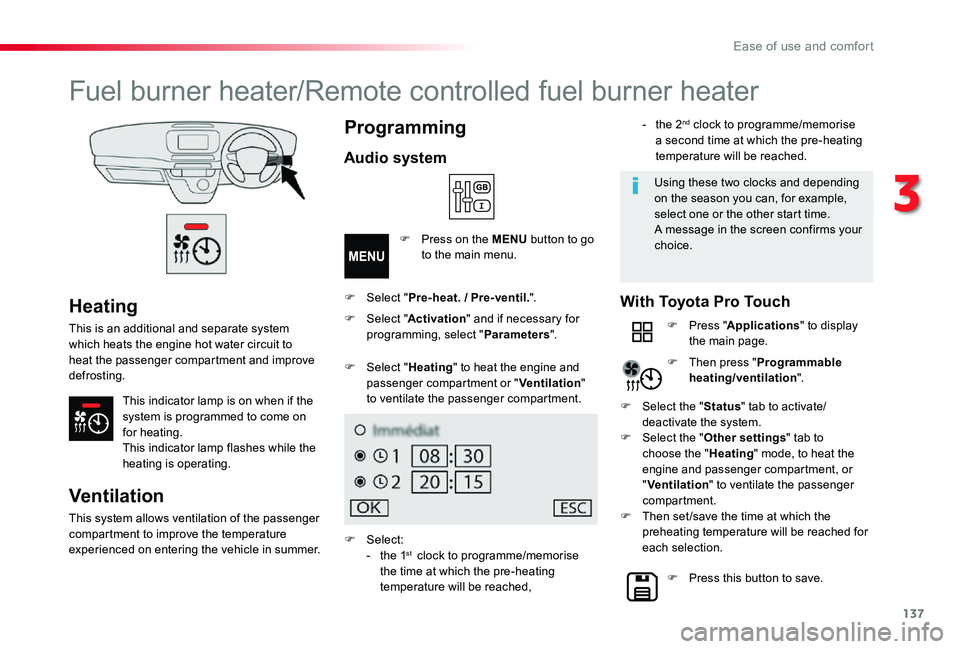
Heating
This is an additional and separate system which heats the engine hot water circuit to heat the passenger compartment and improve defrosting.
This indicator lamp is on when if the system is programmed to come on for heating.This indicator lamp flashes while the heating is operating.
Fuel burner heater/Remote controlled fuel burner heater
Ventilation
This system allows ventilation of the passenger compartment to improve the temperature
experienced on entering the vehicle in summer.
Programming
Audio system
F Press on the MENU button to go to the main menu.
F Select "Pre-heat. / Pre-ventil.".
F Select "Heating" to heat the engine and passenger compartment or "Ventilation" to ventilate the passenger compartment.
F Select:- the 1st clock to programme/memorise the time at which the pre-heating temperature will be reached,
Using these two clocks and depending on the season you can, for example, select one or the other start time.A message in the screen confirms your choice.
F Select "Activation" and if necessary for programming, select "Parameters".
- the 2nd clock to programme/memorise a second time at which the pre-heating temperature will be reached.
With Toyota Pro Touch
F Press "Applications" to display the main page.
F Press this button to save.
F Select the "Status" tab to activate/deactivate the system.F Select the "Other settings" tab to choose the "Heating" mode, to heat the engine and passenger compartment, or "Ventilation" to ventilate the passenger compartment.F Then set /save the time at which the preheating temperature will be reached for
each selection.
F Then press "Programmable heating/ventilation".
3
Ease of use and comfort
Page 138 of 418
138
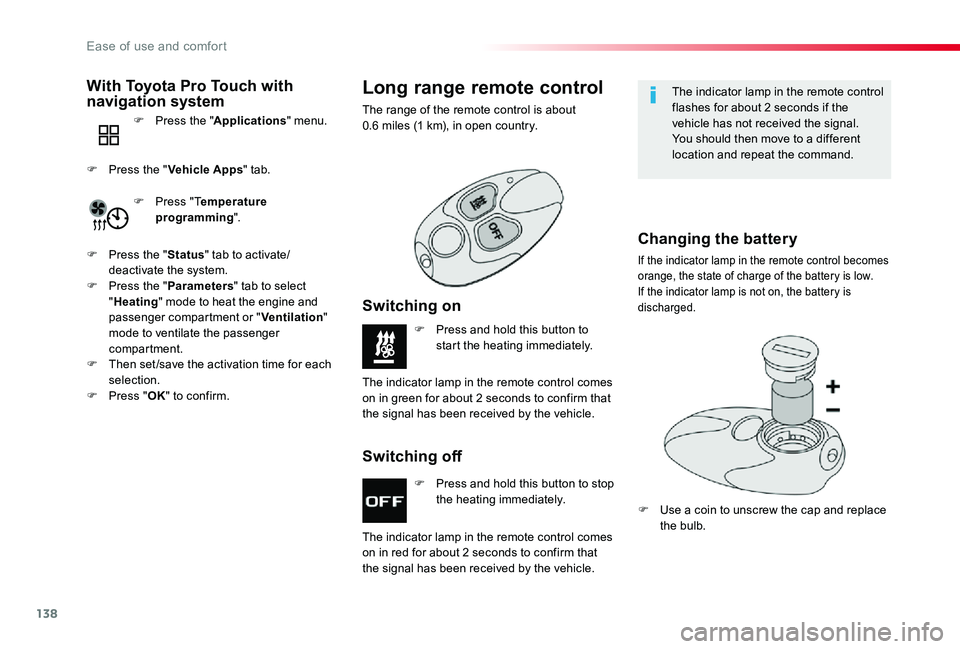
F Press and hold this button to stop the heating immediately.
F Press and hold this button to start the heating immediately.
The indicator lamp in the remote control comes
on in red for about 2 seconds to confirm that the signal has been received by the vehicle.
The indicator lamp in the remote control comes on in green for about 2 seconds to confirm that the signal has been received by the vehicle.
Switching off
Switching on
Long range remote control
The range of the remote control is about 0.6 miles (1 km), in open country.
The indicator lamp in the remote control flashes for about 2 seconds if the vehicle has not received the signal.You should then move to a different location and repeat the command.
Changing the battery
If the indicator lamp in the remote control becomes orange, the state of charge of the battery is low.If the indicator lamp is not on, the battery is discharged.
F Use a coin to unscrew the cap and replace the bulb.
With Toyota Pro Touch with navigation system
F Press the "Applications" menu.
F Press "Temperature programming".
F Press the "Vehicle Apps" tab.
F Press the "Status" tab to activate/deactivate the system.F Press the "Parameters" tab to select "Heating" mode to heat the engine and passenger compartment or "Ventilation" mode to ventilate the passenger compartment.F Then set /save the activation time for each selection.F Press "OK" to confirm.
Ease of use and comfort
Page 139 of 418
139
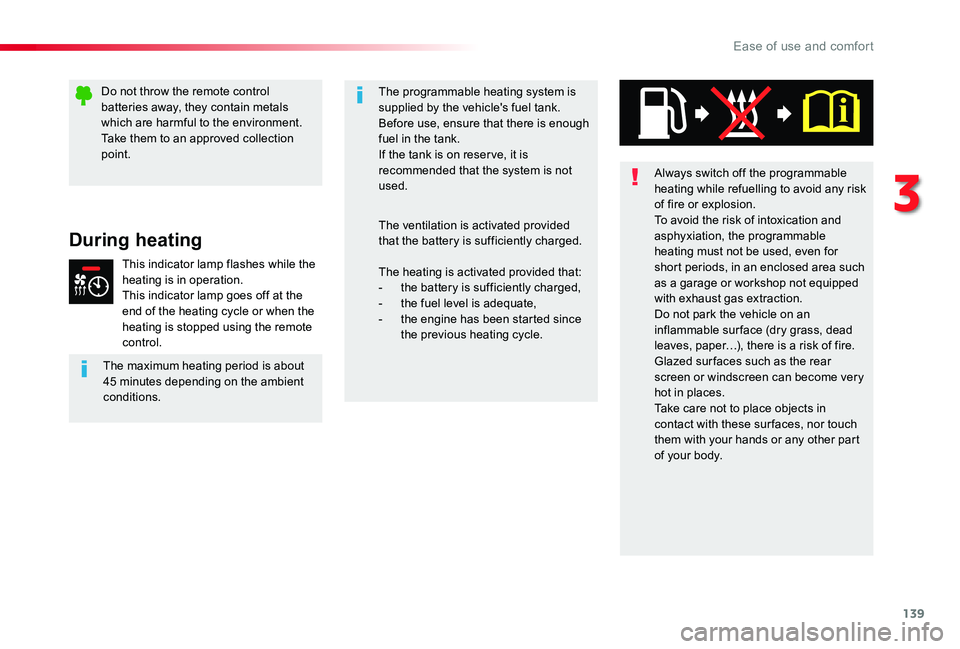
Always switch off the programmable heating while refuelling to avoid any risk of fire or explosion.To avoid the risk of intoxication and asphyxiation, the programmable heating must not be used, even for short periods, in an enclosed area such as a garage or workshop not equipped with exhaust gas extraction.Do not park the vehicle on an inflammable sur face (dry grass, dead leaves, paper…), there is a risk of fire.Glazed sur faces such as the rear screen or windscreen can become very hot in places.Take care not to place objects in contact with these sur faces, nor touch them with your hands or any other part of your body.
The heating is activated provided that:- the battery is sufficiently charged,- the fuel level is adequate,- the engine has been started since the previous heating cycle.
The programmable heating system is supplied by the vehicle's fuel tank.Before use, ensure that there is enough fuel in the tank.If the tank is on reser ve, it is recommended that the system is not used.
The ventilation is activated provided that the battery is sufficiently charged.During heating
This indicator lamp flashes while the heating is in operation.This indicator lamp goes off at the end of the heating cycle or when the heating is stopped using the remote control.
The maximum heating period is about 45 minutes depending on the ambient conditions.
Do not throw the remote control batteries away, they contain metals which are harmful to the environment.Take them to an approved collection point.
3
Ease of use and comfort
Page 144 of 418
144
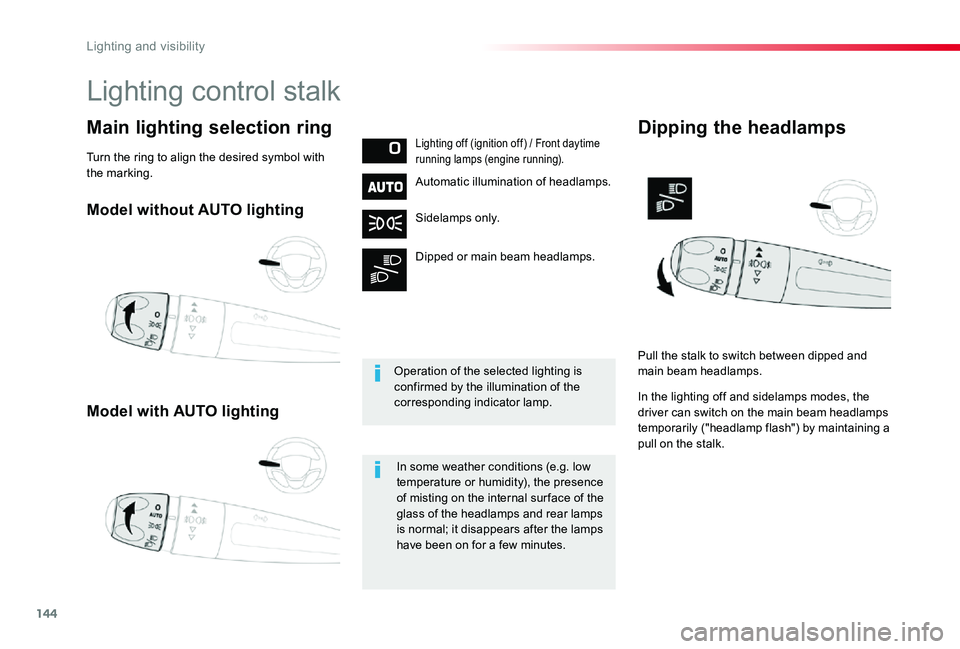
Model without AUTO lighting
Model with AUTO lighting
Main lighting selection ringLighting off (ignition off) / Front daytime running lamps (engine running).
Automatic illumination of headlamps.
Sidelamps only.
Dipped or main beam headlamps.
Dipping the headlamps
In the lighting off and sidelamps modes, the driver can switch on the main beam headlamps temporarily ("headlamp flash") by maintaining a pull on the stalk.
Operation of the selected lighting is confirmed by the illumination of the corresponding indicator lamp.
Pull the stalk to switch between dipped and main beam headlamps.
Lighting control stalk
In some weather conditions (e.g. low temperature or humidity), the presence of misting on the internal sur face of the glass of the headlamps and rear lamps is normal; it disappears after the lamps
have been on for a few minutes.
Turn the ring to align the desired symbol with the marking.
Lighting and visibility
Page 147 of 418
147
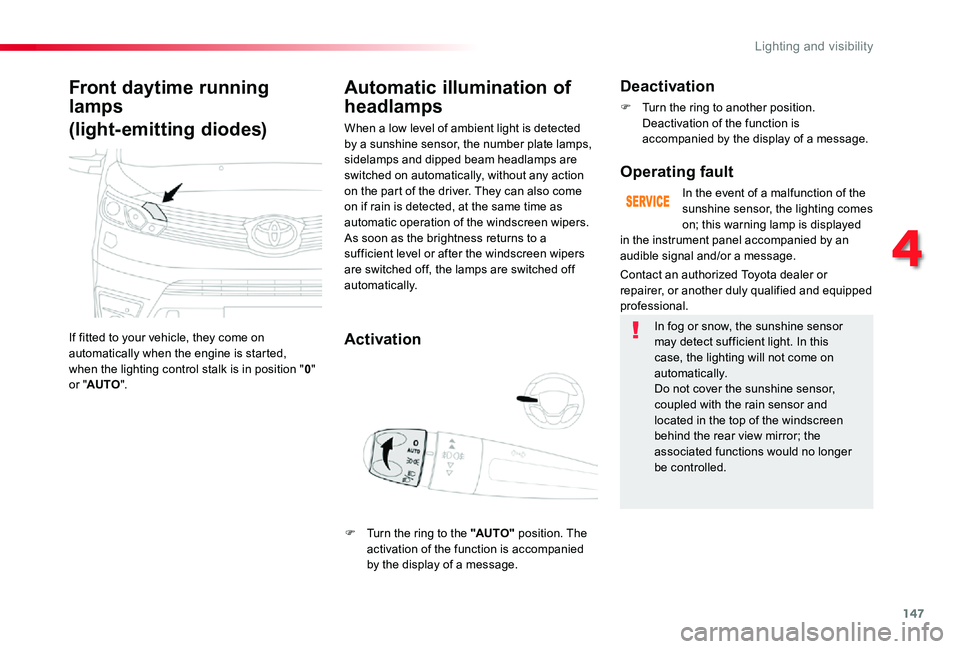
Front daytime running
lamps
(light-emitting diodes)
If fitted to your vehicle, they come on automatically when the engine is started, when the lighting control stalk is in position "0" or "AUTO".
Automatic illumination of
headlamps
Activation
When a low level of ambient light is detected by a sunshine sensor, the number plate lamps, sidelamps and dipped beam headlamps are switched on automatically, without any action on the part of the driver. They can also come on if rain is detected, at the same time as automatic operation of the windscreen wipers.As soon as the brightness returns to a
sufficient level or after the windscreen wipers are switched off, the lamps are switched off automatically.
Deactivation
F Turn the ring to another position. Deactivation of the function is accompanied by the display of a message.
Operating fault
In the event of a malfunction of the sunshine sensor, the lighting comes on; this warning lamp is displayed
Contact an authorized Toyota dealer or repairer, or another duly qualified and equipped professional.
in the instrument panel accompanied by an
audible signal and/or a message.
In fog or snow, the sunshine sensor may detect sufficient light. In this case, the lighting will not come on automatically.Do not cover the sunshine sensor, coupled with the rain sensor and located in the top of the windscreen behind the rear view mirror; the
associated functions would no longer be controlled.
F Turn the ring to the "AUTO" position. The
activation of the function is accompanied by the display of a message.
4
Lighting and visibility
Page 157 of 418
157
* Depending on the country of sale.
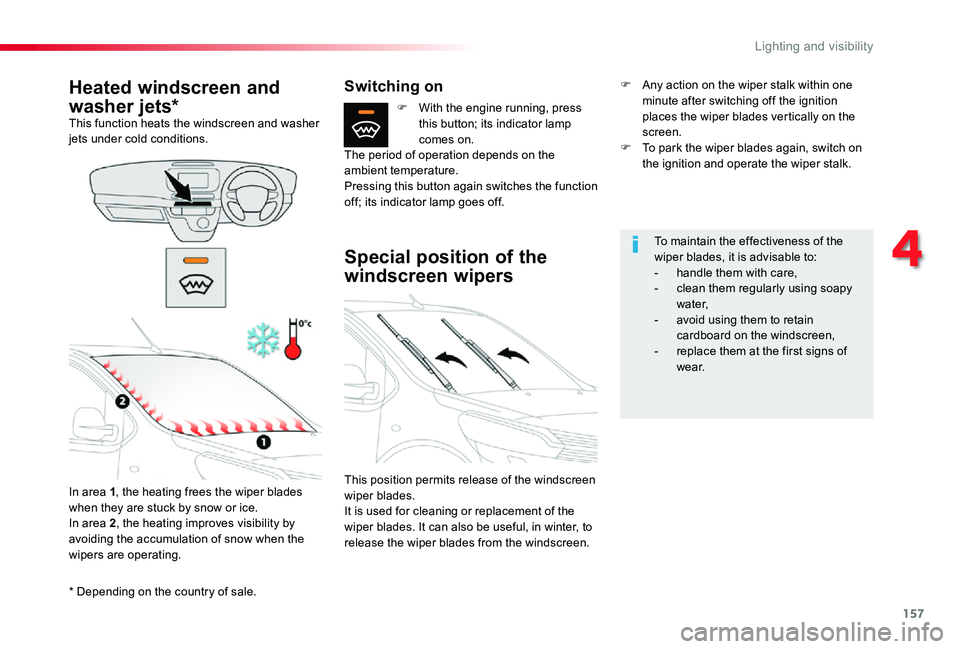
Heated windscreen and
washer jets*This function heats the windscreen and washer jets under cold conditions.
In area 1, the heating frees the wiper blades when they are stuck by snow or ice.In area 2, the heating improves visibility by avoiding the accumulation of snow when the
wipers are operating.
Switching on
F With the engine running, press this button; its indicator lamp comes on.The period of operation depends on the ambient temperature.Pressing this button again switches the function off; its indicator lamp goes off.
Special position of the
windscreen wipers
This position permits release of the windscreen wiper blades.It is used for cleaning or replacement of the wiper blades. It can also be useful, in winter, to release the wiper blades from the windscreen.
To maintain the effectiveness of the wiper blades, it is advisable to:- handle them with care,- clean them regularly using soapy water,- avoid using them to retain cardboard on the windscreen,- replace them at the first signs of w e a r.
F Any action on the wiper stalk within one minute after switching off the ignition places the wiper blades vertically on the screen.F To park the wiper blades again, switch on the ignition and operate the wiper stalk.
4
Lighting and visibility
Page 159 of 418
159
ER A - GLONASS
emergency call system*Electronic stability control (ESC) incorporating the following systems:- anti-lock braking system (ABS) and electronic brake force distribution (EBFD),- emergency braking assistance (EBA),- wheel anti-slip regulation (ASR) or traction control,- dynamic stability control (DSC).
Electronic stability control (ESC)
Definitions
Anti-lock braking system (ABS) and electronic brake force distribution (EBFD)
This system improves the stability and manoeuvrability of your vehicle when braking and contributes towards improved control on corners, in particular on poor or slippery road surfaces.The ABS prevents wheel lock in the event of emergency braking.The EBFD manages the braking pressure wheel by wheel.
Emergency braking assistance (EBA) / Brake assist
In an emergency, this system enables you to reach the optimum braking pressure more quickly and therefore reduce the stopping distance.It is triggered according to the speed at which the brake pedal is pressed. This is felt by a reduction in the resistance of the pedal and an increase in the effectiveness of the braking.
Anti-slip regulation (ASR) / Traction Control (TRC)
The ASR system (also known as Traction Control) optimises traction in order to limit wheel slip by acting on the brakes of the driving wheels and on the engine. It also improves the directional stability of the vehicle on acceleration.
Dynamic stability control (DSC) / Vehicle Stability Control (VSC)
If there is a difference between the path followed by the vehicle and that required by the driver, the DSC monitors each wheel and automatically acts on the brake of one or more
wheels and on the engine to return the vehicle to the required path, within the limits of the laws of physics.
Horn
F Press the central part of the steering wheel.
5
Safety
Page 160 of 418
160
Anti-lock braking system
(ABS) and electronic brake
force distribution (EBFD)
In emergency braking, press ver y firmly and maintain this pressure.
When changing wheels (tyres and rims), ensure that these are approved for your vehicle.Normal operation of the ABS may make itself felt by slight vibrations of the brake pedal.
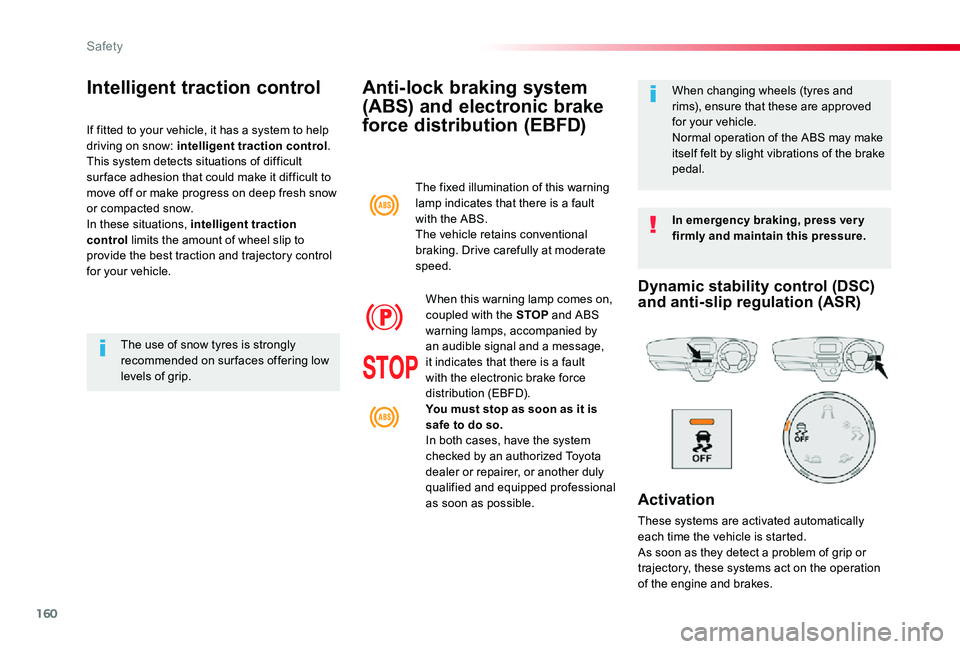
The fixed illumination of this warning lamp indicates that there is a fault with the ABS.The vehicle retains conventional
braking. Drive carefully at moderate speed.
When this warning lamp comes on, coupled with the STOP and ABS warning lamps, accompanied by an audible signal and a message, it indicates that there is a fault with the electronic brake force distribution (EBFD).You must stop as soon as it is safe to do so.In both cases, have the system
checked by an authorized Toyota dealer or repairer, or another duly qualified and equipped professional as soon as possible.
Intelligent traction control
If fitted to your vehicle, it has a system to help driving on snow: intelligent traction control.This system detects situations of difficult sur face adhesion that could make it difficult to move off or make progress on deep fresh snow or compacted snow.In these situations, intelligent traction control limits the amount of wheel slip to provide the best traction and trajectory control for your vehicle.
The use of snow tyres is strongly recommended on sur faces offering low levels of grip.
Dynamic stability control (DSC) and anti-slip regulation (ASR)
Activation
These systems are activated automatically each time the vehicle is started.
As soon as they detect a problem of grip or trajectory, these systems act on the operation of the engine and brakes.
Safety
Page 161 of 418
161
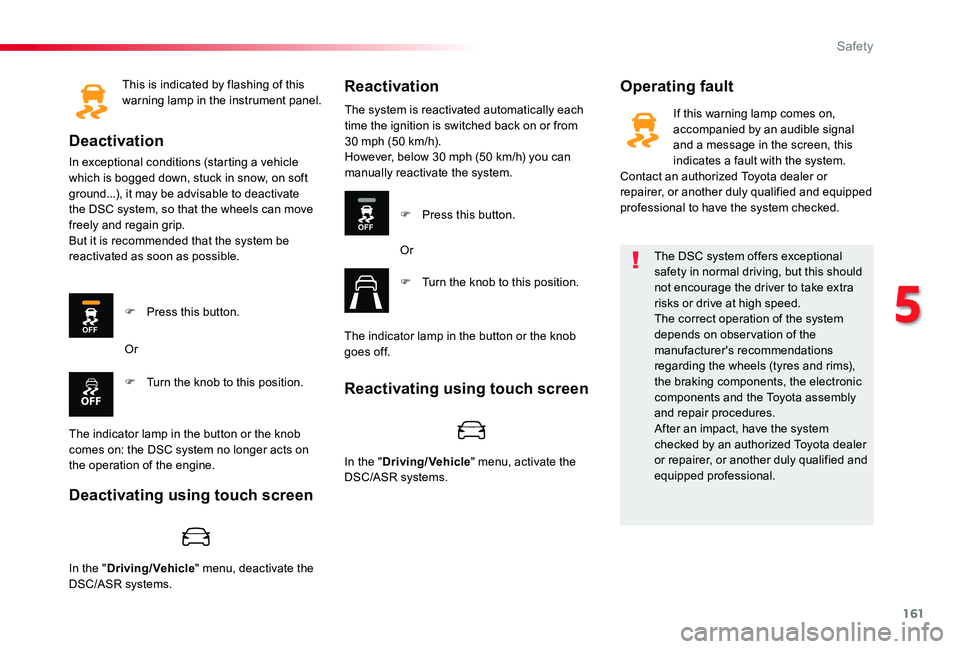
This is indicated by flashing of this warning lamp in the instrument panel.
Deactivation
In exceptional conditions (starting a vehicle which is bogged down, stuck in snow, on soft ground...), it may be advisable to deactivate the DSC system, so that the wheels can move freely and regain grip.But it is recommended that the system be reactivated as soon as possible.
Operating faultReactivation
F Press this button.
F Turn the knob to this position.
Or
The indicator lamp in the button or the knob comes on: the DSC system no longer acts on the operation of the engine.
The system is reactivated automatically each time the ignition is switched back on or from 30 mph (50 km/h).However, below 30 mph (50 km/h) you can manually reactivate the system.
F Press this button.
Or
F Turn the knob to this position.
The indicator lamp in the button or the knob goes off.
The DSC system offers exceptional safety in normal driving, but this should not encourage the driver to take extra risks or drive at high speed.The correct operation of the system depends on obser vation of the manufacturer's recommendations regarding the wheels (tyres and rims), the braking components, the electronic components and the Toyota assembly and repair procedures.After an impact, have the system checked by an authorized Toyota dealer or repairer, or another duly qualified and equipped professional.
If this warning lamp comes on, accompanied by an audible signal and a message in the screen, this indicates a fault with the system.Contact an authorized Toyota dealer or repairer, or another duly qualified and equipped professional to have the system checked.
Deactivating using touch screen
Reactivating using touch screen
In the "Driving/Vehicle" menu, deactivate the DSC/ASR systems.
In the "Driving/Vehicle" menu, activate the DSC/ASR systems.
5
Safety
Page 162 of 418
162
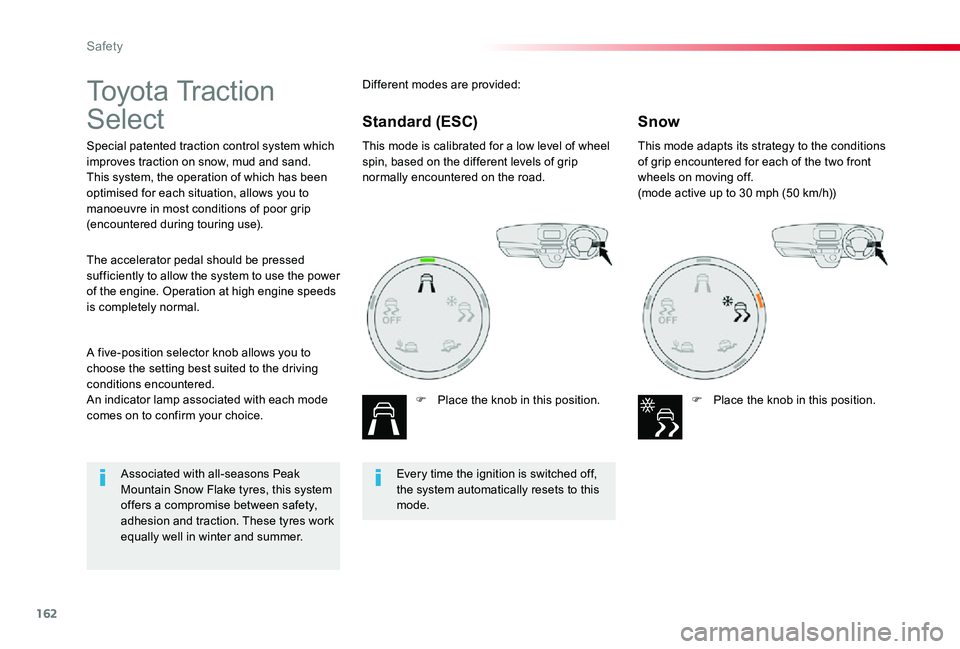
To y o t a Tr a c t i o n
Select
Special patented traction control system which improves traction on snow, mud and sand.This system, the operation of which has been optimised for each situation, allows you to manoeuvre in most conditions of poor grip (encountered during touring use).
This mode is calibrated for a low level of wheel spin, based on the different levels of grip normally encountered on the road.
F Place the knob in this position.
This mode adapts its strategy to the conditions of grip encountered for each of the two front wheels on moving off.(mode active up to 30 mph (50 km/h))
F Place the knob in this position.
A five-position selector knob allows you to choose the setting best suited to the driving conditions encountered.An indicator lamp associated with each mode comes on to confirm your choice.
The accelerator pedal should be pressed sufficiently to allow the system to use the power of the engine. Operation at high engine speeds is completely normal.
Different modes are provided:
SnowStandard (ESC)
Every time the ignition is switched off, the system automatically resets to this mode.
Associated with all-seasons Peak Mountain Snow Flake tyres, this system offers a compromise between safety, adhesion and traction. These tyres work equally well in winter and summer.
Safety