Start TOYOTA RAIZE 2023 Service Manual
[x] Cancel search | Manufacturer: TOYOTA, Model Year: 2023, Model line: RAIZE, Model: TOYOTA RAIZE 2023Pages: 516, PDF Size: 44.62 MB
Page 218 of 516
2164-5. Using the driving support systems
RAIZE_OM_General_BZ358E
dArea approx. between 3 m and 60 m (9.8 and 196.9 ft.) behind the rear
bumper
The greater the speed difference between your vehicle and the other vehicle, the
sooner the outside rear view mirror indicators will turn on and start flashing when
the other vehicle is located further away.
⬛Activation conditions of the BSM function
The BSM function will be activated when all of the following conditions are sat-
isfied:
⚫In the TFT color multi-info rmation display settings (➞P. 109), “BSM” is set to
“ON”
⚫When the shift lever is set in other than R
⚫When the BSM OFF indicator is off
⚫When the vehicle speed is approx. 16 km/h (10 mph) or greater
⬛Conditions where the BSM fu nction detects a vehicle
The BSM function detects a vehicle that has entered the detection area in the
following situations:
⚫When another vehicle traveling in th e next lane passes your vehicle
⚫When your vehicle passes another vehicl e traveling in the next lane with a
small speed difference
⚫When another vehicle enters the de tection range while changing lanes
⬛Conditions where the BSM function does not detect a vehicle
The BSM function may not detect vehicles that fit the following description or
non-vehicle objects:
⚫Small motorcycles, bicycles , pedestrians, and so on
⚫Oncoming vehicles
⚫Still objects such as guardrails, walls, road signs, parked vehicles, and so on
⚫A following vehicle traveling in the same lane
⚫Other vehicle traveling in the lane that is 2 lanes away from yours
⚫Vehicles that your vehicle has passed with a large speed difference
⚫Vehicles in the next lane’s detection area, which is the rear side of your vehi-
cle, but not approaching your vehic le (The system determines approaching
vehicles using radar detection data.)
⚫Vehicles in the shape that do not easily reflect radar signals (such as a low
height trailer without cargo, sports cars)
RAIZE_OM_General_BZ358E.book 216 ページ 2022年5月17日 火曜日 午後1時59分
Page 219 of 516
2174-5. Using the driving support systems
RAIZE_OM_General_BZ358E
Driving
4
⬛Situations where the BSM function may not work properly
⚫The BSM function may not detect vehicles correctly in the following circumstances.
⦁The sensor positions or orientations are off due to a strong impact applied
to the sensors or the surrounding areas
⦁ The sensors or the rear bumper near the sensors are covered with mud,
snow, ice, or stickers
⦁ Driving on a wet road or driving in a puddle under bad weather conditions,
such as heavy rain, snow, or fog
⦁ Several vehicles are continuously approaching in a tight space
⦁ When there is not enough distance between your vehicle and the follow-
ing vehicle
⦁ When the speed difference between yo ur vehicle and the other vehicle in
the detection range is too large
⦁ When the speed difference between your vehicle and the other vehicle is
fluctuating
⦁ When the speed of your vehicle and the other vehicle in the detection
range is almost the same
⦁ When another vehicle continues to stay in the detection range after your
vehicle starts moving from the stopped state
⦁ When driving up and down on a series of steep slopes or driving on
dented areas of a road
⦁ When driving through a sharp curve or continuous curves, or driving in an
area with ups and downs
⦁ When the other vehicle in the next la ne is too far away from your vehicle,
such as while driving in a wide lane or driving on the edge of the lane
⦁When the vehicle has accessories such as a bicycle carrier installed in the rear side
⦁When there is a large difference in th e vehicle height of your vehicle and
the other vehicle in the detection range
⦁ Right after turning on the BSM function or the RCTA function
⦁ Right after setting the shift lever to other than R
⦁ When an extremely heavy load is st ored in the luggage compartment
⦁ When a vehicle changed lanes from 2 lanes away to the next lane
⚫The BSM function may have more unnecessary detections, especially in the
following circumstances.
⦁The sensor positions or orientations are off due to a strong impact applied
to the sensors or the surrounding areas
⦁ When guardrails or walls have ente red the detection area while the dis-
tance from the vehicle is short
⦁ When a vehicle other than that trave ling in the next lane has entered the
detection range, such as while driving in a narrow lane or driving on the
edge of the lane
RAIZE_OM_General_BZ358E.book 217 ページ 2022年5月17日 火曜日 午後1時59分
Page 222 of 516

2204-5. Using the driving support systems
RAIZE_OM_General_BZ358E
⬛Situations where the RCTA function may not work properly
⚫The RCTA function may not detect vehicles correctly in the following circumstances.
⦁The sensor positions or orientations are off due to a strong impact applied
to the sensors or the surrounding areas
⦁ The sensors or the rear bumper near the sensors are covered with mud,
snow, ice, or stickers
⦁ Driving on a wet road or driving in a puddle under bad weather conditions,
such as heavy rain, snow, or fog
⦁ When several vehicles are passing continuously behind your vehicle or
when a vehicle is approaching from th e opposite direction to the vehicle
detected first
⦁ When the vehicle is parked on a hill or an uneven road
⦁ When the vehicle has accessories such as a bicycle carrier installed in the
rear side
⦁ When the vehicle is moving backward on a steep hill with varying slopes
⦁ When the vehicle is parked diagonally
⦁ Right after turning on the RCTA function
⦁ Right after starting the engine wi th the RCTA function turned on
⦁ When being affected by radio wave interference from the radar sensors
installed on the vehicle parked next to your vehicle
⦁ When getting out from a sloped parking spot
⦁ When a large vehicle is parked next to your vehicle
⦁ When the vehicle is backing up at fast speed
⚫The RCTA function may have more unnecessary detections, especially in the
following circumstances.
⦁The sensor positions or orientations are off due to a strong impact applied
to the sensors or the surrounding areas
⦁ When another vehicle passes through the side of your vehicle
⦁ When the vehicle is traveling on a
road facing a parking lot
⦁ When metal objects (such as guardrails, walls, signs, parked vehicles) that
can easily reflect radio waves are located behind the vehicle
⦁ When the vehicle has accessories such as a bicycle carrier installed in the
rear side
⦁ When buildings or roadside walls are present in the direction to which the
vehicle is backing up
KBRO460508
RAIZE_OM_General_BZ358E.book 220 ページ 2022年5月17日 火曜日 午後1時59分
Page 234 of 516
2324-5. Using the driving support systems
RAIZE_OM_General_BZ358E
Driving assist systems
The following devices automatically operate according to the driving
conditions to improve driving safety and performance. However,
these systems are supplementary and you should be careful not to
over-rely on them while driving.
◆ABS (Anti-lock Brake System)
Helps to prevent wheel lock when the brakes are applied suddenly, or if
the brakes are applied while driving on a slippery road surface.
◆Brake assist
Generates an increased level of braking force when the system detects a
panic stop situation.
◆VSC (Vehicle Stability Control)
Helps the driver to control skidding when swerving suddenly or turning on
slippery road surfaces.
◆TRC (Traction Control)
Helps to maintain drive power and pr event the drive wheels from spinning
when starting the vehicle or accelerating on slippery roads.
◆Hill-start assist control
Prevents the vehicle from moving backwards when starting on an uphill.
◆EPS (Electric Power Steering)
Uses an electric motor to assist steering operation.
◆Emergency brake signal
Emergency flashers automatically fl ash when braking suddenly, alerting
the following vehicle and reducing the possibility of a collision.
RAIZE_OM_General_BZ358E.book 232 ページ 2022年5月17日 火曜日 午後1時59分
Page 235 of 516
2334-5. Using the driving support systems
RAIZE_OM_General_BZ358E
Driving
4
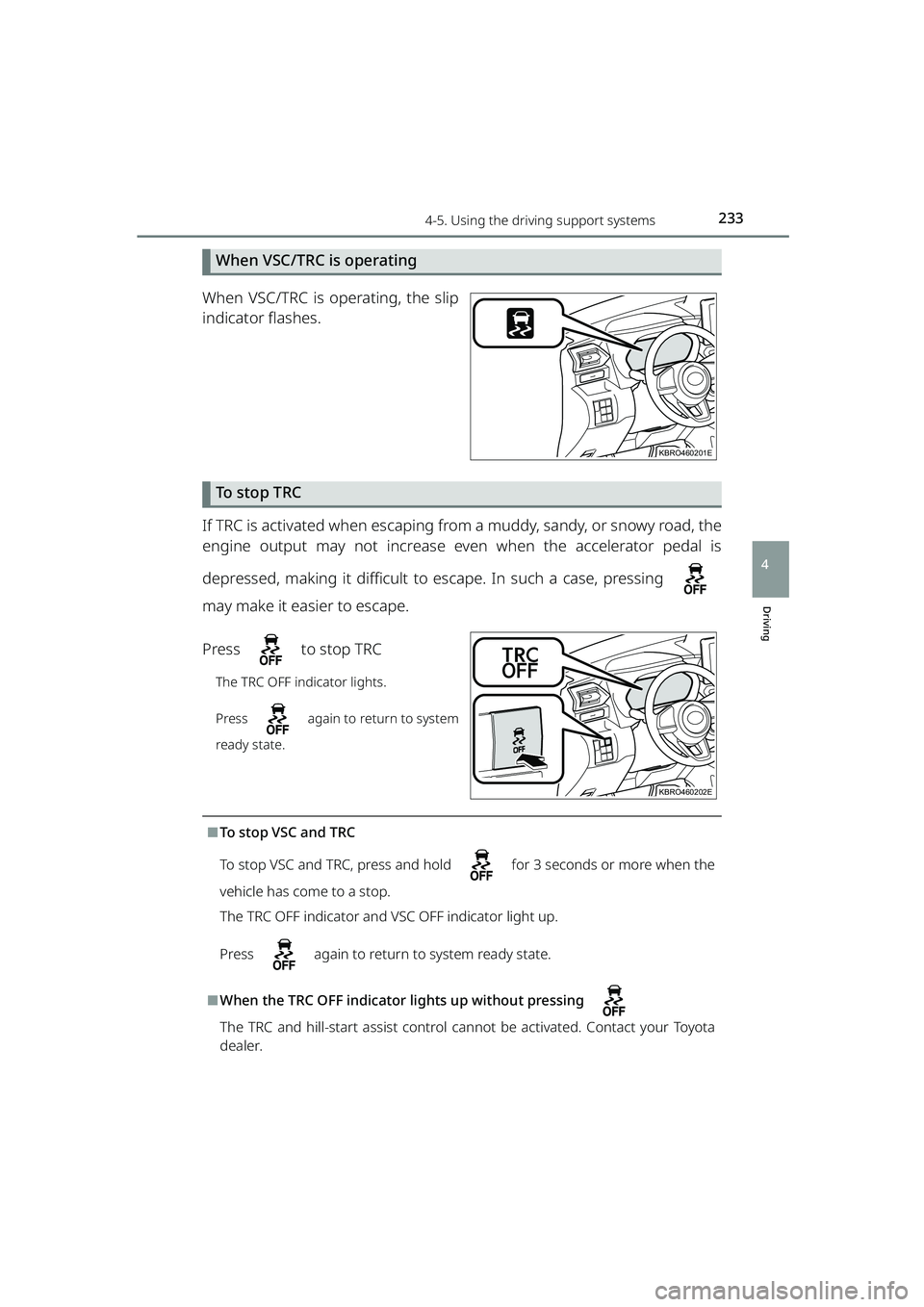
When VSC/TRC is operating
When VSC/TRC is operating, the slip
indicator flashes.
To s t o p T R C
If TRC is activated when escaping from a muddy, sandy, or snowy road, the
engine output may not increase even when the accelerator pedal is
depressed, making it difficult to escape. In such a case, pressing
may make it easier to escape.
Press to stop TRC
The TRC OFF indicator lights.
Press again to return to system
ready state.
⬛To stop VSC and TRC
To stop VSC and TRC, press and hold for 3 seconds or more when the
vehicle has come to a stop.
The TRC OFF indicator and VS C OFF indicator light up.
Press again to return to system ready state.
⬛When the TRC OFF indicator lights up without pressing
The TRC and hill-start assist control ca nnot be activated. Contact your Toyota
dealer.
KBRO460201E
KBRO460202E
RAIZE_OM_General_BZ358E.book 233 ページ 2022年5月17日 火曜日 午後1時59分
Page 236 of 516
2344-5. Using the driving support systems
RAIZE_OM_General_BZ358E
⬛Activation of ABS/VSC
ABS/VSC does not work at low speeds. The operation is the same as the nor-
mal brake.
⬛Activation sound and vibration of the ABS, brake assist, VSC, TRC, and hill-
start assist control
⚫A sound may be heard from the engine compartment when the brake pedal
is depressed repeatedly, when the engine is started or just after the vehicle
begins to move. This sound does not indicate that a malfunction has
occurred in any of these systems.
⚫Any of the following conditions may occur when the above systems are oper-
ating. None of them indicates that a malfunction has occurred.
⦁ Vibrations may be felt through th e vehicle body and steering wheel
⦁ A motor sound may be heard even after the vehicle has come to a stop
⦁ The brake pedal may pulsate slightly after the ABS is activated
⦁ The brake pedal may move down slightly after the ABS is activated
⬛EPS motor operation sound
When the steering wheel is operated, a motor sound (whirring sound) may be
heard, but this does not indicate a malfunction.
⬛Automatic reactivation of VSC and TRC
After turning the TRC and VSC systems off, the systems will return to the ready
state in the following situations:
⚫When the engine switch is turned to “OFF”
⚫If only the TRC system is turned off, when vehicle speed increases
If both the TRC and VSC systems are tu rned off, automatic reactivation will
not occur when vehicle speed increases.
⬛Reduced effectiveness of the EPS system
The effectiveness of the EPS system is reduced to prevent the system from
overheating when there is frequent steering input over an extended period of
time. The steering wheel ma y feel heavy as a result.
Should this occur, refrain from excessive steering input or stop the vehicle and
turn the engine off. It should re turn to normal within 10 minutes.
RAIZE_OM_General_BZ358E.book 234 ページ 2022年5月17日 火曜日 午後1時59分
Page 237 of 516
2354-5. Using the driving support systems
RAIZE_OM_General_BZ358E
Driving
4
⬛Activation conditions of the hill-start assist control
The system operates when all of the following conditions are met:
⚫Continuously variable transmission vehi cles: The shift lever is set to other
than P or N (when starting to move the vehicle forward or backward on an
uphill)
⚫Manual transmission vehicles: The shift lever is set to other than R when
starting to move the vehicle forward on an uphill or the shift lever is set to R
when starting to move the vehicle backward on an uphill
⚫Vehicle stopped state
⚫Not depressing the accelerator
⚫Parking brake is not applied
⬛Automatic deactivation of the hill-start assist control
The system is deactivated when one of the following occurs:
⚫Continuously variable transmission vehicl es: The shift lever is set to P or N
⚫Manual transmission vehicles: The shift lever is set to R when starting to
move the vehicle forward on an uphill or the shift lever is set to other than R
when starting to move the vehicle backward on an uphill
⚫The driver depresses the accelerator
⚫The driver applies the parking brake
⚫About 2 seconds have passed since releasing the brake pedal
⬛When the slip indicator turns on and the warning message ( ➞P. 389)
appears
It may indicate a malfunction in the systems. Contact your Toyota dealer.
⬛Activation conditions of the emergency brake signal
The system operates when all of the following conditions are met:
⚫The emergency flashers are not flashing
⚫The vehicle speed is 60 km/h (38 mph) or more
⚫The brake pedal is depressed and the vehicle is deemed to brake suddenly
based on the deceleration, or ABS is activated
⬛Automatic deactivation of the emergency brake signal
The system is deactivated when one of the following occurs:
⚫The emergency flashers were set to flashing
⚫The brake pedal was released
⚫It was determined that the vehicle did not brake suddenly based on the
deceleration
⚫ABS stopped working
RAIZE_OM_General_BZ358E.book 235 ページ 2022年5月17日 火曜日 午後1時59分
Page 238 of 516
2364-5. Using the driving support systems
RAIZE_OM_General_BZ358E
WARNING
⬛The ABS does not operate effectively when
⚫Do not overly rely on the ABS.
The limits of tire gripping performance have been exceeded (such as exces-
sively worn tires on a snow covered road).
⚫The vehicle hydroplanes while driving at high speed on wet or slick roads.
⬛Stopping distance when the ABS is operating may exceed that of normal
conditions
The ABS is not designed to shorten th e vehicle’s stopping distance. Always
maintain a safe distance from the vehicle in front of you, especially in the fol-
lowing situations:
⚫When driving on dirt, grav el or snow-covered roads
⚫When driving with tire chains
⚫When driving over bumps in the road
⚫When driving over roads with potholes or roads with uneven surfaces
⬛TRC/VSC may not operate effectively when
⚫Do not overly rely on the TRC/VSC.
Directional control and power may not be achievable while driving on slip-
pery road surfaces, even if the TRC/VSC system is operating.
Drive the vehicle carefully in condit ions where stability and power may be
lost.
⚫The VSC and TRC may not function proper ly when tire chains are installed.
⬛Hill-start assist control does not operate effectively when
⚫Do not overly rely on hill-start assist control. Hill-start assist control may not
operate effectively on steep inclines an d dirt, gravel or snow-covered roads.
⚫Unlike the parking brake, hill-start assist control is not intended to hold the
vehicle stationary for an extended period of time. Do not attempt to use hill-
start assist control to hold the vehicle on an incline, as doing so may lead to
an accident.
⚫The hill-start assist control may no t become activated depending on the
number of occupants or luggage weight in the vehicle, or if the driver did not
step on the brake pedal strong enough when stopping.
⬛When the VSC is activated
The slip indicator light flashes. Always drive carefully. Reckless driving may
cause an accident. Exercise particular care when the indicator light flashes.
⬛When the ABS warning light or slip indicator is on
The emergency brake signal ( ➞P. 232) may not be activated.
RAIZE_OM_General_BZ358E.book 236 ページ 2022年5月17日 火曜日 午後1時59分
Page 258 of 516
2565-1. Using the air conditioning system and defogger
RAIZE_OM_General_BZ358E✽
: If equipped
⬛Indicator of the automatic mode
When you adjust the fan speed or the air outlets*, the AUTO indicator
turns off, but the automatic mode settings other than those you just
adjusted continue to work.
*Vehicles with heaters
Other features
⬛Switching between outside air intr oduction mode and recirculated
air mode
Press
Each time the button is pres sed, the mode is switched between outside air introduc-
tion and recirculated air. When the recirc ulated air mode is selected, the indicator
comes on.
⬛Defogging the windshield (vehicles with heaters)
Press
The air conditioning system is started and is automatically set to outside air introduc-
tion mode.
Press after defogging is complete to switch back to the previous mode.
⬛Rear window defogger✽
Use this switch to defog the rear window.
Press
The rear window defogger will automatically turn OFF after a while.
RAIZE_OM_General_BZ358E.book 256 ページ 2022年5月17日 火曜日 午後1時59分
Page 262 of 516
2605-1. Using the air conditioning system and defogger
RAIZE_OM_General_BZ358E
⬛When the outside air temperature drops to around 0°C (32℉)
Even if you press , the air conditioning system may not work.
⬛When the air outlets are set to (vehicles with heaters)
In order to deliver cool air to the driver and passe ngers’ faces and warm air to
their feet, depending on the set temperature, the air sent to the driver and
passengers’ feet will be warmer than the air sent to the upper body.
⬛When driving on dusty roads
Close all windows. If dust thrown up by the vehicle is still drawn into the vehicle
after closing the windows, it is recomme nded that the air intake mode be set
to outside air mode and the fan speed to any setting except off.
⬛Outside/recirculated air mode
Setting to the recirculated air mode temporarily is recommended in prevent-
ing dirty air from entering the vehicle interior and helping to cool the vehicle
when the outside air temperature is high.
⬛Ventilation and air conditioning odors
⚫To let fresh air in, set the air conditio ning system to the outside air introduc-
tion mode.
⚫During use, various odors from inside and outside the vehicle may enter into
and accumulate in the air conditioning system. This may then cause odors to
be emitted from the vents.
⚫When the automatic mode is used, the fan may stop for a while immediately
after the air conditioning system starts to reduce potential odors generated
during startup. In addition, it is re commended that the air conditioning sys-
tem be set to outside air introduction mode prior to turning the vehicle off.
⬛Air conditioning filter
➞P. 3 3 8
RAIZE_OM_General_BZ358E.book 260 ページ 2022年5月17日 火曜日 午後1時59分