display TOYOTA RAV4 1996 Service Repair Manual
[x] Cancel search | Manufacturer: TOYOTA, Model Year: 1996, Model line: RAV4, Model: TOYOTA RAV4 1996Pages: 1632, PDF Size: 41.64 MB
Page 6 of 1632
per second. If ABS light does not blink, go to ABS WARNING LIGHT. If ABS warning light blinks,
go to next step.
3. Drive vehicle straight ahead above 28 MPH for several seconds. Stop vehicle. Jumper terminals Tc and
E
1 of DLC1. See Fig. 2 . If all sensors are okay, a normal DTC is displayed (ABS warning light blinks 2
times a second). If a malfunction is detected, ABS warning light will begin to flash a 2-digit DTC. First
number of blinks will equal first digit in a DTC. After a 1.5-second pause, second number of blinks will
equal second digit in a DTC.
4. If 2 or more DTCs are stored, there will be a 2.5-second pause between each DTC. After all DTCs are
flashed, there will be a 4 second pause and all DTCs will repeat.
5. Record DTCs. Turn ignition off. Repair as necessary. See DTC DEFINITIONS
. Remove jumper wire
from DLC1. Clear DTCs. See CLEARING DTCS
.
ABS WARNING LIGHT
Circuit Description
If ABS ECU detects a system malfunction, ABS ECU illuminates ABS warning light while at the same time
prohibiting ABS control. At this time, ABS ECU records a DTC in memory. After removing short pin from
DLC1, connecting terminals Tc and E
1 of DLC1 causes ABS warning light to blink and output a DTC. See Fig.
2 .
Diagnostic Procedure
1. If ABS warning light stays on, go to step 3 . If ABS warning light does not illuminate, check fuse, light
bulb and wiring. Repair or replace as necessary. If bulb is okay, diagnose combination meter (instrument
panel). See appropriate INSTRUMENT PANELS article in ACCESSORIES & EQUIPMENT. If no
problems were found, go to next step.
2. Check ABS control relay. See SOLENOID RELAY SECTION
under ABS CONTROL RELAY under
COMPONENT TESTS. Replace as necessary. If ABS control relay is okay, go to next step.
3. Retrieve DTCs. See RETRIEVING DTCS
under DIAGNOSIS & TESTING. If DTC is present, perform
appropriate test under DIAGNOSTIC TESTS. If DTC is not present, and ABS warning light goes off
when short pin is removed, go to next step. If ABS warning light does not turn off, check for short circuit
in wiring harness between ABS warning light, DLC1 and ABS ECU. Repair as necessary. See WIRING
DIAGRAMS .
4. Check ABS control relay. See SOLENOID RELAY SECTION
under ABS CONTROL RELAY under
COMPONENT TESTS. Replace relay as necessary. If relay is okay, check for short circuit in wiring
harness between DLC1 and ABS control relay. Repair as necessary. See WIRING DIAGRAMS
.
TC TERMINAL
Circuit Description
Connecting terminals Tc and E1 of DLC1 causes ABS warning light to blink and output a DTC. See Fig. 2 .
Diagnostic Procedure
1999 Toyota RAV4
1999-2000 BRAKES Anti-Lock - RAV4
Microsoft
Sunday, November 22, 2009 10:06:17 AMPage 6 © 2005 Mitchell Repair Information Company, LLC.
Page 8 of 1632
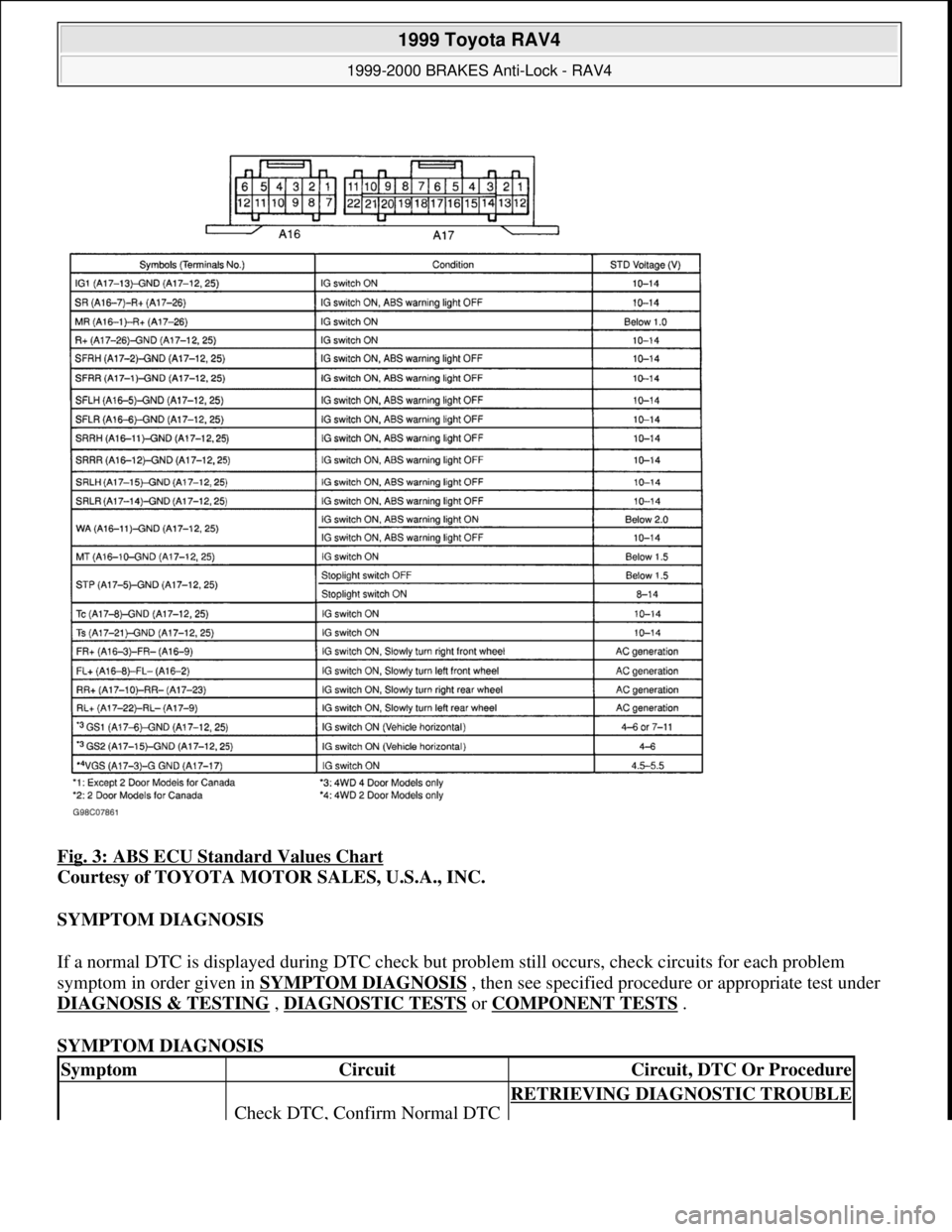
Fig. 3: ABS ECU Standard Values Chart
Courtesy of TOYOTA MOTOR SALES, U.S.A., INC.
SYMPTOM DIAGNOSIS
If a normal DTC is displayed during DTC check but problem still occurs, check circuits for each problem
symptom in order given in SYMPTOM DIAGNOSIS
, then see specified procedure or appropriate test under
DIAGNOSIS & TESTING
, DIAGNOSTIC TESTS or COMPONENT TESTS .
SYMPTOM DIAGNOSIS
SymptomCircuitCircuit, DTC Or Procedure
Check DTC, Confirm Normal DTC
RETRIEVING DIAGNOSTIC TROUBLE
1999 Toyota RAV4
1999-2000 BRAKES Anti-Lock - RAV4
Microsoft
Sunday, November 22, 2009 10:06:17 AMPage 8 © 2005 Mitchell Repair Information Company, LLC.
Page 50 of 1632
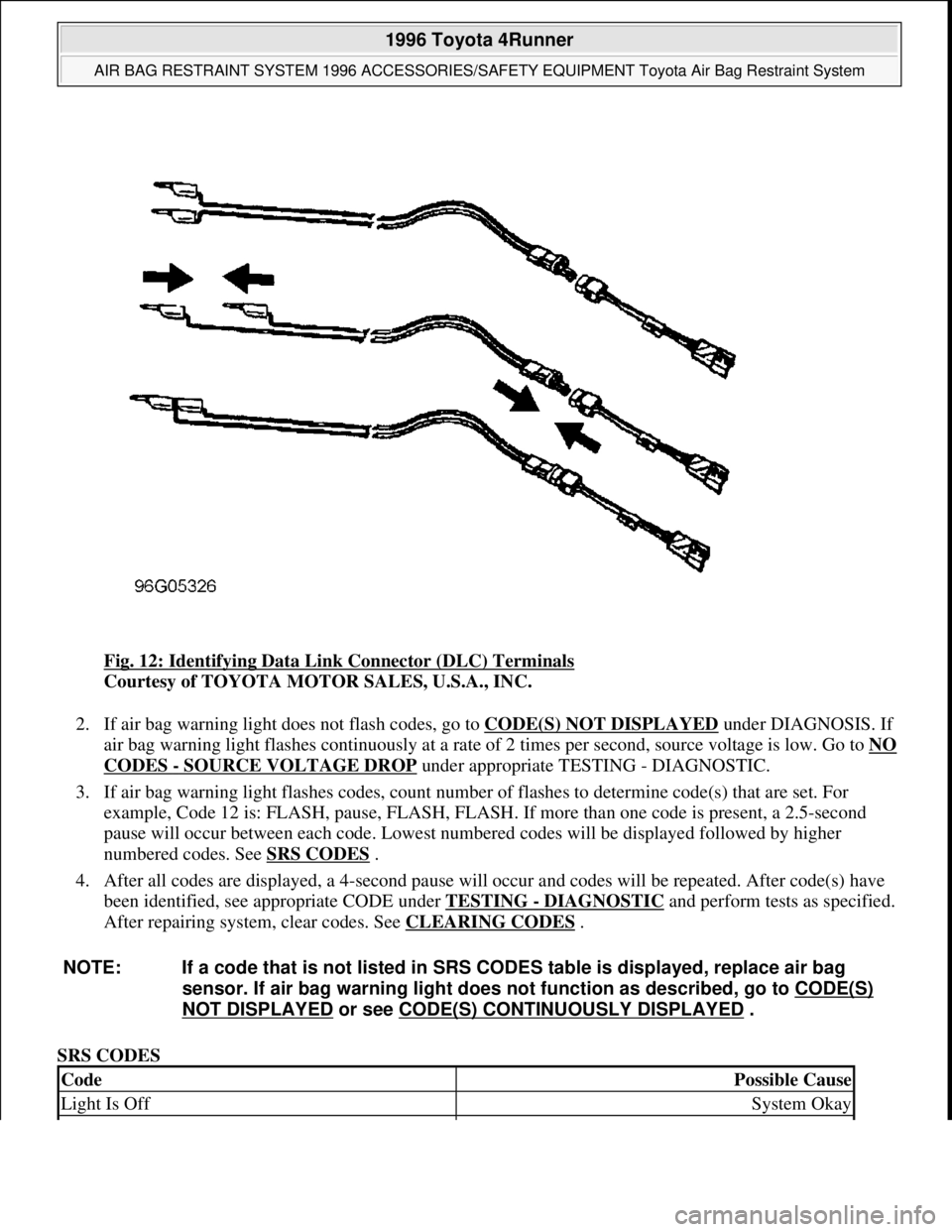
Fig. 12: Identifying Data Link Connector (DLC) Terminals
Courtesy of TOYOTA MOTOR SALES, U.S.A., INC.
2. If air bag warning light does not flash codes, go to CODE(S) NOT DISPLAYED
under DIAGNOSIS. If
air bag warning light flashes continuously at a rate of 2 times per second, source voltage is low. Go to NO
CODES - SOURCE VOLTAGE DROP under appropriate TESTING - DIAGNOSTIC.
3. If air bag warning light flashes codes, count number of flashes to determine code(s) that are set. For
example, Code 12 is: FLASH, pause, FLASH, FLASH. If more than one code is present, a 2.5-second
pause will occur between each code. Lowest numbered codes will be displayed followed by higher
numbered codes. See SRS CODES
.
4. After all codes are displayed, a 4-second pause will occur and codes will be repeated. After code(s) have
been identified, see appropriate CODE under TESTING
- DIAGNOSTICand perform tests as specified.
After repairing system, clear codes. See CLEARING CODES
.
SRS CODES
NOTE: If a code that is not listed in SRS CODES table is displayed, replace air bag
sensor. If air bag warning light does not function as described, go to CODE(S)
NOT DISPLAYED or see CODE(S) CONTINUOUSLY DISPLAYED .
CodePossible Cause
Light Is OffSystem Okay
1996 Toyota 4Runner
AIR BAG RESTRAINT SYSTEM 1996 ACCESSORIES/SAFETY EQUIPMENT Toyota Air Bag Restraint System
Microsoft
Tuesday, August 18, 2009 7:33:32 PMPage 16 © 2005 Mitchell Repair Information Company, LLC.
Page 53 of 1632
light is okay, the malfunction is now corrected. If light is not okay, check terminal LA of air bag sensor
assembly. If terminal is okay, replace air bag sensor assembly.
5. If new fuse burns out again, check harness between SRS fuse and SRS warning light. If fuse is not burned
out check for intermittent fault. See AIR BAG WARNING LIGHT INTERMITTENT
under
DIAGNOSIS.
AIR BAG WARNING LIGHT STAYS ON WITH IGNITION OFF
Disable SRS. See DISABLING & ACTIVATING AIR BAG SYSTEM
. Disconnect air bag sensor connector
(s). Reconnect negative battery cable. If air bag warning light is off, replace air bag sensor. If air bag warning
light is still on, repair warning light circuit or AB circuit leading to DLC. See Fig. 12
.
AIR BAG WARNING LIGHT INTERMITTENT
If air bag warning light comes on intermittently, perform the following tests to simulate driving conditions:
Wiggle-test wiring harness.
Using a hair dryer, apply heat to components.
Spray water onto entire vehicle (not directly onto electrical components) to simulate humidity.
If problem cannot be found, replace all components including wiring harness.
CODE(S) NOT DISPLAYED
1. Turn ignition switch from LOCK to ACC or ON position. If air bag warning light does not come on,
repair air bag warning light circuit. If air bag warning light comes on, go to next step.
2. Turn ignition to ACC or ON. Measure voltage between terminals Tc and E1 of DLC. See Fig. 12
. If
battery voltage is present, go to step 4). If battery voltage is not present go to next step.
3. Measure voltage between body ground and terminal Tc of DLC. If battery voltage is present, repair
harness between body ground and terminal E1 of DLC. If battery voltage is not present, go to next step.
4. Turn ignition to LOCK. Disconnect negative battery cable. wait at least 90 seconds. Disconnect air bag
sensor assembly connector. Connect a jumper wire between body ground and terminal Tc from back side.
See Fig. 13
. If air bag warning light does not come on, replace air bag sensor. If air bag warning light
comes on, check wiring harness between air bag sensor and DLC.
CODE(S) CONTINUOUSLY DISPLAYED
Disable SRS. See DISABLING & ACTIVATING AIR BAG SYSTEM
. Disconnect air bag sensor connector
NOTE: Use the following procedure if code(s) are not displayed or air bag warning light
stays on when jumper wire is connected between terminals Tc and E1 of DLC
connector.
NOTE: Use the following procedure if code(s) are displayed without connecting jumper
wire between terminals Tc and E1 of DLC connector.
1996 Toyota 4Runner
AIR BAG RESTRAINT SYSTEM 1996 ACCESSORIES/SAFETY EQUIPMENT Toyota Air Bag Restraint System
Microsoft
Tuesday, August 18, 2009 7:33:32 PMPage 19 © 2005 Mitchell Repair Information Company, LLC.
Page 56 of 1632
3. With squib circuit connector disconnected, insert paper into female terminal, sliding it under shorting bar
spring. This lifts the spring, breaking the circuit and allowing the test procedure to be performed as
specified.
TESTING - DIAGNOSTIC
NO CODES - SOURCE VOLTAGE DROP
1. Disconnect negative battery cable. Wait at least 90 seconds. Remove steering wheel pad. See
STEERING WHEEL PAD & SPIRAL CABLE
under REMOVAL & INSTALLATION. Disconnect
passenger-side air bag harness connector, accessible through finish plate in glove box. See Fig. 2
.
Disconnect air bag sensor assembly connector.
2. Reconnect negative battery cable. Turn ignition switch to ON position. Measure voltage between ground
and terminals IG2 and ACC of air bag sensor connector. See Fig. 13
. Operate electrical components
(defogger, wiper, headlights, heater blower, etc.). If voltage is 8-14 volts, go to next step. If voltage is not
8-14 volts, check harness between battery and air bag sensor assembly and check battery and charging
system.
3. Turn ignition switch to LOCK position. Connect steering wheel pad connector. Connect passenger-side
air bag connector. Turn ignition switch to ON position. Operate electrical components as in step 2) and
check that SRS warning light goes off. If light does not go off, check diagnostic trouble code and go to
appropriate CODE under TESTING - DIAGNOSTIC. If a normal code is output, replace air bag sensor
assembly. If warning light goes off, no problem detected at this time.
CODE 11
1. Disconnect negative battery cable. Wait at least 90 seconds. Remove steering wheel pad. See
STEERING WHEEL PAD & SPIRAL CABLE
under REMOVAL & INSTALLATION. Disconnect
passenger-side air bag harness connector, accessible through finish plate in glove box. See Fig. 2
.
Disconnect air bag sensor assembly connector.
2. Measure resistance on spiral cable side of connector between spiral cable and steering wheel pad between
D+, D- and ground. If resistance is 1000 ohms or more, go to next step. If resistance is less than 1000
ohms, go to step 7).
3. Measure resistance on air ba
g sensor assembly side of connector between air bag sensor and passenger- WARNING:Paper must not be thicker than male terminal. If paper is thicker,
connector terminal may be damaged, possible resulting in system
fault.
NOTE: Use Diagnosis Check Wiring (09843-18020) when connecting jumper wire
between terminals of DLC. Spiral cable upper connector is same as steering
wheel pad (squib) connector. Spiral cable lower connector (located under
steering column) connects the harness between spiral cable and center air bag
sensor.
NOTE: During testing, if codes other than Code 11 are displayed, disregard them.
1996 Toyota 4Runner
AIR BAG RESTRAINT SYSTEM 1996 ACCESSORIES/SAFETY EQUIPMENT Toyota Air Bag Restraint System
Microsoft
Tuesday, August 18, 2009 7:33:32 PMPage 22 © 2005 Mitchell Repair Information Company, LLC.
Page 57 of 1632
side air bag assembly between P+, P- and ground. If resistance is 1000 ohms or more, go to next step. If
resistance is less than 1000 ohms, replace harness or connector between air bag sensor assembly and
passenger-side air bag assembly.
4. Connect connector to air bag sensor assembly. Use a jumper wire to connect D+ and D- on spiral cable
side of connector between spiral cable and steering wheel pad. Use a jumper to connect P+ and P- on air
bag sensor assembly side of connector between air bag sensor assembly and passenger-side air bag
assembly. Connect negative battery cable and wait 2 seconds. Turn ignition switch to ACC or ON
position and wait at least 20 seconds. Clear malfunction codes. Turn ignition switch to LOCK position.
Wait 20 seconds. Turn ignition switch to ACC or ON position and wait at least 20 seconds. Using
Diagnosis Wire (09843-18020), connect terminals Tc and E1 of DLC1. If DTC 11 is output, go to next
step. If DTC 11 is not output, Replace air bag sensor assembly.
5. Turn ignition switch to LOCK position. Disconnect negative battery cable. Wait 90 seconds. Connect
steering wheel pad connector. Connect negative battery cable. Wait 2 seconds. Turn ignition switch to
ACC or ON position. Wait 20 seconds. Clear malfunction codes. Turn ignition switch to LOCK position.
Wait at least 20 seconds. Turn ignition switch to ACC or ON position. Wait at least 20 seconds. Use
Diagnosis Wire (09843-18020), connect terminals Tc and E1 of DLC1. If DTC 11 is output, replace
steering wheel pad. If DTC 11 is output, go to next step.
6. Turn ignition switch to LOCK position. Disconnect negative battery cable. Wait at least 90 seconds.
Connect passenger-side air bag assembly connector. Connect negative battery cable. Wait at least 2
seconds. Turn ignition switch to ACC or ON position. Wait at least 20 seconds. Clear malfunction codes.
Turn ignition switch to LOCK position. Wait at least 20 seconds. Turn ignition switch to ACC or ON
position. Wait at least 20 seconds. Use Diagnosis Wire (09843-18020) to connect terminals Tc and E1 of
DLC1. If DTC 11 is output, replace passenger-side air bag assembly. If DTC 11 is not output, go to next
step.
7. Disconnect connector between air bag sensor assembly and spiral cable. Measure resistance between D+
on spiral cable side of connector between spiral cable and steering wheel pad and body ground. If
resistance is 1000 ohms or more, replace harness or connector between air bag sensor assembly and spiral
cable. If resistance is less than 1000 ohms, replace spiral cable.
CODE 12
1. Disconnect negative battery cable. Wait at least 90 seconds. Remove steering wheel pad. See
STEERING WHEEL PAD & SPIRAL CABLE
under REMOVAL & INSTALLATION. Disconnect
passenger-side air bag connector, accessible through finish plate inside glove box. See Fig. 2
. Disconnect
air bag sensor assembly connector
2. Check voltage between ground, D+ and D- of connector (spiral cable side) between spiral cable and
steering wheel pad. If voltage is zero volts, go to next step. If voltage is not zero volts, go to step 7).
3. Check voltage between P+, P- and ground of connector (air bag sensor assembly side) between air bag
sensor assembly and passenger-side air bag assembly. If voltage is zero volts, go to next step. If voltage is
not zero volts, replace harness or connector between air bag sensor assembly and passenger-side air bag
assembly.
4. Connect connector to air bag sensor assembly. Use jumper wire to connect D+ and D- on spiral cable side
of connector between spiral cable and steering wheel pad. Use a jumper wire to connect P+ and P- on air NOTE: During testing, if codes other than Code 12 are displayed, disregard them.
1996 Toyota 4Runner
AIR BAG RESTRAINT SYSTEM 1996 ACCESSORIES/SAFETY EQUIPMENT Toyota Air Bag Restraint System
Microsoft
Tuesday, August 18, 2009 7:33:32 PMPage 23 © 2005 Mitchell Repair Information Company, LLC.
Page 58 of 1632
bag sensor assembly side of connector between airbag sensor assembly and passenger-side air bag
assembly. Connect negative battery cable. Wait 2 seconds. Turn ignition switch to ACC or ON position.
Wait at least 20 seconds. Clear malfunction codes. Turn ignition switch to LOCK position. Wait at least
20 seconds. Turn ignition switch to ACC or ON position. Wait at least 20 seconds. Using Diagnosis Wire
(09843-18020) connect terminals Tc and E1 of DLC1. If DTC 12 is output, replace air bag sensor
assembly. If DTC 12 is output, go to next step.
5. Turn ignition switch to LOCK position. Disconnect negative battery cable. Wait 90 seconds. Connect
steering wheel pad connector. Connect negative battery cable. Wait 2 seconds. Turn ignition to ACC or
On. Wait at least 20 seconds. Clear malfunction codes. Turn ignition switch to LOCK position. Wait at
least 20 seconds. Turn ignition to ACC or On. Wait at least 20 seconds. Using Diagnosis Wire (09843-
18020) connect terminals Tc and E1 of DLC1. If DTC 12 is output, replace passenger-side air bag. If
DTC 12 is not output, go to next step.
6. Turn ignition switch to LOCK position. Disconnect connector between air bag sensor assembly and spiral
cable. Turn ignition ON. Measure voltage between D+ terminal on spiral cable side of connector between
spiral cable and steering wheel pad. If voltage is zero volts, replace harness or connector between air bag
sensor assembly and spiral cable. If voltage is not zero volts, replace spiral cable.
CODE 14
1. Disconnect negative battery cable. Wait at least 90 seconds. Remove steering wheel pad. See
STEERING WHEEL PAD & SPIRAL CABLE
under REMOVAL & INSTALLATION. Disconnect
passenger-side air bag connector, accessible through finish plate inside glove box. See Fig. 2
. Disconnect
air bag sensor assembly connector.
2. Use a jumper wire to connect D+ and D- on air bag sensor assembly connector. Measure resistance
between D+ and D-. If resistance is less than one ohm, go to next step. If resistance is more than one ohm,
go to step 5).
3. Connect connector to air bag sensor assembly. Using a jumper wire, connect D+ and D- on spiral cable
side of connector between spiral cable and steering wheel pad. Connect negative battery cable. Wait 2
seconds. Turn ignition switch to ACC or ON position. Wait at least 20 seconds. Clear malfunction codes.
Turn ignition switch to LOCK position. Wait at least 20 seconds. Using Diagnosis Wire (09843-18020),
connect terminals Tc and E1 of DLC1. If DTC 14 is output, replace air bag sensor assembly. If DTC 14 is
not output, go to next step.
4. Turn ignition switch to LOCK position. Disconnect negative battery cable. Wait at least 90 seconds.
Connect steering wheel pad (squib) connector. Connect negative battery cable. Wait 2 seconds. Turn
ignition switch to ACC or ON position. Wait at least 20 seconds. Clear malfunction codes. Turn ignition
switch to LOCK position. Wait at least 20 seconds. Turn ignition switch to ACC or ON position. Wait at
least 20 seconds. Using Diagnosis Wire (09843-18020), connect terminals Tc and E1 of DLC1. If DTC
14 is output, replace steering wheel pad. If DTC 14 is not output, no problem is detected at this time..
5. Disconnect connector between air bag sensor assembly and spiral cable. Measure resistance between
terminals D+ and D- on spiral cable side of connector between spiral cable and steering wheel pad. If
resistance is less than one ohm, go to next step. If resistance is more than one ohm, replace spiral cable.
6. Use a jumper wire to connect D+ and D- on air bag sensor assembly connector. Measure resistance
between D+ and D- on air bag side of connector between air bag sensor assembly and spiral cable. If NOTE: During testing, if codes other than Code 14 are displayed, disregard them.
1996 Toyota 4Runner
AIR BAG RESTRAINT SYSTEM 1996 ACCESSORIES/SAFETY EQUIPMENT Toyota Air Bag Restraint System
Microsoft
Tuesday, August 18, 2009 7:33:32 PMPage 24 © 2005 Mitchell Repair Information Company, LLC.
Page 59 of 1632
resistance is less than one ohm, no problem detected at this time. If resistance is more than one ohm,
replace harness or connector between air bag sensor and spiral cable.
CODE 31
1. Disconnect negative battery cable. Wait at least 90 seconds. Remove steering wheel pad. See
STEERING WHEEL PAD & SPIRAL CABLE
under REMOVAL & INSTALLATION. Disconnect
passenger-side air bag connector, accessible through finish plate inside glove box. See Fig. 2
. Disconnect
air bag sensor assembly connector.
2. Turn ignition switch to ON position. Measure voltage between terminals IG2 and ACC of air bag sensor
assembly and ground. If voltage is less than 16 Volts, go to next step. If voltage is more than 16 volts,
check battery and charging system.
3. Clear malfunction code. Turn ignition switch to LOCK position. Wait at least 20 seconds. Turn ignition
switch to ACC or ON position. Wait at least 20 seconds. Repeat these steps at least 5 times. Using
Diagnosis Wire (09843-18020), connect terminals Tc and E1 of DLC1. Check DTC. If CODE 31 is
output, replace air bag sensor assembly. If CODE 31 is not output, check for intermittent fault. See AIR
BAG WARNING LIGHT INTERMITTENT under DIAGNOSIS.
CODE 54
1. Disconnect negative battery cable. Wait at least 90 seconds. Remove steering wheel pad. See
STEERING WHEEL PAD & SPIRAL CABLE
under REMOVAL & INSTALLATION. Disconnect
passenger-side air bag connector, accessible through finish plate inside glove box. See Fig. 2
. Disconnect
air bag sensor assembly connector.
2. Using a jumper wire, connect P+ and P- of air bag sensor connector. Measure resistance between
terminals of passenger-side air bag connector. If resistance is less than one ohm, go to next step. If
resistance is more than one ohm, replace harness or connector between air bag sensor assembly and
passenger-side air bag assembly.
3. Connect connector to center air bag sensor assembly. Using a jumper wire, connect P+ and P- terminals
(on center air bag sensor assembly side of connector between center air bag sensor assembly) and
passenger-side air bag assembly. Connect negative battery cable and wait 20 seconds. Turn ignition
switch to ACC or ON position. Wait at least 20 seconds. Clear malfunction codes. Turn ignition switch to
LOCK position. Wait at least 20 seconds. Turn ignition switch to ACC or ON position. Wait for at least
20 seconds. Using Diagnosis Wire (09843-18020), check for DTC 54. If DTC 54 is output, replace air
bag sensor assembly. If DTC 54 is not output, go to next step.
4. Turn ignition switch to LOCK position. Disconnect negative battery cable. Wait at least 90 seconds.
Connect passenger-side air bag assembly connector. Connect negative battery cable. Wait 2 seconds.
Turn ignition switch to ACC or ON position. Wait at least 20 seconds. Clear malfunction codes. Turn
ignition switch to LOCK position. Wait at least 20 seconds. Turn ignition switch to ACC or ON position.
Wait at least 20 seconds. Using Diagnosis Wire (09843-18020), check for DTC 54. If DTC 54 is output,
replace passen
ger-side air bag assembly. If DTC 54 is not output, the malfunction is now normal. NOTE: During testing, if codes other than Code 14 are displayed, disregard them.
NOTE: During testing, if codes other than Code 54 are displayed, disregard them.
1996 Toyota 4Runner
AIR BAG RESTRAINT SYSTEM 1996 ACCESSORIES/SAFETY EQUIPMENT Toyota Air Bag Restraint System
Microsoft
Tuesday, August 18, 2009 7:33:32 PMPage 25 © 2005 Mitchell Repair Information Company, LLC.
Page 84 of 1632
Using Diagnosis Check Wire
1. Turn ignition switch to ACC or ON position. Wait about 20 seconds. Using Diagnosis Check Wiring
(09843-18020), connect terminals Tc and E1 of Data Link Connector (DLC1). See Fig. 14
. DLC1 is
located forward of right (passenger-side) front strut tower.
2. If AIR BAG warning light flashes 2 times per second, system is normal (normal code). If AIR BAG
warning light does not flash Diagnostic Trouble Codes (DTCs) or flashes DTCs without DLC1
connection, proceed to DTCS NOT DISPLAYED
under DIAGNOSTIC TESTS or DTCS
CONTINUOUSLY DISPLAYED under DIAGNOSTIC TESTS. If AIR BAG warning light is on
continuously and DTC is normal (flashes 2 times per second), source voltage is low. Go to SOURCE
VOLTAGE DROP under DIAGNOSTIC TESTS.
3. If AIR BAG warning light flashes, count number of flashes to determine DTCs that are set. For example,
DTC 12 is: FLASH, 1.5-second pause, FLASH, FLASH. If more than one DTC is displayed, a 2.5-
second pause will occur between each DTC. Lowest numbered DTC will be displayed first, followed by
next higher number DTC until all DTCs have been displayed.
4. After all DTCs are displayed, a 4-second pause will occur, and DTC display will be repeated. See
appropriate DTC under DIAGNOSTIC TESTS. After repairing, clear DTCs. See CLEARING CODES
.
Using Toyota Hand-Held Tester
Install Toyota hand-held tester to DLC1 or DLC3. DLC1 is located forward of right (passenger-side) front strut
tower. See Fig. 14
. DLC3 is located under left side of instrument panel, to right of steering column. Read DTC
by following prompts on tester. See tester operator's manual for instructions. NOTE: If DTCs other than those listed under DIAGNOSTIC TESTS
are displayed,
replace the air bag sensor assembly. If the air bag warning light does not
function as described, proceed to appropriate test under DIAGNOSTIC TESTS
.
1999 Toyota RAV4
AIR BAG RESTRAINT SYSTEM 1999 Toyota
Microsoft
Sunday, November 22, 2009 10:33:23 AMPage 21 © 2005 Mitchell Repair Information Company, LLC.
Page 88 of 1632
Fig. 15: Releasing Shorting Spring
Courtesy of TOYOTA MOTOR SALES, U.S.A., INC.
DIAGNOSTIC TESTS
AIR BAG WARNING LIGHT DOES NOT ILLUMINATE
Description
AIR BAG warning light is located in instrument cluster. When air bag system is normal, AIR BAG warning
light illuminates for about 6 seconds after ignition switch is turned from LOCK to ACC or ON position, and
turns off automatically. If a malfunction is present in air bag system, AIR BAG warning light illuminates to
inform operator of malfunction. When Data Link Connector 1 (DLC1) terminals Tc and E1 are connected
together, a Diagnostic Trouble Code (DTC) is displayed by flashing AIR BAG warning light.
Diagnostic Procedure
1. Remove SRS-B fuse and check continuity across fuse blades. SRS-B fuse is located in instrument panel
fuse block under left side of instrument panel. If fuse is faulty, go to step 4). If fuse is okay, reinstall fuse
and go to next step.
2. Disable air bag system. See DISABLING SYSTEM
under DISABLING & ACTIVATING AIR BAG
SYSTEM. Reconnect negative battery cable. Turn ignition switch to ACC or ON position. Measure
voltage between ground and harness side of air bag sensor assembly connector C20, terminal No. 3
(circuit LA, Black/Yellow wire). See Fig. 16
. If 10-14 volts is not present, repair AIR BAG warning
light bulb or circuit. If 10-14 volts is present, go to next step.
3. Turn ignition switch to LOCK position. Disconnect negative battery cable. Reconnect 3 air bag sensor
assembly connectors. Leave air bag modules, pretensioners and front air bag sensors disconnected.
Reconnect negative battery cable and wait at least 2 seconds. Turn ignition switch to ACC or ON
position. If AIR BAG warning light illuminates, system operation is normal. If AIR BAG warning light
does not come on, check for poor connection at air bag sensor assembly connector C20, terminal No. 3
(Black/Yellow wire). If connection is oka
y, replace air bag sensor assembly. WARNING:Failure to follow service precautions may result in air bag deployment and
personal injury. See SERVICE PRECAUTIONS
. After component
replacement, check system operation. See SYSTEM OPERATION CHECK
.
CAUTION: Ensure ignition switch is in LOCK position before disconnecting or
connecting negative battery cable. If ignition switch is in ACC or ON
position when negative battery cable is disconnected or connected, air
bag sensor may be damaged. To prevent damage to connector terminals,
DO NOT probe terminal ends. Instead, backprobe terminals (probe
terminal where wire enters harness connector).
NOTE: In the following tests, the term squib connector and module connector may be
used interchangeably.
1999 Toyota RAV4
AIR BAG RESTRAINT SYSTEM 1999 Toyota
Microsoft
Sunday, November 22, 2009 10:33:23 AMPage 25 © 2005 Mitchell Repair Information Company, LLC.