engine TOYOTA RAV4 1997 Repair Manual
[x] Cancel search | Manufacturer: TOYOTA, Model Year: 1997, Model line: RAV4, Model: TOYOTA RAV4 1997Pages: 198, PDF Size: 2.59 MB
Page 168 of 198
172line. This brings the fluid to the correct
level when you put the cover back on.
Use only newly opened brake fluid. Once
opened, brake fluid absorbs moisture
from the air, and excess moisture can cause a dangerous loss of braking.
CAUTION!
Take care when filling the reservoir
because brake fluid can harm your
eyes and damage painted surfaces.
If fluid gets in your eyes, flush your
eyes with clean water.
If you spill the fluid, be sure to wash it off with water to prevent it from
damaging the parts or paint.
NOTICE
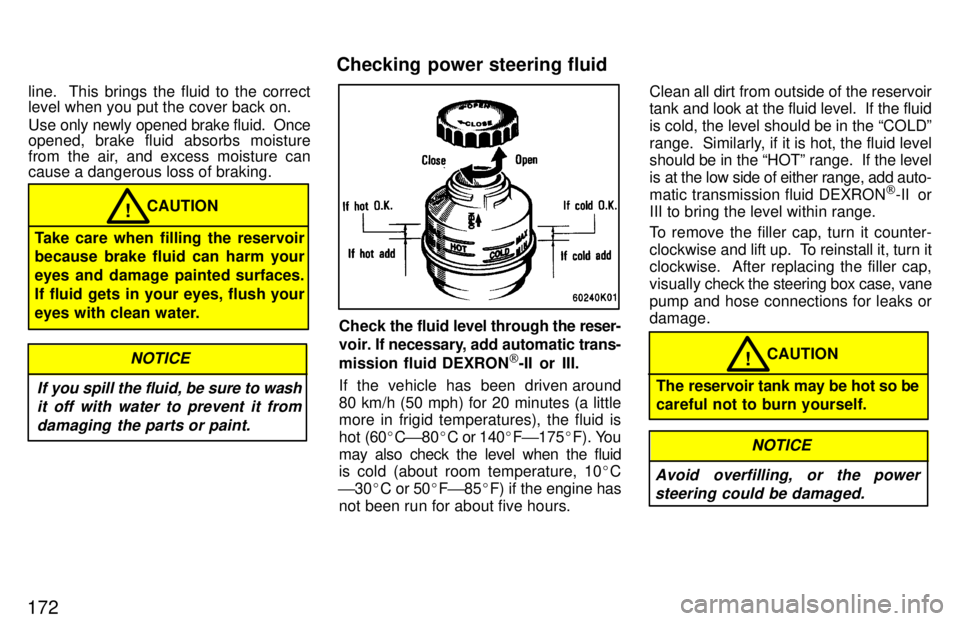
Check the fluid level through the reser-
voir. If necessary, add automatic trans-
mission fluid DEXRON [
-II or III.
If the vehicle has been driven around
80 km/h (50 mph) for 20 minutes (a little more in frigid temperatures), the fluid is
hot (60 C ' 80 C or 140 F ' 175 F). You
may also check the level when the fluid is cold (about room temperature, 10 C
' 30 C or 50 F ' 85 F) if the engine has
not been run for about five hours. Clean all dirt from outside of the reservoirtank and look at the fluid level. If the fluid is cold, the level should be in the COLDº
range. Similarly, if it is hot, the fluid level
should be in the HOTº range. If the level
is at the low side of either range, add auto-
matic transmission fluid DEXRON
[
-II or
III to bring the level within range.
To remove the filler cap, turn it counter-
clockwise and lift up. To reinstall it, turn it
clockwise. After replacing the filler cap,
visually check the steering box case, vane
pump and hose connections for leaks or damage.
CAUTION!
The reservoir tank may be hot so be
careful not to burn yourself.
Avoid overfilling, or the power steering could be damaged.
NOTICE
Checking power steering fluid
Page 176 of 198
180
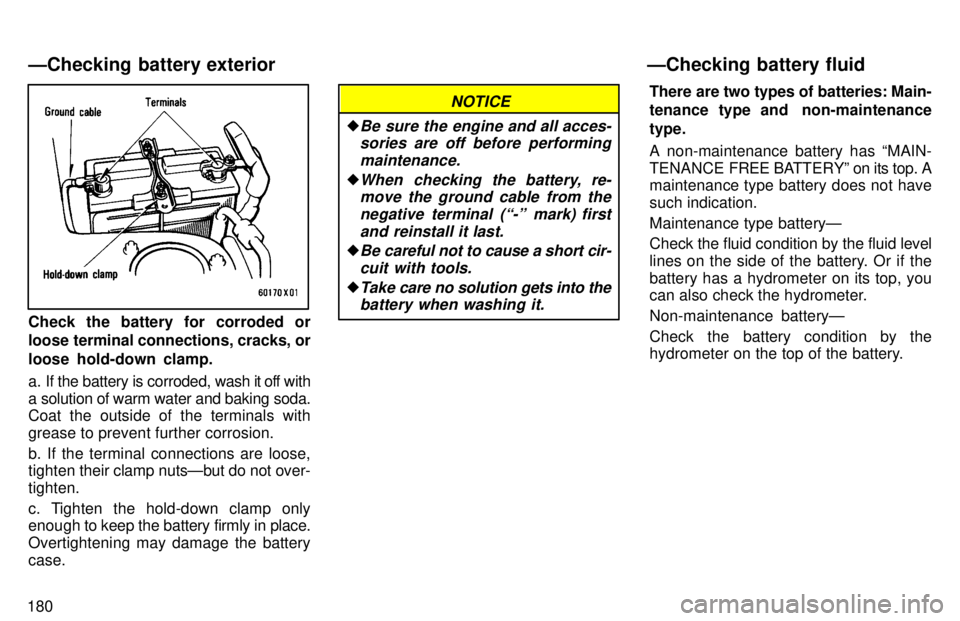
Check the battery for corroded or
loose terminal connections, cracks, or
loose hold-down clamp.
a. If the battery is corroded, wash it off with
a solution of warm water and baking soda. Coat the outside of the terminals with
grease to prevent further corrosion.
b. If the terminal connections are loose, tighten their clamp nutsÐbut do not over-
tighten.
c. Tighten the hold-down clamp only
enough to keep the battery firmly in place.
Overtightening may damage the battery case.
NOTICE
Be sure the engine and all acces-
sories are off before performing
maintenance.
When checking the battery, re-move the ground cable from the
negative terminal (-º mark) first
and reinstall it last.
Be careful not to cause a short cir-cuit with tools.
Take care no solution gets into thebattery when washing it.
There are two types of batteries: Main-
tenance type and non-maintenance type. A non-maintenance battery has MAIN-
TENANCE FREE BATTERYº on its top. A
maintenance type battery does not havesuch indication. Maintenance type batteryÐ Check the fluid condition by the fluid level
lines on the side of the battery. Or if the
battery has a hydrometer on its top, you
can also check the hydrometer. Non-maintenance batteryÐ
Check the battery condition by the
hydrometer on the top of the battery.
ÐChecking battery exterior
ÐChecking battery fluid
Page 179 of 198
183
NOTICE
Never recharge the battery while the
engine is running. Also, be sure all
accessories are turned off.
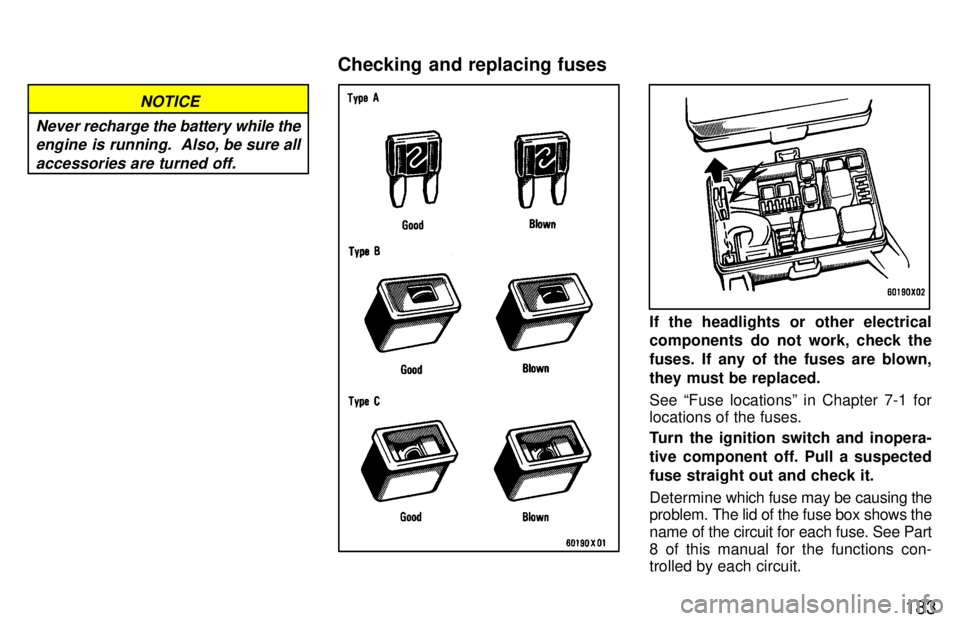
If the headlights or other electrical
components do not work, check the
fuses. If any of the fuses are blown,
they must be replaced.
See Fuse locationsº in Chapter 7-1 for
locations of the fuses.
Turn the ignition switch and inopera-
tive component off. Pull a suspected
fuse straight out and check it.
Determine wh ich fuse may be causing the
problem. The lid of the fuse box shows the name of the circuit for each fuse. See Part8 of this manual for the functions con-
trolled by each circuit.
Checking and replacing fuses
Page 181 of 198
185
To prevent burning yourself, do not check the washer fluid level when
the engine is hot.CAUTION
!
NOTICE
After checking the washer fluid
level, make sure the dipstick is se-
curely reinserted. If it is loose, fluid may leak from the reservoir.
Do not check the washer fluid lev-el or add washer fluid when the en-gine is running or when it is hot.If the fluid is spilled over the hot
engine, a fire could result.
If you have added washer fluid un-til it is close to the top of the open-
ing for adding fluid, do not pullout the dipstick. Otherwise, thefluid will overflow.
Do not use engine antifreeze or
any other substitute because itmay damage your vehicle's paint.
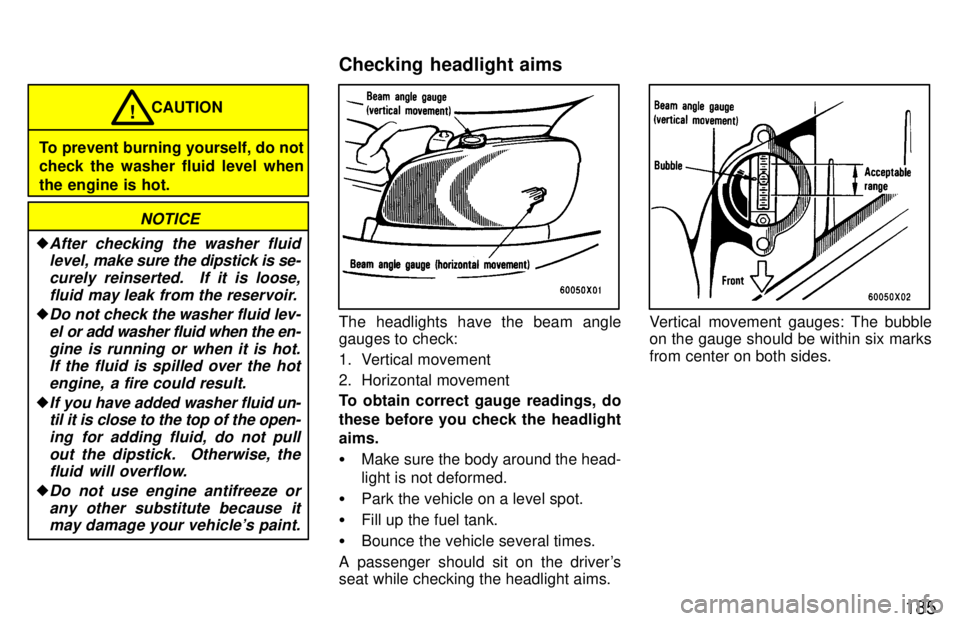
The headlights have the beam angle
gauges to check:
1. Vertical movement
2. Horizontal movement
To obtain correct gauge readings, do
these before you check the headlightaims. Make sure the body around the head- light is not deformed.
Park the vehicle on a level spot.
Fill up the fuel tank.
Bounce the vehicle several times.
A passenger should sit on the driver's
seat while checking the headlight aims.Vertical movement gauges: The bubble
on the gauge should be within six marks
from center on both sides.
Checking headlight aims
Page 189 of 198
Part 8193
SPECIFICATIONS
Dimensions and weight
Engine
Fuel
Service specifications
Tires
Fuses
Page 191 of 198

195
Model:
3S-FE
Type: 4 cylinder in line, 4 cycle, gasoline
Bore and stroke, mm (in.):
86.0 X 86.0 (3.39 X 3.39)
Displacement, cm 3
(cu. in):
1998 (121.9) Fuel type:
unleaded gasoline, Research Octane Number 91 (Octane rating 87) or higher
Fuel tank capacity, L (gal., Imp. gal.):
58 (15.3, 12.8) ENGINE
Valve clearance (engine cold), mm (in.)
Intake 0.19 '0.29 (0.007 '0.011)
Exhaust 0.28 '0.38 (0.011 '0.015)
Spark plug type: NIPPONDENSO PK20R11
NGK BKR6EP-1 1
Spark plug gap, mm (in.): 1.1 (0.043)
Drive belt tension measured with Bor-
oughs drive belt tension gauge No.
BT-33-73F (used belt), Ibf: Generator belt 95 + 20
Air conditioning
compressor belt 66 - 99 Power steering
pump belt 80 + 20
ENGINE LUBRICATION Oil capacity (drain and refill), L (qt., Imp. qt.): With filter
4.1 (4.3, 3.6)
Without filter 3.9 (4.1, 3.4)
Engine Fuel Service specifications
Page 192 of 198

196
Oil grade:
API SH, Energy-Conserving IIº mul-
tigrade engine oil or ILSAC multigrade en-
gine oil is recommended. Recommended oil viscosity (SAE):
COOLING SYSTEM
Total capacity, L (qt., Imp., qt.):
Manual Transmission 8.0 (8.5, 7.0)
Automatic transmission
7.7 (8.1, 6.8) Coolant type:
With ethylene-glycol antifreeze (Do not use alcohol type.)
BATTERY Open voltage* at 20 C (68 F):
12.6 '12.8 V Fully charged
12.2 '12.4 V Half charged
11.8 '12.0 V Discharged
*: Voltage that is checked 20 minutes after
the key is removed with all the lights
turned off Charging rates: 5 A max.
CLUTCH
Pedal freeplay, mm (in.):
5' 15 (0.2 '0.6)
Fluid type: SAE J1703 or FMVSS No. 116 DOT 3
MANUAL TRANSAXLE
Oil capacity, L (qt., Imp. qt.): Two-wheel drive models 3.9 (4.1, 3.4)
Four-wheel drive models
5.0 (5.3, 4.4) Oil type:
Two-wheel drive models
Multipurpose gear oil API GL-4 or GL-5
Four-wheel drive models
Multipurpose gear oil API GL-5
Recommended oil viscosity:
SAE 75W-90
AUTOMATIC TRANSAXLE Fluid capacity (drain and refill), L (qt., Imp. qt.): Two-wheel drive models Up to 3.3 (3.5, 2.9)
Four-wheel drive models Up to 7.0 (7.4, 6.2)
Fluid type:
Two-wheel drive models Automatic transmission fluid D-II or DEXRON [
III (DEX
RON [
II)
Four-wheel drive models Toyota automatic transaxle
fluid Type T or equivalent
Page 193 of 198

197
TRANSFER
(four-wheel drive models with an au-
tomatic transaxle)
Oil capacity, L (qt., Imp. qt.):
0.7 (0.7, 0.6)
Oil type:
Multipurpose gear oil API GL-5
Recommended oil viscosity: SAE 75W-90
REAR DIFFERENTIAL (four-wheel drive models)
Oil capacity, L (qt., Imp. qt.): 0.9 (1.0, 0.8)
Oil type: Hypoid gear oil API GL-5
Recommended oil viscosity:
Above -18 C (0 F)
SAE 90
Below -18 C (0 F)
SAE 80W or 80W-90 BRAKES Minimum pedal clearance when de- pressed with the pressure of 490 N (50
kgf, 110 lbf) with the engine running, mm (in.):
75 (3.0)
Pedal freeplay, mm (in.): 1' 6 (0.04 '0.24)
Pad wear limit, in. (mm): 1.0 (0.04)
Lining wear limit, in. (mm):
1.0 (0.04)
Parking brake adjustment when pulledwith the force of 196 N (20 kgf, 44 lbf): 5' 8 clicks
Fluid type: SAE J1703 or FMVSS No. 116 DOT 3
STEERING Wheel freeplay: Less than 30 mm (1.2 in.)
Power steering fluid type: Automatic transmission fluid DEXRON [
II or III
Page 195 of 198

199
Engine compartment (U.S.A.) Fuses (type A) 1 AM2 20A: Multiport fuel injection sys-
tem/sequential multiport fuel injection
system, charging system
2 DOME 15A: Personal lights, open door
warning light, clock 3 EFI 15A: Multiport fuel injection sys-
tem/sequential multiport fuel injection system 4 HAZ-HORN 15A: Emergency flashers,
horns
5 ALT-S 5A: Charging system
6 SPARE 15A: Spare fuse
7 SPARE 7.5A: Spare fuseEngine compartment (Canada) 8 H-LP LH 15A: Left-hand headlight
9 H-LP RH 15A: Right-hand headlight
10 DRL 7.5A: Daytime running light sys-
tem
11 H-LP LH-L 10A: Left-hand headlight
(low beam)
12 H-LP RH-L 10A: Right hand head-
light (low beam)
13 H-LP LH-H 10A: Left-hand headlight
(high beam)
14 H-LP RH-H 10A: Right-hand healight
(high beam)Engine compartment
15 TAIL 10A: Tail lights, parking lights, li-
cense plate lights, interior lights
16 GAUGE 10A: Gauges and meters,
service reminder indicators (except dis-
charge and open door warning lights),
back-up lights, air conditioning system,
power windows, rear window defogger,
center differential lock system, electroni-
cally controlled automatic transmission system
17 TURN 7.5A: Turn signal lights
18 CIG & RAD 15A: Cigarette lighter,
clock, car audio system, power rear view mirrors
Fuses