fuel TOYOTA RAV4 1999 Owner's Guide
[x] Cancel search | Manufacturer: TOYOTA, Model Year: 1999, Model line: RAV4, Model: TOYOTA RAV4 1999Pages: 226, PDF Size: 3.89 MB
Page 194 of 226
'99 Rav4.U
194
Engine oil selection
Use API grade SJ, ºEnergy- Conservingº or
ILSAC multigrade engine oil.
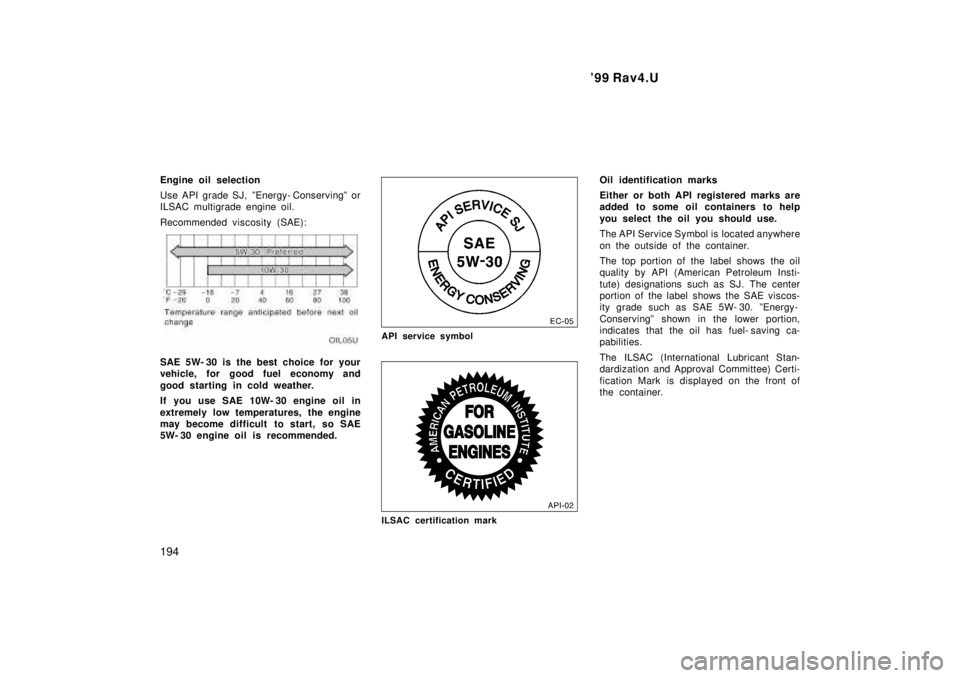
Recommended viscosity (SAE):
SAE 5W- 30 is the best choice for your
vehicle, for good fuel economy and
good starting in cold weather.
If you use SAE 10W- 30 engine oil in
extremely low temperatures, the engine
may become difficult to start, so SAE
5W- 30 engine oil is recommended.
API service symbol
ILSAC certification mark
Oil identification marks
Either or both API registered marks are
added to some oil containers to help
you select the oil you should use.
The API Service Symbol is located anywhere
on the outside of the container.
The top portion of the label shows the oil
quality by API (American Petroleum Insti-
tute) designations such as SJ. The center
portion of the label shows the SAE viscos-
ity grade such as SAE 5W- 30. ºEnergy-
Conservingº shown in the lower portion,
indicates that the oil has fuel- saving ca-
pabilities.
The ILSAC (International Lubricant Stan-
dardization and Approval Committee) Certi-
fication Mark is displayed on the front of
the container.
Page 197 of 226
'99 Rav4.U197
Clean all dirt from outside of the reservoir
tank and look at the fluid level. If the fluid
is cold, the level should be in the ºCOLDº
range. Similarly, if it is hot, the fluid level
should be in the ºHOTº range. If the level
is at the low side of either range, add auto-
matic transmission fluid DEXRON
II or III
to bring the level within the range.
To remove the filler cap, turn it c ounterclock-
wise and lift up. To reinstall it, turn it clock-
wise. After replacing the filler cap, visually
check the steering box case, vane pump and
hose connections for leaks or damage.
CAUTION
The reservoir tank may be hot so be
careful not to burn yourself.
NOTICE
Avoid overfilling, or the power steer-
ing could be damaged.
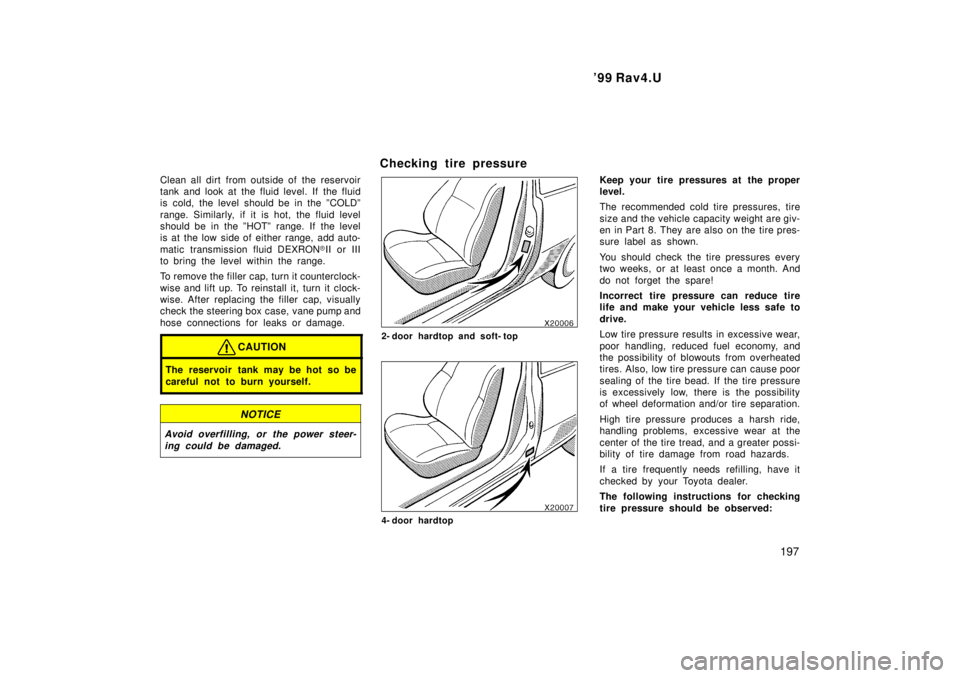
Checking tire pressure
2- door hardtop and soft- top
4- door hardtop Keep your tire pressures at the proper
level.
The recommended cold tire pressures, tire
size and the vehicle capacity weight are giv-
en in Part 8. They are also on the tire pres-
sure label as shown.
You should check the tire pressures every
two weeks, or at least once a month. And
do not forget the spare!
Incorrect tire pressure can reduce tire
life and make your vehicle less safe to
drive.
Low tire pressure results in excessive wear,
poor handling, reduced fuel economy, and
the possibility of blowouts from over
heated
tires. Also, low tire pressure can cause poor
sealing of the tire bead. If the tire pressure
is excessively low, there is the possibility
of wheel deformation and/or tire separation.
High tire pressure produces a harsh ride,
handling problems, excessive wear at the
center of the tire tread, and a greater possi-
bility of tire damage from road hazards.
If a tire frequently needs ref illing, have it
checked by your Toyota dealer.
The following instructions for checking
tire pressure should be observed:
Page 215 of 226
'99 Rav4.U215
Part 8
SPECIFICATIONS
Dimensions and weight
Engine
Fuel
Service specifications
Ti r es
Fuses
Page 217 of 226

'99 Rav4.U217
Engine
Model:
3S- FE
Type: 4 cylinder in line, 4 cycle, gasoline
Bore and stroke, mm (in.): 86.0 86.0 (3.39 3.39)
Displacement, cm 3
(cu. in.):
1998 (121.9) Fuel
Fuel type:
Unleaded gasolene, Octane Rating 87
(Research Octane Number 91) or
higher
Fuel tank capacity, L (gal., lmp. gal.): 58 (15.3, 12.8) Service specifications
ENGINE
Valve clearance (engine cold), mm (in.):
Intake 0.19Ð0.29 (0.007Ð0.011)
Exhaust 0.28Ð0.38 (0.011Ð0.015)
Spark plug type: DENSO PK20TR11
NGK BKR6EKPB11
Spark plug gap, mm (in.): 1.1 (0.043)
Drive belt tension measured with Bor-
roughs drive belt tension gauge No.
BT- 33- 73F (used belt), Ibf: Generator belt 65
20
Air conditioning
compressor belt 66
99
Power steering
pump belt 80
20
ENGINE LUBRICATION
Oil capacity (drain and ref ill),
L (qt., Imp. qt.):
With filter4.1 (4.3, 3.6)
Without filter
3.9 (4.1, 3.4)
Page 221 of 226

'99 Rav4.U221
Fuses
Engine compartment
(without daytime running light system)
Fuses (type A) 1. H- LP (RH) 15 A: Right- hand headlight
2. H- LP (LH) 15 A: Left- hand headlight
3. SPARE 10 A: Spare fuse
4. SPARE 15 A: Spare fuse
5. AM2 5 A: Multiport fuel injection sys-
tem/sequential multiport fuel injection
system, SRS airbag system, seat belt
pretensioners, starting system, dis-
charge warning light
6. ALT- S 5 A: Charging system
7. HAZ 10 A: Emergency flashersEngine compartment
(with daytime running light system)
8. EFI 20 A: Multiport fuel injection sys-
tem/sequential multiport fuel injection
system
9. DOME 15 A: Interior light, personal
lights, clock, daytime running light sys-
tem, gauge and meters, car audio sys-
tem
10. IGN 20 A: Charging system
11. H- LP RH- H 10 A: Right- hand head-
light (high beam)
12. H- LP LH- H 10 A: Left- hand headlight
(high beam)
13. H- LP RH- L 10 A: Right- hand head-
light (low beam)Engine compartment
14. H- LP LH- L 10 A: Left- hand headlight
(low beam)
15. SEAT- HTR 10 A: No circuit
16. PWR OUTLET 15 A: Power outlet
17. CIG 15 A: Cigarette lighter, clock, car
audio system, power rear view mirrors,
electronically controlled automatic
transmission system
18. SRS- ACC 10 A: SRS airbag system,
seat belt pretensioners
19. WIPER 20 A: Windshield wipers and
washer, rear window wiper and washer
Page 222 of 226

'99 Rav4.U
222
Instrument panel
20. ECU- IG 10 A: Electronically controlled
automatic transmission system, rear
window defogger, center differential
lock system, electric moon roof, multi-
port fuel injection system/sequential
multiport fuel injection system, electric
cooling fan, anti- lock brake system,
cruise control system
21. TURN & GAUGE 10 A: Turn signal
lights, gauges and meters, back- up
lights, service reminder indicators, air
conditioning system, daytime running
light systemInstrument panel
22. STOP 10 A: stoplights, high mounted
stoplight, electronically controlled auto-
matic transmission system, anti- lock
brake system
23. TAIL 15 A: Gauges and meters, emer-
gency flashers, cigarette lighter, center
differential lock system, clock, rear win-
dow defogger, air conditioning system,
electronically controlled automatic
transmission system, car audio system,
tail lights, license plate lights, parking
lights, instrument panel light control,
side marker lights
24. OBD 10 A: On- board diagnosis system
25. SRS- B 10 A: SRS airbag warning lightPassenger's side kick panel
26. HORN 10 A: Horn
27. DEFOG 20 A: Rear window defogger
28. AM1 10 A: ºCIGº, ºPWR OUTLETº,
ºSRS- ACCº, ºWIPERº, ºECU- IGº and
ºTURN & GAUGEº fuses
29. A/C 10 A: Air conditioning system
Fuses (type B)
30. MAIN No.1 40 A: Starting system, ºH-
LP (RH)º, ºH- LP (LH)º, ºH- LP RH- Hº,
ºH- LP LH- Hº, ºH- LP RH- Lº and ºH- LP
LH- Lº fuses
31. CDS FAN 30 A: Electric cooling fans
32. RDI FAN 30 A: Electric cooling fans