ABS TOYOTA RAV4 1999 Owners Manual
[x] Cancel search | Manufacturer: TOYOTA, Model Year: 1999, Model line: RAV4, Model: TOYOTA RAV4 1999Pages: 226, PDF Size: 3.89 MB
Page 52 of 226

'99 Rav4.U
52
The SRS airbag system mainly consists of
the following components and their loca-
tions are shown in the illustration. 1. Front airbag sensors
2. SRS airbag warning light
3. Airbag module for passenger (airbag and inflator)
4. Airbag sensor assembly
5. Airbag module for driver (airbag and inflator)
The airbag sensor assembly consists of a
safing sensor and airbag sensor. In a severe frontal impact, sensors detect
deceleration and the system triggers the
airbag inflators. Then a chemical reaction
in the inflators momentarily fills the air-
bags with non- toxic gas to help restrain
the forward motion of the occupants.
When the airbags inflate, they produce a
fairly loud noise and release some smoke
and residue along with non- toxic gas. This
does not indicate a fire. This gas is nor-
mally harmless, however, for those who
have delicate skin, it may cause minor
skin irritation. Be sure to wash off any
residue as soon as possible to prevent
minor skin irritation.
Deployment of the airbags happens in a
fraction of a second, so the airbags must
inflate with considerable force. While the
system is desi
gned to reduce serious inju-
ries, it may also cause minor burns or
abrasions and swellings.
Parts of the airbag module (steering wheel
hub, dashboard) may be hot for several
minutes, but the airbags themselves will
not be hot. The airbags are designed to
inflate only once. A crash severe enough to inflate the air-
bags may break the windshield as the
vehicle buckles. In vehicles with a pas-
senger airbag the windshield may also be
damaged by absorbing some of the force
of the inflating airbag.
Page 88 of 226
'99 Rav4.U
88
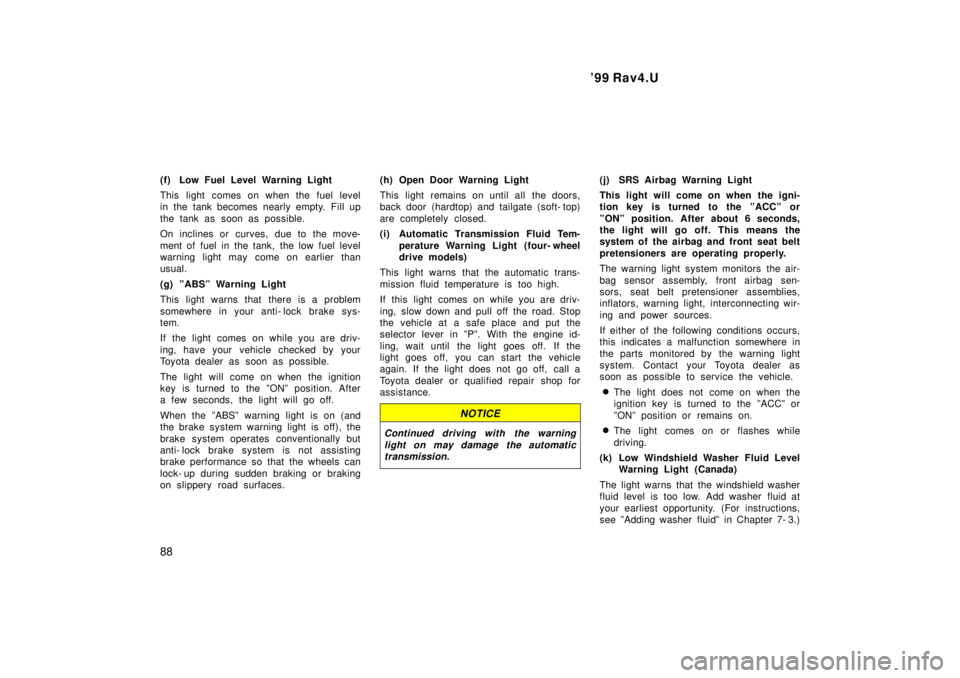
(f) Low Fuel Level Warning Light
This light comes on when the fuel level
in the tank becomes nearly empty. Fill up
the tank as soon as possible.
On inclines or curves, due to the move-
ment of fuel in the tank, the low fuel level
warning light may come on earlier than
usual.
(g) ºABSº Warning Light
This light warns that there is a problem
somewhere in your anti- lock brake sys-
tem.
If the light comes on while you are driv-
ing, have your vehicle checked by your
Toyota dealer as soon as possible.
The light will come on when the ignition
key is turned to the ºONº position. After
a few seconds, the light will go off.
When the ºABSº warning light is on (and
the brake system warning light is off), the
brake system operates conventionally but
anti- lock brake system is not assisting
brake performance so that the wheels can
lock- up during sudden braking or braking
on slippery road surfaces.
(h) Open Door Warning Light
This light remains on until all the doors,
back door (hardtop) and tailgate (soft- top)
are completely closed.
(i) Automatic Transmission Fluid Tem-
perature Warning Light (four- wheel
drive models)
This light warns that the automatic trans-
mission fluid temperature is too high.
If this light comes on while you are driv-
ing, slow down and pull off the road. Stop
the vehicle at a safe place and put the
selector lever in ºPº. With the engine id-
ling, wait until the light goes off. If the
light goes off, you can start the vehicle
again. If the light does not go off, call a
Toyota dealer or qualified repair shop for
assistance.
NOTICE
Continued driving with the warning light on may damage the automatictransmission.
(j) SRS Airbag Warning Light
This light will come on when the igni-
tion key is turned to the ºACCº or
ºONº position. After about 6 seconds,
the light will go off. This means the
system of the airbag and front seat belt
pretensioners are operating properly.
The warning light system monitors the air-
bag sensor assembly, front airbag sen-
sors, seat belt pretensioner assemblies,
inflators, warning light, interconnecting wir-
ing and power sources.
If either of the following conditions occurs,
this indicates a malfunction somewhere in
the parts monitored by the warning light
system. Contact your Toyota dealer as
soon as possible to service the vehicle.
The light does not come on when the
ignition key is turned to the ºACCº or
ºONº position or remains on.
The light comes on or flashes while
driving.
(k) Low Windshield Washer Fluid Level Warning Light (Canada)
The light warns that the windshield washer
fluid level is too low. Add washer fluid at
your earliest opportunity. (For instructions,
see ºAdding washer fluidº in Chapter 7- 3.)
Page 89 of 226

'99 Rav4.U89
(l) Light Reminder Buzzer
This buzzer will sound if the headlight
switch is left on and the driver's door is
opened with the key removed from the
ignition switch.
(m) Key Reminder Buzzer
This buzzer reminds you to remove the
key when you open the driver 's door with
the ignition key in the ºACCº or ºLOCKº
position.
CHECKING SERVICE REMINDER INDICA-
TORS (except the low fuel level warning
light and low windshield washer fluid
level warning light)
1. Apply the parking brake.
2. Open one of the doors or tailgate (soft- top).
The open door warning light should
come on.
3. Close the door or tailgate (soft- top). The open door warning light should go
off.
4. Turn the ignition key to ºACCº. The SRS airbag warning light should
come on. It goes off after about 6 se-
conds. 5. Turn the ignition key to ºONº, but do
not start the engine.
All the service reminder indicators ex-
cept the open door warning light, SRS
airbag warning light and automatic
transmission fluid temperature warning
light should come on. The ºABSº warn-
ing light goes off after a few seconds.
6. Turn the ignition key to ºSTARTº. The automatic transmission fluid tempera-
ture warning light should come on.
If any service reminder indicator or warn-
ing buzzer does not function as described
above, either the bulb is burned out or the
circuit is in need of repair. Have it
checked by your Toyota dealer as soon as
possible.
Page 138 of 226
'99 Rav4.U
138
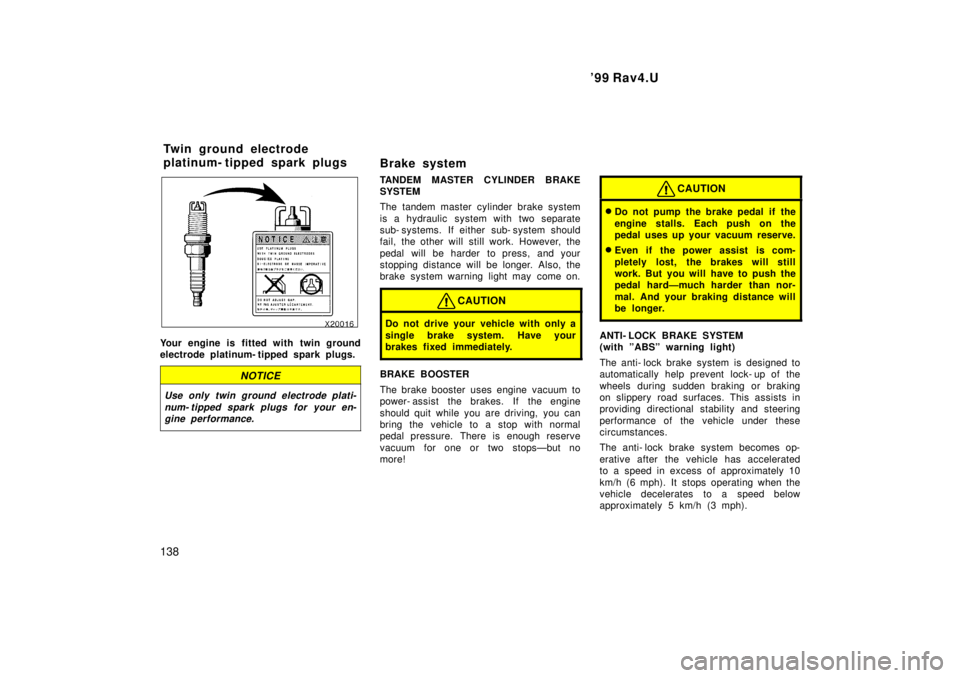
Your engine is fitted with twin ground
electrode platinum- tipped spark plugs.
NOTICE
Use only twin ground electrode plati- num- tipped spark plugs for your en-gine performance.
Brake system
TANDEM MASTER CYLINDER BRAKE SYSTEM
The tandem master cylinder brake system
is a hydraulic system with two separate
sub- systems. If either sub- system s hould
fail, the other will still work. However, the
pedal will be harder to press, and your
stopping distance will be longer. Also, the
brake system warning light may come on.
CAUTION
Do not drive your vehicle with only a
single brake system. Have your
brakes fixed immediately.
BRAKE BOOSTER
The brake booster uses engine vacuum to
power- assist the brakes. If the engine
should quit while you are driving, you can
bring the vehicle to a stop with normal
pedal pressure. There is enough reserve
vacuum for one or two stopsÐbut no
more!
CAUTION
Do not pump the brake pedal if the
engine stalls. Each push on the
pedal uses up your vacuum reserve.
Even if the power assist is com-
pletely lost, the brakes will still
work. But you will have to push the
pedal hardÐmuch harder than nor-
mal. And your braking distance will
be longer.
ANTI- LOCK BRAKE SYSTEM
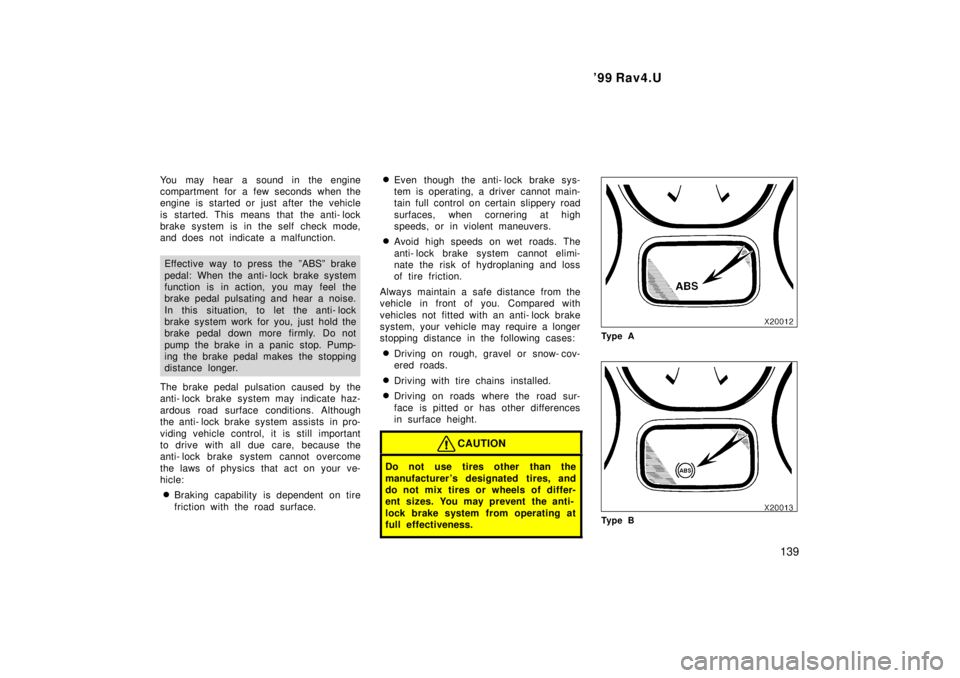
(with ºABSº warning light)
The anti- lock brake system is designed to
automatically help prevent lock- up of the
wheels during sudden braking or braking
on slippery road surfaces. This assists in
providing directional stab ility and steering
performance of the vehicle under these
circumstances.
The anti- lock brake system becomes op-
erative after the vehicle has accelerated
to a speed in excess of approximately 10
km/h (6 mph). It stops operating when the
vehicle decelerates to a speed below
approximately 5 km/h (3 mph).
Twin ground electrode
platinum- tipped spark plugs
Page 139 of 226
'99 Rav4.U139
You may hear a sound in the engine
compartment for a few seconds when the
engine is started or just after the vehicle
is started. This means that the anti- lock
brake system is in the self check mode,
and does not indicate a malfunction.
Effective way to press the ºABSº brake
pedal: When the anti- lock brake system
function is in action, you may feel the
brake pedal pulsating and hear a noise.
In this situation, to let the anti- lock
brake system work for you, just hold the
brake pedal down more firmly. Do not
pump the brake in a panic stop. Pump-
ing the brake pedal makes the stopping
distance longer.
The brake pedal pulsation caused by the
anti- lock brake system may indicate haz-
ardous road surface conditions. Although
the anti- lock brake system assists in pro-
viding vehicle control, it is still important
to drive with all due care, because the
anti- lock brake system cannot overcome
the laws of physics that act on your ve-
hicle: Braking capab ility is dependent on tire
friction with the road surface.
Even though the anti- lock brake sys-
tem is operating, a driver cannot main-
tain full control on certain slippery road
surfaces, when cornering at high
speeds, or in violent maneuvers.
Avoid high speeds on wet roads. The
anti- lock brake system cannot elimi-
nate the risk of hydroplaning and loss
of tire friction.
Always maintain a safe distance from the
vehicle in front of you. Compared with
vehicles not fitted with an anti- lock brake
system, your vehicle may r equire a longer
stopping distance in the following cases:
Driving on rough, gravel or snow- cov-
ered roads.
Driving with tire chains installed.
Driving on roads where the road sur-
face is pitted or has other differences
in surface height.
CAUTION
Do not use tires other than the
manufacturer 's designated tires, and
do not mix tires or wheels of differ-
ent sizes. You may prevent the anti-
lock brake system from operating at
full effectiveness.
Ty p e A
Ty p e B
Page 140 of 226
'99 Rav4.U
140
ºABSº warning light
This light comes on when the ignition key
is turned to the ºONº position. After a few
seconds, the light will go off.
If either of the following conditions occurs,
this indicates a malfunction somewhere in
the parts monitored by the warning light
system. Contact your Toyota dealer as
soon as possible to service the vehicle.
The light does not come on as de-
scribed above, or remains on.
The light comes on while driving.
Even if the anti- lock brake system should
fail, the brake system will still operate
conventionally. However, when the ºABSº
warning light is on (and the brake system
warning light is off), anti- lock brake sys-
tem is not assisting brake performance so
that the wheel can lock- up during sudden
braking or braking on slippery road sur-
faces. Have your vehicle checked by your
Toyota dealer as soon as possible. Brake pad wear limit indicators
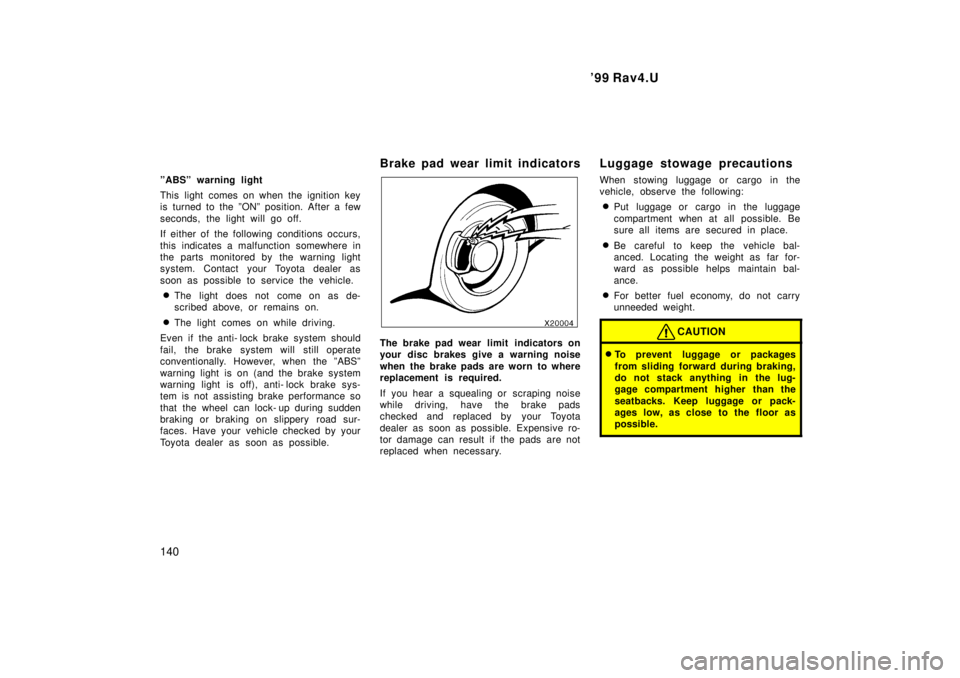
The brake pad wear limit indicators on
your disc brakes give a warning noise
when the brake pads are worn to where
replacement is required.
If you hear a squealing or scraping noise
while driving, have the brake pads
checked and replaced by your Toyota
dealer as soon as possible. Expensive ro-
tor damage can result if the pads are not
replaced when necessary.Luggage stowage pr
ecautions
When stowing luggage or cargo in the
vehicle, observe the following: Put luggage or cargo in the luggage
compartment when at all possible. Be
sure all items are secured in place.
Be careful to keep the vehicle bal-
anced. Locating the weight as far for-
ward as possible helps maintain bal-
ance.
For better fuel economy, do not carry
unneeded weight.CAUTION
To prevent luggage or packages
from sliding forward during braking,
do not stack anything in the lug-
gage compartment higher than the
seatbacks. Keep luggage or pack-
ages low, as close to the floor as
possible.
Page 154 of 226
'99 Rav4.U
154
Crosswinds and rough roads will ad-
versely affect handling of your vehicle
and trailer, causing sway. Pay attention
to the rear from time to time to pre-
pare yourself for being passed by large
trucks or buses, which may cause your
vehicle and trailer to sway. If swaying
happens, firmly grip the steering wheel
and reduce speed immediately but
gradually. Never increase speed. Steer
straight ahead. If you make no extreme
correction with the steering or brakes,
the vehicle and trailer will stabilize.
Be careful when passing other ve-
hicles. Passing requires considerable
distance. After passing a vehicle, do
not forget the length of your trailer and
be sure you have plenty of room be-
fore changing lanes.
In order to maintain engine braking effi-
ciency, do not use fifth gear (manual
transmission) or overdrive (automatic
transmission).
Because of the added load of the trail-
er, your vehicle's engine may overheat
on hot days (at temperatures over 30C [85 F]) when going up a long or
steep grade with a trailer. If the engine
coolant temperature gauge indicates
overheating, immediately turn off the air
conditioning (if in use), pull off the road
and stop in a safe spot. Refer to ºIf
your vehicle overheatsº in Part 4 of
this manual.
Always place wheel blocks under both
the vehicle and trailer wheels when
parking. Apply the parking brake firmly.
Put the transmission in ºPº (automatic)
or in first or reverse (manual). Avoid
parking on a slope with a trailer, but
if it cannot be avoided, do so only
after performing the following:
1. Apply the brakes and hold.
2. Have someone place wheel blocks un- der both the vehicle and trailer wheels.
3. When the wheel blocks are in place, release your brakes slowly until the
blocks absorb the load.
4. Apply the parking brake firmly.
5. Shift into first or reverse (manual) or ºPº (automatic) and turn off the engine. When restarting out after parking on a
slope:
1. With the transmission in ºPº position (automatic) or the clutch pedal de-
pressed (manual), start the engine.
(With an automatic transmission, be
sure to keep the brake pedal de-
pressed.)
2. Shift into gear.
3. Release the parking brake (also foot brake on automatic transmission ve-
hicles) and slowly pull or back away
from the wheel blo cks. Stop and apply
your brakes.
4. Have someone retrieve the blo cks.
CAUTION
Do not exceed 72 km/h (45 mph) or
the posted towing speed limit,
whichever is lower. Because insta-
bility (swaying) of a towing vehicle-
trailer combination usually in-
creases as the speed increases, ex-
ceeding 72 km/h (45 mph) may
cause loss of control.
Page 196 of 226
'99 Rav4.U
196
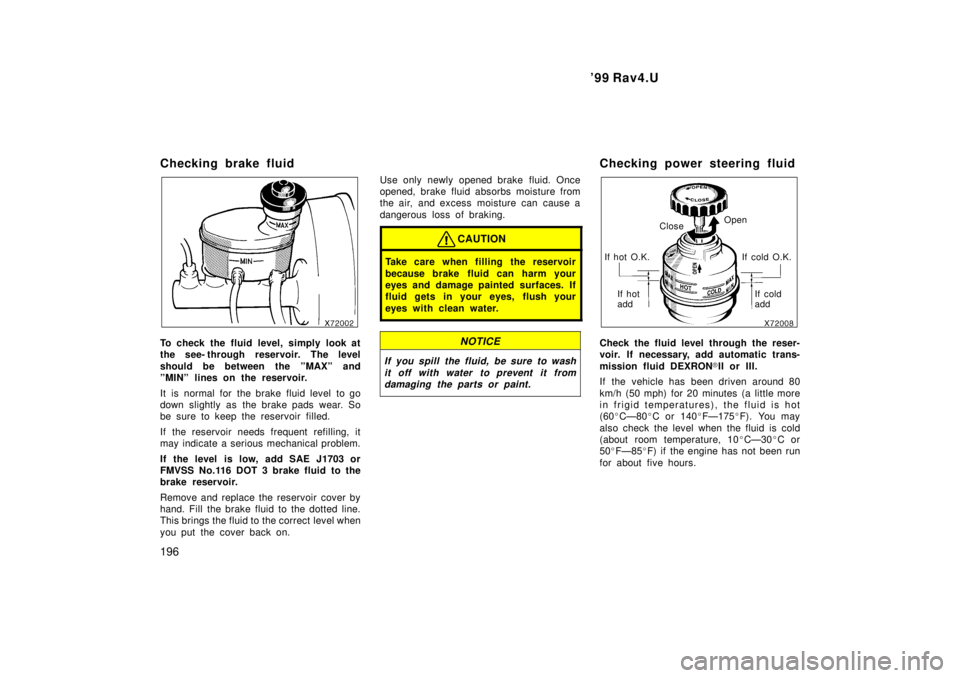
Checking brake fluid
To check the fluid level, simply look at
the see- through reservoir. The level
should be between the ºMAXº and
ºMINº lines on the reservoir.
It is normal for the brake fluid level to go
down slightly as the brake pads wear. So
be sure to keep the reservoir filled.
If the reservoir needs frequent ref
illing, it
may indicate a serious mechanical problem.
If the level is low, add SAE J1703 or
FMVSS No.116 DOT 3 brake fluid to the
brake reservoir.
Remove and replace the reservoir cover by
hand. Fill the brake fluid to the dotted line.
This brings the fluid to the correct level when
you put the cover back on. Use only newly opened brake fluid. Once
opened, brake fluid absorbs moisture from
the air, and excess moisture can cause a
dangerous loss of braking.
CAUTION
Take care when filling the r
eservoir
because brake fluid can harm your
eyes and damage painted surfaces. If
fluid gets in your eyes, flush your
eyes with clean water.
NOTICE
If you spill the fluid, be sure to wash
it off with water to prevent it fromdamaging the parts or paint.
Checking power steering fluid
Close Open
If hot O.K. If hot add If cold O.K.
If cold add
Check the fluid level through the reser-
voir. If necessary, add automatic trans-
mission fluid DEXRON II or III.
If the vehicle has been driven around 80
km/h (50 mph) for 20 minutes (a little more
in frigid temperatures), the fluid is hot
(60 CÐ80 C or 140 FÐ175 F). You may
also check the level when the fluid is cold
(about room temperature, 10 CÐ30 C or
50 FÐ85 F) if the engine has not been run
for about five hours.
Page 223 of 226

'99 Rav4.U223
33. PWR 30 A:
Power door lock system,
electric moon roof, power windows
Fuses (type C)
34. ABS 50 A: Anti- lock brake system
35. MAIN 80 A: ºIGNº, ºHAZº, ºDOMEº,
ºALT- Sº, ºMAIN No.1º, ºAM2º and ºEFIº
fuses
36. ALT 100 A: ºHTRº, ºABSº, ºRDI FANº,
ºCDS FANº, ºCIGº, ºSRS- ACCº,
ºWIPERº, ºECU- IGº, ºTURN &
GAUGEº, ºDEFOGº, ºTAILº, ºSTOPº,
ºHORNº, ºOBDº, ºSRS- Bº, ºPWR
OUTLETº, ºPWRº and ºAM1º fuses
37. HTR 50 A: Air conditioning system,
ºA/Cº fuse