ATF t4 TOYOTA RAV4 2006 Service Repair Manual
[x] Cancel search | Manufacturer: TOYOTA, Model Year: 2006, Model line: RAV4, Model: TOYOTA RAV4 2006Pages: 2000, PDF Size: 45.84 MB
Page 1227 of 2000
U151F AUTOMATIC TRANSAXLE – FORWARD CLUTCHAX–257
AX
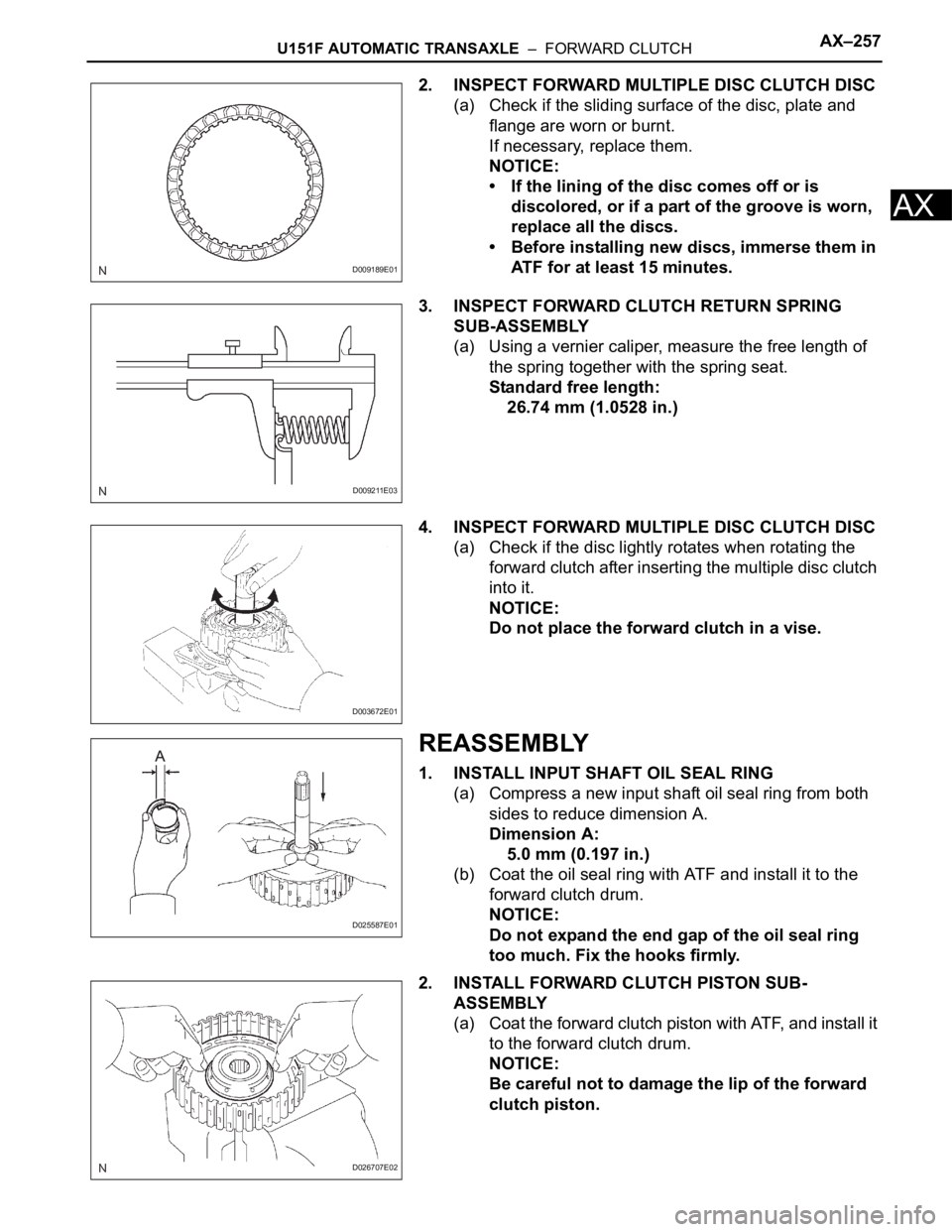
2. INSPECT FORWARD MULTIPLE DISC CLUTCH DISC
(a) Check if the sliding surface of the disc, plate and
flange are worn or burnt.
If necessary, replace them.
NOTICE:
• If the lining of the disc comes off or is
discolored, or if a part of the groove is worn,
replace all the discs.
• Before installing new discs, immerse them in
ATF for at least 15 minutes.
3. INSPECT FORWARD CLUTCH RETURN SPRING
SUB-ASSEMBLY
(a) Using a vernier caliper, measure the free length of
the spring together with the spring seat.
Standard free length:
26.74 mm (1.0528 in.)
4. INSPECT FORWARD MULTIPLE DISC CLUTCH DISC
(a) Check if the disc lightly rotates when rotating the
forward clutch after inserting the multiple disc clutch
into it.
NOTICE:
Do not place the forward clutch in a vise.
REASSEMBLY
1. INSTALL INPUT SHAFT OIL SEAL RING
(a) Compress a new input shaft oil seal ring from both
sides to reduce dimension A.
Dimension A:
5.0 mm (0.197 in.)
(b) Coat the oil seal ring with ATF and install it to the
forward clutch drum.
NOTICE:
Do not expand the end gap of the oil seal ring
too much. Fix the hooks firmly.
2. INSTALL FORWARD CLUTCH PISTON SUB-
ASSEMBLY
(a) Coat the forward clutch piston with ATF, and install it
to the forward clutch drum.
NOTICE:
Be careful not to damage the lip of the forward
clutch piston.
D009189E01
D009211E03
D003672E01
D025587E01
D026707E02
Page 1228 of 2000
AX–258U151F AUTOMATIC TRANSAXLE – FORWARD CLUTCH
AX
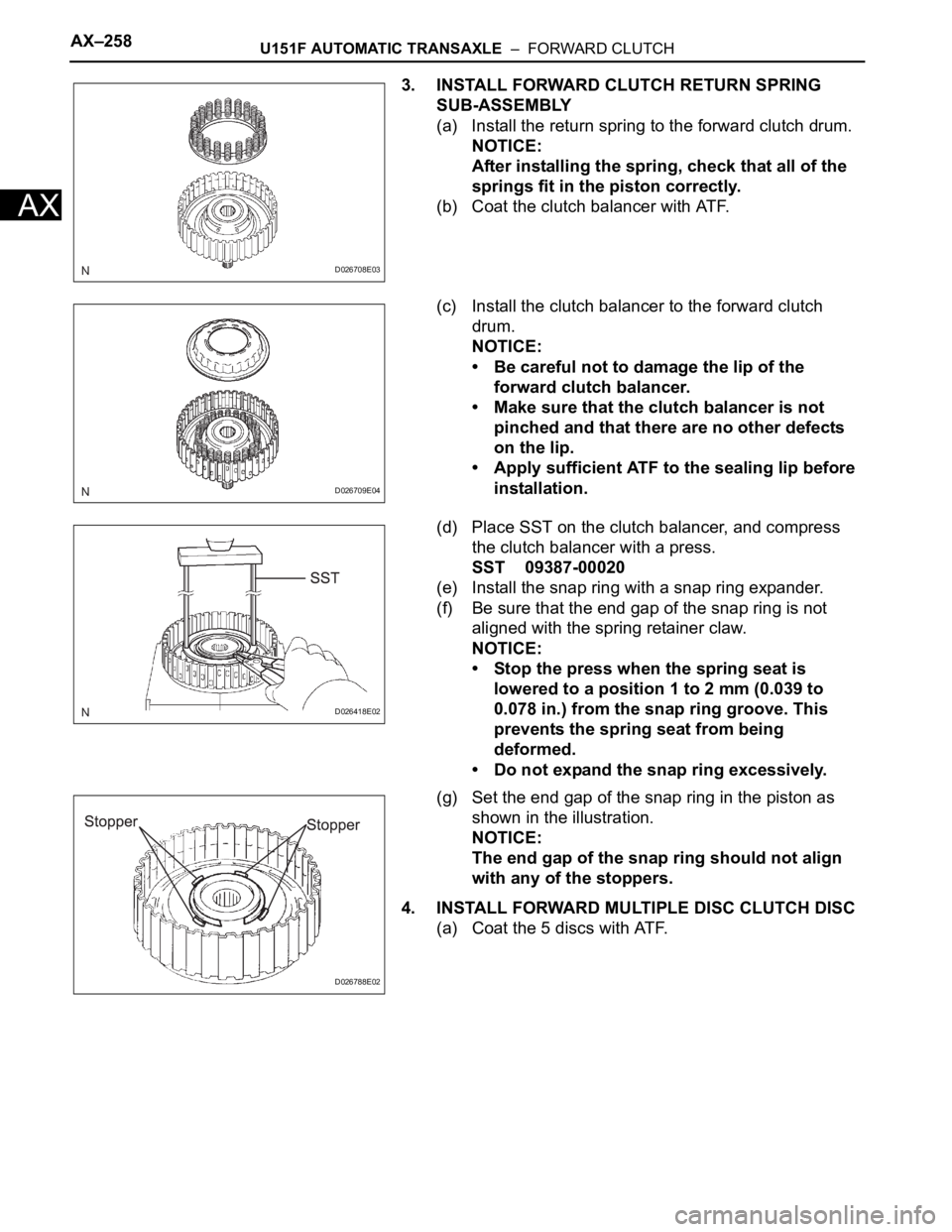
3. INSTALL FORWARD CLUTCH RETURN SPRING
SUB-ASSEMBLY
(a) Install the return spring to the forward clutch drum.
NOTICE:
After installing the spring, check that all of the
springs fit in the piston correctly.
(b) Coat the clutch balancer with ATF.
(c) Install the clutch balancer to the forward clutch
drum.
NOTICE:
• Be careful not to damage the lip of the
forward clutch balancer.
• Make sure that the clutch balancer is not
pinched and that there are no other defects
on the lip.
• Apply sufficient ATF to the sealing lip before
installation.
(d) Place SST on the clutch balancer, and compress
the clutch balancer with a press.
SST 09387-00020
(e) Install the snap ring with a snap ring expander.
(f) Be sure that the end gap of the snap ring is not
aligned with the spring retainer claw.
NOTICE:
• Stop the press when the spring seat is
lowered to a position 1 to 2 mm (0.039 to
0.078 in.) from the snap ring groove. This
prevents the spring seat from being
deformed.
• Do not expand the snap ring excessively.
(g) Set the end gap of the snap ring in the piston as
shown in the illustration.
NOTICE:
The end gap of the snap ring should not align
with any of the stoppers.
4. INSTALL FORWARD MULTIPLE DISC CLUTCH DISC
(a) Coat the 5 discs with ATF.
D026708E03
D026709E04
D026418E02
D026788E02
Page 1239 of 2000
U241E AUTOMATIC TRANSAXLE – AUTOMATIC TRANSAXLE SYSTEMAX–15
AX
ROAD TEST
1. PROBLEM SYMPTOM CONFIRMATION
(a) Based on the result of the customer problem
analysis, try to reproduce the symptoms. If the
problem is that the transaxle does not shift up, shift
down, or the shift point is too high or too low,
conduct the following road test referring to the
automatic shift schedule and simulate the problem
symptoms.
2. ROAD TEST
NOTICE:
Perform the test at the normal operating ATF
temperature of 50 to 80
C (122 to 176F).
(a) D position test
Move the shift lever to D and fully depress the
accelerator pedal. Check the following:
(1) Check up-shift operation.
Check that the 1
2, 2 3 and 3 O/D up-
shifts take place at the shift point shown in the
automatic shift schedule (see page SS-60).
HINT:
O/D Gear Up-shift Prohibition Control
• Engine coolant temperature is 55
C (131F)
or less and vehicle speed is at 70 km/h (43
mph) or less.
• ATF temperature is 5
C (41F) or less.
O/D Gear Lock-up Prohibition Control
• Brake pedal is depressed.
• Accelerator pedal is released.
• Engine coolant temperature is 60
C (140F)
or less.
(2) Check for shift shock and slip.
Check for shock and slip at the 1
2, 2 3 and
3
O/D up-shifts.
(3) Check for abnormal noise and vibration.
Check for abnormal noise and vibration when
up-shifting from 1
2, 2 3 and 3 O/D while
driving with the shift lever on D, and check while
driving in the lock-up condition.
HINT:
The check for the cause of abnormal noise and
vibration must be done thoroughly as it could
also be due to loss of balance in the differential,
torque converter clutch, etc.
(4) Check kick-down operation.
While driving the vehicle in the 2nd, 3rd and O/D
gears with the shift lever on D, check that the
possible kick-down vehicle speed limits for 2
1, 3
2 and O/D 3 kick-downs conform to
those indicated in the automatic shift schedule
(see page SS-60).
(5) Check for abnormal shock and slip at kick-down.
Page 1242 of 2000

AX–18U241E AUTOMATIC TRANSAXLE – AUTOMATIC TRANSAXLE SYSTEM
AX
MECHANICAL SYSTEM TESTS
1. STALL SPEED TEST
HINT:
This test is to check the overall performance of the
engine and transaxle.
NOTICE:
• Do not perform the stall speed test longer than 5
seconds.
• To ensure safety, perform this test in an open and
level area that provides good traction.
• The stall speed test should always be performed
with at least 2 people. One person should observe
the condition of the wheels and wheel chocks
while the other is performing the test.
(a) Connect the intelligent tester to the CAN VIM. Then
connect the CAN VIM to the DLC3.
(b) Run the vehicle until the transmission fluid
temperature has reached 50 to 80
C (122 to 176F).
(c) Allow the engine to idle with the air conditioning
OFF.
(d) Chock all 4 wheels.
(e) Set the parking brake and keep the brake pedal
depressed firmly with your left foot.
(f) Move the shift lever to the D position.
(g) Depress the accelerator pedal as much as possible
with your right foot.
(h) Read the engine rpm (stall speed) and release the
accelerator pedal immediately.
Standard value:
2,150 to 2,450 rpm
Evaluation:
NOTICE:
Perform the test at the normal operating ATF
temperature of 50 to 80
C (122 to 176F).
2. SHIFT TIME LAG TEST
HINT:
This test is to check the condition of the direct clutch,
forward clutch, 1st brake and reverse brake.
(a) Connect the intelligent tester to the CAN VIM. Then
connect the CAN VIM to the DLC3.
(b) Run the vehicle until the transmission fluid
temperature has reached 50 to 80
C (122 to 176F).
(c) Allow the engine to idle with the air conditioning
OFF.
Test Result Possible Cause
Stall speed is lower than standard value • Stator one-way clutch is not operating properly
• Torque converter is faulty (stall speed is less than standard value
by 600 rpm or more)
• Engine power may be insufficient
Stall speed is higher than standard value • Line pressure is low
• C1 clutch slipping
• F3 one-way clutch is not operating properly
• F4 one-way clutch is not operating properly
Page 1243 of 2000
U241E AUTOMATIC TRANSAXLE – AUTOMATIC TRANSAXLE SYSTEMAX–19
AX
(d) Set the parking brake and keep the brake pedal
depressed firmly.
(e) Check the D range time lag.
(1) Move the shift lever to N and wait for 1 minute.
(2) Move the shift lever to D and measure the time
until the shock is felt.
(3) Repeat the 2 procedures above 3 times, and
calculate the average time of the 3 tests.
(f) Check the R range time lag.
(1) Move the shift lever to N and wait for 1 minute.
(2) Move the shift lever to R and measure the time
until the shock is felt.
(3) Repeat the 2 procedures above 3 times, and
calculate the average time of the 3 tests.
Standard value:
D range time lag is less than 1.2 seconds
R range time lag is less than 1.5 seconds
Evaluation:
HYDRAULIC TEST
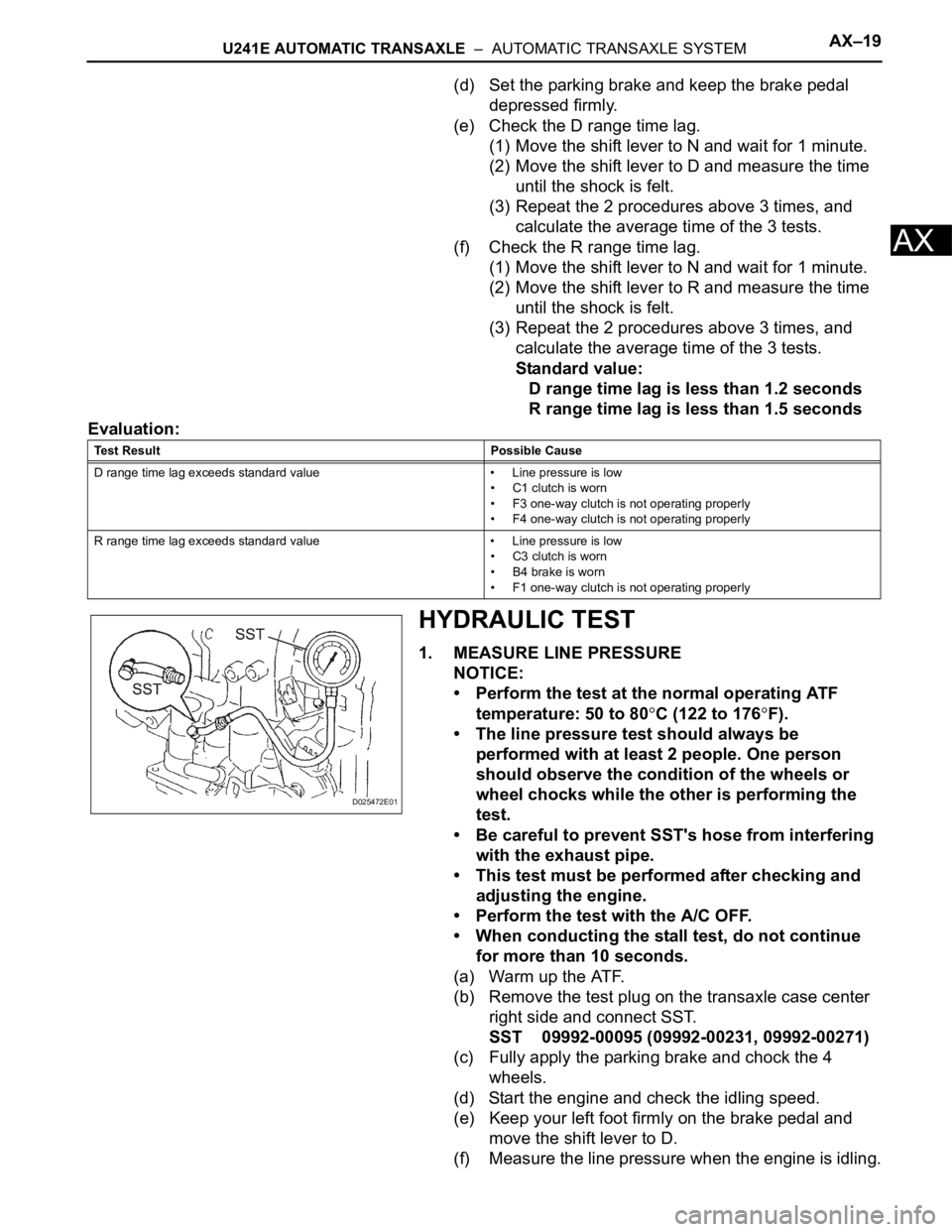
1. MEASURE LINE PRESSURE
NOTICE:
• Perform the test at the normal operating ATF
temperature: 50 to 80
C (122 to 176F).
• The line pressure test should always be
performed with at least 2 people. One person
should observe the condition of the wheels or
wheel chocks while the other is performing the
test.
• Be careful to prevent SST's hose from interfering
with the exhaust pipe.
• This test must be performed after checking and
adjusting the engine.
• Perform the test with the A/C OFF.
• When conducting the stall test, do not continue
for more than 10 seconds.
(a) Warm up the ATF.
(b) Remove the test plug on the transaxle case center
right side and connect SST.
SST 09992-00095 (09992-00231, 09992-00271)
(c) Fully apply the parking brake and chock the 4
wheels.
(d) Start the engine and check the idling speed.
(e) Keep your left foot firmly on the brake pedal and
move the shift lever to D.
(f) Measure the line pressure when the engine is idling.
Test Result Possible Cause
D range time lag exceeds standard value • Line pressure is low
• C1 clutch is worn
• F3 one-way clutch is not operating properly
• F4 one-way clutch is not operating properly
R range time lag exceeds standard value • Line pressure is low
• C3 clutch is worn
• B4 brake is worn
• F1 one-way clutch is not operating properly
D025472E01
Page 1254 of 2000

AX–30U241E AUTOMATIC TRANSAXLE – AUTOMATIC TRANSAXLE SYSTEM
AX
3 (A9-26) - E1 (B30-104) P - BR 3 shift position switch
signalIgnition switch ON and
transfer shift lever on 310 to 14 V
3 (A9-26) - E1 (B30-104) P - BR 3 shift position switch
signalIgnition switch ON and
transfer shift lever not on 3Below 1 V
2 (B30-55) - E1 (B30-104) P - BR 2 shift position switch
signalIgnition switch ON and
transfer shift lever on 2
and L10 to 14 V
2 (B30-55) - E1 (B30-104) P - BR 2 shift position switch
signalIgnition switch ON and
transfer shift lever not on 2
and LBelow 1 V
L (B30-74) - E1 (B30-104) LG - BR L shift position switch
signalIgnition switch ON and
transfer shift lever on L10 to 14 V
L (B30-74) - E1 (B30-104) LG - BR L shift position switch
signalIgnition switch ON and
transfer shift lever not on LBelow 1 V
STP (A9-36) - E1 (B30-
104)L - BR Stop light switch signal Brake pedal is depressed Between 10 V and 14 V
STP (A9-36) - E1 (B30-
104)L - BR Stop light switch signal Brake pedal is released Below 1 V
SL1+ (B30-57) - SL1-
(B30-77)V - P SL1 solenoid signal Engine idle speed Pulse generation
(see waveform 1)
SL1+ (B30-57) - SL1-
(B30-77)V - P SL1 solenoid signal Ignition switch ON Pulse generation
(see waveform 1)
SL1+ (B30-57) - SL1-
(B30-77)V - P SL1 solenoid signal 1st gear Pulse generation
(see waveform 1)
SL1+ (B30-57) - SL1-
(B30-77)V - P SL1 solenoid signal Not on 1st gear Below 1 V
SL2+ (B30-58) - SL2-
(B30-59)Y - L SL2 solenoid signal Engine idle speed Pulse generation
(see waveform 2)
SL2+ (B30-58) - SL2-
(B30-59)Y - L SL2 solenoid signal Ignition switch ON Pulse generation
(see waveform 2)
SL2+ (B30-58) - SL2-
(B30-59)Y - L SL2 solenoid signal 1st or 2nd gear Pulse generation
(see waveform 2)
SL2+ (B30-58) - SL2-
(B30-59)Y - L SL2 solenoid signal 3rd or O/D gear Below 1 V
DSL (B30-79) - E01 (B30-
45)G - BR DSL solenoid signal Vehicle speed 65 km/h (40
mph), lock-up (ON to OFF)Below 1 V
DSL (B30-79) - E01 (B30-
45)G - BR DSL solenoid signal Vehicle driving under lock-
up positionPulse generation
(see waveform 3)
SLT+ (B30-76) - SLT-
(B30-75)R - GR SLT solenoid signal Engine idle speed Pulse generation
(see waveform 4)
S4 (B30-78) - E01 (B30-
45)W - BR S4 solenoid signal Ignition switch ON Below 1 V
S4 (B30-78) - E01 (B30-
45)W - BR S4 solenoid signal O/D gear 10 to 14 V
S4 (B30-78) - E01 (B30-
45)W - BR S4 solenoid signal Not on O/D gear Below 1 V
THO1 (B30-72) - ETHO
(B30-95)LG- BR ATF temperature sensor
signalATF temperature: 115
C
(239F) or moreBelow 1.5 V
NT+ (B30-125) - NT- (B30-
124)W - R Speed sensor (NT) signal Vehicle speed 20 km/h (12
mph)Pulse generation
(see waveform 5)
NC+ (B30-101) - NC-
(B30-102)R - W Speed sensor (NC) signal Vehicle speed 30 km/h (19
mph): (3rd gear)
Engine speed 1,400 rpmPulse generation
(see waveform 6) Symbols (Terminal No.) Wiring Color Terminal Description ConditionSpecified Condition
Page 1266 of 2000
U241E AUTOMATIC TRANSAXLE – AUTOMATIC TRANSAXLE ASSEMBLYAX–149
AX
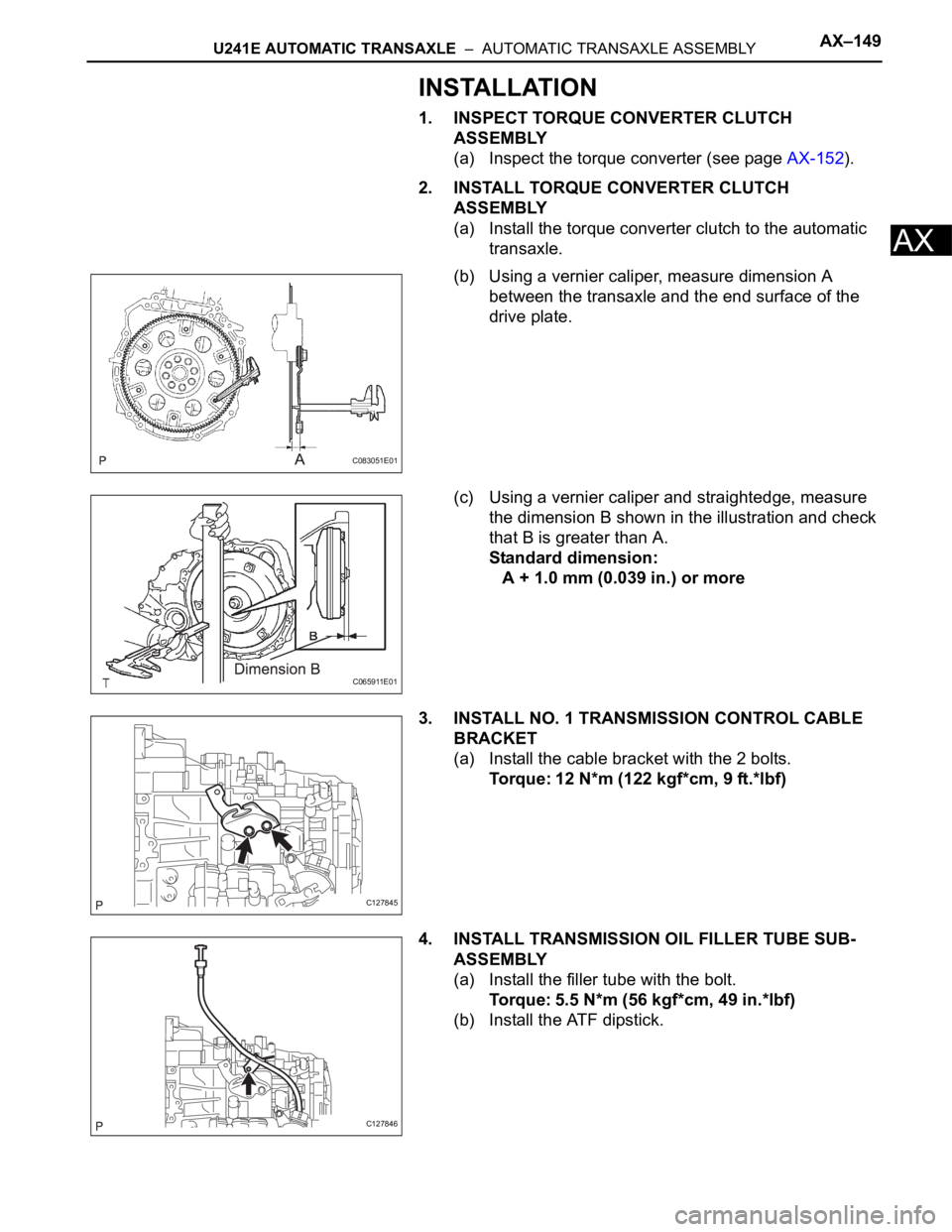
INSTALLATION
1. INSPECT TORQUE CONVERTER CLUTCH
ASSEMBLY
(a) Inspect the torque converter (see page AX-152).
2. INSTALL TORQUE CONVERTER CLUTCH
ASSEMBLY
(a) Install the torque converter clutch to the automatic
transaxle.
(b) Using a vernier caliper, measure dimension A
between the transaxle and the end surface of the
drive plate.
(c) Using a vernier caliper and straightedge, measure
the dimension B shown in the illustration and check
that B is greater than A.
Standard dimension:
A + 1.0 mm (0.039 in.) or more
3. INSTALL NO. 1 TRANSMISSION CONTROL CABLE
BRACKET
(a) Install the cable bracket with the 2 bolts.
Torque: 12 N*m (122 kgf*cm, 9 ft.*lbf)
4. INSTALL TRANSMISSION OIL FILLER TUBE SUB-
ASSEMBLY
(a) Install the filler tube with the bolt.
Torque: 5.5 N*m (56 kgf*cm, 49 in.*lbf)
(b) Install the ATF dipstick.
C083051E01
C065911E01
C127845
C127846
Page 1268 of 2000
U241E AUTOMATIC TRANSAXLE – AUTOMATIC TRANSAXLE ASSEMBLYAX–151
AX
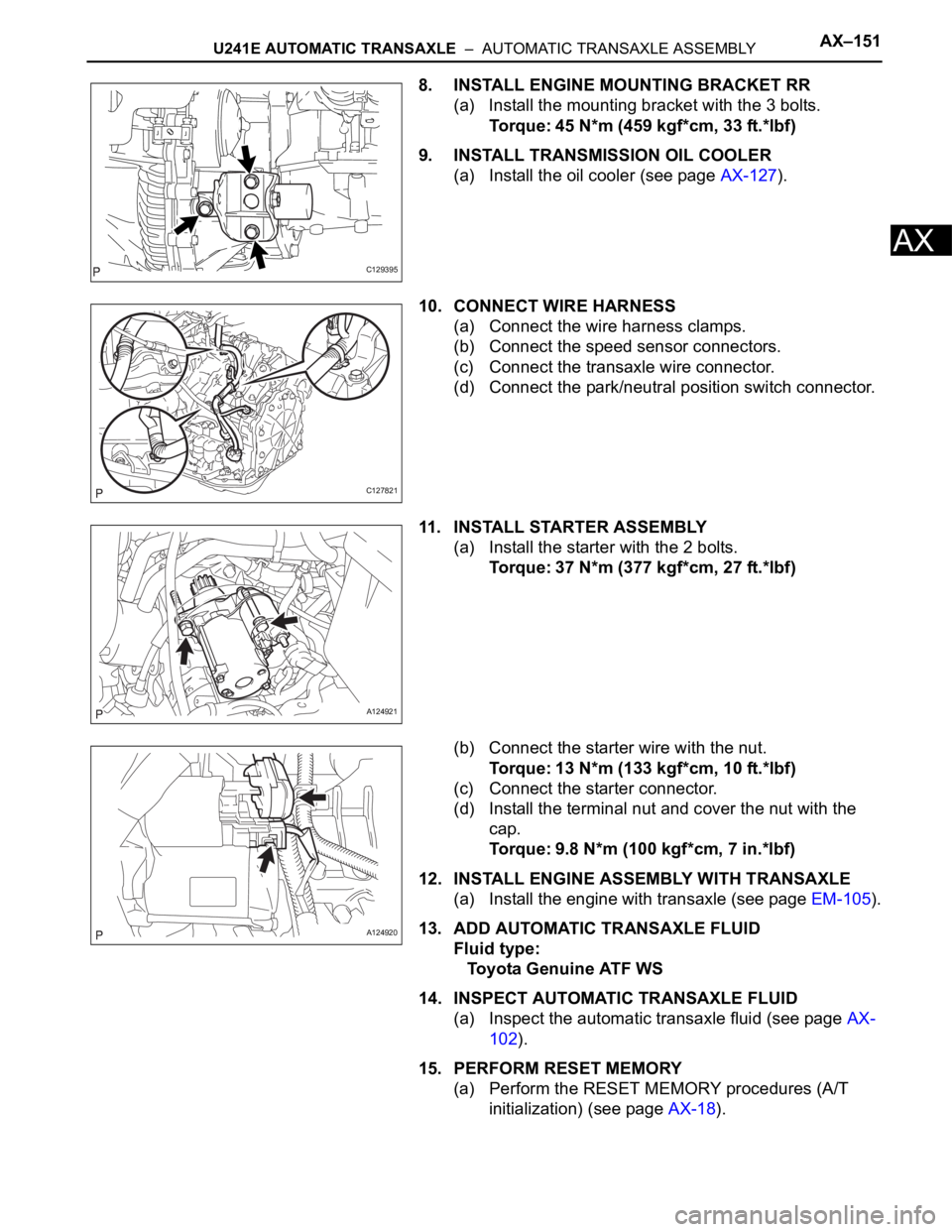
8. INSTALL ENGINE MOUNTING BRACKET RR
(a) Install the mounting bracket with the 3 bolts.
Torque: 45 N*m (459 kgf*cm, 33 ft.*lbf)
9. INSTALL TRANSMISSION OIL COOLER
(a) Install the oil cooler (see page AX-127).
10. CONNECT WIRE HARNESS
(a) Connect the wire harness clamps.
(b) Connect the speed sensor connectors.
(c) Connect the transaxle wire connector.
(d) Connect the park/neutral position switch connector.
11. INSTALL STARTER ASSEMBLY
(a) Install the starter with the 2 bolts.
Torque: 37 N*m (377 kgf*cm, 27 ft.*lbf)
(b) Connect the starter wire with the nut.
Torque: 13 N*m (133 kgf*cm, 10 ft.*lbf)
(c) Connect the starter connector.
(d) Install the terminal nut and cover the nut with the
cap.
Torque: 9.8 N*m (100 kgf*cm, 7 in.*lbf)
12. INSTALL ENGINE ASSEMBLY WITH TRANSAXLE
(a) Install the engine with transaxle (see page EM-105).
13. ADD AUTOMATIC TRANSAXLE FLUID
Fluid type:
Toyota Genuine ATF WS
14. INSPECT AUTOMATIC TRANSAXLE FLUID
(a) Inspect the automatic transaxle fluid (see page AX-
102).
15. PERFORM RESET MEMORY
(a) Perform the RESET MEMORY procedures (A/T
initialization) (see page AX-18).
C129395
C127821
A124921
A124920
Page 1271 of 2000
U241E AUTOMATIC TRANSAXLE – AUTOMATIC TRANSAXLE UNITAX–167
AX
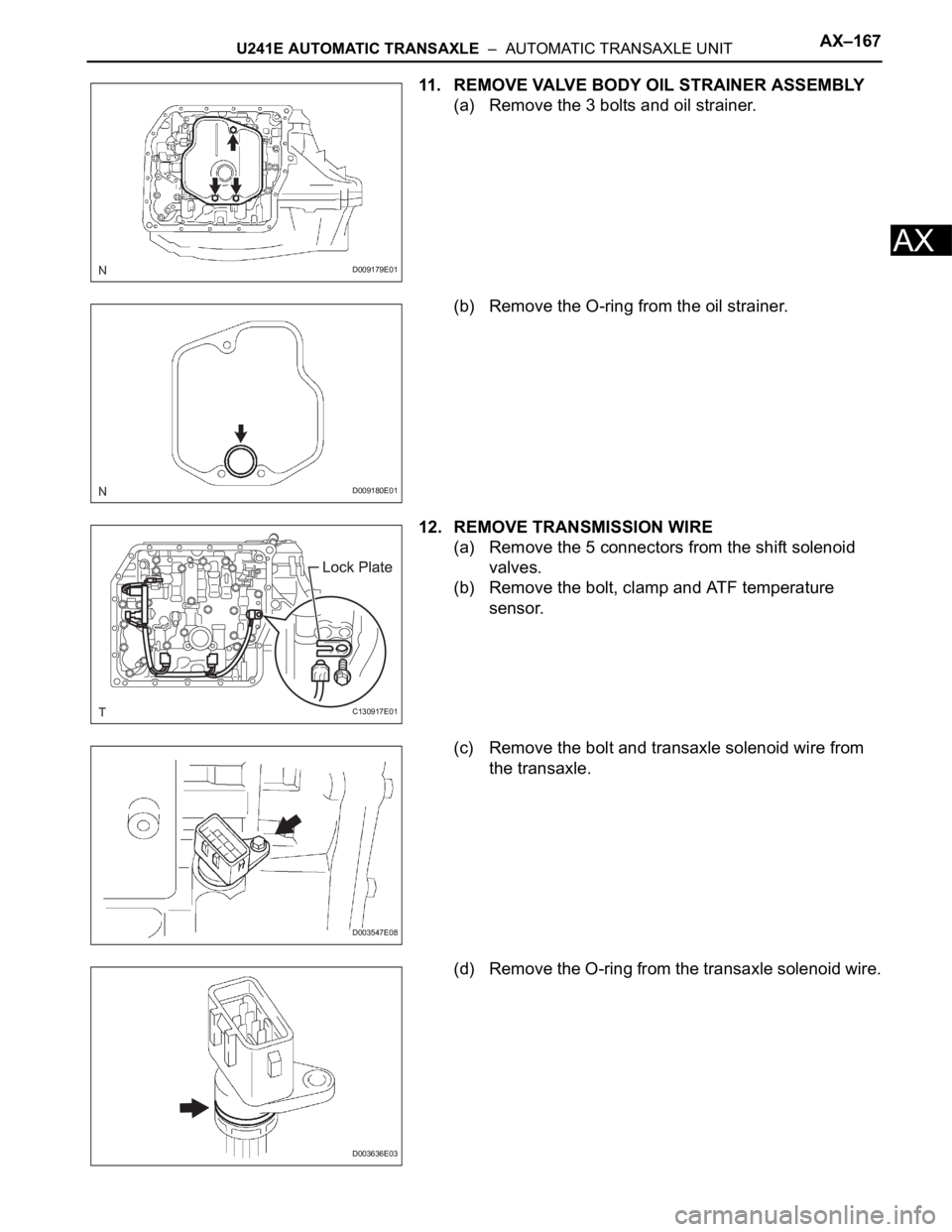
11. REMOVE VALVE BODY OIL STRAINER ASSEMBLY
(a) Remove the 3 bolts and oil strainer.
(b) Remove the O-ring from the oil strainer.
12. REMOVE TRANSMISSION WIRE
(a) Remove the 5 connectors from the shift solenoid
valves.
(b) Remove the bolt, clamp and ATF temperature
sensor.
(c) Remove the bolt and transaxle solenoid wire from
the transaxle.
(d) Remove the O-ring from the transaxle solenoid wire.
D009179E01
D009180E01
C130917E01
D003547E08
D003636E03
Page 1273 of 2000
U241E AUTOMATIC TRANSAXLE – AUTOMATIC TRANSAXLE UNITAX–169
AX
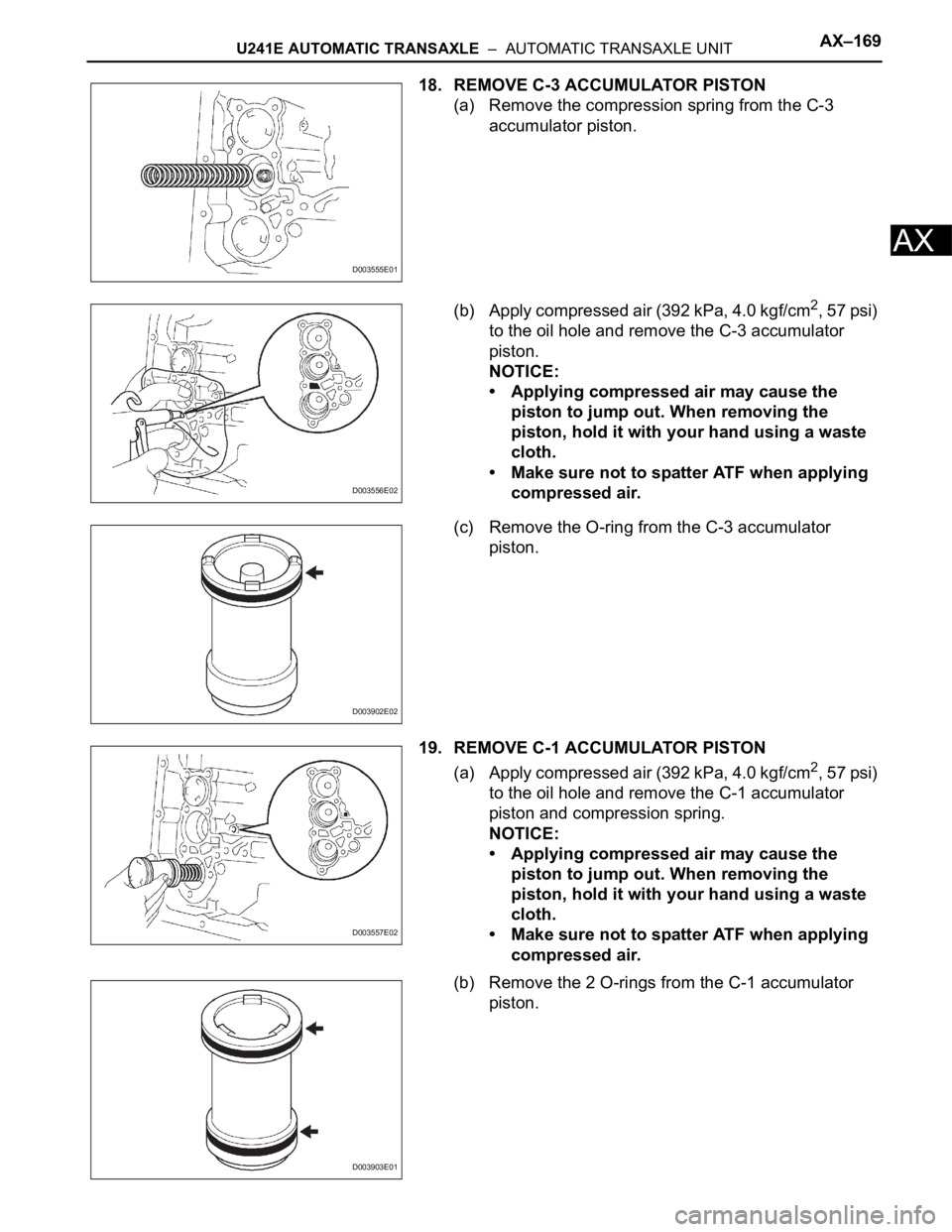
18. REMOVE C-3 ACCUMULATOR PISTON
(a) Remove the compression spring from the C-3
accumulator piston.
(b) Apply compressed air (392 kPa, 4.0 kgf/cm
2, 57 psi)
to the oil hole and remove the C-3 accumulator
piston.
NOTICE:
• Applying compressed air may cause the
piston to jump out. When removing the
piston, hold it with your hand using a waste
cloth.
• Make sure not to spatter ATF when applying
compressed air.
(c) Remove the O-ring from the C-3 accumulator
piston.
19. REMOVE C-1 ACCUMULATOR PISTON
(a) Apply compressed air (392 kPa, 4.0 kgf/cm
2, 57 psi)
to the oil hole and remove the C-1 accumulator
piston and compression spring.
NOTICE:
• Applying compressed air may cause the
piston to jump out. When removing the
piston, hold it with your hand using a waste
cloth.
• Make sure not to spatter ATF when applying
compressed air.
(b) Remove the 2 O-rings from the C-1 accumulator
piston.
D003555E01
D003556E02
D003902E02
D003557E02
D003903E01