oil TOYOTA RAV4 2006 Service User Guide
[x] Cancel search | Manufacturer: TOYOTA, Model Year: 2006, Model line: RAV4, Model: TOYOTA RAV4 2006Pages: 2000, PDF Size: 45.84 MB
Page 29 of 2000

ENGINE - 2AZ-FE ENGINE
01MEG04Y
SENSORSACTUATORS
MASS AIR FLOW METER
INTAKE AIR TEMPERATURE
SENSOR
ENGIEN COOLANT
TEMPERATURE SENSOR
THROTTLE POSITION
SENSOR
CRANKSHAFT POSITION
SENSOR
CAMSHAFT POSITION
SENSOR
ACCELERATOR PEDAL
POSITION SENSOR
AIR-FUEL RATIO SENSOR
(Bank 1, Sensor 1)
HEATED OXYGEN SENSOR
(Bank 1, Sensor 2)
KNOCK SENSOR
COMBINATION METER
Vehicle Speed Signal
IGNITION SWITCH
Ignition Signal
Starter Signal
PA R K / N E U T R A L P O S I T I O N
SWITCH
TRANSMISSION CONTROL
SWITCH
CRUISE CONTROL SWITCHVG
THA
THW
VTA1
VTA2
NE
G2
VPA
VPA2
A1A
OX1B
KNK1
SPD
IGSW
STA
D, 2, L
R, P, N
3
CCSECM#10
#20
#30
#40
IGT1 IGT4
IGF1
M
OC1
FC
HA1A
HT1BSFI
No.1 INJECTOR
No.2 INJECTOR
No.3 INJECTOR
No.4 INJECTOR
ESA
IGNITION COIL
with IGNITER
SPARK PLUGS
ETCS-i
THROTTLE CONTROL
MOTOR
VVT-i
CAMSHAFT TIMING OIL
CONTROL VALVE
FUEL PUMP CONTROL
CIRCUIT OPENING
RELAY
AIR-FUEL RATIO AND
HEATED OXYGEN SENSOR
HEATER CONTROL
AIR-FUEL RATIO SENSOR
HEATER (Bank1, Sensor1)
HEATED OXYGEN SENSOR
HEATER (Bank1, Sensor2)
EG-32
2. Construction
The configuration of the engine control system in the 2AZ-FE engine is shown in the following chart.
(Continued)
Page 31 of 2000

ENGINE - 2AZ-FE ENGINE
01MEG09Y
Accelerator Pedal
Position Sensor
Generator
MIL
DLC3Park / Neutral
Position Switch
Ignition
Switch
Circuit Opening RelayECM
Battery
Throttle
Position
Sensor
Throttle
Control
Motor
Purge VSVMass Air Flow Meter
Intake Air Temperature
Sensor
Camshaft Position
Sensor
Camshaft
Timing
Oil Control
Va l v e
Ignition Coil
with Igniter
Injector
Knock Sensor
Engine
Coolant
Temperature
Sensor
Crankshaft Position
Sensor
Canister
Filter
Fuel Pump
Canister Pump Module
Ve n t Va l v e
Leak Detection Pump
Canister Pressure SensorTWCs
Heated Oxygen Sensor
(Bank 1, Sensor 2)
Air-fuel Ratio Sensor
(Bank 1, Sensor 1) EG-34
3. Engine Control System Diagram
Page 32 of 2000

ENGINE - 2AZ-FE ENGINE
01MEG31Y
DLC3
Accelerator Pedal
Position Sensor
Mass Air Flow Meter
(Built-in Intake Air
Temperature Sensor)
VSV (for EVAP)
Battery Current
Sensor
Fuel Pump
Canister Pump Module
Ve n t Va l v e
Leak Detection Pump
Canister Pressure Sensor
ECM
Heated Oxygen Sensor
(Bank 1, Sensor 2) Air Fuel Ratio Sensor
(Bank 1, Sensor 1)
Camshaft Timing
Oil Control ValveInjectorKnock Sensor
Ignition Coil with Igniter
Throttle Position
Sensor
Camshaft Position
Sensor
Water Temperature
Sensor
Crakshaft Position
SensorEG-35
4. Layout of Main Components
Page 33 of 2000

ENGINE - 2AZ-FE ENGINE EG-36
5. Main Components of Engine Control System
General
The main components of the 2AZ-FE engine control system are as follows:
Component
OutlineQuantity
ECM32-bit CPU1
Mass Air Flow MeterHot-wire Type1
Crankshaft Position Sensor (Rotor Teeth)Pick-up Coil Type (36-2)1
Camshaft Position Sensor (Rotor Teeth)Pick-up Coil Type (3)1
Throttle Position SensorNon-contact Type1
Accelerator Pedal Position SensorNon-contact Type1
Knock SensorBuilt-in Piezoelectric Element Type
(Flat Type)1
Air-fuel Ratio Sensor
(Bank 1, Sensor 1)Type with Heater
(Planar Type)1
Heated Oxygen Sensor
(Bank 1, Sensor 2)Type with Heater
(Cup Type)1
Injector12-hole Type4
ECM
The 32-bit CPU of the ECM is used to increase the speed for processing the signals.
Page 40 of 2000

ENGINE - 2AZ-FE ENGINE
00REG17Y
Accelerator Pedal
Position SensorThrottle Valve
Throttle Position SensorThrottle
Control
Motor
Mass Air
Flow MeterECMSkid
Control
ECU
Ignition
CoilFuel
Injector
: CANEG-43
6. ETCS-i (Electronic Throttle Control System-intelligent)
General
The ETCS-i is used, providing excellent throttle control in all the operating ranges. In the 2AZ-FE
engine, the accelerator cable has been discontinued, and an accelerator pedal position sensor has been
provided on the accelerator pedal.
In the conventional throttle body, the throttle valve opening is determined by the amount of the
accelerator pedal effort. In contrast, the ETCS-i uses the ECM to calculate the optimal throttle valve
opening that is appropriate for the respective driving condition and uses a throttle control motor to control
the opening.
The ETCS-i controls the IAC (Idle Air Control) system, the TRAC (Traction Control), VSC (Vehicle
Stability Control) system and curise control system.
In case of an abnormal condition, this system switches to the limp mode.
System Diagram
Page 44 of 2000

ENGINE - 2AZ-FE ENGINE
199EG47
Injectors
ECMIgnition Coils
Accelerator Pedal
Position Sensor
Main
Sub
Main
Sub
Return to
Prescribed Angle
Throttle ValveReturn
SpringThrottle
Control
Motor
Accelerator Pedal Throttle BodyEG-47
Fail-safe of Throttle Position Sensor
The throttle position sensor is comprised of two (main, sub) sensor circuits. If a malfunction occurs in
either one or both of the sensor circuits, the ECM detects the abnormal signal voltage difference between
these two sensor circuits, cuts off the current to the throttle control motor, and switches to the limp mode.
Then, the force of the return spring causes the throttle valve to return and stay at the prescribed opening
angle. At this time, the vehicle can be driven in the limp mode while the engine output is regulated
through the control of the fuel injection (intermittent fuel-cut) and ignition timing in accordance with the
accelerator opening.
The same control as above is effected if the ECM detects a malfunction in the throttle control motor
system.
Page 45 of 2000
ENGINE - 2AZ-FE ENGINE
DR011EG25
Camshaft Position Sensor
Engine Coolant
Temperature Sensor
Crankshaft
Position Sensor
Camshaft Timing
Oil Control Valve
Throttle Position
Sensor
ECM
Mass Air Flow Meter Vehicle Speed Signal
221EG16
Crankshaft Position Sensor
Mass Air Flow Meter
Throttle Position Sensor
Engine Coolant Temp. Sensor
Camshaft Position Sensor
Vehicle Speed SignalECM
Target Valve Timing
Feedback
Correction
Actual Valve Timing
Duty-cycle
Control
Camshaft Timing
Oil Control Valve
EG-48
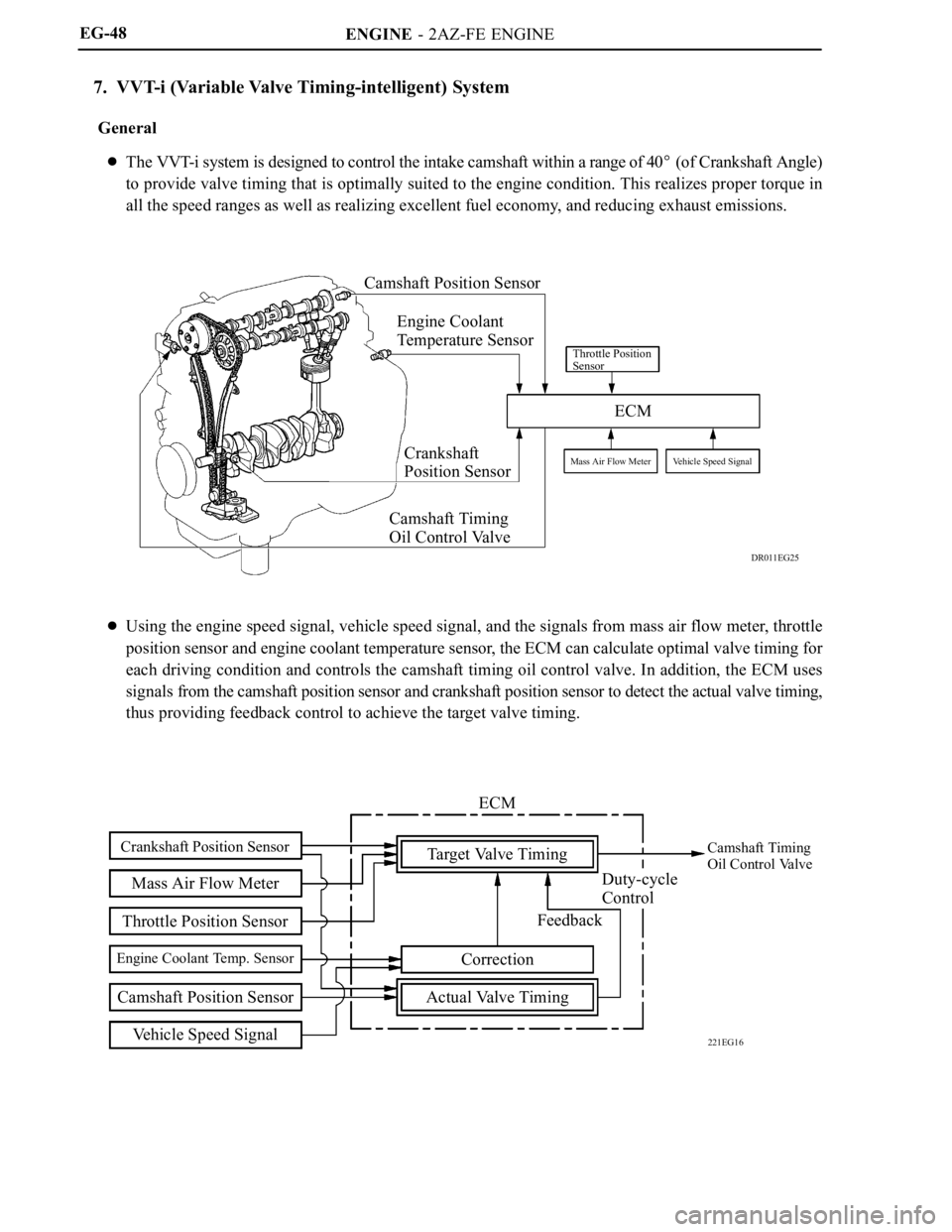
7. VVT-i (Variable Valve Timing-intelligent) System
General
The VVT-i system is designed to control the intake camshaft within a range of 40 (of Crankshaft Angle)
to provide valve timing that is optimally suited to the engine condition. This realizes proper torque in
all the speed ranges as well as realizing excellent fuel economy, and reducing exhaust emissions.
Using the engine speed signal, vehicle speed signal, and the signals from mass air flow meter, throttle
position sensor and engine coolant temperature sensor, the ECM can calculate optimal valve timing for
each driving condition and controls the camshaft timing oil control valve. In addition, the ECM uses
signals from the camshaft position sensor and crankshaft position sensor to detect the actual valve timing,
thus providing feedback control to achieve the target valve timing.
Page 47 of 2000

ENGINE - 2AZ-FE ENGINE
169EG36
HousingLock Pin
Intake Camshaft
Vane (Fixed on Intake Camshaft)
Oil Pressure
At a Stop In Operation
Lock Pin
221EG17
To VVT-i Controller
(Advance Side)To V V T- i C o n t r o l l e r
(Retard Side)
Sleeve
Spring
Drain
Oil PressureDrain
Spool ValveCoil
Plunger EG-50
Construction
1) VVT-i Controller
This controller consists of the housing driven by the timing chain and the vane fixed on the intake
camshaft.
The oil pressure sent from the advance or retard side path at the intake camshaft causes rotation in the
VVT-i controller vane circumferential direction to vary the intake valve timing continuously.
When the engine is stopped, the intake camshaft will be in the most retarded state to ensure startability.
When hydraulic pressure is not applied to the VVT-i controller immediately after the engine has been
started, the lock pin locks the movement of the VVT-i controller to prevent a knocking noise.
2) Camshaft Timing Oil Control Valve
This camshaft timing oil control valve controls the spool valve position in accordance with the duty-cycle
control from the ECM. This allows hydraulic pressure to be applied to the VVT-i controller advance or
retard sides. When the engine is stopped, the camshaft timing oil control valve is in the most retarded
state.
Page 48 of 2000

ENGINE - 2AZ-FE ENGINE
198EG35
Va n e
Rotation DirectionOil PressureECM
IN Drain
198EG36
Va n e
Rotation DirectionOil Pressure
Drain INECMEG-51
Operation
1) Advance
When the camshaft timing oil control valve is operated as illustrated below by the advance signals from
the ECM, the resultant oil pressure is applied to the advance side vane chamber to rotate the camshaft
in the advance direction.
2) Retard
When the camshaft timing oil control valve is operated as illustrated below by the retard signals from
the ECM, the resultant oil pressure is applied to the retard side vane chamber to rotate the camshaft in
the retard direction.
3) Hold
After reaching the target timing, the valve timing is held by keeping the camshaft timing oil control valve
in the neutral position unless the traveling state changes.
This adjusts the valve timing at the desired target position and prevents the engine oil from running out
when it is unnecessary.
Page 66 of 2000

ENGINE - 2AZ-FE ENGINE
01MEG02Y
Valve Timing : Intake Valve Opening Angle
: Exhaust Valve Opening Angle
VVT-i Operation
Range
VVT-i Operation
RangeTDC
3
3
43
65
25
45
BDCEG-3
Engine Specifications
No. of Cyls. & Arrangement4-cylinder, In-line
Valve Mechanism16-valve DOHC, Chain Drive (with VVT-i)
Combustion ChamberPentroof Type
ManifoldsCross-flow
Fuel SystemSFI
Ignition SystemDIS
Displacement cm3 (cu. in.)2362 (144.1)
Bore x Stroke mm (in.)88.5 x 96.0 (3.48 x 3.78)
Compression Ratio9.8 : 1
Max. Output*1(SAE-NET)124 kW @ 6000 rpm (166 HP @ 6000 rpm)
Max. Torque*1(SAE-NET)224 N.m @ 4000 rpm (165 ft-lbf @ 4000 rpm)
IntakeOpen3 - 43 BTDC
Valve Timing
IntakeClose65 - 25 ABDCVa l v e T i m i n g
ExhaustOpen45 BBDCExhaustClose3 ATDC
Firing Order1 - 3 - 4 - 2
Research Octane Number91 or higher
Octane Rating87 or higher
Oil GradeILSAC
Tailpipe Emission RegulationULEV-II, SFTP
Evaporative Emission RegulationLEV-II, ORVR
Engine Service Mass*2 (Reference) kg (lb)138 (304.2)
*1: Maximum output and torque rating is determined by revised SAE J1349 standard.
*
2: Weight shows the figure with oil and water fully filled.