weight TOYOTA RAV4 2006 Service User Guide
[x] Cancel search | Manufacturer: TOYOTA, Model Year: 2006, Model line: RAV4, Model: TOYOTA RAV4 2006Pages: 2000, PDF Size: 45.84 MB
Page 22 of 2000
ENGINE - 2AZ-FE ENGINE
206EG40206EG41
206EG42
Stator Segment
ConductorStator
Joined
Joined Segment
Conductor SystemSegment
ConductorStator
StatorConductor
Wire
Conductor Wire
A
AA - A Cross
Section
Segment Conductor Type GeneratorB
BB - B Cross
Section
Conventional Type GeneratorWinding System
Stator
Segment
Conductor
Cross Section
Stator of Segment Conductor Type GeneratorEG-25
CHARGING SYSTEM
1. Segment Conductor Type Generator
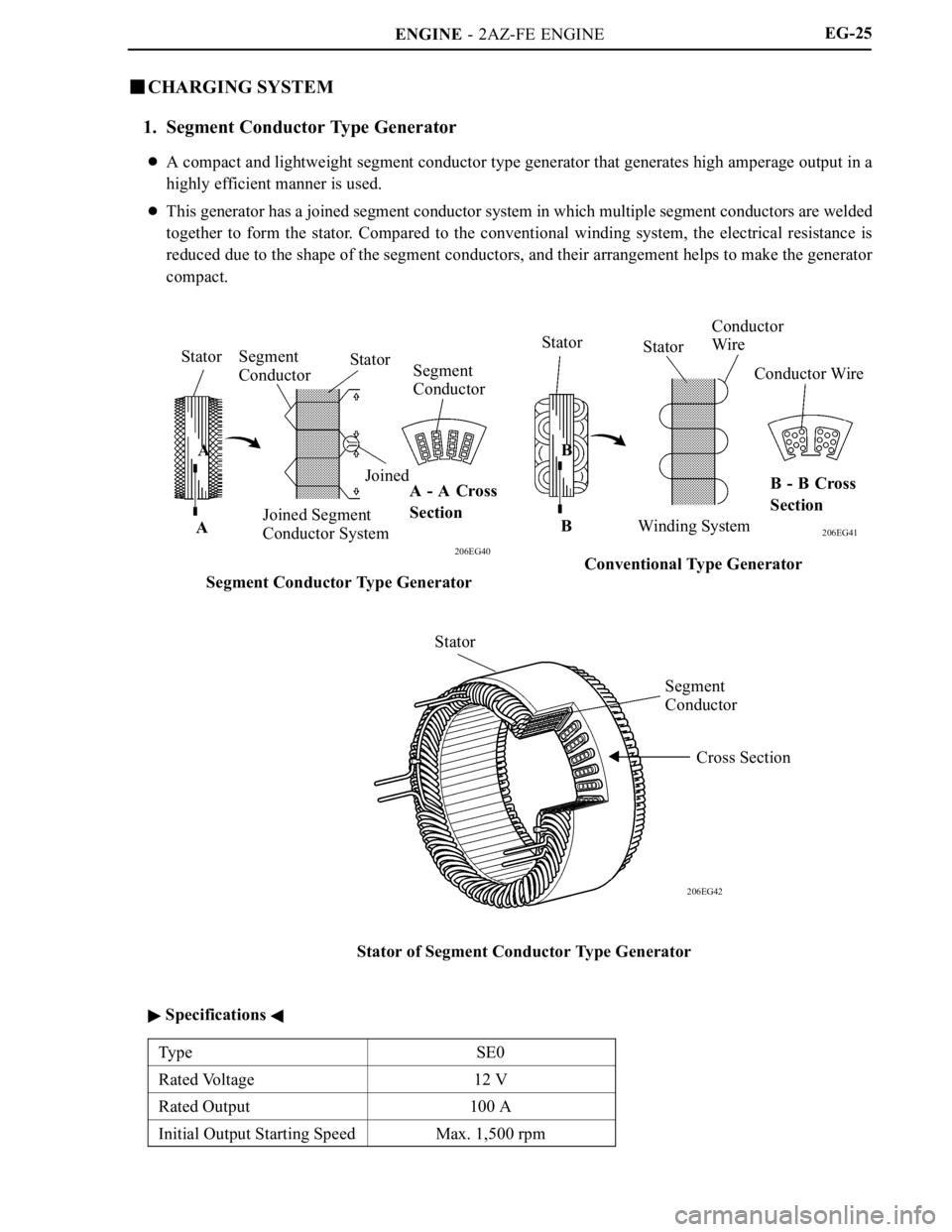
A compact and lightweight segment conductor type generator that generates high amperage output in a
highly efficient manner is used.
This generator has a joined segment conductor system in which multiple segment conductors are welded
together to form the stator. Compared to the conventional winding system, the electrical resistance is
reduced due to the shape of the segment conductors, and their arrangement helps to make the generator
compact.
Specifications
Ty p eSE0
Rated Voltage12 V
Rated Output100 A
Initial Output Starting SpeedMax. 1,500 rpm
Page 24 of 2000
ENGINE - 2AZ-FE ENGINE
01NEG46Y
ArmatureSurface Commutator
Permanent Magnet
Brush
LengthEG-27
STARTING SYSTEM
1. General
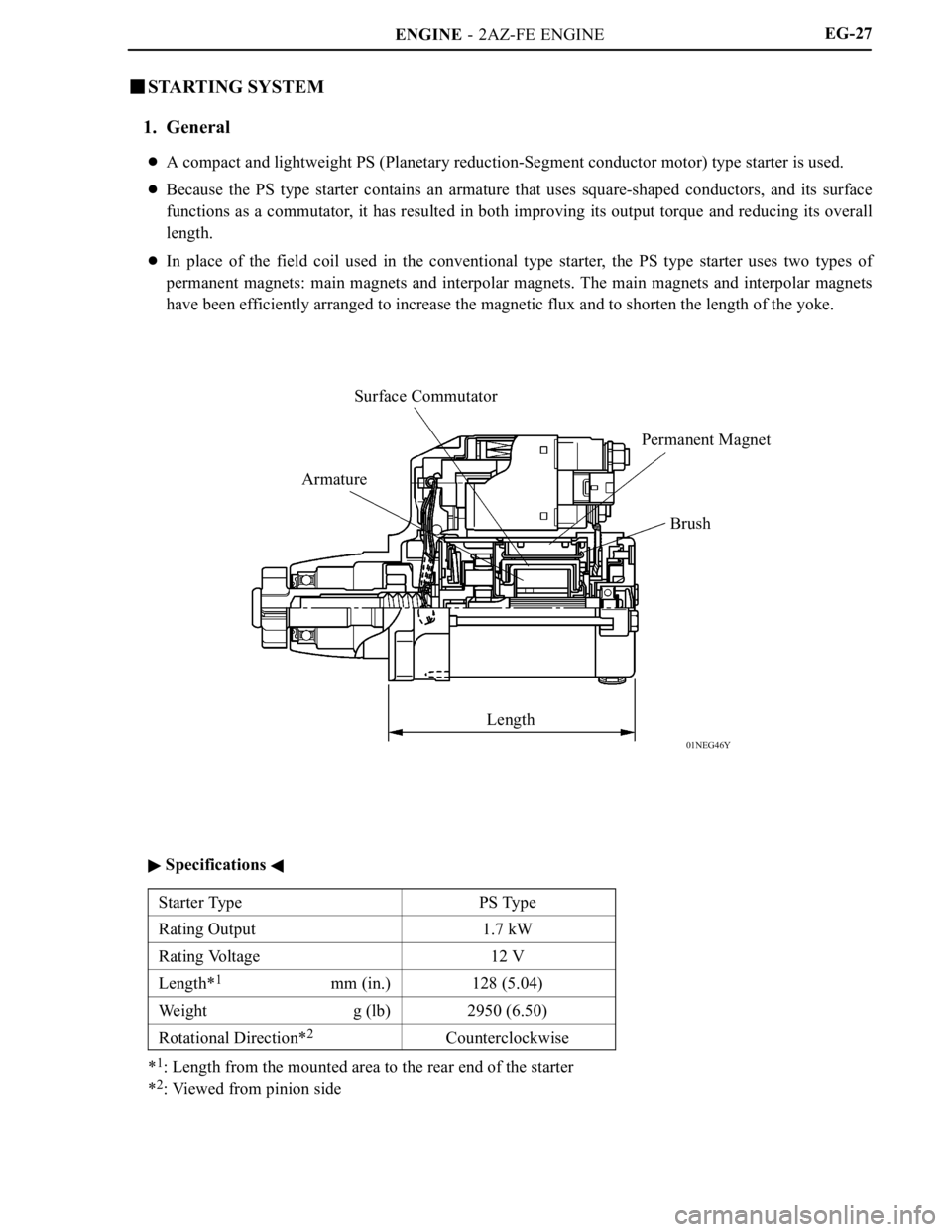
A compact and lightweight PS (Planetary reduction-Segment conductor motor) type starter is used.
Because the PS type starter contains an armature that uses square-shaped conductors, and its surface
functions as a commutator, it has resulted in both improving its output torque and reducing its overall
length.
In place of the field coil used in the conventional type starter, the PS type starter uses two types of
permanent magnets: main magnets and interpolar magnets. The main magnets and interpolar magnets
have been efficiently arranged to increase the magnetic flux and to shorten the length of the yoke.
Specifications
Starter TypePS Type
Rating Output1.7 kW
Rating Voltage12 V
Length*1mm (in.)128 (5.04)
Weight g (lb)2950 (6.50)
Rotational Direction*2Counterclockwise
*1: Length from the mounted area to the rear end of the starter
*
2: Viewed from pinion side
Page 26 of 2000
ENGINE - 2AZ-FE ENGINE
240EG98
Idler Pulley for Automatic Tensioner
Generator Pulley
Water Pump Pulley
Air Conditioning
Compressor Pulley Crankshaft Pulley Idler Pulley
258RV77
ArmIdler Pulley
Te n s i o n e r
A - A Cross SectionAAEG-29
SERPENTINE BELT DRIVE SYSTEM
1. General
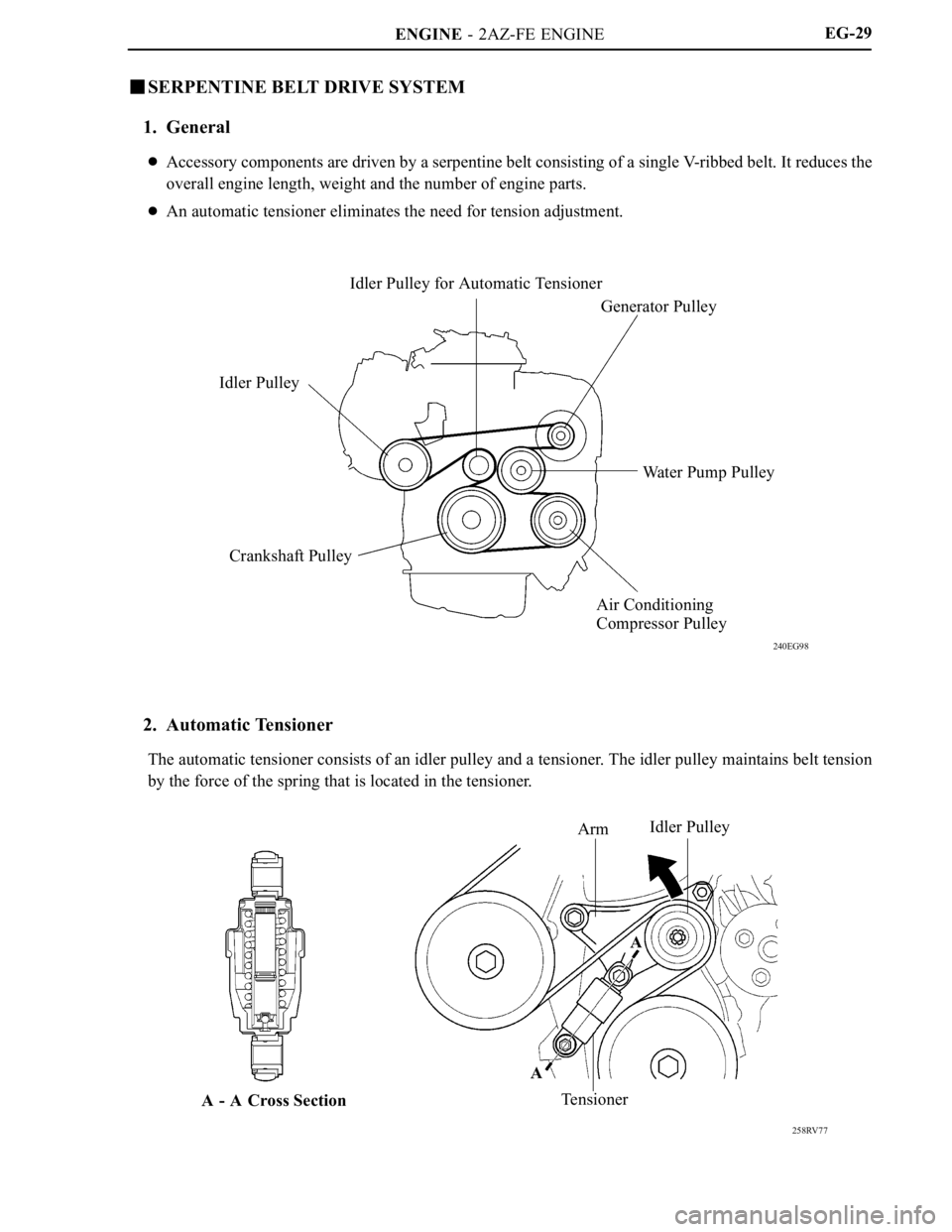
Accessory components are driven by a serpentine belt consisting of a single V-ribbed belt. It reduces the
overall engine length, weight and the number of engine parts.
An automatic tensioner eliminates the need for tension adjustment.
2. Automatic Tensioner
The automatic tensioner consists of an idler pulley and a tensioner. The idler pulley maintains belt tension
by the force of the spring that is located in the tensioner.
Page 35 of 2000
ENGINE - 2AZ-FE ENGINE
271EG45
Alumina
Dilation Layer
Alumina
Platinum
Electrode
Sensor Element (Zirconia)Heater AtmospherePlatinum
ElectrodeHeater
Atmosphere
Sensor Element
(Zirconia)
Planar Type Air-fuel Ratio Sensor Cup Type Heated Oxygen Sensor
204EG54
Temperature Sensing
Element
Platinum Hot-wire
ElementAir FlowIntake Air
Temperature
Sensor EG-38
2) Construction
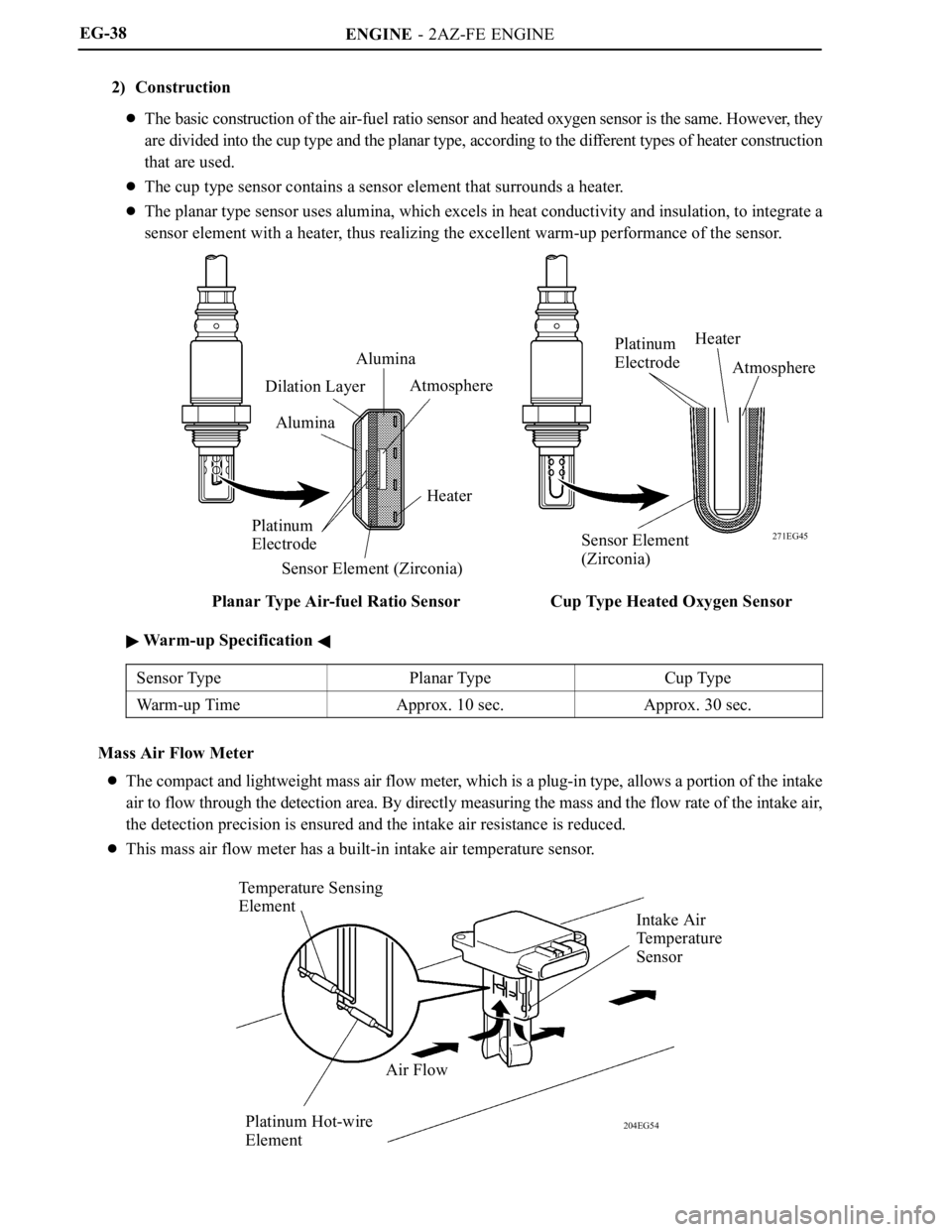
The basic construction of the air-fuel ratio sensor and heated oxygen sensor is the same. However, they
are divided into the cup type and the planar type, according to the different types of heater construction
that are used.
The cup type sensor contains a sensor element that surrounds a heater.
The planar type sensor uses alumina, which excels in heat conductivity and insulation, to integrate a
sensor element with a heater, thus realizing the excellent warm-up performance of the sensor.
Warm-up Specification
Sensor TypePlanar TypeCup Type
Warm-up TimeApprox. 10 sec.Approx. 30 sec.
Mass Air Flow Meter
The compact and lightweight mass air flow meter, which is a plug-in type, allows a portion of the intake
air to flow through the detection area. By directly measuring the mass and the flow rate of the intake air,
the detection precision is ensured and the intake air resistance is reduced.
This mass air flow meter has a built-in intake air temperature sensor.
Page 36 of 2000
ENGINE - 2AZ-FE ENGINE
214CE04
: Conventional Type
: Flat Type
(V)
Vo l t a g e
Frequency (Hz)A
BA: Detection Band of
Conventional Type
B: Detection Band of
Flat Type
Characteristic of Knock Sensor
214CE01214CE02
Steel Weight
Insulator
Piezoelectric
ElementOpen / Short Circuit
Detection Resistor
Flat Type Knock Sensor
(Non-resonant Type)Piezoelectric
Element
Vibration Plate
Conventional Type Knock Sensor
(Resonant Type)EG-39
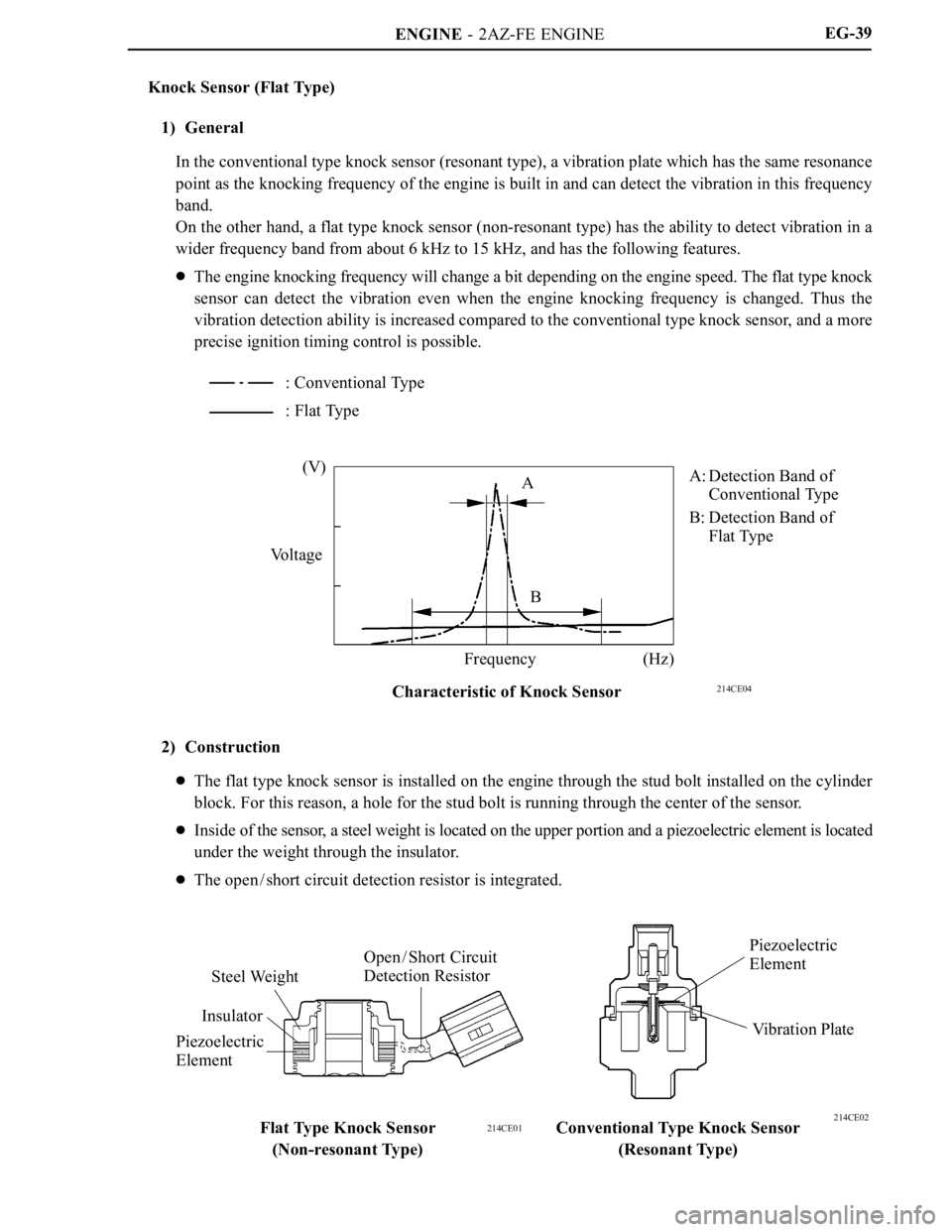
Knock Sensor (Flat Type)
1) General
In the conventional type knock sensor (resonant type), a vibration plate which has the same resonance
point as the knocking frequency of the engine is built in and can detect the vibration in this frequency
band.
On the other hand, a flat type knock sensor (non-resonant type) has the ability to detect vibration in a
wider frequency band from about 6 kHz to 15 kHz, and has the following features.
The engine knocking frequency will change a bit depending on the engine speed. The flat type knock
sensor can detect the vibration even when the engine knocking frequency is changed. Thus the
vibration detection ability is increased compared to the conventional type knock sensor, and a more
precise ignition timing control is possible.
2) Construction
The flat type knock sensor is installed on the engine through the stud bolt installed on the cylinder
block. For this reason, a hole for the stud bolt is running through the center of the sensor.
Inside of the sensor, a steel weight is located on the upper portion and a piezoelectric element is located
under the weight through the insulator.
The open / short circuit detection resistor is integrated.
Page 37 of 2000
ENGINE - 2AZ-FE ENGINE
214CE08
Steel Weight
Inertia
Piezoelectric
Element
214CE06
Knock Sensor
200 k
Piezoelectric
ElementOpen / Short Circuit
Detection ResistorKNK1
EKNKECM
5 V
200 k
IC
Service Tip
In accordance with the adoption of an open / short circuit detection resistor, the inspection
method for the sensor has been changed. For details, refer to the 2006 RAV4 Repair Manual
(Pub. No. RM01M1U).
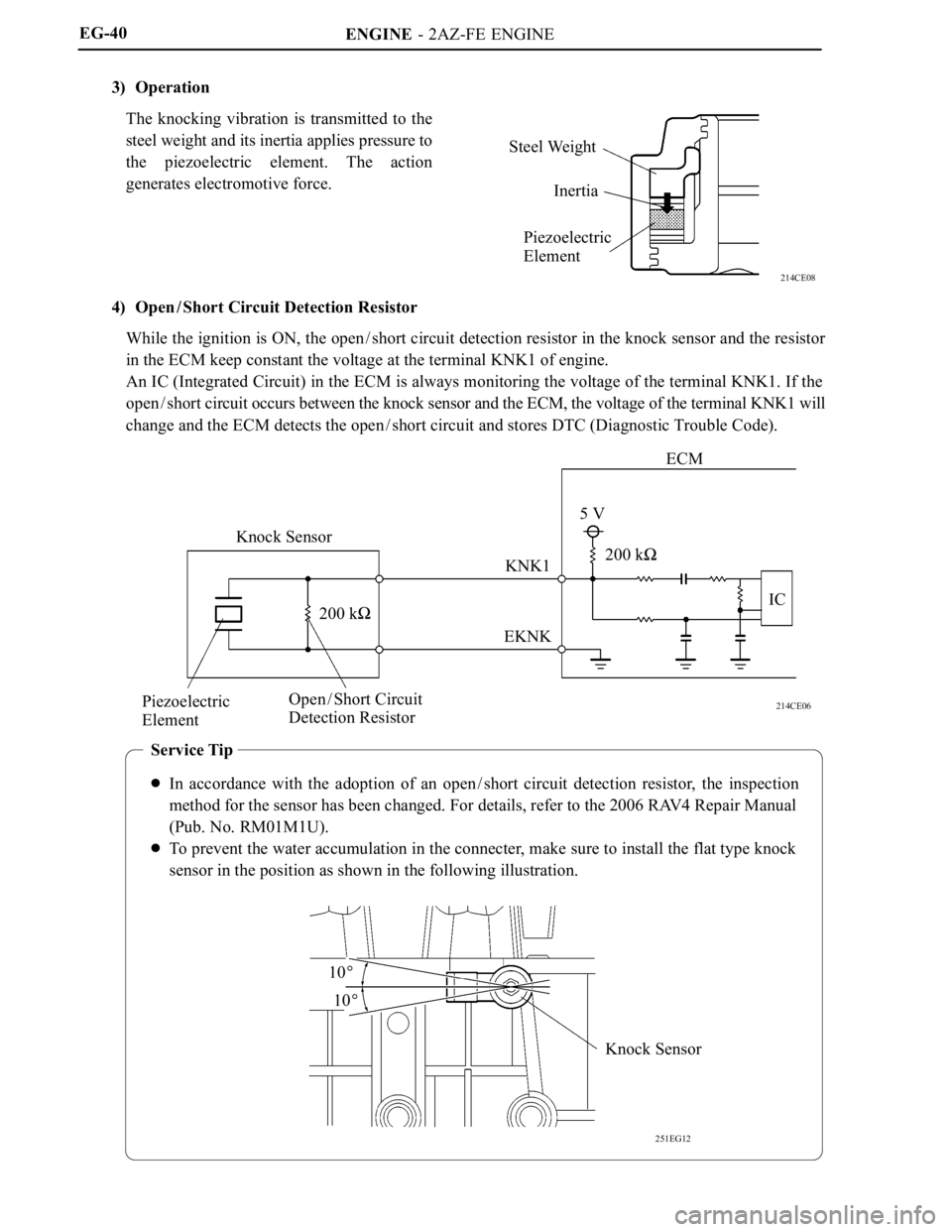
To prevent the water accumulation in the connecter, make sure to install the flat type knock
sensor in the position as shown in the following illustration.
251EG12
10
10
Knock Sensor EG-40
3) Operation
The knocking vibration is transmitted to the
steel weight and its inertia applies pressure to
the piezoelectric element. The action
generates electromotive force.
4) Open / Short Circuit Detection Resistor
While the ignition is ON, the open / short circuit detection resistor in the knock sensor and the resistor
in the ECM keep constant the voltage at the terminal KNK1 of engine.
An IC (Integrated Circuit) in the ECM is always monitoring the voltage of the terminal KNK1. If the
open / short circuit occurs between the knock sensor and the ECM, the voltage of the terminal KNK1 will
change and the ECM detects the open / short circuit and stores DTC (Diagnostic Trouble Code).
Page 66 of 2000
ENGINE - 2AZ-FE ENGINE
01MEG02Y
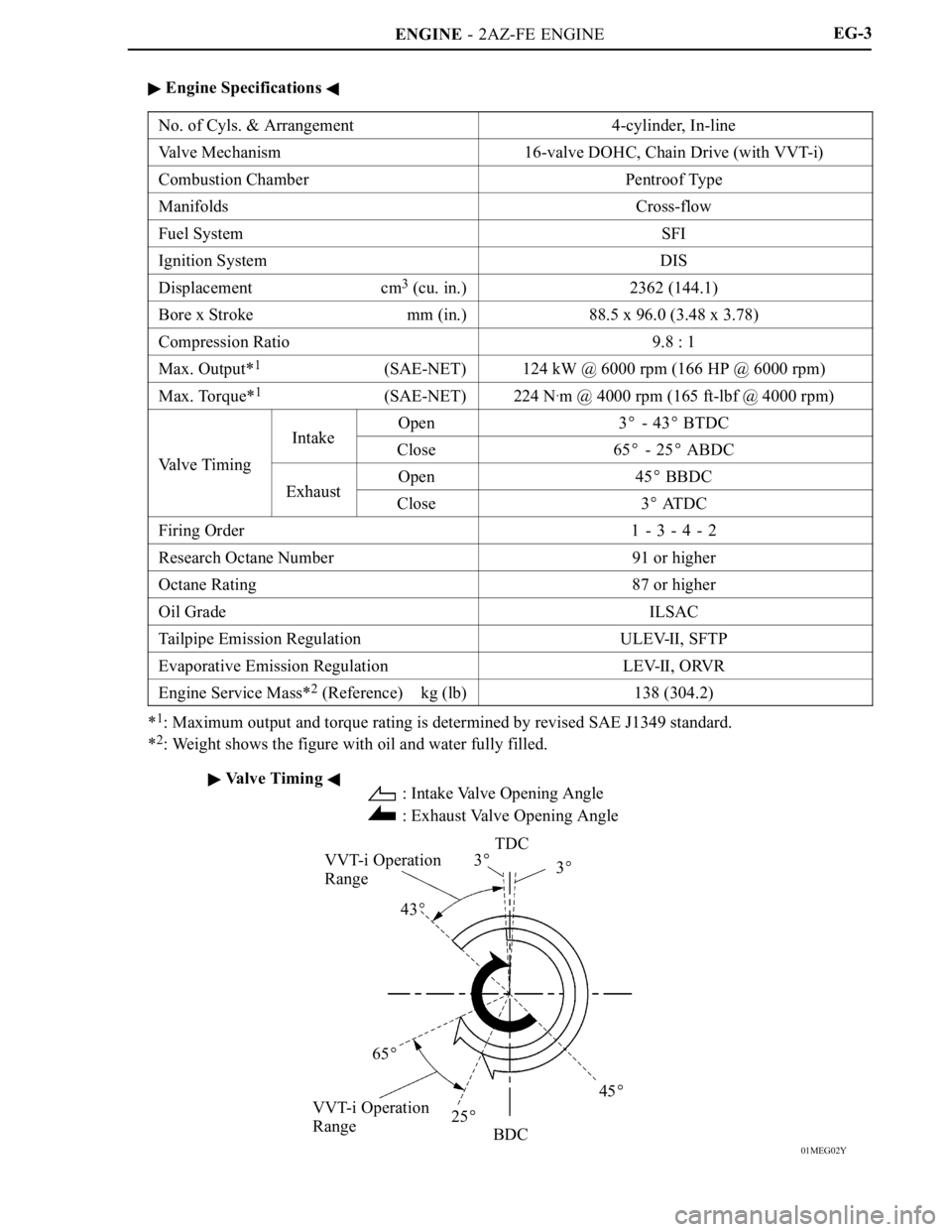
Valve Timing : Intake Valve Opening Angle
: Exhaust Valve Opening Angle
VVT-i Operation
Range
VVT-i Operation
RangeTDC
3
3
43
65
25
45
BDCEG-3
Engine Specifications
No. of Cyls. & Arrangement4-cylinder, In-line
Valve Mechanism16-valve DOHC, Chain Drive (with VVT-i)
Combustion ChamberPentroof Type
ManifoldsCross-flow
Fuel SystemSFI
Ignition SystemDIS
Displacement cm3 (cu. in.)2362 (144.1)
Bore x Stroke mm (in.)88.5 x 96.0 (3.48 x 3.78)
Compression Ratio9.8 : 1
Max. Output*1(SAE-NET)124 kW @ 6000 rpm (166 HP @ 6000 rpm)
Max. Torque*1(SAE-NET)224 N.m @ 4000 rpm (165 ft-lbf @ 4000 rpm)
IntakeOpen3 - 43 BTDC
Valve Timing
IntakeClose65 - 25 ABDCVa l v e T i m i n g
ExhaustOpen45 BBDCExhaustClose3 ATDC
Firing Order1 - 3 - 4 - 2
Research Octane Number91 or higher
Octane Rating87 or higher
Oil GradeILSAC
Tailpipe Emission RegulationULEV-II, SFTP
Evaporative Emission RegulationLEV-II, ORVR
Engine Service Mass*2 (Reference) kg (lb)138 (304.2)
*1: Maximum output and torque rating is determined by revised SAE J1349 standard.
*
2: Weight shows the figure with oil and water fully filled.
Page 67 of 2000
ENGINE - 2GR-FE ENGINEEG-71
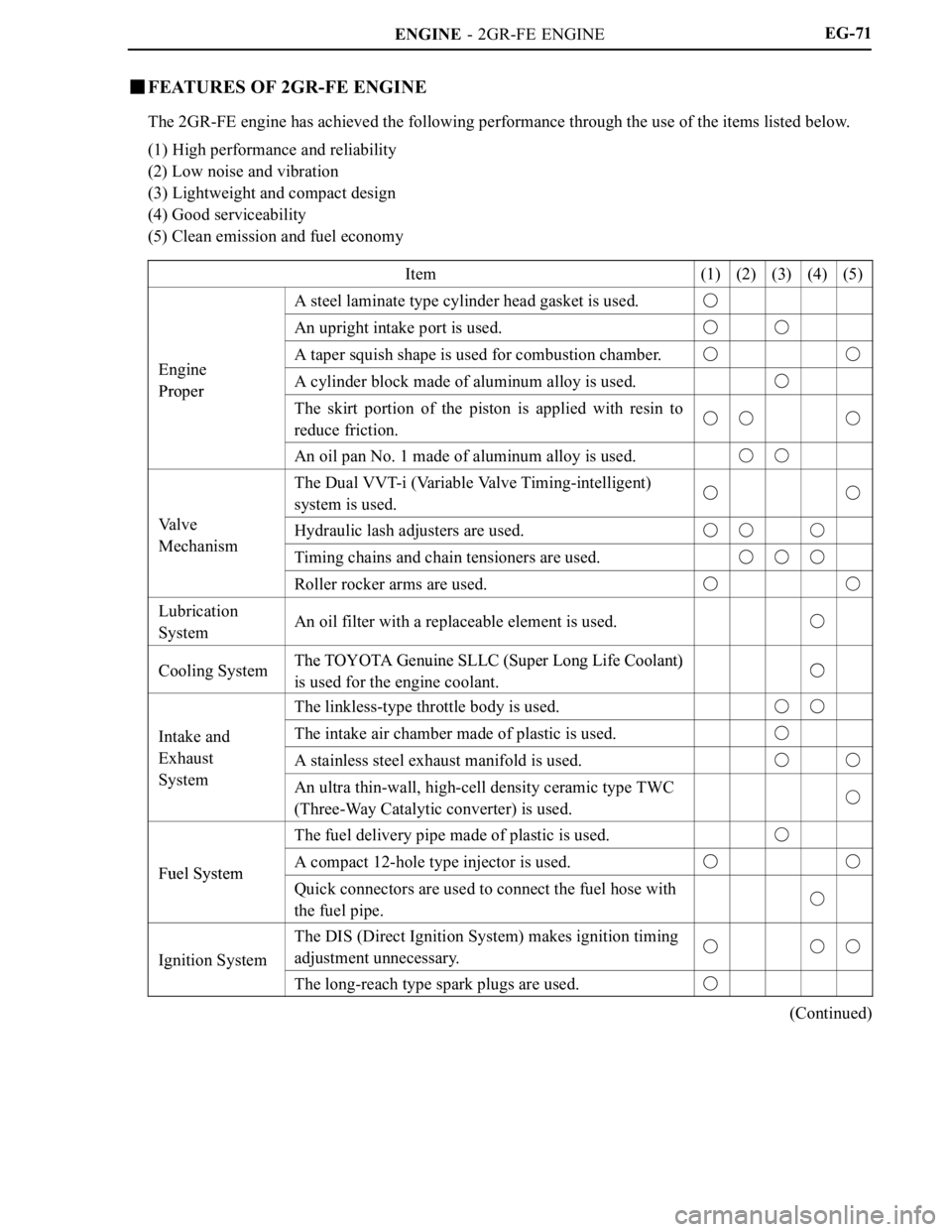
FEATURES OF 2GR-FE ENGINE
The 2GR-FE engine has achieved the following performance through the use of the items listed below.
(1) High performance and reliability
(2) Low noise and vibration
(3) Lightweight and compact design
(4) Good serviceability
(5) Clean emission and fuel economy
Item
(1)(2)(3)(4)(5)
A steel laminate type cylinder head gasket is used.
An upright intake port is used.
EngineA taper squish shape is used for combustion chamber.Engine
ProperA cylinder block made of aluminum alloy is used.Proper
The skirt portion of the piston is applied with resin to
reduce friction.
An oil pan No. 1 made of aluminum alloy is used.
The Dual VVT-i (Variable Valve Timing-intelligent)
system is used.
Va l v e
Mh i
Hydraulic lash adjusters are used.
MechanismTiming chains and chain tensioners are used.
Roller rocker arms are used.
Lubrication
SystemAn oil filter with a replaceable element is used.
Cooling SystemThe TOYOTA Genuine SLLC (Super Long Life Coolant)Cooling SystemThe TOYOTA Genuine SLLC (Super Long Life Coolant)
is used for the engine coolant.
The linkless-type throttle body is used.
Intake andThe intake air chamber made of plastic is used.Intake and
Exhaust
S
A stainless steel exhaust manifold is used.
SystemAn ultra thin-wall, high-cell density ceramic type TWC
(Three-Way Catalytic converter) is used.
The fuel delivery pipe made of plastic is used.
Fuel SystemA compact 12-hole type injector is used.Fuel SystemQuick connectors are used to connect the fuel hose with
the fuel pipe.
Ignition System
The DIS (Direct Ignition System) makes ignition timing
adjustment unnecessary.
Ignition System
The long-reach type spark plugs are used.
(Continued)
Page 69 of 2000

ENGINE - 2GR-FE ENGINE
285EG05
Oil Delivery PipeCylinder Head Covers
Cylinder Head
Cover Gaskets
Oil Delivery Pipe
285EG06
Engine
FrontShim A A
For Right Bank
For Left BankA - A Cross SectionEG-73
ENGINE PROPER
1. Cylinder Head Cover
Lightweight yet high-strength aluminum cylinder head covers are used.
An oil delivery pipe is installed inside the cylinder head cover. This ensures lubrication to the sliding parts
of the roller rocker arm, improving reliability.
2. Cylinder Head Gasket
A steel-laminate type cylinder head gasket is used. A shim is used around the cylinder bore of the gasket to
help enhance sealing performance and durability.
Page 71 of 2000
ENGINE - 2GR-FE ENGINE
285EG10 285EG09
60
Knock Sensor Bosses
36.6 mm
(1.441 in.)
105.5 mm
(4.15 in.)
View from Top Side
285EG11
Wa t e r P a s s a g eEG-75
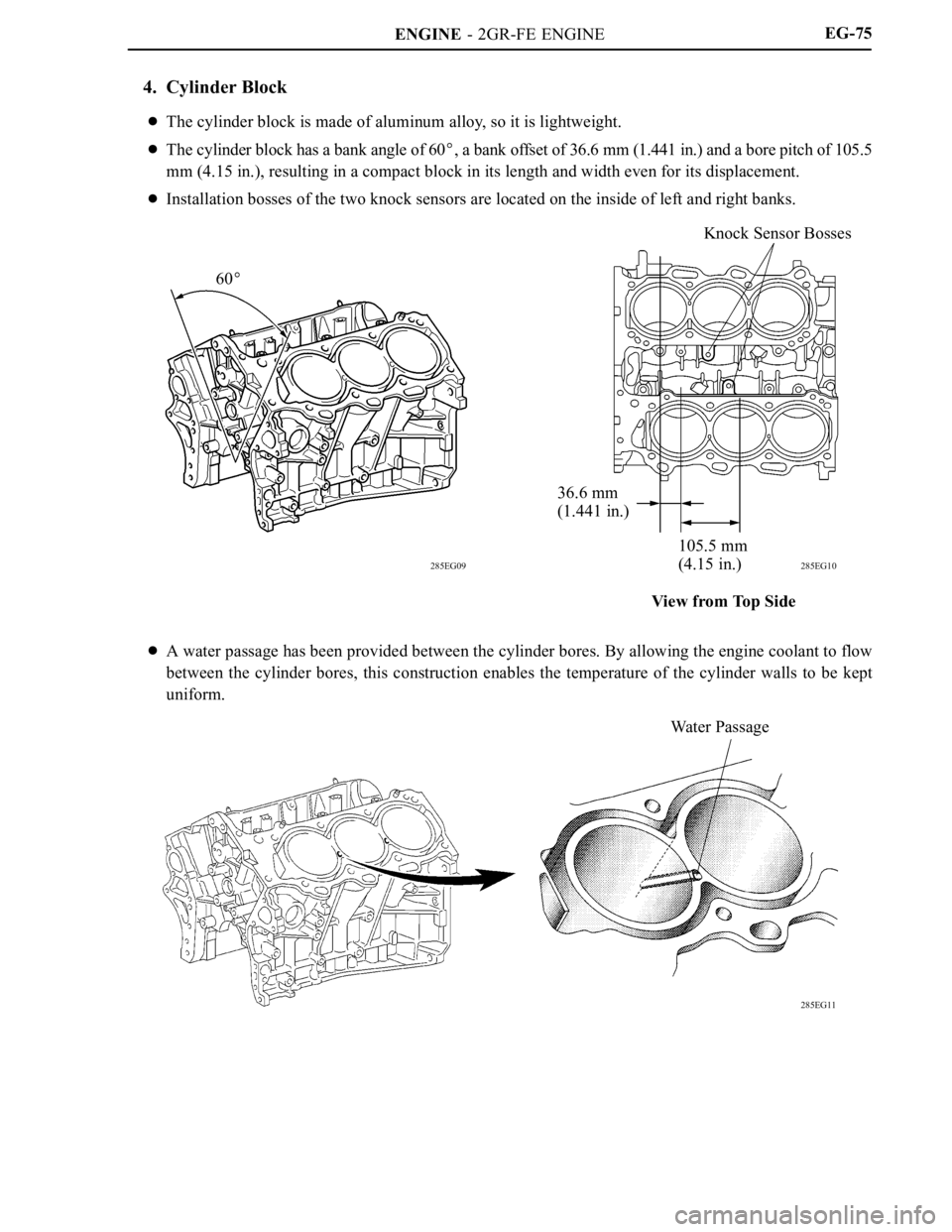
4. Cylinder Block
The cylinder block is made of aluminum alloy, so it is lightweight.
The cylinder block has a bank angle of 60, a bank offset of 36.6 mm (1.441 in.) and a bore pitch of 105.5
mm (4.15 in.), resulting in a compact block in its length and width even for its displacement.
Installation bosses of the two knock sensors are located on the inside of left and right banks.
A water passage has been provided between the cylinder bores. By allowing the engine coolant to flow
between the cylinder bores, this construction enables the temperature of the cylinder walls to be kept
uniform.