Sensor O2 TOYOTA RAV4 2006 Service Repair Manual
[x] Cancel search | Manufacturer: TOYOTA, Model Year: 2006, Model line: RAV4, Model: TOYOTA RAV4 2006Pages: 2000, PDF Size: 45.84 MB
Page 1645 of 2000
AIR CONDITIONING – AIR CONDITIONING SYSTEM (for Automatic Air Conditioning Sys-
tem)AC–17
AC
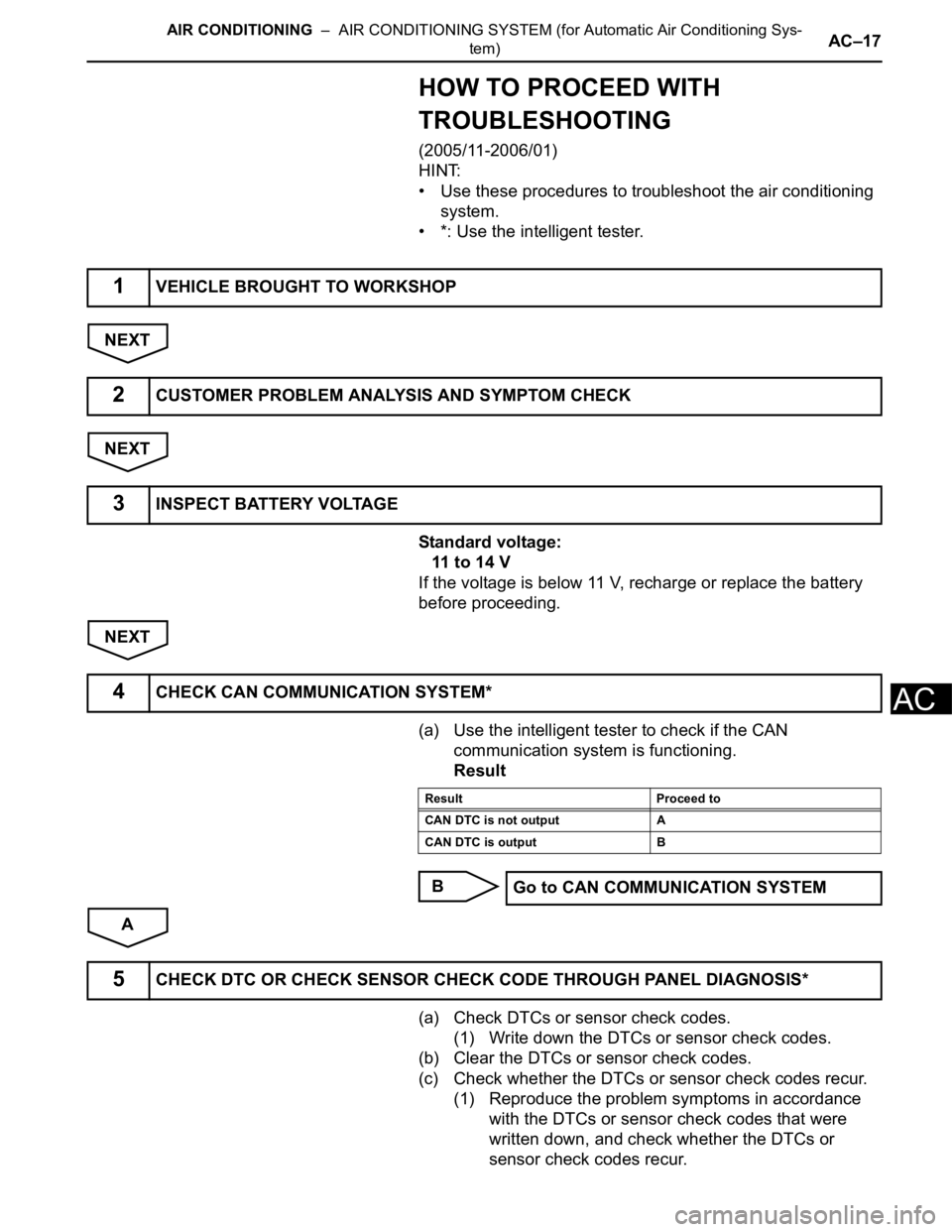
HOW TO PROCEED WITH
TROUBLESHOOTING
(2005/11-2006/01)
HINT:
• Use these procedures to troubleshoot the air conditioning
system.
• *: Use the intelligent tester.
NEXT
NEXT
Standard voltage:
11 to 14 V
If the voltage is below 11 V, recharge or replace the battery
before proceeding.
NEXT
(a) Use the intelligent tester to check if the CAN
communication system is functioning.
Result
B
A
(a) Check DTCs or sensor check codes.
(1) Write down the DTCs or sensor check codes.
(b) Clear the DTCs or sensor check codes.
(c) Check whether the DTCs or sensor check codes recur.
(1) Reproduce the problem symptoms in accordance
with the DTCs or sensor check codes that were
written down, and check whether the DTCs or
sensor check codes recur.
1VEHICLE BROUGHT TO WORKSHOP
2CUSTOMER PROBLEM ANALYSIS AND SYMPTOM CHECK
3INSPECT BATTERY VOLTAGE
4CHECK CAN COMMUNICATION SYSTEM*
Result Proceed to
CAN DTC is not output A
CAN DTC is output B
Go to CAN COMMUNICATION SYSTEM
5CHECK DTC OR CHECK SENSOR CHECK CODE THROUGH PANEL DIAGNOSIS*
Page 1646 of 2000
AC–18AIR CONDITIONING – AIR CONDITIONING SYSTEM (for Automatic Air Conditioning Sys-
tem)
AC
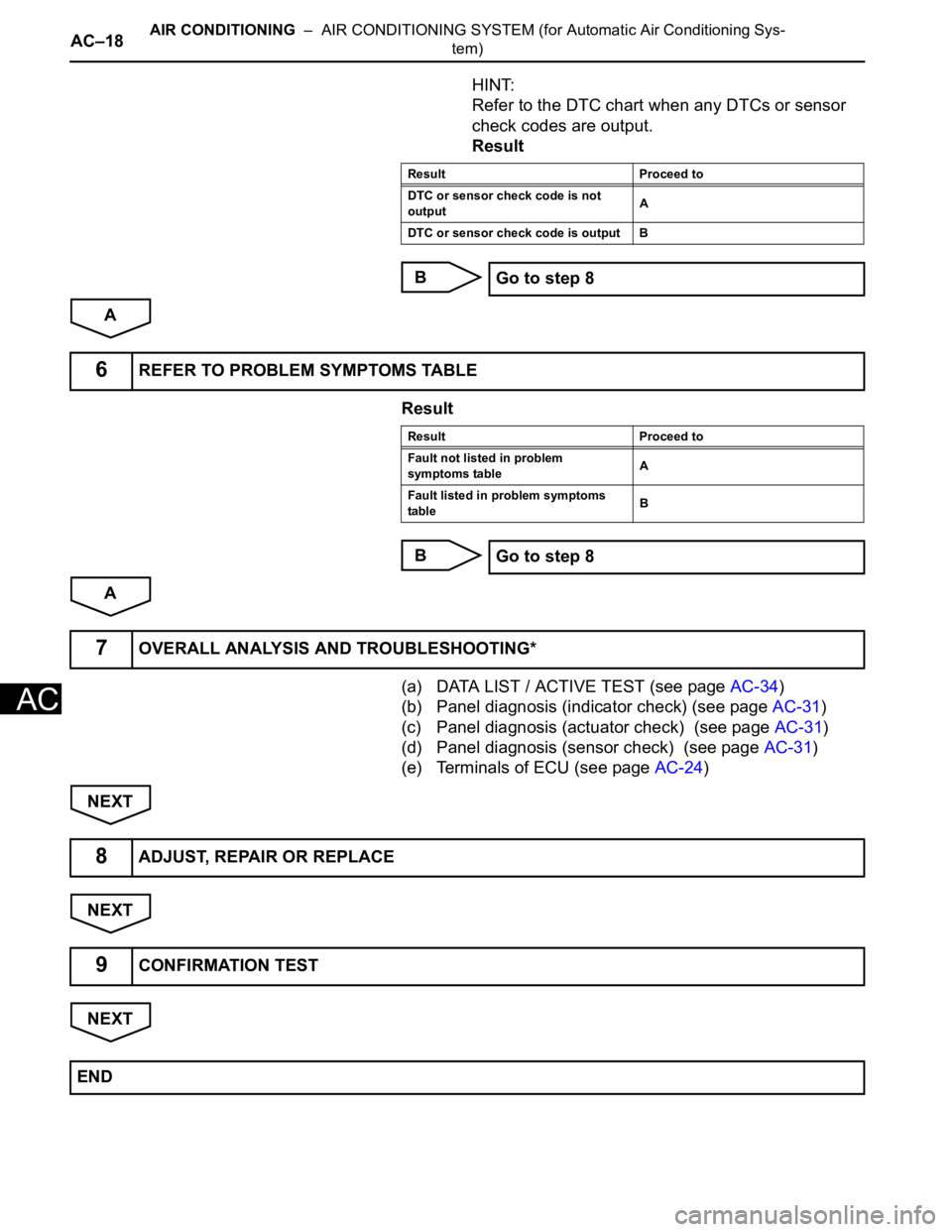
HINT:
Refer to the DTC chart when any DTCs or sensor
check codes are output.
Result
B
A
Result
B
A
(a) DATA LIST / ACTIVE TEST (see page AC-34)
(b) Panel diagnosis (indicator check) (see page AC-31)
(c) Panel diagnosis (actuator check) (see page AC-31)
(d) Panel diagnosis (sensor check) (see page AC-31)
(e) Terminals of ECU (see page AC-24)
NEXT
NEXT
NEXT
Result Proceed to
DTC or sensor check code is not
outputA
DTC or sensor check code is output B
Go to step 8
6REFER TO PROBLEM SYMPTOMS TABLE
Result Proceed to
Fault not listed in problem
symptoms tableA
Fault listed in problem symptoms
tableB
Go to step 8
7OVERALL ANALYSIS AND TROUBLESHOOTING*
8ADJUST, REPAIR OR REPLACE
9CONFIRMATION TEST
END
Page 1647 of 2000
AIR CONDITIONING – AIR CONDITIONING SYSTEM (for Automatic Air Conditioning Sys-
tem)AC–19
AC
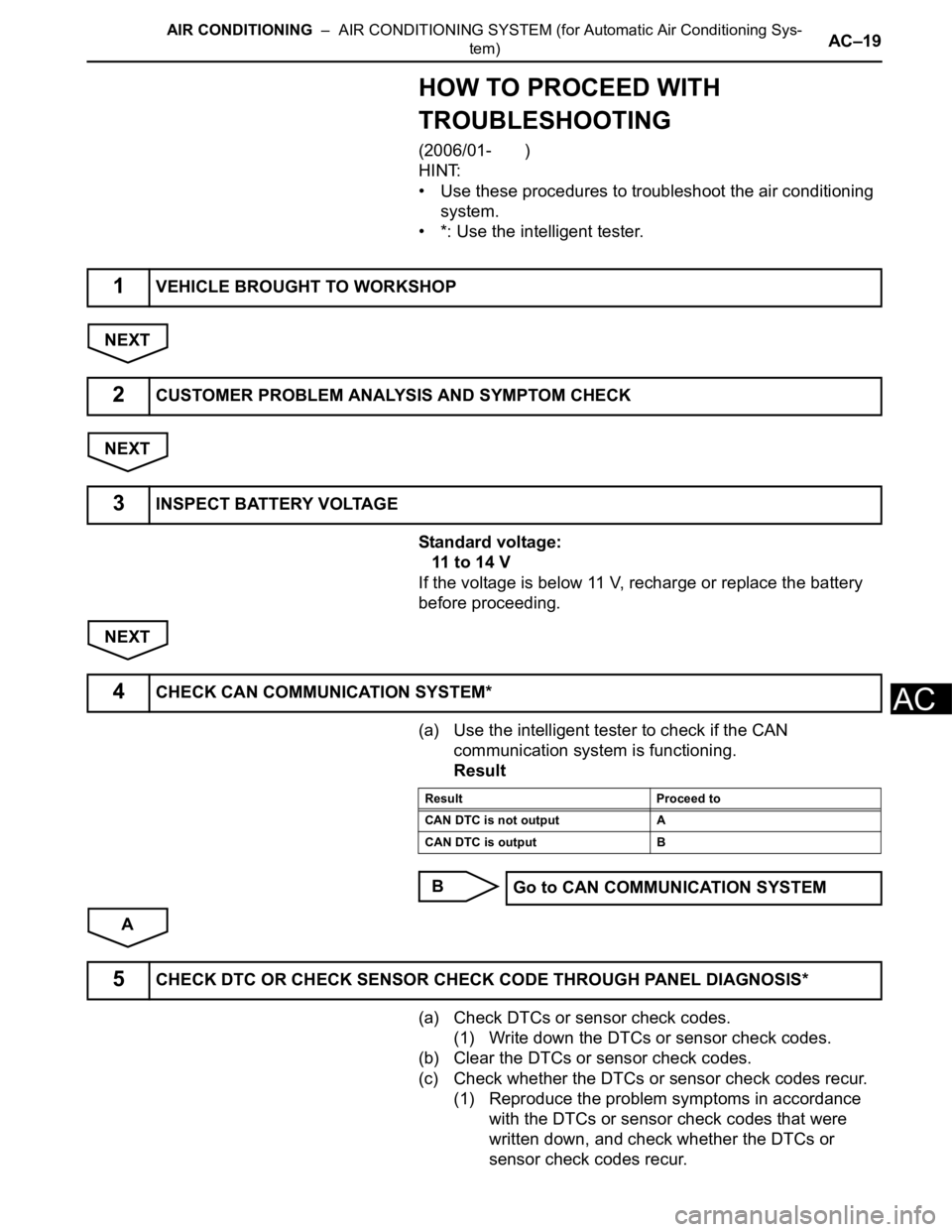
HOW TO PROCEED WITH
TROUBLESHOOTING
(2006/01- )
HINT:
• Use these procedures to troubleshoot the air conditioning
system.
• *: Use the intelligent tester.
NEXT
NEXT
Standard voltage:
11 to 14 V
If the voltage is below 11 V, recharge or replace the battery
before proceeding.
NEXT
(a) Use the intelligent tester to check if the CAN
communication system is functioning.
Result
B
A
(a) Check DTCs or sensor check codes.
(1) Write down the DTCs or sensor check codes.
(b) Clear the DTCs or sensor check codes.
(c) Check whether the DTCs or sensor check codes recur.
(1) Reproduce the problem symptoms in accordance
with the DTCs or sensor check codes that were
written down, and check whether the DTCs or
sensor check codes recur.
1VEHICLE BROUGHT TO WORKSHOP
2CUSTOMER PROBLEM ANALYSIS AND SYMPTOM CHECK
3INSPECT BATTERY VOLTAGE
4CHECK CAN COMMUNICATION SYSTEM*
Result Proceed to
CAN DTC is not output A
CAN DTC is output B
Go to CAN COMMUNICATION SYSTEM
5CHECK DTC OR CHECK SENSOR CHECK CODE THROUGH PANEL DIAGNOSIS*
Page 1648 of 2000
AC–20AIR CONDITIONING – AIR CONDITIONING SYSTEM (for Automatic Air Conditioning Sys-
tem)
AC
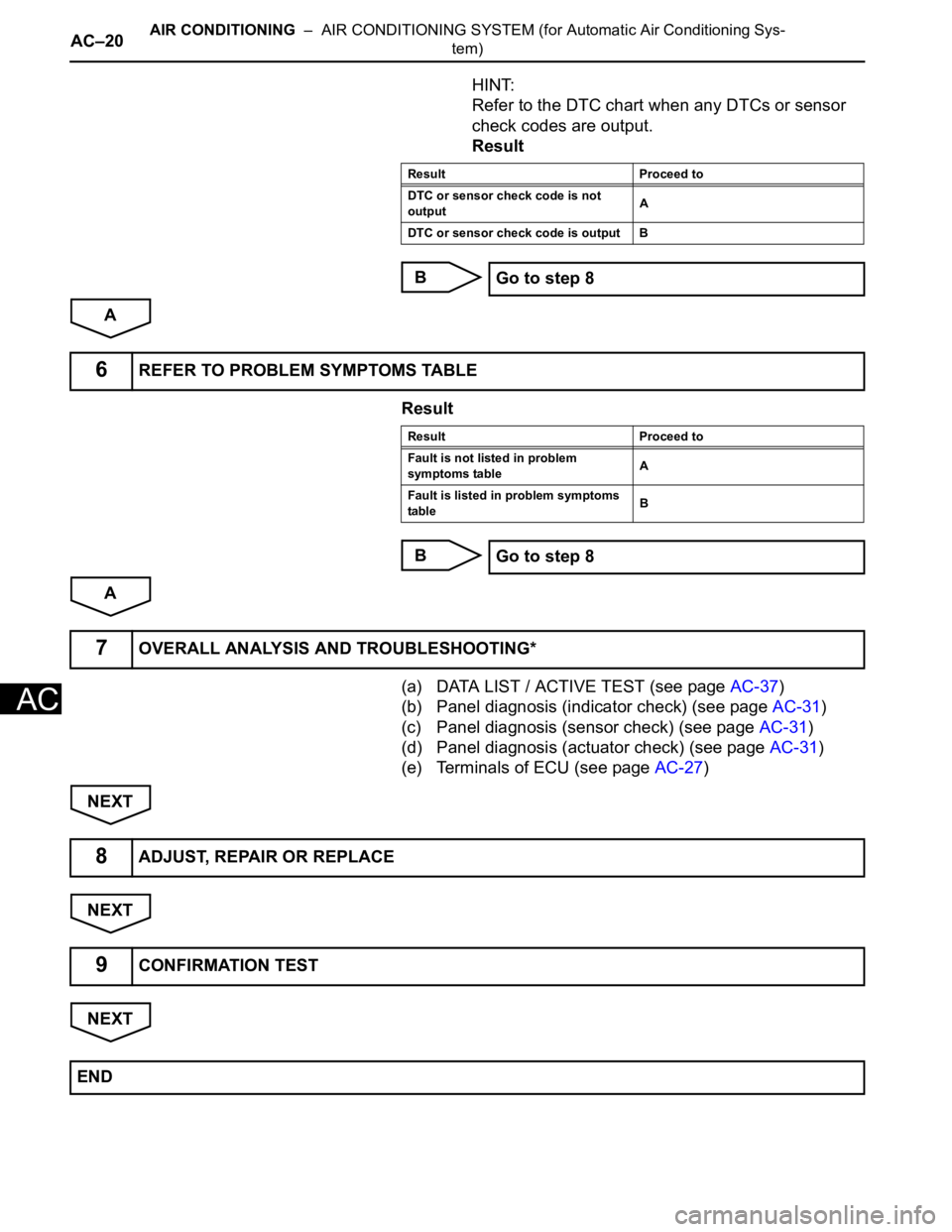
HINT:
Refer to the DTC chart when any DTCs or sensor
check codes are output.
Result
B
A
Result
B
A
(a) DATA LIST / ACTIVE TEST (see page AC-37)
(b) Panel diagnosis (indicator check) (see page AC-31)
(c) Panel diagnosis (sensor check) (see page AC-31)
(d) Panel diagnosis (actuator check) (see page AC-31)
(e) Terminals of ECU (see page AC-27)
NEXT
NEXT
NEXT
Result Proceed to
DTC or sensor check code is not
outputA
DTC or sensor check code is output B
Go to step 8
6REFER TO PROBLEM SYMPTOMS TABLE
Result Proceed to
Fault is not listed in problem
symptoms tableA
Fault is listed in problem symptoms
tableB
Go to step 8
7OVERALL ANALYSIS AND TROUBLESHOOTING*
8ADJUST, REPAIR OR REPLACE
9CONFIRMATION TEST
END
Page 1650 of 2000
AC–22AIR CONDITIONING – AIR CONDITIONING SYSTEM (for Automatic Air Conditioning Sys-
tem)
AC
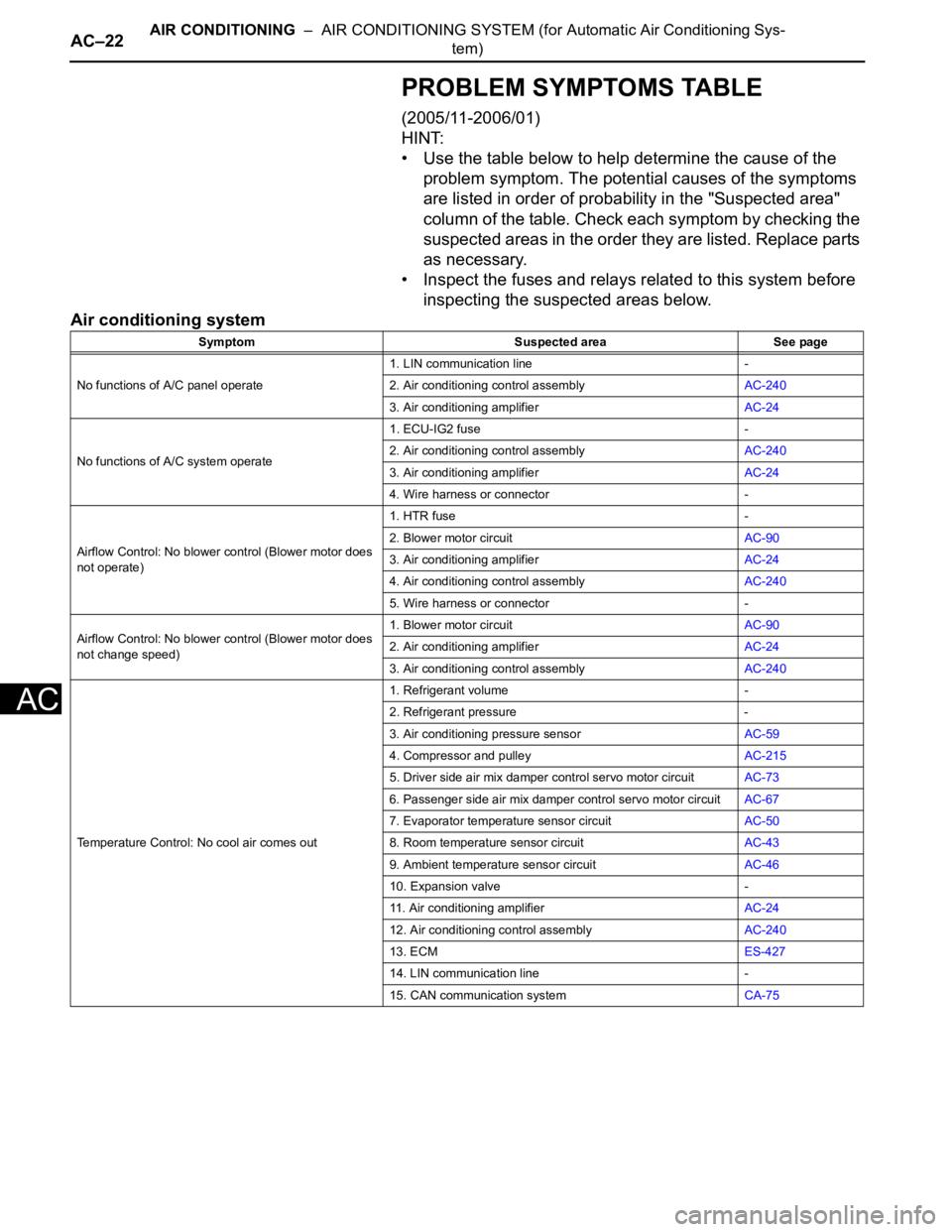
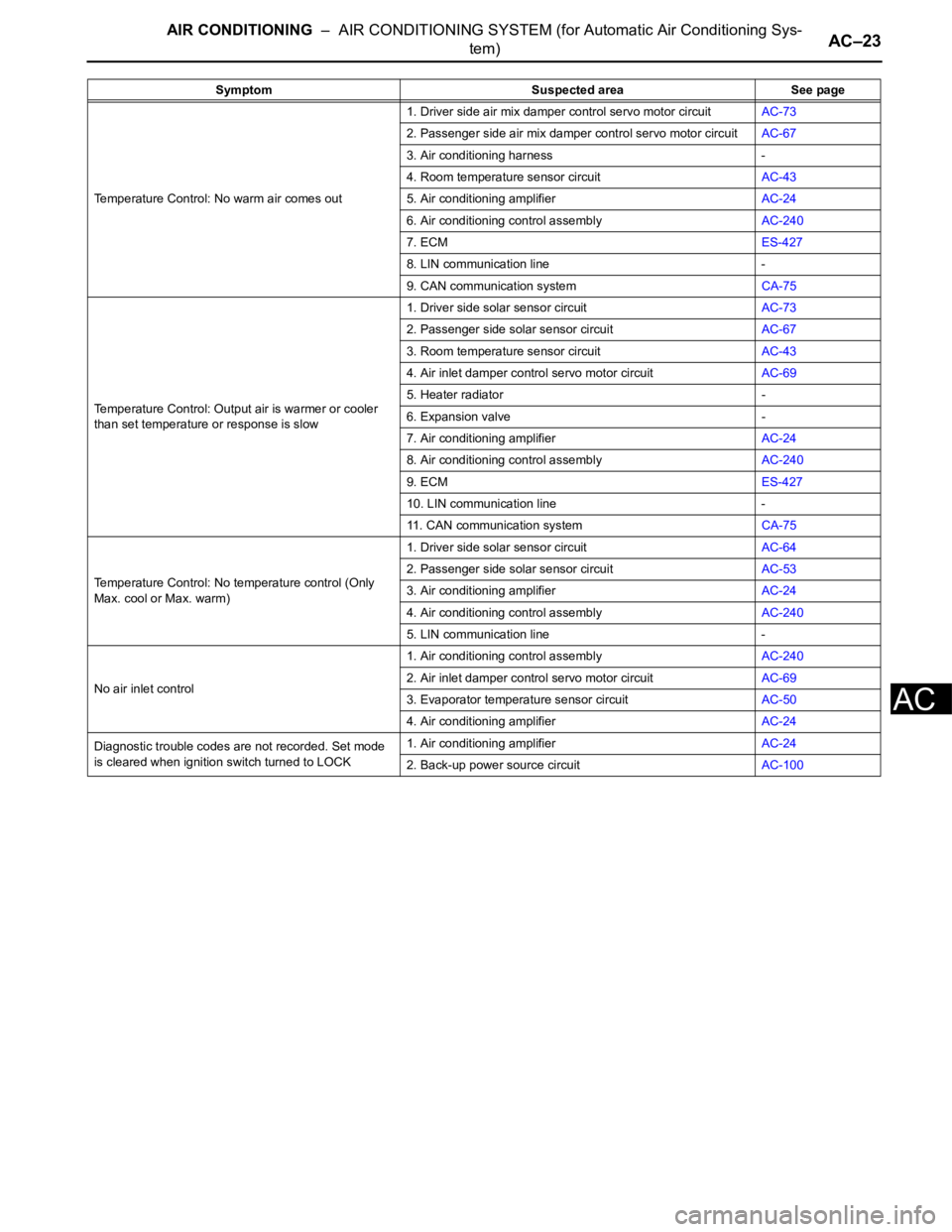
PROBLEM SYMPTOMS TABLE
(2005/11-2006/01)
HINT:
• Use the table below to help determine the cause of the
problem symptom. The potential causes of the symptoms
are listed in order of probability in the "Suspected area"
column of the table. Check each symptom by checking the
suspected areas in the order they are listed. Replace parts
as necessary.
• Inspect the fuses and relays related to this system before
inspecting the suspected areas below.
Air conditioning system
Symptom Suspected area See page
No functions of A/C panel operate1. LIN communication line -
2. Air conditioning control assemblyAC-240
3. Air conditioning amplifierAC-24
No functions of A/C system operate1. ECU-IG2 fuse -
2. Air conditioning control assemblyAC-240
3. Air conditioning amplifierAC-24
4. Wire harness or connector -
Airflow Control: No blower control (Blower motor does
not operate)1. HTR fuse -
2. Blower motor circuitAC-90
3. Air conditioning amplifierAC-24
4. Air conditioning control assemblyAC-240
5. Wire harness or connector -
Airflow Control: No blower control (Blower motor does
not change speed)1. Blower motor circuitAC-90
2. Air conditioning amplifierAC-24
3. Air conditioning control assemblyAC-240
Temperature Control: No cool air comes out1. Refrigerant volume -
2. Refrigerant pressure -
3. Air conditioning pressure sensorAC-59
4. Compressor and pulleyAC-215
5. Driver side air mix damper control servo motor circuitAC-73
6. Passenger side air mix damper control servo motor circuitAC-67
7. Evaporator temperature sensor circuitAC-50
8. Room temperature sensor circuitAC-43
9. Ambient temperature sensor circuitAC-46
10. Expansion valve -
11. Air conditioning amplifierAC-24
12. Air conditioning control assemblyAC-240
13. ECMES-427
14. LIN communication line -
15. CAN communication systemCA-75
Page 1651 of 2000
AIR CONDITIONING – AIR CONDITIONING SYSTEM (for Automatic Air Conditioning Sys-
tem)AC–23
AC
Temperature Control: No warm air comes out1. Driver side air mix damper control servo motor circuitAC-73
2. Passenger side air mix damper control servo motor circuitAC-67
3. Air conditioning harness -
4. Room temperature sensor circuitAC-43
5. Air conditioning amplifierAC-24
6. Air conditioning control assemblyAC-240
7. ECMES-427
8. LIN communication line -
9. CAN communication systemCA-75
Temperature Control: Output air is warmer or cooler
than set temperature or response is slow1. Driver side solar sensor circuitAC-73
2. Passenger side solar sensor circuitAC-67
3. Room temperature sensor circuitAC-43
4. Air inlet damper control servo motor circuitAC-69
5. Heater radiator -
6. Expansion valve -
7. Air conditioning amplifierAC-24
8. Air conditioning control assemblyAC-240
9. ECMES-427
10. LIN communication line -
11. CAN communication systemCA-75
Temperature Control: No temperature control (Only
Max. cool or Max. warm)1. Driver side solar sensor circuitAC-64
2. Passenger side solar sensor circuitAC-53
3. Air conditioning amplifierAC-24
4. Air conditioning control assemblyAC-240
5. LIN communication line -
No air inlet control1. Air conditioning control assemblyAC-240
2. Air inlet damper control servo motor circuitAC-69
3. Evaporator temperature sensor circuitAC-50
4. Air conditioning amplifierAC-24
Diagnostic trouble codes are not recorded. Set mode
is cleared when ignition switch turned to LOCK1. Air conditioning amplifierAC-24
2. Back-up power source circuitAC-100 Symptom Suspected area See page
Page 1652 of 2000
AC–24AIR CONDITIONING – AIR CONDITIONING SYSTEM (for Automatic Air Conditioning Sys-
tem)
AC
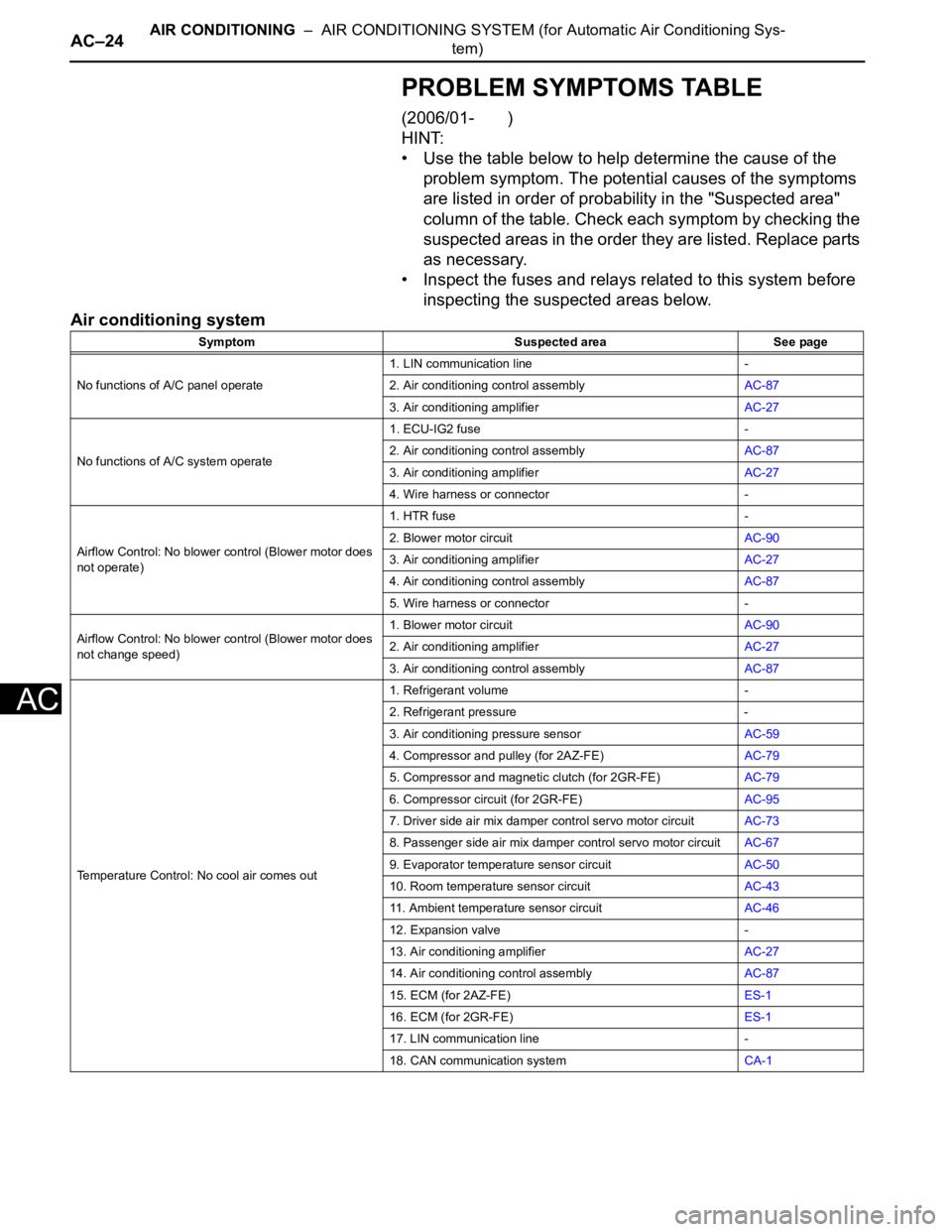
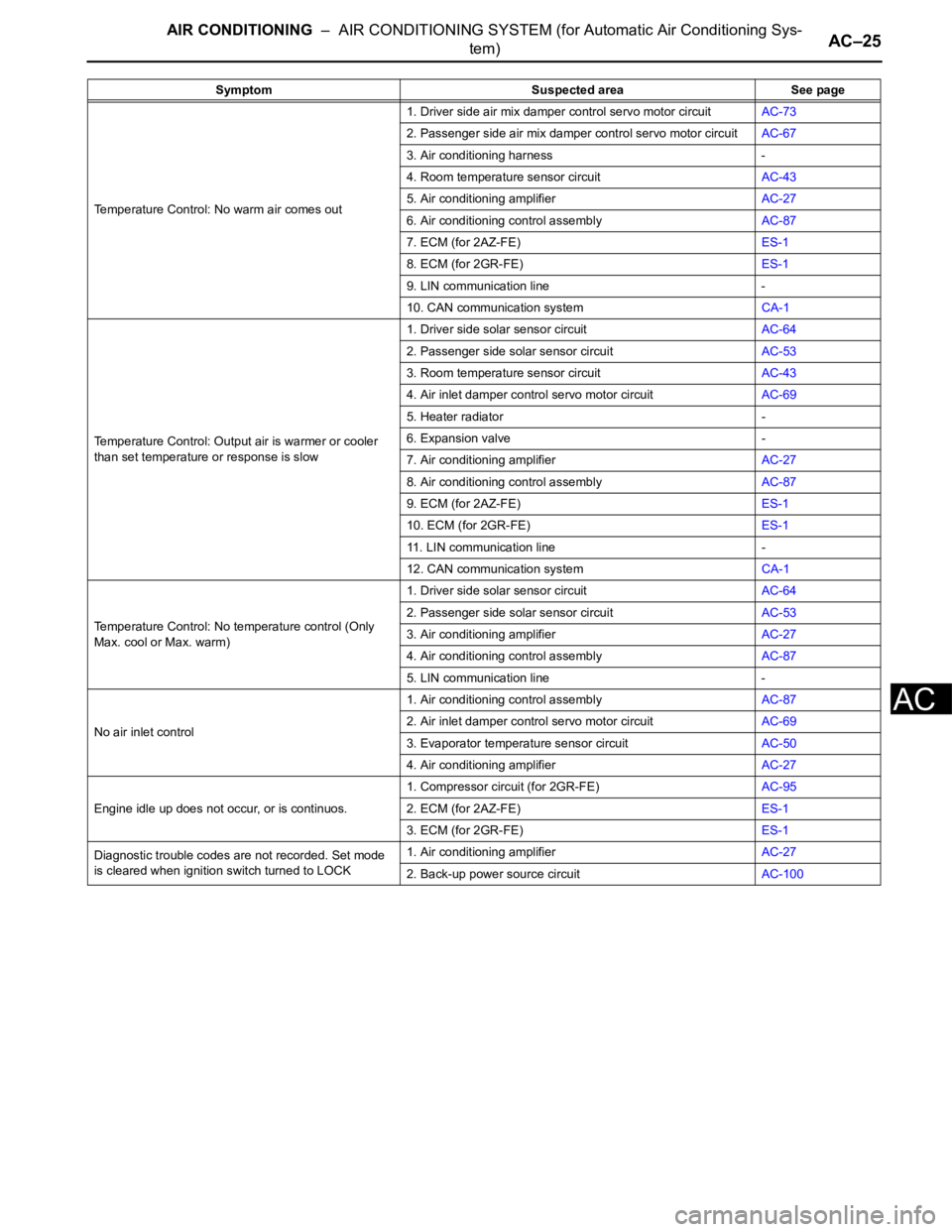
PROBLEM SYMPTOMS TABLE
(2006/01- )
HINT:
• Use the table below to help determine the cause of the
problem symptom. The potential causes of the symptoms
are listed in order of probability in the "Suspected area"
column of the table. Check each symptom by checking the
suspected areas in the order they are listed. Replace parts
as necessary.
• Inspect the fuses and relays related to this system before
inspecting the suspected areas below.
Air conditioning system
Symptom Suspected area See page
No functions of A/C panel operate1. LIN communication line -
2. Air conditioning control assemblyAC-87
3. Air conditioning amplifierAC-27
No functions of A/C system operate1. ECU-IG2 fuse -
2. Air conditioning control assemblyAC-87
3. Air conditioning amplifierAC-27
4. Wire harness or connector -
Airflow Control: No blower control (Blower motor does
not operate)1. HTR fuse -
2. Blower motor circuitAC-90
3. Air conditioning amplifierAC-27
4. Air conditioning control assemblyAC-87
5. Wire harness or connector -
Airflow Control: No blower control (Blower motor does
not change speed)1. Blower motor circuitAC-90
2. Air conditioning amplifierAC-27
3. Air conditioning control assemblyAC-87
Temperature Control: No cool air comes out1. Refrigerant volume -
2. Refrigerant pressure -
3. Air conditioning pressure sensorAC-59
4. Compressor and pulley (for 2AZ-FE)AC-79
5. Compressor and magnetic clutch (for 2GR-FE)AC-79
6. Compressor circuit (for 2GR-FE)AC-95
7. Driver side air mix damper control servo motor circuitAC-73
8. Passenger side air mix damper control servo motor circuitAC-67
9. Evaporator temperature sensor circuitAC-50
10. Room temperature sensor circuitAC-43
11. Ambient temperature sensor circuitAC-46
12. Expansion valve -
13. Air conditioning amplifierAC-27
14. Air conditioning control assemblyAC-87
15. ECM (for 2AZ-FE)ES-1
16. ECM (for 2GR-FE)ES-1
17. LIN communication line -
18. CAN communication systemCA-1
Page 1653 of 2000
AIR CONDITIONING – AIR CONDITIONING SYSTEM (for Automatic Air Conditioning Sys-
tem)AC–25
AC
Temperature Control: No warm air comes out1. Driver side air mix damper control servo motor circuitAC-73
2. Passenger side air mix damper control servo motor circuitAC-67
3. Air conditioning harness -
4. Room temperature sensor circuitAC-43
5. Air conditioning amplifierAC-27
6. Air conditioning control assemblyAC-87
7. ECM (for 2AZ-FE)ES-1
8. ECM (for 2GR-FE)ES-1
9. LIN communication line -
10. CAN communication systemCA-1
Temperature Control: Output air is warmer or cooler
than set temperature or response is slow1. Driver side solar sensor circuitAC-64
2. Passenger side solar sensor circuitAC-53
3. Room temperature sensor circuitAC-43
4. Air inlet damper control servo motor circuitAC-69
5. Heater radiator -
6. Expansion valve -
7. Air conditioning amplifierAC-27
8. Air conditioning control assemblyAC-87
9. ECM (for 2AZ-FE)ES-1
10. ECM (for 2GR-FE)ES-1
11. LIN communication line -
12. CAN communication systemCA-1
Temperature Control: No temperature control (Only
Max. cool or Max. warm)1. Driver side solar sensor circuitAC-64
2. Passenger side solar sensor circuitAC-53
3. Air conditioning amplifierAC-27
4. Air conditioning control assemblyAC-87
5. LIN communication line -
No air inlet control1. Air conditioning control assemblyAC-87
2. Air inlet damper control servo motor circuitAC-69
3. Evaporator temperature sensor circuitAC-50
4. Air conditioning amplifierAC-27
Engine idle up does not occur, or is continuos.1. Compressor circuit (for 2GR-FE)AC-95
2. ECM (for 2AZ-FE)ES-1
3. ECM (for 2GR-FE)ES-1
Diagnostic trouble codes are not recorded. Set mode
is cleared when ignition switch turned to LOCK1. Air conditioning amplifierAC-27
2. Back-up power source circuitAC-100 Symptom Suspected area See page
Page 1654 of 2000
AC–26AIR CONDITIONING – AIR CONDITIONING SYSTEM (for Automatic Air Conditioning Sys-
tem)
AC
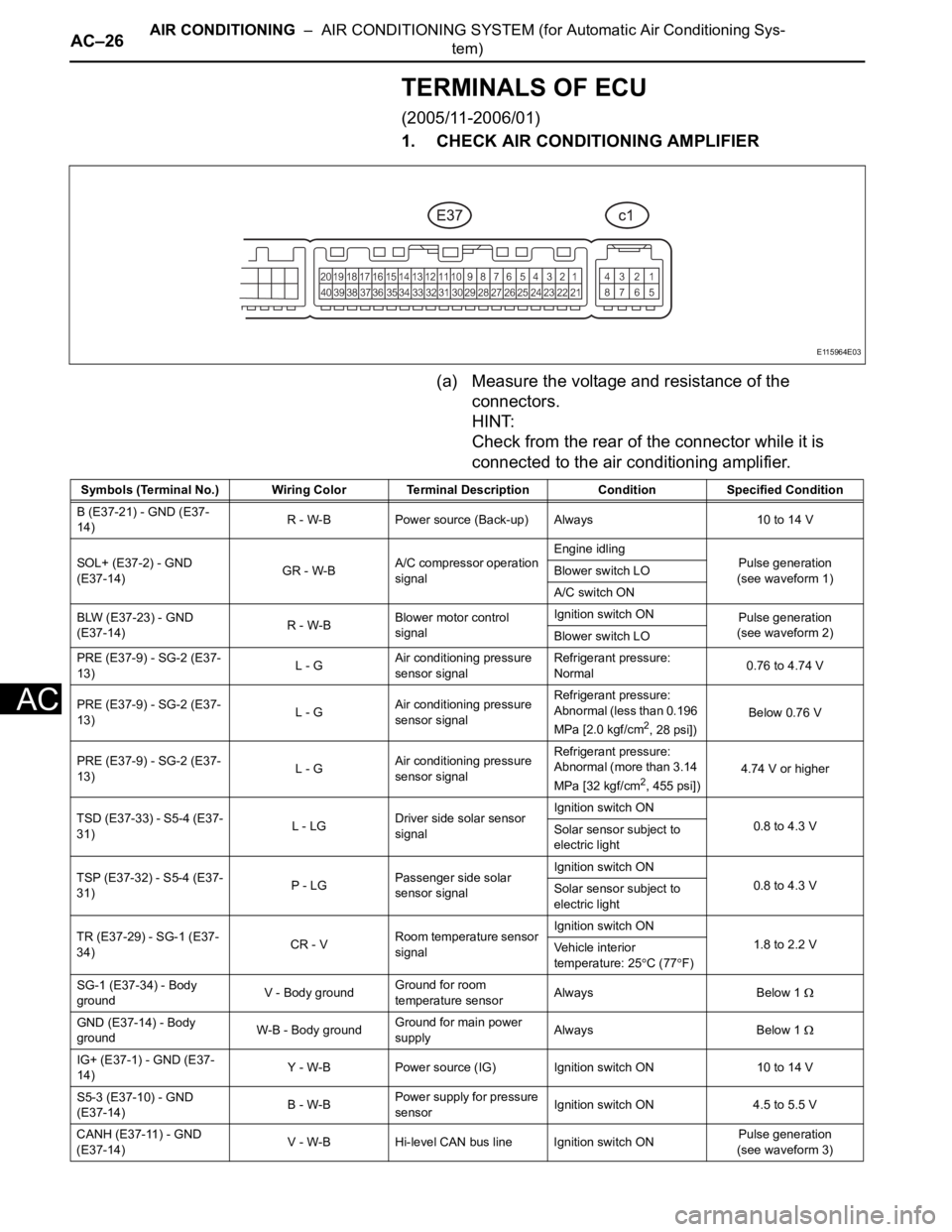
TERMINALS OF ECU
(2005/11-2006/01)
1. CHECK AIR CONDITIONING AMPLIFIER
(a) Measure the voltage and resistance of the
connectors.
HINT:
Check from the rear of the connector while it is
connected to the air conditioning amplifier.
E115964E03
Symbols (Terminal No.) Wiring Color Terminal Description ConditionSpecified Condition
B (E37-21) - GND (E37-
14)R - W-B Power source (Back-up) Always 10 to 14 V
SOL+ (E37-2) - GND
(E37-14)GR - W-BA/C compressor operation
signalEngine idling
Pulse generation
(see waveform 1) Blower switch LO
A/C switch ON
BLW (E37-23) - GND
(E37-14)R - W-BBlower motor control
signalIgnition switch ON
Pulse generation
(see waveform 2)
Blower switch LO
PRE (E37-9) - SG-2 (E37-
13)L - GAir conditioning pressure
sensor signalRefrigerant pressure:
Normal0.76 to 4.74 V
PRE (E37-9) - SG-2 (E37-
13)L - GAir conditioning pressure
sensor signalRefrigerant pressure:
Abnormal (less than 0.196
MPa [2.0 kgf/cm
2, 28 psi]) Below 0.76 V
PRE (E37-9) - SG-2 (E37-
13)L - GAir conditioning pressure
sensor signalRefrigerant pressure:
Abnormal (more than 3.14
MPa [32 kgf/cm
2, 455 psi])4.74 V or higher
TSD (E37-33) - S5-4 (E37-
31)L - LGDriver side solar sensor
signalIgnition switch ON
0.8 to 4.3 V
Solar sensor subject to
electric light
TSP (E37-32) - S5-4 (E37-
31)P - LGPassenger side solar
sensor signalIgnition switch ON
0.8 to 4.3 V
Solar sensor subject to
electric light
TR (E37-29) - SG-1 (E37-
34)CR - VRoom temperature sensor
signalIgnition switch ON
1.8 to 2.2 V
Vehicle interior
temperature: 25
C (77F)
SG-1 (E37-34) - Body
groundV - Body groundGround for room
temperature sensorAlways Below 1
GND (E37-14) - Body
groundW-B - Body groundGround for main power
supplyAlways Below 1
IG+ (E37-1) - GND (E37-
14)Y - W-B Power source (IG) Ignition switch ON 10 to 14 V
S5-3 (E37-10) - GND
(E37-14)B - W-BPower supply for pressure
sensorIgnition switch ON 4.5 to 5.5 V
CANH (E37-11) - GND
(E37-14)V - W-B Hi-level CAN bus line Ignition switch ONPulse generation
(see waveform 3)
Page 1655 of 2000
AIR CONDITIONING – AIR CONDITIONING SYSTEM (for Automatic Air Conditioning Sys-
tem)AC–27
AC
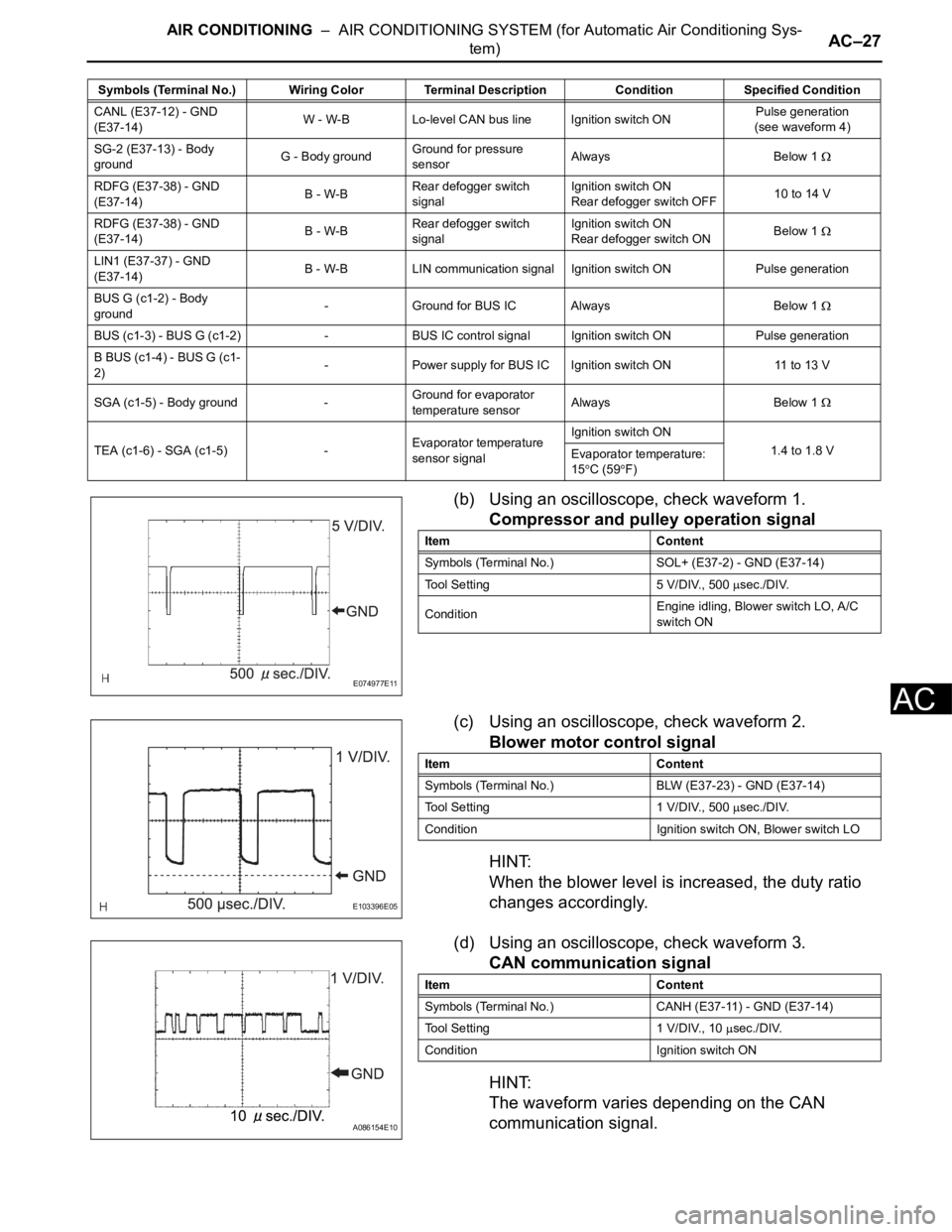
(b) Using an oscilloscope, check waveform 1.
Compressor and pulley operation signal
(c) Using an oscilloscope, check waveform 2.
Blower motor control signal
HINT:
When the blower level is increased, the duty ratio
changes accordingly.
(d) Using an oscilloscope, check waveform 3.
CAN communication signal
HINT:
The waveform varies depending on the CAN
communication signal.
CANL (E37-12) - GND
(E37-14)W - W-B Lo-level CAN bus line Ignition switch ONPulse generation
(see waveform 4)
SG-2 (E37-13) - Body
groundG - Body groundGround for pressure
sensorAlways Below 1
RDFG (E37-38) - GND
(E37-14)B - W-BRear defogger switch
signalIgnition switch ON
Rear defogger switch OFF10 to 14 V
RDFG (E37-38) - GND
(E37-14)B - W-BRear defogger switch
signalIgnition switch ON
Rear defogger switch ONBelow 1
LIN1 (E37-37) - GND
(E37-14)B - W-B LIN communication signalIgnition switch ON Pulse generation
BUS G (c1-2) - Body
ground- Ground for BUS IC Always Below 1
BUS (c1-3) - BUS G (c1-2) - BUS IC control signal Ignition switch ON Pulse generation
B BUS (c1-4) - BUS G (c1-
2)- Power supply for BUS IC Ignition switch ON 11 to 13 V
SGA (c1-5) - Body ground -Ground for evaporator
temperature sensorAlways Below 1
TEA (c1-6) - SGA (c1-5) -Evaporator temperature
sensor signalIgnition switch ON
1.4 to 1.8 V
Evaporator temperature:
15
C (59F) Symbols (Terminal No.) Wiring Color Terminal Description ConditionSpecified Condition
E074977E11
Item Content
Symbols (Terminal No.) SOL+ (E37-2) - GND (E37-14)
Tool Setting 5 V/DIV., 500
sec./DIV.
ConditionEngine idling, Blower switch LO, A/C
switch ON
E103396E05
Item Content
Symbols (Terminal No.) BLW (E37-23) - GND (E37-14)
Tool Setting 1 V/DIV., 500
sec./DIV.
Condition Ignition switch ON, Blower switch LO
A086154E10
Item Content
Symbols (Terminal No.) CANH (E37-11) - GND (E37-14)
Tool Setting 1 V/DIV., 10
sec./DIV.
Condition Ignition switch ON