engine TOYOTA RAV4 2006 Service Repair Manual
[x] Cancel search | Manufacturer: TOYOTA, Model Year: 2006, Model line: RAV4, Model: TOYOTA RAV4 2006Pages: 2000, PDF Size: 45.84 MB
Page 1137 of 2000

AX–18U151F AUTOMATIC TRANSAXLE – AUTOMATIC TRANSAXLE SYSTEM
AX
MECHANICAL SYSTEM TESTS
1. STALL SPEED TEST
HINT:
This test is to check the overall performance of the
engine and transaxle.
NOTICE:
• Do not perform the stall speed test longer than 10
seconds.
• To ensure safety, perform this test in an open and
level area that provides good traction.
• The stall speed test should always be performed
with at least 2 people. One person should observe
the condition of the wheels and wheel chocks
while the other is performing the test.
(a) Connect the intelligent tester to the CAN VIM. Then
connect the CAN VIM to the DLC3.
(b) Run the vehicle until the transmission fluid
temperature has reached 50 to 80
C (122 to 176F).
(c) Allow the engine to idle with the air conditioning
OFF.
(d) Chock all 4 wheels.
(e) Set the parking brake and keep the brake pedal
depressed firmly with your left foot.
(f) Move the shift lever to the D position.
(g) Depress the accelerator pedal as much as possible
with your right foot.
(h) Read the engine rpm (stall speed) and release the
accelerator pedal immediately.
Standard value:
2,450 to 2,750 rpm
Evaluation:
NOTICE:
Perform the test at the normal operating ATF
temperature of 50 to 80
C (122 to 176F).
2. SHIFT TIME LAG TEST
HINT:
This test is to check the condition of the direct clutch,
forward clutch, 1st brake and reverse brake.
(a) Connect the intelligent tester to the CAN VIM. Then
connect the CAN VIM to the DLC3.
(b) Run the vehicle until the transmission fluid
temperature has reached 50 to 80
C (122 to 176F).
Test Result Possible Cause
Stall speed is lower than standard value • Engine power output may be insufficient
• Stator one-way clutch not operating properly
HINT:
If the value is less than the specified value by 600 rpm or more, the
torque converter could be faulty.
Stall speed is higher than standard value • Line pressure is too low
• Forward clutch slipping
• U/D (underdrive) brake slipping
• U/D (underdrive) one-way clutch is not operating properly
• No. 1 one-way clutch not operating properly
• Improper fluid level
Page 1138 of 2000

U151F AUTOMATIC TRANSAXLE – AUTOMATIC TRANSAXLE SYSTEMAX–19
AX
(c) Allow the engine to idle with the air conditioning
OFF.
(d) Set the parking brake and keep the brake pedal
depressed firmly.
(e) Check the D range time lag.
(1) Move the shift lever to N and wait for 1 minute.
(2) Move the shift lever to D and measure the time
until the shock is felt.
(3) Repeat the 2 procedures above 3 times, and
calculate the average time of the 3 tests.
(f) Check the R range time lag.
(1) Move the shift lever to N and wait for 1 minute.
(2) Move the shift lever to R and measure the time
until the shock is felt.
(3) Repeat the 2 procedures above 3 times, and
calculate the average time of the 3 tests.
Standard value:
D range time lag is less than 1.2 seconds
R range time lag is less than 1.5 seconds
Evaluation:
Test Result Possible Cause
D range time lag exceeds standard value • Line pressure is too low
• Forward clutch worn
• No. 1 one-way clutch is not operating properly
• U/D (underdrive) one-way clutch is not operating
• U/D (underdrive) brake worn
R range time lag exceeds standard value • Line pressure is too low
• Reverse clutch worn
• 1st and reverse brake worn
• U/D (underdrive) brake worn
Page 1139 of 2000
AX–20U151F AUTOMATIC TRANSAXLE – AUTOMATIC TRANSAXLE SYSTEM
AX
HYDRAULIC TEST
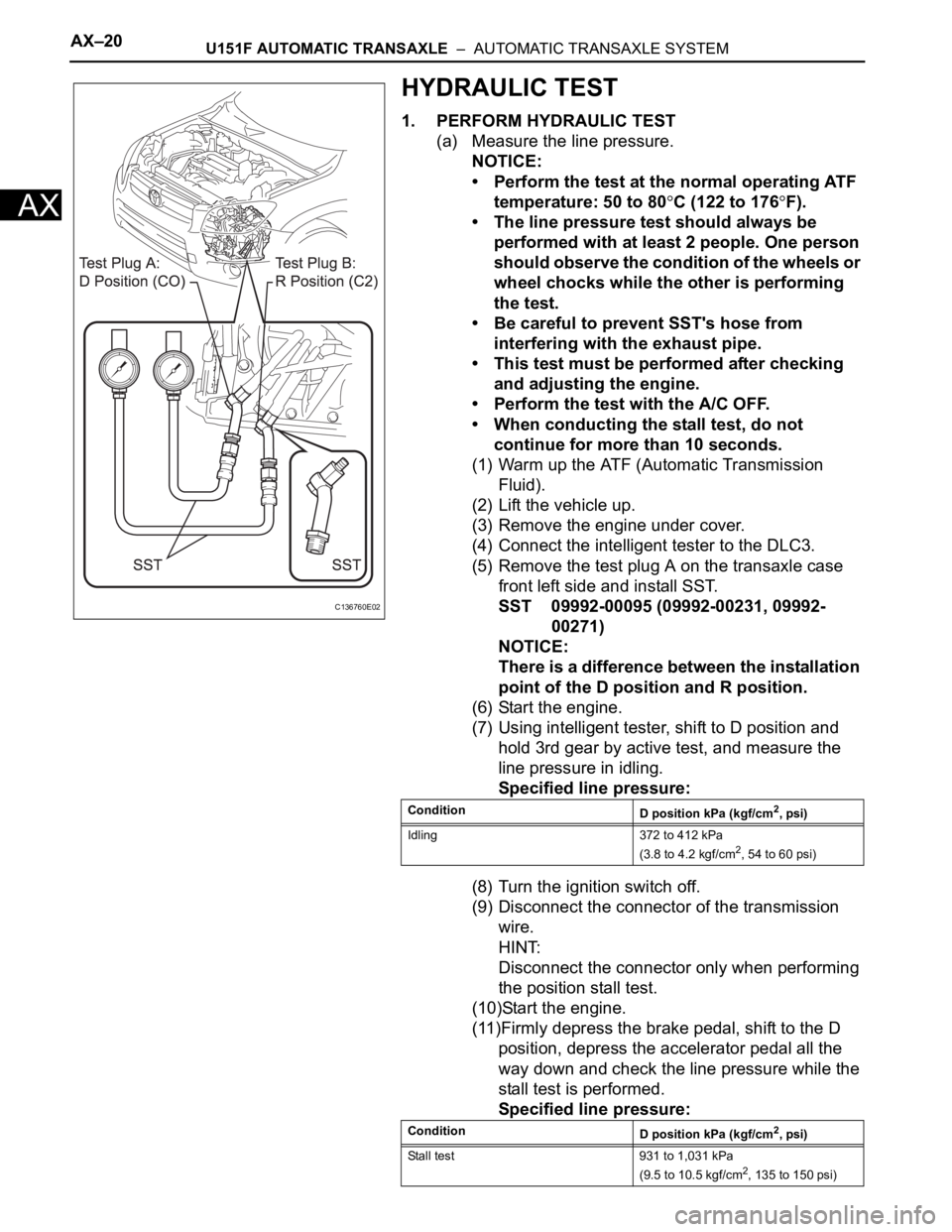
1. PERFORM HYDRAULIC TEST
(a) Measure the line pressure.
NOTICE:
• Perform the test at the normal operating ATF
temperature: 50 to 80
C (122 to 176F).
• The line pressure test should always be
performed with at least 2 people. One person
should observe the condition of the wheels or
wheel chocks while the other is performing
the test.
• Be careful to prevent SST's hose from
interfering with the exhaust pipe.
• This test must be performed after checking
and adjusting the engine.
• Perform the test with the A/C OFF.
• When conducting the stall test, do not
continue for more than 10 seconds.
(1) Warm up the ATF (Automatic Transmission
Fluid).
(2) Lift the vehicle up.
(3) Remove the engine under cover.
(4) Connect the intelligent tester to the DLC3.
(5) Remove the test plug A on the transaxle case
front left side and install SST.
SST 09992-00095 (09992-00231, 09992-
00271)
NOTICE:
There is a difference between the installation
point of the D position and R position.
(6) Start the engine.
(7) Using intelligent tester, shift to D position and
hold 3rd gear by active test, and measure the
line pressure in idling.
Specified line pressure:
(8) Turn the ignition switch off.
(9) Disconnect the connector of the transmission
wire.
HINT:
Disconnect the connector only when performing
the position stall test.
(10)Start the engine.
(11)Firmly depress the brake pedal, shift to the D
position, depress the accelerator pedal all the
way down and check the line pressure while the
stall test is performed.
Specified line pressure:
C136760E02
Condition
D position kPa (kgf/cm2, psi)
Idling 372 to 412 kPa
(3.8 to 4.2 kgf/cm
2, 54 to 60 psi)
Condition
D position kPa (kgf/cm
2, psi)
Stall test 931 to 1,031 kPa
(9.5 to 10.5 kgf/cm
2, 135 to 150 psi)
Page 1140 of 2000

U151F AUTOMATIC TRANSAXLE – AUTOMATIC TRANSAXLE SYSTEMAX–21
AX
(12)Turn the ignition switch off.
(13)Remove SST, and install the test plug A.
(14)Remove the test plug B, install SST and start
the engine.
SST 09992-00095 (09992-00231, 09992-
00271)
(15)Connect the transmission wire connector,
depress the brake pedal firmly, shift to the R
position and check the line pressure while the
engine is idling and during the stall test.
Specified line pressure:
(16)Remove SST, and install the test plug B.
(17)Clear the DTC.
Evaluation:
Condition
R position kPa (kgf/cm2, psi)
Idling 672 to 742 kPa
(6.9 to 7.6 kgf/cm
2, 97 to 108 psi)
Stall test 1,768 to 1,968 kPa
(18.0 to 20.0 kgf/cm
2, 256 to 285 psi)
Problem Possible cause
Measured values at all positions are higher than specified • Shift solenoid valve SLT defective
• Regulator valve defective
Measured values at all positions are lower than specified • Shift solenoid valve SLT defective
• Regulator valve defective
• Oil pump defective
• U/D (underdrive) direct clutch defective
Pressure is low when shift lever is on D only • D position circuit fluid leak
• Forward clutch defective
Pressure is low when shift lever is on R only • R position circuit fluid leak
• Reverse clutch defective
• 1st and reverse brake defective
Page 1142 of 2000
U151F AUTOMATIC TRANSAXLE – AUTOMATIC TRANSAXLE SYSTEMAX–23
AX
INITIALIZATION
1. RESET MEMORY
NOTICE:
• Perform the RESET MEMORY procedures (A/T
initialization) when replacing the automatic
transaxle assembly, engine assembly or ECM.
• RESET MEMORY can be performed only with the
intelligent tester.
HINT:
The ECM memorizes the vehicle conditions when the
ECT controls the automatic transaxle assembly and
engine assembly. Therefore, when the automatic
transaxle assembly, engine assembly, or ECM has been
replaced, it is necessary to reset the memory so that the
ECM can memorize the new information.
The reset procedures are as follows.
(a) Turn the ignition switch OFF.
(b) Connect the intelligent tester to the CAN VIM. Then
connect the CAN VIM to the DLC3.
(c) Turn the ignition switch ON and turn the tester ON.
(d) Enter the following menus: DIAGNOSIS /
ENHANCED OBD II.
(e) Perform the reset memory procedures from the
Engine menu.
CAUTION:
After performing the RESET MEMORY
procedures, be sure to perform the ROAD TEST
(see page AX-13) as described earlier.
HINT:
The ECM learns through the ROAD TEST.
Page 1144 of 2000

U151F AUTOMATIC TRANSAXLE – AUTOMATIC TRANSAXLE SYSTEMAX–25
AX
MONITOR DRIVE PATTERN
1. TEST MONITOR DRIVE PATTERN FOR ECT
CAUTION:
Perform this drive pattern on a level surface and
strictly observe the posted speed limits and traffic
laws while driving.
HINT:
Performing this drive pattern is one method to simulate
the ECT's malfunction detection conditions.
The DTCs may not be detected through ordinary,
everyday driving. Also, DTCs may not be detected
through this drive pattern.
(a) Preparation for driving
(1) Warm up the engine sufficiently (engine coolant
temperature is 60
C (140F) or higher).
(2) Drive the vehicle when the atmospheric
temperature is -10
C (14F) or higher.
Malfunction is not detected when the
atmospheric temperature is less than -10
C
(14
F).
(b) Drive pattern
(1) Drive the vehicle through all the gears.
St o p
1st 2nd 3rd 4th 5th 5th
(lock-up ON).
(2) Repeat the above drive pattern 3 times or more.
NOTICE:
• When using the intelligent tester, the
monitor status can be found in
"ENHANCED OBD II / DATA LIST" or under
"CARB OBD II".
• In the event that the drive pattern must be
interrupted (due to traffic conditions or
other factors), the drive pattern can be
resumed and, in most cases, the monitor
can be completed.
CAUTION:
Perform this drive pattern on a level road as
much as possible and strictly observe the
posted speed limits and traffic laws while
driving.
Page 1146 of 2000

U151F AUTOMATIC TRANSAXLE – AUTOMATIC TRANSAXLE SYSTEMAX–27
AX
PROBLEM SYMPTOMS TABLE
HINT:
• Use the table below to help determine the cause of the
problem symptom. The potential causes of the symptoms
are listed in order of probability in the "Suspected area"
column of the table. Check each symptom by checking the
suspected areas in the order they are listed. Replace parts
as necessary.
• The Matrix Chart is divided into 2 chapters. When
troubleshooting, check Chapter 1 first. If instructions are
given in Chapter 1 to proceed to 2, proceed as instructed.
• If the instruction "Proceed to next circuit inspection shown
in problem symptoms table" is given in the flowchart for
each circuit, proceed to the next suspected area in the
table.
• If the problem still occurs even though there are no
malfunctions in any of the circuits, check the ECM and
replace it if necessary.
1. Chapter 1: Electronic Circuit Matrix Chart
Symptom Suspected area See page
No down-shift (a particular gear, from 1st to 4th gear, is
not down-shifted)ECMIN-37
No down-shift (5th -> 4th)1. Transmission control switch (4 <--> D position) circuitAX-44
2. Shift solenoid valve S4 circuit*AX-106
3. ECMIN-37
No up-shift (a particular gear, from 1st to 4th gear, is
not up-shifted)ECMIN-37
No up-shift (4th -> 5th)1. Transmission control switch (4 <--> D position) circuitAX-44
2. Shift solenoid valve S4 circuit*AX-106
3. ECMIN-37
No lock-up1. Stop light switch circuit*AX-62
2. Engine coolant temperature sensor circuit*ES-56
3. ECMIN-37
No lock-up off ECMIN-37
Shift point too high or too low1. Throttle position sensor circuit*ES-56
2. ECMIN-37
Up-shift to 5th from 4th while shift lever on 41. Transmission control switch (4 <--> D position) circuitAX-44
2. ECMIN-37
Up-shift to 5th from 4th while engine is cold1. Engine coolant temperature sensor circuit*ES-56
2. ECMIN-37
Up-shift to 2nd from 1st while shift lever is on L1. Transmission control switch (2 <--> L position) circuit*AX-44
2. ECMIN-37
Harsh engagement (N -> D)1. Shift solenoid valve SL1 circuit*AX-76
2. ECMIN-37
Harsh engagement (lock-up) ECMIN-37
Harsh engagement (any driving position) ECMIN-37
Poor acceleration ECMIN-37
No kick-down ECMIN-37
Engine stalls when starting off or stopping ECMIN-37
Malfunction in shifting1. Park/Neutral position switch circuit*AX-44
2. Transmission control switch (4 <--> D position) circuitAX-44
3. ECMIN-37
Page 1148 of 2000

U151F AUTOMATIC TRANSAXLE – AUTOMATIC TRANSAXLE SYSTEMAX–29
AX
Harsh engagement (4th -> 5th)1. Valve body assemblyAX-142
2. C3 accumulatorAX-181
3. B3 U/D clutchAX-181
Harsh engagement (5th -> 4th)1. Valve body assemblyAX-142
2. B3 accumulatorAX-181
Slip or shudder (forward and reverse: after warm-up)1. Valve body assemblyAX-142
2. Oil strainerAX-142
3. C0 direct and O/D clutchAX-181
4. C1 forward clutchAX-181
5. C3 U/D clutchAX-181
6. B1 2nd and brakeAX-181
7. B3 U/D brakeAX-181
8. F1 No. 1 one-way clutchAX-181
9. F2 U/D one-way clutchAX-181
10. Torque converter clutchAX-179
Slip or shudder (particular position: just after engine
starts)Torque converter clutchAX-179
Slip or shudder (shift lever on R)1. C2 reverse clutchAX-181
2. B2 1st and reverse brakeAX-181
Slip or shudder (1st)1. C1 forward clutchAX-181
2. F1 No. 1 one-way clutchAX-181
3. F2 U/D one-way clutchAX-181
Slip or shudder (2nd) B1 2nd and O/D brakeAX-181
Slip or shudder (3rd) C0 direct and O/D clutchAX-181
Slip or shudder (4th) B1 2nd and O/D brakeAX-181
Slip or shudder (5th) C3 U/D clutchAX-181
Shift position too high or too low Shift solenoid valve SLTAX-120
No engine braking (1st to 4th/shift lever on D) B3 U/D brakeAX-181
No engine braking (1st/shift lever on L)1. Valve body assemblyAX-142
2. B2 1st and reverse brakeAX-181
No engine braking (2nd/shift lever on 2)1. Valve body assemblyAX-142
2. B1 2nd and O/D brakeAX-181
No engine braking (3rd/shift lever on 3) B3 U/D brakeAX-181
No kick-down Valve body assemblyAX-142
Poor acceleration (all positions)1. Shift solenoid valve SLTAX-120
2. Torque converter clutchAX-179
Poor acceleration (5th)1. C3 U/D clutchAX-181
2. U/D planetary gear unitAX-181
Engine stalls when starting off or stopping1. Shift solenoid valve DSLAX-65
2. Torque converter clutchAX-179 Symptom Suspected area See page
Page 1150 of 2000

U151F AUTOMATIC TRANSAXLE – AUTOMATIC TRANSAXLE SYSTEMAX–31
AX
3 (B30-29) - E1 (B30-81) LG - BR 3 shift position switch
signalIgnition switch ON and
transfer shift lever on 310 to 14 V
3 (B30-29) - E1 (B30-81) LG - BR 3 shift position switch
signalIgnition switch ON and
transfer shift lever not on 3Below 1 V
2 (B30-28) - E1 (B30-81) V - BR 2 shift position switch
signalIgnition switch ON and
transfer shift lever on 2
and L10 to 14 V
2 (B30-28) - E1 (B30-81) V - BR 2 shift position switch
signalIgnition switch ON and
transfer shift lever not on 2
and LBelow 1 V
L (A9-26) - E1 (B30-81) V - BR L shift position switch
signalIgnition switch ON and
transfer shift lever on L10 to 14 V
L (A9-26) - E1 (B30-81) V - BR L shift position switch
signalIgnition switch ON and
transfer shift lever not on LBelow 1 V
STP (A9-36) - E1 (B30-81) L - BR Stop light switch signal Brake pedal is depressed Between 10 V and 14 V
STP (A9-36) - E1 (B30-81) L - BR Stop light switch signal Brake pedal is released Below 1 V
SL1+ (B30-16) - SL1-
(B30-17)P - LG SL1 solenoid signal Engine idle speed Pulse generation
(see waveform 1)
SL1+ (B30-16) - SL1-
(B30-17)P - LG SL1 solenoid signal Ignition switch ON Pulse generation
(see waveform 1)
SL1+ (B30-16) - SL1-
(B30-17)P - LG SL1 solenoid signal 1st gear Pulse generation
(see waveform 1)
SL1+ (B30-16) - SL1-
(B30-17)P - LG SL1 solenoid signal Not on 1st gear Below 1 V
SL2+ (B30-12) - SL2-
(B30-13)BR - R SL2 solenoid signal Engine idle speed Pulse generation
(see waveform 2)
SL2+ (B30-12) - SL2-
(B30-13)BR - R SL2 solenoid signal Ignition switch ON Pulse generation
(see waveform 2)
SL2+ (B30-12) - SL2-
(B30-13)BR - R SL2 solenoid signal 1st or 2nd gear Pulse generation
(see waveform 2)
SL2+ (B30-12) - SL2-
(B30-13)BR - R SL2 solenoid signal 3rd, 4th or 5th gear Below 1 V
SL3+ (B30-14) - SL3-
(B30-15)GR - G-R SL3 solenoid signal Engine idle speed Pulse generation
(see waveform 3)
SL3+ (B30-14) - SL3-
(B30-15)GR - G-R SL3 solenoid signal Ignition switch ON Pulse generation
(see waveform 3)
SL3+ (B30-14) - SL3-
(B30-15)GR - G-R SL3 solenoid signal 1st or 2nd gear Pulse generation
(see waveform 3)
SL3+ (B30-14) - SL3-
(B30-15)GR - G-R SL3 solenoid signal 3rd, 4th or 5th gear Below 1 V
DSL (B30-9) - E01 (B30-
22)V - BR DSL solenoid signal Vehicle speed 65 km/h (40
mph), lock-up (ON to OFF)Below 1 V
DSL (B30-9) - E01 (B30-
22)V - BR DSL solenoid signal Vehicle driving under lock-
up positionPulse generation
(see waveform 4)
SLT+ (B30-11) - SLT-
(B30-10)L - W SLT solenoid signal Engine idle speed Pulse generation
(see waveform 5)
SR (B30-8) - E01 (B30-22) G - BR SR solenoid signal Ignition switch ON Below 1 V
SR (B30-8) - E01 (B30-22) G - BR SR solenoid signal 3th, 4th or 5th gear 10 to 14 V
SR (B30-8) - E01 (B30-22) G - BR SR solenoid signal 1st or 2nd gear Below 1 V
S4 (B30-7) - E01 (B30-22) L-B - BR S4 solenoid signal Ignition switch ON Below 1 V
S4 (B30-7) - E01 (B30-22) L-B - BR S4 solenoid signal 5th gear 10 to 14 V
S4 (B30-7) - E01 (B30-22) L-B - BR S4 solenoid signal Not on 5th gear Below 1 V
THO1 (B30-126) - ETHO
(B30-124)Y - B ATF temperature sensor
signalATF temperature 115
C
(239
F) or moreBelow 1.5 V
NT+ (B30-6) - NT- (B30-5) B - G Speed sensor (NT) signal Vehicle speed 20 km/h (12
mph)Pulse generation
(see waveform 6) Symbols (Terminal No.) Wiring Color Terminal Description ConditionSpecified Condition
Page 1151 of 2000
AX–32U151F AUTOMATIC TRANSAXLE – AUTOMATIC TRANSAXLE SYSTEM
AX
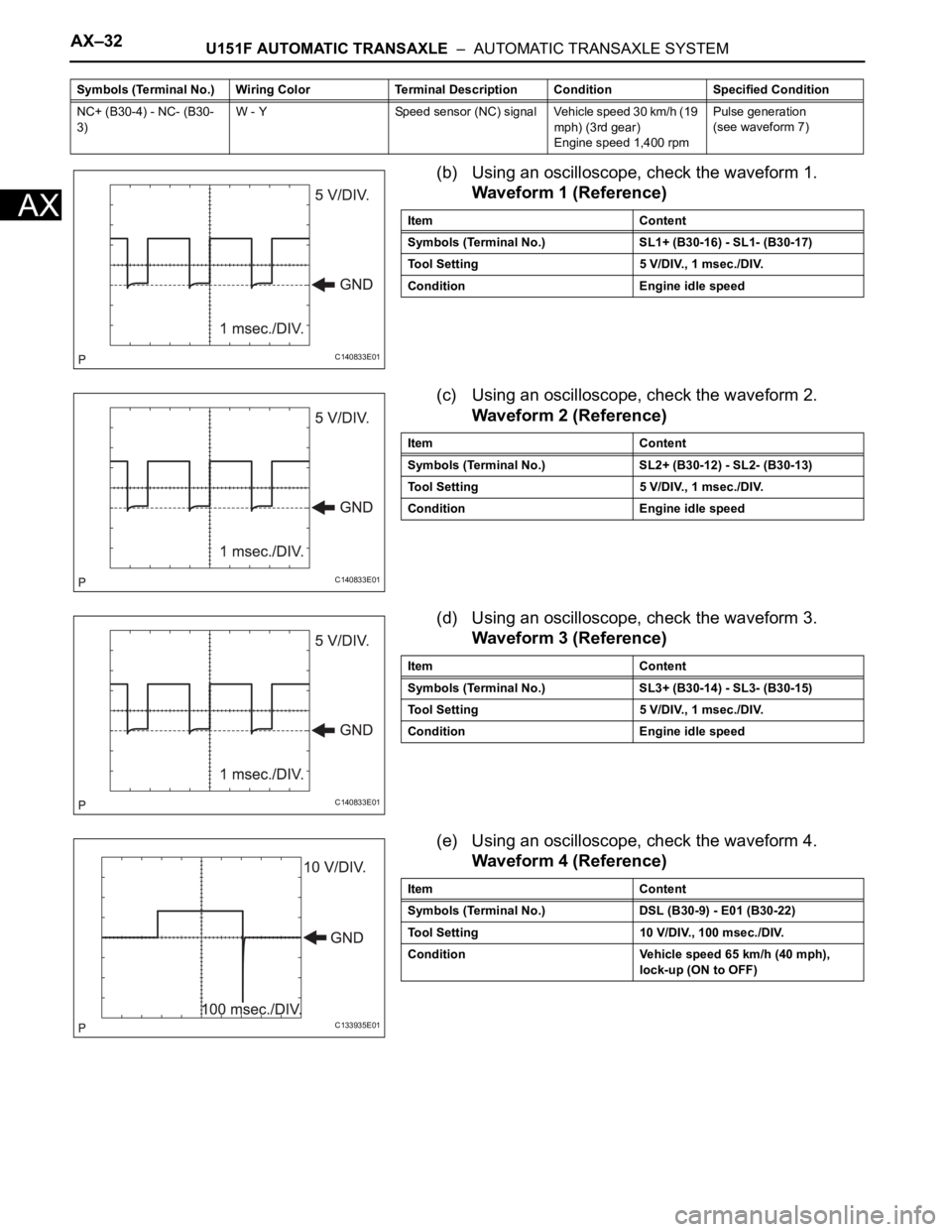
(b) Using an oscilloscope, check the waveform 1.
Waveform 1 (Reference)
(c) Using an oscilloscope, check the waveform 2.
Waveform 2 (Reference)
(d) Using an oscilloscope, check the waveform 3.
Waveform 3 (Reference)
(e) Using an oscilloscope, check the waveform 4.
Waveform 4 (Reference)
NC+ (B30-4) - NC- (B30-
3)W - Y Speed sensor (NC) signal Vehicle speed 30 km/h (19
mph) (3rd gear)
Engine speed 1,400 rpmPulse generation
(see waveform 7) Symbols (Terminal No.) Wiring Color Terminal Description ConditionSpecified Condition
C140833E01
Item Content
Symbols (Terminal No.) SL1+ (B30-16) - SL1- (B30-17)
Tool Setting 5 V/DIV., 1 msec./DIV.
Condition Engine idle speed
C140833E01
Item Content
Symbols (Terminal No.) SL2+ (B30-12) - SL2- (B30-13)
Tool Setting 5 V/DIV., 1 msec./DIV.
Condition Engine idle speed
C140833E01
Item Content
Symbols (Terminal No.) SL3+ (B30-14) - SL3- (B30-15)
Tool Setting 5 V/DIV., 1 msec./DIV.
Condition Engine idle speed
C133935E01
Item Content
Symbols (Terminal No.) DSL (B30-9) - E01 (B30-22)
Tool Setting 10 V/DIV., 100 msec./DIV.
Condition Vehicle speed 65 km/h (40 mph),
lock-up (ON to OFF)