engine TOYOTA RAV4 2006 Service Repair Manual
[x] Cancel search | Manufacturer: TOYOTA, Model Year: 2006, Model line: RAV4, Model: TOYOTA RAV4 2006Pages: 2000, PDF Size: 45.84 MB
Page 977 of 2000
U140F AUTOMATIC TRANSAXLE – DIFFERENTIAL OIL SEALAX–145
AX
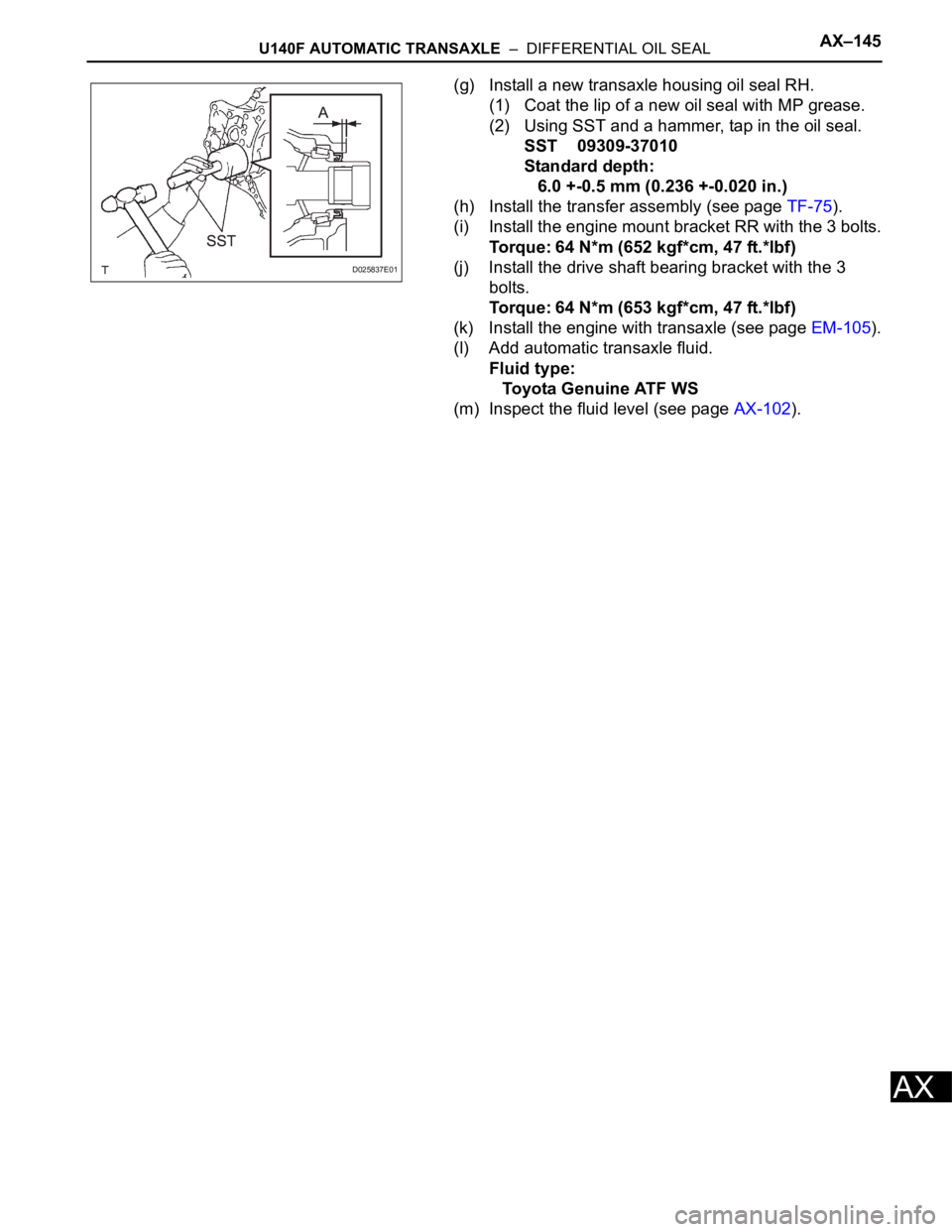
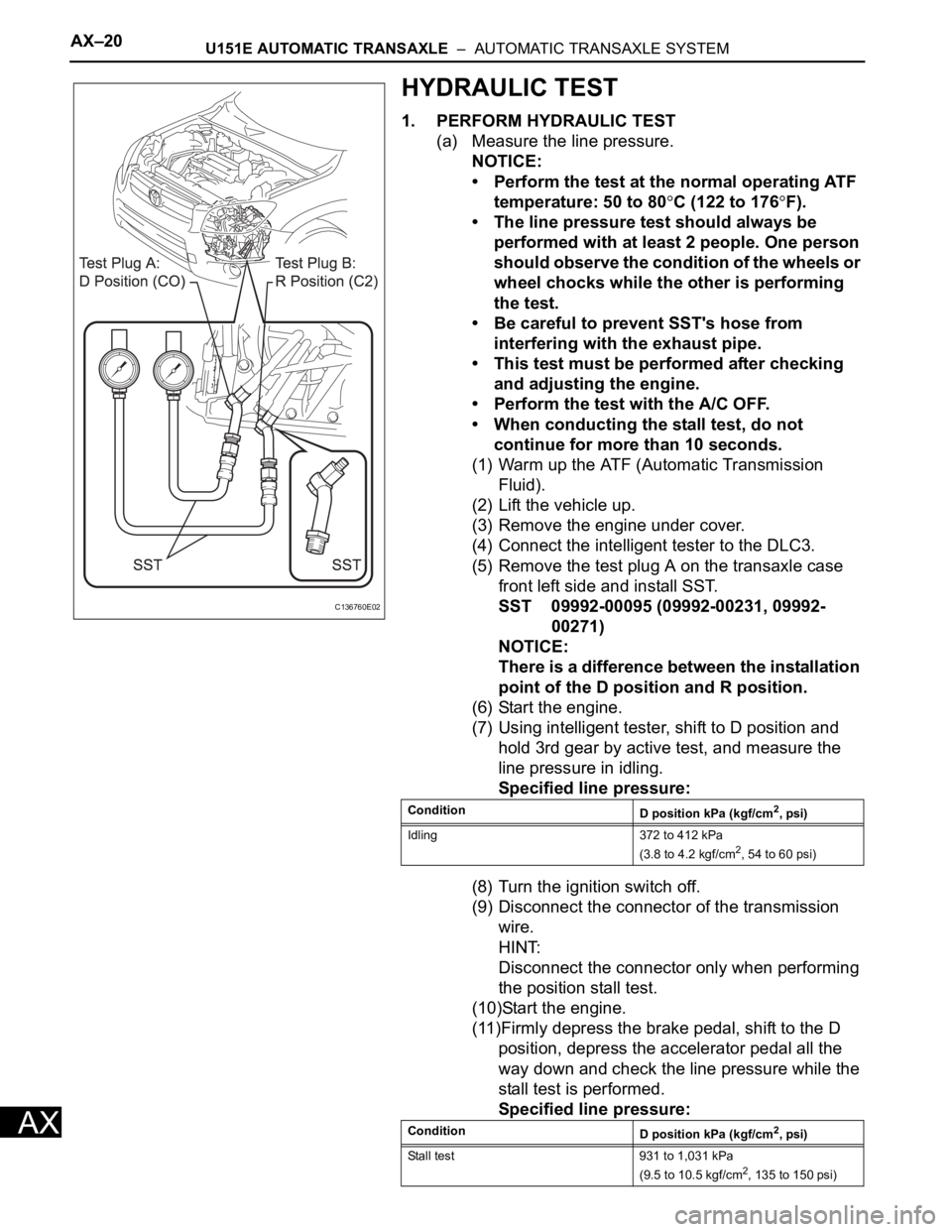
(g) Install a new transaxle housing oil seal RH.
(1) Coat the lip of a new oil seal with MP grease.
(2) Using SST and a hammer, tap in the oil seal.
SST 09309-37010
Standard depth:
6.0 +-0.5 mm (0.236 +-0.020 in.)
(h) Install the transfer assembly (see page TF-75).
(i) Install the engine mount bracket RR with the 3 bolts.
Torque: 64 N*m (652 kgf*cm, 47 ft.*lbf)
(j) Install the drive shaft bearing bracket with the 3
bolts.
Torque: 64 N*m (653 kgf*cm, 47 ft.*lbf)
(k) Install the engine with transaxle (see page EM-105).
(l) Add automatic transaxle fluid.
Fluid type:
Toyota Genuine ATF WS
(m) Inspect the fluid level (see page AX-102).
D025837E01
Page 979 of 2000
U140F AUTOMATIC TRANSAXLE – AUTOMATIC TRANSAXLE ASSEMBLYAX–151
AX
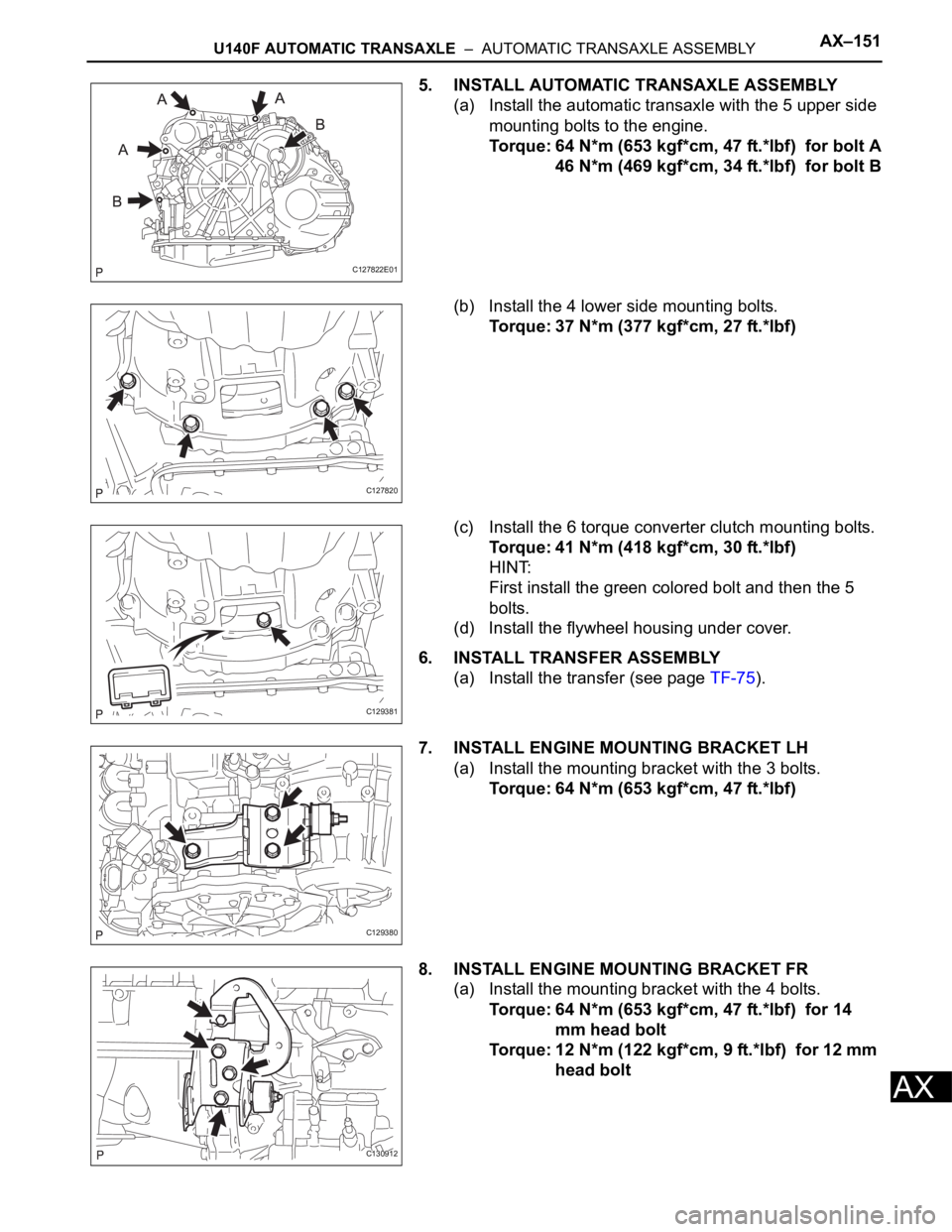
5. INSTALL AUTOMATIC TRANSAXLE ASSEMBLY
(a) Install the automatic transaxle with the 5 upper side
mounting bolts to the engine.
Torque: 64 N*m (653 kgf*cm, 47 ft.*lbf) for bolt A
46 N*m (469 kgf*cm, 34 ft.*lbf) for bolt B
(b) Install the 4 lower side mounting bolts.
Torque: 37 N*m (377 kgf*cm, 27 ft.*lbf)
(c) Install the 6 torque converter clutch mounting bolts.
Torque: 41 N*m (418 kgf*cm, 30 ft.*lbf)
HINT:
First install the green colored bolt and then the 5
bolts.
(d) Install the flywheel housing under cover.
6. INSTALL TRANSFER ASSEMBLY
(a) Install the transfer (see page TF-75).
7. INSTALL ENGINE MOUNTING BRACKET LH
(a) Install the mounting bracket with the 3 bolts.
Torque: 64 N*m (653 kgf*cm, 47 ft.*lbf)
8. INSTALL ENGINE MOUNTING BRACKET FR
(a) Install the mounting bracket with the 4 bolts.
Torque: 64 N*m (653 kgf*cm, 47 ft.*lbf) for 14
mm head bolt
Torque: 12 N*m (122 kgf*cm, 9 ft.*lbf) for 12 mm
head bolt
C127822E01
C127820
C129381
C129380
C130912
Page 980 of 2000
AX–152U140F AUTOMATIC TRANSAXLE – AUTOMATIC TRANSAXLE ASSEMBLY
AX
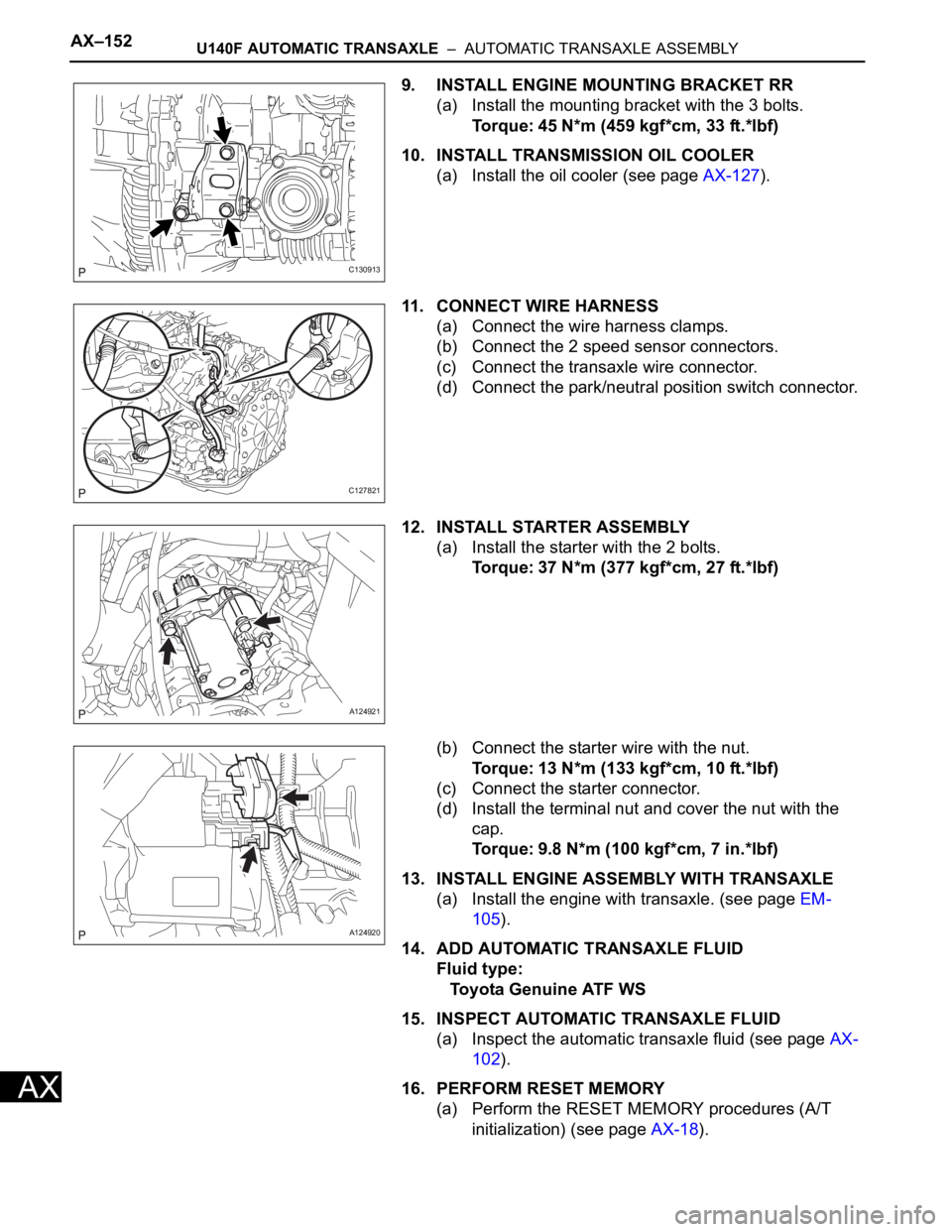
9. INSTALL ENGINE MOUNTING BRACKET RR
(a) Install the mounting bracket with the 3 bolts.
Torque: 45 N*m (459 kgf*cm, 33 ft.*lbf)
10. INSTALL TRANSMISSION OIL COOLER
(a) Install the oil cooler (see page AX-127).
11. CONNECT WIRE HARNESS
(a) Connect the wire harness clamps.
(b) Connect the 2 speed sensor connectors.
(c) Connect the transaxle wire connector.
(d) Connect the park/neutral position switch connector.
12. INSTALL STARTER ASSEMBLY
(a) Install the starter with the 2 bolts.
Torque: 37 N*m (377 kgf*cm, 27 ft.*lbf)
(b) Connect the starter wire with the nut.
Torque: 13 N*m (133 kgf*cm, 10 ft.*lbf)
(c) Connect the starter connector.
(d) Install the terminal nut and cover the nut with the
cap.
Torque: 9.8 N*m (100 kgf*cm, 7 in.*lbf)
13. INSTALL ENGINE ASSEMBLY WITH TRANSAXLE
(a) Install the engine with transaxle. (see page EM-
105).
14. ADD AUTOMATIC TRANSAXLE FLUID
Fluid type:
Toyota Genuine ATF WS
15. INSPECT AUTOMATIC TRANSAXLE FLUID
(a) Inspect the automatic transaxle fluid (see page AX-
102).
16. PERFORM RESET MEMORY
(a) Perform the RESET MEMORY procedures (A/T
initialization) (see page AX-18).
C130913
C127821
A124921
A124920
Page 1026 of 2000

AX–10U151E AUTOMATIC TRANSAXLE – AUTOMATIC TRANSAXLE SYSTEM
AX
SYSTEM DESCRIPTION
1. SYSTEM DESCRIPTION
(a) The Electronic Controlled Automatic Transaxle
(ECT) is an automatic transaxle that electronically
controls shift timing using the Engine Control
Module (ECM). The ECM detects electrical signals
that indicate engine and driving conditions, and
controls the shift point based on driver habits and
road conditions. As a result, fuel efficiency and
power transaxle performance are improved.
Shift shock is reduced by controlling the engine and
transaxle simultaneously.
In addition, the ECT has the following features:
• Diagnostic function.
• Fail-safe function when a malfunction occurs.
Page 1031 of 2000

U151E AUTOMATIC TRANSAXLE – AUTOMATIC TRANSAXLE SYSTEMAX–15
AX
ROAD TEST
1. PROBLEM SYMPTOM CONFIRMATION
(a) Based on the result of the customer problem
analysis, try to reproduce the symptoms. If the
problem is that the transaxle does not shift up, shift
down, or the shift point is too high or too low,
conduct the following road test referring to the
automatic shift schedule and simulate the problem
symptoms.
2. ROAD TEST
NOTICE:
Perform the test at the normal operating ATF
temperature of 50 to 80
C (122 to 176F).
(a) D position test:
Move the shift lever to D and fully depress the
accelerator pedal. Check the following:
(1) Check up-shift operation.
Check that the 1
2, 2 3, 3 4 and 4 5th
up-shifts take place at the shift point shown in
the automatic shift schedule (see page SS-43).
HINT:
5th Gear Up-shift Prohibition Control
• Engine coolant temperature is 55
C (131F)
or less and vehicle speed is at 80 km/h (50
mph) or less.
• ATF temperature is -2
C (28F) or less.
4th Gear Up-shift Prohibition Control
• Engine coolant temperature is 47
C (117F)
or less and vehicle speed is at 55 km/h (34
mph) or less.
5th and 4th Gear Lock-up Prohibition Control
• Brake pedal is depressed.
• Accelerator pedal is released.
• Engine coolant temperature is 60
C (140F)
or less.
(2) Check for shift shock and slip.
Check for shock and slip at the 1
2, 2 3, 3
4 and 4 5th up-shifts.
(3) Check for abnormal noise and vibration.
Check for abnormal noise and vibration when
up-shifting from 1
2, 2 3, 3 4 and 4
5th while driving with the shift lever on D, and
check while driving in the lock-up condition.
HINT:
The check for the cause of abnormal noise and
vibration must be done thoroughly as it could
also be due to loss of balance in the differential,
torque converter clutch, etc.
Page 1032 of 2000
AX–16U151E AUTOMATIC TRANSAXLE – AUTOMATIC TRANSAXLE SYSTEM
AX
(4) Check kick-down operation.
While driving the vehicle in the 2nd, 3rd, 4th and
5th gears with the shift lever on D, check that the
possible kick-down vehicle speed limits for 2
1, 3
2, 4 3 and 5 4 kick-downs conform
to those indicated in the automatic shift schedule
(see page SS-43).
(5) Check for abnormal shock and slip at kick-down.
(6) Check the lock-up mechanism.
• Drive the vehicle in the 5th gear with the shift
lever on D. Maintain a steady speed (lock-up
ON).
• Lightly depress the accelerator pedal and
check that the engine speed does not change
abruptly.
HINT:
• There is no lock-up in the 1st, 2nd and 3rd
gear.
• 4th lock-up operates while uphill-downhill
control is active with the shift lever on D.
• If there is a sudden increase in engine speed,
there is no lock-up.
(b) 4 (O/D OFF) position test:
Move the shift lever to 4 and fully depress the
accelerator pedal. Check the following:
(1) Check up-shift operation.
Check that the 1
2, 2 3 and 3 4 up-shifts
take place and that the shifts point conforms to
the automatic shift schedule (see page SS-43).
HINT:
There is no 5th up-shift in the 4 position.
(2) Check engine braking.
While driving the vehicle in the 4th gear with the
shift lever on 4, release the accelerator pedal
and check the engine braking effect.
(3) Check for abnormal noise during acceleration
and deceleration, and for shock at up-shift and
down-shift.
(c) 3 position test:
Move the shift lever to 3 and fully depress the
accelerator pedal. Check the following:
(1) Check up-shift operation.
Check that the 1
2 and 2 3 up-shifts take
place and that the shifts point conforms to the
automatic shift schedule (see page SS-43).
HINT:
There is no 3rd up-shift and lock-up in the 3
position.
(2) Check engine braking.
While driving the vehicle in the 3rd gear with the
shift lever on 3, release the accelerator pedal
and check the engine braking effect.
Page 1033 of 2000

U151E AUTOMATIC TRANSAXLE – AUTOMATIC TRANSAXLE SYSTEMAX–17
AX
(3) Check for abnormal noise during acceleration
and deceleration, and for shock at up-shift and
down-shift.
(d) 2 position test:
Move the shift lever to 2 and fully depress the
accelerator pedal. Check the following:
(1) Check up-shift operation.
Check that the 1
2 up-shifts take place and
that the shift point conforms to the automatic
shift schedule (see page SS-43).
HINT:
There is no 3rd up-shift and lock-up when the
shift lever is on 2.
(2) Check engine braking.
While driving the vehicle in the 2nd gear with the
shift lever on 2, release the accelerator pedal
and check the engine braking effect.
(3) Check for abnormal noise during acceleration
and deceleration, and for shock at up-shift and
down-shift.
(e) L position test:
Move the shift lever to L and fully depress the
accelerator pedal. Check the following:
(1) Check no up-shift.
While driving the vehicle with the shift lever on L,
check that there is no up-shift to 2nd gear.
HINT:
There is no lock-up in L.
(2) Check engine braking.
While driving the vehicle with the shift lever on L,
release the accelerator pedal and check the
engine braking effect.
(3) Check for abnormal noises during acceleration
and deceleration.
(f) R position test:
Move the shift lever to R and lightly depress the
accelerator pedal. Check that the vehicle moves
backward without any abnormal noise or vibration.
CAUTION:
Before conducting this test, ensure that no
people or obstacles are in the test area.
(g) P position test:
Stop the vehicle on an incline (more than 5
). Then
move the shift lever to P and release the parking
brake. Check that the parking lock pawl holds the
vehicle in place.
(h) Uphill/downhill control function test:
(1) Check that the gear does not up-shift to the 4th
or 5th gear while the vehicle is driving uphill.
(2) Check that the gear automatically down-shifts
from 5
4 or from 4 3 when the brake is
applied while the vehicle is driving downhill.
Page 1034 of 2000

AX–18U151E AUTOMATIC TRANSAXLE – AUTOMATIC TRANSAXLE SYSTEM
AX
MECHANICAL SYSTEM TESTS
1. STALL SPEED TEST
HINT:
This test is to check the overall performance of the
engine and transaxle.
NOTICE:
• Do not perform the stall speed test longer than 10
seconds.
• To ensure safety, perform this test in an open and
level area that provides good traction.
• The stall speed test should always be performed
with at least 2 people. One person should observe
the condition of the wheels and wheel chocks
while the other is performing the test.
(a) Connect the intelligent tester to the CAN VIM. Then
connect the CAN VIM to the DLC3.
(b) Run the vehicle until the transmission fluid
temperature has reached 50 to 80
C (122 to 176F).
(c) Allow the engine to idle with the air conditioning
OFF.
(d) Chock all 4 wheels.
(e) Set the parking brake and keep the brake pedal
depressed firmly with your left foot.
(f) Move the shift lever to the D position.
(g) Depress the accelerator pedal as much as possible
with your right foot.
(h) Read the engine rpm (stall speed) and release the
accelerator pedal immediately.
Standard value:
2,030 to 2,330 rpm
Evaluation:
NOTICE:
Perform the test at the normal operating ATF
temperature of 50 to 80
C (122 to 176F).
2. SHIFT TIME LAG TEST
HINT:
This test is to check the condition of the direct clutch,
forward clutch, 1st brake and reverse brake.
(a) Connect the intelligent tester to the CAN VIM. Then
connect the CAN VIM to the DLC3.
(b) Run the vehicle until the transmission fluid
temperature has reached 50 to 80
C (122 to 176F).
Test Result Possible Cause
Stall speed is lower than standard value • Engine power output may be insufficient
• Stator one-way clutch not operating properly
HINT:
If the value is less than the specified value by 600 rpm or more, the
torque converter could be faulty.
Stall speed is higher than standard value • Line pressure is too low
• Forward clutch slipping
• U/D (underdrive) brake slipping
• U/D (underdrive) one-way clutch is not operating properly
• No. 1 one-way clutch not operating properly
• Improper fluid level
Page 1035 of 2000

U151E AUTOMATIC TRANSAXLE – AUTOMATIC TRANSAXLE SYSTEMAX–19
AX
(c) Allow the engine to idle with the air conditioning
OFF.
(d) Set the parking brake and keep the brake pedal
depressed firmly.
(e) Check the D range time lag.
(1) Move the shift lever to N and wait for 1 minute.
(2) Move the shift lever to D and measure the time
until the shock is felt.
(3) Repeat the 2 procedures above 3 times, and
calculate the average time of the 3 tests.
(f) Check the R range time lag.
(1) Move the shift lever to N and wait for 1 minute.
(2) Move the shift lever to R and measure the time
until the shock is felt.
(3) Repeat the 2 procedures above 3 times, and
calculate the average time of the 3 tests.
Standard value:
D range time lag is less than 1.2 seconds
R range time lag is less than 1.5 seconds
Evaluation:
Test Result Possible Cause
D range time lag exceeds standard value • Line pressure is too low
• Forward clutch worn
• No. 1 one-way clutch is not operating properly
• U/D (underdrive) one-way clutch is not operating
• U/D (underdrive) brake worn
R range time lag exceeds standard value • Line pressure is too low
• Reverse clutch worn
• 1st and reverse brake worn
• U/D (underdrive) brake worn
Page 1036 of 2000
AX–20U151E AUTOMATIC TRANSAXLE – AUTOMATIC TRANSAXLE SYSTEM
AX
HYDRAULIC TEST
1. PERFORM HYDRAULIC TEST
(a) Measure the line pressure.
NOTICE:
• Perform the test at the normal operating ATF
temperature: 50 to 80
C (122 to 176F).
• The line pressure test should always be
performed with at least 2 people. One person
should observe the condition of the wheels or
wheel chocks while the other is performing
the test.
• Be careful to prevent SST's hose from
interfering with the exhaust pipe.
• This test must be performed after checking
and adjusting the engine.
• Perform the test with the A/C OFF.
• When conducting the stall test, do not
continue for more than 10 seconds.
(1) Warm up the ATF (Automatic Transmission
Fluid).
(2) Lift the vehicle up.
(3) Remove the engine under cover.
(4) Connect the intelligent tester to the DLC3.
(5) Remove the test plug A on the transaxle case
front left side and install SST.
SST 09992-00095 (09992-00231, 09992-
00271)
NOTICE:
There is a difference between the installation
point of the D position and R position.
(6) Start the engine.
(7) Using intelligent tester, shift to D position and
hold 3rd gear by active test, and measure the
line pressure in idling.
Specified line pressure:
(8) Turn the ignition switch off.
(9) Disconnect the connector of the transmission
wire.
HINT:
Disconnect the connector only when performing
the position stall test.
(10)Start the engine.
(11)Firmly depress the brake pedal, shift to the D
position, depress the accelerator pedal all the
way down and check the line pressure while the
stall test is performed.
Specified line pressure:
C136760E02
Condition
D position kPa (kgf/cm2, psi)
Idling 372 to 412 kPa
(3.8 to 4.2 kgf/cm
2, 54 to 60 psi)
Condition
D position kPa (kgf/cm
2, psi)
Stall test 931 to 1,031 kPa
(9.5 to 10.5 kgf/cm
2, 135 to 150 psi)