engine TOYOTA RAV4 2006 Service Repair Manual
[x] Cancel search | Manufacturer: TOYOTA, Model Year: 2006, Model line: RAV4, Model: TOYOTA RAV4 2006Pages: 2000, PDF Size: 45.84 MB
Page 1824 of 2000
CRUISE CONTROL – CRUISE CONTROL SYSTEMCC–25
CC
INSPECTION PROCEDURE
(a) Check the DATA LIST for proper functioning of the stop
light switch.
ECM
OK:
Display changes according to brake pedal
operation described in above table.
NG
OK
(a) Remove the STOP and IGN fuses from the instrument
panel junction block.
(b) Remove the IG2 fuse from the engine room No. 1 relay
block.
(c) Measure the resistance of the fuses.
Standard resistance:
Below 1
NG
OK
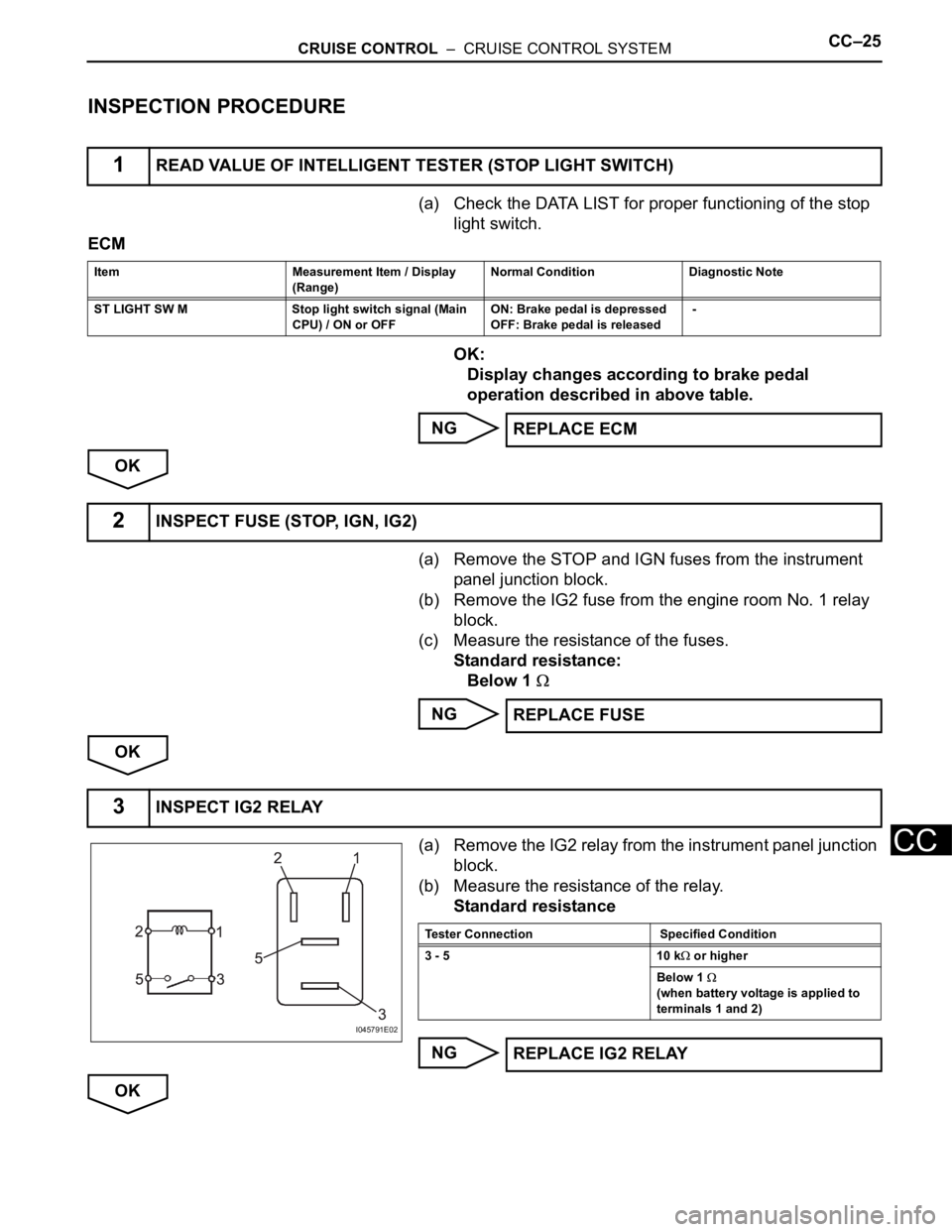
(a) Remove the IG2 relay from the instrument panel junction
block.
(b) Measure the resistance of the relay.
Standard resistance
NG
OK
1READ VALUE OF INTELLIGENT TESTER (STOP LIGHT SWITCH)
Item Measurement Item / Display
(Range) Normal Condition Diagnostic Note
ST LIGHT SW M Stop light switch signal (Main
CPU) / ON or OFF ON: Brake pedal is depressed
OFF: Brake pedal is released -
REPLACE ECM
2INSPECT FUSE (STOP, IGN, IG2)
REPLACE FUSE
3INSPECT IG2 RELAY
I045791E02
Tester Connection Specified Condition
3 - 5 10 k
or higher
Below 1
(when battery voltage is applied to
terminals 1 and 2)
REPLACE IG2 RELAY
Page 1838 of 2000

LIGHTING – LIGHTING SYSTEMLI–7
LI
SYSTEM DESCRIPTION
1. LIGHTING SYSTEM
(a) Illumination control system (Illuminated entry
system):
When the doors are unlocked by a key or
transmitter operation, or when a door is opened or
closed, the illuminated entry system turns on the
room light, map light, foot light and ignition key
cylinder light*1 or transponder key amplifier*2.
(1) The main body ECU receives the following
signals (A).
• Door courtesy switch signal
• Door detection switch signal
• Ignition switch signal
(2) The main body ECU controls the following signal
based on the signals listed in A.
• Illumination operation signal
(3) The main body ECU controls the on/off and
fade-in/fade-out operation of the following parts.
•Room light
• Map light
•Foot light
• Ignition key cylinder light*1 or transponder
key amplifier*2
HINT:
*1: w/o Engine immobiliser system
*2: w/ Engine immobiliser system
(b) Battery saver system:
When the ignition switch is turned off and any of the
doors is open continuously for 20 minutes, the main
body ECU turns the illumination operation signal off.
As a result, the room light, map light, foot light and
ignition key cylinder lights*1 or transponder key
amplifier*2 turn off.
HINT:
*1: w/o Engine immobiliser system
*2: w/ Engine immobiliser system
(1) The main body ECU receives the following
signals (B).
• Door courtesy switch signal
• Ignition switch signal
(2) The main body ECU controls the following signal
based on the signals listed in B (C).
• Illumination operation signal
(3) The main body ECU controls the illumination
period of the following parts based on the
signals listed in C.
•Room light
• Map light
•Foot light
• Ignition key cylinder light*1 or transponder
key amplifier*2
HINT:
*1: w/o Engine immobiliser system
Page 1839 of 2000

LI–8LIGHTING – LIGHTING SYSTEM
LI
*2: w/ Engine immobiliser system
(c) Manual light control system:
This system functions when lights such as the
headlights and taillights are illuminated by manual
operation of the light control switch.
(1) The main body ECU receives the following
signals (D).
• Light control switch signal
• Headlight dimmer switch signal
• Front fog light switch signal
(2) The main body ECU controls the following
signals based on the signals listed in D (E).
• Headlight relay operation signal
• Taillight relay operation signal
• Daytime running light No. 2 relay operation
signal
• Daytime running light No. 3 relay operation
signal
• Daytime running light No. 4 relay operation
signal
• Front fog light relay operation signal
(3) The main body ECU controls the on/off
operation of the following parts based on the
signals listed in E.
• Headlight (LOW)
• Headlight (HIGH)
• Side marker light (front and rear)
• Front fog light
(d) Light auto turn off system:
When the headlights and taillights are illuminated by
the operation of the light control switch, if the
ignition switch is turned OFF, this system continues
illuminating the headlights and taillights for
approximately 30 seconds, and then turns off the
lights. However, when all the doors are locked
manually, using the door lock button, using the key
or pressing LOCK on the transmitter turns the
headlights and taillights off immediately.
(1) The main body ECU receives the following
signals (F).
• Door courtesy switch signal
• Ignition switch signal
(2) The main body ECU controls the following
signals based on the signals listed in F (G).
• Headlight relay operation signal
• Taillight relay operation signal
• Daytime running light No. 2 relay operation
signal
• Daytime running light No. 3 relay operation
signal
• Daytime running light No. 4 relay operation
signal
• Front fog light relay operation signal
Page 1840 of 2000

LIGHTING – LIGHTING SYSTEMLI–9
LI
(3) The main body ECU controls the illumination
period of the following parts based on the
signals listed in G.
• Headlight (LOW)
• Headlight (HIGH)
• Side marker light (front and rear)
• Front fog light
(e) Daytime running light system:
This system is directly connected to the high-beam
headlights and is designed to automatically activate
the daytime running lights in order to increase the
visibility of the vehicle.
(1) The main body ECU receives the following (H).
• Ignition switch signal
• Engine speed
• Parking brake switch signal
• Light control switch signal
(2) The main body ECU controls the following signal
based on the signals listed in H (I).
• Daytime running light No. 2 relay operation
signal
(3) The main body ECU controls the on/off
operation of the following part based on the
signal listed in I.
• Headlight (HIGH)
Page 1842 of 2000

LIGHTING – LIGHTING SYSTEMLI–11
LI
OPERATION CHECK
1. ILLUMINATED ENTRY SYSTEM OPERATION CHECK
(a) The illuminated entry system controls the following
lights:
• Ignition key cylinder light*1 or transponder key
amplifier*2
• Foot light
• Map light and room light
HINT:
*1: w/o Engine immobiliser system
*2: w/ Engine immobiliser system
(b) Check that the lights come on when unlocking any
of the doors that are closed and locked with the
ignition switch OFF. Then check that the lights fade
out under the following conditions:
(1) Leave the doors unlocked for 15 seconds.
(2) Turn the ignition switch ACC or ON.
(3) Lock all the doors.
(c) Check that the lights stay on for at least 15 seconds
after opening any of the doors before fading out.
Then check that the lights fade out 15 seconds after
closing all the doors.
(d) Check that the lights stay lit after turning the ignition
switch OFF with all the doors closed and the ignition
switch in the ACC or ON position. Then check that
the lights fade out under the following conditions:
(1) Leave the doors unlocked for 15 seconds.
(2) Turn the ignition switch ACC or ON.
(3) Lock all the doors.
(e) Check that the lights stay on for at least 15 seconds
after opening any of the doors. Then check that the
lights fade out 15 seconds after closing all the
doors.
(f) Check that the lights come on when opening any of
the doors and fade out when closing and locking all
the doors or turning the ignition switch to the ACC or
ON position.
2. FOOT LIGHT OPERATION CHECK
(a) Check that the lights come on when unlocking any
of the doors that are closed and locked with the
ignition switch OFF. Then check that the lights fade
out under the following conditions:
(1) Leave the doors unlocked for 15 seconds.
(2) Lock all the closed doors and turn the ignition
switch OFF.
(b) Check that the lights stay on for at least 15 seconds
under the following conditions before going off.
(1) Turn the ignition switch to the ON position, and
move the shift lever to the P position.
(2) Open any of the doors.
(c) Check that the lights dim before going off when
turning the ignition switch ON and shifting the shift
lever into any position other than P.
Page 1843 of 2000

LI–12LIGHTING – LIGHTING SYSTEM
LI
(d) Check the conditions below before the lights go off.
(1) The lights dim when shifting the shift lever into a
position other than P and closing all the doors
with the ignition switch ON.
(2) The lights come on for 15 seconds and fade out
when shifting the shift lever into the P position
and closing all the doors with the ignition switch
OFF.
(e) Check that the lights come on after opening any of
the doors.
(f) Check that the lights fade out 15 seconds after
closing all the doors, or locking all the doors.
(g) Check that the lights come on gradually with the
ignition switch ON and the shift lever in the P
position.
(h) Check that the lights dim when shifting the shift
lever from P into another position with all the doors
closed.
(i) Check that the lights stay dimmed with the ignition
switch ON and the shift lever in a position other than
P.
3. BATTERY SAVER OPERATION CHECK
(a) Turn the ignition switch OFF and close all the doors.
(b) Open any door to turn the room light on, and leave it
open. Check that the light goes off after about 20
minutes.
(c) After the room light goes off, close the driver's door.
(d) Open any door to turn the room light on, and then
open another door. Check that the room light goes
off within 20 minutes after opening the doors.
(e) Close all the doors. Open any door to turn the room
light on. Check that the room light goes off within 20
minutes.
4. LIGHT AUTO TURN OFF OPERATION CHECK
(a) Turn the ignition switch ON, and turn the light
control switch to the TAIL or HEAD position.
(b) Turn the ignition switch OFF and open the driver's
door, and check that the headlights go off after
about 30 seconds.
(c) Turn the ignition switch to the ON position, and turn
the light control switch to the TAIL or HEAD position.
(d) Turn the ignition switch OFF and open the driver's
door. Before the headlight goes off after about 30
seconds, lock all the doors and press the LOCK
switch on the wireless transmitter. Check that the
headlights go off immediately.
5. DAYTIME RUNNING LIGHT OPERATION CHECK
(a) Check that the headlights come on when the light
control switch is off with the engine running and the
parking brake released. Then check that the lights
go off under the following conditions:
(1) Turn the light control switch to the TAIL or HEAD
position.
Page 1858 of 2000
LIGHTING – LIGHTING SYSTEMLI–27
LI
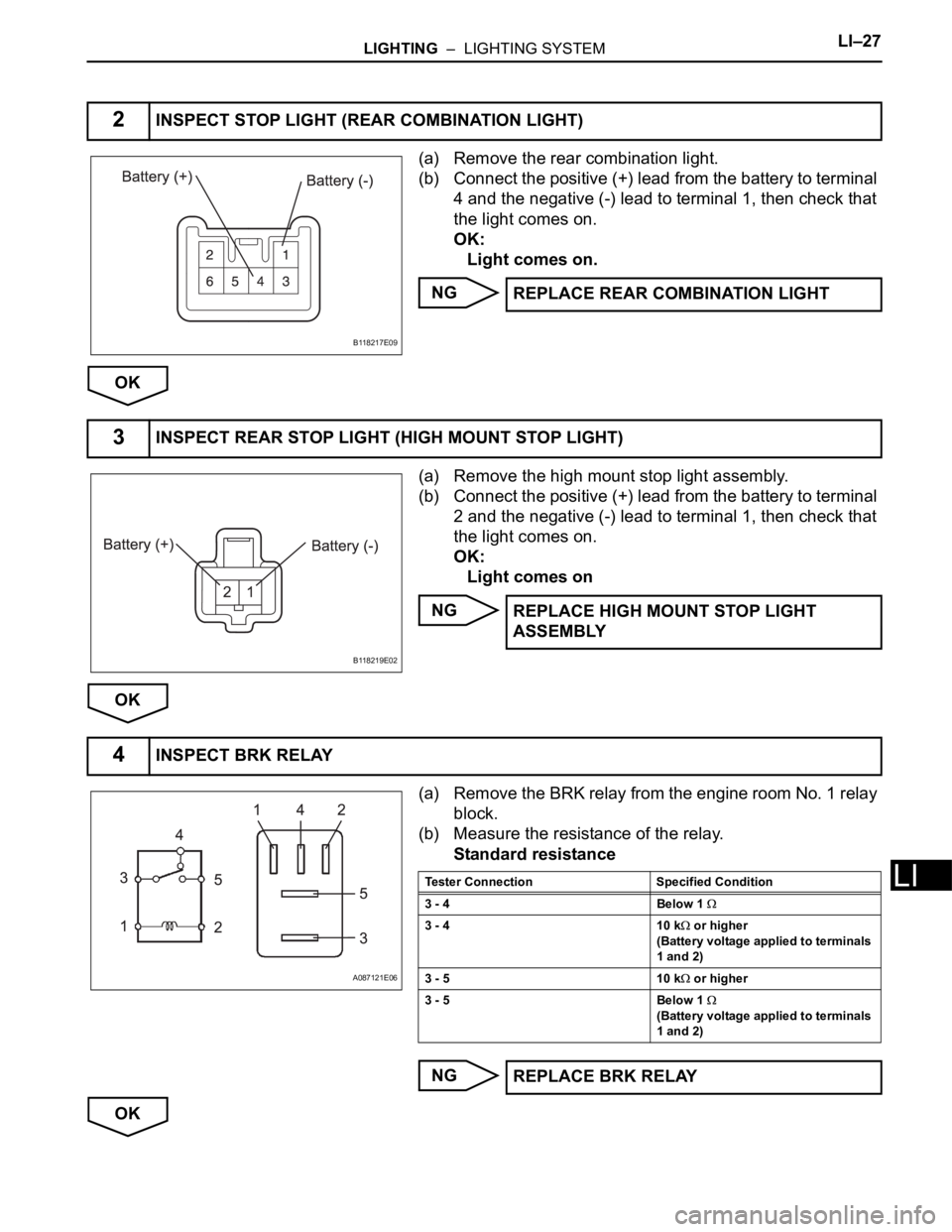
(a) Remove the rear combination light.
(b) Connect the positive (+) lead from the battery to terminal
4 and the negative (-) lead to terminal 1, then check that
the light comes on.
OK:
Light comes on.
NG
OK
(a) Remove the high mount stop light assembly.
(b) Connect the positive (+) lead from the battery to terminal
2 and the negative (-) lead to terminal 1, then check that
the light comes on.
OK:
Light comes on
NG
OK
(a) Remove the BRK relay from the engine room No. 1 relay
block.
(b) Measure the resistance of the relay.
Standard resistance
NG
OK
2INSPECT STOP LIGHT (REAR COMBINATION LIGHT)
B118217E09
REPLACE REAR COMBINATION LIGHT
3INSPECT REAR STOP LIGHT (HIGH MOUNT STOP LIGHT)
B118219E02
REPLACE HIGH MOUNT STOP LIGHT
ASSEMBLY
4INSPECT BRK RELAY
A087121E06
Tester Connection Specified Condition
3 - 4 Below 1
3 - 4 10 k or higher
(Battery voltage applied to terminals
1 and 2)
3 - 5 10 k
or higher
3 - 5 Below 1
(Battery voltage applied to terminals
1 and 2)
REPLACE BRK RELAY
Page 1862 of 2000
LIGHTING – LIGHTING SYSTEMLI–31
LI
Main body ECU
OK:
Headlight comes on
OK
NG
(a) Remove the HEAD LL fuse and HEAD RL fuse from the
engine room No. 2 relay block.
(b) Measure the resistance of the fuses.
Standard resistance:
Below 1
NG
OK
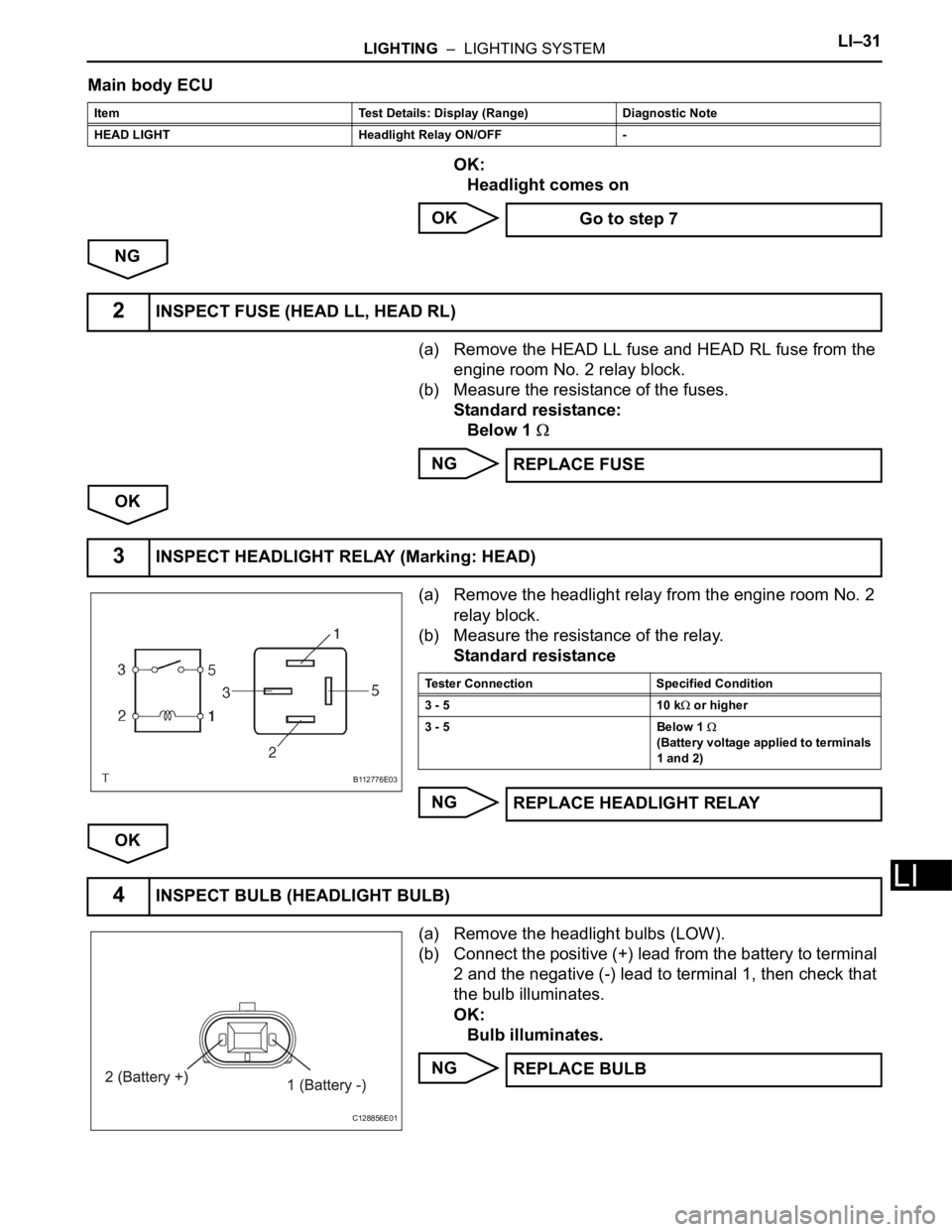
(a) Remove the headlight relay from the engine room No. 2
relay block.
(b) Measure the resistance of the relay.
Standard resistance
NG
OK
(a) Remove the headlight bulbs (LOW).
(b) Connect the positive (+) lead from the battery to terminal
2 and the negative (-) lead to terminal 1, then check that
the bulb illuminates.
OK:
Bulb illuminates.
NG
Item Test Details: Display (Range) Diagnostic Note
HEAD LIGHT Headlight Relay ON/OFF -
Go to step 7
2INSPECT FUSE (HEAD LL, HEAD RL)
REPLACE FUSE
3INSPECT HEADLIGHT RELAY (Marking: HEAD)
B112776E03
Tester Connection Specified Condition
3 - 5 10 k
or higher
3 - 5 Below 1
(Battery voltage applied to terminals
1 and 2)
REPLACE HEADLIGHT RELAY
4INSPECT BULB (HEADLIGHT BULB)
C128856E01
REPLACE BULB
Page 1867 of 2000
LI–36LIGHTING – LIGHTING SYSTEM
LI
INSPECTION PROCEDURE
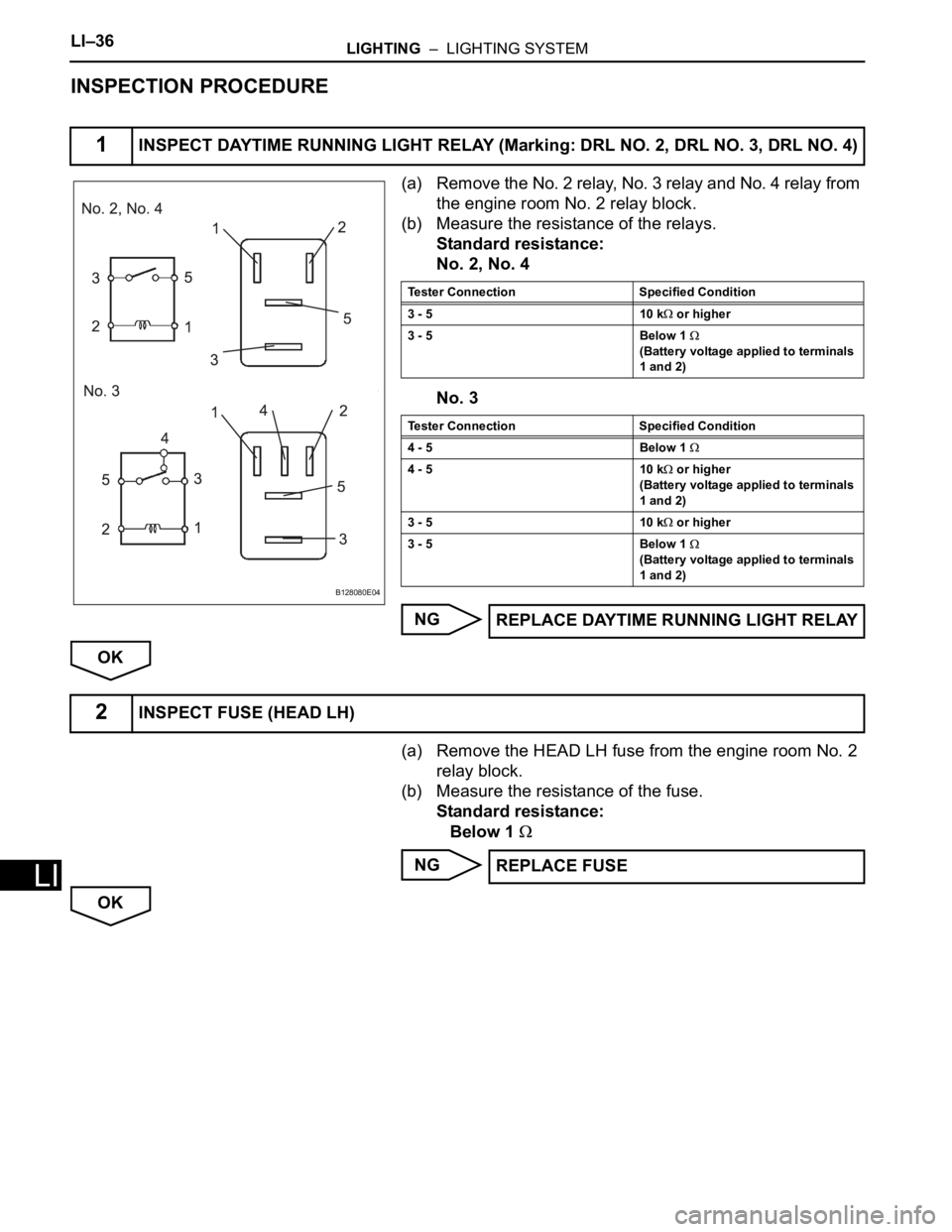
(a) Remove the No. 2 relay, No. 3 relay and No. 4 relay from
the engine room No. 2 relay block.
(b) Measure the resistance of the relays.
Standard resistance:
No. 2, No. 4
No. 3
NG
OK
(a) Remove the HEAD LH fuse from the engine room No. 2
relay block.
(b) Measure the resistance of the fuse.
Standard resistance:
Below 1
NG
OK
1INSPECT DAYTIME RUNNING LIGHT RELAY (Marking: DRL NO. 2, DRL NO. 3, DRL NO. 4)
B128080E04
Tester Connection Specified Condition
3 - 5 10 k
or higher
3 - 5 Below 1
(Battery voltage applied to terminals
1 and 2)
Tester Connection Specified Condition
4 - 5 Below 1
4 - 5 10 k or higher
(Battery voltage applied to terminals
1 and 2)
3 - 5 10 k
or higher
3 - 5 Below 1
(Battery voltage applied to terminals
1 and 2)
REPLACE DAYTIME RUNNING LIGHT RELAY
2INSPECT FUSE (HEAD LH)
REPLACE FUSE
Page 1868 of 2000
LIGHTING – LIGHTING SYSTEMLI–37
LI
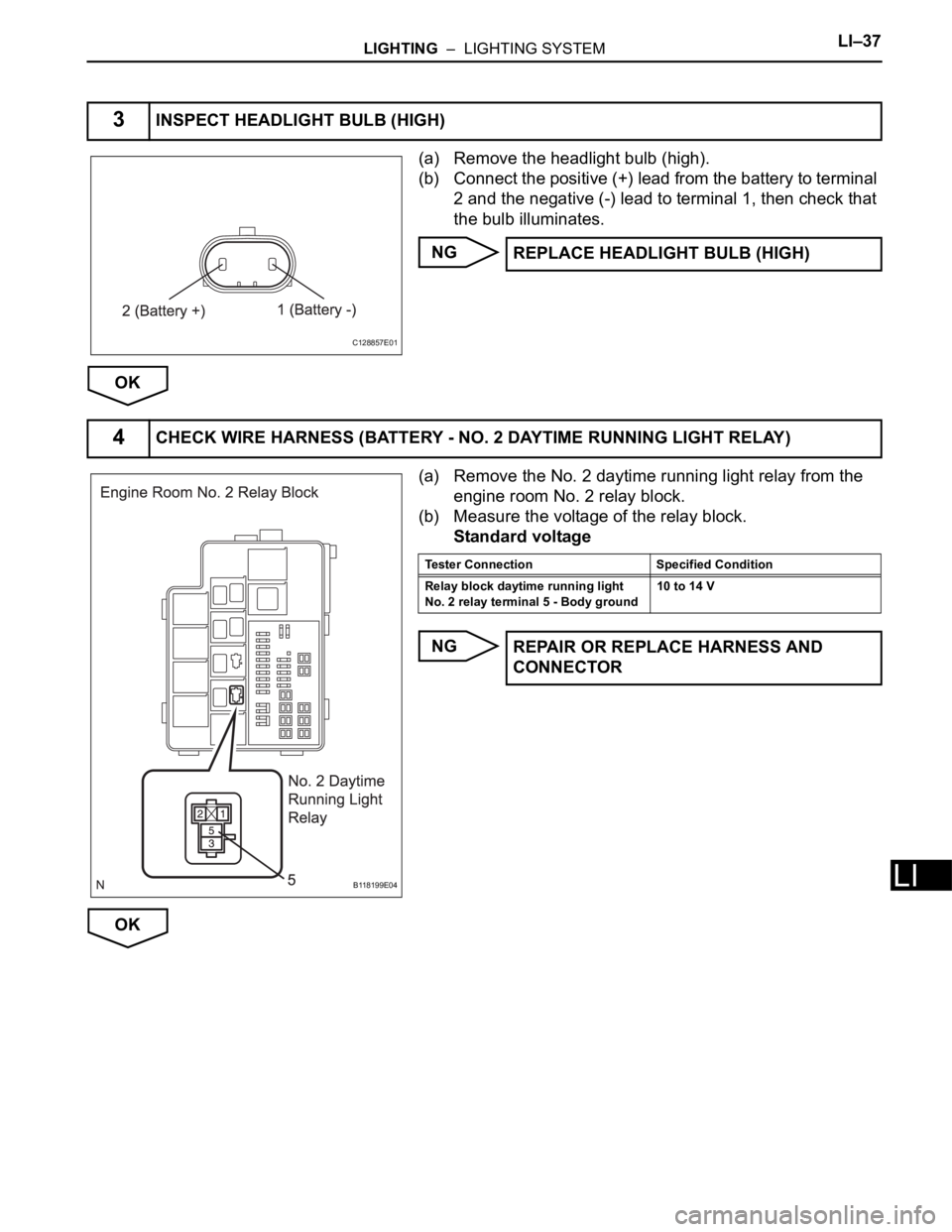
(a) Remove the headlight bulb (high).
(b) Connect the positive (+) lead from the battery to terminal
2 and the negative (-) lead to terminal 1, then check that
the bulb illuminates.
NG
OK
(a) Remove the No. 2 daytime running light relay from the
engine room No. 2 relay block.
(b) Measure the voltage of the relay block.
Standard voltage
NG
OK
3INSPECT HEADLIGHT BULB (HIGH)
C128857E01
REPLACE HEADLIGHT BULB (HIGH)
4CHECK WIRE HARNESS (BATTERY - NO. 2 DAYTIME RUNNING LIGHT RELAY)
B118199E04
Tester Connection Specified Condition
Relay block daytime running light
No. 2 relay terminal 5 - Body ground10 to 14 V
REPAIR OR REPLACE HARNESS AND
CONNECTOR