engine TOYOTA RAV4 2006 Service Repair Manual
[x] Cancel search | Manufacturer: TOYOTA, Model Year: 2006, Model line: RAV4, Model: TOYOTA RAV4 2006Pages: 2000, PDF Size: 45.84 MB
Page 1869 of 2000
LI–38LIGHTING – LIGHTING SYSTEM
LI
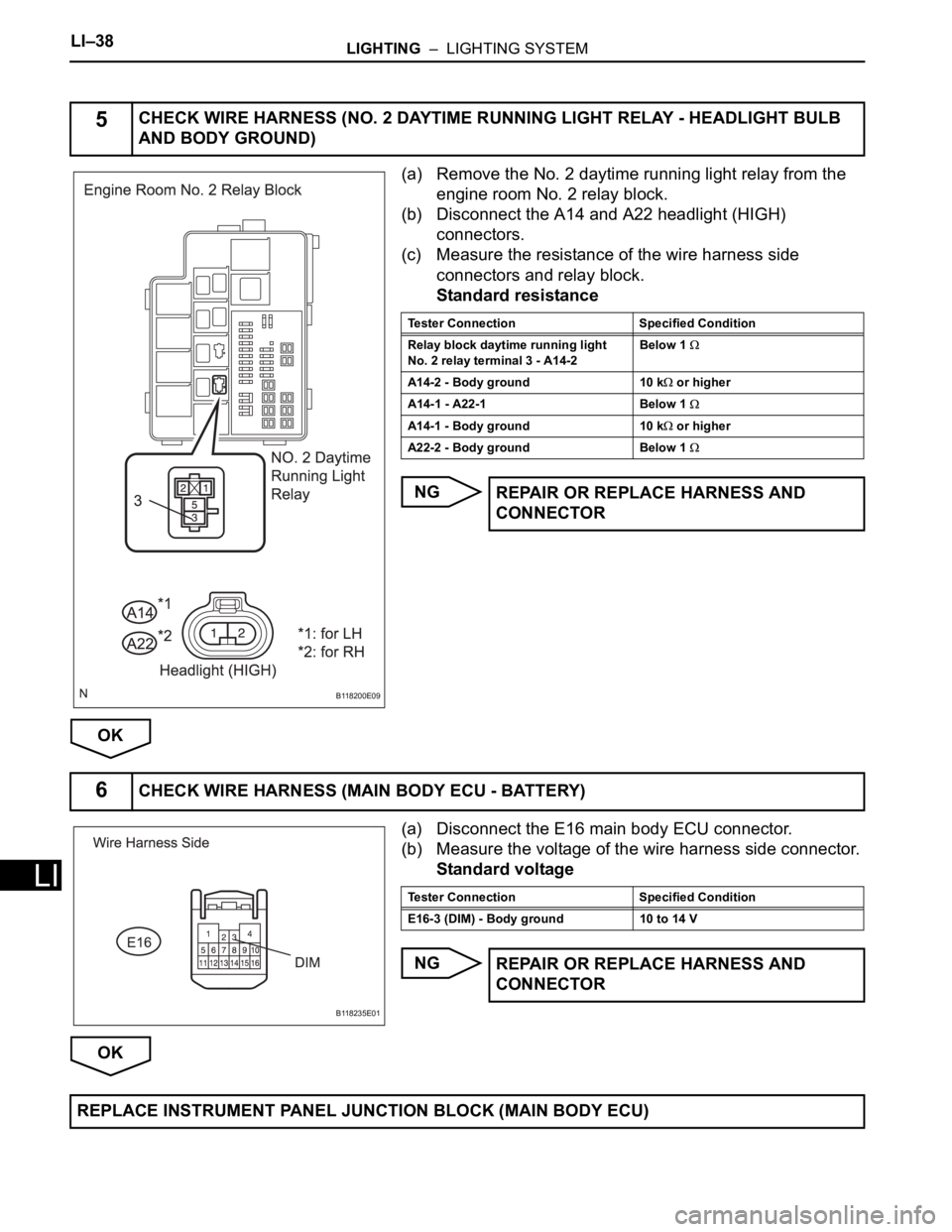
(a) Remove the No. 2 daytime running light relay from the
engine room No. 2 relay block.
(b) Disconnect the A14 and A22 headlight (HIGH)
connectors.
(c) Measure the resistance of the wire harness side
connectors and relay block.
Standard resistance
NG
OK
(a) Disconnect the E16 main body ECU connector.
(b) Measure the voltage of the wire harness side connector.
Standard voltage
NG
OK
5CHECK WIRE HARNESS (NO. 2 DAYTIME RUNNING LIGHT RELAY - HEADLIGHT BULB
AND BODY GROUND)
B118200E09
Tester Connection Specified Condition
Relay block daytime running light
No. 2 relay terminal 3 - A14-2Below 1
A14-2 - Body ground 10 k or higher
A14-1 - A22-1 Below 1
A14-1 - Body ground 10 k or higher
A22-2 - Body ground Below 1
REPAIR OR REPLACE HARNESS AND
CONNECTOR
6CHECK WIRE HARNESS (MAIN BODY ECU - BATTERY)
B118235E01
Tester Connection Specified Condition
E16-3 (DIM) - Body ground 10 to 14 V
REPAIR OR REPLACE HARNESS AND
CONNECTOR
REPLACE INSTRUMENT PANEL JUNCTION BLOCK (MAIN BODY ECU)
Page 1872 of 2000
LIGHTING – LIGHTING SYSTEMLI–41
LI
NG
(a) Check that the headlight (LOW) comes on when the light
control switch is on (HEAD).
OK:
Headlight (LOW) comes on.
NG
OK
(a) Remove the HEAD LH fuse and HEAD RH fuse from the
engine room No. 2 relay block.
(b) Measure the resistance of the fuses.
Standard resistance:
Below 1
NG
OK
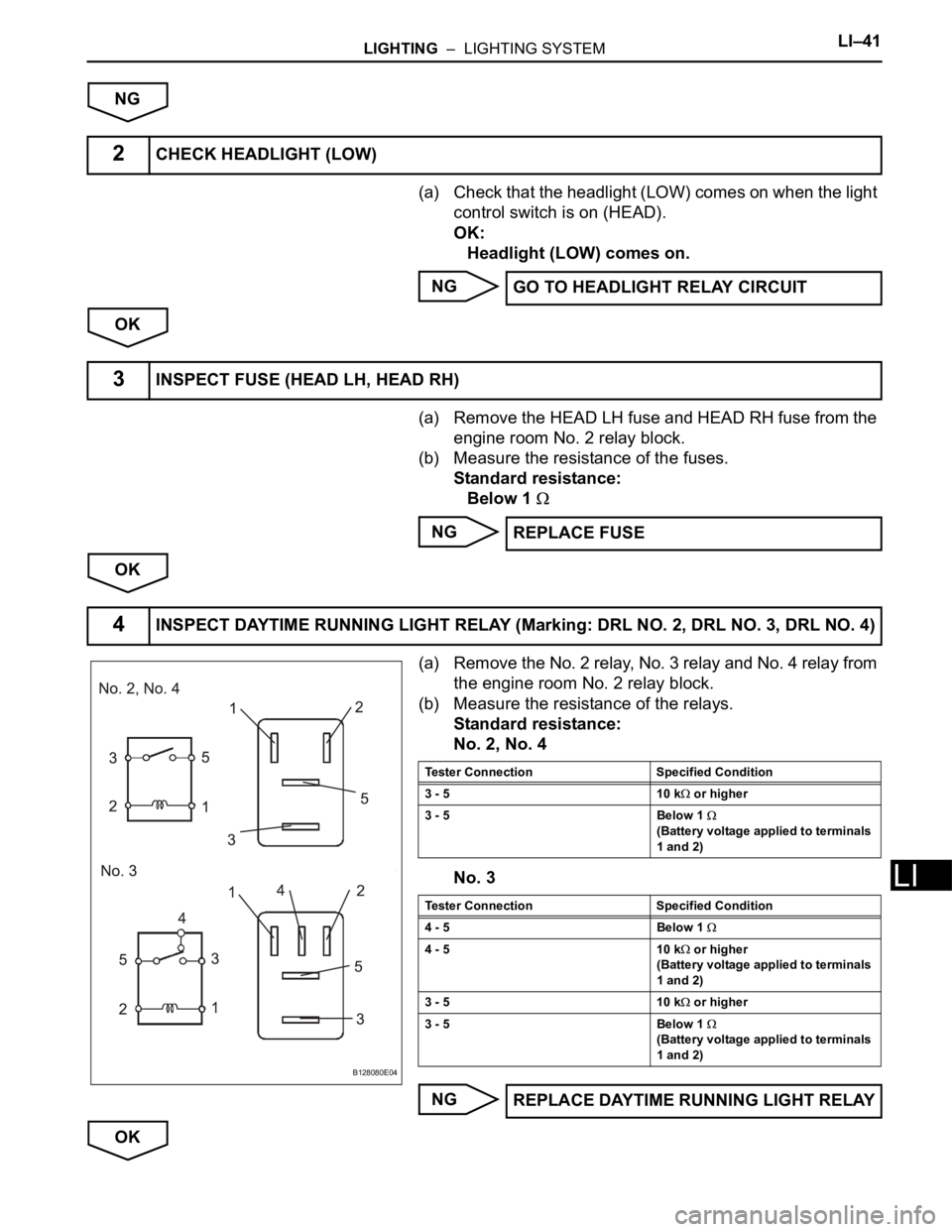
(a) Remove the No. 2 relay, No. 3 relay and No. 4 relay from
the engine room No. 2 relay block.
(b) Measure the resistance of the relays.
Standard resistance:
No. 2, No. 4
No. 3
NG
OK
2CHECK HEADLIGHT (LOW)
GO TO HEADLIGHT RELAY CIRCUIT
3INSPECT FUSE (HEAD LH, HEAD RH)
REPLACE FUSE
4INSPECT DAYTIME RUNNING LIGHT RELAY (Marking: DRL NO. 2, DRL NO. 3, DRL NO. 4)
B128080E04
Tester Connection Specified Condition
3 - 5 10 k
or higher
3 - 5 Below 1
(Battery voltage applied to terminals
1 and 2)
Tester Connection Specified Condition
4 - 5 Below 1
4 - 5 10 k or higher
(Battery voltage applied to terminals
1 and 2)
3 - 5 10 k
or higher
3 - 5 Below 1
(Battery voltage applied to terminals
1 and 2)
REPLACE DAYTIME RUNNING LIGHT RELAY
Page 1873 of 2000
LI–42LIGHTING – LIGHTING SYSTEM
LI
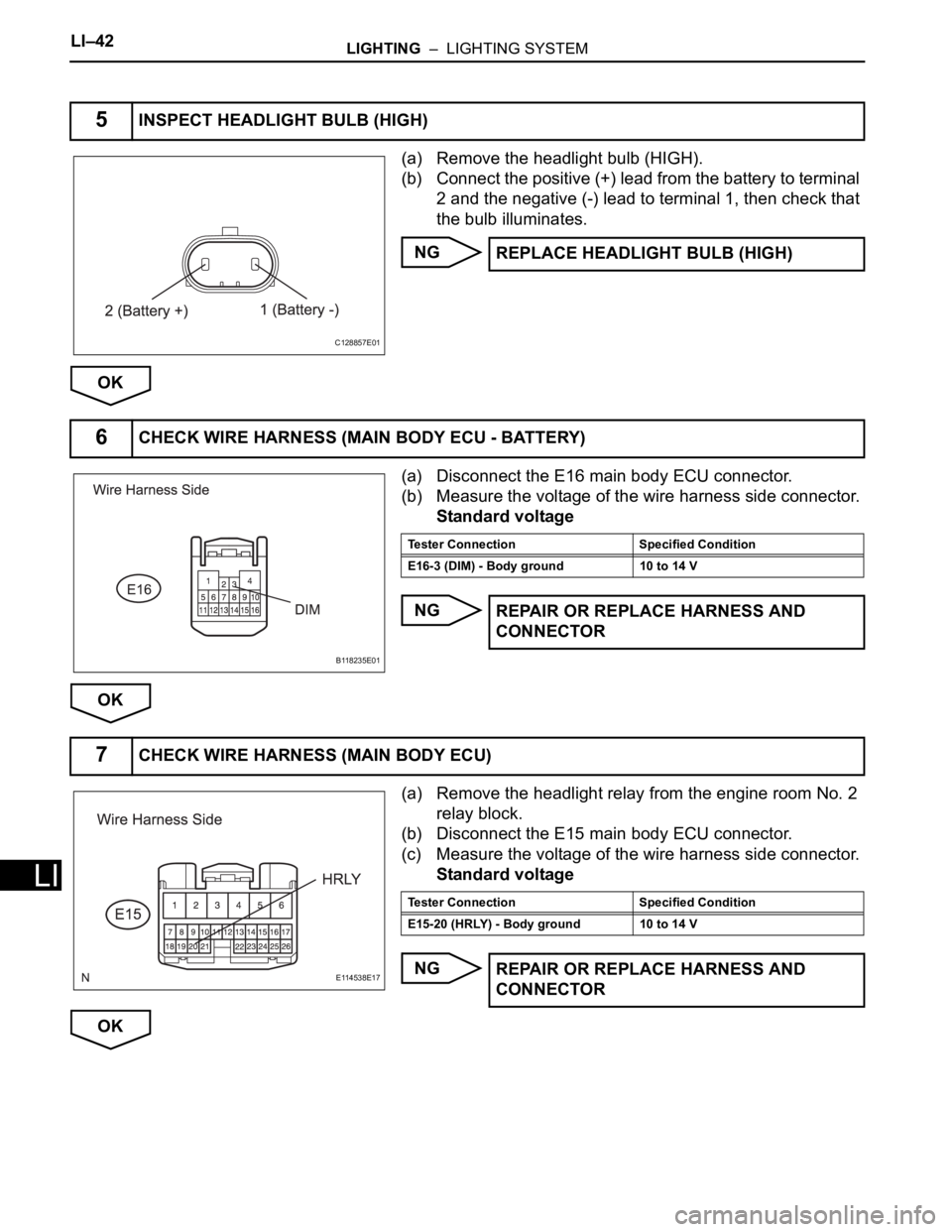
(a) Remove the headlight bulb (HIGH).
(b) Connect the positive (+) lead from the battery to terminal
2 and the negative (-) lead to terminal 1, then check that
the bulb illuminates.
NG
OK
(a) Disconnect the E16 main body ECU connector.
(b) Measure the voltage of the wire harness side connector.
Standard voltage
NG
OK
(a) Remove the headlight relay from the engine room No. 2
relay block.
(b) Disconnect the E15 main body ECU connector.
(c) Measure the voltage of the wire harness side connector.
Standard voltage
NG
OK
5INSPECT HEADLIGHT BULB (HIGH)
C128857E01
REPLACE HEADLIGHT BULB (HIGH)
6CHECK WIRE HARNESS (MAIN BODY ECU - BATTERY)
B118235E01
Tester Connection Specified Condition
E16-3 (DIM) - Body ground 10 to 14 V
REPAIR OR REPLACE HARNESS AND
CONNECTOR
7CHECK WIRE HARNESS (MAIN BODY ECU)
E114538E17
Tester Connection Specified Condition
E15-20 (HRLY) - Body ground 10 to 14 V
REPAIR OR REPLACE HARNESS AND
CONNECTOR
Page 1874 of 2000
LIGHTING – LIGHTING SYSTEMLI–43
LI
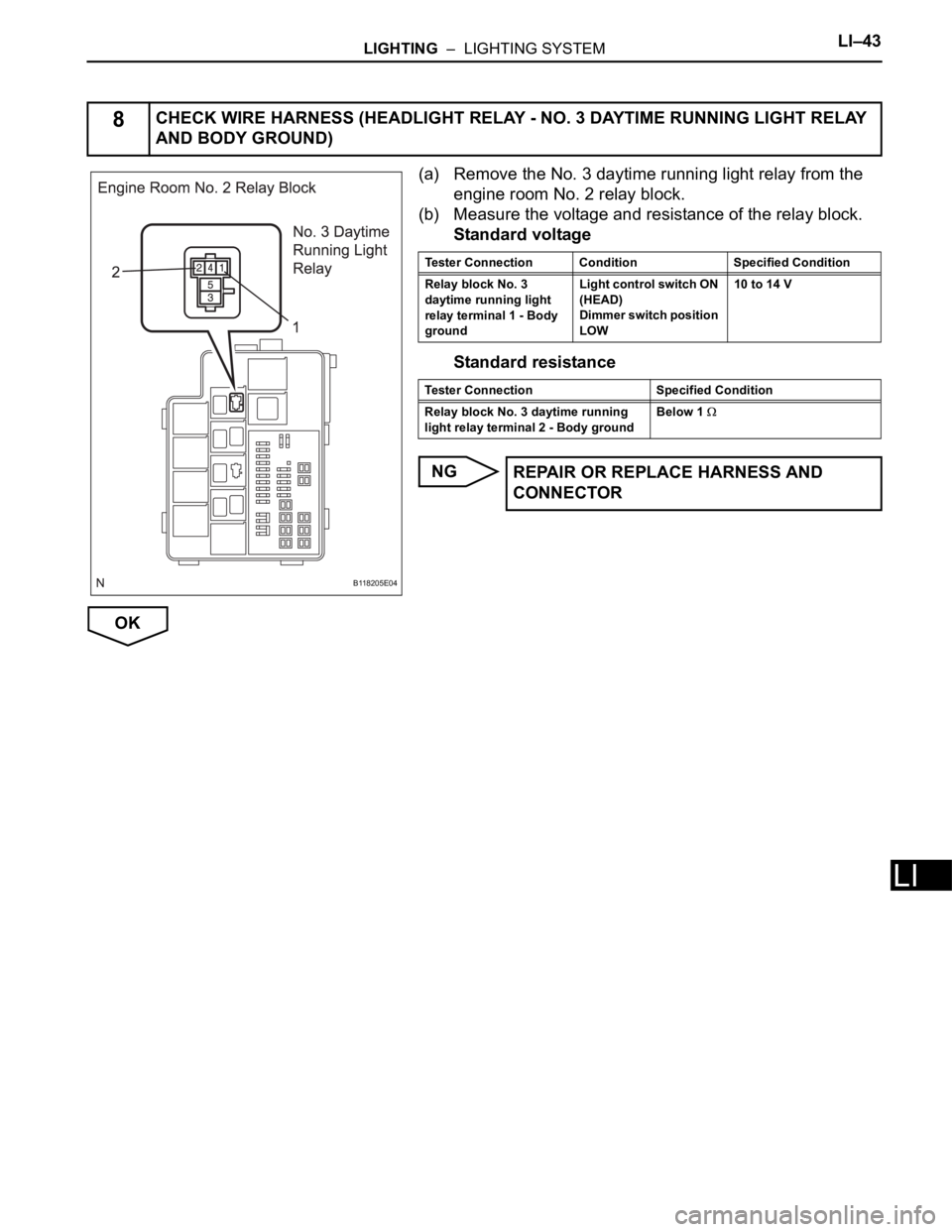
(a) Remove the No. 3 daytime running light relay from the
engine room No. 2 relay block.
(b) Measure the voltage and resistance of the relay block.
Standard voltage
Standard resistance
NG
OK
8CHECK WIRE HARNESS (HEADLIGHT RELAY - NO. 3 DAYTIME RUNNING LIGHT RELAY
AND BODY GROUND)
B118205E04
Tester Connection Condition Specified Condition
Relay block No. 3
daytime running light
relay terminal 1 - Body
groundLight control switch ON
(HEAD)
Dimmer switch position
LOW10 to 14 V
Tester Connection Specified Condition
Relay block No. 3 daytime running
light relay terminal 2 - Body groundBelow 1
REPAIR OR REPLACE HARNESS AND
CONNECTOR
Page 1875 of 2000
LI–44LIGHTING – LIGHTING SYSTEM
LI
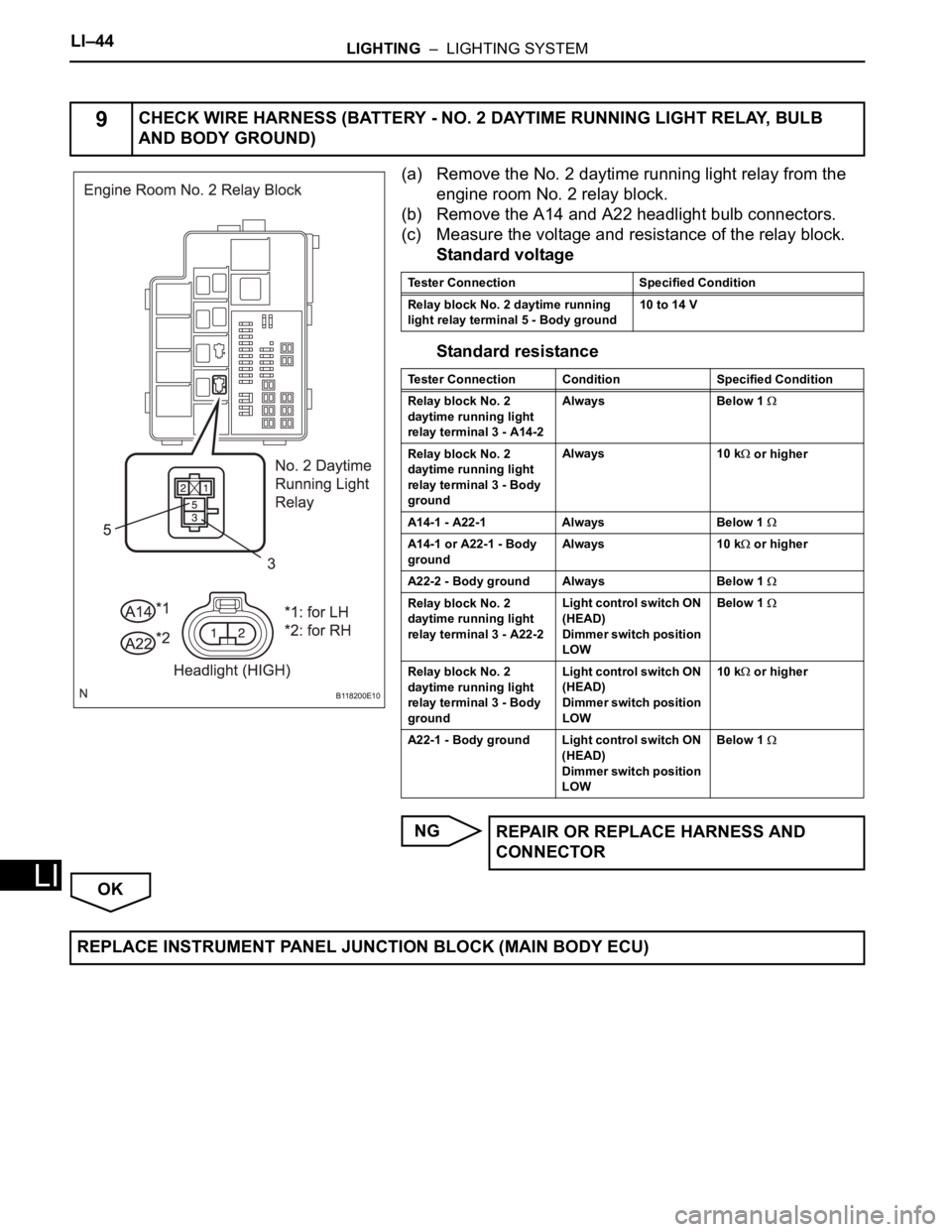
(a) Remove the No. 2 daytime running light relay from the
engine room No. 2 relay block.
(b) Remove the A14 and A22 headlight bulb connectors.
(c) Measure the voltage and resistance of the relay block.
Standard voltage
Standard resistance
NG
OK
9CHECK WIRE HARNESS (BATTERY - NO. 2 DAYTIME RUNNING LIGHT RELAY, BULB
AND BODY GROUND)
B118200E10
Tester Connection Specified Condition
Relay block No. 2 daytime running
light relay terminal 5 - Body ground10 to 14 V
Tester Connection Condition Specified Condition
Relay block No. 2
daytime running light
relay terminal 3 - A14-2Always Below 1
Relay block No. 2
daytime running light
relay terminal 3 - Body
groundAlways 10 k or higher
A14-1 - A22-1 Always Below 1
A14-1 or A22-1 - Body
groundAlways 10 k or higher
A22-2 - Body ground Always Below 1
Relay block No. 2
daytime running light
relay terminal 3 - A22-2Light control switch ON
(HEAD)
Dimmer switch position
LOWBelow 1
Relay block No. 2
daytime running light
relay terminal 3 - Body
groundLight control switch ON
(HEAD)
Dimmer switch position
LOW10 k or higher
A22-1 - Body ground Light control switch ON
(HEAD)
Dimmer switch position
LOWBelow 1
REPAIR OR REPLACE HARNESS AND
CONNECTOR
REPLACE INSTRUMENT PANEL JUNCTION BLOCK (MAIN BODY ECU)
Page 1914 of 2000
DL–18DOOR LOCK – POWER DOOR LOCK CONTROL SYSTEM
DL
INSPECTION PROCEDURE
(a) Select the ACTIVE TEST, use the intelligent tester to
generate a control command, and then check that the
doors lock / unlock.
Main body ECU
OK:
Doors can lock / unlock.
OK
NG
(a) Remove the ECU-B fuse from the engine room No. 2
relay block.
(b) Measure the resistance.
Standard resistance:
Below 1
NG
OK
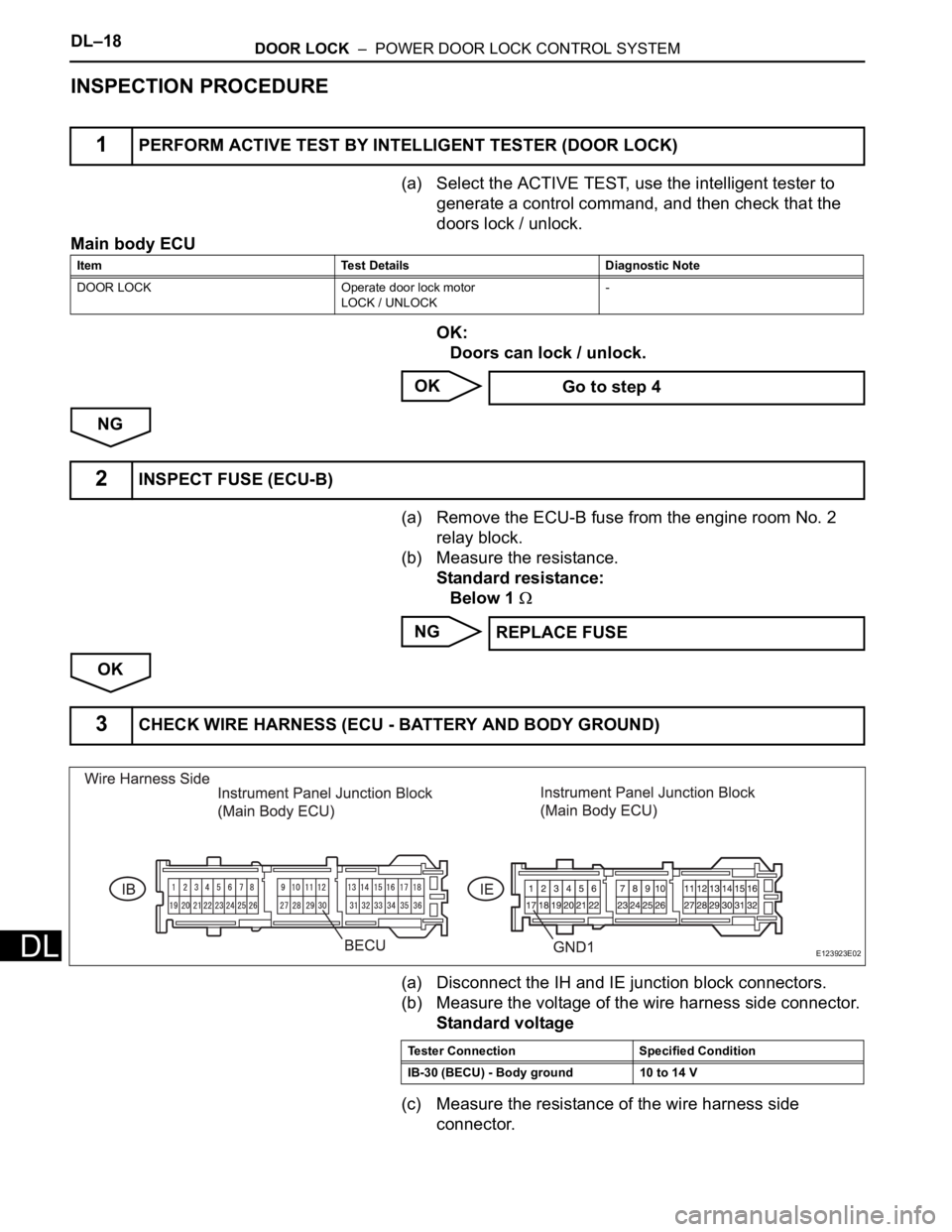
(a) Disconnect the IH and IE junction block connectors.
(b) Measure the voltage of the wire harness side connector.
Standard voltage
(c) Measure the resistance of the wire harness side
connector.
1PERFORM ACTIVE TEST BY INTELLIGENT TESTER (DOOR LOCK)
Item Test Details Diagnostic Note
DOOR LOCK Operate door lock motor
LOCK / UNLOCK-
Go to step 4
2INSPECT FUSE (ECU-B)
REPLACE FUSE
3CHECK WIRE HARNESS (ECU - BATTERY AND BODY GROUND)
E123923E02
Tester Connection Specified Condition
IB-30 (BECU) - Body ground 10 to 14 V
Page 1933 of 2000
2AZ-FE ENGINE CONTROL SYSTEM – SFI SYSTEMES–45
ES
CHECK MODE PROCEDURE
HINT:
Intelligent tester only:
Compared to normal mode, check mode is more sensitive to
malfunctions. Therefore, check mode can detect the
malfunctions that cannot be detected by normal mode.
NOTICE:
All the stored DTCs and freeze frame data are erased if:
1) the ECM is changed from normal mode to check mode
or vice versa; or 2) the ignition switch is turned from ON
to ACC or OFF while in check mode. Before changing
modes, always check and make a note of any DTCs and
freeze frame data.
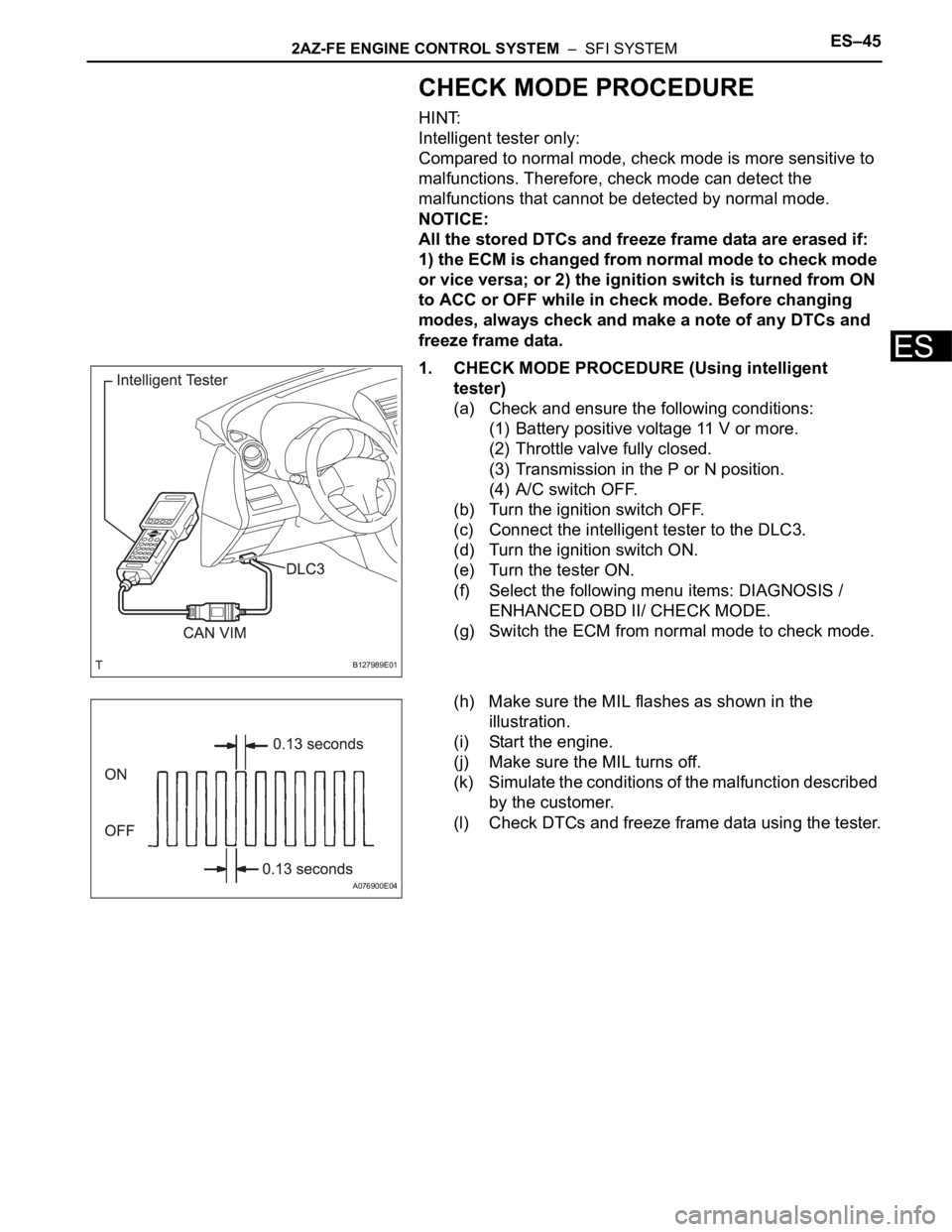
1. CHECK MODE PROCEDURE (Using intelligent
tester)
(a) Check and ensure the following conditions:
(1) Battery positive voltage 11 V or more.
(2) Throttle valve fully closed.
(3) Transmission in the P or N position.
(4) A/C switch OFF.
(b) Turn the ignition switch OFF.
(c) Connect the intelligent tester to the DLC3.
(d) Turn the ignition switch ON.
(e) Turn the tester ON.
(f) Select the following menu items: DIAGNOSIS /
ENHANCED OBD II/ CHECK MODE.
(g) Switch the ECM from normal mode to check mode.
(h) Make sure the MIL flashes as shown in the
illustration.
(i) Start the engine.
(j) Make sure the MIL turns off.
(k) Simulate the conditions of the malfunction described
by the customer.
(l) Check DTCs and freeze frame data using the tester.
B127989E01
A076900E04
Page 1934 of 2000

ES–462AZ-FE ENGINE CONTROL SYSTEM – SFI SYSTEM
ES
FAIL-SAFE CHART
If any of the following DTCs are set, the ECM enters fail-safe
mode to allow the vehicle to be driven temporarily.
HINT:
*: The vehicle can be driven slowly when the accelerator
pedal is depressed firmly and slowly. If the accelerator pedal
is depressed quickly, the vehicle may speed up and slow
down erratically.
DTCs Components Fail-Safe OperationsFail-Safe Deactivation
Conditions
P0031 and P0032Air-Fuel Ratio (A/F) Sensor
HeaterECM turns off A/F sensor heater. Ignition switch OFF
P0037 and P0038Heated Oxygen (HO2) Sensor
HeaterECM turns off HO2 sensor heater. Ignition switch OFF
P0100, P0102 and P0103 Mass Air Flow (MAF) MeterECM calculates ignition timing
according to engine speed and
throttle valve position.Pass condition detected
P0110, P0112 and P0113Intake Air Temperature (IAT)
SensorECM estimates IAT to be 20
C
(68
F).Pass condition detected
P0115, P0117 and P0118Engine Coolant Temperature
(ECT) SensorECM estimates ECT to be 80
C
(176
F).Pass condition detected
P0120, P0121, P0122, P0123,
P0220, P0222, P0223, P0604,
P0606, P0607, P0657, P2102,
P2103, P2111, P2112, P2118,
P2119 and P2135Electronic Throttle Control
System (ETCS)ECM cuts off throttle actuator
current and throttle valve returned
to 6
throttle position by return
spring.
ECM then adjusts engine output
by controlling fuel injection
(intermittent fuel-cut) and ignition
timing in accordance with
accelerator pedal opening angle
to allow vehicle to continue at
minimal speed*.Pass condition detected and then
ignition switch turned OFF
P0327 and P0328 Knock SensorECM sets ignition timing to
maximum retard.Ignition switch OFF
P0351 to P0354 Igniter ECM cuts fuel. Pass condition detected
P1550, P1551, P1552 and P1602 Generator Alternator command is fixed. Pass condition detected
P2120, P2121, P2122, P2123,
P2125, P2127, P2128 and P2138Accelerator Pedal Position (APP)
SensorAPP sensor has 2 sensor circuits:
Main and Sub.
If either circuit malfunctions, ECM
controls engine using other
circuit.
If both circuits malfunction, ECM
regards accelerator pedal as
being released. As result, throttle
valve closed and engine idles.Pass condition detected and then
ignition switch turned OFF
Page 1935 of 2000

2AZ-FE ENGINE CONTROL SYSTEM – SFI SYSTEMES–47
ES
DATA LIST / ACTIVE TEST
1. DATA LIST
HINT:
By reading the DATA LIST displayed on an intelligent
tester, values can be checked, including those of the
switches, sensors, and actuators, without removing any
parts. Reading the DATA LIST as the first step of
troubleshooting is one method of shortening diagnostic
time.
NOTICE:
In the table below, the values listed under Normal
Condition are for reference only. Do not depend
solely on these values when determining whether or
not a part is faulty.
(a) Warm up the engine.
(b) Turn the ignition switch OFF.
(c) Connect the intelligent tester to the DLC3.
(d) Turn the ignition switch ON.
(e) Turn the tester ON.
(f) Select the following menu items: DIAGNOSIS /
ENHANCED OBD II / DATA LIST.
(g) Check the values by referring to the table below.
ECM:
Intelligent Tester Display Measurement: Range (Display) Normal Condition*1 Diagnostic Note
INJECTORInjection period of No. 1 cylinder:
Min.: 0 ms, Max.: 32.64 ms1.0 to 3.0 ms: Idling -
IGN ADVANCE Ignition timing advance for No. 1
cylinder:
Min.: -64 deg, Max.: 63.5 degBTDC 0 to 14 deg: Idling -
CALC LOADCalculated load by ECM:
Min.: 0 %, Max.: 100 %• 10 to 30 %: Idling
• 10 to 30 %: Running without
load at 2,500 rpmLoad value
VEHICLE LOADVehicle load:
Min.: 0 %, Max.: 25,700 %Actual vehicle loadLoad percentage in terms of
maximum intake air flow amount
MAFAir flow rate from Mass Air Flow
(MAF) meter:
Min.: 0 g/sec., Max.: 655.35 g/sec.1 to 3 g/sec.: Idling
2 to 6 g/sec.: Running without
load at 2,500 rpmIf value approximately 0.0 g/sec.:
• MAF meter power source
circuit open
• VG circuit open or short
If value 160.0 g/sec. or more:
• E2G circuit open
ENGINE SPDEngine speed:
Min.: 0 rpm, Max.: 16,383.75 rpm650 to 750 rpm: Idling -
VEHICLE SPDVehicle speed:
Min.: 0 km/h, Max.: 255 km/hActual vehicle speed Speed indicated on speedometer
COOLANT TEMPEngine coolant temperature:
Min.: -40
C, Max.: 140C80 to 100C (176 to 212F):
After warming up• If -40
C (-40F): sensor circuit
open
• If 140
C (284F) or more:
sensor circuit shorted
INTAKE AIRIntake air temperature:
Min.: -40
C, Max.: 140CEquivalent to ambient air
temperature• If -40
C (-40F): sensor circuit
open
• If 140
C (284F) or more:
sensor circuit shorted
AIR-FUEL RATIORatio compared to stoichiometric
level:
Min.: 0, Max.: 1.9990.8 to 1.2: Idling• Less than 1 (0 to 0.999) =
Lean
• Stoichiometric air-fuel ratio = 1
• Greater than 1 (1.001 to
1.999) = Rich
Page 1936 of 2000

ES–482AZ-FE ENGINE CONTROL SYSTEM – SFI SYSTEM
ES
PURGE DENSITY Learning value of purge density:
Min.: -50, Max.: 350-40 to 10: Idling -
EVAP PURGE FLOWRatio of evaporative purge flow to
intake air volume:
Min.: 0 %, Max.: 102.4 %0 to 10 %: Idling -
EVAP PURGE VSVEVAP (PURGE) VSV control duty:
Min.: 0 %, Max.: 100 %10 to 50 %: Idling Order signal from ECM
VAPOR PRES PUMPVapor pressure:
Min.: 33.853 kPa, Max.: 125.596
kPaApproximately 100 kPa: Ignition
switch ONEVAP system pressure monitored
by canister pressure sensor
VAPOR PRES CALCVapor pressure (calculated):
Min.: -5.632 kPa, Max.: 715.264
kPaApproximately 100 kPa: Ignition
switch ONEVAP system pressure monitored
by canister pressure sensor
KNOCK CRRT VALKnock correction learning value:
Min: -64
CA, Max.: 1,984CA0 to 20
CA: Driving at 70 km/h
(44 mph)Service data
KNOCK FB VALKnock feedback value:
Min: -64
CA, Max.: 1,984CA-20 to 0
CA: Driving at 70 km/h
(44 mph)Service data
CLUTCHClutch current:
Min.: 0 A, Max.: 2.49 A--
EVAP VAPOR PRESEVAP vapor pressure:
Min.: 0 kPa, Max.: 327.675 kPaApproximately 100 kPa: Ignition
switch ONEVAP system pressure monitored
by canister pressure sensor
ACCEL POS #1Absolute Accelerator Pedal
Position (APP) No. 1:
Min.: 0 %, Max.: 100 %10 to 22 %: Accelerator pedal
released
52 to 90 %: Accelerator pedal
fully depressedRead value with ignition switch ON
(Do not start engine)
ACCEL POS #2Absolute APP No. 2:
Min.: 0 %, Max.: 100 %24 to 40 %: Accelerator pedal
released
68 to 100 %: Accelerator pedal
fully depressedRead value with ignition switch ON
(Do not start engine)
ACCEL POS #1APP sensor No. 1 voltage:
Min.: 0 V, Max.: 4.98 V- ETCS freeze data
ACCEL POS #2APP sensor No. 2 voltage:
Min.: 0 V, Max.: 4.98 V- ETCS freeze data
ACCEL POS #1APP sensor No. 1 voltage:
Min.: 0 V, Max.: 5 V0.5 to 1.1 V: Accelerator pedal
released
2.6 to 4.5 V: Accelerator pedal
fully depressedRead value with ignition switch ON
(Do not start engine)
ACCEL POS #2APP sensor No. 2 voltage:
Min.: 0 V, Max.: 5 V1.2 to 2.0 V: Accelerator pedal
released
3.4 to 5.0 V: Accelerator pedal
fully depressedRead value with ignition switch ON
(Do not start engine)
ACCEL IDL POSWhether or not accelerator pedal
position sensor detecting idle:
ON or OFFON: Idling -
THRTL LEARN VALThrottle valve fully closed
(learned value):
Min.: 0 V, Max.: 5 V0.4 to 0.8 V -
ACCEL SSR #1 ADAPP sensor No. 1 voltage (AD):
Min.: 0 V, Max.: 4.98 V-ETCS service data
ACCEL LRN VAL#1 Accelerator fully closed learning
value No. 1:
Min.: 0 deg, Max.: 124.512 deg-ETCS service data
ACCEL LRN VAL#2Accelerator fully closed learning
value No. 2:
Min.: 0 deg, Max.: 124.512 deg-ETCS service data
FAIL #1 Whether or not fail safe function
executed:
ON or OFFON: ETCS has failed -
FAIL #2 Whether or not fail safe function
executed:
ON or OFFON: ETCS has failed - Intelligent Tester Display Measurement: Range (Display) Normal Condition*1 Diagnostic Note