compression check TOYOTA RAV4 2006 Service Repair Manual
[x] Cancel search | Manufacturer: TOYOTA, Model Year: 2006, Model line: RAV4, Model: TOYOTA RAV4 2006Pages: 2000, PDF Size: 45.84 MB
Page 236 of 2000
EX–62AZ-FE EXHAUST – EXHAUST PIPE
EX
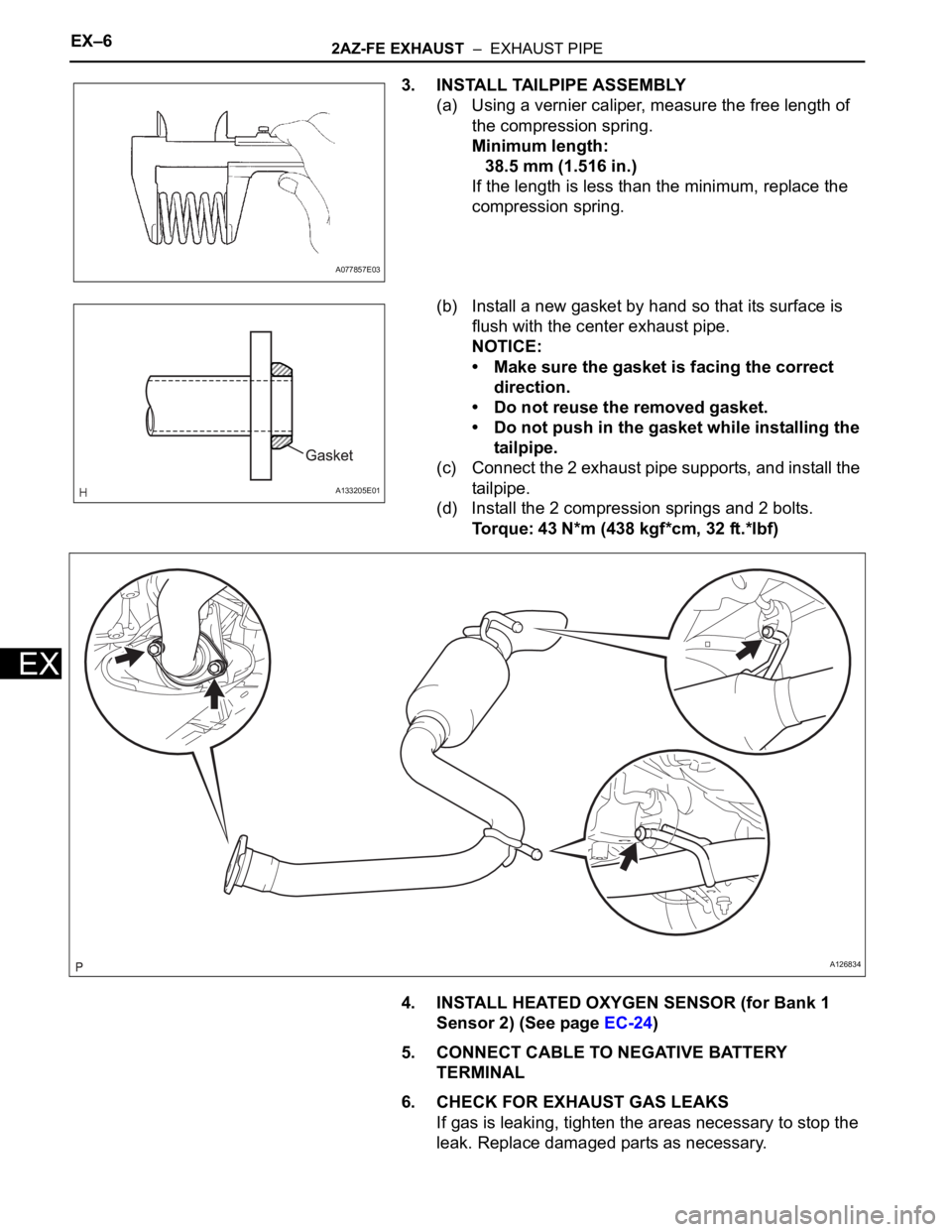
3. INSTALL TAILPIPE ASSEMBLY
(a) Using a vernier caliper, measure the free length of
the compression spring.
Minimum length:
38.5 mm (1.516 in.)
If the length is less than the minimum, replace the
compression spring.
(b) Install a new gasket by hand so that its surface is
flush with the center exhaust pipe.
NOTICE:
• Make sure the gasket is facing the correct
direction.
• Do not reuse the removed gasket.
• Do not push in the gasket while installing the
tailpipe.
(c) Connect the 2 exhaust pipe supports, and install the
tailpipe.
(d) Install the 2 compression springs and 2 bolts.
Torque: 43 N*m (438 kgf*cm, 32 ft.*lbf)
4. INSTALL HEATED OXYGEN SENSOR (for Bank 1
Sensor 2) (See page EC-24)
5. CONNECT CABLE TO NEGATIVE BATTERY
TERMINAL
6. CHECK FOR EXHAUST GAS LEAKS
If gas is leaking, tighten the areas necessary to stop the
leak. Replace damaged parts as necessary.
A077857E03
A133205E01
A126834
Page 483 of 2000
2AZ-FE ENGINE CONTROL SYSTEM – SFI SYSTEMES–29
ES
PROBLEM SYMPTOMS TABLE
HINT:
Use the table below to help determine the cause of the
problem symptom. The potential causes of the symptoms are
listed in order of probability in the "Suspected area" column of
the table. Check each symptom by checking the suspected
areas in the order they are listed. Replace parts as
necessary.
SFI system
Symptom Suspected area See page
Engine does not crank (Does not start)1. BatteryCH-4
2. StarterST-8
3. Starter relayST-16
4. Park/neutral position switchAX-108
5. Immobiliser systemEI-3
No initial combustion (Does not start)1. ECM power source circuitES-366
2. Crankshaft position sensorES-402
3. Camshaft position sensorES-399
4. Ignition systemIG-4
5. Fuel pump control circuitES-378
6. ECMES-26
7. VC output circuitES-373
Engine cranks normally but difficult to start1. Fuel pump control circuitES-378
2. CompressionEM-3
Difficult to start with cold engine1. Ignition systemIG-4
2. Spark plugIG-7
3. Fuel pump control circuitES-378
4. InjectorFU-11
Difficult to start with warm engine1. InjectorFU-11
2. Ignition systemIG-4
3. Spark plugIG-7
4. Fuel pump control circuitES-378
High engine idle speed1. Electronic throttle control systemES-265
2. A/C signal circuit -
3. ECM power source circuitES-366
Low engine idle speed (Poor idling)1. Electronic throttle control systemES-265
2. A/C signal circuit -
3. Fuel pump control circuitES-378
4. Air induction systemEC-7
5. PCV hoseEC-7
Rough idling1. CompressionEM-3
2. Spark plugIG-7
3. InjectorFU-11
4. Ignition systemIG-4
5. Fuel pump control circuitES-378
6. Electronic throttle control systemES-265
7. Air induction systemEC-7
8. PCV hoseEC-7
9. Mass air flow meterES-391
Page 556 of 2000
ES–322GR-FE ENGINE CONTROL SYSTEM – SFI SYSTEM
ES
PROBLEM SYMPTOMS TABLE
HINT:
Use the table below to help determine the cause of the
problem symptom. The potential causes of the symptoms are
listed in order of probability in the "Suspected area" column of
the table. Check each symptom by checking the suspected
areas in the order they are listed. Replace parts as
necessary.
Symptom Suspected area See page
Engine does not crank (Does not start)1. BatteryCH-5
2. StarterST-8
3. Starter relayST-16
4. Park/neutral position switchAX-132
5. Immobiliser systemEI-3
No initial combustion (Does not start)1. ECM power source circuitES-402
2. Crankshaft position sensorES-448
3. VVT sensorES-214
4. Ignition systemIG-5
5. Fuel pump control circuitES-414
6. ECMES-470
7. VC output circuitES-408
Engine cranks normally but difficult to start1. Fuel pump control circuitES-414
2. CompressionEM-3
Difficult to start with cold engine1. Ignition systemIG-5
2. Spark plugIG-7
3. Fuel pump control circuitES-414
4. InjectorFU-15
Difficult to start with warm engine1. InjectorFU-15
2. Ignition systemIG-5
3. Spark plugIG-7
4. Fuel pump control circuitES-414
High engine idle speed1. Electronic throttle control systemES-311
2. A/C signal circuit -
3. ECM power source circuitES-402
4. Acoustic Control Induction System (ACIS)ES-423
Low engine idle speed (Poor idling)1. Electronic throttle control systemES-311
2. A/C signal circuit -
3. Fuel pump control circuitES-414
4. Air induction systemIT-5
5. Acoustic Control Induction System (ACIS)ES-423
6. PCV hose -
Page 582 of 2000
2AZ-FE ENGINE MECHANICAL – TIMING CHAINEM–25
EM
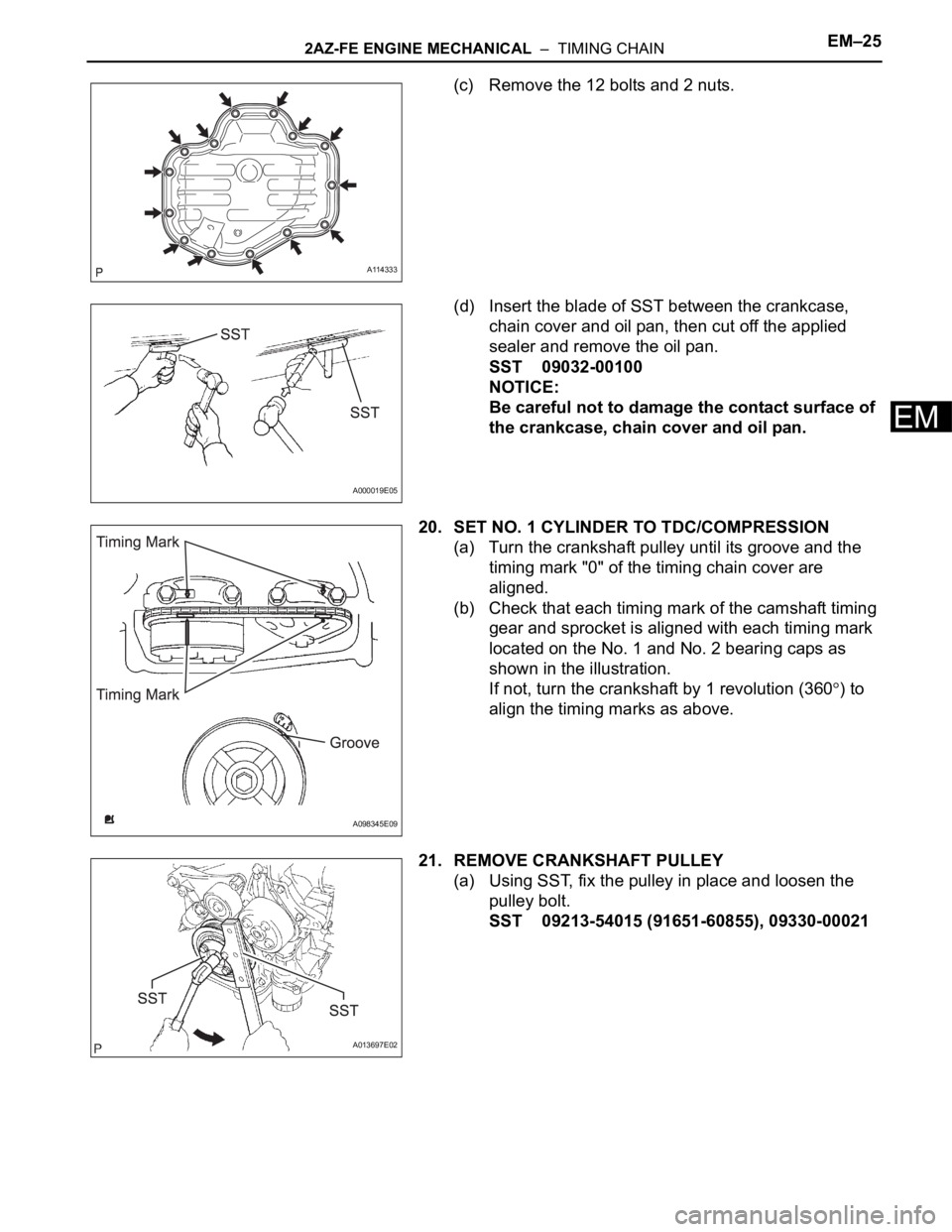
(c) Remove the 12 bolts and 2 nuts.
(d) Insert the blade of SST between the crankcase,
chain cover and oil pan, then cut off the applied
sealer and remove the oil pan.
SST 09032-00100
NOTICE:
Be careful not to damage the contact surface of
the crankcase, chain cover and oil pan.
20. SET NO. 1 CYLINDER TO TDC/COMPRESSION
(a) Turn the crankshaft pulley until its groove and the
timing mark "0" of the timing chain cover are
aligned.
(b) Check that each timing mark of the camshaft timing
gear and sprocket is aligned with each timing mark
located on the No. 1 and No. 2 bearing caps as
shown in the illustration.
If not, turn the crankshaft by 1 revolution (360
) to
align the timing marks as above.
21. REMOVE CRANKSHAFT PULLEY
(a) Using SST, fix the pulley in place and loosen the
pulley bolt.
SST 09213-54015 (91651-60855), 09330-00021
A114333
A000019E05
A098345E09
A013697E02
Page 603 of 2000
2AZ-FE ENGINE MECHANICAL – CYLINDER HEADEM–59
EM
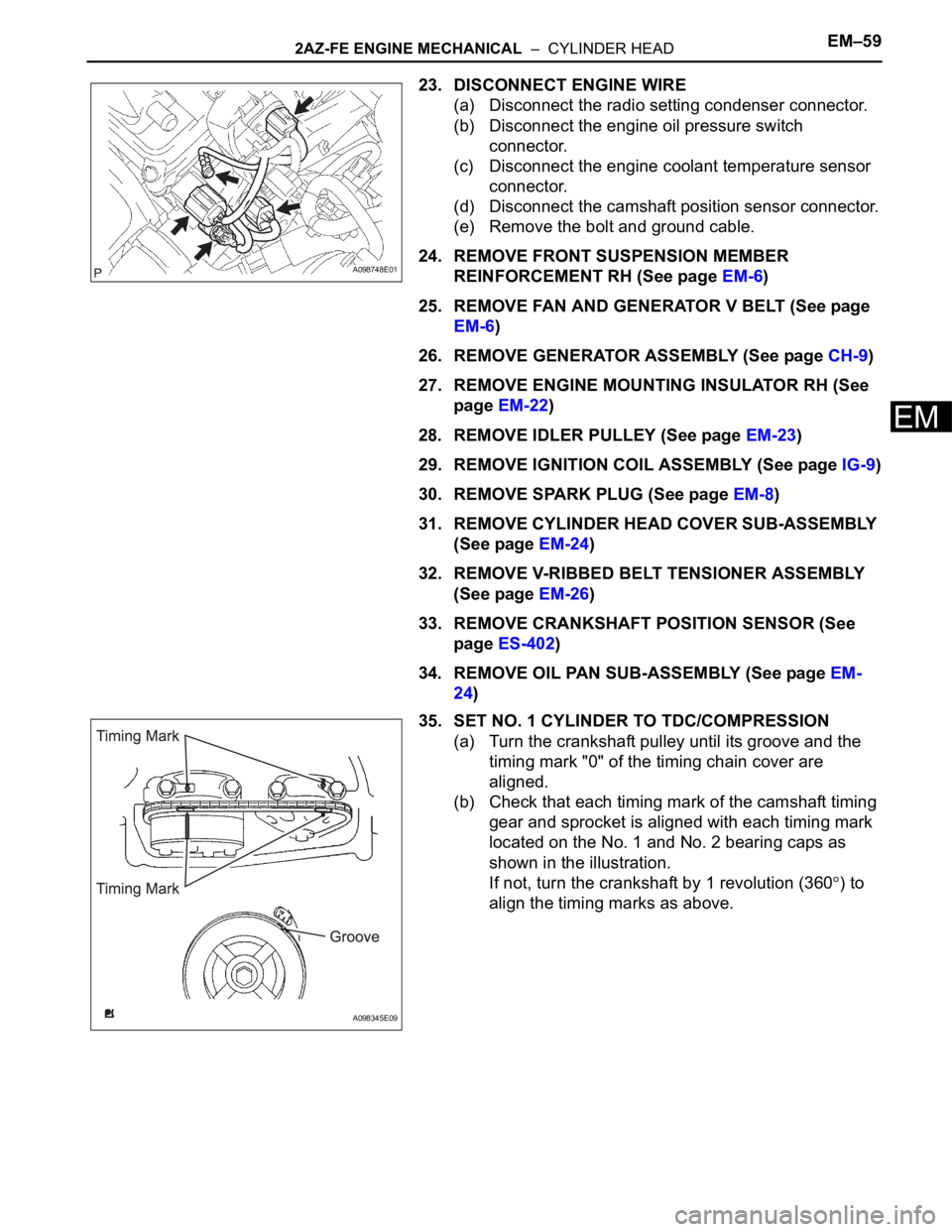
23. DISCONNECT ENGINE WIRE
(a) Disconnect the radio setting condenser connector.
(b) Disconnect the engine oil pressure switch
connector.
(c) Disconnect the engine coolant temperature sensor
connector.
(d) Disconnect the camshaft position sensor connector.
(e) Remove the bolt and ground cable.
24. REMOVE FRONT SUSPENSION MEMBER
REINFORCEMENT RH (See page EM-6)
25. REMOVE FAN AND GENERATOR V BELT (See page
EM-6)
26. REMOVE GENERATOR ASSEMBLY (See page CH-9)
27. REMOVE ENGINE MOUNTING INSULATOR RH (See
page EM-22)
28. REMOVE IDLER PULLEY (See page EM-23)
29. REMOVE IGNITION COIL ASSEMBLY (See page IG-9)
30. REMOVE SPARK PLUG (See page EM-8)
31. REMOVE CYLINDER HEAD COVER SUB-ASSEMBLY
(See page EM-24)
32. REMOVE V-RIBBED BELT TENSIONER ASSEMBLY
(See page EM-26)
33. REMOVE CRANKSHAFT POSITION SENSOR (See
page ES-402)
34. REMOVE OIL PAN SUB-ASSEMBLY (See page EM-
24)
35. SET NO. 1 CYLINDER TO TDC/COMPRESSION
(a) Turn the crankshaft pulley until its groove and the
timing mark "0" of the timing chain cover are
aligned.
(b) Check that each timing mark of the camshaft timing
gear and sprocket is aligned with each timing mark
located on the No. 1 and No. 2 bearing caps as
shown in the illustration.
If not, turn the crankshaft by 1 revolution (360
) to
align the timing marks as above.
A098748E01
A098345E09
Page 632 of 2000
EM–882AZ-FE ENGINE MECHANICAL – CYLINDER HEAD
EM
47. CHECK FOR ENGINE OIL LEAKS
48. CHECK FOR EXHAUST GAS LEAKS
49. INSPECT IGNITION TIMING (See page EM-1)
50. INSPECT ENGINE IDLING SPEED (See page EM-2)
51. INSPECT COMPRESSION (See page EM-3)
52. INSPECT CO/HC (See page EM-4)
53. INSTALL NO. 1 ENGINE COVER (See page EM-43)
54. INSTALL FRONT FENDER APRON RH
55. INSTALL NO. 1 ENGINE UNDER COVER
56. INSTALL FRONT WHEEL RH
57. INSTALL RADIATOR SUPPORT OPENING COVER
REPAIR
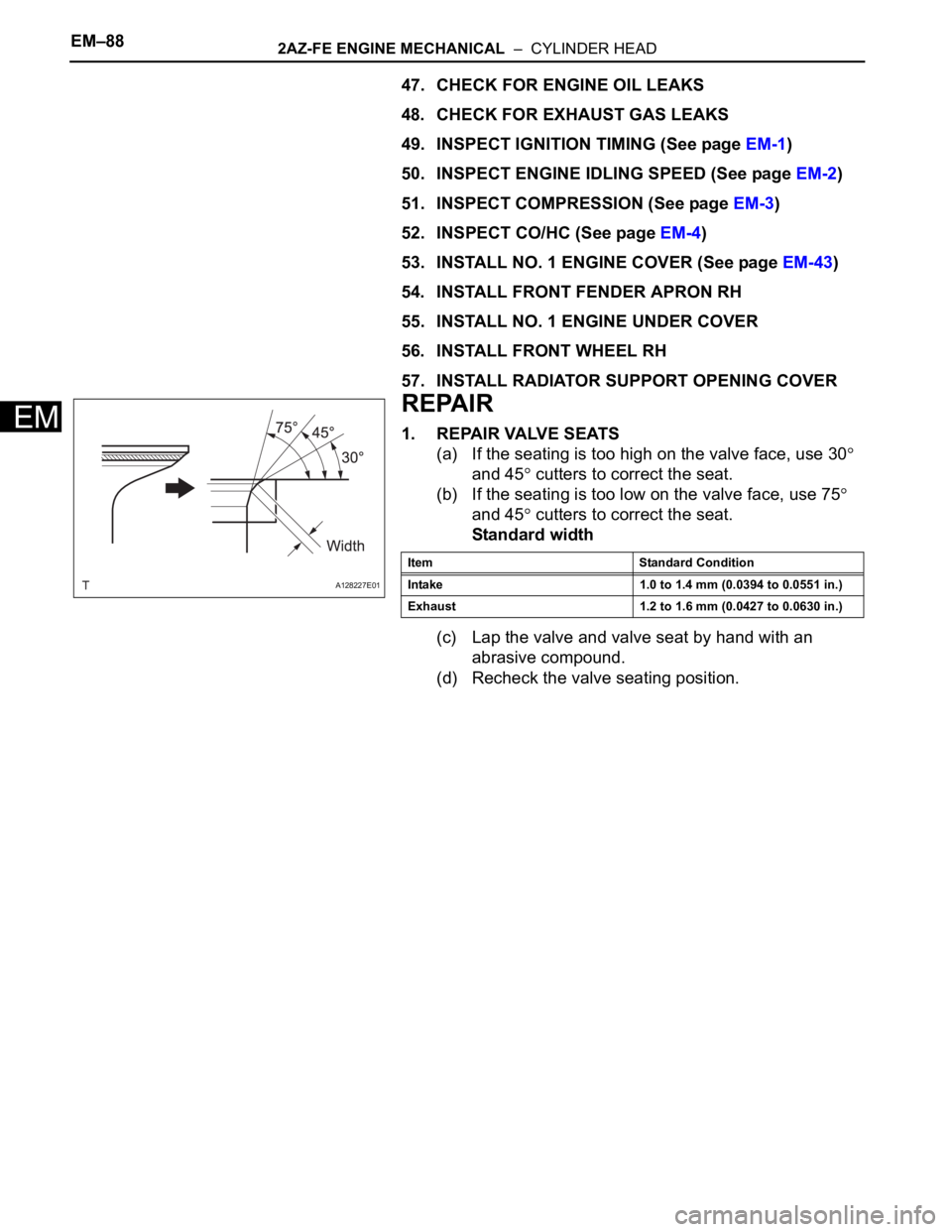
1. REPAIR VALVE SEATS
(a) If the seating is too high on the valve face, use 30
and 45
cutters to correct the seat.
(b) If the seating is too low on the valve face, use 75
and 45
cutters to correct the seat.
Standard width
(c) Lap the valve and valve seat by hand with an
abrasive compound.
(d) Recheck the valve seating position.
A128227E01
Item Standard Condition
Intake 1.0 to 1.4 mm (0.0394 to 0.0551 in.)
Exhaust 1.2 to 1.6 mm (0.0427 to 0.0630 in.)
Page 692 of 2000
2GR-FE ENGINE MECHANICAL – ENGINE UNITEM–55
EM
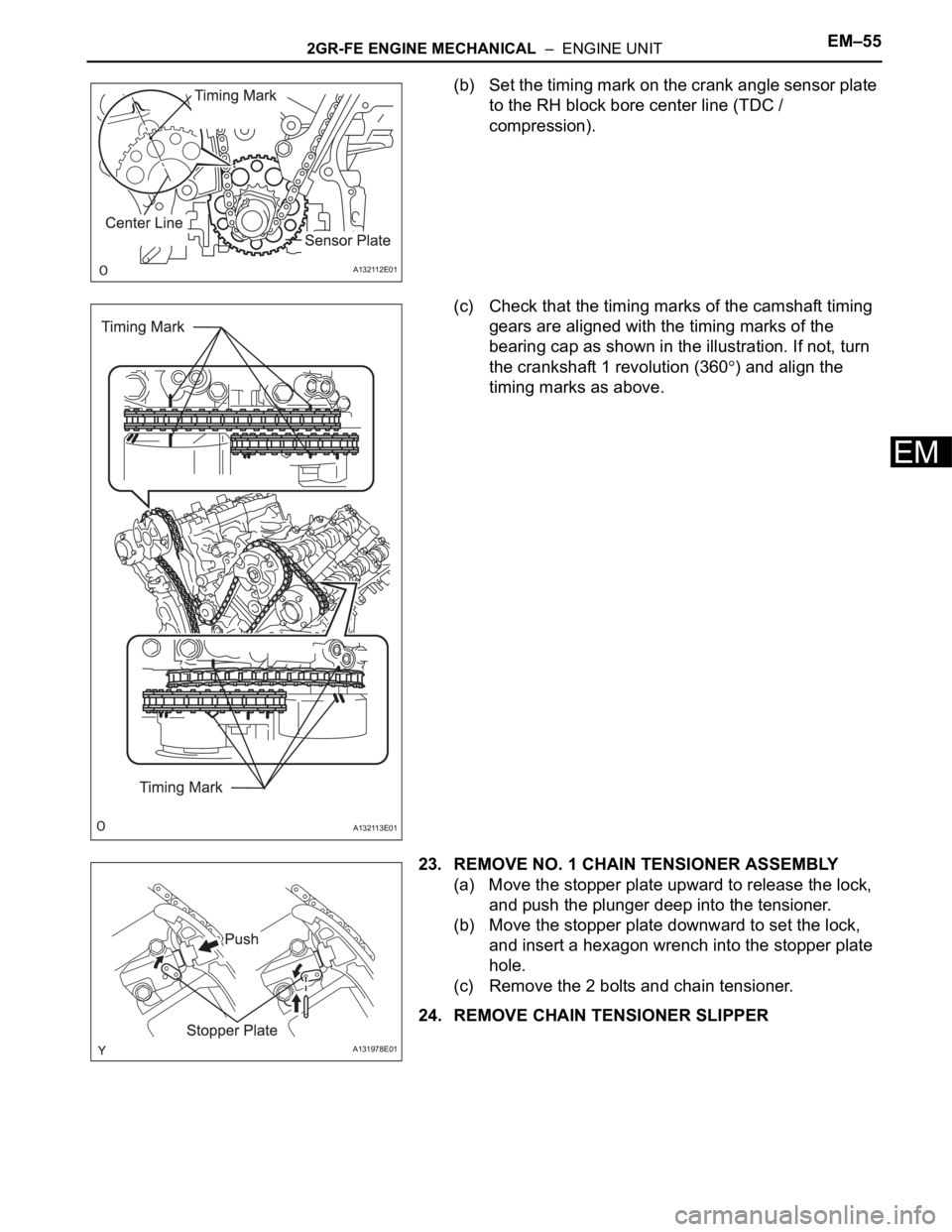
(b) Set the timing mark on the crank angle sensor plate
to the RH block bore center line (TDC /
compression).
(c) Check that the timing marks of the camshaft timing
gears are aligned with the timing marks of the
bearing cap as shown in the illustration. If not, turn
the crankshaft 1 revolution (360
) and align the
timing marks as above.
23. REMOVE NO. 1 CHAIN TENSIONER ASSEMBLY
(a) Move the stopper plate upward to release the lock,
and push the plunger deep into the tensioner.
(b) Move the stopper plate downward to set the lock,
and insert a hexagon wrench into the stopper plate
hole.
(c) Remove the 2 bolts and chain tensioner.
24. REMOVE CHAIN TENSIONER SLIPPER
A132112E01
A132113E01
A131978E01
Page 710 of 2000
2GR-FE ENGINE MECHANICAL – ENGINE UNITEM–73
EM
(v) Remove the upper bearings and upper thrust
washers from the cylinder block.
HINT:
Arrange the bearings and thrust washers in the
correct order.
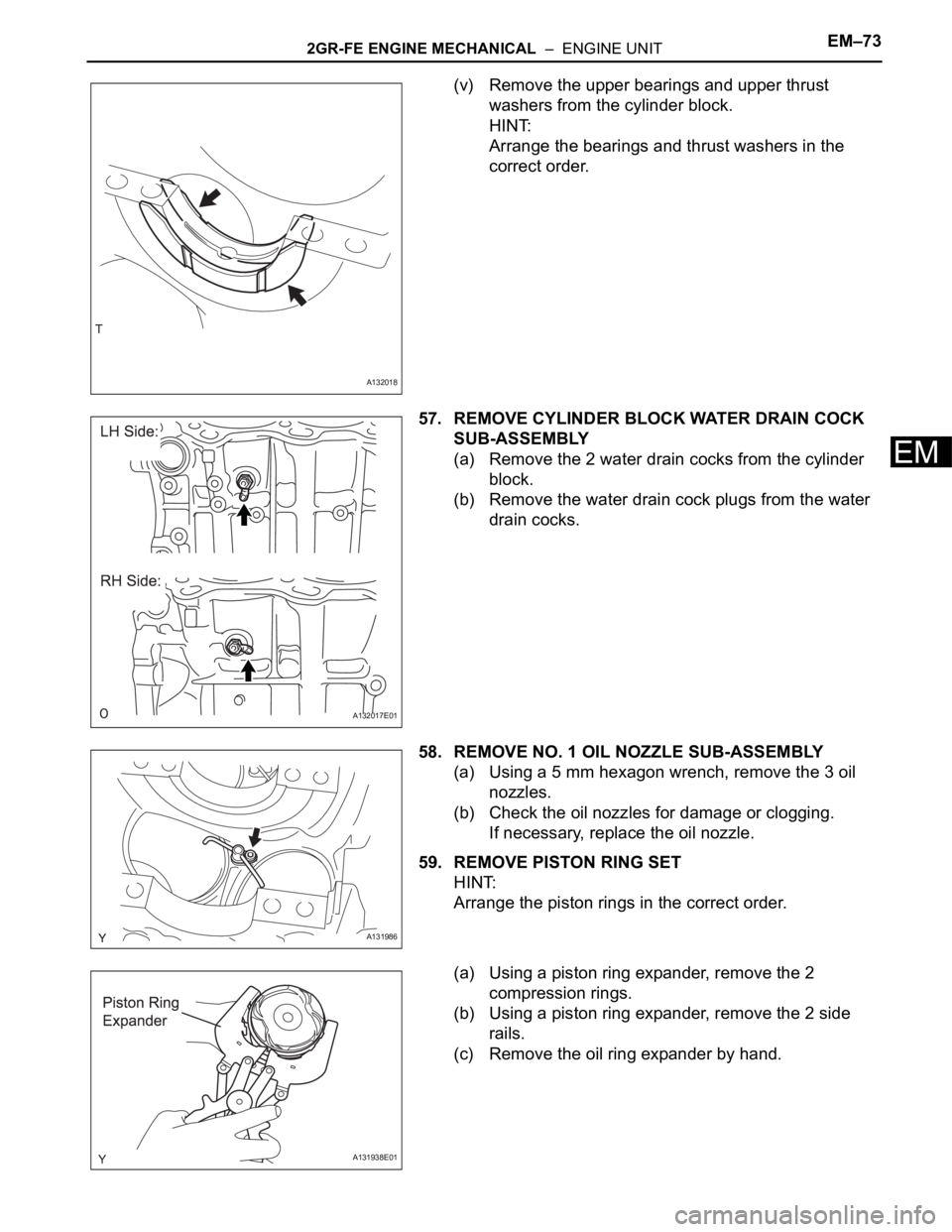
57. REMOVE CYLINDER BLOCK WATER DRAIN COCK
SUB-ASSEMBLY
(a) Remove the 2 water drain cocks from the cylinder
block.
(b) Remove the water drain cock plugs from the water
drain cocks.
58. REMOVE NO. 1 OIL NOZZLE SUB-ASSEMBLY
(a) Using a 5 mm hexagon wrench, remove the 3 oil
nozzles.
(b) Check the oil nozzles for damage or clogging.
If necessary, replace the oil nozzle.
59. REMOVE PISTON RING SET
HINT:
Arrange the piston rings in the correct order.
(a) Using a piston ring expander, remove the 2
compression rings.
(b) Using a piston ring expander, remove the 2 side
rails.
(c) Remove the oil ring expander by hand.
A132018
A132017E01
A131986
A131938E01
Page 713 of 2000
EM–762GR-FE ENGINE MECHANICAL – ENGINE UNIT
EM
INSPECTION
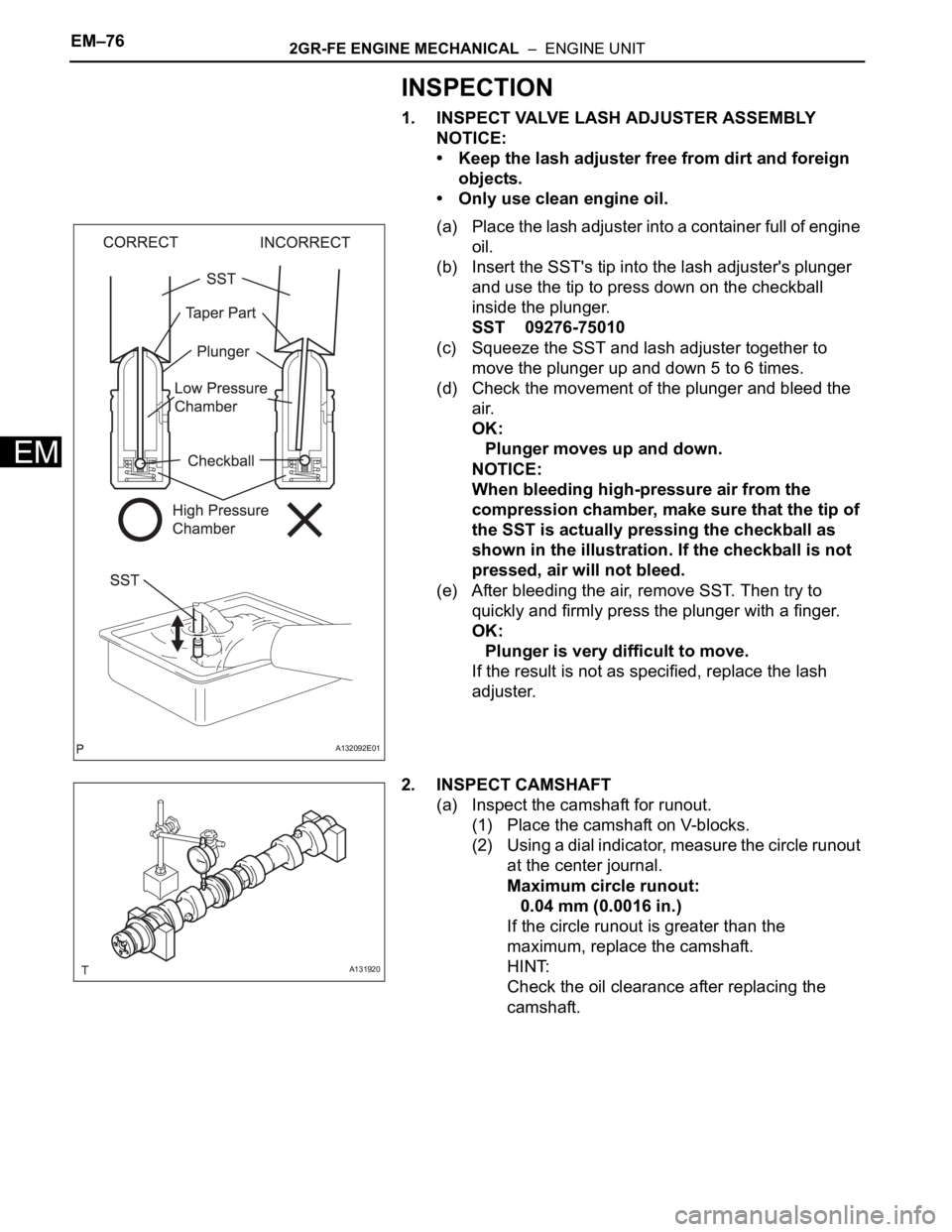
1. INSPECT VALVE LASH ADJUSTER ASSEMBLY
NOTICE:
• Keep the lash adjuster free from dirt and foreign
objects.
• Only use clean engine oil.
(a) Place the lash adjuster into a container full of engine
oil.
(b) Insert the SST's tip into the lash adjuster's plunger
and use the tip to press down on the checkball
inside the plunger.
SST 09276-75010
(c) Squeeze the SST and lash adjuster together to
move the plunger up and down 5 to 6 times.
(d) Check the movement of the plunger and bleed the
air.
OK:
Plunger moves up and down.
NOTICE:
When bleeding high-pressure air from the
compression chamber, make sure that the tip of
the SST is actually pressing the checkball as
shown in the illustration. If the checkball is not
pressed, air will not bleed.
(e) After bleeding the air, remove SST. Then try to
quickly and firmly press the plunger with a finger.
OK:
Plunger is very difficult to move.
If the result is not as specified, replace the lash
adjuster.
2. INSPECT CAMSHAFT
(a) Inspect the camshaft for runout.
(1) Place the camshaft on V-blocks.
(2) Using a dial indicator, measure the circle runout
at the center journal.
Maximum circle runout:
0.04 mm (0.0016 in.)
If the circle runout is greater than the
maximum, replace the camshaft.
HINT:
Check the oil clearance after replacing the
camshaft.
A132092E01
A131920
Page 724 of 2000
2GR-FE ENGINE MECHANICAL – ENGINE UNITEM–87
EM
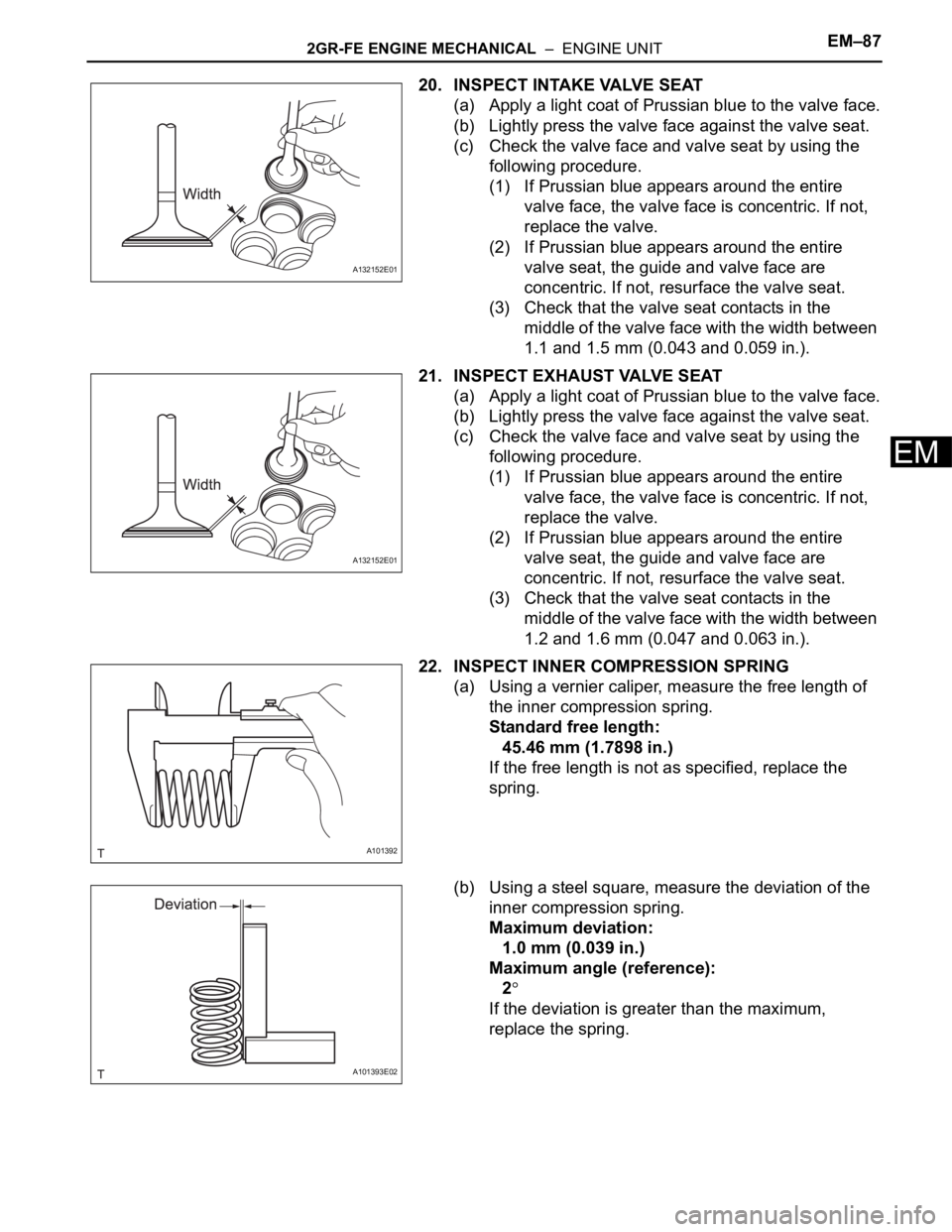
20. INSPECT INTAKE VALVE SEAT
(a) Apply a light coat of Prussian blue to the valve face.
(b) Lightly press the valve face against the valve seat.
(c) Check the valve face and valve seat by using the
following procedure.
(1) If Prussian blue appears around the entire
valve face, the valve face is concentric. If not,
replace the valve.
(2) If Prussian blue appears around the entire
valve seat, the guide and valve face are
concentric. If not, resurface the valve seat.
(3) Check that the valve seat contacts in the
middle of the valve face with the width between
1.1 and 1.5 mm (0.043 and 0.059 in.).
21. INSPECT EXHAUST VALVE SEAT
(a) Apply a light coat of Prussian blue to the valve face.
(b) Lightly press the valve face against the valve seat.
(c) Check the valve face and valve seat by using the
following procedure.
(1) If Prussian blue appears around the entire
valve face, the valve face is concentric. If not,
replace the valve.
(2) If Prussian blue appears around the entire
valve seat, the guide and valve face are
concentric. If not, resurface the valve seat.
(3) Check that the valve seat contacts in the
middle of the valve face with the width between
1.2 and 1.6 mm (0.047 and 0.063 in.).
22. INSPECT INNER COMPRESSION SPRING
(a) Using a vernier caliper, measure the free length of
the inner compression spring.
Standard free length:
45.46 mm (1.7898 in.)
If the free length is not as specified, replace the
spring.
(b) Using a steel square, measure the deviation of the
inner compression spring.
Maximum deviation:
1.0 mm (0.039 in.)
Maximum angle (reference):
2
If the deviation is greater than the maximum,
replace the spring.
A132152E01
A132152E01
A101392
A101393E02