start TOYOTA RAV4 2006 Service Repair Manual
[x] Cancel search | Manufacturer: TOYOTA, Model Year: 2006, Model line: RAV4, Model: TOYOTA RAV4 2006Pages: 2000, PDF Size: 45.84 MB
Page 1 of 2000

ENGINE - 2AZ-FE ENGINE EG-4
FEATURES OF 2AZ-FE ENGINE
The 2AZ-FE engine has achieved the following performance through the use of the items listed below.
(1) High performance and reliability
(2) Low noise and vibration
(3) Lightweight and compact design
(4) Good serviceability
(5) Clean emission and fuel economy
Section
Item(1)(2)(3)(4)(5)
Engine
A cylinder block made of aluminum alloy along with a
magnesium alloy die-cast cylinder head cover is used.
Engine
ProperA taper squish shape is used for the combustion chamber.p
A resin gear balance shaft is used.
Vl
A timing chain and chain tensioner are used.
Va l v e
MechanismThe shim-less type valve lifters are used.MechanismThe VVT-i system is used.
A chacoal filter is used in the air cleaner cap.
Intake andIntake manifold made of plastic is used.Intake and
ExhaustThe linkless-type throttle body is used.
SystemA thin-wall ceramic TWC (Three-Way Catalytic converter)
is used.
The fuel returnless system is used.
Fuel
System
Quick connectors are used to connect the fuel hose with the
fuel pipe.
System12-hole type fuel injectors with high atomizing performance
are used.
Ignition
SystemIridium-tipped spark plugs are used.
Charging
SystemThe segment conductor type generator is used.
Starting
SystemPS (Planetary reduction-Segment conductor motor) type
starter is used.
The ETCS-i is used.
Engine
Control
The DIS (Direct Ignition System) makes ignition timing
adjustment unnecessary.
Control
SystemThe non-contact type sensor is used in the throttle position
sensor.
The planar type air-fuel ratio sensor is used.
Page 22 of 2000

ENGINE - 2AZ-FE ENGINE
206EG40206EG41
206EG42
Stator Segment
ConductorStator
Joined
Joined Segment
Conductor SystemSegment
ConductorStator
StatorConductor
Wire
Conductor Wire
A
AA - A Cross
Section
Segment Conductor Type GeneratorB
BB - B Cross
Section
Conventional Type GeneratorWinding System
Stator
Segment
Conductor
Cross Section
Stator of Segment Conductor Type GeneratorEG-25
CHARGING SYSTEM
1. Segment Conductor Type Generator
A compact and lightweight segment conductor type generator that generates high amperage output in a
highly efficient manner is used.
This generator has a joined segment conductor system in which multiple segment conductors are welded
together to form the stator. Compared to the conventional winding system, the electrical resistance is
reduced due to the shape of the segment conductors, and their arrangement helps to make the generator
compact.
Specifications
Ty p eSE0
Rated Voltage12 V
Rated Output100 A
Initial Output Starting SpeedMax. 1,500 rpm
Page 24 of 2000

ENGINE - 2AZ-FE ENGINE
01NEG46Y
ArmatureSurface Commutator
Permanent Magnet
Brush
LengthEG-27
STARTING SYSTEM
1. General
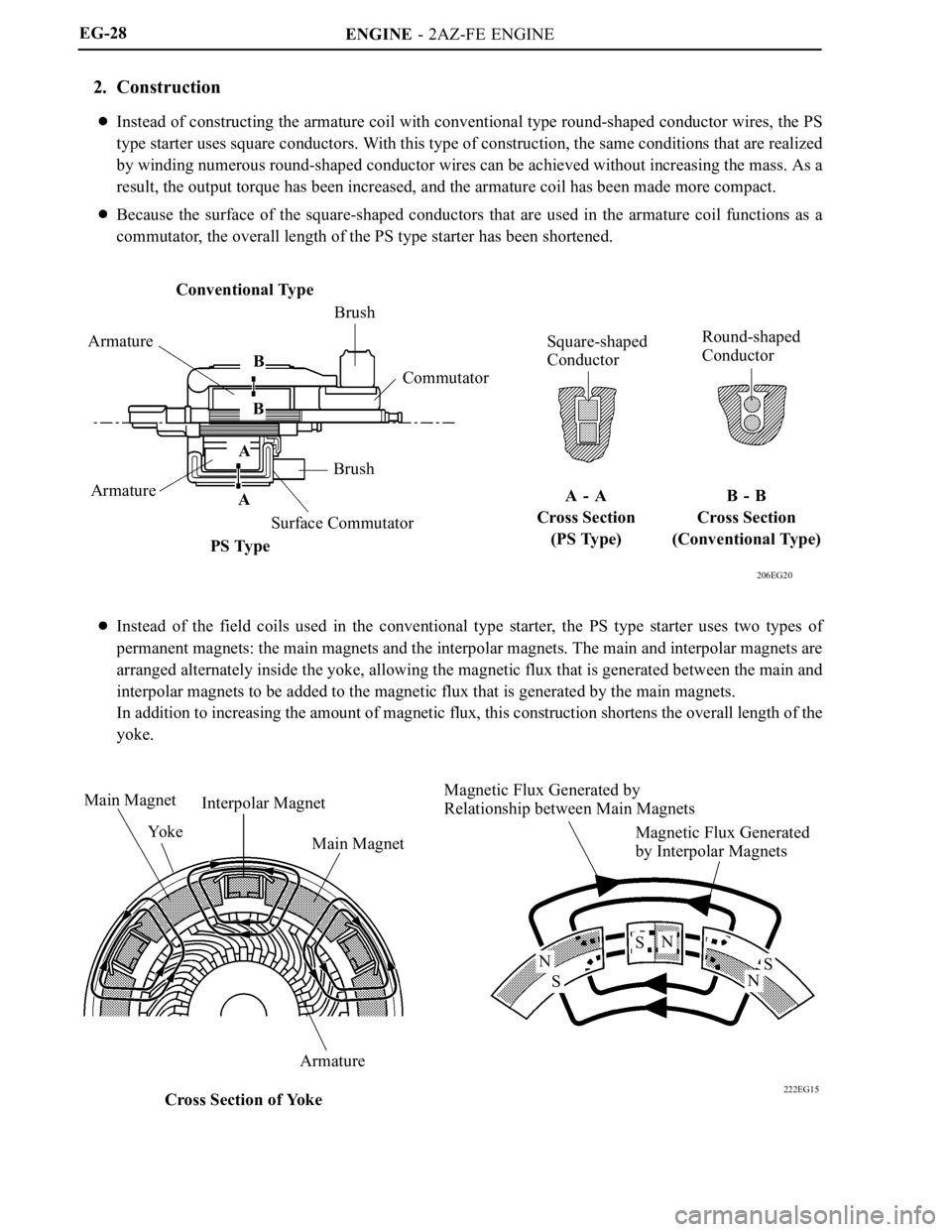
A compact and lightweight PS (Planetary reduction-Segment conductor motor) type starter is used.
Because the PS type starter contains an armature that uses square-shaped conductors, and its surface
functions as a commutator, it has resulted in both improving its output torque and reducing its overall
length.
In place of the field coil used in the conventional type starter, the PS type starter uses two types of
permanent magnets: main magnets and interpolar magnets. The main magnets and interpolar magnets
have been efficiently arranged to increase the magnetic flux and to shorten the length of the yoke.
Specifications
Starter TypePS Type
Rating Output1.7 kW
Rating Voltage12 V
Length*1mm (in.)128 (5.04)
Weight g (lb)2950 (6.50)
Rotational Direction*2Counterclockwise
*1: Length from the mounted area to the rear end of the starter
*
2: Viewed from pinion side
Page 25 of 2000
ENGINE - 2AZ-FE ENGINE
206EG20
Conventional Type
A - A
Cross Section
(PS Type)B - B
Cross Section
(Conventional Type)
B
B
A
A Armature
ArmatureBrushCommutator Brush
Surface CommutatorSquare-shaped
ConductorRound-shaped
Conductor
PS Type
222EG15
Main Magnet
Interpolar Magnet
Yo k e
Main Magnet
Armature
Cross Section of YokeMagnetic Flux Generated by
Relationship between Main Magnets
Magnetic Flux Generated
by Interpolar Magnets
N
N
N
S
S
S EG-28
2. Construction
Instead of constructing the armature coil with conventional type round-shaped conductor wires, the PS
type starter uses square conductors. With this type of construction, the same conditions that are realized
by winding numerous round-shaped conductor wires can be achieved without increasing the mass. As a
result, the output torque has been increased, and the armature coil has been made more compact.
Because the surface of the square-shaped conductors that are used in the armature coil functions as a
commutator, the overall length of the PS type starter has been shortened.
Instead of the field coils used in the conventional type starter, the PS type starter uses two types of
permanent magnets: the main magnets and the interpolar magnets. The main and interpolar magnets are
arranged alternately inside the yoke, allowing the magnetic flux that is generated between the main and
interpolar magnets to be added to the magnetic flux that is generated by the main magnets.
In addition to increasing the amount of magnetic flux, this construction shortens the overall length of the
yoke.
Page 28 of 2000

ENGINE - 2AZ-FE ENGINEEG-31
System
Outline
Engine
Immobilizer*
2
Prohibits fuel delivery and ignition if an attempt is made to start the engine with
an invalid ignition key.
Diagnosis
(See page EG-67)When the ECM detects a malfunction, the ECM diagnoses and memorizes the
failed section.
Fail-safe
(See page EG-67)When the ECM detects a malfunction, the ECM stops or controls the engine
according to the data already stored in memory.
*2: Models with Engine Immobilizer System
Page 29 of 2000

ENGINE - 2AZ-FE ENGINE
01MEG04Y
SENSORSACTUATORS
MASS AIR FLOW METER
INTAKE AIR TEMPERATURE
SENSOR
ENGIEN COOLANT
TEMPERATURE SENSOR
THROTTLE POSITION
SENSOR
CRANKSHAFT POSITION
SENSOR
CAMSHAFT POSITION
SENSOR
ACCELERATOR PEDAL
POSITION SENSOR
AIR-FUEL RATIO SENSOR
(Bank 1, Sensor 1)
HEATED OXYGEN SENSOR
(Bank 1, Sensor 2)
KNOCK SENSOR
COMBINATION METER
Vehicle Speed Signal
IGNITION SWITCH
Ignition Signal
Starter Signal
PA R K / N E U T R A L P O S I T I O N
SWITCH
TRANSMISSION CONTROL
SWITCH
CRUISE CONTROL SWITCHVG
THA
THW
VTA1
VTA2
NE
G2
VPA
VPA2
A1A
OX1B
KNK1
SPD
IGSW
STA
D, 2, L
R, P, N
3
CCSECM#10
#20
#30
#40
IGT1 IGT4
IGF1
M
OC1
FC
HA1A
HT1BSFI
No.1 INJECTOR
No.2 INJECTOR
No.3 INJECTOR
No.4 INJECTOR
ESA
IGNITION COIL
with IGNITER
SPARK PLUGS
ETCS-i
THROTTLE CONTROL
MOTOR
VVT-i
CAMSHAFT TIMING OIL
CONTROL VALVE
FUEL PUMP CONTROL
CIRCUIT OPENING
RELAY
AIR-FUEL RATIO AND
HEATED OXYGEN SENSOR
HEATER CONTROL
AIR-FUEL RATIO SENSOR
HEATER (Bank1, Sensor1)
HEATED OXYGEN SENSOR
HEATER (Bank1, Sensor2)
EG-32
2. Construction
The configuration of the engine control system in the 2AZ-FE engine is shown in the following chart.
(Continued)
Page 46 of 2000

ENGINE - 2AZ-FE ENGINE
185EG48
185EG49
185EG50
287EG34
185EG48
185EG48
TDCLatest Timing
EX IN
BDC
To Advance Side
EX IN
EX IN
To Advance Side
EX IN
To Retard Side
Latest Timing
EX IN
Latest Timing
EX INEG-49
Effectiveness of the VVT-i System
Operation State
ObjectiveEffect
During Idling
At Light Load
Minimizing overlap to
reduce blowback to the
intake sideStabilized idling rpm
Better fuel economy
At Medium Load
Increasing overlap
increases internal EGR,
reducing pumping lossBetter fuel economy
Improved emission
control
In Low to Medium
Speed Range with
Heavy LoadAdvancing the intake
valve close timing for
volumetric efficiency
improvement
Improved torque in low
to medium speed range
In High Speed Range
with Heavy Load
Retarding the intake
valve close timing for
volumetric efficiency
improvement
Improved output
At LowTemperature
Minimizing overlap to
prevent blowback to
the intake side leads to
the lean burning
condition, and
stabilizes the idling
speed at fast idle
Stabilized fast
idle rpm
Better fuel economy
Upon Starting
Stopping the
Engine
Minimizing overlap to
minimize blowback to
the intake side
Improved startability
Page 47 of 2000

ENGINE - 2AZ-FE ENGINE
169EG36
HousingLock Pin
Intake Camshaft
Vane (Fixed on Intake Camshaft)
Oil Pressure
At a Stop In Operation
Lock Pin
221EG17
To VVT-i Controller
(Advance Side)To V V T- i C o n t r o l l e r
(Retard Side)
Sleeve
Spring
Drain
Oil PressureDrain
Spool ValveCoil
Plunger EG-50
Construction
1) VVT-i Controller
This controller consists of the housing driven by the timing chain and the vane fixed on the intake
camshaft.
The oil pressure sent from the advance or retard side path at the intake camshaft causes rotation in the
VVT-i controller vane circumferential direction to vary the intake valve timing continuously.
When the engine is stopped, the intake camshaft will be in the most retarded state to ensure startability.
When hydraulic pressure is not applied to the VVT-i controller immediately after the engine has been
started, the lock pin locks the movement of the VVT-i controller to prevent a knocking noise.
2) Camshaft Timing Oil Control Valve
This camshaft timing oil control valve controls the spool valve position in accordance with the duty-cycle
control from the ECM. This allows hydraulic pressure to be applied to the VVT-i controller advance or
retard sides. When the engine is stopped, the camshaft timing oil control valve is in the most retarded
state.
Page 50 of 2000

ENGINE - 2AZ-FE ENGINE
00REG18Y
Front Airbag
Sensor
(RH and LH)
Curtain Shield
Airbag Sensor*
(RH and LH)Airbag
Sensor
Side Airbag
Sensor*
(RH or LH)ECMCircuit
Opening
Relay
Fuel
Pump
Motor
: CANEG-53
9. Fuel Pump Control
A fuel cut control is used to stop the fuel pump when the SRS airbag is deployed at the front collision. In this
system, the airbag deployment signal from the airbag sensor is detected by the ECM, which turns OFF the
circuit opening relay.
After the fuel cut control has been activated, turning the ignition switch from OFF to ON cancels the fuel cut
control, and the engine can be restarted.
*: Models with SRS Driver, Front Passenger, Side and Curtain Shield Airbags
Page 68 of 2000

ENGINE - 2GR-FE ENGINE EG-72
Item
(1)(2)(3)(4)(5)
ChargingA segment conductor type generator is used.Charging
SystemA generator pulley with a clutch is used.
Starting
SystemThe PS (Planetary reduction-Segment conductor motor)
type starter is used.
Serpentine Belt
Drive SystemA serpentine belt drive system is used.
The MRE (Magnetic Resistance Element) type VVT sensorsThe MRE (Magnetic Resistance Element) type VVT sensors
are used.
The ETCS-i (Electronic Throttle Control System-intelligent)
Engine
The ETCS i (Electronic Throttle Control System intelligent)
is used.
Control
SystemThe ACIS (Acoustic Control Induction System) is used.SystemThe air intake control system is used.
The charging control is used.
Evaporative emission control system is used.