start TOYOTA RAV4 2006 Service User Guide
[x] Cancel search | Manufacturer: TOYOTA, Model Year: 2006, Model line: RAV4, Model: TOYOTA RAV4 2006Pages: 2000, PDF Size: 45.84 MB
Page 96 of 2000

ENGINE - 2GR-FE ENGINE
01MEG38Y
Water Pump Pulley
Crankshaft Pulley
Air Conditioning
Compressor PulleyIdler Pulley for
Automatic
Te n s i o n e rGenerator Pulley Belt Idler
285EG78
Idler
PulleySpring
Arm
BracketBelt Pulling
Direction
Belt Tension
Direction
Fulcrum
Cross Section EG-98
STARTING SYSTEM
The 2GR-FE engine uses the same starter as the 2AZ-FE engine. For details, see page EG-27.
SERPENTINE BELT DRIVE SYSTEM
1. General
Accessory components are driven by a serpentine belt consisting of a single V-ribbed belt. It reduces the
overall engine length, weight and the number of engine parts.
An automatic tensioner eliminates the need for tension adjustment.
2. Automatic Tensioner
The tension of the V-ribbed belt is properly maintained by the tension spring that is enclosed in the automatic
tensioner.
Page 98 of 2000

ENGINE - 2GR-FE ENGINE EG-102
System
Outline
Air-fuel Ratio Sensor and
Oxygen Sensor Heater
ControlMaintains the temperature of the air-fuel ratio sensor or oxygen sensor at an
appropriate level to increase accuracy of detection of the oxygen
concentration in the exhaust gas.
Evaporative Emission
Control
[See page EG-131]
The ECM controls the purge flow of evaporative emission (HC) in the
canister in accordance with engine conditions.
Approximately five hours after the ignition switch has been turned OFF,
the ECM operates the canister pump module to detect any evaporative
emission leakage occurring in the EVAP (evaporative emission) control
system through changes in the EVAP control system pressure.
Engine ImmobilizerProhibits fuel delivery and ignition if an attempt is made to start the engine
with an invalid ignition key.
Diagnosis
[See page EG-132]When the ECM detects a malfunction, the ECM diagnoses and memorizes
the failed section.
Fail-safe
[See page EG-133]When the ECM detects a malfunction, the ECM stops or controls the engine
according to the data already stored in the memory.
Page 108 of 2000

ENGINE - 2GR-FE ENGINE
271EG160
Timing Rotor
Intake VVT
Sensor
VC
VV1+
VV1 -ECM
Intake VVT Sensor (Bank 1) EG-112
2) MRE Type VVT Sensor
The MRE type VVT sensor consists of an MRE, a magnet and a sensor. The direction of the magnetic
field changes due to the different shapes (protruded and non-protruded portions) of the timing rotor,
which passes by the sensor. As a result, the resistance of the MRE changes, and the output voltage to
the ECM changes to Hi or Lo. The ECM detects the camshaft position based on this output voltage.
The differences between the MRE type VVT sensor and the pick-up coil type VVT sensor used on
the conventional models are as follows.
ItemSensor TypeItemMREPick-up Coil
Signal OutputConstant digital output starts from
low engine speeds.Analog output changes with the
engine speed.
Camshaft Position
Detection
Detection is made by comparing
the NE signals with the Hi / Lo
output switch timing due to the
protruded / non-protruded portions
of the timing rotor, or made based
on the number of the input NE
signals during Hi / Lo outputs.
Detection is made by comparing
the NE signals with the change of
waveform that is output when the
protruded portion of the timing
rotor passes.
Wiring Diagram
Page 117 of 2000

ENGINE - 2GR-FE ENGINE
285EG62 285EG61 285EG60
285EG63
285EG59
285EG59 285EG59
Earliest Timing
(EX)Latest Timing
(IN)TDC
EX IN
BDC
To Advance
Side (EX)To R e t a r d
Side (IN)
EX IN
To Advance
Side (IN)To R e t a r d
Side (EX)
EX IN
EX IN
EX IN
To Retard
Side (EX)To Advance
Side (IN)
To R e t a r d
Side (IN)To A d v a n c e
Side (EX)
Earliest Timing
(EX)Latest Timing
(IN)
Earliest Timing
(EX)Latest Timing
(IN)
EX IN
EX IN
EG-121
Effectiveness of the VVT-i System
Operation State
ObjectiveEffect
During Idling
Eliminating overlap to
reduce blow back to the
intake side.Stabilized idling rpm
Better fuel economy
At Light Load
Eliminating overlap to
reduce blow back to the
intake side.
Ensured engine stability
At Medium Load
Increasing overlap
increases internal EGR,
reducing pumping loss.Better fuel economy
Improved emission
control
In Low to
Medium Speed
Range with
Heavy LoadAdvancing the intake
valve close timing for
volumetric efficiency
improvement.
Improved torque in low
to medium speed range
In High Speed
Range with
Heavy LoadRetarding the intake
valve close timing for
volumetric efficiency
improvement.
Improved output
At Low
Temperatures
Eliminating overlap to
reduce blow back to the
intake side leads to the
lean burning condition,
and stabilizes the idling
speed at fast idle.
Stabilized fast idle
rpm
Better fuel economy
Upon Starting
Stopping the
Engine
Eliminating overlap to
minimize blow back to
the intake side.
Improved startability
Page 118 of 2000

ENGINE - 2GR-FE ENGINE
271EG93
Timing RotorHousingLock PinSprocket
Intake Camshaft
Vane (Fixed on Intake Camshaft)
Oil Pressure
In Operation At a Stop
Lock Pin
281EG47
Housing
Advanced Angle Assist SpringVane (Fixed on Exhaust Camshaft)Lock PinExhaust Camshaft Sprocket EG-122
Construction
1) VVT-i Controller
This controller consists of the housing driven by the timing chain and the vane coupled with the intake
and exhaust camshafts.
The intake side uses a VVT-i controller with 3 vanes, and the exhaust side uses one with 4 vanes.
When the engine stops, the intake side VVT-i controller is locked on the most retarded angle side by
the lock pin, and the exhaust side VVT-i controller is locked on the most advanced angle side. This
ensures excellent engine startability.
The oil pressure sent from the advance or retard side path at the intake and exhaust camshaft causes
rotation in the VVT-i controller vane circumferential direction to vary the intake valve timing
continuously.
An advanced angle assist spring is provided on the exhaust side VVT-i controller. This helps to apply
torque in the advanced angle direction so that the vane lock pin securely engages with the housing
when the engine stops.
Intake Side VVT-i Controller
Exhaust Side VVT-i Controller
Page 133 of 2000

CHASSIS - 4WD SYSTEM CH-66
4WD SYSTEM
DESCRIPTION
The 4WD system of the ’06 RAV4 uses an active torque control 4WD system.
It is a compact, lightweight, and high performance 4WD system that optimally controls the torque
distribution to the front and rear wheels through the electric control coupling in the rear differential.
ACTIVE TORQUE CONTROL 4WD SYSTEM
1. General
Based on information provided by various sensors, the 4WD ECU controls the amperage that is applied
to the electric control coupling, in order to transmit drive torque to the rear wheels when needed, and in
the amount needed. The following describes the features of the active torque control 4WD system.
Traction performance
Realizes stable start-off and acceleration performance
Driving stability performanceRealizes stable cornering performance
Fuel economyRealizes better fuel economy by transmitting drive torque to the rear
wheels when needed, in the amount needed.
A four-wheel drive lock switch has been provided. This enables the driver to select between the AUTO
and LOCK modes by operating the switch. The system optimally controls the torque distribution to the
front and rear wheels in the respective modes.
Mode
Four-wheel Drive
Lock Switch and
Indicator Light
Outline
AUTOOFF
Optimally distributes drive torque to the front and rear wheels.
Ensures optimal start-off performance during a start-off, based on
information provided by various sensors.
Suppresses the tight corner braking phenomenon* during low-speed
cornering.
Reduces the amount of torque distribution to the rear wheels and
improves fuel economy when the system judges that the vehicle is
traveling steadily.
Disengages the 4WD during braking deceleration.
LOCKON
Distributes the maximum torque limit to the rear wheels.
Distributes the maximum torque limit to the rear wheels during
start-off.
Distributes optimal torque during low-speed cornering.
Disengages the 4WD during braking deceleration.
Disengages the LOCK mode and transfers to the AUTO mode when
the vehicle speed exceeds 40 km / h (25 mph).
*: Tight corner braking phenomenon: a condition in which the brakes are applied due to a rotational difference
between the front and rear wheels, such as during low-speed cornering in the 4WD mode.
The 4WD ECU effects cooperative control with the skid control ECU, in order to control the drive torque
distribution to the front and rear wheels in accordance with information received from the skid control
ECU. These controls ensure a smooth acceleration and driving stability.
Page 137 of 2000

CHASSIS - 4WD SYSTEM
01NCH38Y
Torque Distribution
to Rear WheelsTorque Distribution
to Rear Wheels
Straightline Driving Low-Speed Cornering
01NCH39Y
Torque Distribution
to Rear WheelsTorque Distribution
to Rear Wheels
Steady Driving Straightline Acceleration
NOTICE
In the LOCK mode after the four-wheel drive lock switch is pressed, the system starts control upon
judging that the vehicle is operating in a stable manner. During this judgment, the 4WD LOCK
indicator light blinks.
CH-70
5. System Operation
Auto Mode
1) Starting Off
The system ensures start-off performance by optimally distributing the entire drive torque, which is
transmitted by the engine, to the front and rear wheels.
To prevent the tight corner braking phenomenon from occurring during low-speed cornering, the
system reduces the amount of torque distribution to the rear wheels.
2) Normal Driving
During normal driving, when the system judges that the vehicle is traveling steadily, it reduces the
amount of torque distribution to the rear wheels. This allows the vehicle to operate in conditions
similar to front-wheel-drive, which improves fuel economy.
To ensure excellent acceleration performance during straightline acceleration and excellent driving
stability during cornering, the system controls the amount of torque distribution to the rear wheels.
Lock Mode
When the vehicle is in a situation that poses difficulty for it to pull itself out, such as sand, the driver can
switch to LOCK mode by operating the four-wheel drive lock switch. Thus, this mode effects optimal
control in accordance with the driving conditions and transmits as much drive torque as possible to the rear
wheels, in a mode that is similar to the locked 4WD mode.
Page 179 of 2000

SERVICE SPECIFICATIONS – U151E AUTOMATIC TRANSMISSIONSS–47
SS
TORQUE SPECIFICATIONS
Automatic Transaxle Assembly
Part Tightened N*m kgf*cm ft*lbf
Park/neutral position switch Nut 6.9 70 61 in.*lbf
Bolt 5.4 55 48 in.*lbf
Control shaft lever x Control shaft 13 133 10
Shift control cable x Control shaft lever 15 153 11
Transaxle housing x Engine block Upper side bolt 64 653 47
Lower side bolt
A37 377 27
Lower side bolt
B46 470 34
Torque converter clutch x Drive plate 41 418 30
Flywheel housing under cover x Automatic transaxle 7.8 80 69 in.*lbf
Front engine mounting bracket x Transaxle 64 653 47
Rear engine mounting bracket x Transaxle 45 459 33
Engine mounting bracket LH x Transaxle 64 653 47
Oil filler tube x Transaxle
Oil filler tube x Front engine mounting bracket5.5 56 49 in.*lbf
Control cable bracket No. 1 x Transaxle 12 122 9
Control cable bracket No. 2 x Transaxle 12 122 9
Oil cooler inlet elbow x Transaxle 27 276 20
Oil cooler outlet elbow x Transaxle 27 276 20
Starter x Transaxle37 377 27
Starter wire x Starter9.8 100 88 in.*lbf
Speed sensor (NC) x Transaxle 11 112 8
Speed sensor (NT) x Transaxle 11 112 8
Drain plug x Oil pan47 479 35
Transmission wire x Transaxle 5.4 55 48 in.*lbf
ATF temperature sensor x Valve body 6.6 67 58 in.*lbf
Oil pan x Transaxle7.8 80 69 in.*lbf
Solenoid valve x Valve body SL2, DSL, S4 11 110 8
SL1, SL3 6.6 67 58 in.*lbf
Valve body x Transaxle11 11 2 8
Oil strainer x Valve body11 11 2 8
Floor shift assembly x Body12 122 9
Control cable clamp x Engine mounting insulator 12 122 9
Differential gear lube apply tube x Transaxle housing 9.8 100 87 in.*lbf
Front planetary gear lock nut 280 3,355 207
Brake apply tube clamp x Transaxle case 5.4 55 48 in.*lbf
Transaxle case No. 1 plug x Transaxle rear cover 7.4 75 65 in.*lbf
Transaxle rear cover x Transaxle case Bolt A 19 194 14
Other bolt 25 255 18
Parking lock pawl shaft x Transaxle case 9.8 100 87 in.*lbf
Oil pump assembly x Transaxle case 22 226 16
Transaxle housing x Transaxle case Bolt A 22 254 16
Bolt B 29 295 21
Bolt C 29 295 21
Bolt D 22 254 16
Automatic transmission case plug x Transaxle housing 7.4 75 65 in.*lbf
Automatic transmission case plug x Transaxle case 7.4 75 65 in.*lbf
Page 180 of 2000

SS–48SERVICE SPECIFICATIONS – U151E AUTOMATIC TRANSMISSION
SS
Parking lock pawl bracket x Transaxle case 20 205 15
Manual detent spring x Transaxle case Bolt A 20 205 15
Bolt B 12 120 9
Automatic transaxle oil pan sub-assembly x Transaxle case 7.6 77 67 in.*lbf
Speed sensor x Transaxle case 11 112 8
Park/neutral start switch x Control shaft lever 13 130 9
Speedometer driven hole cover sub-assembly x Transaxle case 5.5 56 49 in.*lbf
Oil pump body x Stator shaft assembly 9.8 100 87 in.*lbf
Front differential case x Front differential ring gear 95 969 70Part Tightened N*m kgf*cm ft*lbf
Page 198 of 2000
2GR-FE ENGINE MECHANICAL – ENGINE ASSEMBLYEM–23
EM
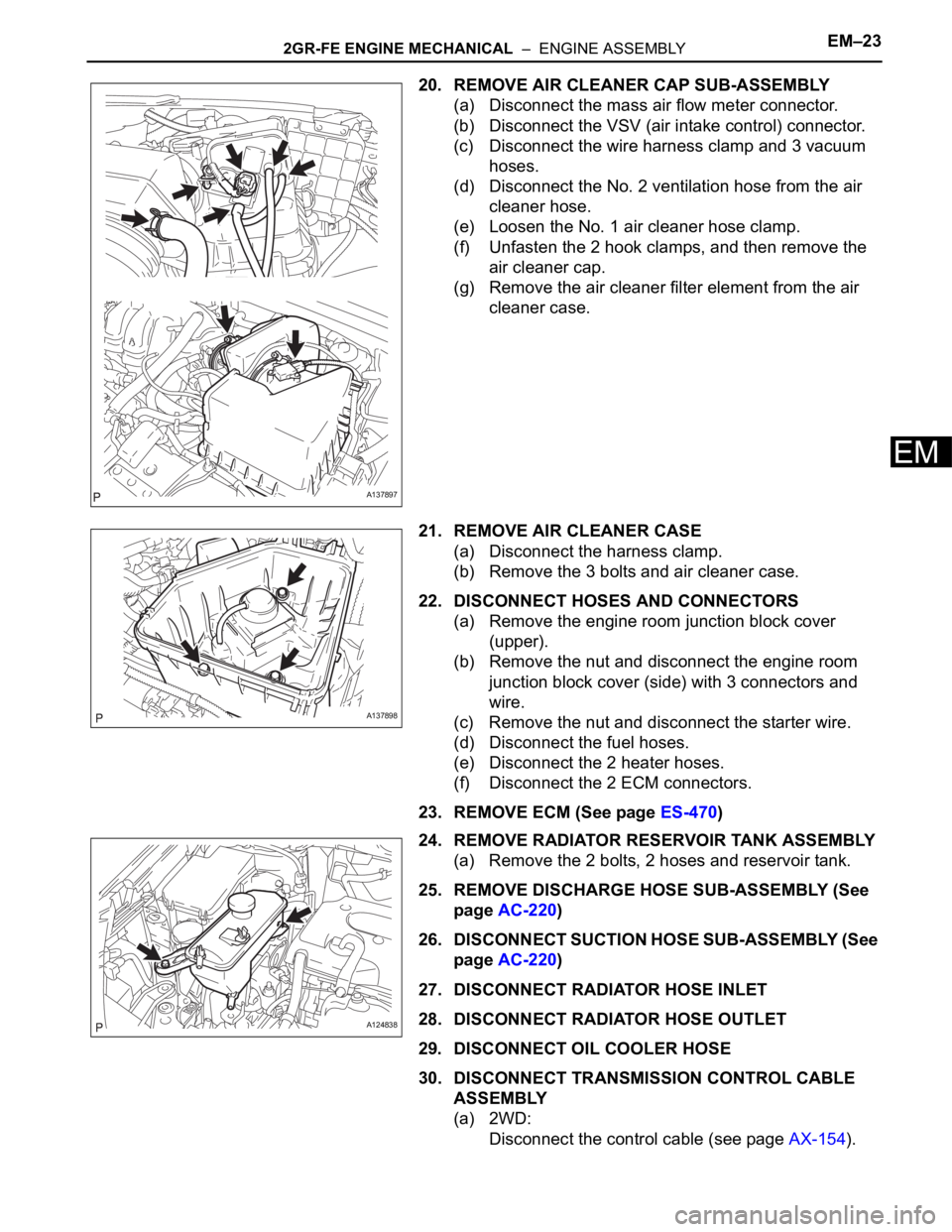
20. REMOVE AIR CLEANER CAP SUB-ASSEMBLY
(a) Disconnect the mass air flow meter connector.
(b) Disconnect the VSV (air intake control) connector.
(c) Disconnect the wire harness clamp and 3 vacuum
hoses.
(d) Disconnect the No. 2 ventilation hose from the air
cleaner hose.
(e) Loosen the No. 1 air cleaner hose clamp.
(f) Unfasten the 2 hook clamps, and then remove the
air cleaner cap.
(g) Remove the air cleaner filter element from the air
cleaner case.
21. REMOVE AIR CLEANER CASE
(a) Disconnect the harness clamp.
(b) Remove the 3 bolts and air cleaner case.
22. DISCONNECT HOSES AND CONNECTORS
(a) Remove the engine room junction block cover
(upper).
(b) Remove the nut and disconnect the engine room
junction block cover (side) with 3 connectors and
wire.
(c) Remove the nut and disconnect the starter wire.
(d) Disconnect the fuel hoses.
(e) Disconnect the 2 heater hoses.
(f) Disconnect the 2 ECM connectors.
23. REMOVE ECM (See page ES-470)
24. REMOVE RADIATOR RESERVOIR TANK ASSEMBLY
(a) Remove the 2 bolts, 2 hoses and reservoir tank.
25. REMOVE DISCHARGE HOSE SUB-ASSEMBLY (See
page AC-220)
26. DISCONNECT SUCTION HOSE SUB-ASSEMBLY (See
page AC-220)
27. DISCONNECT RADIATOR HOSE INLET
28. DISCONNECT RADIATOR HOSE OUTLET
29. DISCONNECT OIL COOLER HOSE
30. DISCONNECT TRANSMISSION CONTROL CABLE
ASSEMBLY
(a) 2WD:
Disconnect the control cable (see page AX-154).
A137897
A137898
A124838