towing TOYOTA RAV4 2018 Owners Manual (in English)
[x] Cancel search | Manufacturer: TOYOTA, Model Year: 2018, Model line: RAV4, Model: TOYOTA RAV4 2018Pages: 744, PDF Size: 13.78 MB
Page 3 of 744
3
RAV4_OM_OM0R012U_(U)
1
9 8
7
6 4 3
2
10
5
4-1. Before drivingDriving the vehicle ............. 166
Cargo and luggage............ 176
Vehicle load limits ............. 180
Trailer towing..................... 181
Dinghy towing.................... 197
4-2. Driving procedures Engine (ignition) switch (vehicles without
smart key system) ........... 198
Engine (ignition) switch (vehicles with
smart key system) ........... 200
Automatic transmission ..... 205
Turn signal lever................ 213
Parking brake .................... 214
4-3. Operating the lights and wipers
Headlight switch ................ 215
Automatic High Beam ....... 220
Fog light switch ................. 224
Windshield wipers and washer ..................... 225
Rear window wiper and washer ..................... 229 4-4. Refueling
Opening the fuel tank cap................................... 232
4-5. Using the driving support systems
Toyota Safety Sense P ...... 235
PCS (Pre-Collision System)..... 242
LDA (Lane Departure Alert with steering
control) ............................ 256
Dynamic radar cruise control.............................. 264
Cruise control .................... 276
Intuitive parking assist ....... 280
Rear view monitor system ............................. 289
All-wheel drive lock switch (AWD models) ...... 299
BSM (Blind Spot Monitor)......... 300
• The Blind Spot Monitor function.......................... 304
• The Rear Cross Traffic Alert function ................. 307
Driving assist systems ....... 310
4-6. Driving tips Winter driving tips .............. 317
Utility vehicle precautions ...................... 321
4Driving
Page 16 of 744
16Pictorial index
RAV4_OM_OM0R012U_(U)
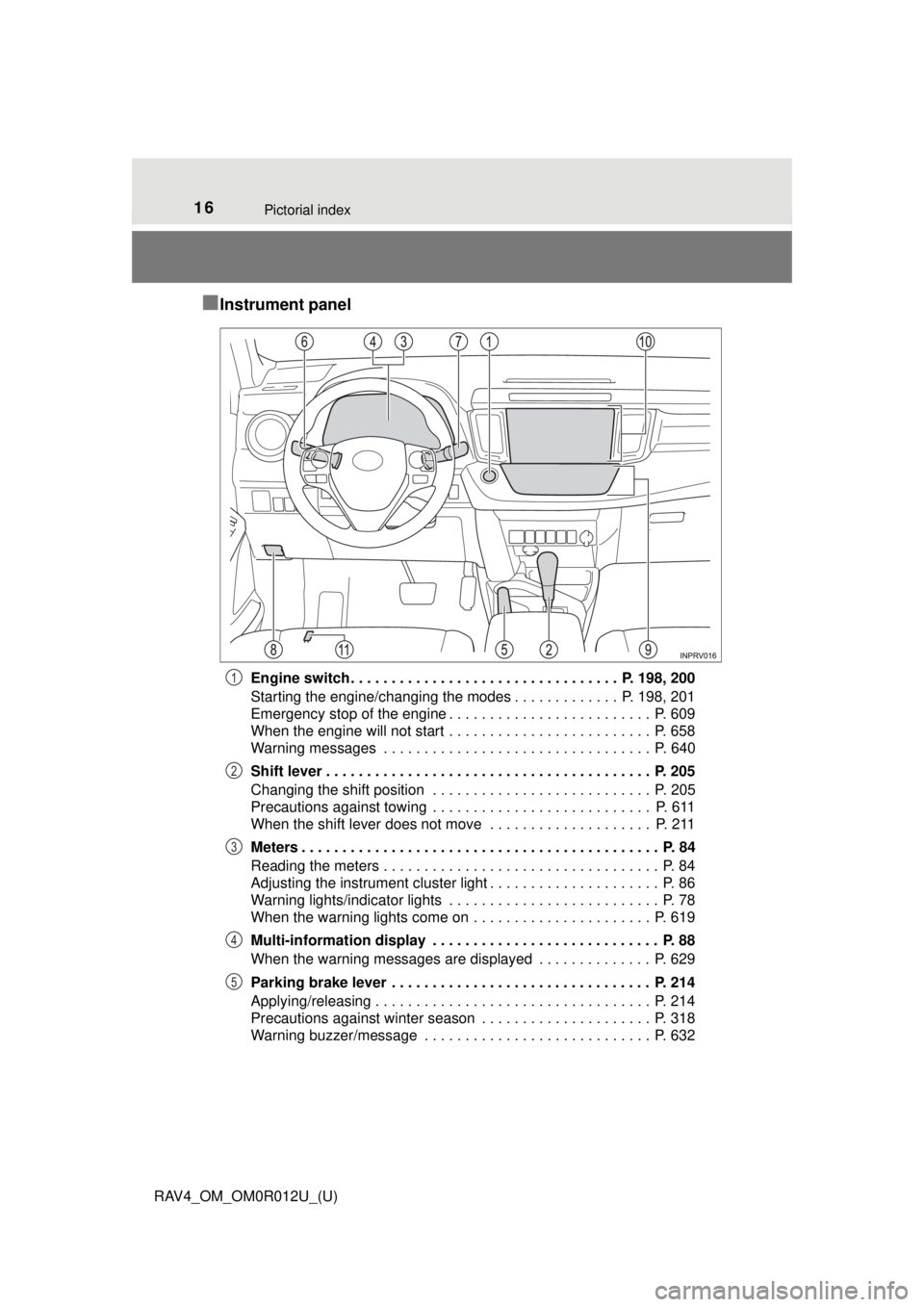
■Instrument panel
Engine switch . . . . . . . . . . . . . . . . . . . . . . . . . . . . . . . . . P. 198, 200
Starting the engine/changing the modes . . . . . . . . . . . . . P. 198, 201
Emergency stop of the engine . . . . . . . . . . . . . . . . . . . . . . . . . P. 609
When the engine will not start . . . . . . . . . . . . . . . . . . . . . . . . . P. 658
Warning messages . . . . . . . . . . . . . . . . . . . . . . . . . . . . . . . . . P. 640
Shift lever . . . . . . . . . . . . . . . . . . . . . . . . . . . . . . . . . . . . . . . . P. 205
Changing the shift position . . . . . . . . . . . . . . . . . . . . . . . . . . . P. 205
Precautions against towing . . . . . . . . . . . . . . . . . . . . . . . . . . . P. 611
When the shift lever does not move . . . . . . . . . . . . . . . . . . . . P. 211
Meters . . . . . . . . . . . . . . . . . . . . . . . . . . . . . . . . . . . . . . . . . . . . P. 84
Reading the meters . . . . . . . . . . . . . . . . . . . . . . . . . . . . . . . . . . P. 84
Adjusting the instrument cluster light . . . . . . . . . . . . . . . . . . . . . P. 86
Warning lights/indicator lights . . . . . . . . . . . . . . . . . . . . . . . . . . P. 78
When the warning lights come on . . . . . . . . . . . . . . . . . . . . . . P. 619
Multi-information display . . . . . . . . . . . . . . . . . . . . . . . . . . . . P. 88
When the warning messages are displayed . . . . . . . . . . . . . . P. 629
Parking brake lever . . . . . . . . . . . . . . . . . . . . . . . . . . . . . . . . P. 214
Applying/releasing . . . . . . . . . . . . . . . . . . . . . . . . . . . . . . . . . . P. 214
Precautions against winter season . . . . . . . . . . . . . . . . . . . . . P. 318
Warning buzzer/message . . . . . . . . . . . . . . . . . . . . . . . . . . . . P. 6321
2
3
4
5
Page 30 of 744
301-1. For safe use
RAV4_OM_OM0R012U_(U)
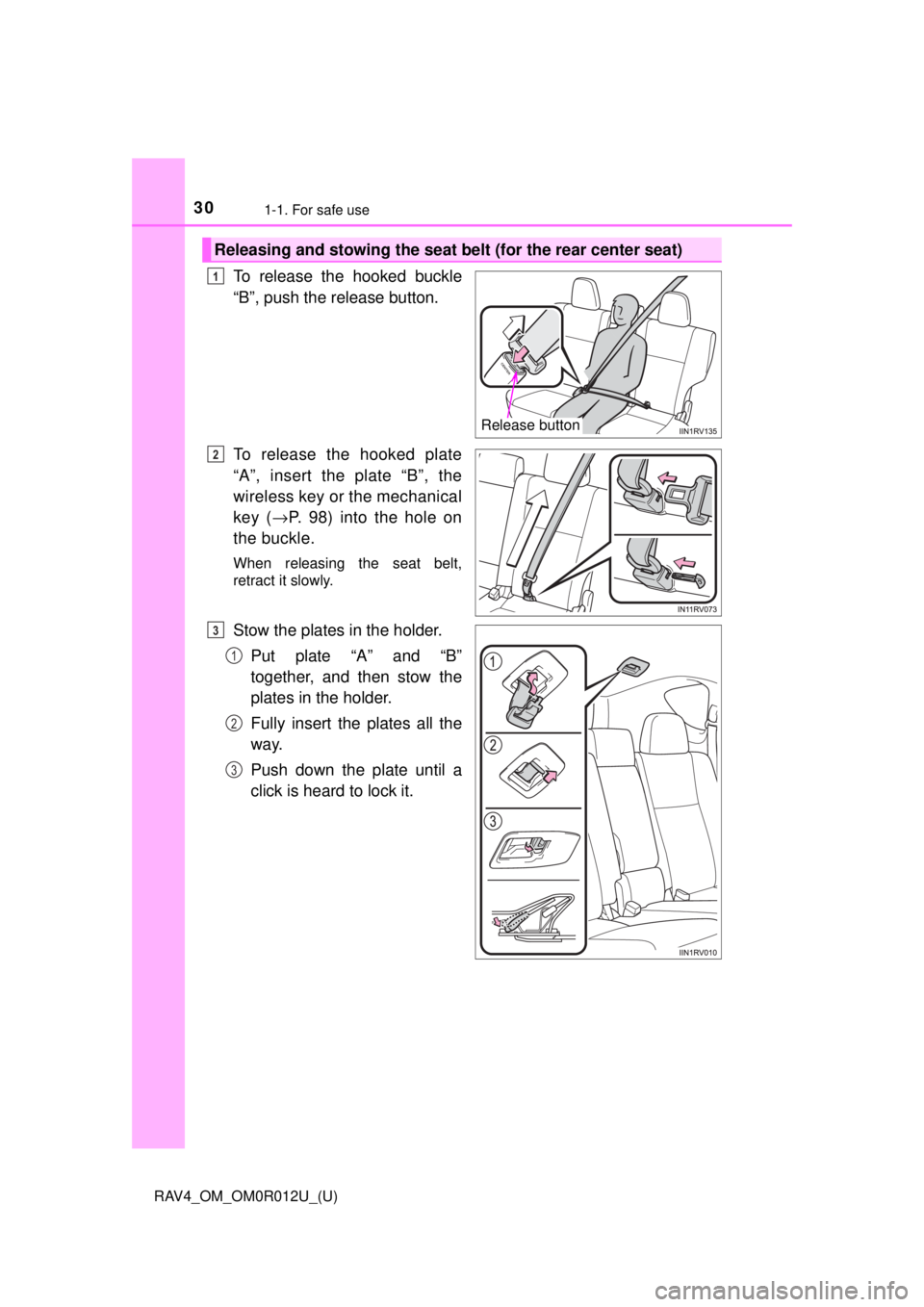
To release the hooked buckle
“B”, push the release button.
To release the hooked plate
“A”, insert the plate “B”, the
wireless key or the mechanical
key (→P. 98) into the hole on
the buckle.
When releasing the seat belt,
retract it slowly.
Stow the plates in the holder.
Put plate “A” and “B”
together, and then stow the
plates in the holder.
Fully insert the plates all the
way.
Push down the plate until a
click is heard to lock it.
Releasing and stowing the seat belt (for the rear center seat)
Release button
1
2
3
1
2
3
Page 122 of 744

122
RAV4_OM_OM0R012U_(U)
3-2. Opening, closing and locking the doors
■Situations in which the touchless sensor does not operate properly
(vehicles with touc hless power back door)
If the touchless sensor does not operate in the following situations, use the
back door opener switch or power back door switch or wireless remote con-
trol to open the power back door. ( →P. 114)
● When the rear bumper is subjected to strong impact
● When an external radio wave source interferes with the communication
between the vehicle and electronic key ( →P. 111 )
● When a large amount of water is kept applying to the lower center part of the
rear bumper, such as in heavy rain
● When the vehicle is being washed and water is kept applying to the lower
center part of the rear bumper
● When the lower center part of the rear bumper is covered with mud, snow,
ice, etc.
● When a metal object, etc., such as a towing hitch is installed near the lower
center part of the rear bumper
● When the vehicle has been parked for a while near objects that may move
and contact the lower center part of the rear bumper, such as grass or trees
● When the vehicle is parked at an area where an electromagnetic field is
generated, such as a road with an electric snow melting system or parking
meters
■ Customization (vehicles with power back door)
Settings (e.g. power back door opening angle) can be changed.
(Customizable features: →P. 701)
Page 143 of 744
RAV4_OM_OM0R012U_(U)
1433-3. Adjusting the seats
3
Operation of each component
WARNING
■When folding the rear seatbacks down
Observe the following precautions. Failure to do so may result in death or
serious injury.
● Do not fold the seatbacks down while driving.
● Stop the vehicle on level ground, set the parking brake and shift the shift
lever to P.
● Do not allow anyone to sit on a folded seatback or in the luggage compart-
ment while driving.
● Do not allow children to enter the luggage compartment.
■ Seat adjustment
● To reduce the risk of sliding under the lap belt during a collision, do not
recline the seat more than necessary.
If the seat is too reclined, the lap belt may slide past the hips and apply
restraint forces directly to the abdomen, or your neck may contact the
shoulder belt, increasing the risk of death or serious injury in the event of
an accident.
Adjustments should not be made while driving as the seat may unexpect-
edly move and cause the driver to lose control of the vehicle.
● Be careful not to get hands or feet pinched between the rear console box\
and the rear seat when folding down the rear seatback.
■ After returning the rear seat back to the upright position
Observe the following precautions. Failure to do so may result in death or
serious injury.
● Make sure the seatback is securely locked by pushing it forward and rear-
ward on the top.
● Check that the seat belts are not twisted or caught in the seatback.
NOTICE
■Stowing the seat belts
The seat belts and the buckles must be stowed before you fold down the
rear seatbacks.
Page 165 of 744
165
RAV4_OM_OM0R012U_(U)
4Driving
4-1. Before drivingDriving the vehicle ............. 166
Cargo and luggage ........... 176
Vehicle load limits ............. 180
Trailer towing..................... 181
Dinghy towing ................... 197
4-2. Driving procedures Engine (ignition) switch (vehicles without
smart key system) ........... 198
Engine (ignition) switch (vehicles with
smart key system) ........... 200
Automatic transmission ..... 205
Turn signal lever................ 213
Parking brake .................... 214
4-3. Operating the lights and wipers
Headlight switch ................ 215
Automatic High Beam ....... 220
Fog light switch ................. 224
Windshield wipers and washer ..................... 225
Rear window wiper and washer ..................... 229 4-4. Refueling
Opening the fuel tank cap .................................. 232
4-5. Using the driving support systems
Toyota Safety Sense P ..... 235
PCS (Pre-Collision System) .... 242
LDA (Lane Departure Alert with steering
control) ............................ 256
Dynamic radar cruise control ............................. 264
Cruise control .................... 276
Intuitive parking assist....... 280
Rear view monitor system ............................ 289
All-wheel drive lock switch (AWD models) ..... 299
BSM (Blind Spot Monitor) ........ 300
• T he Blind Spot Monitor
function ......................... 304
• T he Rear Cross Traffic
Alert function ................. 307
Driving assist systems ...... 310
4-6. Driving tips Winter driving tips ............. 317
Utility vehicle precautions ..................... 321
Page 176 of 744

176
RAV4_OM_OM0R012U_(U)
4-1. Before driving
Cargo and luggage
Cargo capacity depends on the total weight of the occupants.
(Cargo capacity) = (Total load capacity) − (Total weight of occupants)
Steps for Determining Correct Load Limit ⎯
(1) Locate the statement “The comb ined weight of occupants and
cargo should never exceed XXX kg or XXX lbs.” on your vehicle’s
placard.
(2) Determine the combined weight of the driver and passengers that
will be riding in your vehicle.
(3) Subtract the combined weight of the driver and passengers from
XXX kg or XXX lbs.
(4) The resulting figure equals the available amount of cargo and lug- gage load capacity.
For example, if the “ XXX” amount equals 1400 lbs. and there will be
five 150 lb passengers in your v ehicle, the amount of available
cargo and luggage load capacity is 650 lbs. (1400 − 750 (5 × 150) =
650 lbs.)
(5) Determine the combined weight of luggage and cargo being loaded on the vehicle. That weight ma y not safely exceed the available
cargo and luggage load capacity calculated in Step 4.
(6) If your vehicle will be towing a tr ailer, load from your trailer will be
transferred to your vehicle. Consult this manual to determine how
this reduces the available cargo and luggage load capacity of your
vehicle. ( →P. 180)
For vehicles with SE grade: Toyota does not recommend towing a trailer
with your vehicle. Your vehicle is not designed for trailer towing.
Take notice of the following information about storage precau-
tions, cargo capacity and load:
Capacity and distribution
Page 181 of 744

181
RAV4_OM_OM0R012U_(U)
4-1. Before driving
4
Driving
Trailer towing
For vehicles with SE grade
Toyota does not recommend towi ng a trailer with your vehicle.
Toyota also does not recommend the installation of a tow hitch
or the use of a tow hitch carrier for a wheelchair, scooter, bicy-
cle, etc. Your vehicle is not desi gned for trailer towing or for the
use of tow hitch mounted carriers.
Page 182 of 744

182
RAV4_OM_OM0R012U_(U)
4-1. Before driving
Except vehicles with SE grade
Your vehicle is designed primarily as a passenger-and-load-car-
rying vehicle. Towing a trailer can have an adverse impact on
handling, performance, braking, durability, and fuel consump-
tion. For your safety and the safe ty of others, you must not over-
load your vehicle or trailer. You must also ensure that you are
using appropriate towing equipmen t, that the towing equipment
has been installed correctly an d used properly, and that you
employ the requisite driving habits.
Vehicle-trailer stability and braking performance are affected by
trailer stability, brake performance and setting, trailer brakes,
the hitch and hitch systems (if equipped).
To tow a trailer safely, use extreme care and drive the vehicle in
accordance with your trailer’s characteristics and operating
conditions.
Toyota warranties do not appl y to damage or malfunction
caused by towing a trailer for commercial purposes.
Contact your Toyota dealer for further information about additional
requirements such as a towing kit, etc.
Page 183 of 744

RAV4_OM_OM0R012U_(U)
1834-1. Before driving
4
Driving
■GCWR (Gross Combination Weight Rating)
The maximum allowable gross
combination weight. The gross
combination weight is the sum
of the total vehicle weight
(including the occupants, cargo
and any optional equipment
installed on the vehicle) and the
weight of the trailer being towed
(including the cargo in the
trailer).
■GVWR (Gross Vehicle Weight Rating)
The maximum allowable gross
vehicle weight. The gross vehi-
cle weight is the total weight of
the vehicle. When towing a
trailer, it is the sum of the vehi-
cle weight (including the occu-
pants, cargo and any optional
equipment installed on the vehi-
cle) and the tongue weight.
Towing related terms