warning light TOYOTA RAV4 2020 Owners Manual (in English)
[x] Cancel search | Manufacturer: TOYOTA, Model Year: 2020, Model line: RAV4, Model: TOYOTA RAV4 2020Pages: 736, PDF Size: 30.79 MB
Page 2 of 736
2TABLE OF CONTENTS
For your information...................8
Reading this manual ................ 12
How to search .......................... 13
Pictorial index .......................... 14
1-1. For safe use Before driving ................... 26
For safe driving ................ 27
Seat belts ......................... 29
SRS airbags ..................... 33
Front passenger occupant classification system ...... 43
Exhaust gas precautions.. 48
1-2. Child safety Riding with children .......... 49
Child restraint systems..... 50
1-3. Emergency assistance Safety Connect ................ 65
1-4. Theft deterrent system Engine immobilizer system....................................... 70
Alarm................................ 73
2-1. Instrument cluster Warning lights and indicators....................................... 76
Gauges and meters (with 4.2- inch display) ................... 82
Gauges and meters (with 7- inch display) ................... 85
Multi-information display .. 89Fuel consumption information
....................................... 99
3-1. Key information Keys .............................. 102
3-2. Opening, closing and lock- ing the doors
Side doors ..................... 108
Back door ...................... 114
Smart key system .......... 128
3-3. Adjusting the seats Front seats .................... 134
Rear seats ..................... 135
Driving position memory 137
Head restraints .............. 140
3-4. Adjusting the steering wheel and mirrors
Steering wheel............... 142
Inside rear view mirror ... 143
Digital Rear-view Mirror . 145
Outside rear view mirrors .................................... 154
3-5. Opening, closing the win- dows and moon roof
Power windows ............. 156
Moon roof ...................... 159
Panoramic moon roof .... 162
4-1. Before driving Driving the vehicle ......... 169
Cargo and luggage ........ 175
Vehicle load limits .......... 178
1For safety and security
2
Vehicle status
information and
indicators
3Before driving
4Driving
Page 6 of 736
6TABLE OF CONTENTS
8-1. Essential informationEmergency flashers ...... 618
If your vehicle has to be stopped in an emergency.................................... 618
If the vehicle is trapped in ris- ing water...................... 619
8-2. Steps to take in an emer- gency
If your vehicle needs to be
towed........................... 621
If you think something is wrong .......................... 626
Fuel pump shut off system .................................... 627
If a warning light turns on or a warning buzzer sounds 628
If a warning message is dis- played.......................... 639
If you have a flat tire...... 642
If the engine will not start 651
If you lose your keys ..... 653
If the electronic key does not operate properly (vehicles
with smart key system) 653
If the vehicle battery is dis- charged ....................... 655
If your vehicle overheats 659
If the vehicle becomes stuck .................................... 6619-1. Specifications
Maintenance data (fuel, oil level, etc.) .................... 664
Fuel information............. 676
Tire information ............. 678
9-2. Customization Customizable features... 688
9-3. Initialization Items to initialize ............ 699
10-1.For owners Reporting safet y defects for
U.S. owners ................. 702
Seat belt instructions for Canadian owners (in
French) ........................ 703
SRS airbag instructions for Canadian owners (in
French) ........................ 704
What to do if... (Troubleshoot- ing) ............................. 714
Alphabetical Index ........ 717
8When trouble arises9Vehicle specifications
10For owners
Index
Page 15 of 736
15Pictorial index
Precautions against winter season ...................................... P.367
To prevent freezing (windshield wiper de-icer)
*.................... P.520
Precautions against car wash
(Rain-sensing windshield wipers)
*....................................... P.559
Replacing the wiper insert ..................................... ............... P.601
Fuel filler door ............................................... ..................... P.220
Refueling method ............................................... .................. P.220
Fuel type/fuel tan k capacity ................................... .............. P.666
Tires.......................................................... ........................... P.581
Tire size/inflation pressure ................................... ................ P.671
Winter tires/tire chain ........................................ ................... P.367
Checking/rotation/tire pressure warning system
*................. P.581
Coping with flat tires......................................... .................... P.642
Hood ........................................................... ......................... P.571
Opening ............................................................................... P.571
Engine oil ..................................................... ........................ P.666
Coping with overheat ........................................... ................ P.659
Warning messages ............................................... ............... P.639
Headlights..................................................... ...................... P.209
Turn signal lights ............................................. .................. P.202
Parking lights ................................................. .................... P.209
Daytime running lights .. .................................................... P.209
Side marker lights ............................................. ................. P.209
Fog lights
*............................................................... ............ P.437
Stop lights/tail lights/turn s ignal lights .................... P.202, 209
Tail lights.................................................... ......................... P.209
Back-up lights
Light bulbs of the exterior lights for driving
(Replacing method: P.609, Watts: P.675)
E
F
G
H
I
J
K
L
M
N
O
Page 17 of 736
17Pictorial index
■Instrument panel
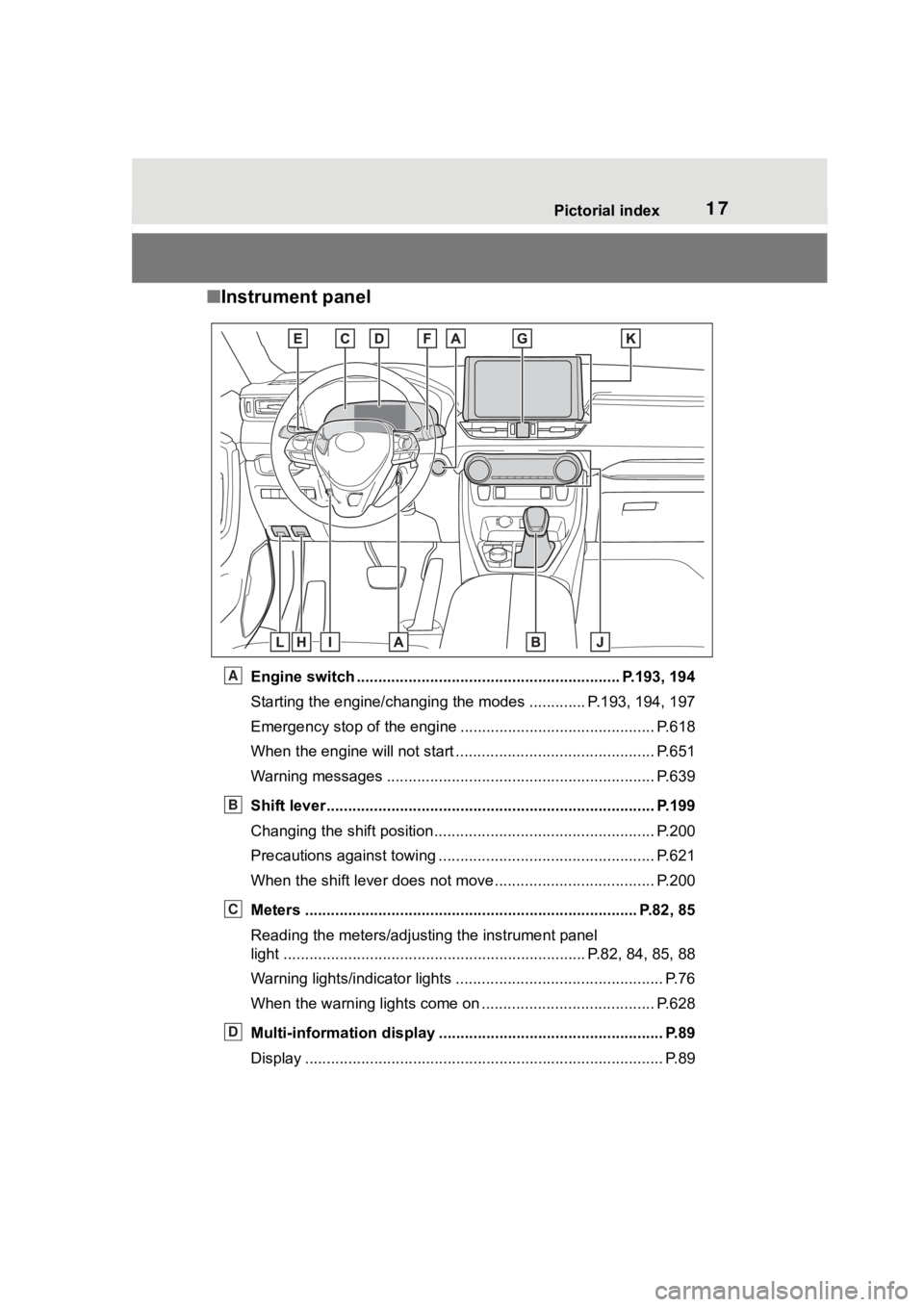
Engine switch ............................................................. P.193, 194
Starting the engine/changing the modes ............. P.193, 194, 197
Emergency stop of the engin e ............................................. P.618
When the engine will not start ................................. ............. P.651
Warning messages ............................................... ............... P.639
Shift lever.................................................... ........................ P.199
Changing the shift position.................................... ............... P.200
Precautions against towing ..................................... ............. P.621
When the shift lever does not move............................. ........ P.200
Meters ............................................................................. P.82, 85
Reading the meters/adjusting the instrument panel
light .......................................................... ............ P.82, 84, 85, 88
Warning lights/indicator lights ................................ ................ P.76
When the warning lights come on ................................ ........ P.628
Multi-information display . ................................................... P.89
Display ........................................................ ........................... P.89A
B
C
D
Page 18 of 736
18Pictorial index
When the warning messages are displayed ........................P. 6 3 9
Turn signal lever.............................................. ................... P.202
Headlight switch ............................................... ................. P.209
Headlights/parking lights/tail lights/
license plate lights/daytime running lights .................... ........ P.209
Fog lights
*1............................................................... ............ P.437
Windshield wiper and washer switch............................... P.215
Rear window wiper and washer switch ........................... P.218
Usage.......................................................... ................. P.215, 218
Adding washer fluid .............................................................. P.580
Warning messages ............................................... ............... P.639
Emergency flasher switch ....................................... .......... P.618
Hood lock release lever ........................................ ............. P.571
Tilt and telescopic steering lock release lever ................P. 1 4 2
Adjustment ..................................................... ...................... P.142
Air conditioning system ............................. ............... P.510, 515
Usage.......................................................... ................. P.510, 515
Rear window defogger ........................................... ...... P.511, 517
Audio
*1............................................................... ................. P.375
Audio Plus
*1, 2
Premium Audio*1, 2
Fuel filler door opener lever .................................. ............ P.221
*1: If equipped
*2: Refer to “NAVIGATION AND MULTIMEDIA SYSTEM OWNER’S MAN-
UAL”.
E
F
G
H
I
J
K
L
Page 32 of 736
321-1. For safe use
click.
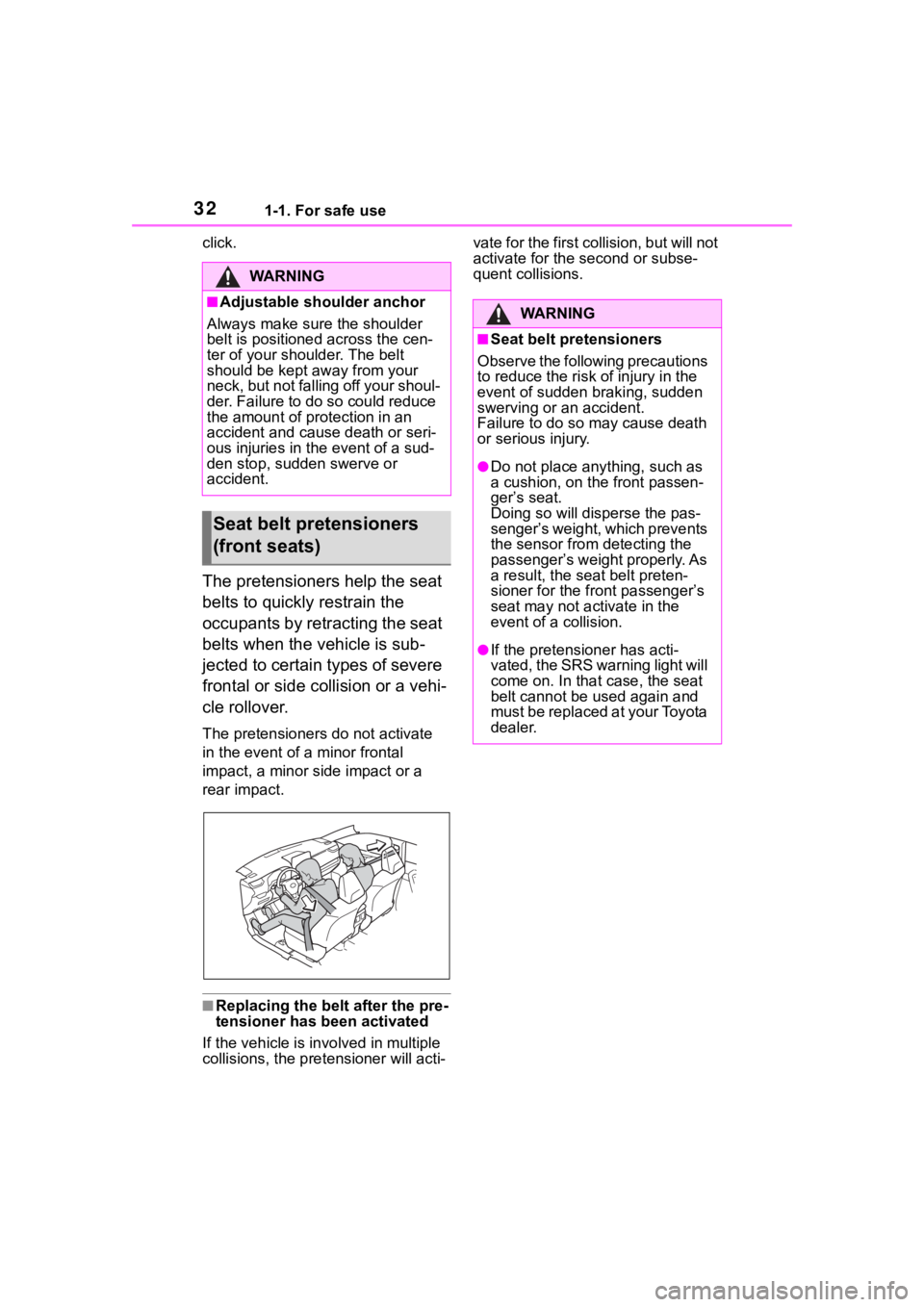
The pretensioners help the seat
belts to quickly restrain the
occupants by retracting the seat
belts when the vehicle is sub-
jected to certain types of severe
frontal or side collision or a vehi-
cle rollover.
The pretensioners do not activate
in the event of a minor frontal
impact, a minor side impact or a
rear impact.
■Replacing the belt after the pre-
tensioner has been activated
If the vehicle is in volved in multiple
collisions, the pret ensioner will acti- vate for the first collision, but will not
activate for the
second or subse-
quent collisions.
WA R N I N G
■Adjustable shoulder anchor
Always make sure the shoulder
belt is positioned across the cen-
ter of your shoulder. The belt
should be kept away from your
neck, but not falling off your shoul-
der. Failure to do so could reduce
the amount of protection in an
accident and cause death or seri-
ous injuries in the event of a sud-
den stop, sudden swerve or
accident.
Seat belt pretensioners
(front seats)
WA R N I N G
■Seat belt pretensioners
Observe the following precautions
to reduce the risk of injury in the
event of sudden braking, sudden
swerving or an accident.
Failure to do so may cause death
or serious injury.
●Do not place anything, such as
a cushion, on the front passen-
ger’s seat.
Doing so will disperse the pas-
senger’s weight, which prevents
the sensor from detecting the
passenger’s weight properly. As
a result, the seat belt preten-
sioner for the fr ont passenger’s
seat may not activate in the
event of a collision.
●If the pretensioner has acti-
vated, the SRS warning light will
come on. In that case, the seat
belt cannot be used again and
must be replaced at your Toyota
dealer.
Page 35 of 736
351-1. For safe use
1
For safety and security
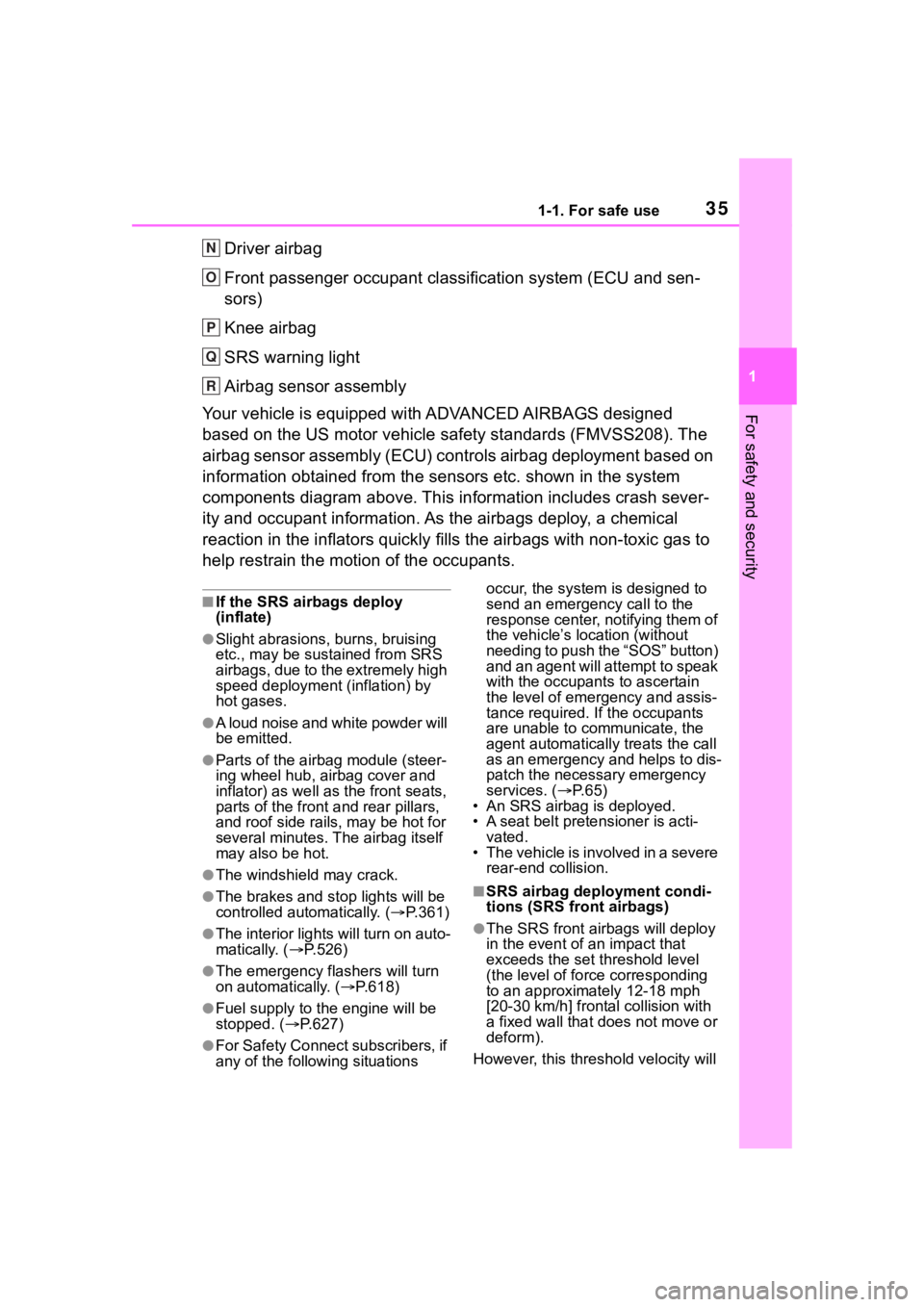
Driver airbag
Front passenger occupant classification system (ECU and sen-
sors)
Knee airbag
SRS warning light
Airbag sensor assembly
Your vehicle is equipped with ADVANCED AIRBAGS designed
based on the US motor vehicle safety standards (FMVSS208). The
airbag sensor assembly (ECU) cont rols airbag deployment based on
information obtained from the sensors etc. shown in the system
components diagram above. This in formation includes crash sever-
ity and occupant information. As the airbags deploy, a chemical
reaction in the inflators quickly fills the airbags with non-toxic gas to
help restrain the motion of the occupants.
■If the SRS airbags deploy
(inflate)
●Slight abrasions, burns, bruising
etc., may be sustained from SRS
airbags, due to the extremely high
speed deployment (inflation) by
hot gases.
●A loud noise and white powder will
be emitted.
●Parts of the airbag module (steer-
ing wheel hub, airbag cover and
inflator) as well as the front seats,
parts of the front and rear pillars,
and roof side rails, may be hot for
several minutes. T he airbag itself
may also be hot.
●The windshield may crack.
●The brakes and st op lights will be
controlled automatically. ( P.361)
●The interior lights will turn on auto-
matically. ( P.526)
●The emergency flashers will turn
on automatically. ( P.618)
●Fuel supply to the engine will be
stopped. (P.627)
●For Safety Connect subscribers, if
any of the followin g situations occur, the system is designed to
send an emergency call to the
response center, notifying them of
the vehicle’s location (without
needing to push the “SOS” button)
and an agent will attempt to speak
with the occupants to ascertain
the level of emergency and assis-
tance required. If the occupants
are unable to communicate, the
agent automatically treats the call
as an emergency and helps to dis-
patch the necessary emergency
services. (
P. 6 5 )
• An SRS airbag is deployed.
• A seat belt pretensioner is acti- vated.
• The vehicle is involved in a severe rear-end collision.
■SRS airbag deployment condi-
tions (SRS front airbags)
●The SRS front airbags will deploy
in the event of an impact that
exceeds the set threshold level
(the level of forc e corresponding
to an approximately 12-18 mph
[20-30 km/h] frontal collision with
a fixed wall that does not move or
deform).
However, this threshold velocity will
N
O
P
Q
R
Page 43 of 736
431-1. For safe use
1
For safety and security
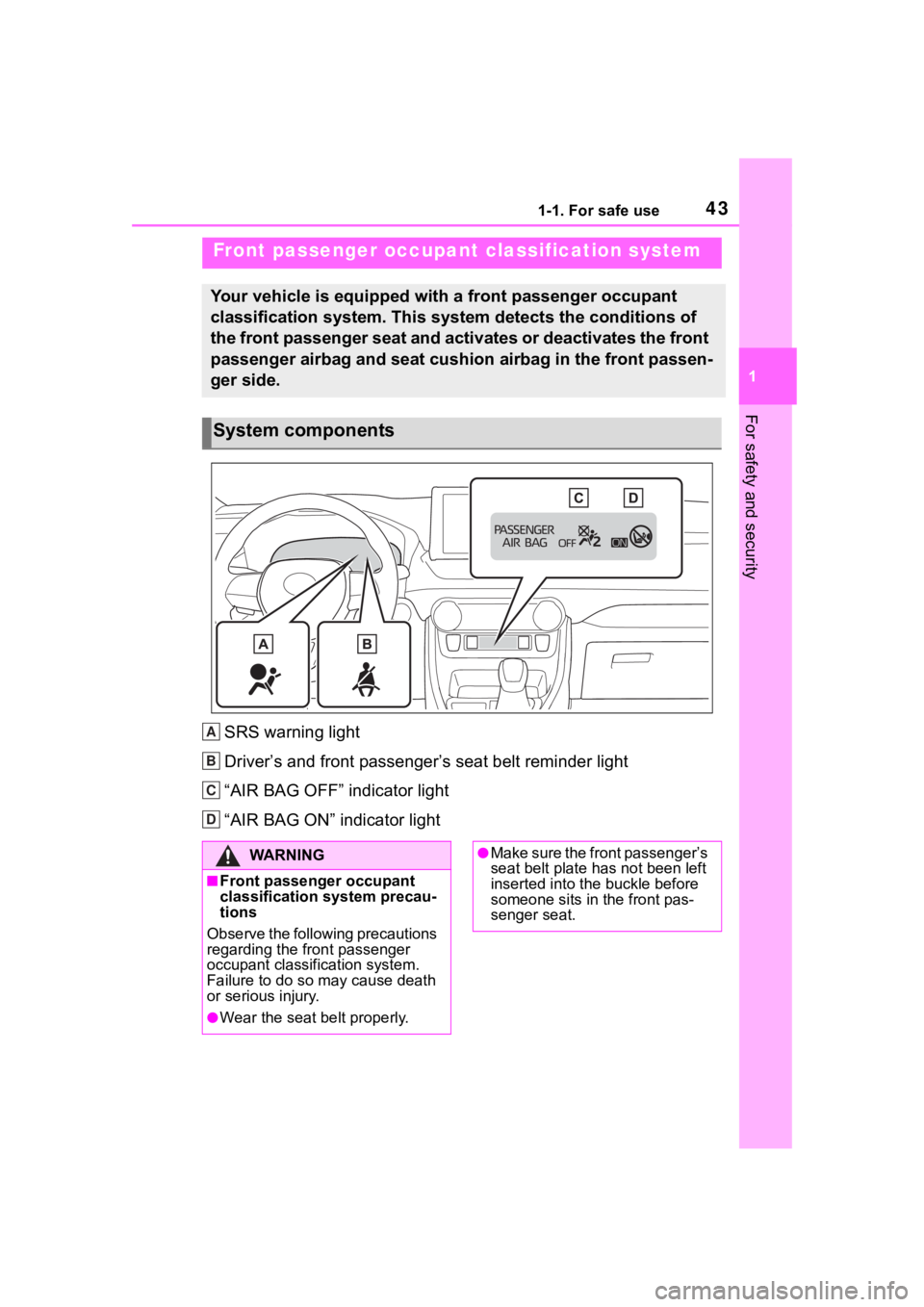
SRS warning light
Driver’s and front passenger’s seat belt reminder light
“AIR BAG OFF” indicator light
“AIR BAG ON” indicator light
Front passenger occupant classification system
Your vehicle is equipped with a front passenger occupant
classification system. This system detects the conditions of
the front passenger seat and activates or deactivates the front
passenger airbag and seat cushion airbag in the front passen-
ger side.
System components
A
B
C
D
:$ 5 1 , 1 *
■Front passenger occupant
classification system precau-
tions
Observe the following precautions
regarding the front passenger
occupant classification system.
Failure to do so may cause death
or serious injury.
●Wear the seat belt properly.
●Make sure the front passenger’s
seat belt plate has not been left
inserted into the buckle before
someone sits in the front pas-
senger seat.
Page 44 of 736
441-1. For safe use
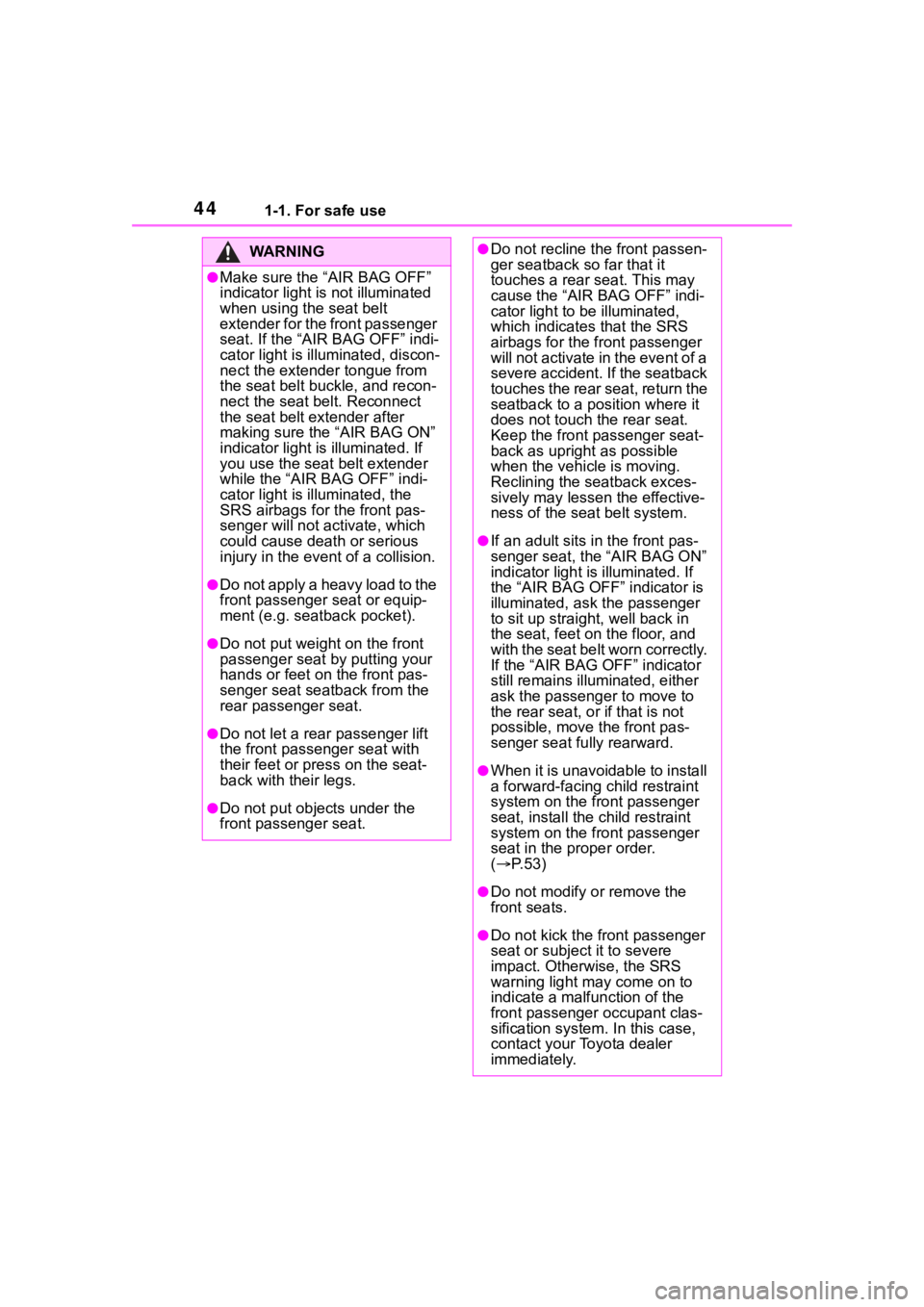
WA R N I N G
●Make sure the “AIR BAG OFF”
indicator light is not illuminated
when using the seat belt
extender for the front passenger
seat. If the “AIR BAG OFF” indi-
cator light is illuminated, discon-
nect the extender tongue from
the seat belt buckle, and recon-
nect the seat belt. Reconnect
the seat belt extender after
making sure the “AIR BAG ON”
indicator light is illuminated. If
you use the seat belt extender
while the “AIR BAG OFF” indi-
cator light is illuminated, the
SRS airbags for the front pas-
senger will not activate, which
could cause death or serious
injury in the ev ent of a collision.
●D o n o t a p p l y a h e a v y l o a d t o t h e
front passenger seat or equip-
ment (e.g. seatback pocket).
●Do not put weight on the front
passenger seat by putting your
hands or feet on the front pas-
senger seat seatback from the
rear passenger seat.
●Do not let a rea r passenger lift
the front passenger seat with
their feet or press on the seat-
back with their legs.
●Do not put objec ts under the
front passenger seat.
●Do not recline t he front passen-
ger seatback so far that it
touches a rear seat. This may
cause the “AIR BAG OFF” indi-
cator light to be illuminated,
which indicates that the SRS
airbags for the front passenger
will not activate in the event of a
severe accident. If the seatback
touches the rear seat, return the
seatback to a pos ition where it
does not touch the rear seat.
Keep the front passenger seat-
back as upright as possible
when the vehicle is moving.
Reclining the seatback exces-
sively may lessen the effective-
ness of the seat belt system.
●If an adult sits i n the front pas-
senger seat, the “AIR BAG ON”
indicator light i s illuminated. If
the “AIR BAG OFF” indicator is
illuminated, ask the passenger
to sit up straight, well back in
the seat, feet on the floor, and
with the seat belt worn correctly.
If the “AIR BAG OFF” indicator
still remains illumi nated, either
ask the passenger to move to
the rear seat, or if that is not
possible, move the front pas-
senger seat fully rearward.
●When it is unavoidable to install
a forward-facing c hild restraint
system on the front passenger
seat, install the child restraint
system on the front passenger
seat in the proper order.
( P. 5 3 )
●Do not modify or remove the
front seats.
●Do not kick the front passenger
seat or subject it to severe
impact. Otherwise, the SRS
warning light m ay come on to
indicate a malfu nction of the
front passenger occupant clas-
sification system. In this case,
contact your Toyota dealer
immediately.
Page 45 of 736
451-1. For safe use
1
For safety and security
■Adult*1
WA R N I N G
●Child restraint systems installed
on the rear seat should not con-
tact the front seatbacks.
●Do not use a seat accessory,
such as a cushion and seat
cover, that covers the seat
cushion surface.
●Do not modify or replace the
upholstery of the front seat.
●Adjust the front passenger seat
so that the head restraint does
not touch the ceiling. If the head
restraint is left in contact with
the ceiling, the system may not
detect the front passenger prop-
erly, leading to improper opera-
tion of the airbags.
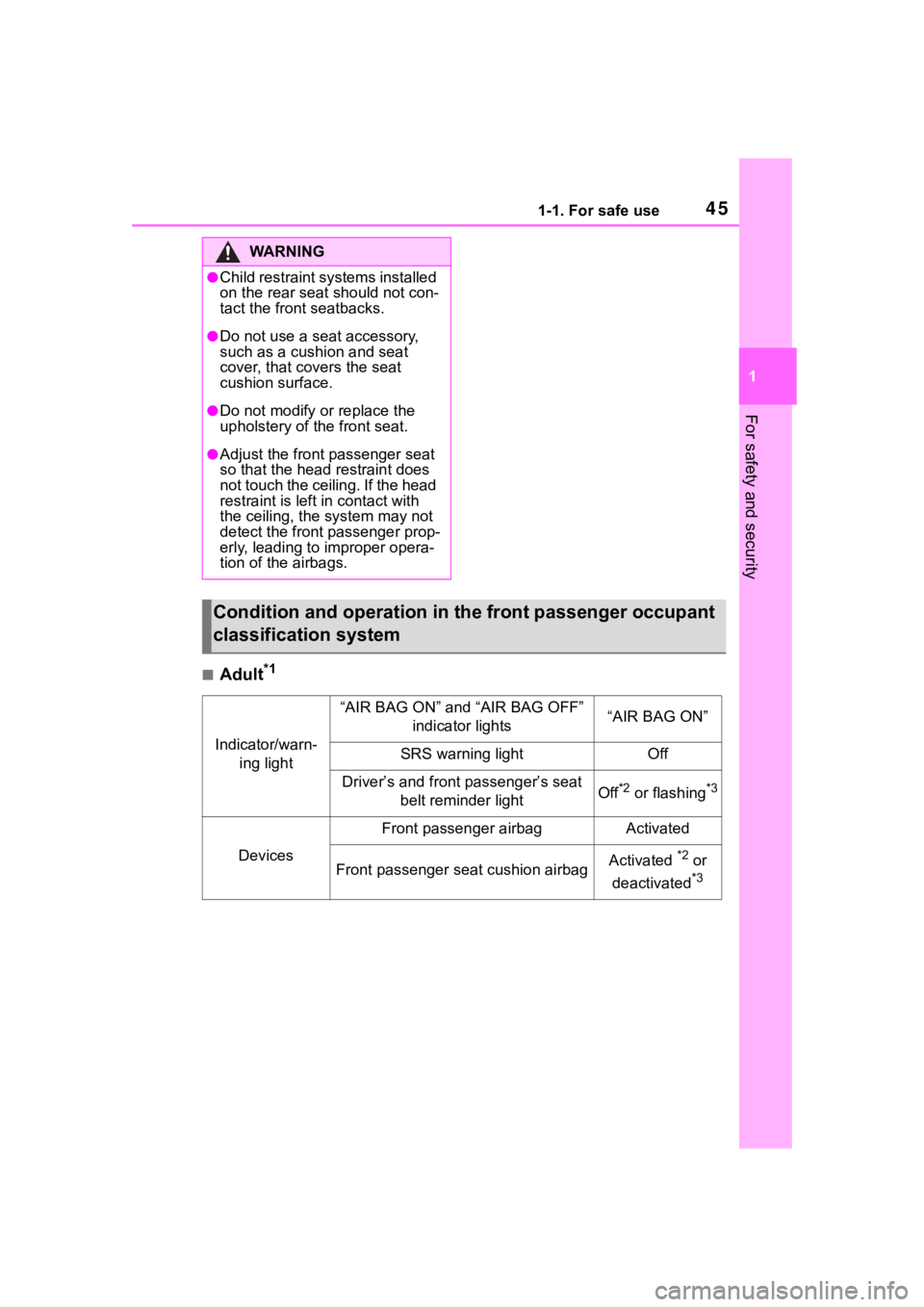
Condition and operation in th e front passenger occupant
classification system
Indicator/warn- ing light
“AIR BAG ON” and “AIR BAG OFF” indicator lights“AIR BAG ON”
SRS warning lightOff
Driver’s and front passenger’s seat belt reminder lightOff*2 or flashing*3
Devices
Front passenger airbagActivated
Front passenger seat cushion airbagActivated *2 or
deactivated
*3