fuel cap TOYOTA RAV4 2022 User Guide
[x] Cancel search | Manufacturer: TOYOTA, Model Year: 2022, Model line: RAV4, Model: TOYOTA RAV4 2022Pages: 748, PDF Size: 22.93 MB
Page 517 of 748
5176-1. Using the air conditioning system and defogger
6
Interior features
the temperature setting or the
inside temperature.
■When the outside temperature
exceeds 75°F (24°C) and the air
conditioning system is on
●In order to reduce the air condi-
tioning power consumption, the air
conditioning system may switch to
recirculated air mode automati-
cally. This may also reduce fuel
consumption.
●Recirculated air mode is selected
as a default mode when the
engine switch is turned to ON.
●It is possible to switch to outside
air mode at any time by pressing
the outside/recirculated air mode
switch.
■Operation of the air condition-
ing system in Eco drive mode
●In Eco drive mode, the air condi-
tioning system is controlled as fol-
lows to prioritize fuel efficiency:
• Engine speed and compressor operation controlled to restrict
heating/cooling capacity
• Fan speed restr icted when auto-
matic mode is selected
●To improve air conditioning perfor-
mance, perform the following
operations:
• Adjust the fan speed
• Turn off Eco drive mode ( P.347)
• Turn off Eco air conditioning mode
●When the driving mode is set to
Eco driving mode, the Eco air con-
ditioning mode will be turned on
automatically. Even in this case,
the Eco air conditioning mode can
be turned off by pressing the Eco
air conditioning mode switch.
■When the outside temperature
falls to nearly 32°F (0°C)
The dehumidification function may
not operate even when “A/C” switch
is pressed.
■Ventilation and air conditioning
odors
●To let fresh air in, set the air condi- tioning system to the outside air
mode.
●During use, various odors from
inside and outside the vehicle may
enter into and accumulate in the
air conditioning system. This may
then cause odor
to be emitted
from the vents.
●To reduce potential odors from
occurring:
• It is recommended that the air conditioning system be set to out-
side air mode prior to turning the
vehicle off.
• The start timing of the blower may be delayed for a short period of
time immediately after the air con-
ditioning system is started in auto-
matic mode.
●When parking, the system auto-
matically switches to outside air
mode to encourage better air cir-
culation throughout the vehicle,
helping to reduce odors that occur
when starting the vehicle.
■Air conditioning system opera-
tions when the engine is
stopped due to the Stop & Start
system (vehicles with Stop &
Start system)
When the engine is stopped due to
Stop & Start system operations, the
automatic air conditioning cooling,
heating and dehumidification func-
tions turn off and the fan speed is
decreased according to the outside
temperature etc. or air blowing
stops. To stop the air conditioning
system from turning off, press the
Stop & Start cancel switch and
refrain from using the Stop & Start
system.
■When the windshield is fogged
up and the engine is stopped
due to the Stop & Start system
(vehicles with Stop & Start sys-
tem)
Press the windshield defogger
switch to restart the engine and
defog the windshield.
If the windshield continuously fogs
Page 566 of 748
5667-2. Maintenance
The OBD system determines
that a problem exists some-
where in the emission control
system. Your vehicle may not
pass the I/M test and may need
to be repaired. Contact your
Toyota dealer to service the
vehicle.
When the battery is discon-
nected or discharged
Readiness codes that are set
during ordinary driving are
erased.
Also, depending on your driv-
ing habits, the readiness
codes may not be completely
set.
When the fuel tank cap is loose
The malfunction indicator
lamp comes on indicating a
temporary malfunction and
your vehicle may not pass the
I/M test.
The error code in the OBD sys-
tem will not be cleared unless
the vehicle is driven 40 or more
times.
Contact your Toyota dealer to
prepare the vehicle for re-test-
ing.
Emission inspection
and maintenance (I/M)
programs
Some states have vehicle
emission inspection pro-
grams which include OBD
(On Board Diagnostics)
checks. The OBD system
monitors the operation of
the emission control sys-
tem.
If the malfunc tion indica-
tor lamp comes on
Your vehicle may not
pass the I/M test in the fol-
lowing situations:
When the malfunction
indicator lamp still
remains on after several
driving trips
If your vehicle does not
pass the I/M test
Page 589 of 748
5897-3. Do-it-yourself maintenance
7
Maintenance and care
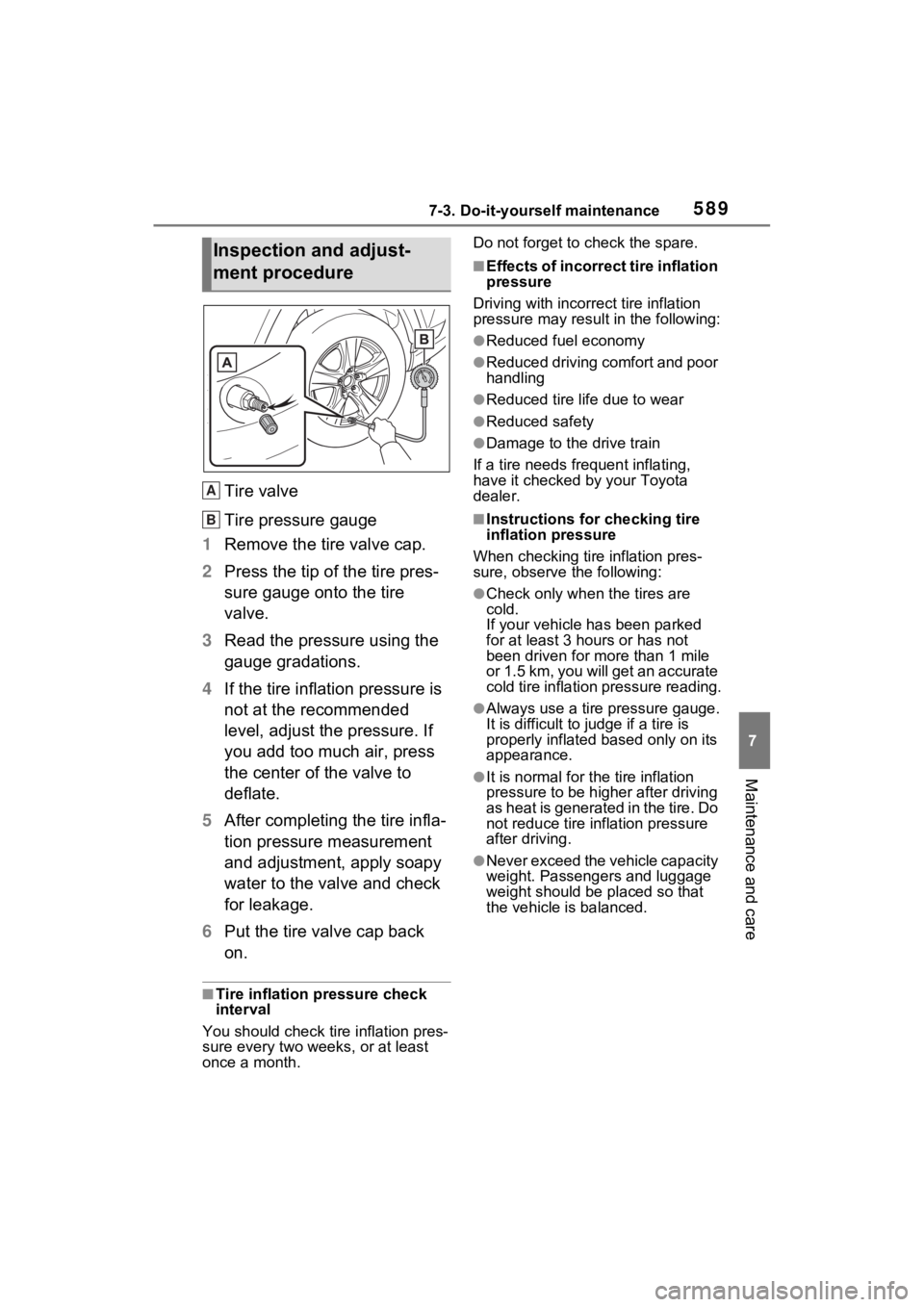
Tire valve
Tire pressure gauge
1 Remove the tire valve cap.
2 Press the tip of the tire pres-
sure gauge onto the tire
valve.
3 Read the pressure using the
gauge gradations.
4 If the tire inflation pressure is
not at the recommended
level, adjust the pressure. If
you add too much air, press
the center of the valve to
deflate.
5 After completing the tire infla-
tion pressure measurement
and adjustment, apply soapy
water to the valve and check
for leakage.
6 Put the tire valve cap back
on.
■Tire inflation pressure check
interval
You should check tire inflation pres-
sure every two weeks, or at least
once a month. Do not forget to
check the spare.
■Effects of incorrect tire inflation
pressure
Driving with incorrec t tire inflation
pressure may resul t in the following:
●Reduced fuel economy
●Reduced driving comfort and poor
handling
●Reduced tire life due to wear
●Reduced safety
●Damage to the drive train
If a tire needs frequent inflating,
have it checked by your Toyota
dealer.
■Instructions for checking tire
inflation pressure
When checking tire inflation pres-
sure, observe the following:
●Check only when the tires are
cold.
If your vehicle has been parked
for at least 3 hours or has not
been driven for more than 1 mile
or 1.5 km, you will get an accurate
cold tire inflation pressure reading.
●Always use a tire pressure gauge.
It is difficult to judge if a tire is
properly inflated based only on its
appearance.
●It is normal for the tire inflation
pressure to be higher after driving
as heat is generated in the tire. Do
not reduce tire inflation pressure
after driving.
●Never exceed the vehicle capacity
weight. Passengers and luggage
weight should be placed so that
the vehicle is balanced.
Inspection and adjust-
ment procedure
A
B
Page 630 of 748
6308-2. Steps to take in an emergency
the warning light to flash and the
warning buzzer to sound even if a
passenger is not sitting in the
seat.
●If a cushion is placed on the seat,
the sensor may not detect a pas-
senger, and the warning light may
not operate properly.
■SRS warning light
This warning light system monitors
the airbag sensor assembly, front
impact sensors, side impact sensors
(front door), side impact sensors
(front), driver’s seat position sen-
sor, driver’s seat belt buckle switch,
front passenger occupant classifica-
tion system (ECU and sensors),
“AIR BAG ON” indicator light, “AIR
BAG OFF” indicator light, front pas-
senger’s seat belt buckle switch,
driver’s seat belt p retensioner, front
passenger’s seat be lt pretensioner
and force limiter, airbags, intercon-
necting wiring and power sources.
( P.36)
■If the malfunction indicator
lamp comes on while driving
First check the following:
●Is the fuel t ank empty?
If it is, fill the fuel tank immediately.
●Is the fuel tank cap loose?
If it is, tighten it securely.
The light will go o ff after several
driving trips.
If the light does not go off even after
several trips, contact your Toyota
dealer as soon as possible.
■Electric power steering system
warning light (warning buzzer)
When the battery charge becomes
insufficient or the voltage temporar-
ily drops, the electric power steering
system warning light may come on
and the warning buzzer may sound.
■When the tire pressure warning
light comes on ( vehicles with
tire pressure warning system)
Inspect the tires to check if a tire is
punctured.
If a tire is punctured: P.637
If none of the tires are punctured:
Turn the engine switch to OFF then
turn it to ON. Check if the tire pres-
sure warning light comes on or
blinks.
If the tire pressur e warning light
blinks for approximately 1 minute
then stays on
There may be a malfunction in the
tire pressure warning system. Have
the vehicle inspected by your
Toyota dealer immediately.
If the tire pressur e warning light
comes on
1 After the temperature of the tires
has lowered sufficiently, check
the inflation pressure of each tire
and adjust them to the specified
level.
2 If the warning light does not turn
off even after several minutes
have elapsed, check that the
inflation pressure of each tire is
at the specified level and perform
initialization. ( P.584)
■The tire pressure warning light
may come on due to natural
causes (vehicles with tire pres-
sure warning system)
The tire pressure warning light may
come on due to natural causes such
as natural air leaks and tire inflation
pressure changes caused by tem-
perature. In this ca se, adjusting the
tire inflation pressure will turn off the
warning ligh t (after a few minutes).
■When a tire is replaced with a
compact spare tire (vehicles
with tire pressure warning sys-
tem)
The compact spare tire is not
equipped with a tire pressure warn-
Page 662 of 748
6629-1. Specifications
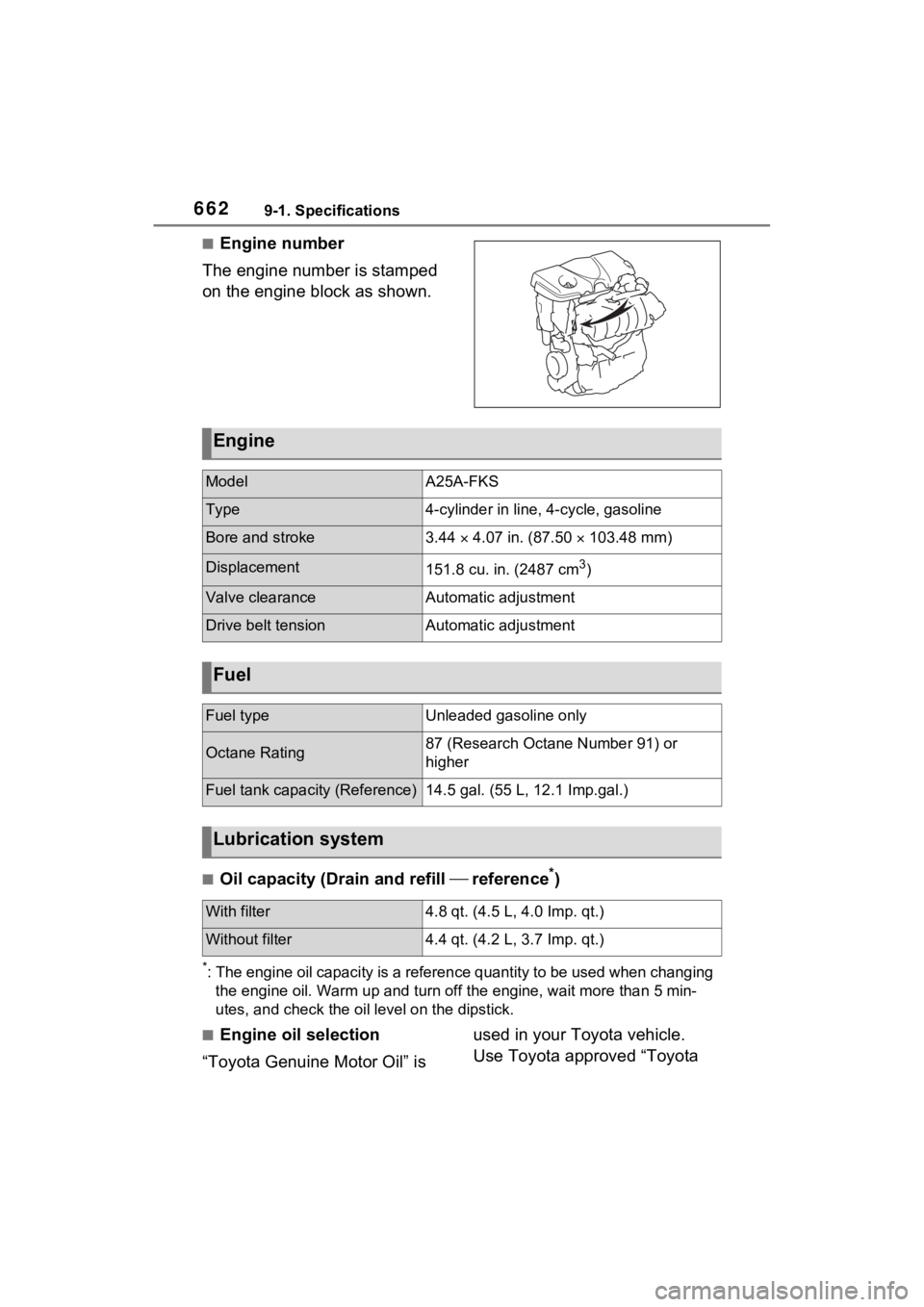
■Engine number
The engine number is stamped
on the engine block as shown.
■Oil capacity (Drain and refill reference*)
*: The engine oil capacity is a reference quantity to be used whe n changing
the engine oil. Warm up and turn off the engine, wait more than 5 min-
utes, and check the oil level on the dipstick.
■Engine oil selection
“Toyota Genuine Motor Oil” is used in your Toyota vehicle.
Use Toyota approved “Toyota
Engine
ModelA25A-FKS
Type4-cylinder in line
, 4-cycle, gasoline
Bore and stroke3.44 4.07 in. (87.50 103.48 mm)
Displacement151.8 cu. in. (2487 cm3)
Valve clearanceAutomatic adjustment
Drive belt tensionAutomatic adjustment
Fuel
Fuel typeUnleaded gasoline only
Octane Rating87 (Research Octane Number 91) or
higher
Fuel tank capacity (Reference)14.5 gal. (55 L, 12.1 Imp.gal.)
Lubrication system
With filter4.8 qt. (4.5 L , 4.0 Imp. qt.)
Without filter4.4 qt. (4.2 L, 3.7 Imp. qt.)
Page 678 of 748
6789-1. Specifications
■Temperature A, B, C
The temperature grades are A
(the highest), B, and C, repre-
senting the tire’s resistance to
the generation of heat and its
ability to dissipate heat when
tested under controlled condi-
tions on a specified indoor labo-
ratory test wheel.
Sustained high temperature can
cause the material of the tire to
degenerate and reduce tire life, and
excessive temperature can lead to
sudden tire failure.
Grade C corresponds to a level of performance which all passenger
car tires must meet under the Fed-
eral Motor Vehicle Safety Standard
No. 109.
Grades B and A represent higher
levels of performance on the labo-
ratory test wheel than the minimum
required by law.
Warning: The temperature grades
of a tire assume tha
t it is properly
inflated and not overloaded.
Excessive speed, underinflation, or
excessive loading, either sepa-
rately or in combination, can cause
heat buildup and possible tire fail-
ure.
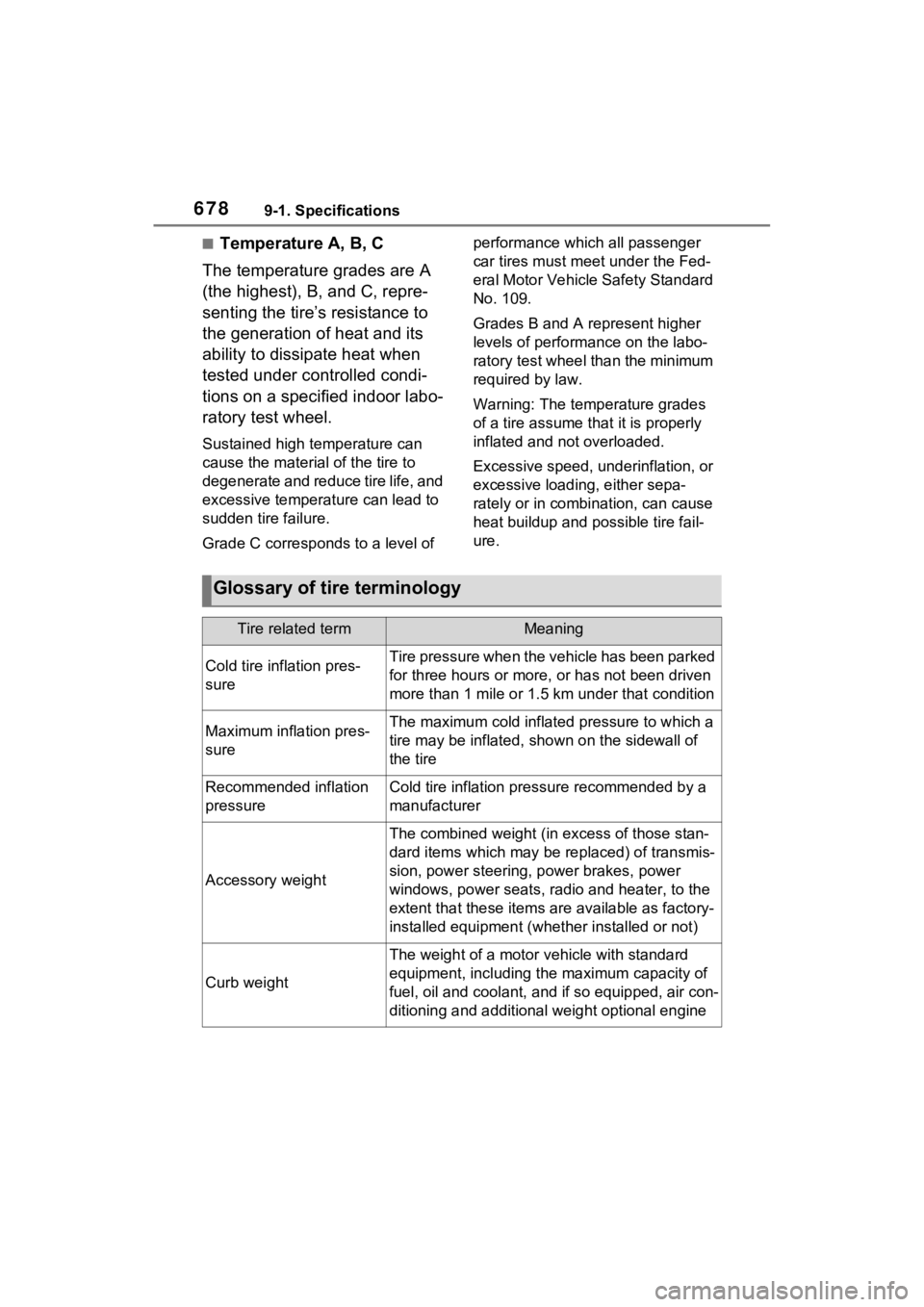
Glossary of tire terminology
Tire related termMeaning
Cold tire inflation pres-
sureTire pressure when the vehicle has been parked
for three hours or more, or has not been driven
more than 1 mile or 1.5 km under that condition
Maximum inflation pres-
sureThe maximum cold inflated pressure to which a
tire may be inflated, shown on the sidewall of
the tire
Recommended inflation
pressureCold tire inflation pressure recommended by a
manufacturer
Accessory weight
The combined weight (in excess of those stan-
dard items which may be replaced) of transmis-
sion, power steering, power brakes, power
windows, power seats, radio and heater, to the
extent that these items are available as factory-
installed equipment (whether installed or not)
Curb weight
The weight of a motor vehicle with standard
equipment, including th e maximum capacity of
fuel, oil and coolant, and if so equipped, air con-
ditioning and additional weight optional engine
Page 717 of 748
Alphabetical Index717
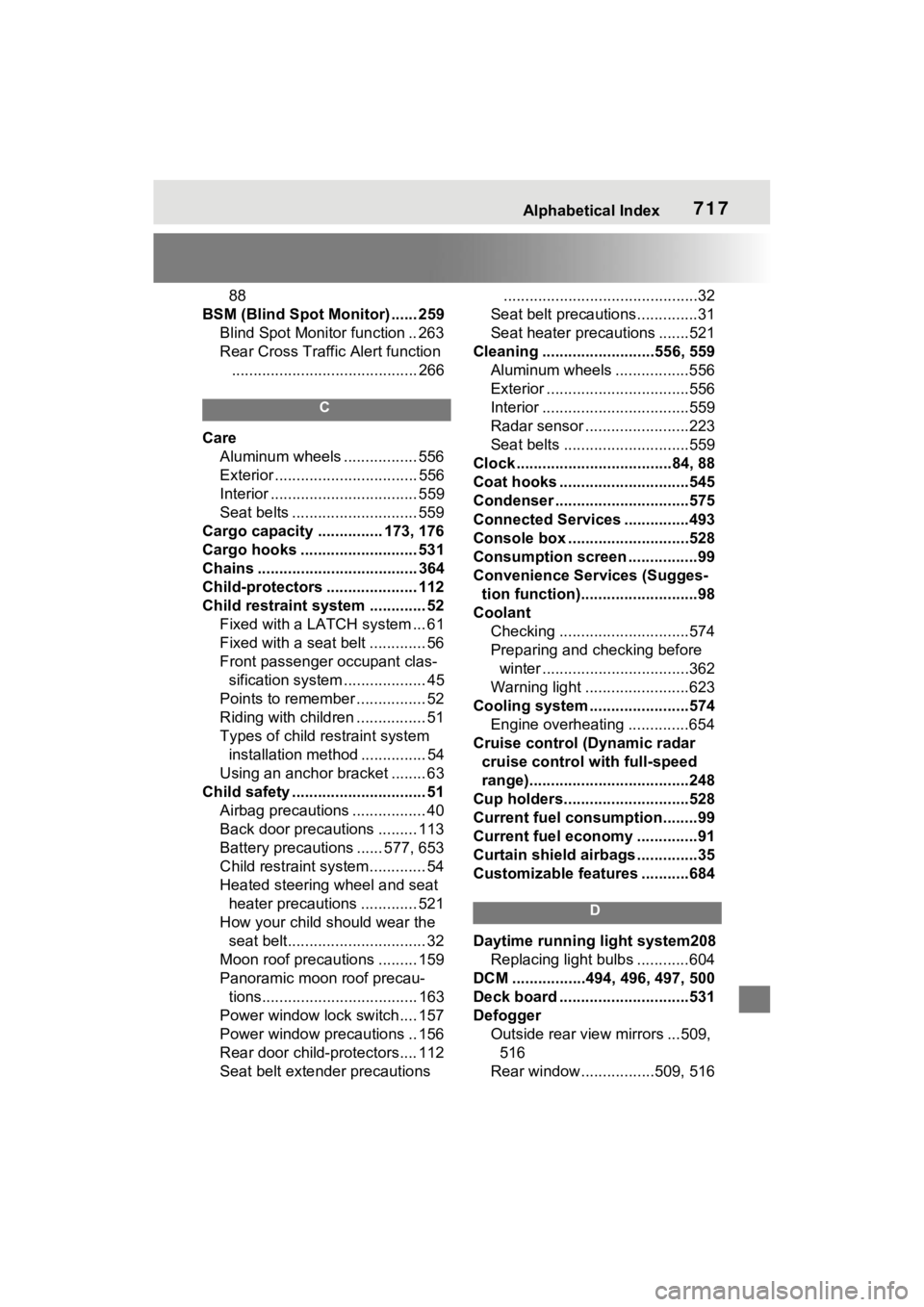
88
BSM (Blind Spot Monitor) ...... 259 Blind Spot Monitor function .. 263
Rear Cross Traffic Alert function........................................... 266
C
Care Aluminum wheels ................. 556
Exterior ................................. 556
Interior .................................. 559
Seat belts ............................. 559
Cargo capacity ............... 173, 176
Cargo hooks ........................... 531
Chains ..................................... 364
Child-protectors ..................... 112
Child restraint s ystem ............. 52
Fixed with a LATCH system ... 61
Fixed with a seat belt ............. 56
Front passenger occupant clas- sification system ................... 45
Points to remember ................ 52
Riding with children ................ 51
Types of child restraint system installation met hod ............... 54
Using an anchor bracket ........ 63
Child safety ............................... 51 Airbag precautions ................. 40
Back door precautions ......... 113
Battery precautions ...... 577, 653
Child restraint system............. 54
Heated steering wheel and seat
heater precautions ............. 521
How your child should wear the seat belt................................ 32
Moon roof precau tions ......... 159
Panoramic moon roof precau- tions.................................... 163
Power window lock switch.... 157
Power window precautions .. 156
Rear door child-protectors.... 112
Seat belt extender precautions .............................................32
Seat belt precautions..............31
Seat heater precautions .......521
Cleaning ..........................556, 559 Aluminum wheels .................556
Exterior .................................556
Interior ..................................559
Radar sensor ........................223
Seat belts .............................559
Clock ....................................84, 88
Coat hooks ..............................545
Condenser ............. ..................575
Connected Service s ...............493
Console box ............................528
Consumption screen ................99
Convenience Services (Sugges- tion function)...........................98
Coolant Checking ..............................574
Preparing and checking before winter ..................................362
Warning light ........................623
Cooling system .......................574 Engine overheating ..............654
Cruise control (Dynamic radar cruise control with full-speed
range).....................................248
Cup holders.............................528
Current fuel consumption........99
Current fuel economy ..............91
Curtain shield airbags ..............35
Customizable featu res ...........684
D
Daytime running light system208
Replacing light bulbs ............604
DCM .................494, 496, 497, 500
Deck board ..............................531
Defogger Outside rear view mirrors ...509, 516
Rear window.................509, 516
Page 719 of 748

Alphabetical Index719
Operation ............................. 161
Emergency, in case of If a warning buzzer sounds .. 622
If a warning light turns on ..... 622
If a warning message is dis-played................................. 633
If the electronic key does not operate properly ................. 648
If the engin e will not start ..... 646
If the vehicle battery is dis- charged .............................. 650
If the vehicle is submerged or water on the road is rising .. 613
If you have a flat tire ............. 637
If you lose your keys ............ 648
If you think something is wrong ........................................... 620
If your vehicle becomes stuck ........................................... 656
If your vehicle has to be stopped in an emergency................. 612
If your vehicle needs to be towed ........................................... 615
If your vehicle overheats ...... 654
Emergency flashers ............... 612
Engine ACC.............................. 191, 195
Compartment ....................... 572
Engine switch ............... 191, 192
Fuel pump shut off system ... 621
Hood..................................... 569
How to start the engine 191, 192
Identification number ............ 662
If the engin e will not start ..... 646
If your vehicle has to be stopped in an emergency................. 612
Ignition switch (Engine switch) ................................... 191, 192
Overheating.......................... 654
Tachometer ...................... 82, 85
Engine coolant Capacity ............................... 664 Checking ..............................574
Preparing and checking before
winter ..................................362
Warning light ........................623
Engine coolant temperature gauge .................................82, 85
Engine immobilizer system .....71
Engine oil Capacity ...............................662
Checking ..............................572
Preparing and checking before winter ..................................362
Warning light ........................623
Engine switch .................191, 192 Auto power off fun ction.........195
Changing the engine switch modes.................................195
Changing the engine switch positions .............................191
If your vehicle has to be stopped in an emergency .................612
Enhanced Vehicle Stability Con- trol (Enhanced VSC ) .............356
Enhanced VSC (Enhanced Vehi- cle Stability Control).............356
Entering letters and numbers/list screen operation...................381Entering letters and numbers381
List screen ............................382
EPS (Electric Po wer Steering)
Function................................356
Warning light ........................624
Establishing an Android Auto connection .......... ..................404
Establishing an Apple CarPlay connection .......... ..................403
Event data recorder (EDR) .......10
F
Flat tire.....................................637 Tire pressure warning system...........................................582
Page 720 of 748
720Alphabetical Index
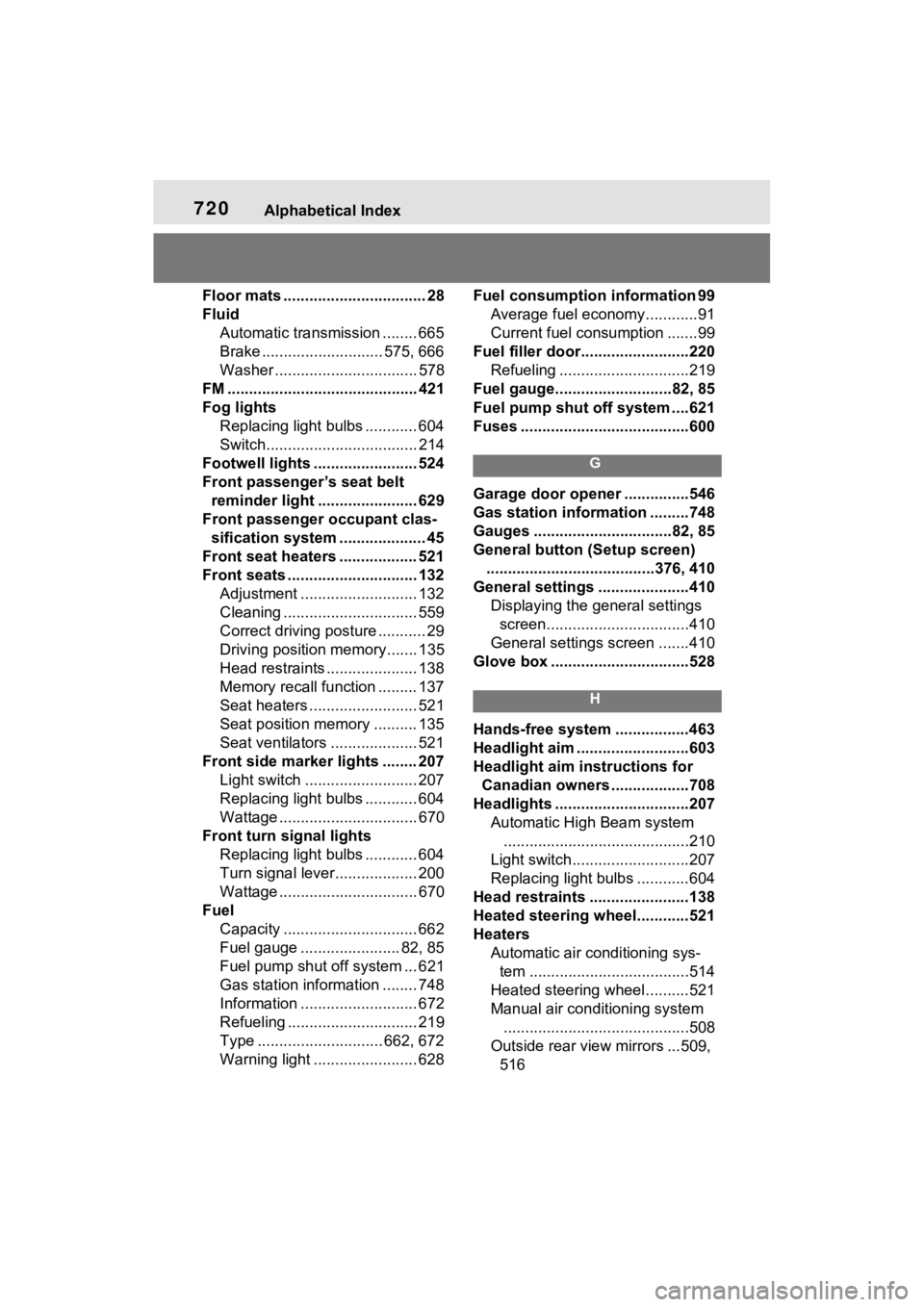
Floor mats ................................. 28
FluidAutomatic transmission ........ 665
Brake ............................ 575, 666
Washer ................................. 578
FM ............................................ 421
Fog lights Replacing light bulbs ............ 604
Switch................................... 214
Footwell lights ..... ................... 524
Front passenger’s seat belt reminder light ....................... 629
Front passenger occupant clas- sification system .................... 45
Front seat heaters .................. 521
Front seats .............................. 132 Adjustment ........................... 132
Cleaning ............................... 559
Correct driving posture ........... 29
Driving position memory....... 135
Head restraints ..................... 138
Memory recall function ......... 137
Seat heaters ......................... 521
Seat position memory .......... 135
Seat ventilators .................... 521
Front side marker lights ........ 207 Light switch .......................... 207
Replacing light bulbs ............ 604
Wattage ................................ 670
Front turn signal lights Replacing light bulbs ............ 604
Turn signal lever................... 200
Wattage ................................ 670
Fuel Capacity ............................... 662
Fuel gauge ....................... 82, 85
Fuel pump shut off system ... 621
Gas station information ........ 748
Information ........................... 672
Refueling .............................. 219
Type ............................. 662, 672
Warning light ........................ 628 Fuel consumption information 99
Average fuel economy............91
Current fuel consumption .......99
Fuel filler door.........................220 Refueling ..............................219
Fuel gauge...........................82, 85
Fuel pump shut off system ....621
Fuses .......................................600
G
Garage door opene r ...............546
Gas station information .........748
Gauges ................................82, 85
General button (Setup screen) .......................................376, 410
General settings .....................410 Displaying the general settings screen.................................410
General settings screen .......410
Glove box ................................528
H
Hands-free system .................463
Headlight aim ..........................603
Headlight aim instructions for Canadian owners ..................708
Headlights ...............................207 Automatic High Beam system...........................................210
Light switch...........................207
Replacing light bulbs ............604
Head restraints .......................138
Heated steering wheel............521
Heaters Automatic air conditioning sys-tem .....................................514
Heated steering wheel..........521
Manual air conditioning system ...........................................508
Outside rear view mirrors ...509, 516
Page 725 of 748
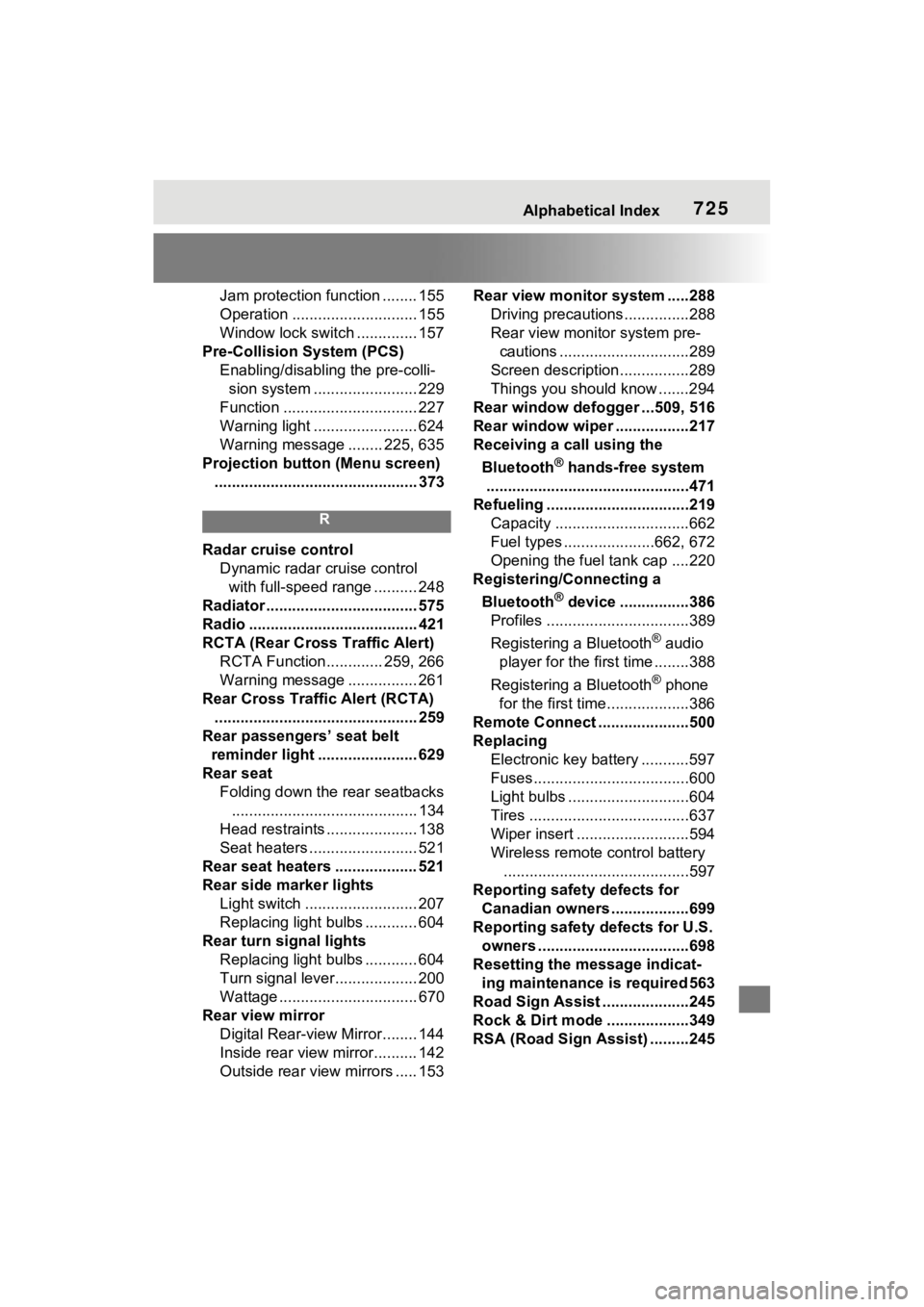
Alphabetical Index725
Jam protection function ........ 155
Operation ............................. 155
Window lock switch .............. 157
Pre-Collision System (PCS) Enabling/disabling the pre-colli-sion system ........................ 229
Function ............................... 227
Warning light ........................ 624
Warning message ........ 225, 635
Projection button (Menu screen) ............................................... 373
R
Radar cruise control Dynamic radar cruise control with full-speed range .......... 248
Radiator ................................... 575
Radio ....................................... 421
RCTA (Rear Cross Traffic Alert) RCTA Function............. 259, 266
Warning message ................ 261
Rear Cross Traffic Alert (RCTA) ............................................... 259
Rear passengers’ seat belt reminder light ....................... 629
Rear seat Folding down the rear seatbacks........................................... 134
Head restraints ..................... 138
Seat heaters ......................... 521
Rear seat heaters ................... 521
Rear side marker lights Light switch .......................... 207
Replacing light bulbs ............ 604
Rear turn signal lights Replacing light bulbs ............ 604
Turn signal lever................... 200
Wattage ................................ 670
Rear view mirror Digital Rear-view Mirror........ 144
Inside rear view mirror.......... 142
Outside rear view mirrors ..... 153 Rear view monitor system .....288
Driving precautions ...............288
Rear view monitor system pre-cautions ..............................289
Screen description................289
Things you should know .......294
Rear window defogger ...509, 516
Rear window wiper .................217
Receiving a call using the
Bluetooth
® hands-free system
...............................................471
Refueling ............ .....................219
Capacity ...............................662
Fuel types .....................662, 672
Opening the fuel tank cap ....220
Registering/Connecting a
Bluetooth
® device ................386
Profiles .................................389
Registering a Bluetooth
® audio
player for the first time ........388
Registering a Bluetooth
® phone
for the first time...................386
Remote Connect .....................500
Replacing Electronic key battery ...........597
Fuses....................................600
Light bulbs ............................604
Tires .....................................637
Wiper insert ..........................594
Wireless remote control battery...........................................597
Reporting safety defects for Canadian owners ..................699
Reporting safety defects for U.S. owners ...................................698
Resetting the message indicat- ing maintenance is required 563
Road Sign Assist ....................245
Rock & Dirt mode ...................349
RSA (Road Sign Assist) .........245