light TOYOTA RAV4 EV 2012 1.G Owners Manual
[x] Cancel search | Manufacturer: TOYOTA, Model Year: 2012, Model line: RAV4 EV, Model: TOYOTA RAV4 EV 2012 1.GPages: 520, PDF Size: 8.29 MB
Page 443 of 520
5
When trouble arises
443
5-2. Steps to take in an emergency
Charging and pre-climate messages
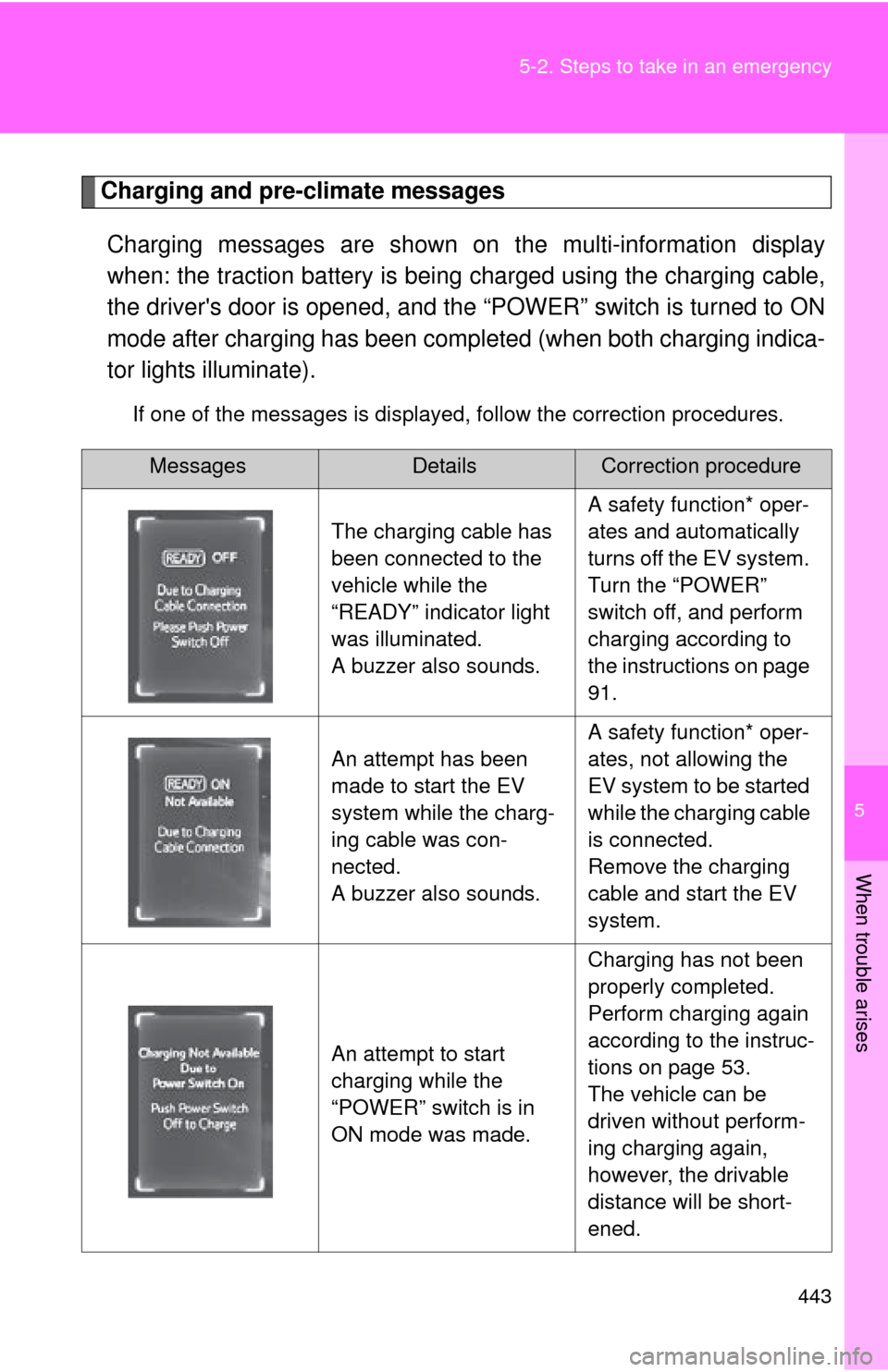
Charging messages are shown on the multi-information display
when: the traction battery is bei ng charged using the charging cable,
the driver's door is opened, and th e “POWER” switch is turned to ON
mode after charging has been comp leted (when both charging indica-
tor lights illuminate).
If one of the messages is displayed, follow the correction procedures.
MessagesDetailsCorrection procedure
The charging cable has
been connected to the
vehicle while the
“READY” indicator light
was illuminated.
A buzzer also sounds.
A safety function* oper-
ates and automatically
turns off the EV system.
Turn the “POWER”
switch off, and perform
charging according to
the instructions on page
91.
An attempt has been
made to start the EV
system while the charg-
ing cable was con-
nected.
A buzzer also sounds.
A safety function* oper-
ates, not allowing the
EV system to be started
while the charging cable
is connected.
Remove the charging
cable and start the EV
system.
An attempt to start
charging while the
“POWER” switch is in
ON mode was made.
Charging has not been
properly completed.
Perform charging again
according to the instruc-
tions on page 53.
The vehicle can be
driven without perform-
ing charging again,
however, the drivable
distance will be short-
ened.
Page 446 of 520
446 5-2. Steps to take in an emergency
* For more information regarding safety systems, see page 88.
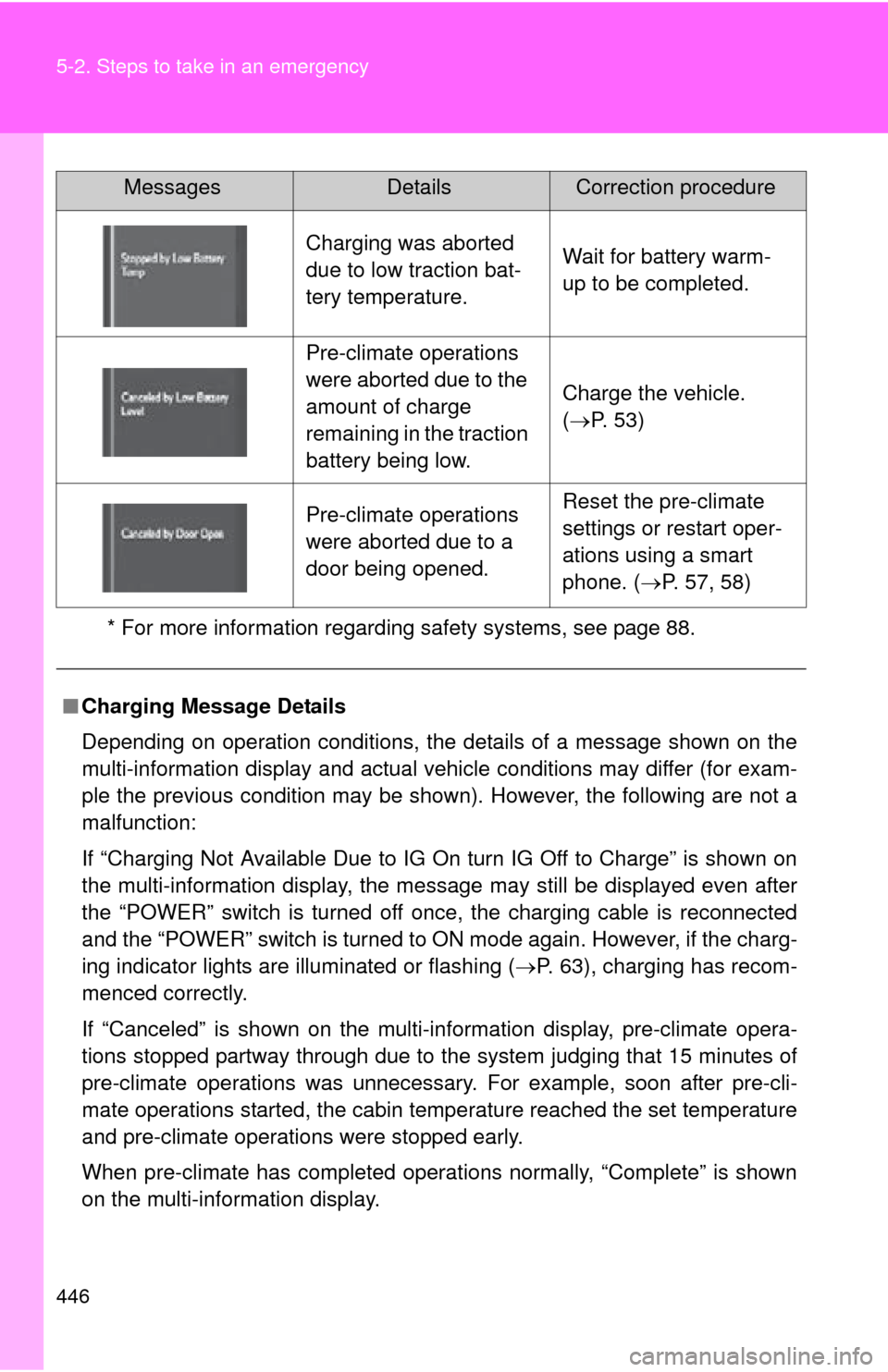
Charging was aborted
due to low traction bat-
tery temperature.Wait for battery warm-
up to be completed.
Pre-climate operations
were aborted due to the
amount of charge
remaining in the traction
battery being low.
Charge the vehicle.
(P. 53)
Pre-climate operations
were aborted due to a
door being opened.Reset the pre-climate
settings or restart oper-
ations using a smart
phone. ( P. 57, 58)
■ Charging Message Details
Depending on operation conditions, the details of a message shown on the
multi-information display and actual vehicle conditions may differ (for exam-
ple the previous condition may be shown). However, the following are not a
malfunction:
If “Charging Not Available Due to IG On turn IG Off to Charge” is shown on
the multi-information display, the message may still be displayed even after
the “POWER” switch is turned off once, the charging cable is reconnected
and the “POWER” switch is turned to ON mode again. However, if the charg-
ing indicator lights are illuminated or flashing ( P. 63), charging has recom-
menced correctly.
If “Canceled” is shown on the multi-in formation display, pre-climate opera-
tions stopped partway through due to the system judging that 15 minutes of
pre-climate operations was unnecessary . For example, soon after pre-cli-
mate operations started, the cabin temperature reached the set temperature
and pre-climate operations were stopped early.
When pre-climate has completed operations normally, “Complete” is shown
on the multi-information display.
MessagesDetailsCorrection procedure
Page 465 of 520
5
When trouble arises
465
5-2. Steps to take in an emergency
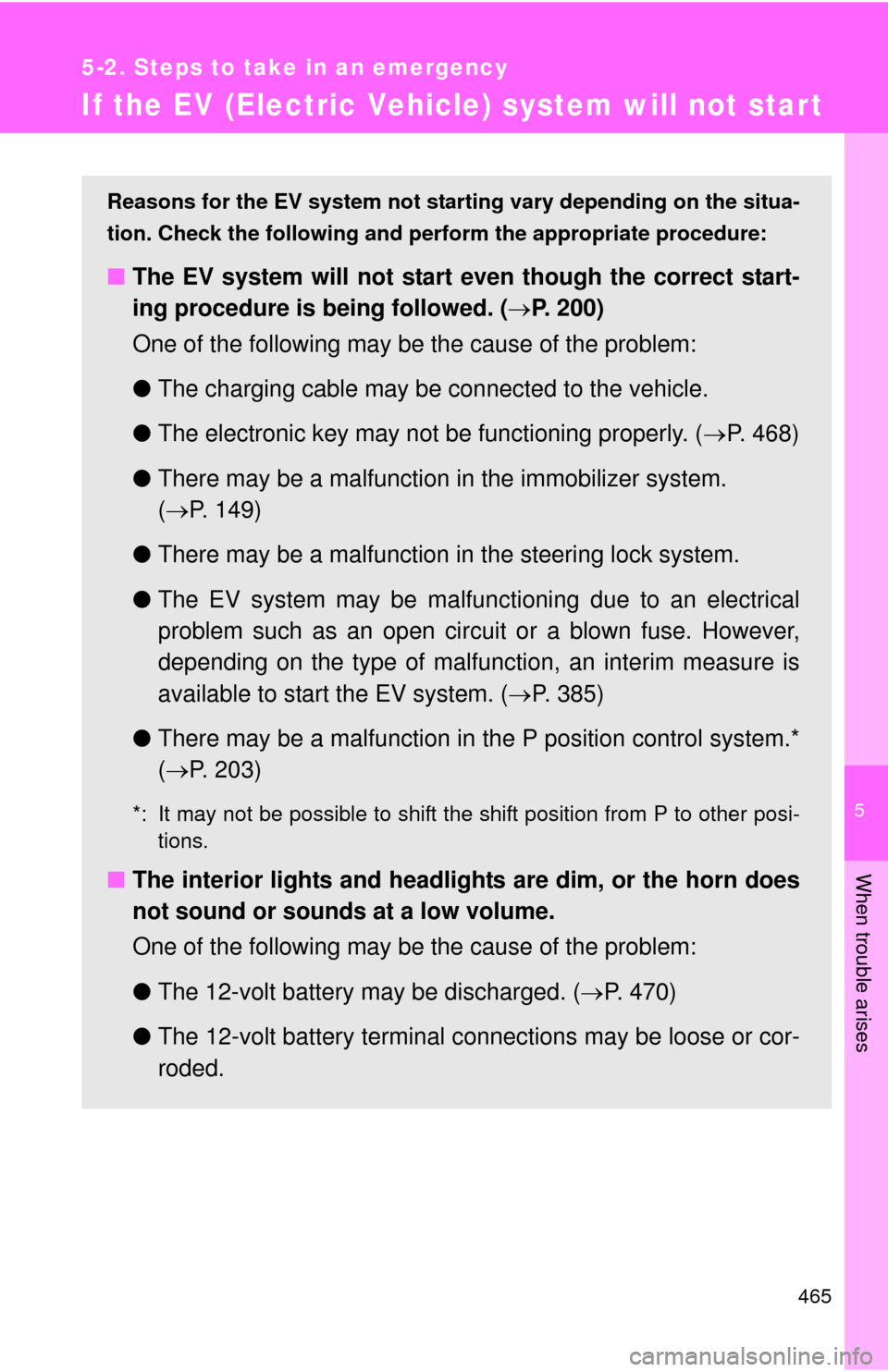
If the EV (Electric Vehicle) system will not start
Reasons for the EV system not star ting vary depending on the situa-
tion. Check the following and pe rform the appropriate procedure:
■The EV system will not start even though the correct start-
ing procedure is being followed. ( P. 200)
One of the following may be the cause of the problem:
● The charging cable may be connected to the vehicle.
● The electronic key may not be functioning properly. ( P. 468)
● There may be a malfunction in the immobilizer system.
( P. 149)
● There may be a malfunction in the steering lock system.
● The EV system may be malfunct ioning due to an electrical
problem such as an open circuit or a blown fuse. However,
depending on the type of malf unction, an interim measure is
available to start the EV system. ( P. 385)
● There may be a malfunction in th e P position control system.*
( P. 203)
*: It may not be possible to shift the shift position from P to other posi-
tions.
■The interior lights and headlights are dim, or the horn does
not sound or sounds at a low volume.
One of the following may be the cause of the problem:
●The 12-volt battery may be discharged. ( P. 470)
● The 12-volt battery terminal c onnections may be loose or cor-
roded.
Page 466 of 520
466 5-2. Steps to take in an emergency
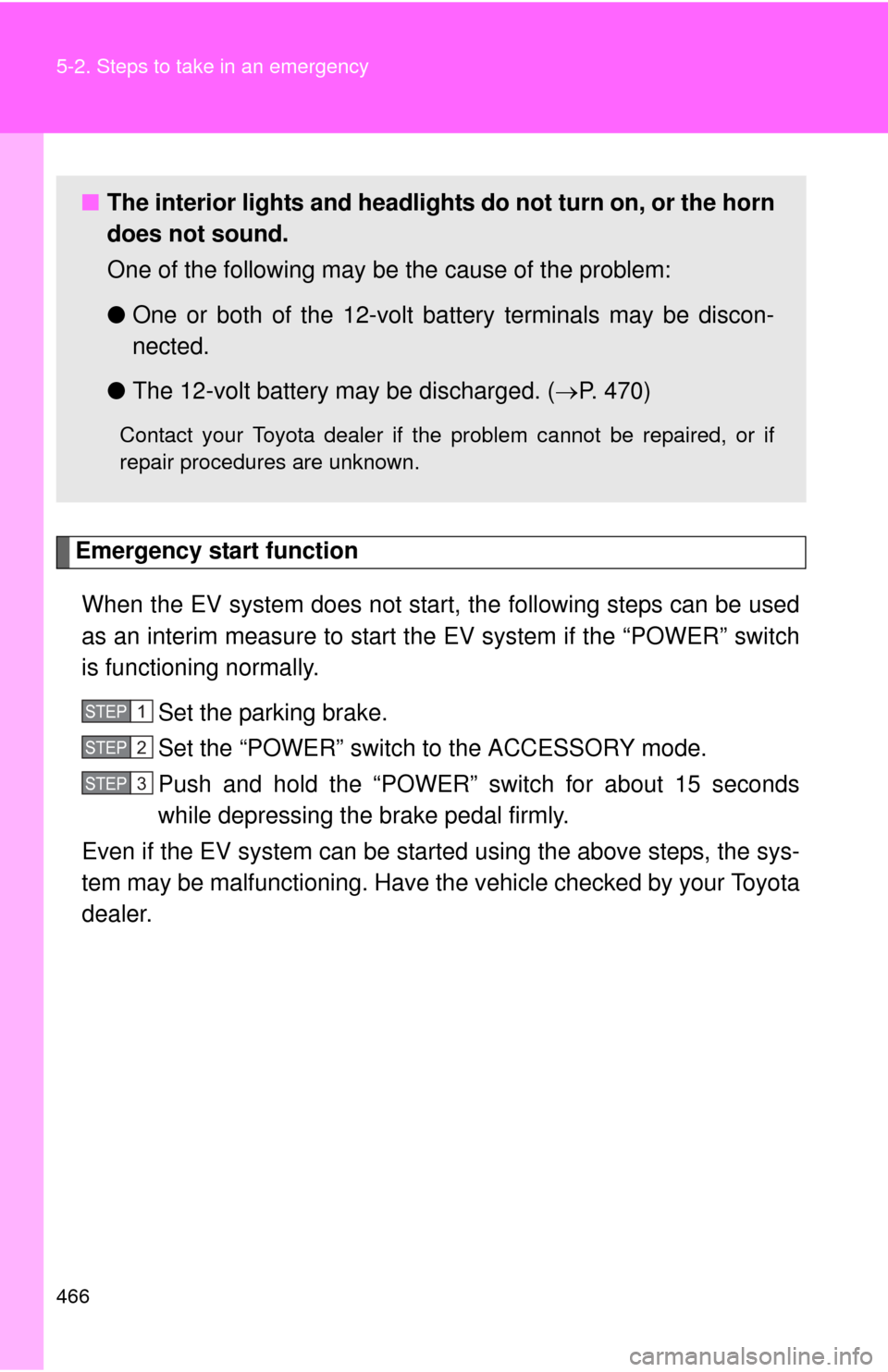
Emergency start functionWhen the EV system does not start, the following steps can be used
as an interim measure to start the EV system if the “POWER” switch
is functioning normally. Set the parking brake.
Set the “POWER” switch to the ACCESSORY mode.
Push and hold the “POWER” switch for about 15 seconds
while depressing the brake pedal firmly.
Even if the EV system can be st arted using the above steps, the sys-
tem may be malfunctioning. Have th e vehicle checked by your Toyota
dealer.
■ The interior lights and headlights do not turn on, or the horn
does not sound.
One of the following may be the cause of the problem:
●One or both of the 12-volt ba ttery terminals may be discon-
nected.
● The 12-volt battery may be discharged. ( P. 470)
Contact your Toyota dealer if the problem cannot be repaired, or if
repair procedures are unknown.
STEP 1
STEP 2
STEP 3
Page 471 of 520
5
When trouble arises
471
5-2. Steps to take in an emergency
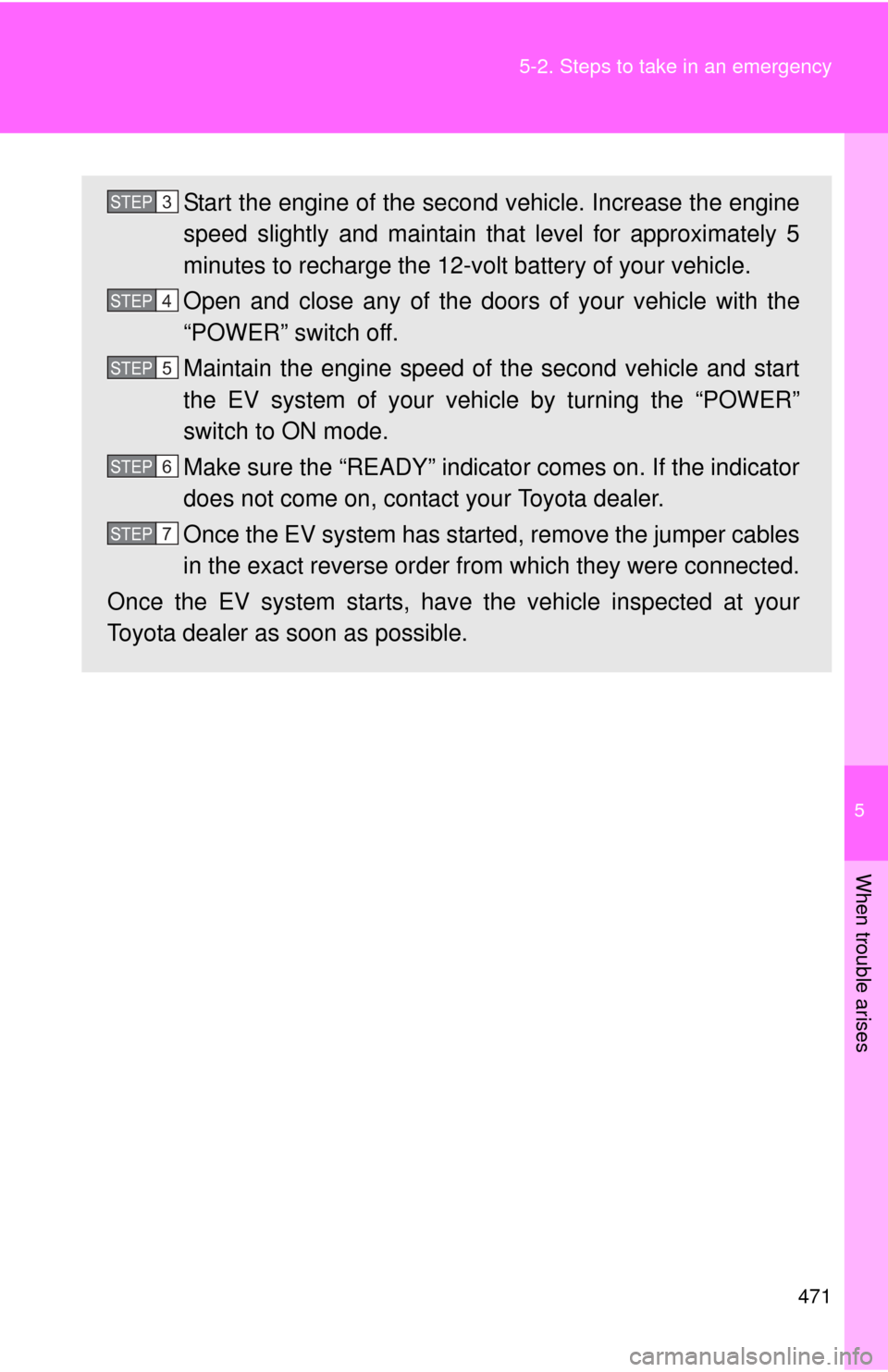
Start the engine of the second vehicle. Increase the engine
speed slightly and maintain that level for approximately 5
minutes to recharge the 12-v
olt battery of your vehicle.
Open and close any of the door s of your vehicle with the
“POWER” switch off.
Maintain the engine speed of the second vehicle and start
the EV system of your vehicle by turning the “POWER”
switch to ON mode.
Make sure the “READY” indicator comes on. If the indicator
does not come on, contact your Toyota dealer.
Once the EV system has started, remove the jumper cables
in the exact reverse order from which they were connected.
Once the EV system starts, hav e the vehicle inspected at your
Toyota dealer as soon as possible.STEP 3
STEP 4
STEP 5
STEP 6
STEP 7
Page 472 of 520

472 5-2. Steps to take in an emergency
■Starting the EV system when the 12-volt battery is discharged
The EV system cannot be started by push-starting.
■ To prevent 12-volt battery discharge
●Turn off the headlights and the navigation system while the EV system is
off.
● Turn off any unnecessary electrical components when the vehicle is run-
ning at a low speed for an extended period, such as in heavy traffic.
■ When the 12-volt battery is removed or discharged
●The EV system may not start. (P. 363)
● If the 12-volt battery discharges while the shift position is in P, it may not
be possible to shift the shift position to other positions.
In this case, the vehicle cannot be moved without lifting both front wheels
because the front wheels will be locked. ( P. 413)
● The power windows must be initialized. ( P. 147)
■ Charging the 12-volt battery
The electricity stored in the 12-volt battery will discharge gradually even
when the vehicle is not in use, due to natural discharge and the draining
effects of certain electrical appliances. If the vehicle is left for a long time, the
12-volt battery may discharge, and the EV system may be unable to start.
(The 12-volt battery recharges automatically while the EV system is operat-
ing.)
Page 473 of 520

5
When trouble arises
473
5-2. Steps to take in an emergency
CAUTION
■
Avoiding 12-volt battery fires or explosions
Observe the following precautions to prevent accidentally igniting the flam-
mable gas that may be emitted from the 12-volt battery:
●Make sure each jumper cable is connected to the correct terminal and that
it is not unintentionally in contact with any other than the intended terminal.
● Do not allow the other end of the jumper cable connected to the “+” termi-
nal to come into contact with any other parts or metal surfaces in the area,
such as brackets or unpainted metal.
● Do not allow the + and - clamps of the jumper cables to come into contact
with each other.
● Do not smoke, use matches, cigarette lighters or allow open flame near
the 12-volt battery.
■ 12-volt battery precautions
The 12-volt battery contains poisonous and corrosive acidic electrolyte,
while related parts contain lead and lead compounds. Observe the following
precautions when handling the 12-volt battery:
●When working with the 12-volt battery, always wear safety glasses and
take care not to allow any 12-volt battery fluids (acid) to come into contact
with skin, clothing or the vehicle body.
● Do not lean over the 12-volt battery.
● In the event that battery fluid comes into contact with the skin or eyes,
immediately wash the affected area with water and seek medical attention.
Place a wet sponge or cloth over the affected area until medical attention
can be received.
● Always wash your hands after handling the 12-volt battery support, termi-
nals, and other battery-related parts.
● Do not allow children near the 12-volt battery.
Page 486 of 520
486 6-1. Specifications
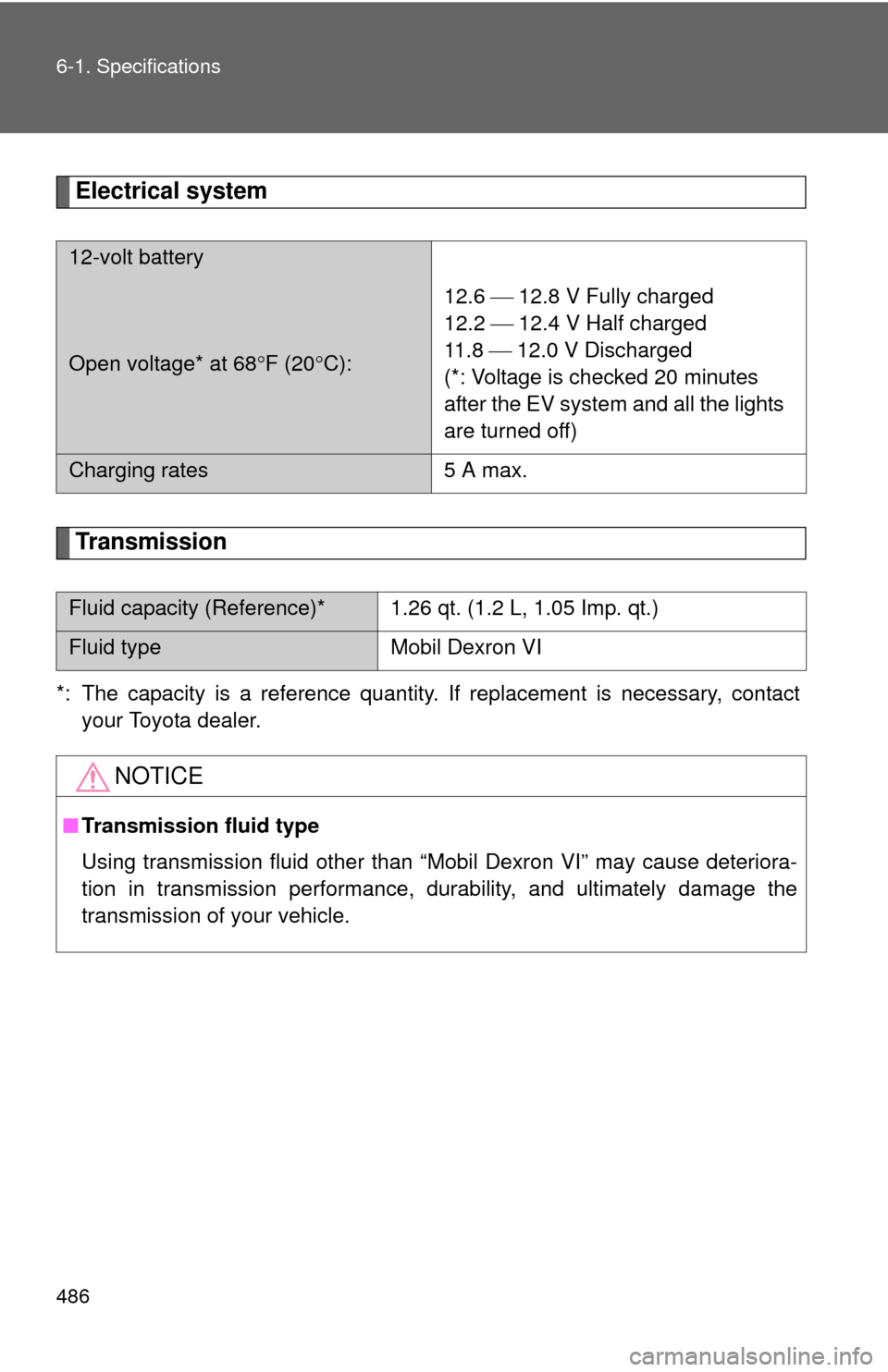
Electrical system
Transmission
*: The capacity is a reference quantity. If replacement is necessary, contactyour Toyota dealer.
12-volt battery
Open voltage* at 68 F (20C): 12.6 12.8 V Fully charged
12.2 12.4 V Half charged
11 . 8
12.0 V Discharged
(*: Voltage is checked 20 minutes
after the EV system and all the lights
are turned off)
Charging rates 5 A max.
Fluid capacity (Reference)* 1.26 qt. (1.2 L, 1.05 Imp. qt.)
Fluid typeMobil Dexron VI
NOTICE
■Transmission fluid type
Using transmission fluid other than “Mobil Dexron VI” may cause deteriora-
tion in transmission performance, durability, and ultimately damage the
transmission of your vehicle.
Page 488 of 520
488 6-1. Specifications
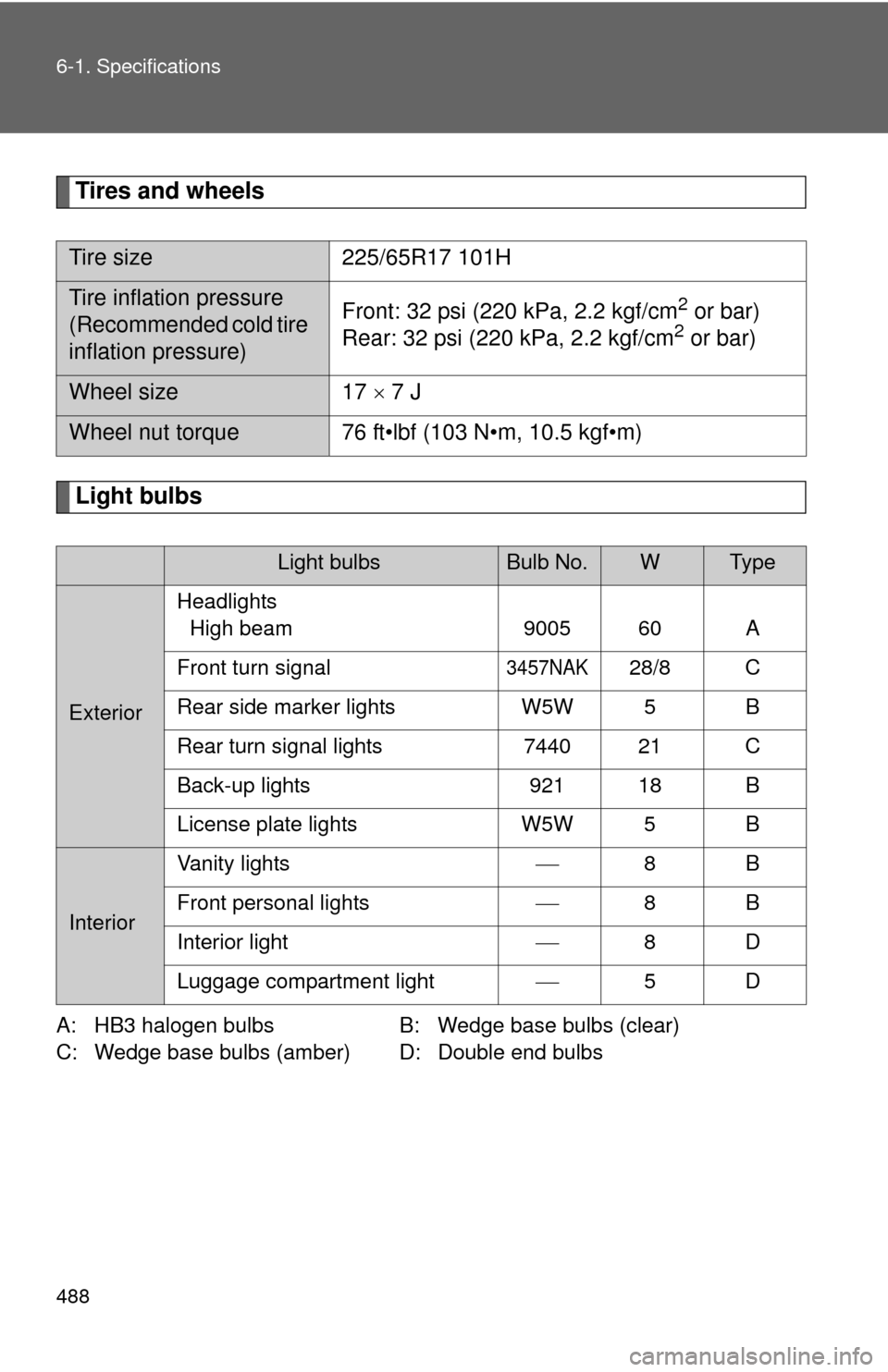
Tires and wheels
Light bulbs
A: HB3 halogen bulbsB: Wedge base bulbs (clear)
C: Wedge base bulbs (amber) D: Double end bulbs
Tire size 225/65R17 101H
Tire inflation pressure
(Recommended cold tire
inflation pressure)Front: 32 psi (220 kPa, 2.2 kgf/cm2 or bar)
Rear: 32 psi (220 kPa, 2.2 kgf/cm2 or bar)
Wheel size 17 7 J
Wheel nut torque 76 ft•lbf (103 N•m, 10.5 kgf•m)
Light bulbsBulb No.WTy p e
Exterior Headlights
High beam 9005 60 A
Front turn signal
3457NAK28/8 C
Rear side marker lights W5W 5 B
Rear turn signal lights 7440 21 C
Back-up lights 921 18 B
License plate lights W5W 5 B
InteriorVanity lights
8B
Front personal lights 8B
Interior light 8D
Luggage compartment light 5D
Page 497 of 520

497
6-1. Specifications
6
Vehicle specifications
Tire related termMeaning
Innerliner separation The parting of the innerliner from cord material
in the carcass
Intended outboard
sidewall (a) The sidewall that contains a whitewall,
bears white lettering, or bears manufac-
turer, brand, and/or model name molding
that is higher or deeper than the same
molding on the other sidewall of the tire, or
(b) The outward facing sidewall of an asym- metrical tire that has a particular side that
must always face outward when mounted
on a vehicle
Light truck (LT) tire A tire designated by its manufacturer as prima-
rily intended for use on lightweight trucks or
multipurpose passenger vehicles
Load rating The maximum load that a tire is rated to carry
for a given inflation pressure
Maximum load rating The load rating for a tire at the maximum per-
missible inflation pressure for that tire
Maximum permissible
inflation pressure The maximum cold inflation pressure to which
a tire may be inflated
Measuring rim The rim on which a tire is fitted for physical
dimension requirements
Open splice Any parting at any junction of tread, sidewall, or
innerliner that extends to cord material
Outer diameter The overall diameter of an inflated new tire
Overall width The linear distance between the exteriors of
the sidewalls of an inflated tire, including eleva-
tions due to labeling, decorations, or protective
bands or ribs
Passenger car tire A tire intended for use on passenger cars, mul-
tipurpose passenger vehicles, and trucks, that
have a gross vehicle weight rating (GVWR) of
10,000 lb. or less.