light TOYOTA RAV4 EV 2012 1.G Owners Manual
[x] Cancel search | Manufacturer: TOYOTA, Model Year: 2012, Model line: RAV4 EV, Model: TOYOTA RAV4 EV 2012 1.GPages: 520, PDF Size: 8.29 MB
Page 336 of 520

336 4-1. Maintenance and care
NOTICE
■To prevent paint deterioration and corrosion on the body and compo-
nents (aluminum wheels etc.)
● Wash the vehicle immediately in the following cases:
• After driving near the sea coast
• After driving on salted roads
• If coal tar or tree sap is present on the paint surface
• If dead insects, insect droppings or bird droppings are present on the
paint surface
• After driving in an area contaminated with soot, oily smoke, mine dust, iron powder or chemical substances
• If the vehicle becomes heavily soiled with dust or mud
• If liquids such as benzene and gasoline are spilled on the paint surface
● If the paint is chipped or scratched, have it repaired immediately.
● To prevent the wheels from corroding, remove any dirt and store in a place
with low humidity when storing the wheels.
■ Cleaning the exterior lights
●Wash carefully. Do not use organic substances or scrub with a hard brush.
This may damage the surfaces of the lights.
● Do not apply wax on the surfaces of the lights.
Wax may cause damage to the lenses.
■ Antenna installation and removal precautions
●Before driving, ensure that the antenna is installed.
● When the antenna is removed, such as before entering an automatic car
wash, make sure to store it in a suitable place so as not to lose it. Also,
before driving, make sure to reinstall the antenna in its original position.
■ To prevent damage to the windshield wiper arms
When lifting the wiper arms away from the windshield, pull the driver side
wiper arm upward first, and repeat for the passenger side. When returning
the wipers to their original position, do so from the passenger side first.
Page 339 of 520

339
4-1. Maintenance and care
4
Maintenance and care
NOTICE
■
Cleaning detergents
●Do not use organic substances such as benzene or gasoline, acidic or
alkaline solutions, dye, bleach or other detergent. Doing so may discolor
the vehicle interior or cause streaks or damage to painted surfaces.
● Do not use polish wax or polish cleaner. The instrument panel's or other
interior part’s painted surface may be damaged.
■ Preventing damage to leather surfaces
Observe the following precautions to avoid damage to and deterioration o\
f
leather surfaces:
●Remove any dust or dirt from leather surfaces immediately.
● Do not expose the vehicle to direct sunlight for extended periods of time.
Park the vehicle in the shade, especially during summer.
● Do not place items made of vinyl, plastic, or containing wax on the uphol-
stery, as they may stick to the leather surface if the vehicle interior heats
up significantly.
■ Water on the floor
Do not wash the vehicle floor with water.
Vehicle systems such as the audio system may be damaged if water comes
into contact with electrical components such as the audio system above or
under the floor of the vehicle. Water may also cause the body to rust.
■ Cleaning the inside of the rear window
●Do not use glass cleaner to clean the rear window, as this may cause
damage to the rear window defogger heater wires or antenna. Use a cloth
dampened with lukewarm water to gently wipe the window clean. Wipe the
window in strokes running parallel to the heater wires or antenna.
● Be careful not to scratch or damage the heater wires or antenna.
Page 343 of 520
343
4-2. Maintenance
4
Maintenance and care
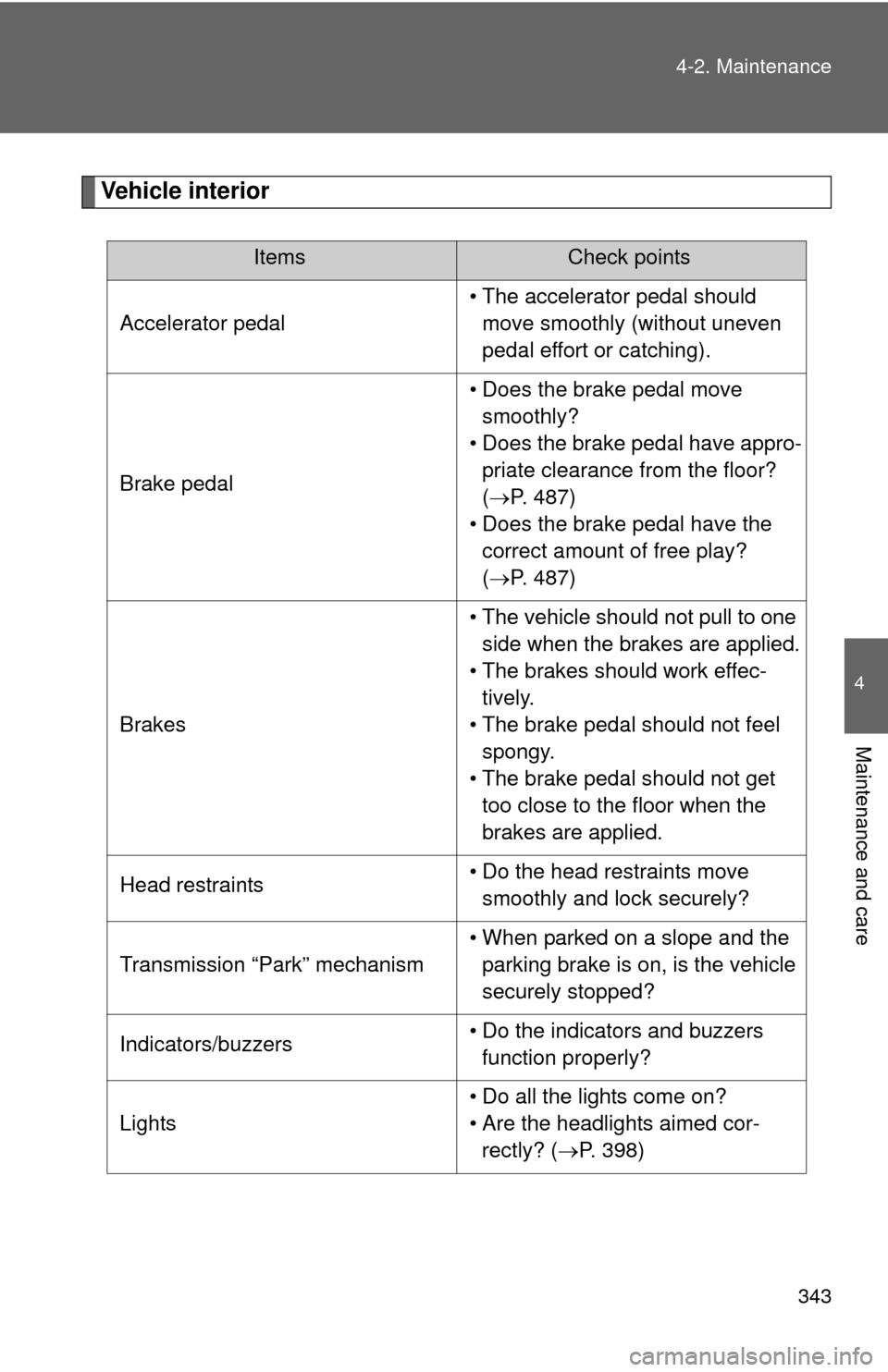
Vehicle interior
ItemsCheck points
Accelerator pedal • The accelerator pedal should
move smoothly (without uneven
pedal effort or catching).
Brake pedal • Does the brake pedal move
smoothly?
• Does the brake pedal have appro- priate clearance from the floor?
(P. 487)
• Does the brake pedal have the correct amount of free play?
(P. 487)
Brakes • The vehicle should not pull to one
side when the brakes are applied.
• The brakes should work effec- tively.
• The brake pedal should not feel spongy.
• The brake pedal should not get too close to the floor when the
brakes are applied.
Head restraints • Do the head restraints move
smoothly and lock securely?
Transmission “Park” mechanism • When parked on a slope and the
parking brake is on, is the vehicle
securely stopped?
Indicators/buzzers • Do the indicators and buzzers
function properly?
Lights • Do all the lights come on?
• Are the headlights aimed cor-
rectly? ( P. 398)
Page 347 of 520
347
4-3. Do-it-yourself maintenance
4
Maintenance and care
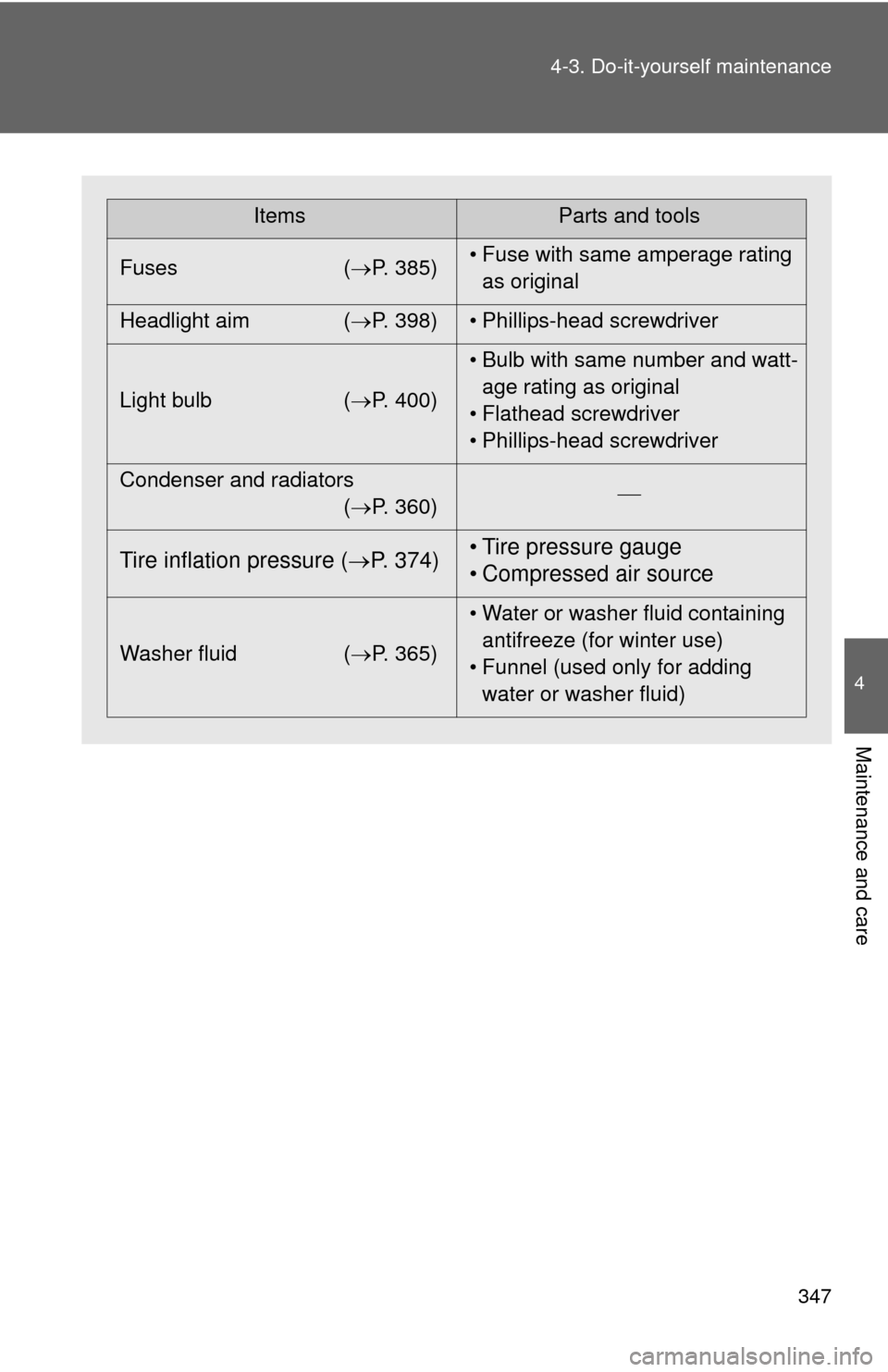
ItemsParts and tools
Fuses ( P. 385)• Fuse with same amperage rating
as original
Headlight aim ( P. 398) • Phillips-head screwdriver
Light bulb ( P. 400)• Bulb with same number and watt-
age rating as original
• Flathead screwdriver
• Phillips-head screwdriver
Condenser and radiators (P. 360)
Tire inflation pressure (
P. 374) • Tire pressure gauge
• Compressed air source
Washer fluid
(P. 365) • Water or washer fluid containing
antifreeze (for winter use)
• Funnel (used only for adding water or washer fluid)
Page 349 of 520
349
4-3. Do-it-yourself maintenance
4
Maintenance and care
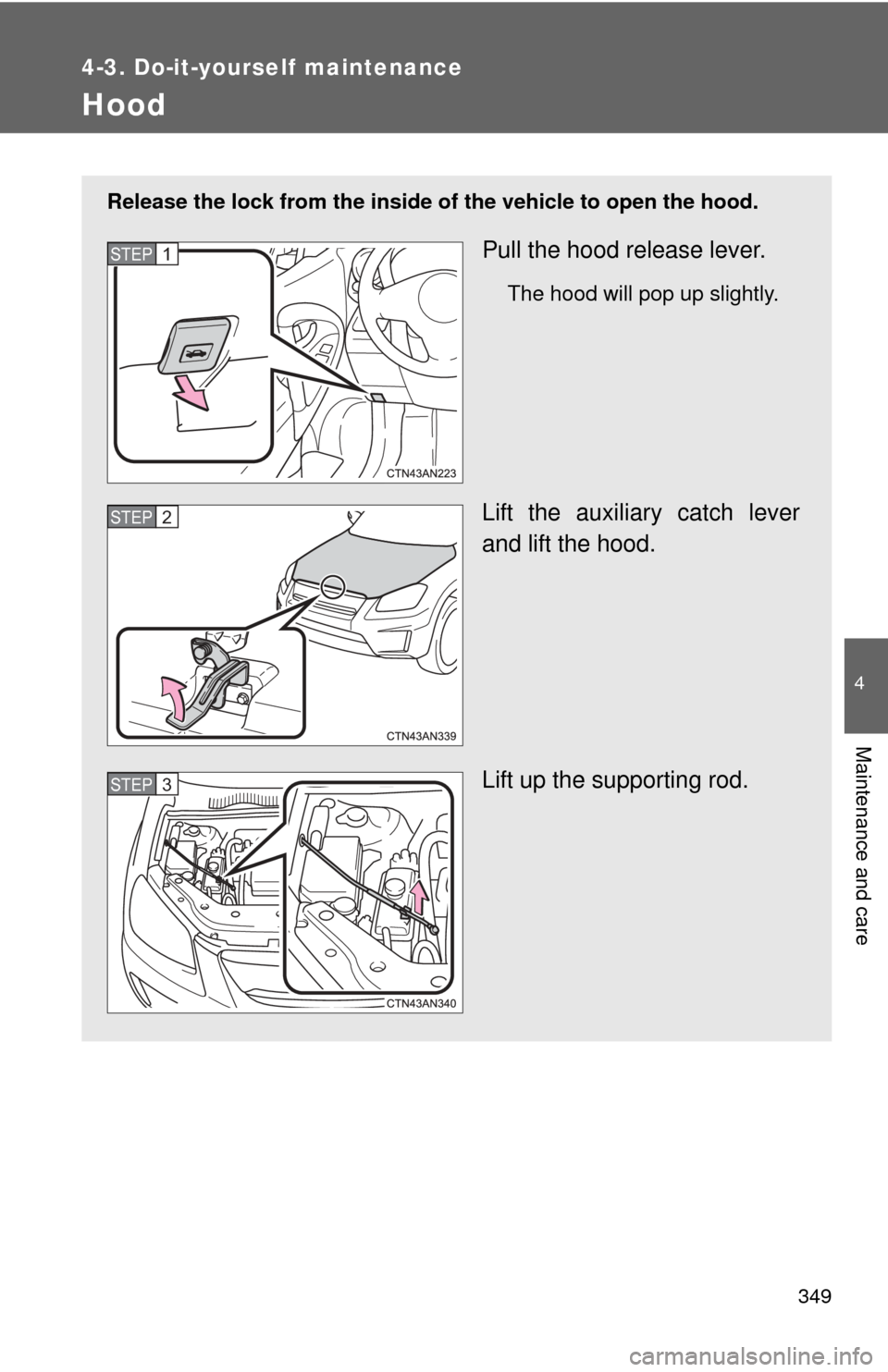
Hood
Release the lock from the inside of the vehicle to open the hood.
Pull the hood release lever.
The hood will pop up slightly.
Lift the auxiliary catch lever
and lift the hood.
Lift up the supporting rod.
STEP 1
STEP 2
STEP 3
Page 362 of 520
362 4-3. Do-it-yourself maintenance
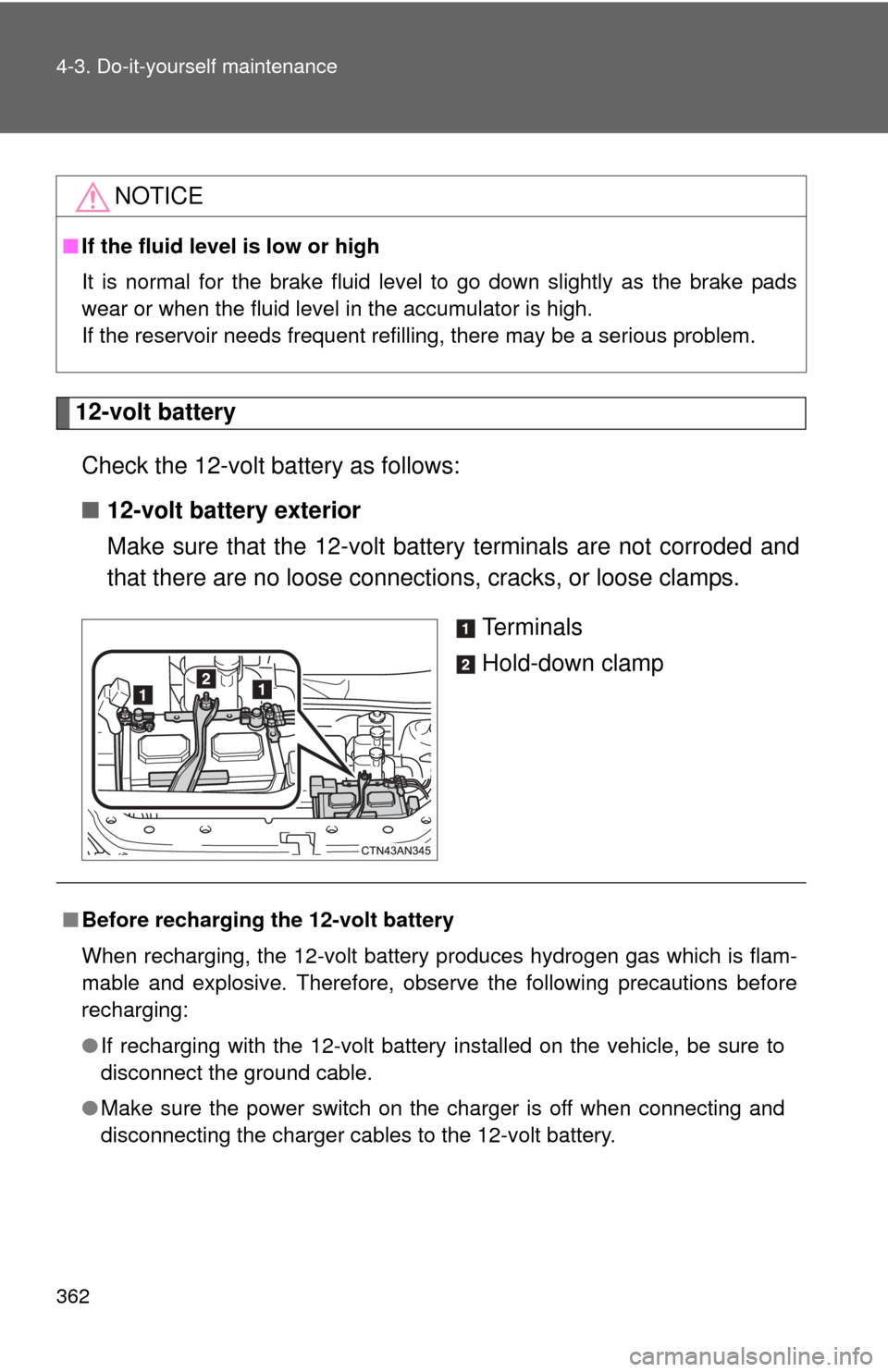
12-volt batteryCheck the 12-volt battery as follows:
■ 12-volt battery exterior
Make sure that the 12-volt battery terminals are not corroded and
that there are no loose connecti ons, cracks, or loose clamps.
Te r m i n a l s
Hold-down clamp
NOTICE
■If the fluid level is low or high
It is normal for the brake fluid level to go down slightly as the brake pads
wear or when the fluid level in the accumulator is high.
If the reservoir needs frequent refilling, there may be a serious proble\
m.
■Before recharging the 12-volt battery
When recharging, the 12-volt battery produces hydrogen gas which is flam-
mable and explosive. Therefore, observe the following precautions before
recharging:
●If recharging with the 12-volt battery installed on the vehicle, be sure to
disconnect the ground cable.
● Make sure the power switch on the charger is off when connecting and
disconnecting the charger cables to the 12-volt battery.
Page 363 of 520
363
4-3. Do-it-yourself maintenance
4
Maintenance and care
■
After recharging/reconnecting the 12-volt battery
●Unlocking the doors using the smart key system may not be possible
immediately after reconnecting the 12-volt battery. If this happens, use
the wireless remote control or the mechanical key to lock/unlock the
doors.
● Start the EV system with the “POWER” switch in ACCESSORY mode.
The EV system may not start with the “POWER” switch turned off. How-
ever, the EV system will operate normally from the second attempt.
● The “POWER” switch mode is recorded by the vehicle. If the 12-volt bat-
tery is reconnected, the vehicle will return the “POWER” switch mode to
the status it was in before the 12-volt battery was disconnected. Make
sure to turn the “POWER” switch off before disconnecting the 12-volt bat-
tery. Take extra care when connecting the 12-volt battery if the “POWER”
switch mode prior to discharge is unknown.
● When the 12-volt battery is reconnected, start the EV system, depress
the brake pedal, and confirm that it is possible to shift into each shift posi-
tion.
If the system will not start even after multiple attempts, contact your Toyota
dealer.
CAUTION
■ Chemicals in the 12-volt battery
The 12-volt battery contains poisonous and corrosive sulfuric acid and may
produce hydrogen gas which is flammable and explosive. To reduce the risk
of death or serious injury, take the following precautions while working on or
near the 12-volt battery:
●Do not cause sparks by touching the 12-volt battery terminals with tools.
● Do not smoke or light a match near the 12-volt battery.
● Avoid contact with eyes, skin and clothes.
● Never inhale or swallow electrolyte.
● Wear protective safety glasses when working near the 12-volt battery.
● Keep children away from the 12-volt battery.
Page 368 of 520
368 4-3. Do-it-yourself maintenance
■When to replace your vehicle's tires
Tires should be replaced if:
●You have tire damage such as cuts, splits, cracks deep enough to
expose the fabric, or bulges indicating internal damage.
●A tire goes flat repeatedly or cannot be properly repaired due to the
size or location of a cut or other damage.
If you are not sure, consult with your Toyota dealer.
■Replacing tires and wheels
If the ID code of the tire pressure warning valve and transmitter is not
registered, the tire pre ssure warning system will not work properly. After
driving for about 20 minutes, the tire pressure warning light blinks for 1
minute and stays on to indicate a system malfunction.
■Tire life
Any tire over 6 years old must be checked by a qualified technician even
if they have seldom or never been used or damage is not obvious.
■Routine tire inflation pressure checks
The tire pressure warning system doe s not replace routine tire inflation
pressure checks. Make sure to check tire inflation pressure as part of
your routine of daily vehicle checks.
■Maximum load of tire
Check that the number given by di viding the maximum load by 1.10 of
the replacement tire is greater than 1/2 of the Gross Axle Weight Ratings
(GAWR) of either the front axle or the rear axle, whichever is greater.
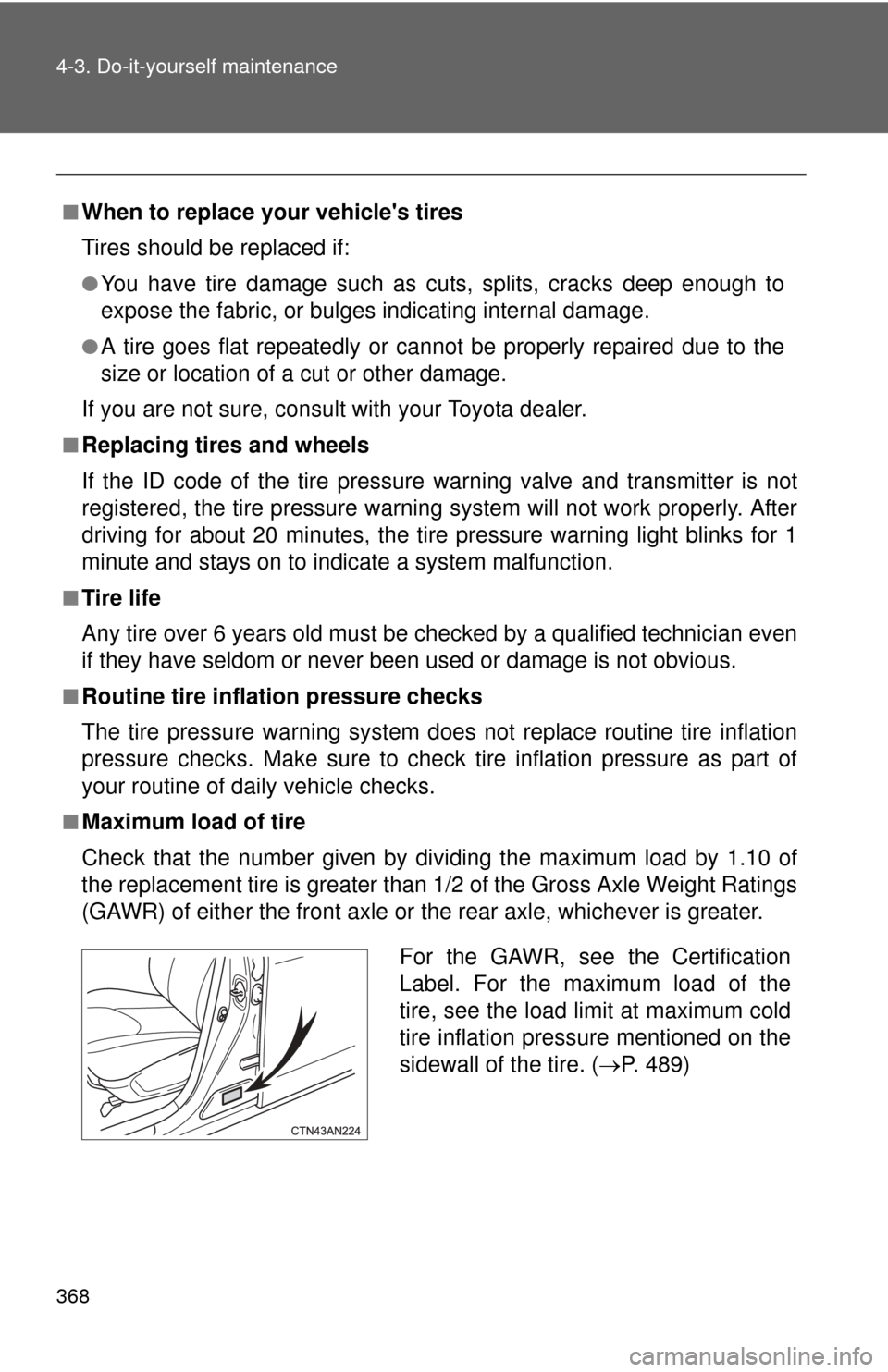
For the GAWR, see the Certification
Label. For the maximum load of the
tire, see the load limit at maximum cold
tire inflation pressure mentioned on the
sidewall of the tire. (P. 489)
Page 391 of 520
391
4-3. Do-it-yourself maintenance
4
Maintenance and care
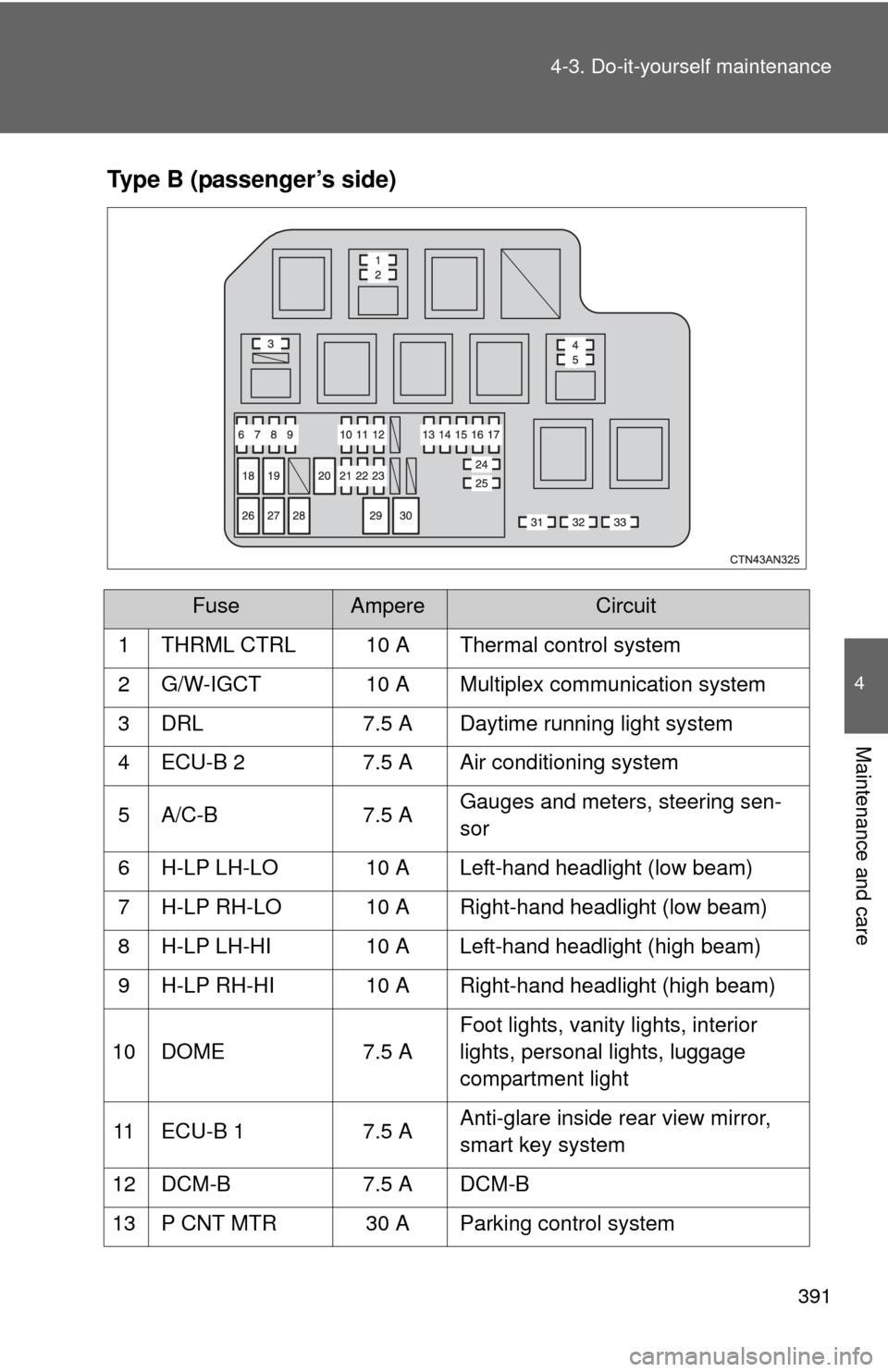
Type B (passenger’s side)
FuseAmpereCircuit
1 THRML CTRL 10 A Thermal control system
2 G/W-IGCT 10 A Multiplex communication system
3 DRL 7.5 A Daytime running light system
4 ECU-B 2 7.5 A Air conditioning system
5 A/C-B 7.5 A Gauges and meters, steering sen-
sor
6 H-LP LH-LO 10 A Left-hand headlight (low beam)
7 H-LP RH-LO 10 A Right-hand headlight (low beam)
8 H-LP LH-HI 10 A Left-hand headlight (high beam)
9 H-LP RH-HI 10 A Right-hand headlight (high beam)
10 DOME 7.5 AFoot lights, vanity lights, interior
lights, personal lights, luggage
compartment light
11 ECU-B 1 7.5 AAnti-glare inside rear view mirror,
smart key system
12 DCM-B 7.5 A DCM-B
13 P CNT MTR 30 A Parking control system
Page 392 of 520
392 4-3. Do-it-yourself maintenance
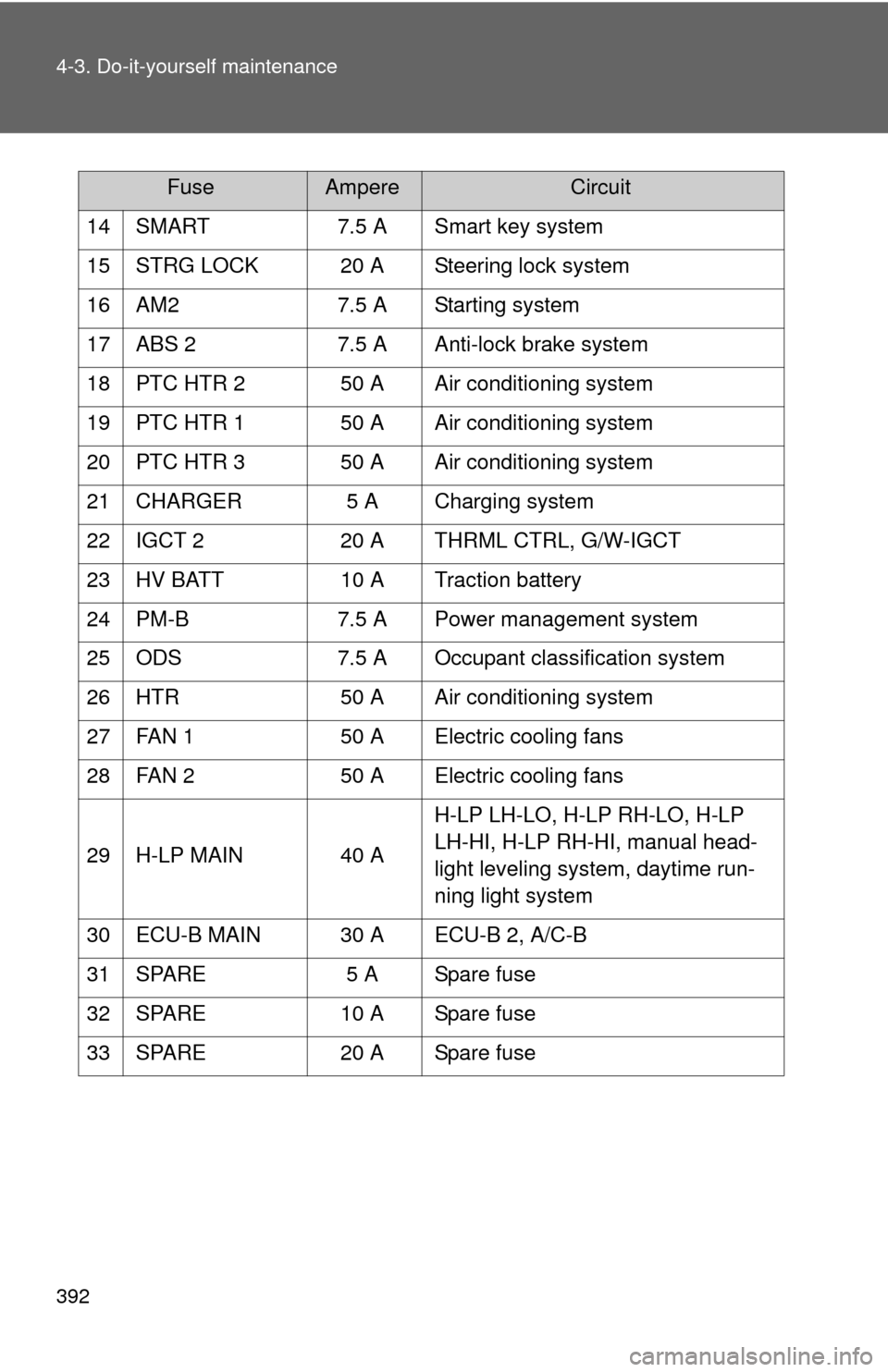
14 SMART7.5 A Smart key system
15 STRG LOCK 20 A Steering lock system
16 AM2 7.5 A Starting system
17 ABS 2 7.5 A Anti-lock brake system
18 PTC HTR 2 50 A Air conditioning system
19 PTC HTR 1 50 A Air conditioning system
20 PTC HTR 3 50 A Air conditioning system
21 CHARGER 5 A Charging system
22 IGCT 2 20 A THRML CTRL, G/W-IGCT
23 HV BATT 10 A Traction battery
24 PM-B 7.5 A Power management system
25 ODS 7.5 A Occupant classification system
26 HTR 50 A Air conditioning system
27 FAN 1 50 A Electric cooling fans
28 FAN 2 50 A Electric cooling fans
29 H-LP MAIN 40 A H-LP LH-LO, H-LP RH-LO, H-LP
LH-HI, H-LP RH-HI, manual head-
light leveling system, daytime run-
ning light system
30 ECU-B MAIN 30 A ECU-B 2, A/C-B
31 SPARE 5 A Spare fuse
32 SPARE 10 A Spare fuse
33 SPARE 20 A Spare fuse
FuseAmpereCircuit