ESP TOYOTA RAV4 EV 2012 1.G Owner's Guide
[x] Cancel search | Manufacturer: TOYOTA, Model Year: 2012, Model line: RAV4 EV, Model: TOYOTA RAV4 EV 2012 1.GPages: 520, PDF Size: 8.29 MB
Page 370 of 520

370 4-3. Do-it-yourself maintenance
■Tire pressure warning system certification
U.S.A.
FCC ID: PAXPMV107J
FCC ID: HYQ13BCX
NOTE:
This device complies with part 15 of the FCC Rules. Operation is subject
to the following two conditions: (1) This device may not cause harmful
interference, and (2) this device must accept any interference received,
including interference that may cause undesired operation.
FCC WARNING:
Changes or modifications not expre ssly approved by the party responsi-
ble for compliance could void the user's authority to operate the equip-
ment.
Canada
NOTE:
Operation is subject to the following two conditions: (1) this device may
not cause interference, and (2) this de vice must accept any interference,
including interference that may caus e undesired operation of the device.
NOTE:
L’utilisation de ce dispositif est autorisée seulement aux deux conditions
suivantes : (1) il ne doit pas produir e de brouillage, et (2) l’utilisateur du
dispositif doit être prêt à accepter tout brouillage radioélectrique reçu,
même si ce brouillage est susceptible de compromettre le
fonctionnement du dispositif.
Page 425 of 520

5
When trouble arises
425
5-2. Steps to take in an emergency
CAUTION
■Maintenance of the tires
Each tire, including the spare (if provided), should be checked monthly
when cold and inflated to the inflation pressure recommended by the
vehicle manufacturer on the vehicle
placard or tire inflation pressure
label (tire and load information label). (If your vehicle has tires of a differ-
ent size than the size indicated on the vehicle placard or tire inflation
pressure label [tire and load information label], you should determine the
proper tire inflation pr essure for those tires.)
As an added safety feature, your vehicle has been equipped with a tire
pressure monitoring system (TPMS-ti re pressure warning system) that
illuminates a low tire pressure telltale (tire pressure warning light) when
one or more of your tires is significantly under-inflated. Accordingly,
when the low tire pressure telltale (tire pre ssure warning light) illumi-
nates, you should stop and check your tires as soon as possible, and
inflate them to the proper pressure. Driving on a significantly under-
inflated tire causes the tire to overheat and can lead to tire failure.
Under-inflation also reduces fuel effi ciency (for electric vehicles, traction
battery efficiency) and tire tread lif e, and may affect the vehicle's han-
dling and stopping ability.
Please note that the TPMS (tire pressure warning system) is not a sub-
stitute for proper ti re maintenance, an d it is the driver's responsibility to
maintain correct tire pressure, even if under-inflation has not reached the
level to trigger illu mination of the TPMS low ti re pressure telltale (tire
pressure warning light).
Page 461 of 520

5
When trouble arises
461
5-2. Steps to take in an emergency
■Emergency tire puncture repair kit
●The sealant stored in the emergency tire puncture repair kit can be
used only once to temporarily repair a single tire. If the sealant has
been used and needs to be replaced, purchase a new bottle at your
Toyota dealer. The compressor is reusable.
●The sealant can be used when the outside temperature is from
-40°F (-40°C) to 140°F (60°C).
●The repair kit is exclusively designed for the size and type of tires
originally installed on your vehicle. Do not use it for tires that are a dif-
ferent size than the original ones, or for any other purposes.
●The sealant has a limited lifespan. The expiration date is marked on
the bottle. The bottle of sealant should be replaced with a new bottle
before the expiration date. Contact your Toyota dealer for replace-
ment.
●If the sealant gets on your clothes, it may stain.
●If the sealant adheres to a wheel or the surface of the vehicle body,
the stain may not be removable if it is not cleaned at once. Immedi-
ately wipe away the sealant with a wet cloth.
●During operation of the repair kit, a loud operation noise is produced.
This does not indicate a malfunction.
●Do not use to check or to adjust the tire pressure.
Page 463 of 520

5
When trouble arises
463
5-2. Steps to take in an emergency
CAUTION
●After inflation of the tire has comp
leted, the sealant may splatter when
the hose is disconnected or so me air is let out of the tire.
●Follow the operation procedure to repair the tire. If the procedures not
followed, the sealant may spray out.
●Keep back from the tire while it is being repaired, as there is a chance
of it bursting while the repair ope ration is being performed. If you
notice any cracks or deformation of the tire, turn off the compressor
switch and stop the repair operation immediately.
●The repair kit may overheat if operated for a long period of time. Do not
operate the repair kit continuously for more than 35 minutes.
●Parts of the repair kit become hot during operation. Be careful when
handling the repair kit during and after operation. Do not touch the
metal part around the connecting area between the bottle and com-
pressor. It will be extremely hot.
●Do not attach the vehicle speed warning sticker to an area other than
the one indicated. If the sticker is attached to an area where an SRS
airbag is located, such as the pad of the steering wheel, it may prevent
the SRS airbag from operating properly.
■Driving to spread the liquid sealant evenly
Observe the following precautions to reduce the risk of accidents.
Failing to do so may result in a loss of vehicle control and cause death or
serious injury.
●Drive the vehicle carefully at a lo w speed. Be especially careful when
turning and cornering.
●If the vehicle does not drive straight or you feel a pull through the
steering wheel, stop the vehicle and check the following.
• Tire condition. The tire may have separated from the wheel.
• Tire inflation pressure. If the tire inflation pressure is 19 psi (130
kPa, 1.3 kgf/cm
2 or bar) or less, the tire may be severely dam-
aged.
Page 493 of 520

493
6-1. Specifications
6
Vehicle specifications
■
Treadwear
The treadwear grade is a comparative rating based on the wear
rate of the tire when tested under controlled conditions on a speci-
fied government test course.
For example, a tire graded 150 would wear one and a half (1 - 1/2)
times as well on the government course as a tire graded 100.
The relative performance of tires depends upon the actual conditions
of their use, however, and may depart significantly from the norm due
to variations in driving habits, service practices and differences in
road characteristics and climate.
■ Traction AA, A, B, C
The traction grades, from highest to lowest, are AA, A, B and C,
and they represent the tire's ability to stop on wet pavement as
measured under controlled cond itions on specified government
test surfaces of asphalt and concrete.
A tire marked C may have poor traction performance.
Warning: The traction grade assigned to this tire is based on braking
(straight ahead) traction tests and does not include cornering (turn-
ing) traction.
■ Temperature A, B, C
The temperature grades are A (the highest), B, and C, represent-
ing the tire's resistance to the generation of heat and its ability to
dissipate heat when tested under controlled conditions on a speci-
fied indoor laboratory test wheel.
Sustained high temperature can cause the material of the tire to
degenerate and reduce tire life, and excessive temperature can lead
to sudden tire failure.
The grade C corresponds to a level of performance which all passen-
ger car tires must meet under the Federal Motor Vehicle Safety Stan-
dard No. 109.
Grades B and A represent higher levels of performance on the labo-
ratory test wheel than the minimum required by law.
Page 518 of 520
518
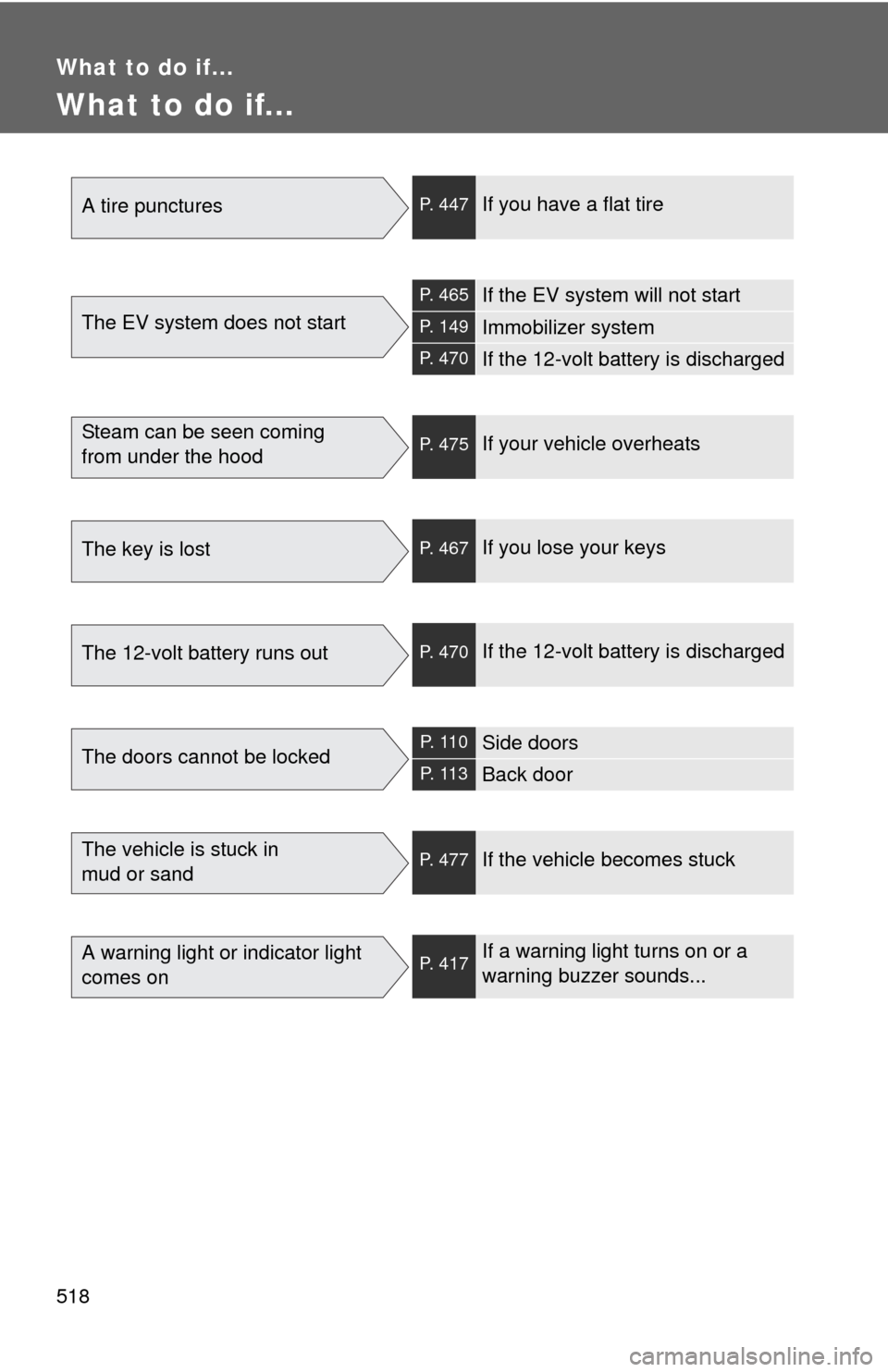
What to do if...
What to do if...
A tire puncturesP. 447If you have a flat tire
The EV system does not start
P. 465If the EV system will not start
P. 149Immobilizer system
P. 470If the 12-volt battery is discharged
Steam can be seen coming
from under the hoodP. 475If your vehicle overheats
The key is lostP. 467If you lose your keys
The 12-volt battery runs outP. 470If the 12-volt battery is discharged
The doors cannot be lockedP. 1 1 0Side doors
P. 1 1 3Back door
The vehicle is stuck in
mud or sandP. 477If the vehicle becomes stuck
A warning light or indicator light
comes onP. 417If a warning light turns on or a
warning buzzer sounds...