lights TOYOTA RAV4 EV 2012 1.G Workshop Manual
[x] Cancel search | Manufacturer: TOYOTA, Model Year: 2012, Model line: RAV4 EV, Model: TOYOTA RAV4 EV 2012 1.GPages: 520, PDF Size: 8.29 MB
Page 396 of 520
396 4-3. Do-it-yourself maintenance
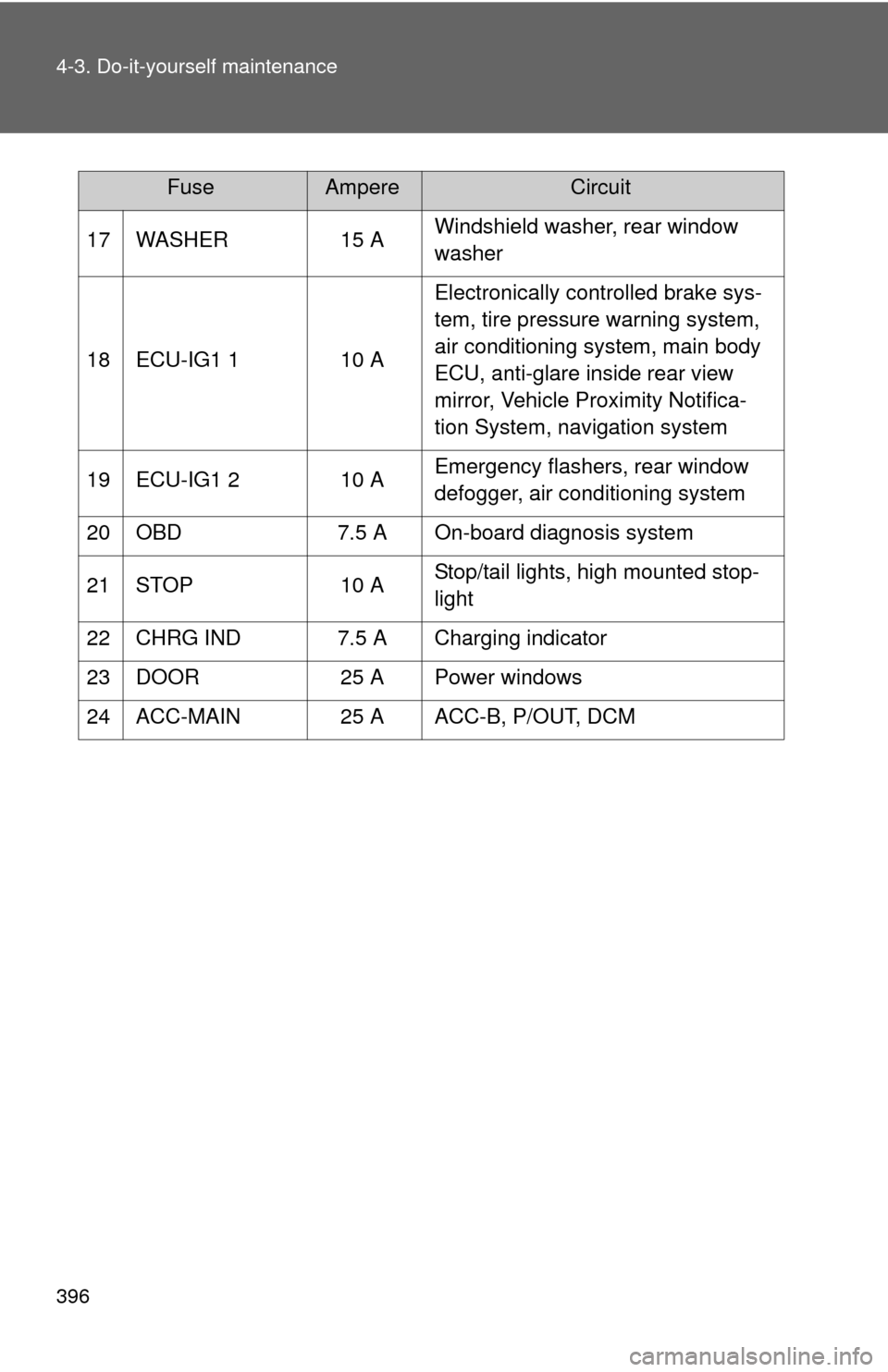
17 WASHER15 AWindshield washer, rear window
washer
18 ECU-IG1 1 10 A Electronically controlled brake sys-
tem, tire pressure warning system,
air conditioning system, main body
ECU, anti-glare inside rear view
mirror, Vehicle Proximity Notifica-
tion System, navigation system
19 ECU-IG1 2 10 A Emergency flashers, rear window
defogger, air conditioning system
20 OBD 7.5 A On-board diagnosis system
21 STOP 10 AStop/tail lights, high mounted stop-
light
22 CHRG IND 7.5 A Charging indicator
23 DOOR 25 A Power windows
24 ACC-MAIN 25 A ACC-B, P/OUT, DCM
FuseAmpereCircuit
Page 397 of 520
397
4-3. Do-it-yourself maintenance
4
Maintenance and care
■
After a fuse is replaced
●If the lights do not turn on even after the fuse has been replaced, a bulb
may need replacement. ( P. 400)
● If the replaced fuse blows again, have the vehicle inspected by your
Toyota dealer.
■ If there is an overload in a circuit
The fuses are designed to blow, protecting the wiring harness from damage.
■ When replacing light bulbs
Toyota recommends that you use genuine Toyota products designed for this
vehicle.
Because certain bulbs are connected to circuits designed to prevent over-
load, non-genuine parts or parts not designed for this vehicle may be unus-
able.
CAUTION
■To prevent system breakdowns and vehicle fire
Observe the following precautions.
Failure to do so may cause damage, and possibly a fire or injury.
●Never use a fuse of a higher amperage rating than that indicated, or use
any other object in place of a fuse.
● Always use a genuine Toyota fuse or equivalent.
Never replace a fuse with a wire, even as a temporary fix.
This can cause extensive damage or even fire.
● Do not modify the fuses or fuse boxes.
NOTICE
■Before replacing fuses
Have the cause of electrical overload determined and repaired by your
Toyota dealer as soon as possible.
Page 401 of 520
401
4-3. Do-it-yourself maintenance
4
Maintenance and care
■
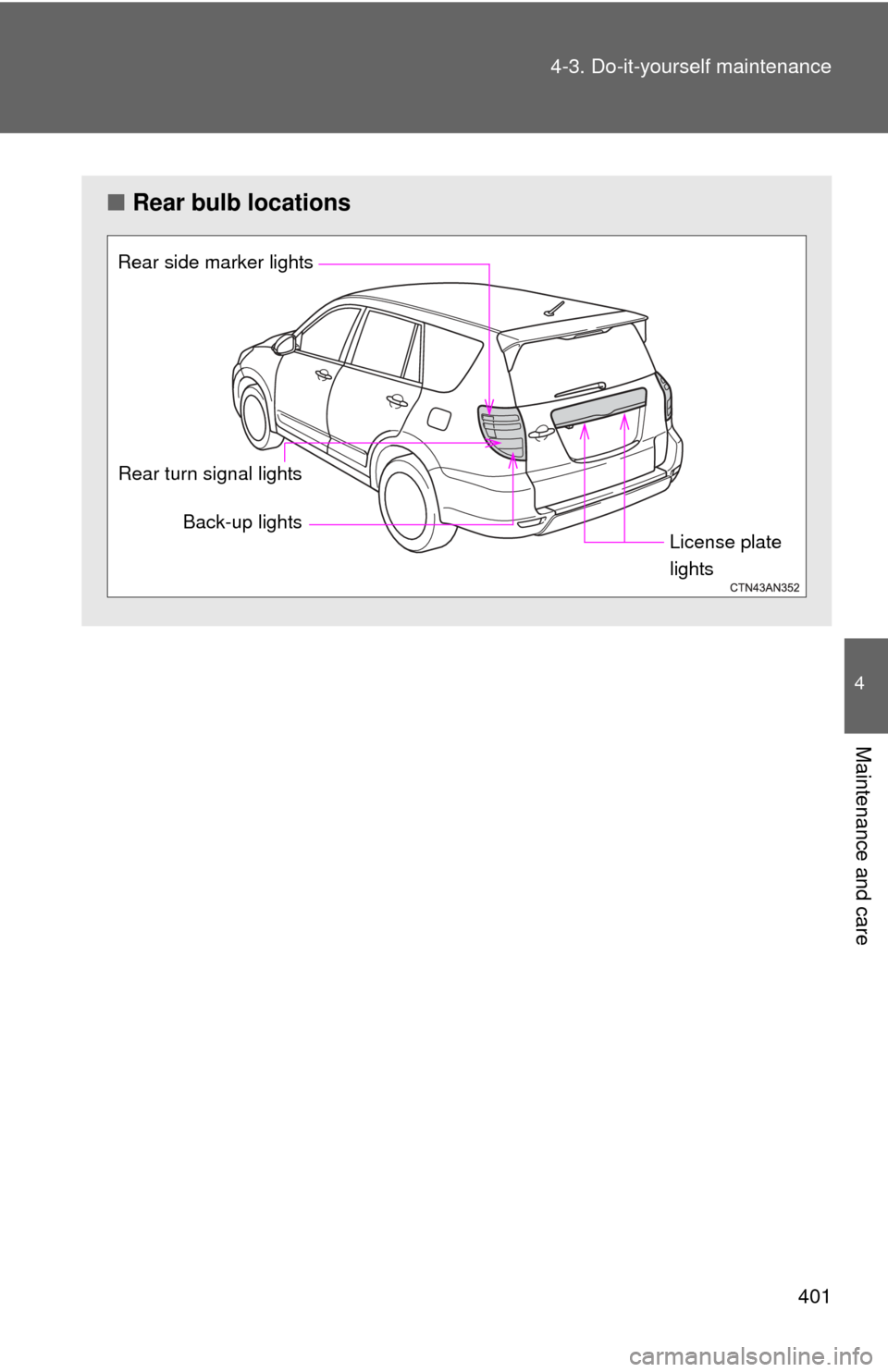
Rear bulb locations
Rear turn signal lights
Rear side marker lights
Back-up lights
License plate
lights
Page 406 of 520
406 4-3. Do-it-yourself maintenance
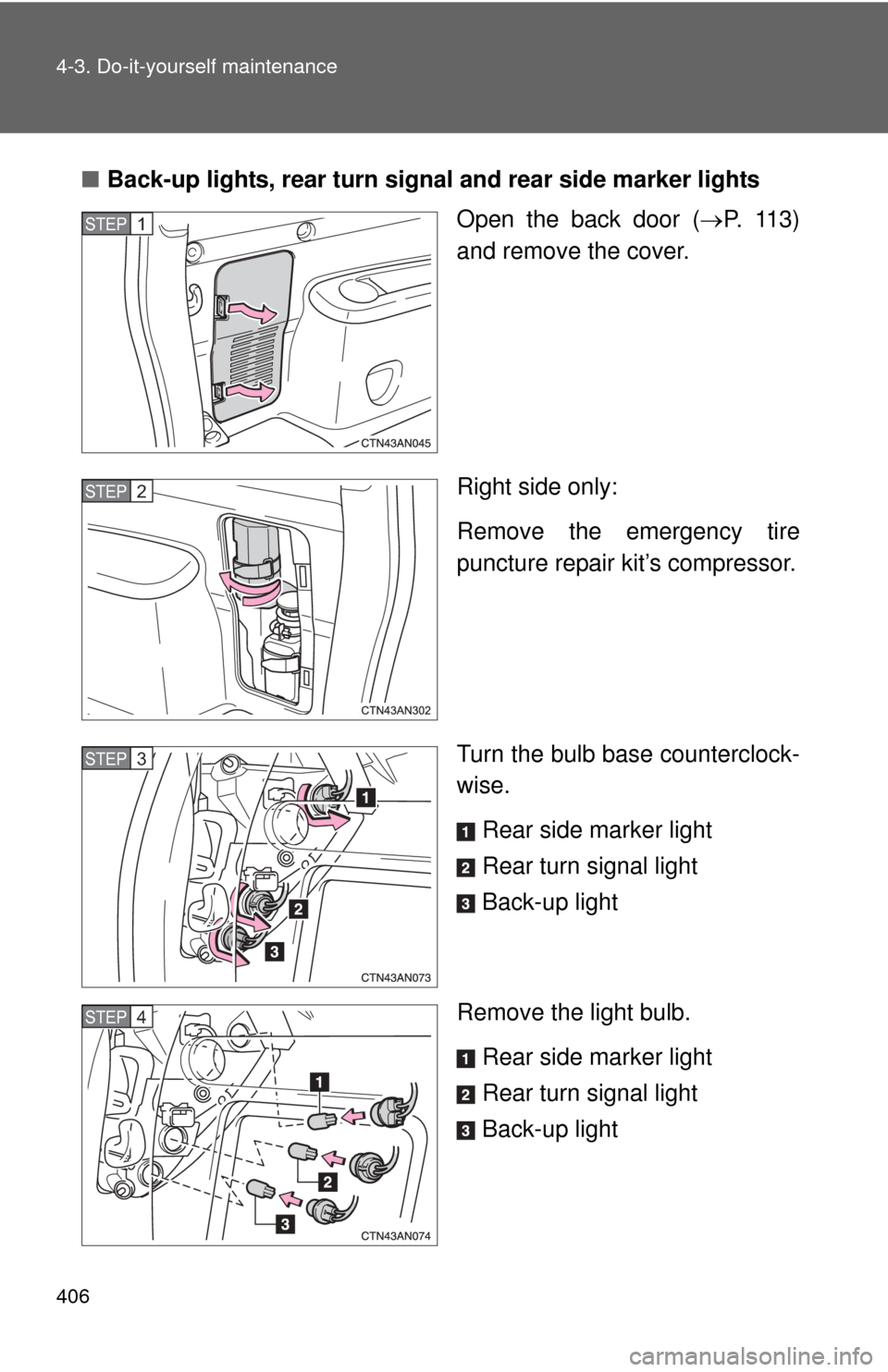
■Back-up lights, rear turn signal and rear side marker lights
Open the back door (P. 113)
and remove the cover.
Right side only:
Remove the emergency tire
puncture repair kit’s compressor.
Turn the bulb base counterclock-
wise.
Rear side marker light
Rear turn signal light
Back-up light
Remove the light bulb. Rear side marker light
Rear turn signal light
Back-up light
STEP 1
STEP 2
STEP 3
STEP 4
Page 407 of 520
407
4-3. Do-it-yourself maintenance
4
Maintenance and care
■
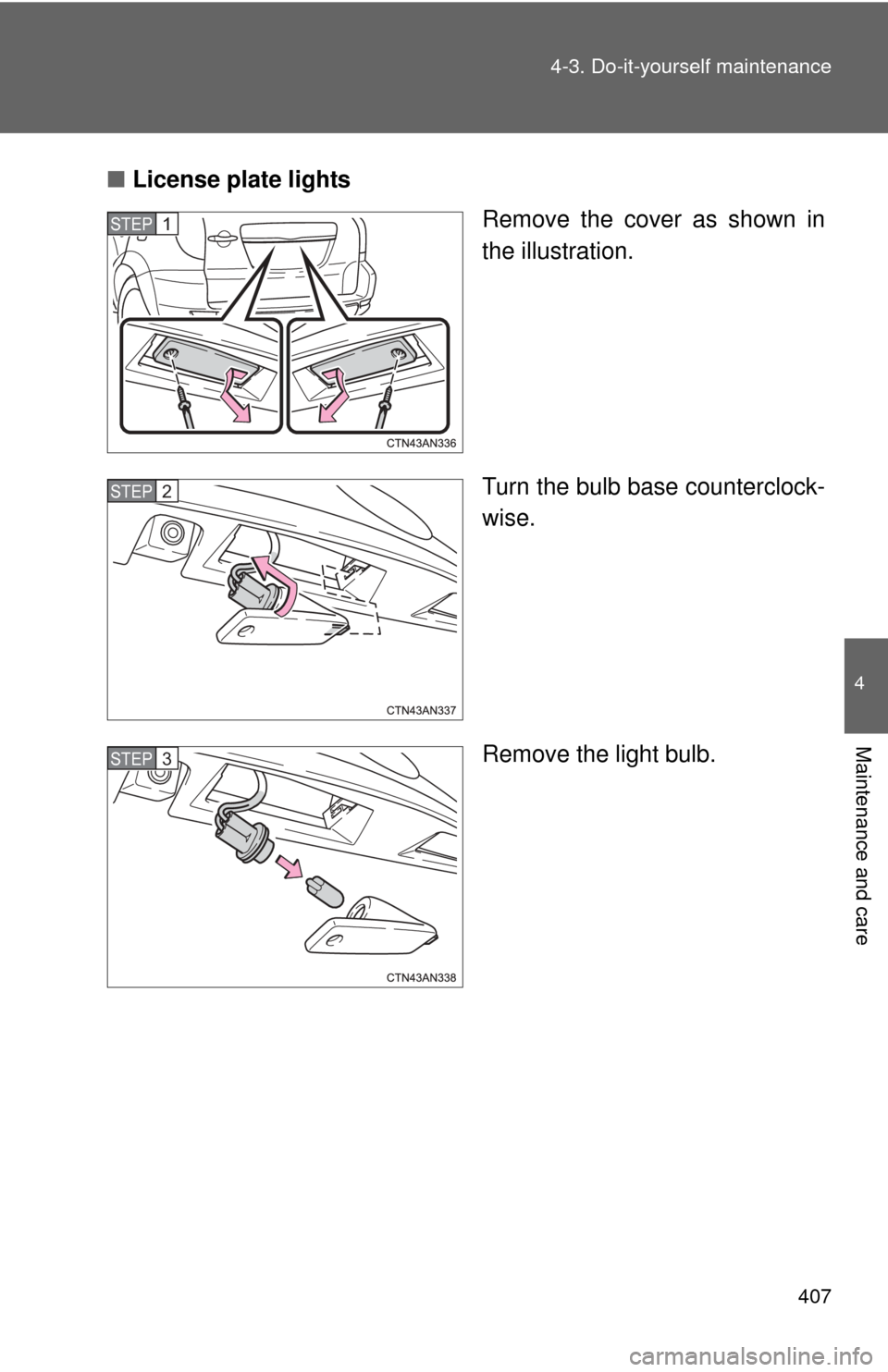
License plate lights
Remove the cover as shown in
the illustration.
Turn the bulb base counterclock-
wise.
Remove the light bulb.
STEP 1
STEP 2
STEP 3
Page 408 of 520
408 4-3. Do-it-yourself maintenance
■Replacing the following lights
If any of the lights listed below has burnt out, have it replaced by
your Toyota dealer.
●Headlight low beams
● Daytime running/parking lights
● Front side marker lights
● Side turn signal lights
● Stop/tail lights
● High mounted stoplight
■LED lights
The headlight low beams, daytime running/parking lights, front side marker
lights, stop/tail lights and high mounted stoplight consists of a number of
LEDs. If any of the LEDs burn out, take your vehicle to your Toyota dealer to
have the light replaced.
■ Condensation build-up on th e inside of the lens
Contact your Toyota dealer for more information in the following situations.
Temporary condensation build-up on the inside of the headlight lens does
not indicate a malfunction.
● Large drops of water have built up on the inside of the lens.
● Water has built up inside the headlight.
■ Replacing the back-up light , rear turn signal and rear side marker light
bulbs
There is a ECU near the left hand side bulb bases.
When removing the bulb base, make sure to not subject the ECU to impacts.
( P. 319)
■ When replacing light bulbs
P. 397
Page 409 of 520
409
4-3. Do-it-yourself maintenance
4
Maintenance and care
CAUTION
■
Replacing light bulbs
●Turn off the lights. Do not attempt to replace the bulb immediately after
turning off the lights.
The bulbs become very hot and may cause burns.
● Do not touch the glass portion of the light bulb with bare hands. Hold the
bulb by the plastic or metal portion.
If the bulb is scratched or dropped, it may blow out or crack.
● Fully install light bulbs and any parts used to secure them. Failure to do so
may result in heat damage, fire, or water entering the headlight unit. This
may damage the headlights or cause condensation to build up on the lens.
■ To prevent damage or fire
Make sure bulbs are fully seated and locked.
Page 412 of 520
412
5-1. Essential information
Emergency flashers
■Emergency flashers
If the emergency flashers are used for a long time while the EV system is not
operating (while the “READY” indicator is not illuminated), the 12-volt battery
may discharge.
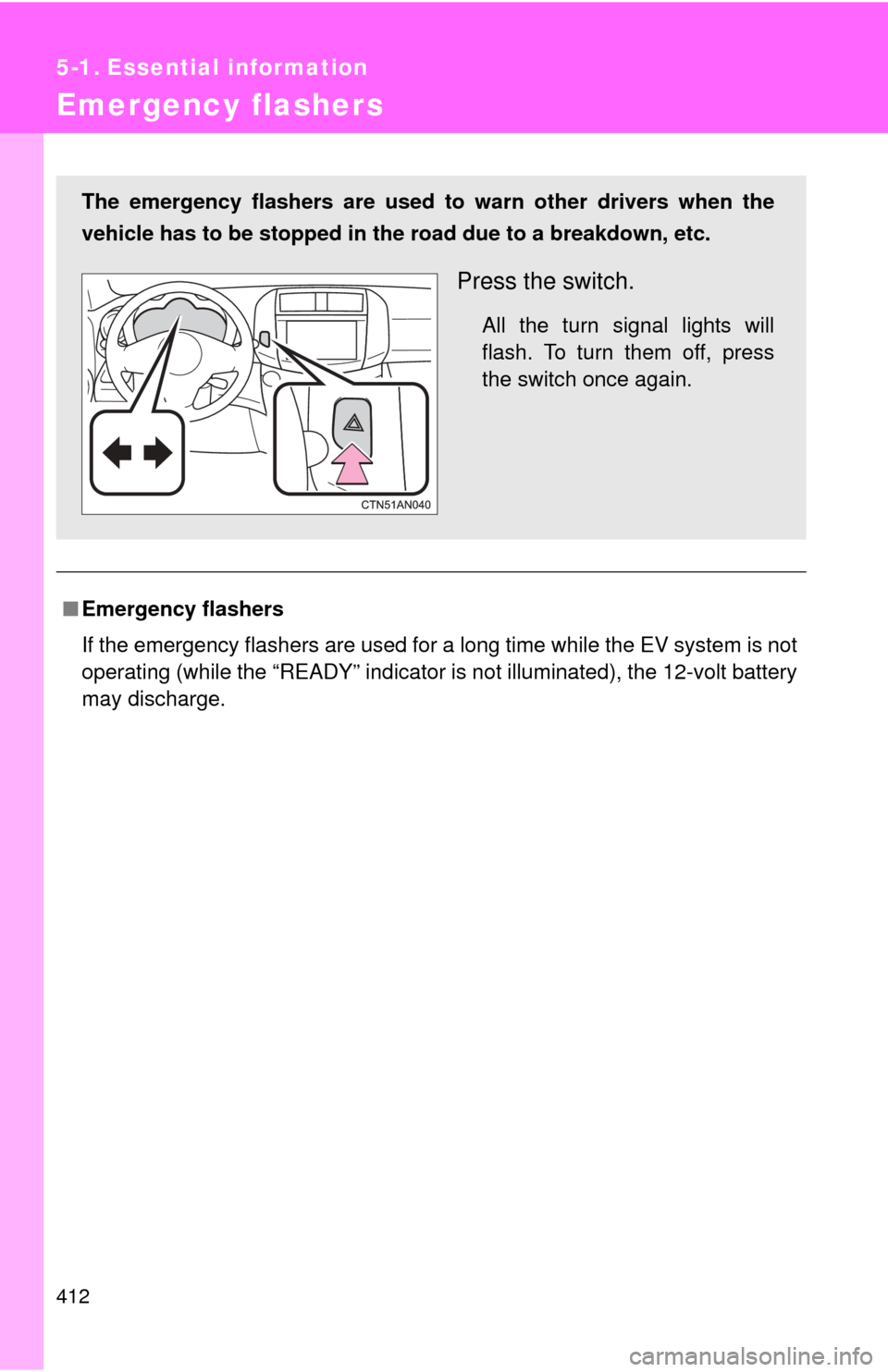
The emergency flashers are used to warn other drivers when the
vehicle has to be stopped in the road due to a breakdown, etc.
Press the switch.
All the turn signal lights will
flash. To turn them off, press
the switch once again.
Page 417 of 520
5
When trouble arises
417
5-2. Steps to take in an emergency
If a war ning light turns on or a war ning buzzer sounds...
Stop the vehicle immediately. Continuing to drive the vehicle
may be dangerous.The following warning indicates a possible problem in the brake sys-
tem. Immediately stop the vehicle in a safe place and contact your
Toyota dealer.
*: Brake system warning buzzer:
When there is a possible problem that could affect braking performance, the
warning light will come on and a warning buzzer may sound.
Parking brake engaged warning buzzer:
P. 433
Warning lightWarning light/Details
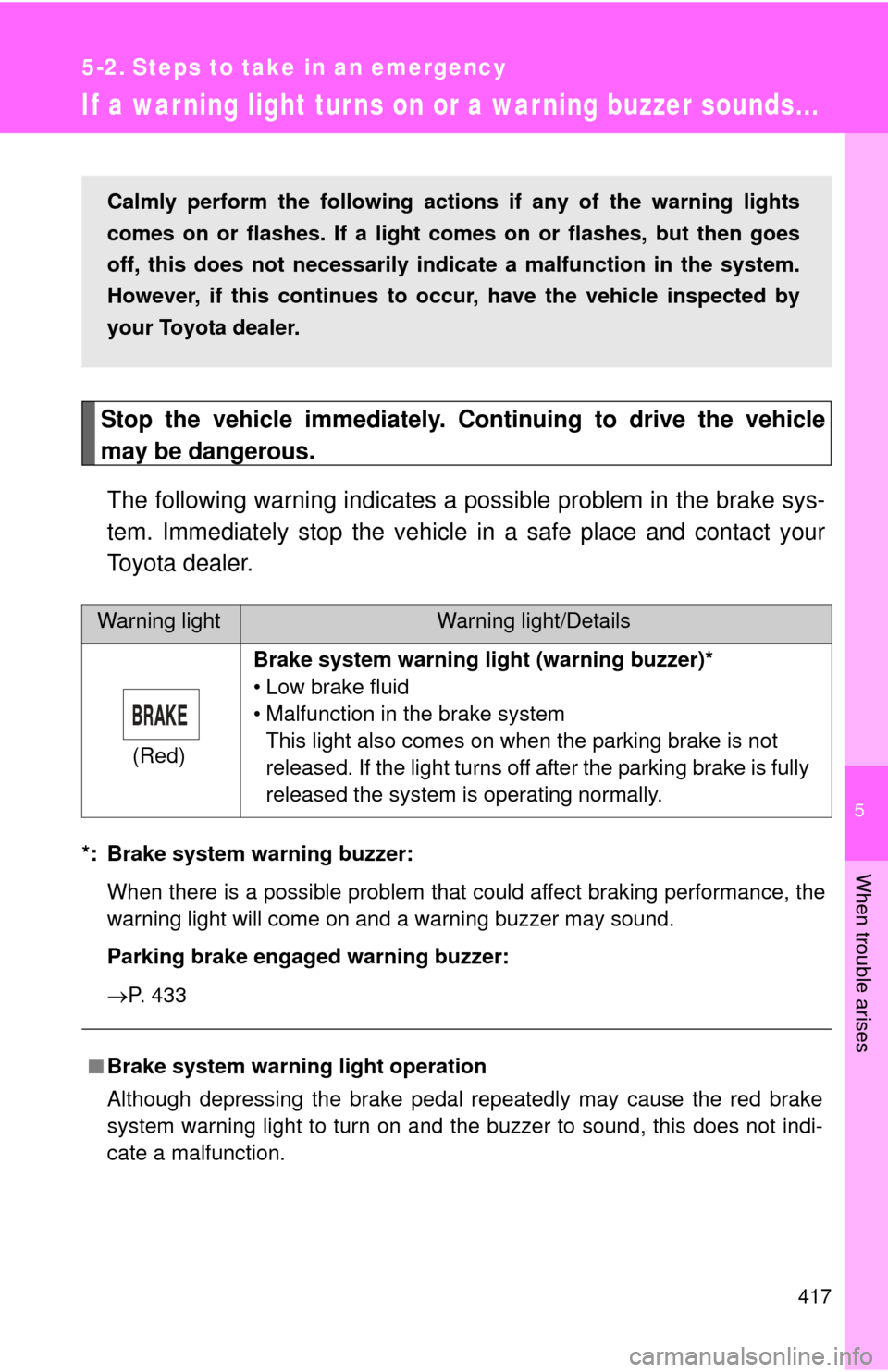
(Red) Brake system warning light (warning buzzer)*
• Low brake fluid
• Malfunction in the brake system
This light also comes on when the parking brake is not
released. If the light turns off after the parking brake is fully
released the system is operating normally.
■ Brake system warning light operation
Although depressing the brake pedal repeatedly may cause the red brake
system warning light to turn on and the buzzer to sound, this does not indi-
cate a malfunction.
Calmly perform the following actio ns if any of the warning lights
comes on or flashes. If a light comes on or flashes, but then goes
off, this does not necessarily indicate a malfunction in the system.
However, if this continues to o ccur, have the vehicle inspected by
your Toyota dealer.
Page 427 of 520
5
When trouble arises
427
5-2. Steps to take in an emergency
If a warning message is displayed
If a warning is shown on the multi-information display, stay calm and
perform the following actions:
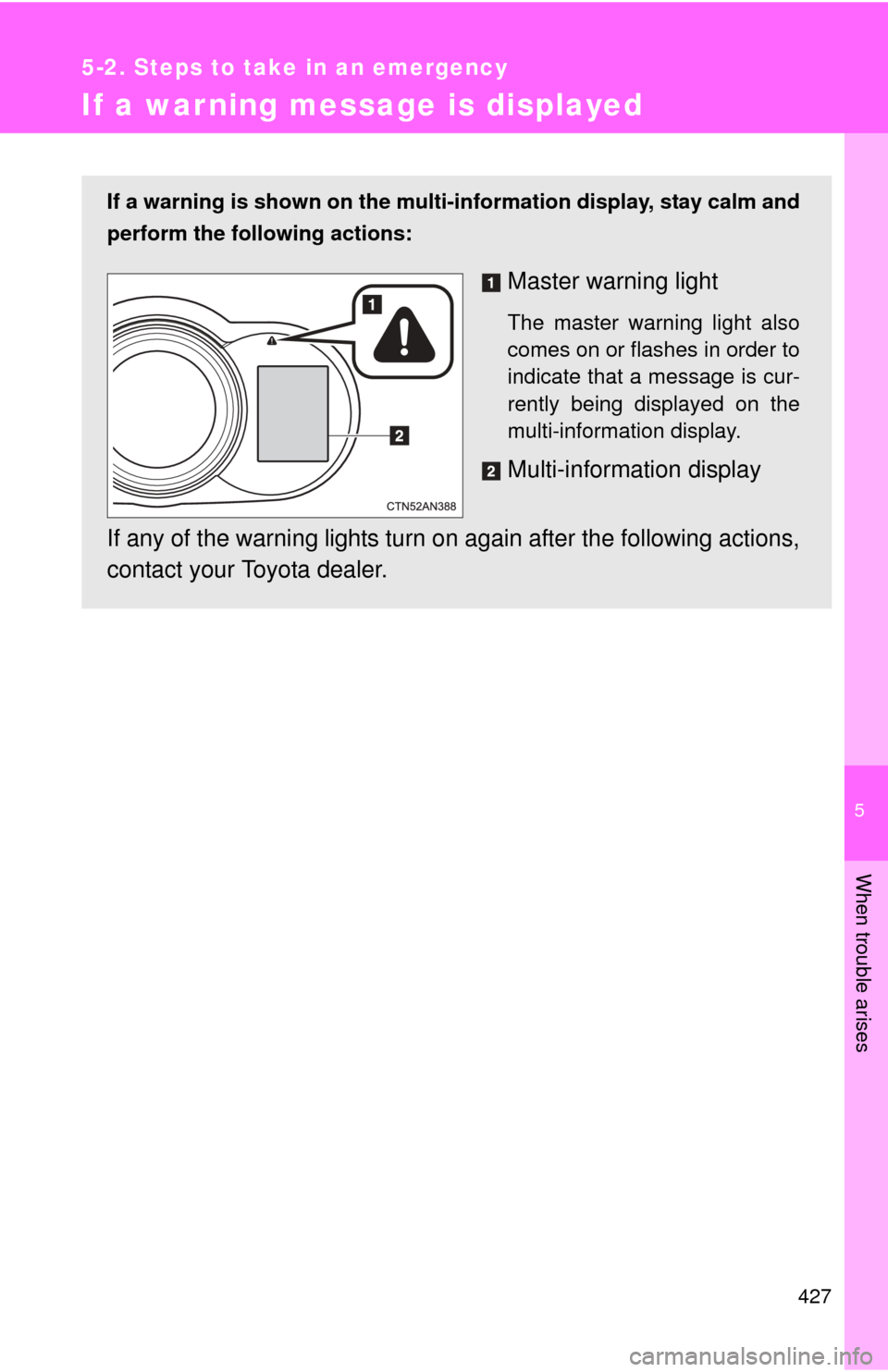
Master warning light
The master warning light also
comes on or flashes in order to
indicate that a message is cur-
rently being displayed on the
multi-information display.
Multi-information display
If any of the warning lights turn on again after the following actions,
contact your Toyota dealer.