ECU TOYOTA RAV4 EV 2013 1.G User Guide
[x] Cancel search | Manufacturer: TOYOTA, Model Year: 2013, Model line: RAV4 EV, Model: TOYOTA RAV4 EV 2013 1.GPages: 520, PDF Size: 7.4 MB
Page 133 of 520
133
1-6. Adjustable components (s
eats, mirrors, steering wheel)
1
Before driving
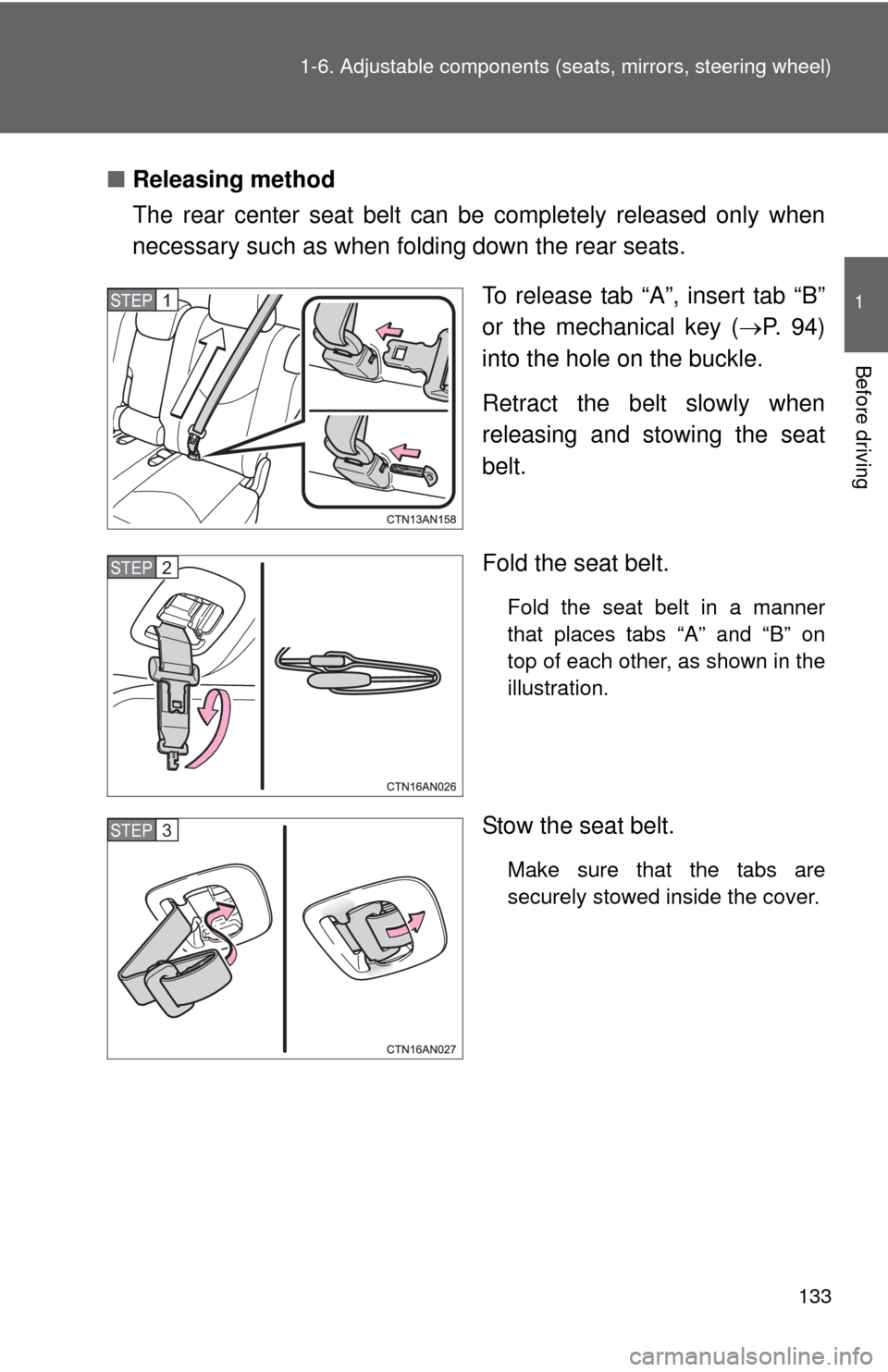
■Releasing method
The rear center seat belt can be completely released only when
necessary such as when folding down the rear seats.
To release tab “A”, insert tab “B”
or the mechanical key (P. 94)
into the hole on the buckle.
Retract the belt slowly when
releasing and stowing the seat
belt.
Fold the seat belt.
Fold the seat belt in a manner
that places tabs “A” and “B” on
top of each other, as shown in the
illustration.
Stow the seat belt.
Make sure that the tabs are
securely stowed inside the cover.
STEP 1
STEP 2
STEP 3
Page 134 of 520
134 1-6. Adjustable components (seats, mirrors, steering wheel)
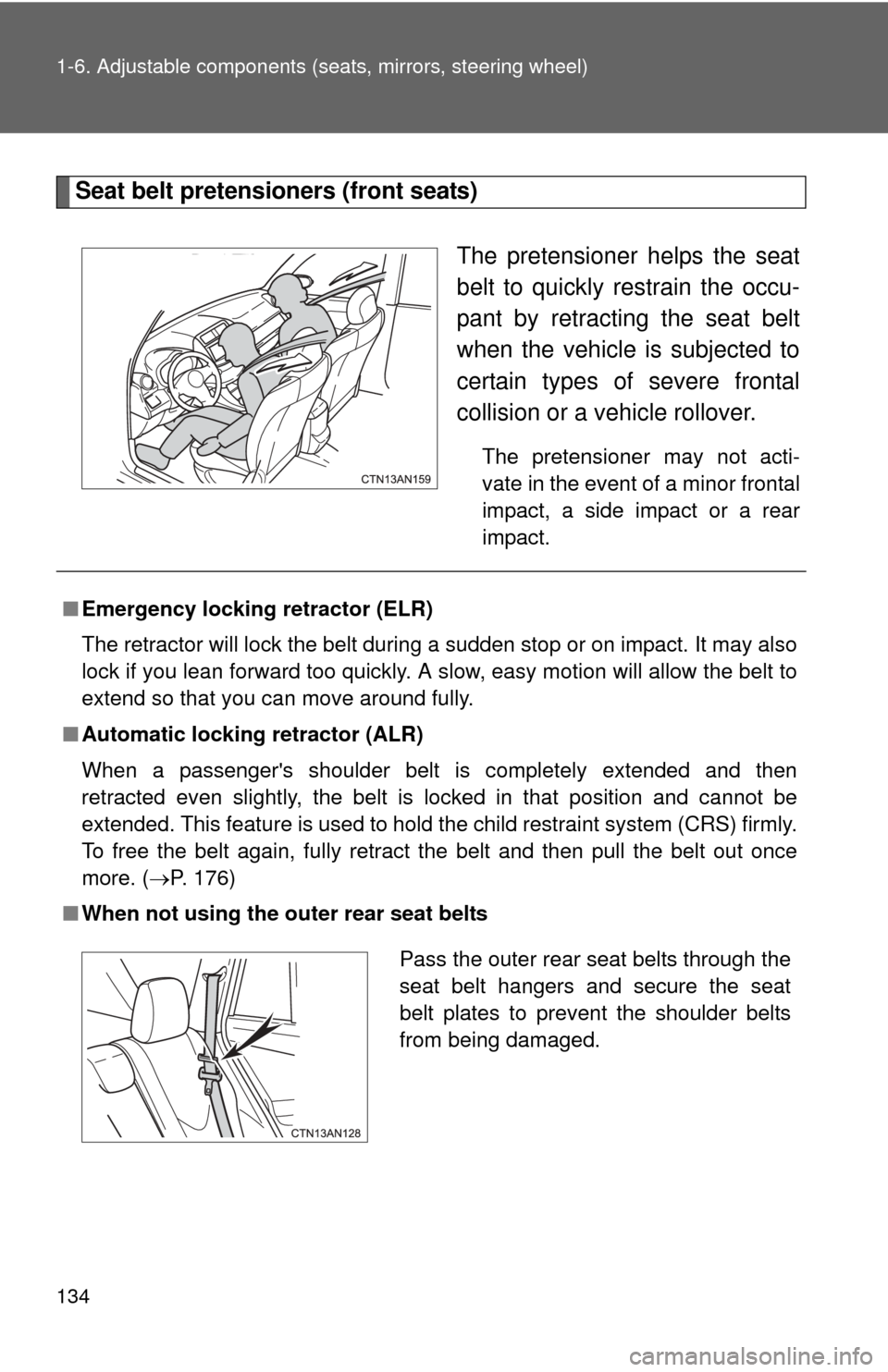
Seat belt pretensioners (front seats)
The pretensioner helps the seat
belt to quickly restrain the occu-
pant by retracting the seat belt
when the vehicle is subjected to
certain types of severe frontal
collision or a vehicle rollover.
The pretensioner may not acti-
vate in the event of a minor frontal
impact, a side impact or a rear
impact.
■Emergency locking retractor (ELR)
The retractor will lock the belt during a sudden stop or on impact. It may also
lock if you lean forward too quickly. A slow, easy motion will allow the belt to
extend so that you can move around fully.
■ Automatic locking retractor (ALR)
When a passenger's shoulder belt is completely extended and then
retracted even slightly, the belt is locked in that position and cannot be
extended. This feature is used to hold the child restraint system (CRS) firmly.
To free the belt again, fully retract the belt and then pull the belt out once
more. ( P. 176)
■ When not using the ou ter rear seat belts
Pass the outer rear seat belts through the
seat belt hangers and secure the seat
belt plates to prevent the shoulder belts
from being damaged.
Page 135 of 520
135
1-6. Adjustable components (s
eats, mirrors, steering wheel)
1
Before driving
■Child seat belt usage
The seat belts of your vehicle were principally designed for persons of adult
size.
●Use a child restraint system appropriate for the child, until the child
becomes large enough to properly wear the vehicle's seat belt. ( P. 172)
● When the child becomes large enough to properly wear the vehicle's seat
belt, follow the instructions on P. 131 regarding seat belt usage.
■ Replacing the belt after the pretensioner has been activated
If the vehicle is involved in multiple collisions, the pretensioner will activate
for the first collision, but will not activate for the second or subsequent colli-
sions.
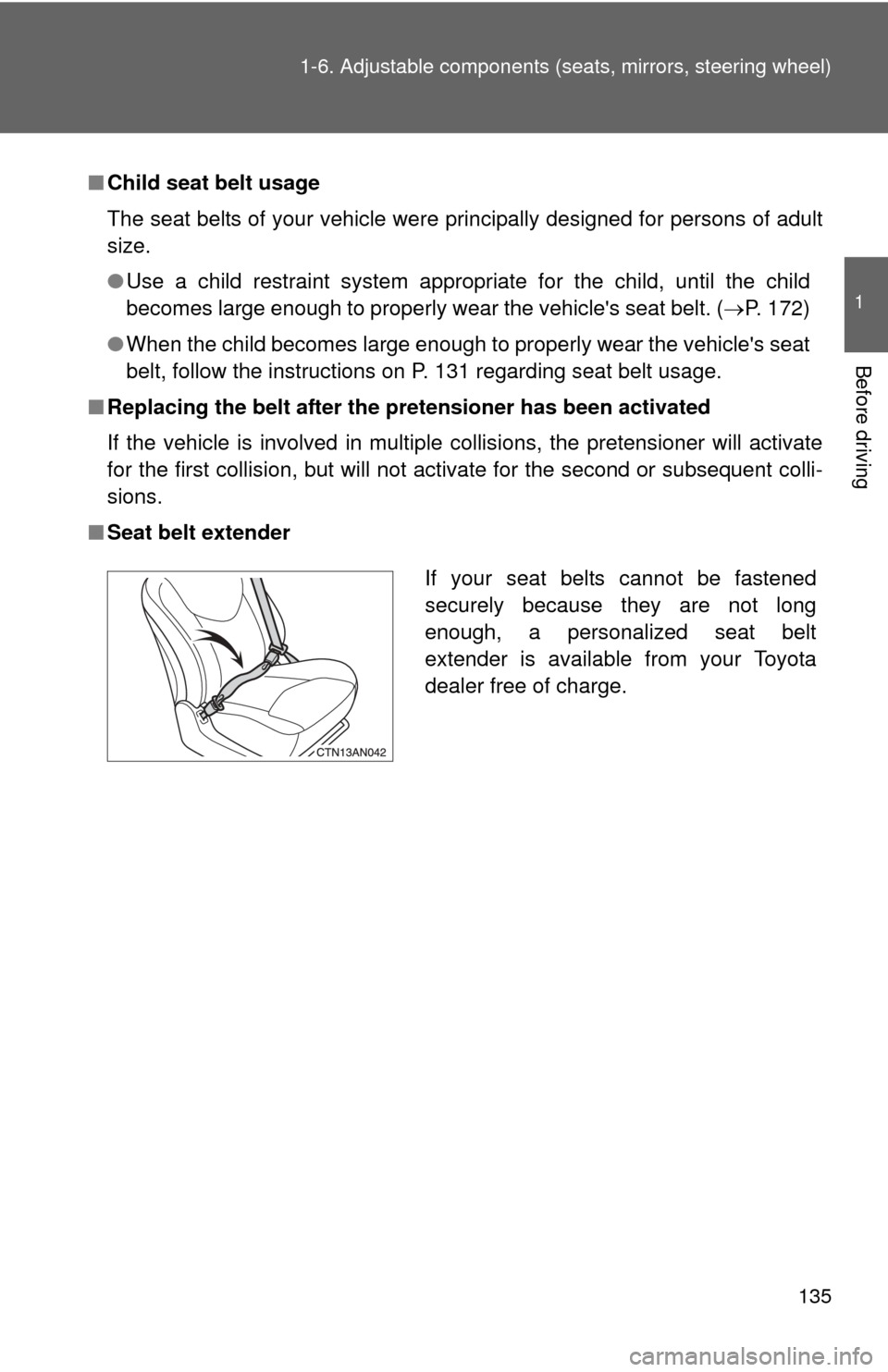
■ Seat belt extender
If your seat belts cannot be fastened
securely because they are not long
enough, a personalized seat belt
extender is available from your Toyota
dealer free of charge.
Page 138 of 520
138 1-6. Adjustable components (seats, mirrors, steering wheel)
CAUTION
■Seat belt damage and wear
●Do not damage the seat belts by allowing the belt, plate, or buckle to be
jammed in the door.
● Inspect the seat belt system periodically. Check for cuts, fraying, and loose
parts. Do not use a damaged seat belt until it is replaced. Damaged seat
belts cannot protect an occupant from death or serious injury.
● Ensure that the belt and plate are locked and the belt is not twisted.
If the seat belt does not function correctly, immediately contact your Toyota
dealer.
● Replace the seat assembly, including the belts, if your vehicle has been
involved in a serious accident, even if there is no obvious damage.
● Do not attempt to install, remove, modify, disassemble or dispose of the
seat belts. Have any necessary repairs carried out by your Toyota dealer.
Inappropriate handling of the pretensioner may prevent it from operating
properly, resulting in death or serious injury.
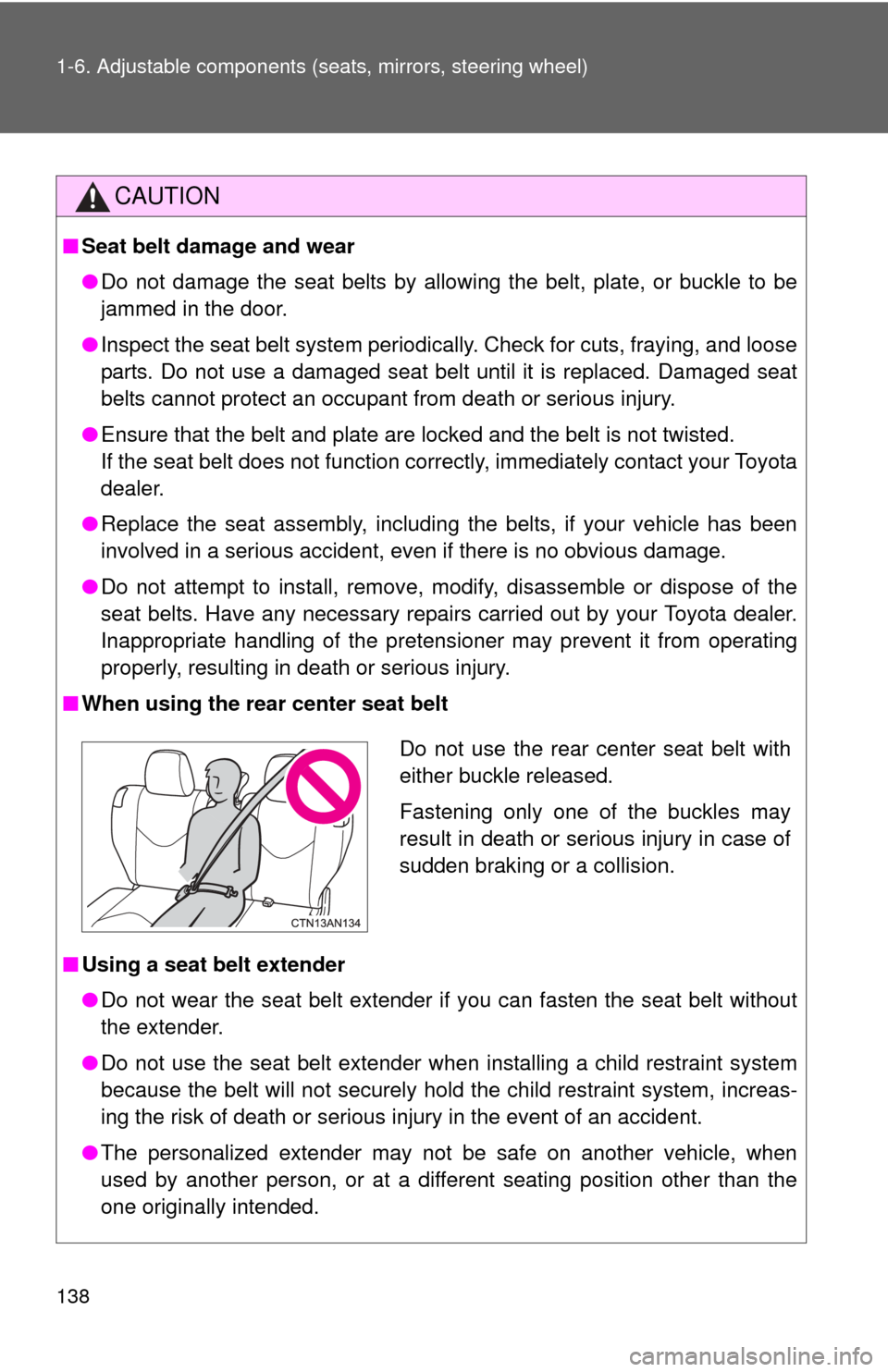
■ When using the rear center seat belt
■ Using a seat belt extender
●Do not wear the seat belt extender if you can fasten the seat belt without
the extender.
● Do not use the seat belt extender when installing a child restraint system
because the belt will not securely hold the child restraint system, increas-
ing the risk of death or serious injury in the event of an accident.
● The personalized extender may not be safe on another vehicle, when
used by another person, or at a different seating position other than the
one originally intended.
Do not use the rear center seat belt with
either buckle released.
Fastening only one of the buckles may
result in death or serious injury in case of
sudden braking or a collision.
Page 140 of 520
140
1-6. Adjustable components (seats, mirrors, steering wheel)
Steering wheel
CAUTION
■Caution while driving
Do not adjust the steering wheel while driving.
Doing so may cause the driver to mishandle the vehicle and cause an acci-
dent, resulting in death or serious injury.
■ After adjusting the steering wheel
Make sure that the steering wheel is securely locked.
Otherwise, the steering wheel may move suddenly, possibly causing an
accident, and resulting in death or serious injury.
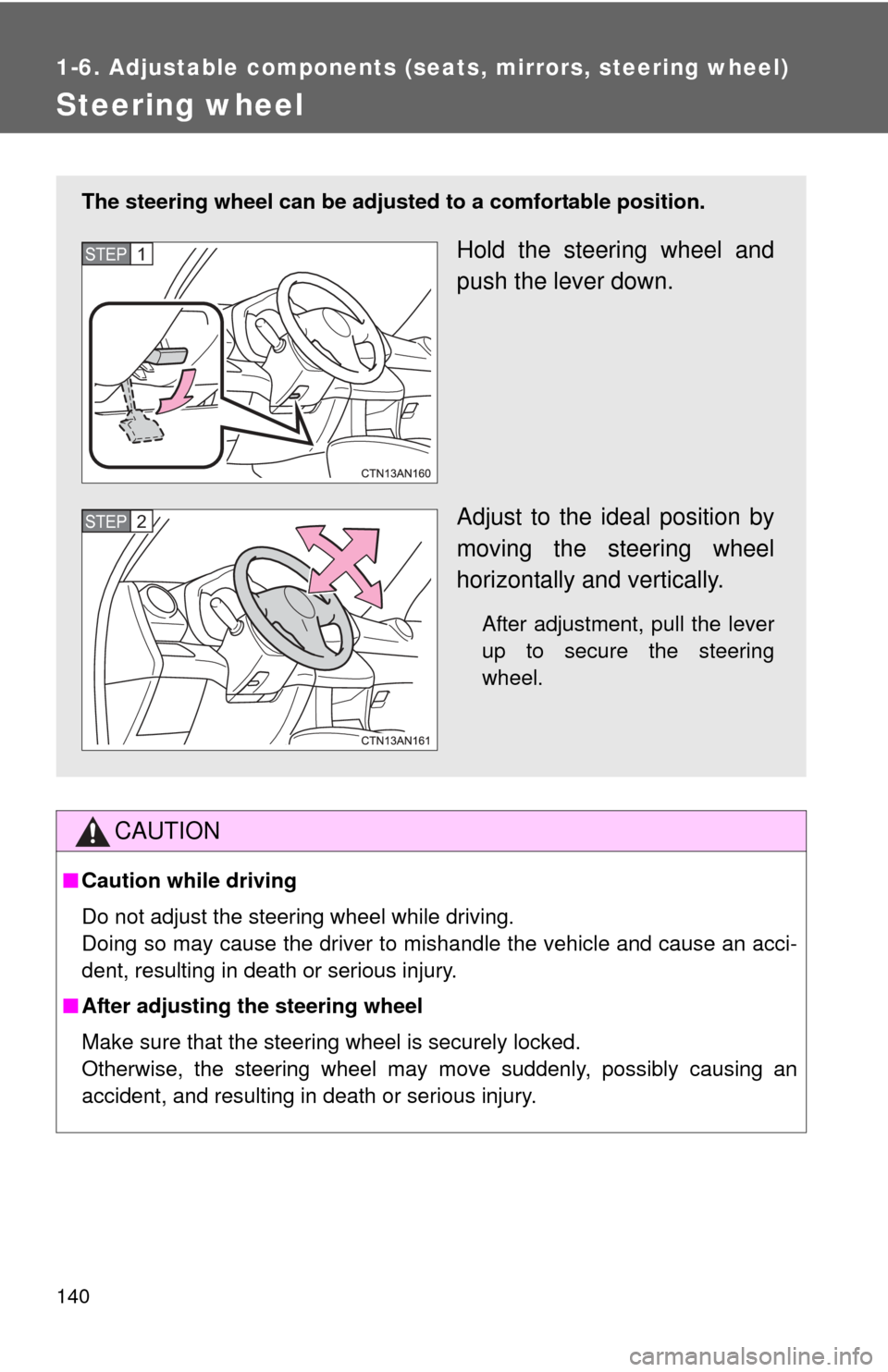
The steering wheel can be adjust ed to a comfortable position.
Hold the steering wheel and
push the lever down.
Adjust to the ideal position by
moving the steering wheel
horizontally and vertically.
After adjustment, pull the lever
up to secure the steering
wheel.
STEP 1
STEP 2
Page 155 of 520
155
1-9. Safety information
1
Before driving
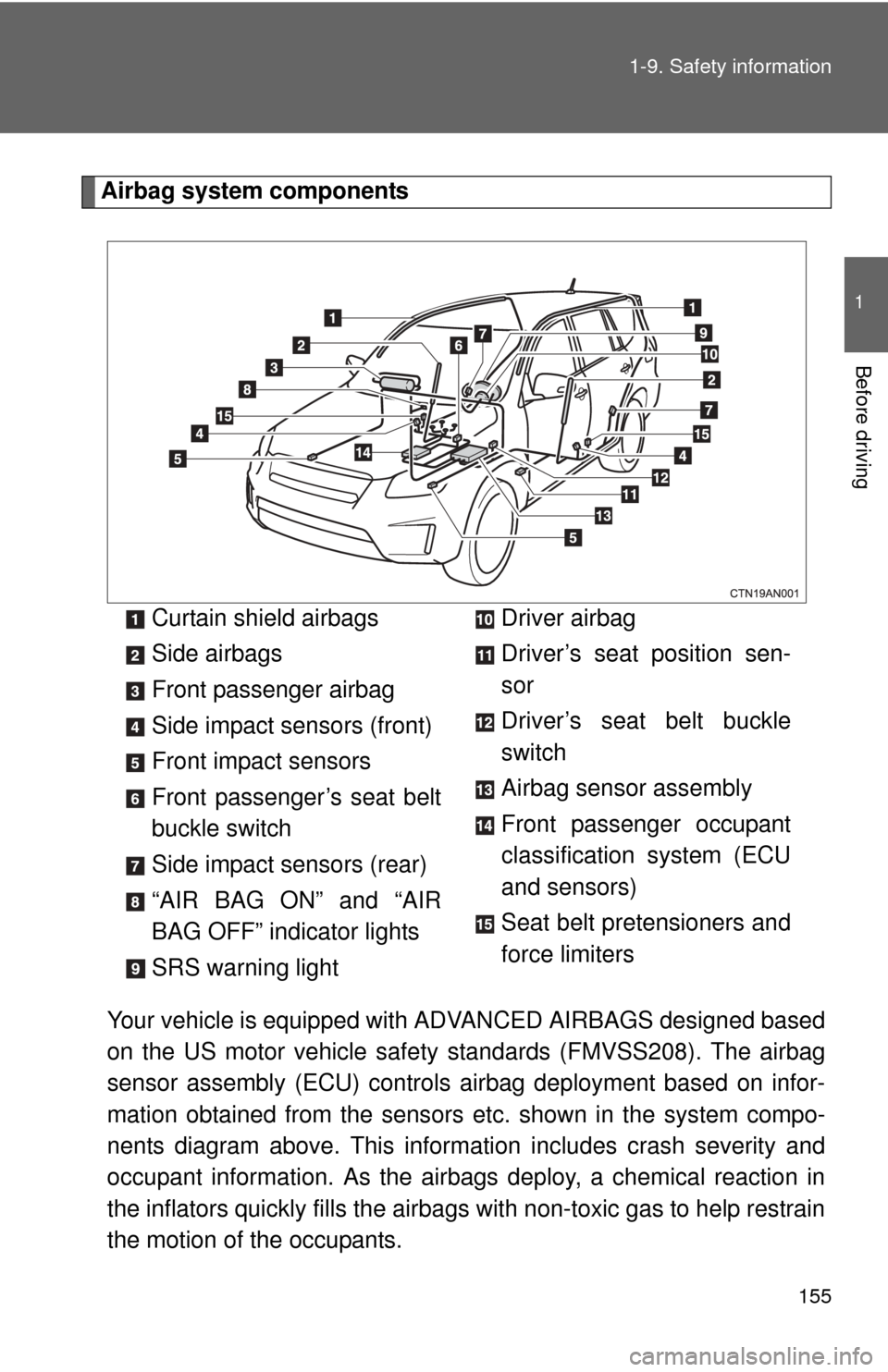
Airbag system components
Your vehicle is equipped with ADVANCED AIRBAGS designed based
on the US motor vehicle safety standards (FMVSS208). The airbag
sensor assembly (ECU) controls ai rbag deployment based on infor-
mation obtained from the sensors etc. shown in the system compo-
nents diagram above. This inform ation includes crash severity and
occupant information. As the air bags deploy, a chemical reaction in
the inflators quickly fills the airbag s with non-toxic gas to help restrain
the motion of the occupants. Curtain shield airbags
Side airbags
Front passenger airbag
Side impact sensors (front)
Front impact sensors
Front passenger’s seat belt
buckle switch
Side impact sensors (rear)
“AIR BAG ON” and “AIR
BAG OFF” indicator lights
SRS warning light
Driver airbag
Driver’s seat position sen-
sor
Driver’s seat belt buckle
switch
Airbag sensor assembly
Front passenger occupant
classification system (ECU
and sensors)
Seat belt pretensioners and
force limiters
Page 162 of 520
162 1-9. Safety information
CAUTION
■SRS airbag precautions
●The SRS front passenger airbag also deploys with considerable force, and
can cause death or serious injury especially if the front passenger is very
close to the airbag. The front passenger seat should be as far from the air-
bag as possible with the seatback adjusted, so the front passenger sits
upright.
● Improperly seated and/or restrained in fants and children can be killed or
seriously injured by a deploying airbag. An infant or child who is too small
to use a seat belt should be properly secured using a child restraint sys-
tem. Toyota strongly recommends that all infants and children be placed in
the rear seats of the vehicle and properly restrained. The rear seats are
safer for infants and children than the front passenger seat. ( P. 172)
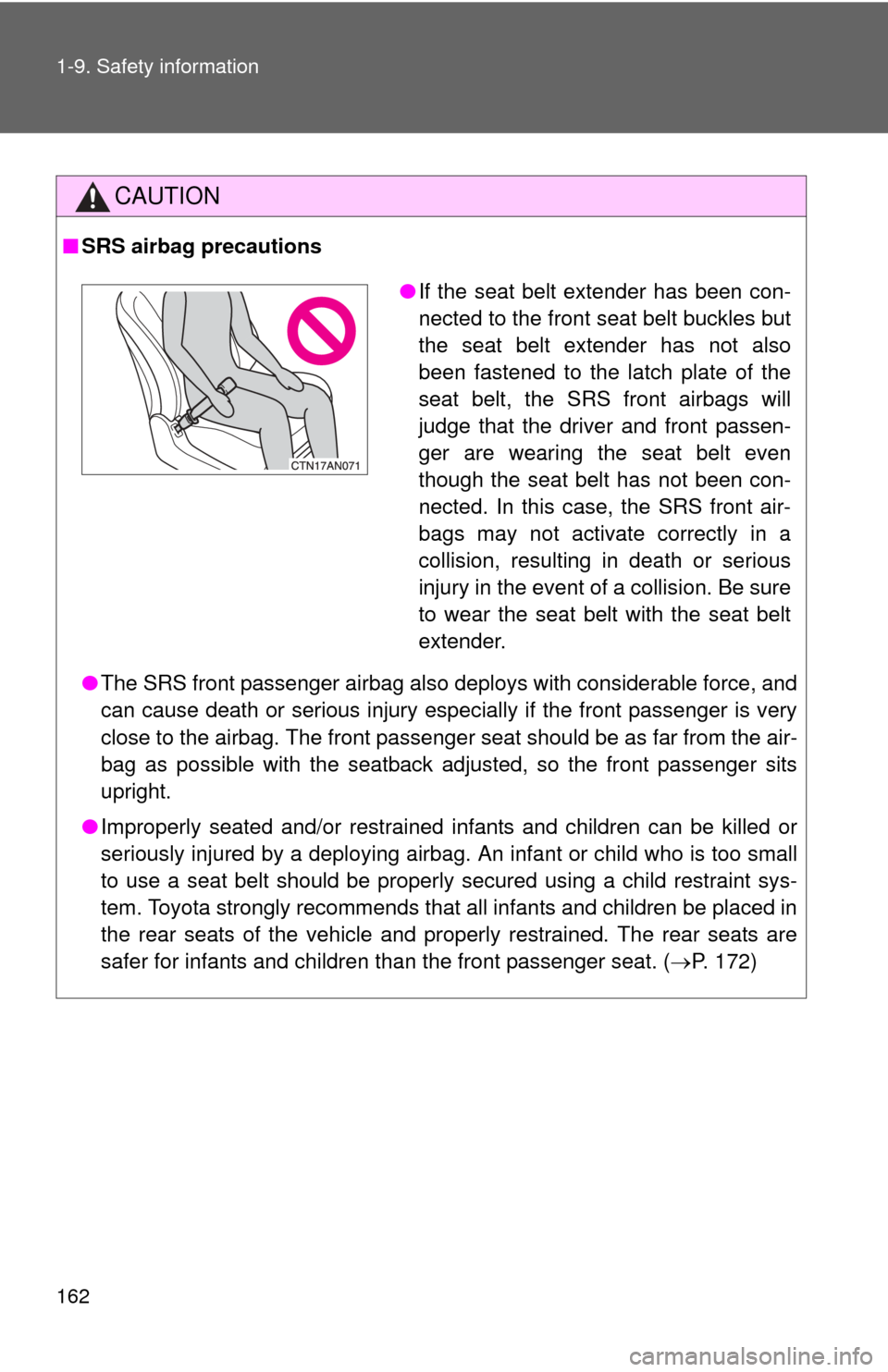
●If the seat belt extender has been con-
nected to the front seat belt buckles but
the seat belt extender has not also
been fastened to the latch plate of the
seat belt, the SRS front airbags will
judge that the driver and front passen-
ger are wearing the seat belt even
though the seat belt has not been con-
nected. In this case, the SRS front air-
bags may not activate correctly in a
collision, resulting in death or serious
injury in the event of a collision. Be sure
to wear the seat belt with the seat belt
extender.
Page 175 of 520
175
1-9. Safety information
1
Before driving
CAUTION
■
Child restraint precautions
●Do not use the seat belt extender when installing a child restraint system
on the front or rear passenger seat. If installing a child restraint system
with the seat belt extender connected to the seat belt, the seat belt will not
securely hold the child restraint system, which could cause death or seri-
ous injury to the child or other passengers in the event of a sudden stop,
sudden swerve or accident.
● Do not allow the child to lean his/her head or any part of his/her body
against the door or the area of the seat , front and rear pillars or roof side
rails from which the SRS side airbags or SRS curtain shield airbags deploy
even if the child is seated in the child restraint system. It is dangerous if
the SRS side airbags and curtain shield airbags inflate, and the impact
could cause death or serious injury to the child.
● Make sure you have complied with all installation instructions provided by
the child restraint manufacturer and that the system is properly secured. If
it is not secured properly, it may cause death or serious injury to the child
in the event of a sudden stop, sudden swerve or an accident.
■ When children are in the vehicle
Do not allow children to play with the seat belt. If the seat belt becomes
twisted around a child’s neck, it may lead to choking or other serious injuries
that could result in death.
If this occurs and the buckle cannot be unfastened, scissors should be used
to cut the belt.
■ When the child restrain t system is not in use
● Keep the child restraint system properly secured on the seat even if it is
not in use.
Do not store the child restraint system unsecured in the passenger com-
partment.
● If it is necessary to detach the child restraint system, remove it from the
vehicle or store it securely in the luggage compartment. This will prevent it
from injuring passengers in the event of a sudden stop, sudden swerve or
accident.
Page 176 of 520
176
1-9. Safety information
Installing child restraints
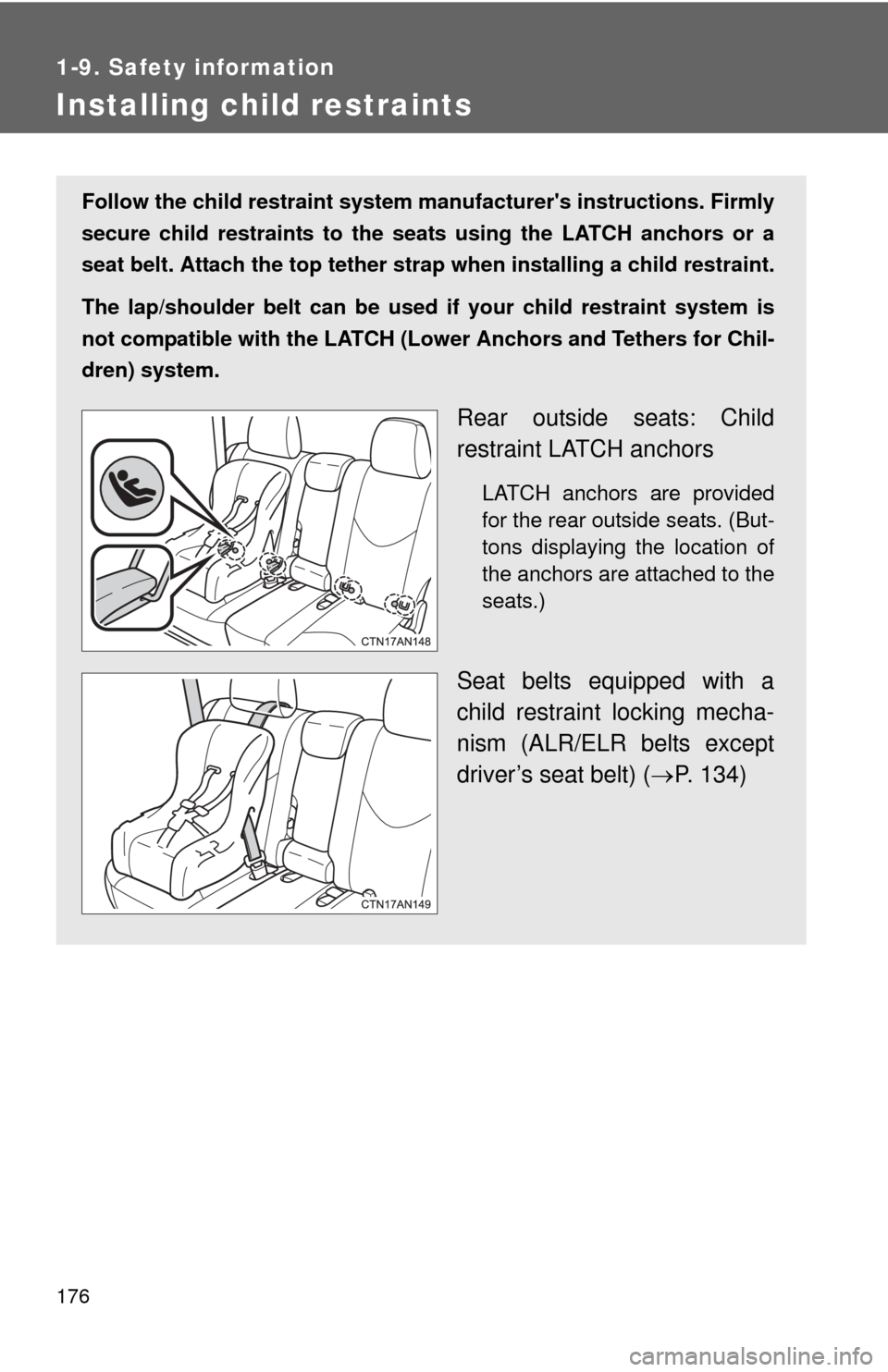
Follow the child restraint system manufacturer's instructions. Firmly
secure child restraints to the seat s using the LATCH anchors or a
seat belt. Attach the top tether stra p when installing a child restraint.
The lap/shoulder belt can be used if your child restraint system is
not compatible with the LATCH (Low er Anchors and Tethers for Chil-
dren) system.
Rear outside seats: Child
restraint LATCH anchors
LATCH anchors are provided
for the rear outside seats. (But-
tons displaying the location of
the anchors are attached to the
seats.)
Seat belts equipped with a
child restraint locking mecha-
nism (ALR/ELR belts except
driver’s seat belt) ( P. 134)
Page 178 of 520
178 1-9. Safety information
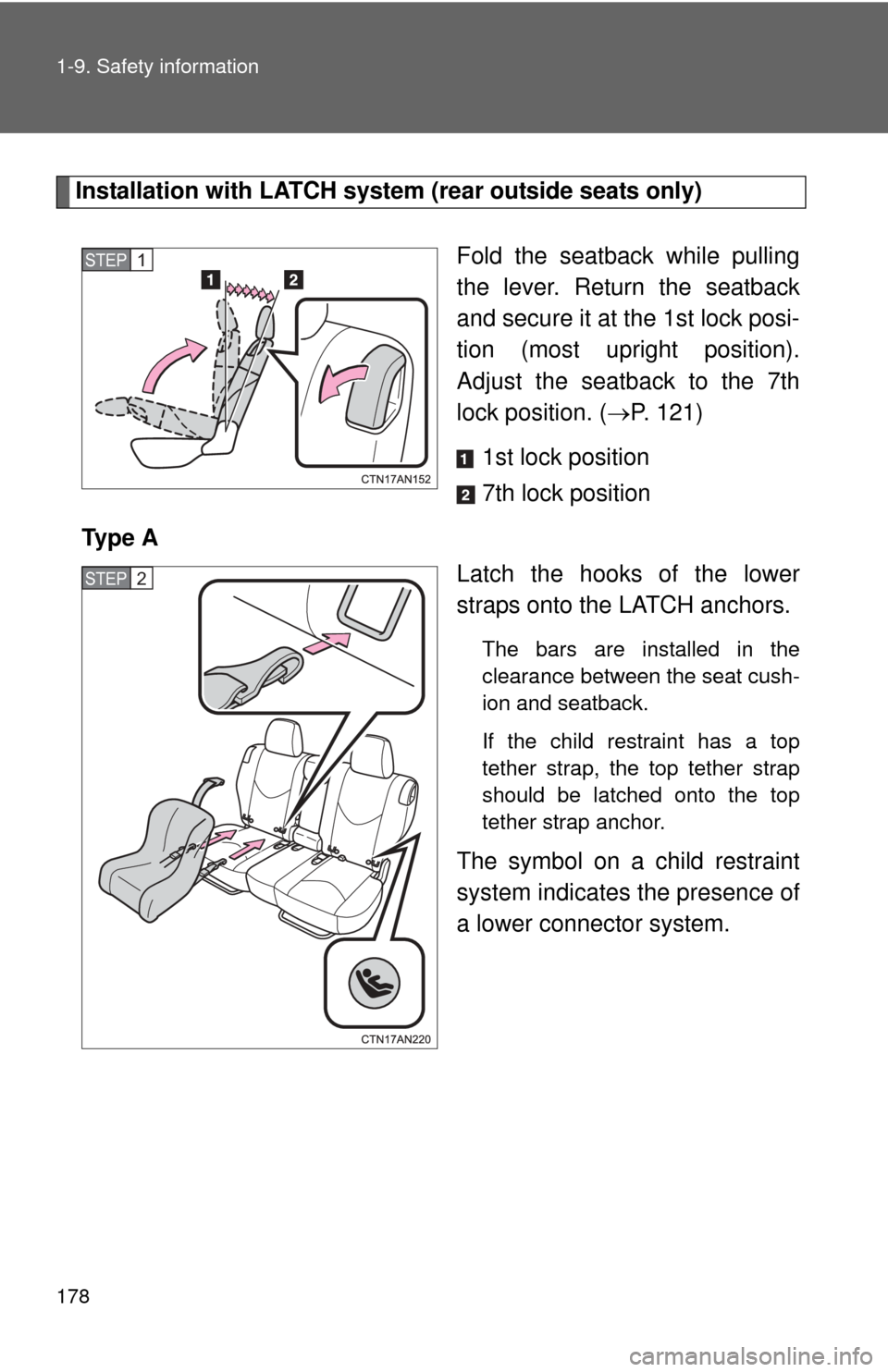
Installation with LATCH system (rear outside seats only)Fold the seatback while pulling
the lever. Return the seatback
and secure it at the 1st lock posi-
tion (most upright position).
Adjust the seatback to the 7th
lock position. (P. 121)
1st lock position
7th lock position
Ty p e A Latch the hooks of the lower
straps onto the LATCH anchors.
The bars are installed in the
clearance between the seat cush-
ion and seatback.
If the child restraint has a top
tether strap, the top tether strap
should be latched onto the top
tether strap anchor.
The symbol on a child restraint
system indicates the presence of
a lower connector system.
STEP 1
STEP 2