ECU TOYOTA RAV4 EV 2013 1.G Workshop Manual
[x] Cancel search | Manufacturer: TOYOTA, Model Year: 2013, Model line: RAV4 EV, Model: TOYOTA RAV4 EV 2013 1.GPages: 520, PDF Size: 7.4 MB
Page 396 of 520

396 4-3. Do-it-yourself maintenance
17 WASHER15 AWindshield washer, rear window
washer
18 ECU-IG1 1 10 A Electronically controlled brake sys-
tem, tire pressure warning system,
air conditioning system, main body
ECU, anti-glare inside rear view
mirror, Vehicle Proximity Notifica-
tion System, navigation system
19 ECU-IG1 2 10 A Emergency flashers, rear window
defogger, air conditioning system
20 OBD 7.5 A On-board diagnosis system
21 STOP 10 AStop/tail lights, high mounted stop-
light
22 CHRG IND 7.5 A Charging indicator
23 DOOR 25 A Power windows
24 ACC-MAIN 25 A ACC-B, P/OUT, DCM
FuseAmpereCircuit
Page 403 of 520
403
4-3. Do-it-yourself maintenance
4
Maintenance and care
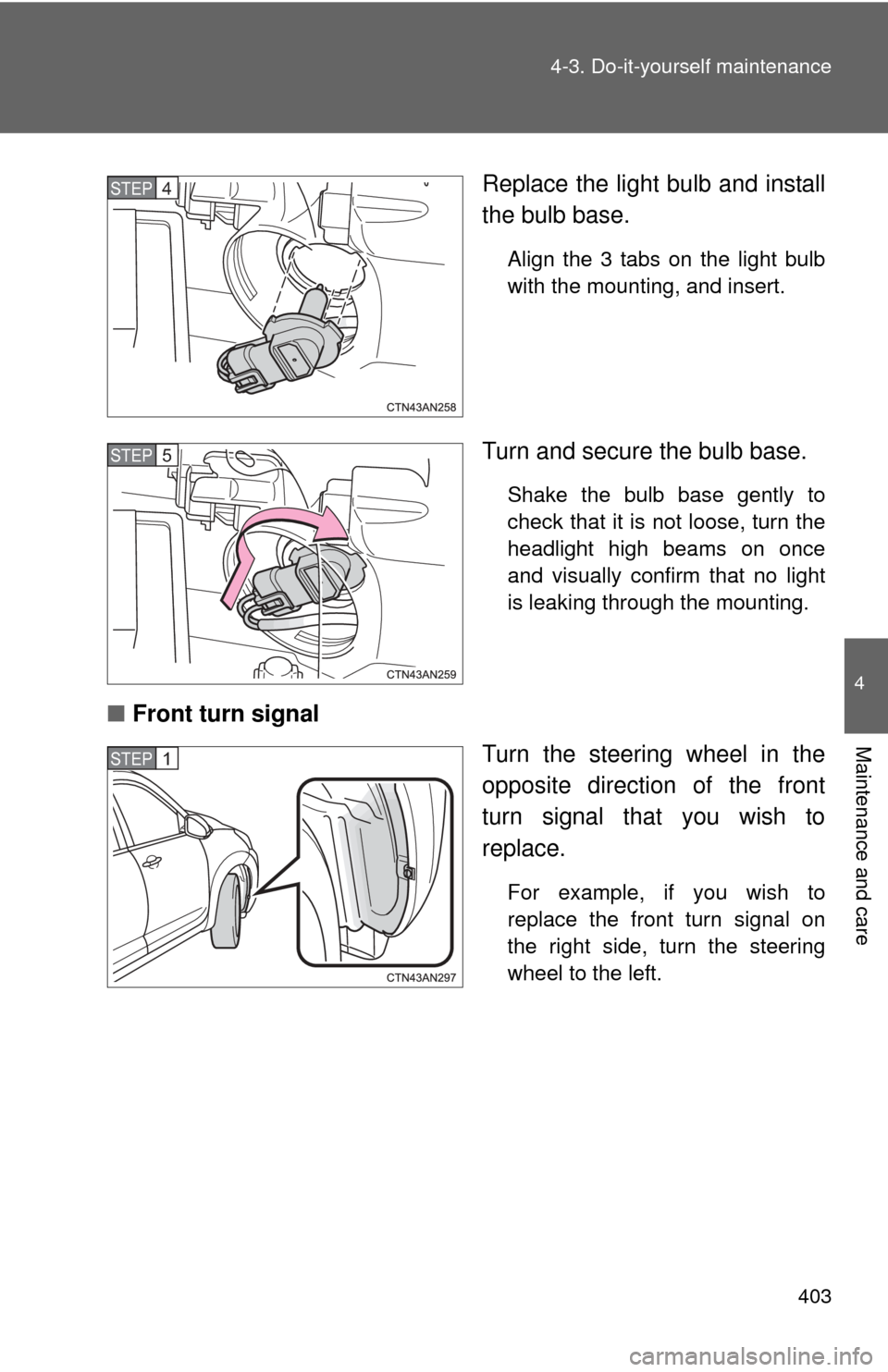
Replace the light bulb and install
the bulb base.
Align the 3 tabs on the light bulb
with the mounting, and insert.
Turn and secure the bulb base.
Shake the bulb base gently to
check that it is not loose, turn the
headlight high beams on once
and visually confirm that no light
is leaking through the mounting.
■
Front turn signal
Turn the steering wheel in the
opposite direction of the front
turn signal that you wish to
replace.
For example, if you wish to
replace the front turn signal on
the right side, turn the steering
wheel to the left.
STEP 4
STEP 5
STEP 1
Page 408 of 520

408 4-3. Do-it-yourself maintenance
■Replacing the following lights
If any of the lights listed below has burnt out, have it replaced by
your Toyota dealer.
● Headlight low beams
● Daytime running/parking lights
● Front side marker lights
● Side turn signal lights
● Stop/tail lights
● High mounted stoplight
■LED lights
The headlight low beams, daytime running/parking lights, front side marker
lights, stop/tail lights and high mounted stoplight consists of a number of
LEDs. If any of the LEDs burn out, take your vehicle to your Toyota dealer to
have the light replaced.
■ Condensation build-up on th e inside of the lens
Temporary condensation build-up on the inside of the headlight lens does
not indicate a malfunction.
Contact your Toyota dealer for more information in the following situations:
● Large drops of water have built up on the inside of the lens.
● Water has built up inside the headlight.
■ Replacing the back-up light , rear turn signal and rear side marker light
bulbs
There is a ECU near the left hand side bulb bases.
When removing the bulb base, make sure to not subject the ECU to impacts.
( P. 319)
■ When replacing light bulbs
P. 397
Page 409 of 520
409
4-3. Do-it-yourself maintenance
4
Maintenance and care
CAUTION
■
Replacing light bulbs
●Turn off the lights. Do not attempt to replace the bulb immediately after
turning off the lights.
The bulbs become very hot and may cause burns.
● Do not touch the glass portion of the light bulb with bare hands. Hold the
bulb by the plastic or metal portion.
If the bulb is scratched or dropped, it may blow out or crack.
● Fully install light bulbs and any parts used to secure them. Failure to do so
may result in heat damage, fire, or water entering the headlight unit. This
may damage the headlights or cause condensation to build up on the lens.
■ To prevent damage or fire
Make sure bulbs are fully seated and locked.
Page 432 of 520
432 5-2. Steps to take in an emergency
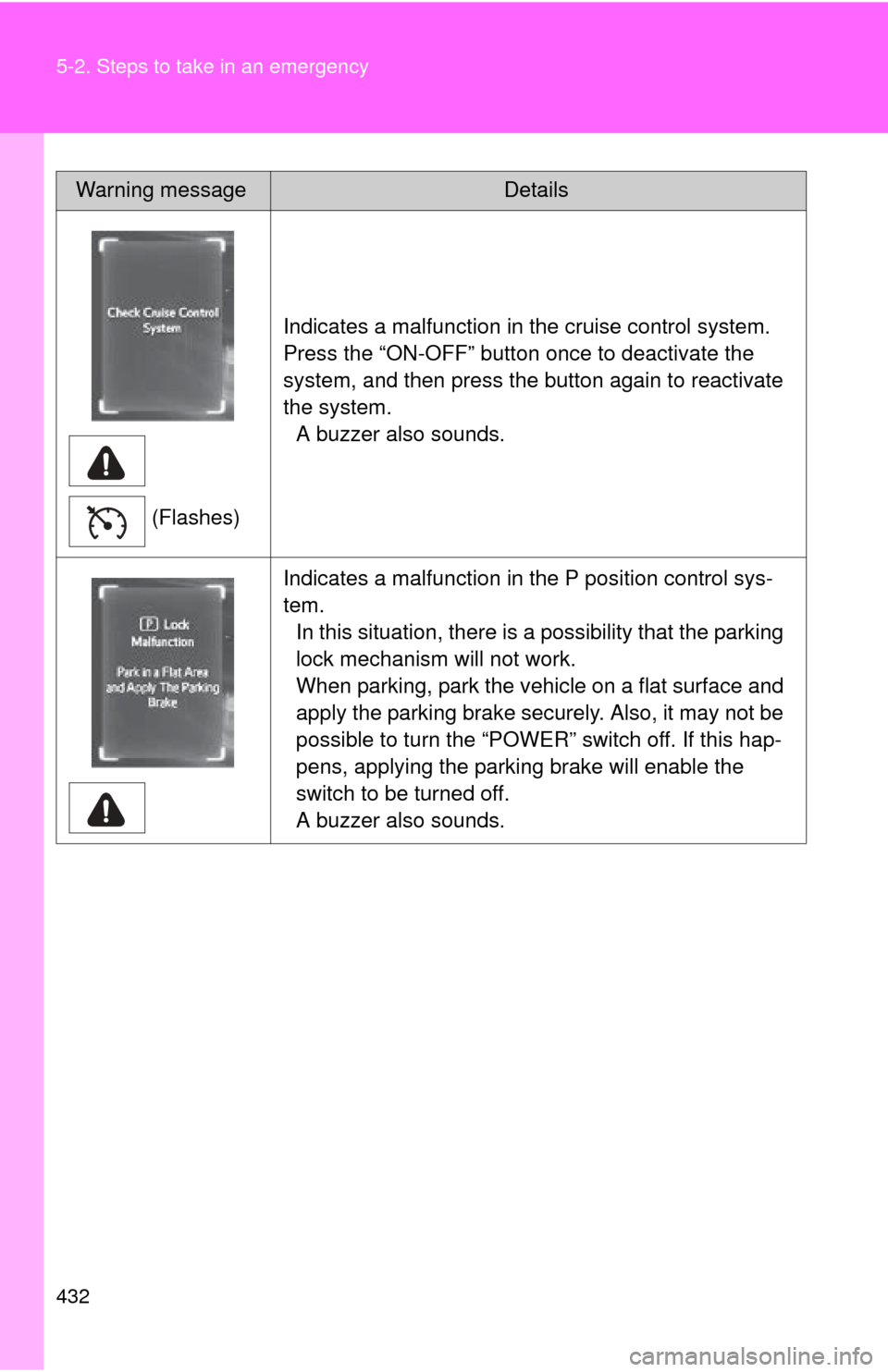
(Flashes)Indicates a malfunction in the cruise control system.
Press the “ON-OFF” button once to deactivate the
system, and then press the button again to reactivate
the system.
A buzzer also sounds.
Indicates a malfunction in the P position control sys-
tem. In this situation, there is a possibility that the parking
lock mechanism will not work.
When parking, park the vehicle on a flat surface and
apply the parking brake securely. Also, it may not be
possible to turn the “POWER” switch off. If this hap-
pens, applying the parking brake will enable the
switch to be turned off.
A buzzer also sounds.
Warning messageDetails
Page 455 of 520
5
When trouble arises
455
5-2. Steps to take in an emergency
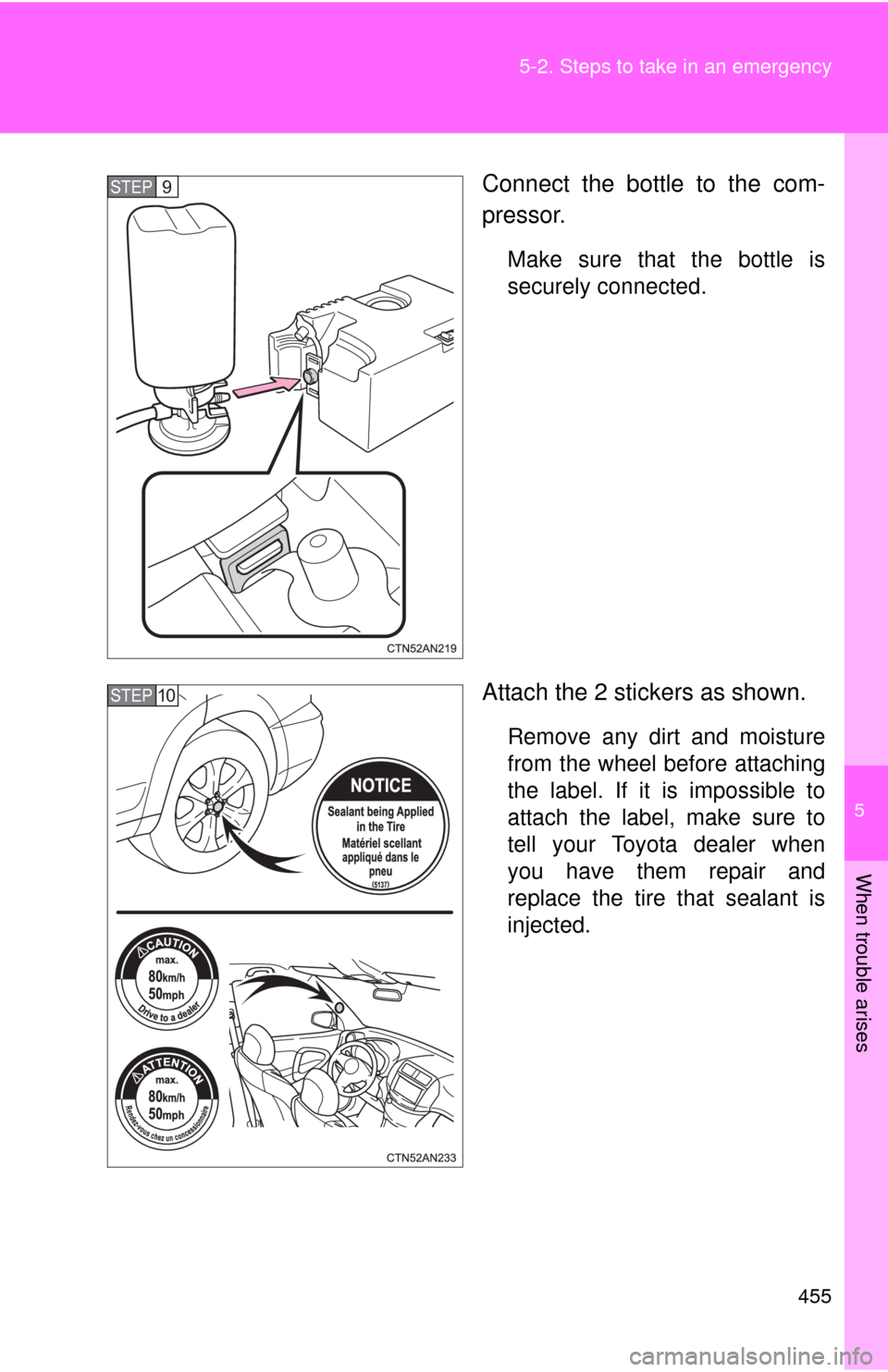
Connect the bottle to the com-
pressor.
Make sure that the bottle is
securely connected.
Attach the 2 stickers as shown.
Remove any dirt and moisture
from the wheel before attaching
the label. If it is impossible to
attach the label, make sure to
tell your Toyota dealer when
you have them repair and
replace the tire that sealant is
injected.
STEP 9
STEP 10
Page 462 of 520

462 5-2. Steps to take in an emergency
CAUTION
■Do not drive the vehicle with a flat tire
Do not continue driving with a flat tire.
Driving even a short distance with a flat tire can damage the tire and the
wheel beyond repair.
Driving with a flat tire may cause a circumferential groove on the side
wall. In such a case, the tire may explode when using a repair kit.
■Caution while driving
●Store the repair kit in the luggage compartment.
Injuries may result in the event of an accident or sudden braking.
●The repair kit is exclusively only for your vehicle.
Do not use repair kit on other vehicles, which could lead to an accident
causing death or serious injury.
●Do not use repair kit for tires that are different size than the original
ones, or for any other purpose. If the tires have not been completely
repaired, it could lead to an accident causing death or serious injury.
■Precautions for use of the sealant
●Ingesting the sealant is hazardous to your health. If you ingest sealant,
consume as much water as possible, and then immediately consult a
doctor.
●If sealant gets in eyes or adheres to skin, immediately wash it off with
water. If discomfort persists, consult a doctor.
■When fixing the flat tire
●Stop your vehicle in a safe and flat area.
●Do not touch the wheels or the ar ea around the brakes immediately
after the vehicle has been driven.
After the vehicle has been driven, the wheels and the area around the
brakes may be extremely hot. Touching these areas with hands, feet or
other body parts may result in burns.
●Connect the valve and hose securely with the tire installed on the vehi-
cle. If the hose is not properly con nected to the valve, air leakage may
occur as sealant may be sprayed out.
●If the hose comes off the valve while inflating the tire, there is a risk
that the hose will move abruptly due to air pressure.
Page 479 of 520
5
When trouble arises
479
5-2. Steps to take in an emergency
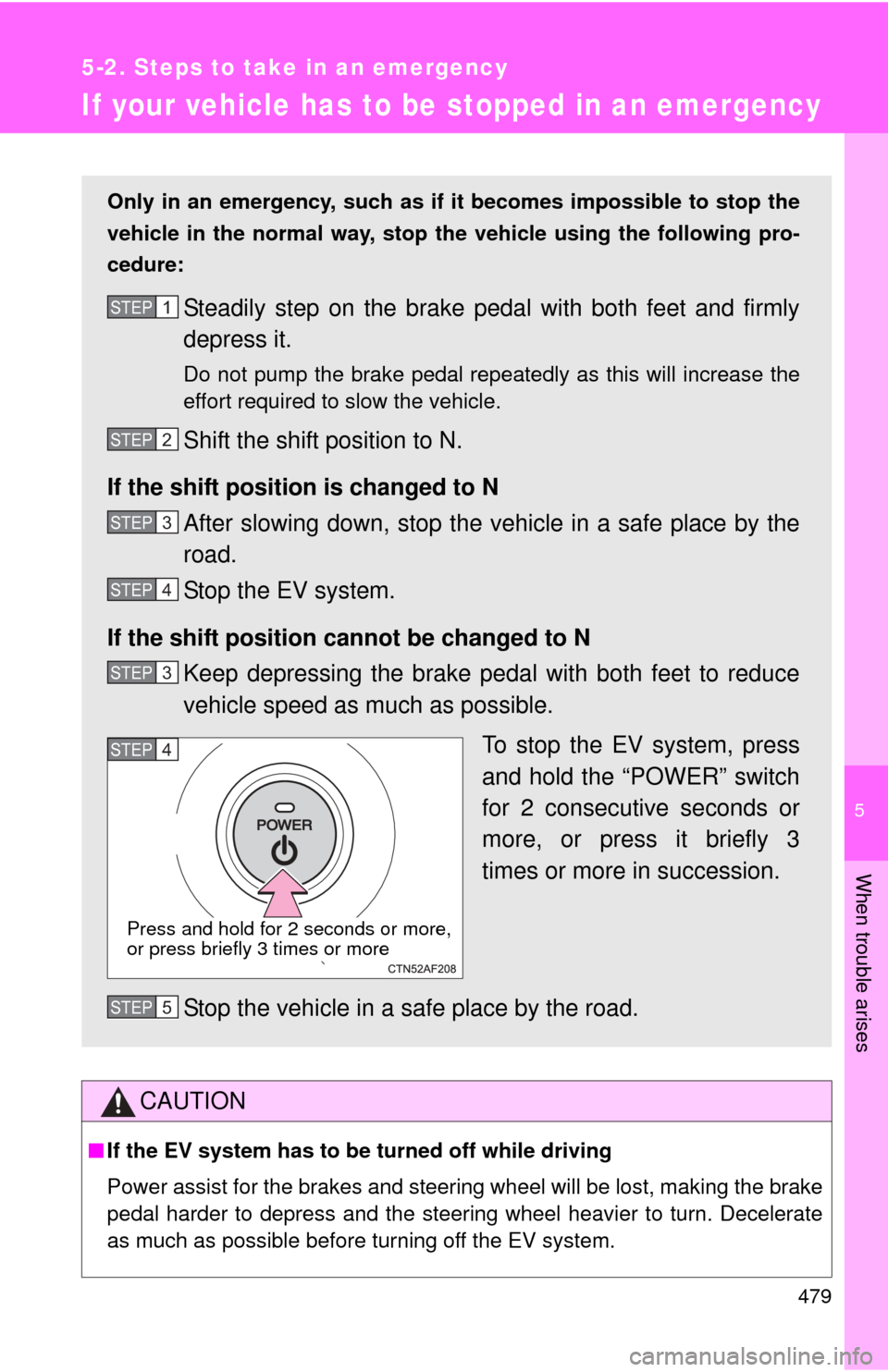
If your vehicle has to be stopped in an emergency
CAUTION
■If the EV system has to be turned off while driving
Power assist for the brakes and steering wheel will be lost, making the brake
pedal harder to depress and the steering wheel heavier to turn. Decelerate
as much as possible before turning off the EV system.
Only in an emergency, such as if it becomes impossible to stop the
vehicle in the normal way, stop the vehicle using the following pro-
cedure:
Steadily step on the brake pedal with both feet and firmly
depress it.
Do not pump the brake pedal repeatedly as this will increase the
effort required to slow the vehicle.
Shift the shift position to N.
If the shift position is changed to N After slowing down, stop the vehi cle in a safe place by the
road.
Stop the EV system.
If the shift position cannot be changed to N Keep depressing the brake pedal with both feet to reduce
vehicle speed as much as possible.
To stop the EV system, press
and hold the “POWER” switch
for 2 consecutive seconds or
more, or press it briefly 3
times or more in succession.
Stop the vehicle in a safe place by the road.
STEP 1
STEP 2
STEP 3
STEP 4
STEP 3
STEP 4
Press and hold for 2 seconds or more,
or press briefly 3 times or more
STEP 5
Page 499 of 520
499
6-1. Specifications
6
Vehicle specifications
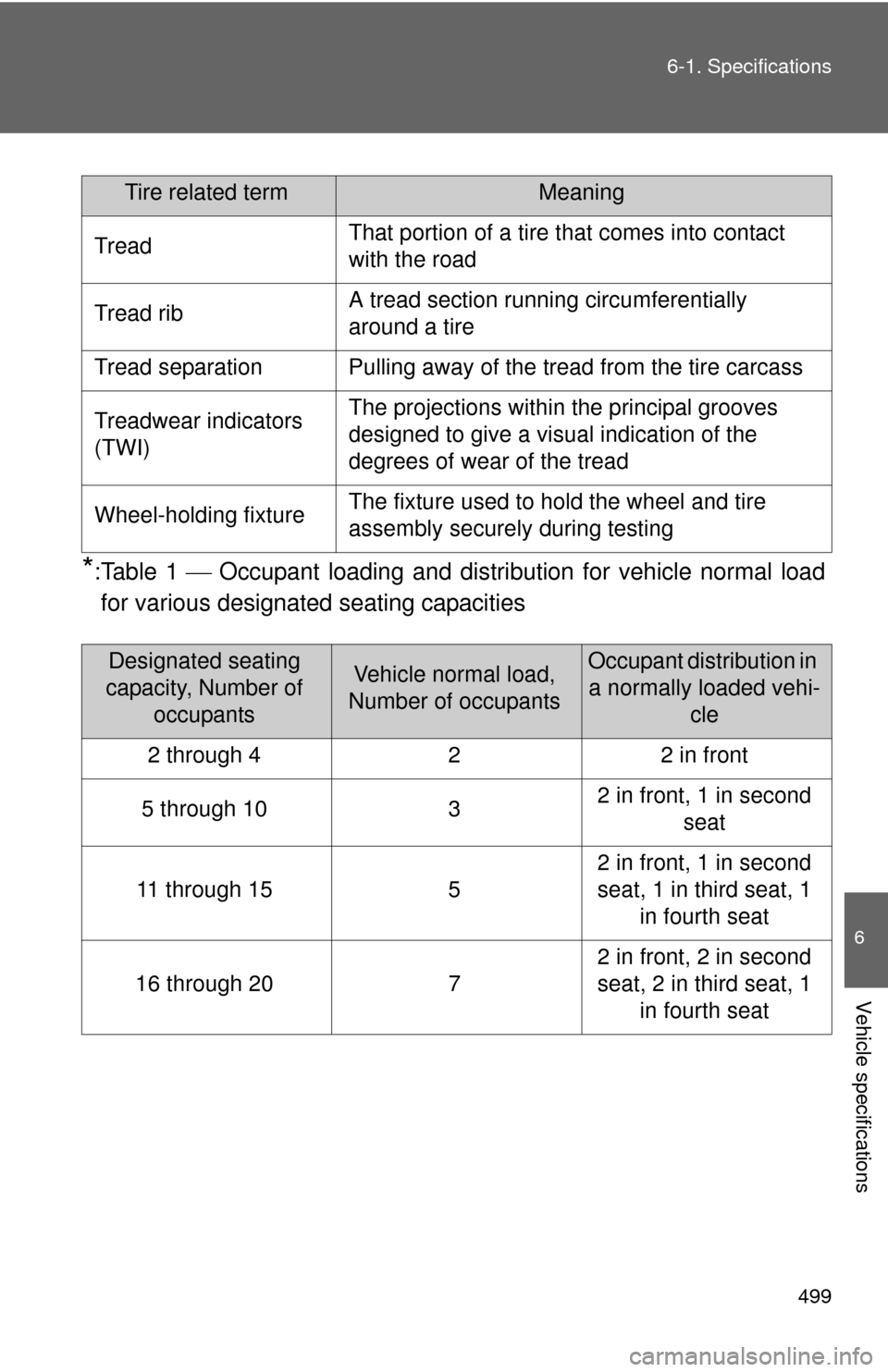
*:Table 1
Occupant loading and distri bution for vehicle normal load
for various designated seating capacities
Tire related termMeaning
Tread That portion of a tire that comes into contact
with the road
Tread rib A tread section running circumferentially
around a tire
Tread separation Pulling away of the tread from the tire carcass
Treadwear indicators
(TWI) The projections within the principal grooves
designed to give a visual indication of the
degrees of wear of the tread
Wheel-holding fixture The fixture used to hold the wheel and tire
assembly securely
during testing
Designated seating
capacity, Number of occupantsVehicle normal load,
Number of occupantsOccupant distribution in a normally loaded vehi- cle
2 through 4 2 2 in front
5 through 10 3 2 in front, 1 in second
seat
11 through 15 5 2 in front, 1 in second
seat, 1 in third seat, 1
in fourth seat
16 through 20 7 2 in front, 2 in second
seat, 2 in third seat, 1
in fourth seat
Page 508 of 520
508
Abbreviation list
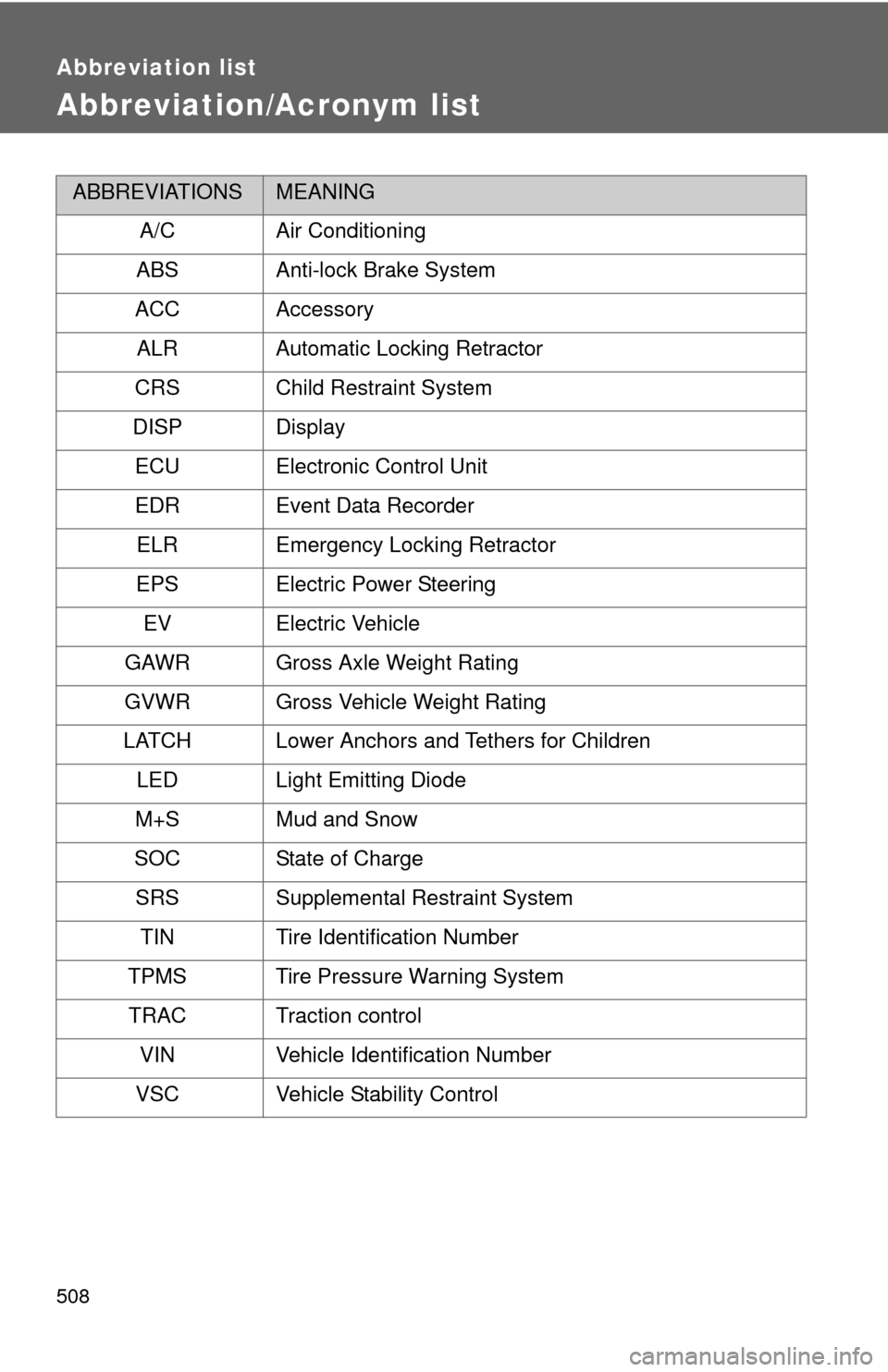
Abbreviation/Acronym list
ABBREVIATIONSMEANING
A/C Air Conditioning
ABS Anti-lock Brake System
ACC Accessory
ALR Automatic Locking Retractor
CRS Child Restraint System
DISP Display
ECU Electronic Control Unit
EDR Event Data RecorderELR Emergency Locking Retractor
EPS Electric Power Steering EV Electric Vehicle
GAWR Gross Axle Weight Rating
GVWR Gross Vehicle Weight Rating
LATCH Lower Anchors and Tethers for Children LED Light Emitting Diode
M+S Mud and Snow
SOC State of Charge SRS Supplemental Restraint System TIN Tire Identification Number
TPMS Tire Pressure Warning System TRAC Traction control VIN Vehicle Identification Number
VSC Vehicle Stability Control