battery TOYOTA RAV4 EV 2013 1.G User Guide
[x] Cancel search | Manufacturer: TOYOTA, Model Year: 2013, Model line: RAV4 EV, Model: TOYOTA RAV4 EV 2013 1.GPages: 520, PDF Size: 7.4 MB
Page 31 of 520

31
1-1. EV system
1
Before driving
■
If the amount of charge remaining in the traction battery becomes low
P. 5 3
■ Vehicle Proximity Notification System
In the following cases, the Vehicle Proximity Notification System sound may
be difficult for pedestrians, people riding bicycles or other people and vehi-
cles in the surrounding area to hear:
●When there is a lot of noise in the vicinity
● When it is raining or during strong winds
● When in the area surrounding the rear of the vehicle, rather than in front
of the vehicle
■ Maintenance, Repair and Disposal
Contact your Toyota dealer regarding maintenance, repair and disposal.
When disposing of your vehicle, traction batteries are collected through
Toyota dealers, and as such we appreciate your cooperation.
Page 32 of 520
32
1-1. EV system
EV (Electric Vehicle) system precautions
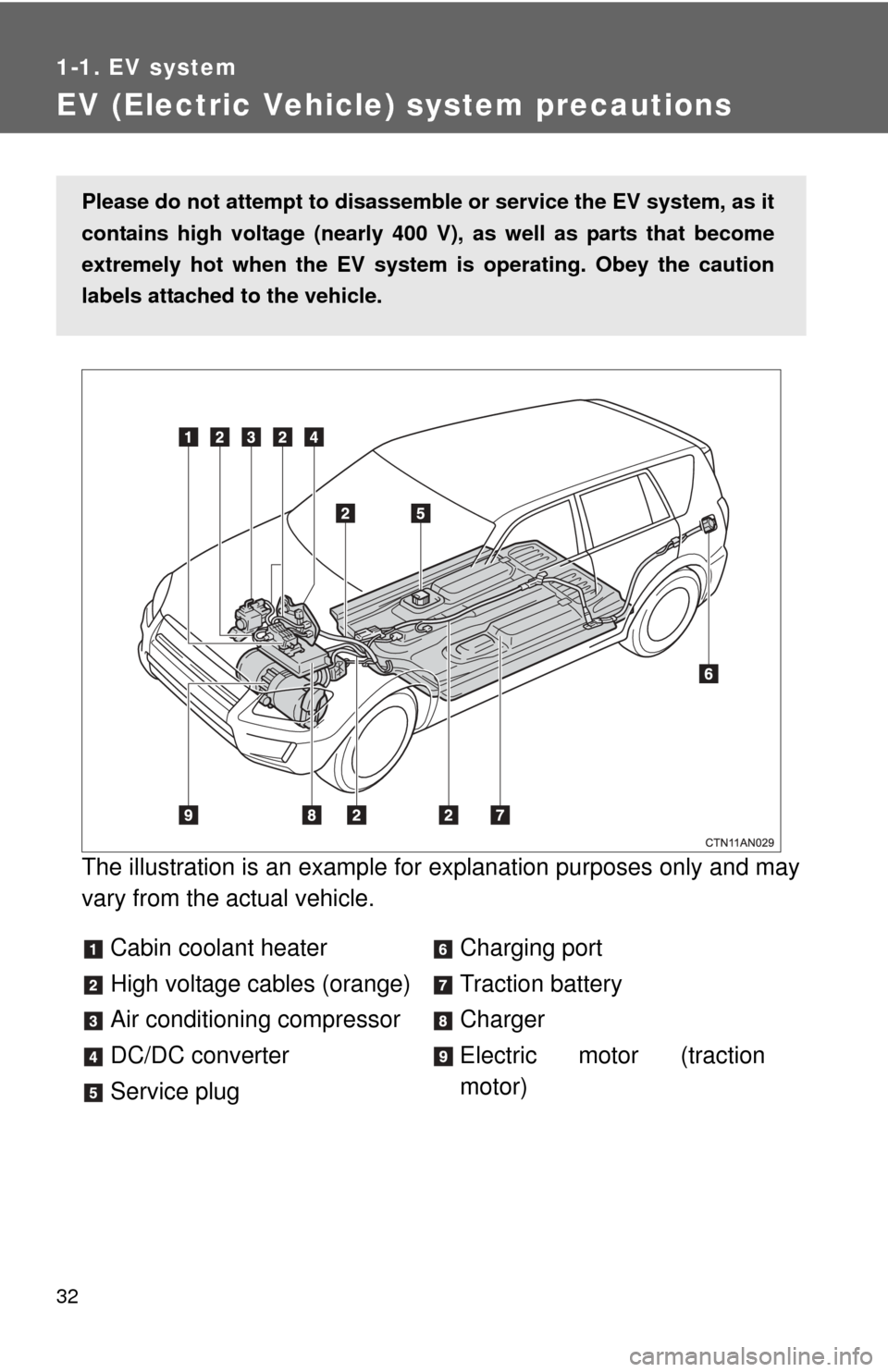
The illustration is an example for explanation purposes only and may
vary from the actual vehicle.
Cabin coolant heater
High voltage cables (orange)
Air conditioning compressor
DC/DC converter
Service plug Charging port
Traction battery
Charger
Electric motor (traction
motor)
Please do not attempt to disassemble or service the EV system, as it
contains high voltage (nearly 400 V), as well as parts that become
extremely hot when the EV system is operating. Obey the caution
labels attached to the vehicle.
Page 34 of 520

34 1-1. EV system
■If a warning light comes on, a warn ing message is displayed, or the 12-
volt battery has been disconnected
The EV system may not start. In that case, try to start the system again. If
the “READY” indicator does not come on, contact your Toyota dealer.
■ Electromagnetic waves
●High voltage parts and cables on electric vehicles incorporate electro-
magnetic shielding, and therefore emit approximately the same amount
of electromagnetic waves as conventional gasoline powered vehicles or
home electronic appliances.
● Your vehicle may cause sound interference in some third party-produced
radio parts.
■ Traction battery (Lithium-ion battery)
The traction battery has a limited service life.
The traction battery capacity (the ability to store energy) reduces with time
and use in the same way as other rechargeable batteries. The extent at
which capacity reduces changes drastically depending on the environment
(ambient temperature, etc.) and usage conditions, such as how the vehicle
is driven and how the traction battery is charged. This is a natural character-
istic of lithium-ion batteries, and is not a malfunction. In order to reduce the
possibility of the capacity decreasing, follow the directions listed on P. 80,
“Capacity reduction of the traction battery”.
Page 36 of 520
36 1-1. EV system
CAUTION
■Road accident cautions
Observe the following precautions to reduce the risk of death or serious
injury:
●Stop the vehicle in a safe place, apply the parking brake while depressing
the brake pedal, shift the shift position to P and turn the EV system off.
Then gradually release the brake pedal.
● Do not touch the high voltage parts, cables or connectors.
● If electric wires are exposed inside or outside your vehicle, an electric
shock may occur. Never touch exposed electric wires.
● Do not touch the traction battery if liquid is leaking from or adhering to it.
If electrolyte (Organic Carbonate-based electrolyte) from the traction bat-
tery comes into contact with the eyes or skin, it could cause blindness or
skin wounds. In the unlikely event that it comes into contact with the eyes
or skin, wash it off immediately with a large amount of water, and seek
immediate medical attention.
● If electrolyte is leaking from the traction battery, do not approach the vehi-
cle.
Even in the unlikely event that the traction battery is damaged, the internal
construction of the battery will prevent a large amount of electrolyte from
leaking out. However, any electrolyte that does leak out will give off acidic
fumes. These fumes are an irritant to skin and eyes and could cause acute
poisoning if inhaled.
● Do not bring burning or high-temperat ure items close to the electrolyte.
The electrolyte may ignite and cause a fire.
● If a fire occurs in the electric vehicle, leave the vehicle as soon as possi-
ble. Never use a fire extinguisher that is not meant for electrical fires.
Using even a small amount of water may be dangerous.
● If your vehicle needs to be towed, do so with the front wheels raised. If the
wheels connected to the electric motor (traction motor) are on the ground
when towing, the motor may continue to generate electricity. This may
cause an electricity leakage leading to a fire. ( P. 413)
Page 37 of 520

37
1-1. EV system
1
Before driving
CAUTION
●
Carefully check to see if there are exposed high voltage parts or cables.
Never touch the parts or cables. (P. 32)
● Carefully inspect the ground under the vehicle. If you find that liquid (other
than water from the air conditioning) has leaked onto the ground, the trac-
tion battery may have been damaged. Leave the vehicle as soon as possi-
ble.
■ Traction battery (lithium-ion battery) replacement and disposal
Do not replace, dispose of, modify, or reuse the traction battery and do not
use it for anything other than its intended use. Contact your Toyota dealer for
replacement or disposal.
If the traction battery is replaced, disposed of, modified or reused in \
an
improper way, or if the traction battery is used in a way it is not intended for,
there is a risk of severe burns and electrical shock that may result in death or
serious injury.
Also, improper handling of the traction battery can lead to environmental
hazards.
■ Caution while driving
The RAV4 EV does not make the sounds that a gasoline vehicle makes. As
such, pedestrians, people riding bicycles or other people and vehicles in the
surrounding area may not be aware of t he vehicle starting off or approaching
them, so take extra care while driving.
Page 41 of 520
41
1
1-1. EV system
Before driving
EV (Electric Vehicle) driving tips
Observe the following to reduce traction battery consumption and
increase driving range.
■ Driving in normal mode:
Normal mode (when compared with sport mode) allows the most effi-
cient driving. ( P. 208)
■Route selection
In addition to a driving style of repeated acceleration and deceleration,
driving on routes that have steep inclines and long waits at traffic lights
will lead to poor power consumption. Check traffic reports before leav-
ing, avoid delays and drive on flat roads as much as possible. When
encountering a delay, gently release the brake pedal to allow the vehi-
cle to move forward slightly while avoiding overuse of the accelerator
pedal. Doing so can help control excessive energy consumption.
■Use of EV System Indicator
Keeping the EV System Indicator needle within ECO area can help
improve Eco-friendly driving. ( P. 221)
■When braking the vehicle
Make sure to operate the brakes gently and in good time. A greater
amount of electrical energy can be retained when slowing down.
■Highway driving
Control your speed, keep at a constant speed and obey speed limits.
Also, before stopping at a toll booth or similar, allow plenty of time to
release the accelerator and slowly stop the vehicle using regenerative
braking and the brake pedal. A greater amount of electrical energy can
be retained while slowing down.
Page 42 of 520
42 1-1. EV system
■Air conditioning system
Use the air conditioning only when necessary. Doing so can help con-
trol excessive energy consumption. Even when the air conditioning is
on, driving range can be extended by setting it to “ECO LO” or “ECO
HI”, or by turning the A/C off. ( P. 276) If pre-climate (Remote Climate
Control) is operated before departure when the vehicle is plugged in,
depending on air-conditioning specifications, traction battery power
consumption can be reduced. ( P. 53)
Additionally, keep in mind the following during heavy air conditioning
use in summer and winter. In summer: In high temperatures, use the recirculated mode. Doing so
can help control excessive power consumption.
In winter: By combining use with the seat heater, the set temperature
for the heater can be reduced. This can increase power efficiency.
■ Checking tire inflation pressure
Make sure to check the tire inflation pressure frequently. Improper tire
inflation pressure can cause poor power consumption.
Also, as snow tires can cause large amounts of friction, their use on dry
roads can lead to poor power consumption. Use a tire that is appropri-
ate for the season.
■Luggage
Carrying luggage can lead to poor power consumption. Avoid carrying
unnecessary luggage. Installing a roof rack can also cause poor power
consumption.
Page 43 of 520
43
1-1. EV system
1
Before driving
■
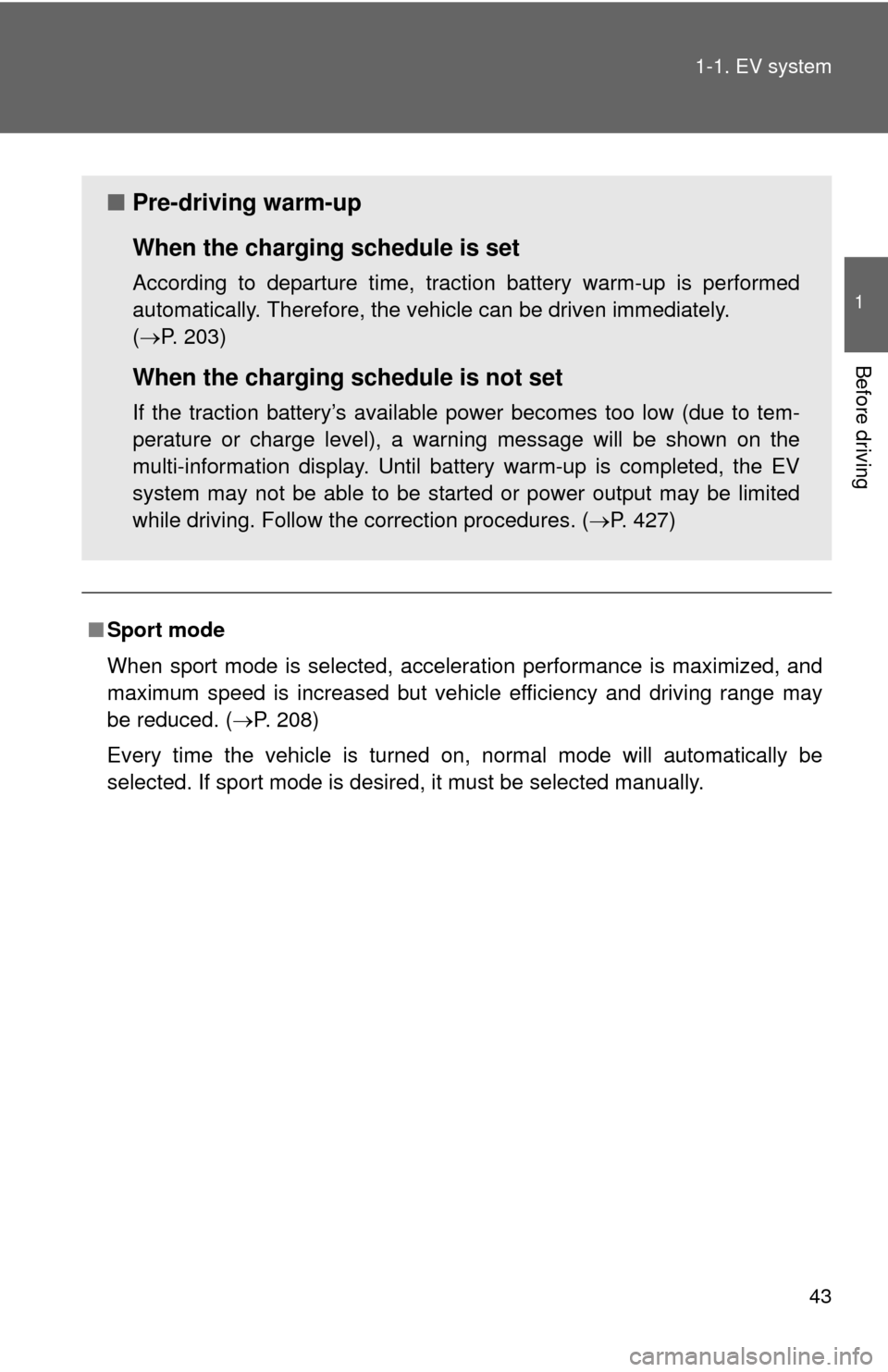
Sport mode
When sport mode is selected, acceleration performance is maximized, and
maximum speed is increased but vehicle efficiency and driving range may
be reduced. ( P. 208)
Every time the vehicle is turned on, normal mode will automatically be
selected. If sport mode is desired, it must be selected manually.
■ Pre-driving warm-up
When the charging schedule is set
According to departure time, traction battery warm-up is performed
automatically. Therefore, the vehicle can be driven immediately.
(P. 203)
When the charging schedule is not set
If the traction battery’s available power becomes too low (due to tem-
perature or charge level), a warning message will be shown on the
multi-information display. Until battery warm-up is completed, the EV
system may not be able to be started or power output may be limited
while driving. Follow the correction procedures. (P. 427)
Page 54 of 520
54 1-3. Charging
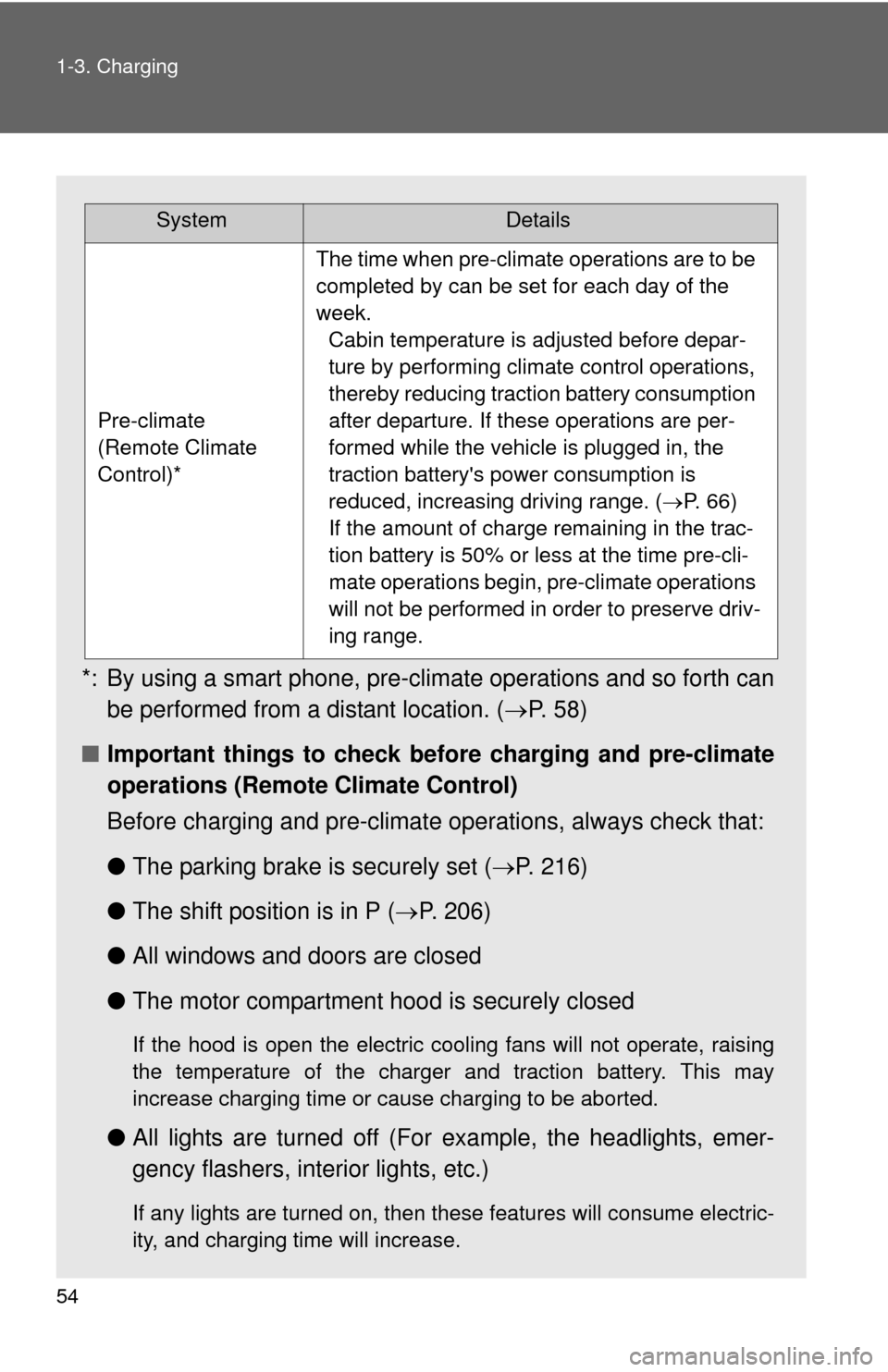
*: By using a smart phone, pre-climate operations and so forth can
be performed from a distant location. ( P. 58)
■ Important things to check be fore charging and pre-climate
operations (Remote Climate Control)
Before charging and pre-climate operations, always check that:
● The parking brake is securely set ( P. 216)
● The shift position is in P ( P. 206)
● All windows and doors are closed
● The motor compartment hood is securely closed
If the hood is open the electric cooling fans will not operate, raising
the temperature of the charger and traction battery. This may
increase charging time or cause charging to be aborted.
●All lights are turned off (For example, the headlights, emer-
gency flashers, interior lights, etc.)
If any lights are turned on, then these features will consume electric-
ity, and charging time will increase.
SystemDetails
Pre-climate
(Remote Climate
Control)*
The time when pre-climate operations are to be
completed by can be set for each day of the
week. Cabin temperature is adjusted before depar-
ture by performing climate control operations,
thereby reducing traction battery consumption
after departure. If these operations are per-
formed while the vehicle is plugged in, the
traction battery's power consumption is
reduced, increasing driving range. ( P. 66)
If the amount of charge remaining in the trac-
tion battery is 50% or less at the time pre-cli-
mate operations begin, pre-climate operations
will not be performed in order to preserve driv-
ing range.
Page 56 of 520
56 1-3. Charging
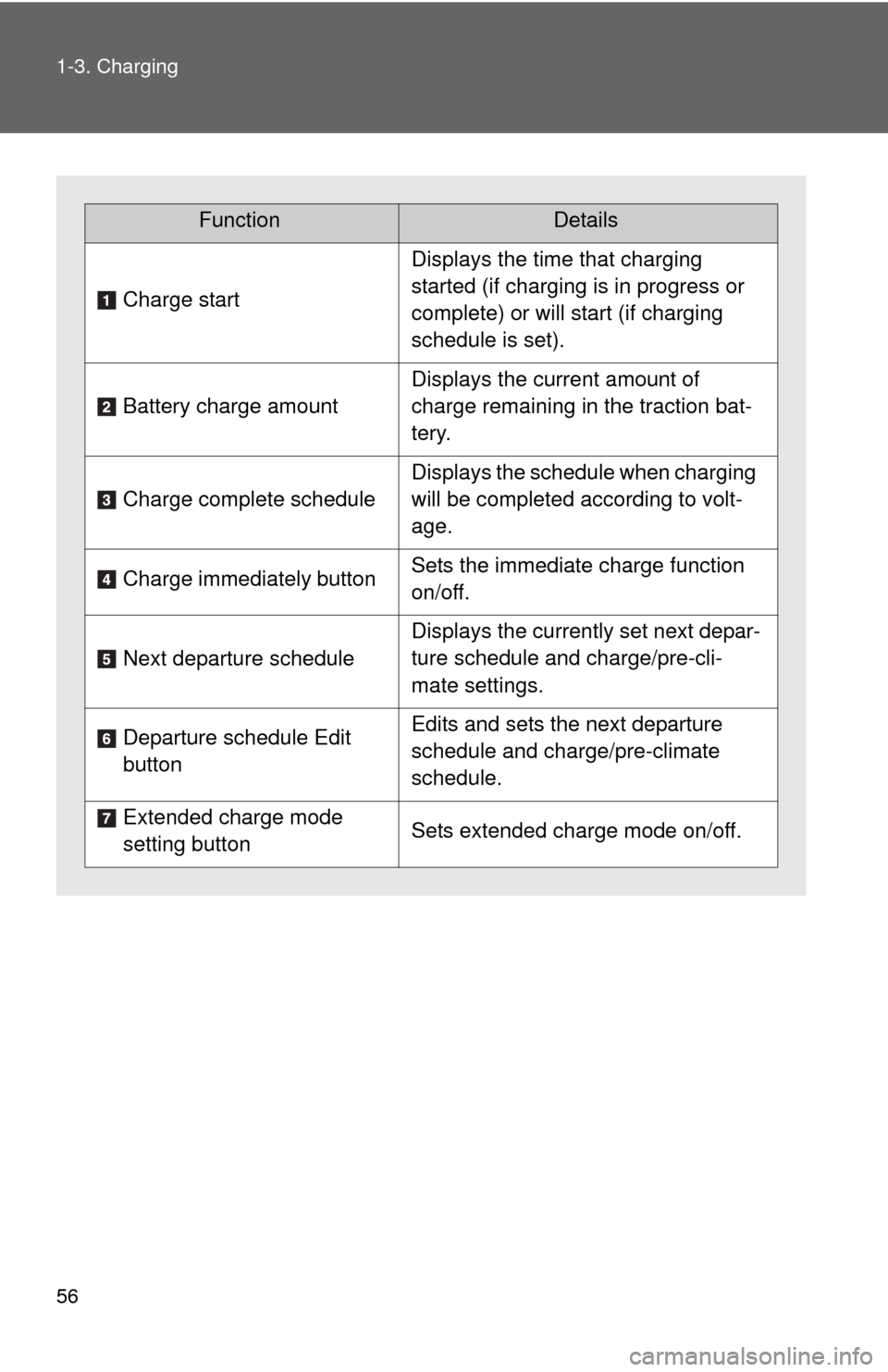
FunctionDetails
Charge start
Displays the time that charging
started (if charging is in progress or
complete) or will start (if charging
schedule is set).
Battery charge amount
Displays the current amount of
charge remaining in the traction bat-
tery.
Charge complete schedule
Displays the schedule when charging
will be completed according to volt-
age.
Charge immediately button Sets the immediate charge function
on/off.
Next departure schedule
Displays the currently set next depar-
ture schedule and charge/pre-cli-
mate settings.
Departure schedule Edit
button Edits and sets the next departure
schedule and charge/pre-climate
schedule.
Extended charge mode
setting button Sets extended charge mode on/off.