brake TOYOTA RAV4 EV 2013 1.G Workshop Manual
[x] Cancel search | Manufacturer: TOYOTA, Model Year: 2013, Model line: RAV4 EV, Model: TOYOTA RAV4 EV 2013 1.GPages: 520, PDF Size: 7.4 MB
Page 355 of 520

355
4-3. Do-it-yourself maintenance
4
Maintenance and care
Motor compartment
Fuse boxes (P. 385)
Motor coolant reservoir ( P. 357)
12-volt battery ( P. 362)
Brake fluid reservoir ( P. 361)
Heater coolant reservoir ( P. 359)Traction battery coolant
reservoir ( P. 357)
Radiators ( P. 360)
Condenser ( P. 360)
Electric cooling fans
Washer fluid tank ( P. 365)
Page 361 of 520

361
4-3. Do-it-yourself maintenance
4
Maintenance and care
Brake fluid
■ Checking fluid level
The brake fluid level should be
between the “MAX” and “MIN”
lines on the tank.
■ Adding fluid
Make sure to check the fluid type and prepare the necessary items.
Fluid type SAE J1703 or FMVSS No.116 DOT 3 brake fluid
Items Clean funnel
■ Brake fluid can absorb moisture from the air
Excess moisture in the brake fluid can cause a dangerous loss of braking
efficiency. Use only newly opened brake fluid.
CAUTION
■When filling the reservoir
Take care as brake fluid can harm your hands and eyes and damage painted
surfaces.
If fluid gets on your hands or in your eyes, flush the affected area with clean
water immediately.
If you still experience discomfort, see a doctor.
Page 362 of 520

362 4-3. Do-it-yourself maintenance
12-volt batteryCheck the 12-volt battery as follows:
■ 12-volt battery exterior
Make sure that the 12-volt battery terminals are not corroded and
that there are no loose connecti ons, cracks, or loose clamps.
Te r m i n a l s
Hold-down clamp
NOTICE
■If the fluid level is low or high
It is normal for the brake fluid level to go down slightly as the brake pads
wear or when the fluid level in the accumulator is high.
If the reservoir needs frequent refilling, there may be a serious proble\
m.
■Before recharging the 12-volt battery
When recharging, the 12-volt battery produces hydrogen gas which is flam-
mable and explosive. Therefore, observe the following precautions before
recharging:
●If recharging with the 12-volt battery installed on the vehicle, be sure to
disconnect the ground cable.
● Make sure the power switch on the charger is off when connecting and
disconnecting the charger cables to the 12-volt battery.
Page 363 of 520
363
4-3. Do-it-yourself maintenance
4
Maintenance and care
■
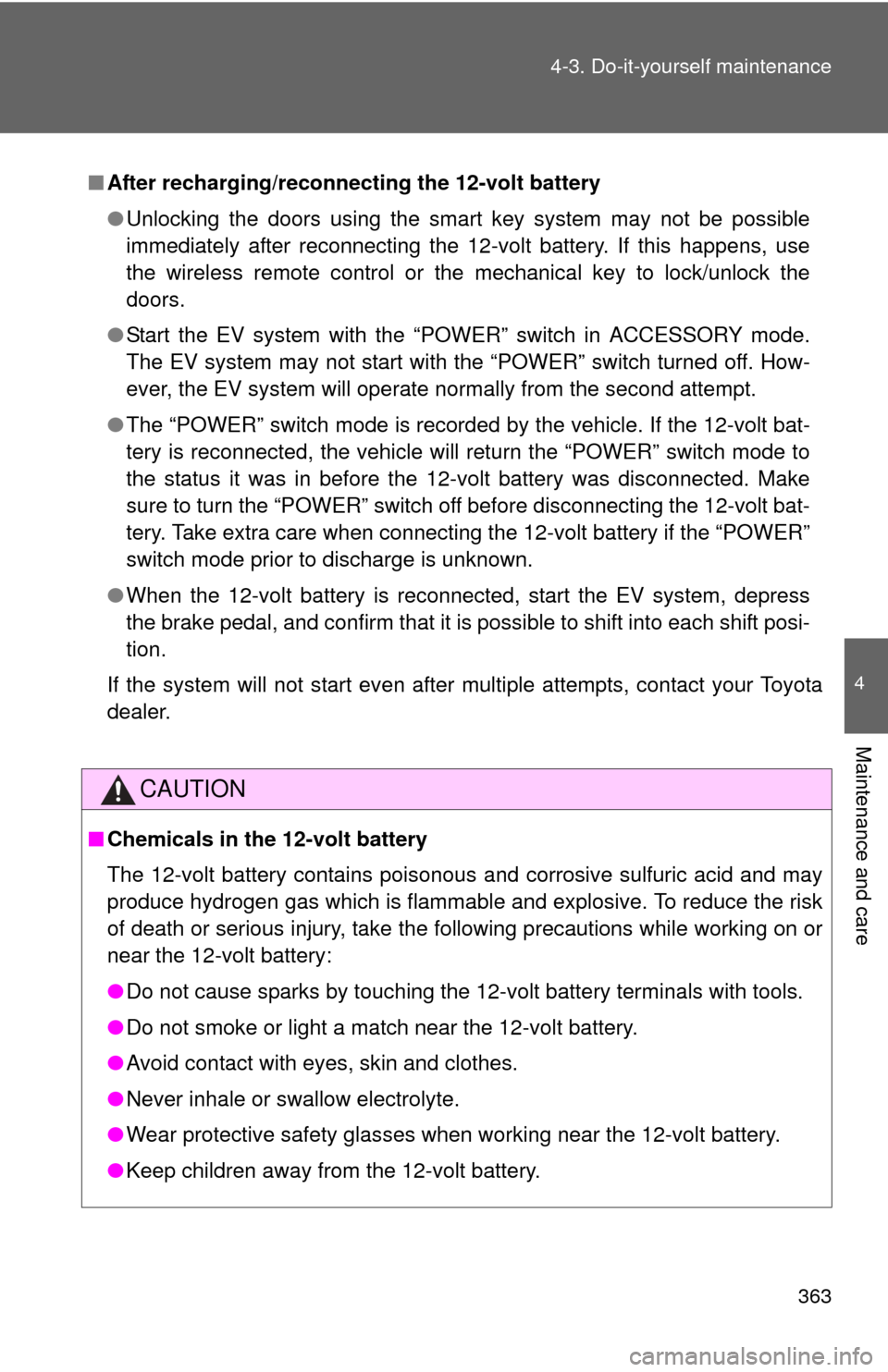
After recharging/reconnecting the 12-volt battery
●Unlocking the doors using the smart key system may not be possible
immediately after reconnecting the 12-volt battery. If this happens, use
the wireless remote control or the mechanical key to lock/unlock the
doors.
● Start the EV system with the “POWER” switch in ACCESSORY mode.
The EV system may not start with the “POWER” switch turned off. How-
ever, the EV system will operate normally from the second attempt.
● The “POWER” switch mode is recorded by the vehicle. If the 12-volt bat-
tery is reconnected, the vehicle will return the “POWER” switch mode to
the status it was in before the 12-volt battery was disconnected. Make
sure to turn the “POWER” switch off before disconnecting the 12-volt bat-
tery. Take extra care when connecting the 12-volt battery if the “POWER”
switch mode prior to discharge is unknown.
● When the 12-volt battery is reconnected, start the EV system, depress
the brake pedal, and confirm that it is possible to shift into each shift posi-
tion.
If the system will not start even after multiple attempts, contact your Toyota
dealer.
CAUTION
■ Chemicals in the 12-volt battery
The 12-volt battery contains poisonous and corrosive sulfuric acid and may
produce hydrogen gas which is flammable and explosive. To reduce the risk
of death or serious injury, take the following precautions while working on or
near the 12-volt battery:
●Do not cause sparks by touching the 12-volt battery terminals with tools.
● Do not smoke or light a match near the 12-volt battery.
● Avoid contact with eyes, skin and clothes.
● Never inhale or swallow electrolyte.
● Wear protective safety glasses when working near the 12-volt battery.
● Keep children away from the 12-volt battery.
Page 390 of 520
390 4-3. Do-it-yourself maintenance
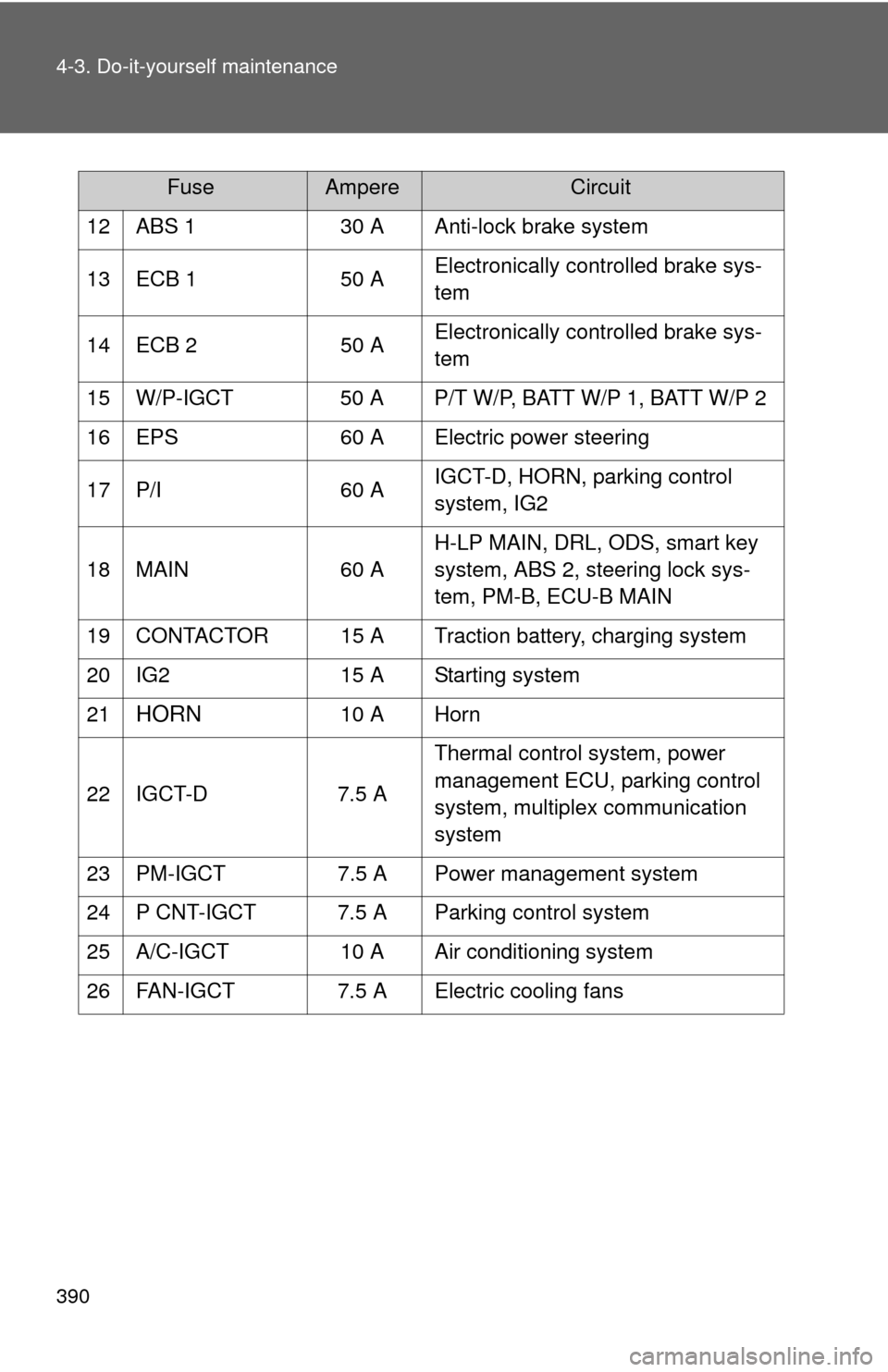
12 ABS 130 A Anti-lock brake system
13 ECB 1 50 AElectronically controlled brake sys-
tem
14 ECB 2 50 AElectronically controlled brake sys-
tem
15 W/P-IGCT 50 A P/T W/P, BATT W/P 1, BATT W/P 2
16 EPS 60 A Electric power steering
17 P/I 60 AIGCT-D, HORN, parking control
system, IG2
18 MAIN 60 AH-LP MAIN, DRL, ODS, smart key
system, ABS 2, steering lock sys-
tem, PM-B, ECU-B MAIN
19 CONTACTOR 15 A Traction battery, charging system
20 IG2 15 A Starting system
21
HORN 10 A Horn
22 IGCT-D 7.5 A Thermal control system, power
management ECU, parking control
system, multiplex communication
system
23 PM-IGCT 7.5 A Power management system
24 P CNT-IGCT 7.5 A Parking control system
25 A/C-IGCT 10 A Air conditioning system
26 FAN-IGCT 7.5 A Electric cooling fans
FuseAmpereCircuit
Page 392 of 520
392 4-3. Do-it-yourself maintenance
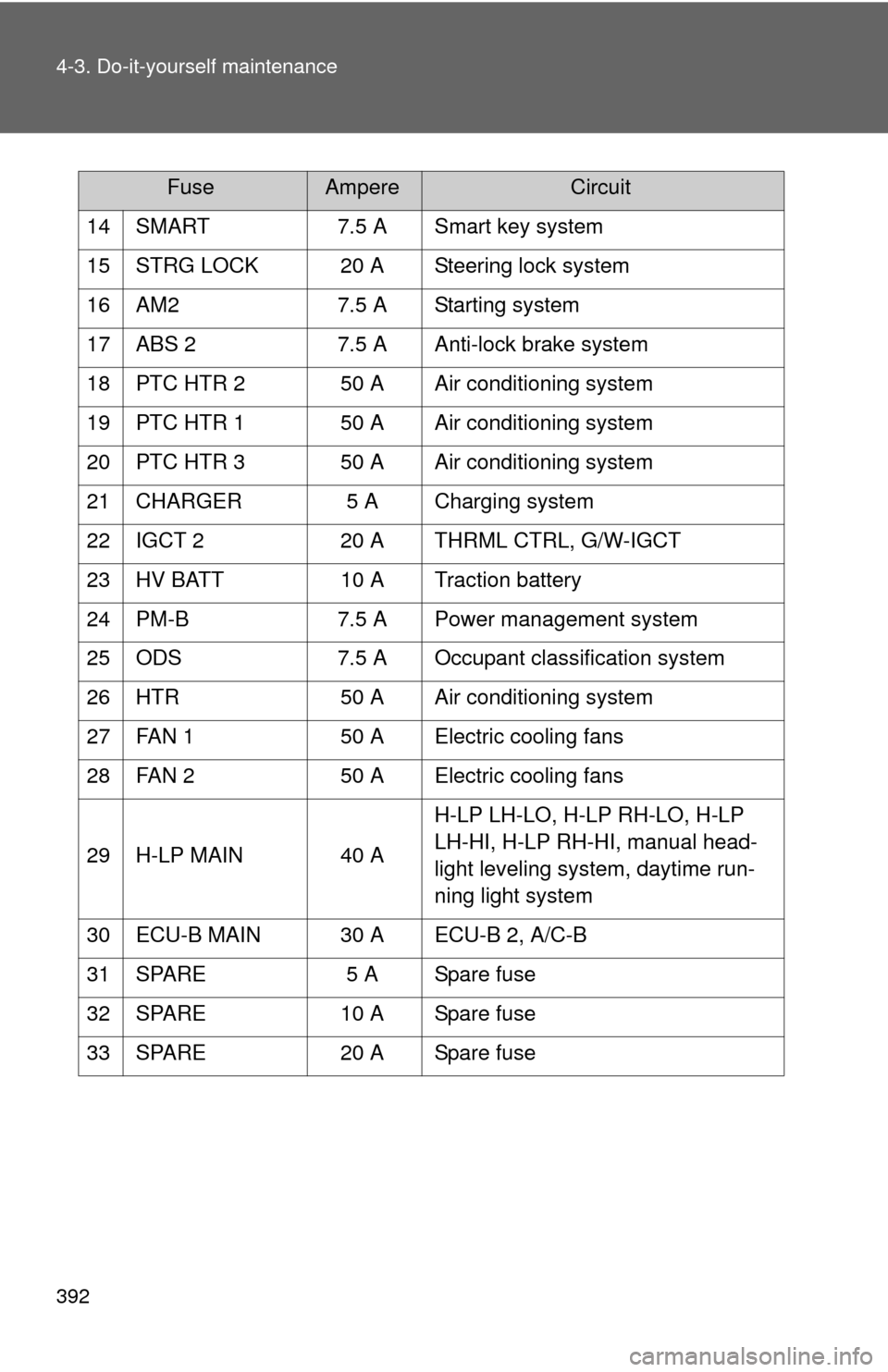
14 SMART7.5 A Smart key system
15 STRG LOCK 20 A Steering lock system
16 AM2 7.5 A Starting system
17 ABS 2 7.5 A Anti-lock brake system
18 PTC HTR 2 50 A Air conditioning system
19 PTC HTR 1 50 A Air conditioning system
20 PTC HTR 3 50 A Air conditioning system
21 CHARGER 5 A Charging system
22 IGCT 2 20 A THRML CTRL, G/W-IGCT
23 HV BATT 10 A Traction battery
24 PM-B 7.5 A Power management system
25 ODS 7.5 A Occupant classification system
26 HTR 50 A Air conditioning system
27 FAN 1 50 A Electric cooling fans
28 FAN 2 50 A Electric cooling fans
29 H-LP MAIN 40 A H-LP LH-LO, H-LP RH-LO, H-LP
LH-HI, H-LP RH-HI, manual head-
light leveling system, daytime run-
ning light system
30 ECU-B MAIN 30 A ECU-B 2, A/C-B
31 SPARE 5 A Spare fuse
32 SPARE 10 A Spare fuse
33 SPARE 20 A Spare fuse
FuseAmpereCircuit
Page 394 of 520

394 4-3. Do-it-yourself maintenance
■Under the instrument panel
Front side of the fuse block
FuseAmpereCircuit
1 DCM-IG2 5 A DCM-IG2
2 PM-IG2 5 A Power management system
3 IG2 2 5 A Steering lock system, smart key
system
4 IG2 1 5 A Electronically controlled brake sys-
tem, stop/tail lights, high mounted
stoplight
5 SSR-IG1 5 A Vehicle stability control system,
steering sensor
6 EPS-IG1 5 A Electric power steering
7 P/W-MAIN 30 A Power windows
8 DEF 30 A Rear window defogger
Page 396 of 520
396 4-3. Do-it-yourself maintenance
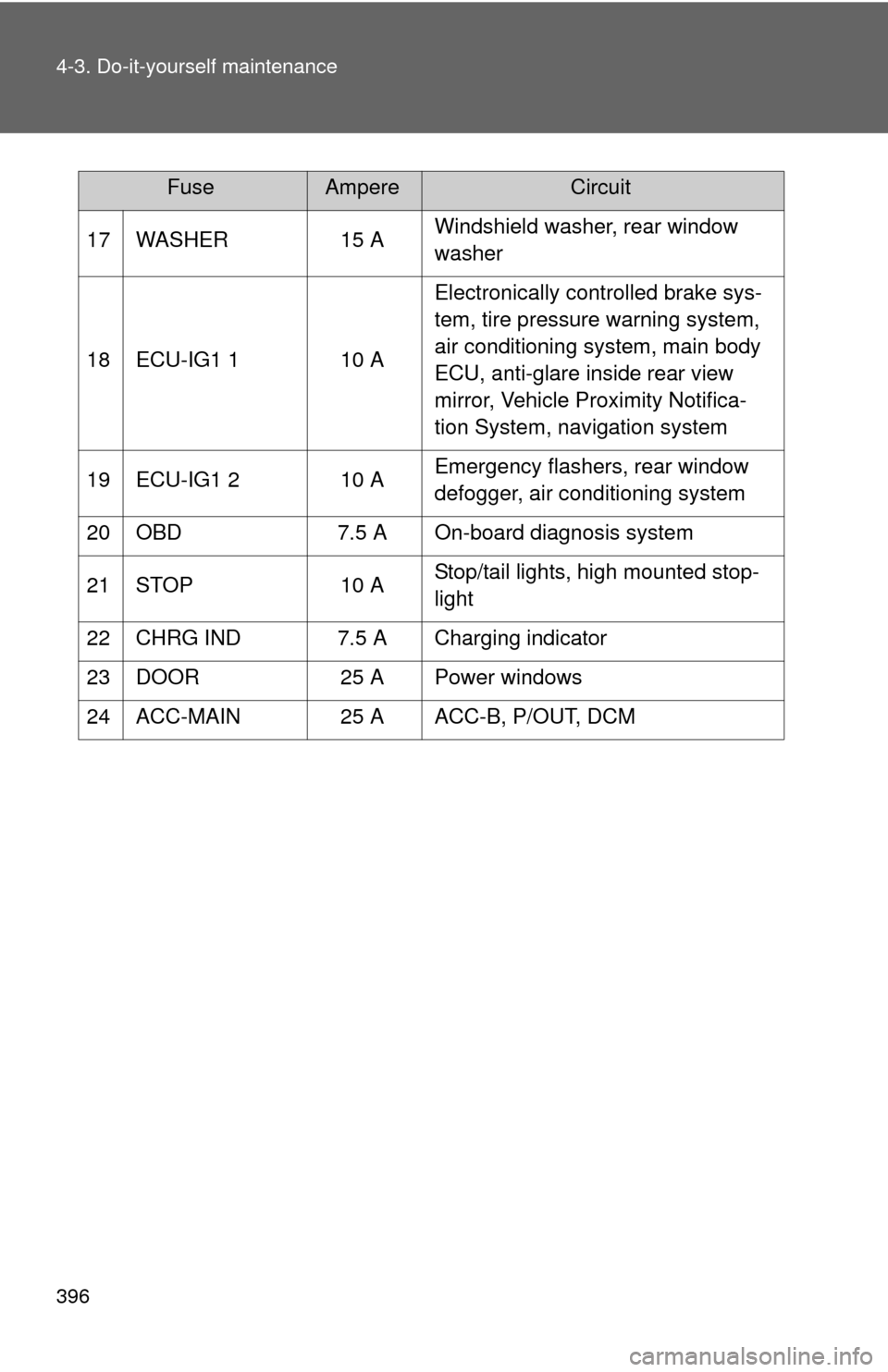
17 WASHER15 AWindshield washer, rear window
washer
18 ECU-IG1 1 10 A Electronically controlled brake sys-
tem, tire pressure warning system,
air conditioning system, main body
ECU, anti-glare inside rear view
mirror, Vehicle Proximity Notifica-
tion System, navigation system
19 ECU-IG1 2 10 A Emergency flashers, rear window
defogger, air conditioning system
20 OBD 7.5 A On-board diagnosis system
21 STOP 10 AStop/tail lights, high mounted stop-
light
22 CHRG IND 7.5 A Charging indicator
23 DOOR 25 A Power windows
24 ACC-MAIN 25 A ACC-B, P/OUT, DCM
FuseAmpereCircuit
Page 414 of 520

414 5-1. Essential information
Towing with a sling-type truckDo not tow with a sling-type truck
to prevent body damage.
Towing with a wheel-lift type truckFrom the front Release the parking brake.
From the rear Use a towing dolly under the
front wheels.
Page 416 of 520

416
5-1. Essential information
If you think something is wrong
If you notice any of the following symptoms, your vehicle probably
needs adjustment or repair. Contact your Toyota dealer as soon as
possible.
■ Visible symptoms
●Fluid leaks under the vehicle
(Water dripping from the air cond itioning after use is normal.)
● Flat-looking tires or uneven tire wear
■ Audible symptoms
●Excessive tire squeal when cornering
● Strange noises related to the suspension system
■ Operational symptoms
●Stumbling or running roughly
● Appreciable loss of power
● Vehicle pulls heavily to one side when braking
● Vehicle pulls heavily to one side when driving on a level road
● Loss of brake effectiveness, s pongy feeling, pedal almost
touches the floor