brake TOYOTA RAV4 EV 2013 1.G Repair Manual
[x] Cancel search | Manufacturer: TOYOTA, Model Year: 2013, Model line: RAV4 EV, Model: TOYOTA RAV4 EV 2013 1.GPages: 520, PDF Size: 7.4 MB
Page 417 of 520

5
When trouble arises
417
5-2. Steps to take in an emergency
If a war ning light turns on or a war ning buzzer sounds...
Stop the vehicle immediately. Continuing to drive the vehicle
may be dangerous.The following warning indicates a possible problem in the brake sys-
tem. Immediately stop the vehicle in a safe place and contact your
Toyota dealer.
*: Brake system warning buzzer:
When there is a possible problem that could affect braking performance, the
warning light will come on and a warning buzzer may sound.
Parking brake engaged warning buzzer:
P. 433
Warning lightWarning light/Details
(Red) Brake system warning light (warning buzzer)*
• Low brake fluid
• Malfunction in the brake system
This light also comes on when the parking brake is not
released. If the light turns off after the parking brake is fully
released the system is operating normally.
■ Brake system warning light operation
Although depressing the brake pedal repeatedly may cause the red brake
system warning light to turn on and the buzzer to sound, this does not indi-
cate a malfunction.
Calmly perform the following actio ns if any of the warning lights
comes on or flashes. If a light comes on or flashes, but then goes
off, this does not necessarily indicate a malfunction in the system.
However, if this continues to o ccur, have the vehicle inspected by
your Toyota dealer.
Page 418 of 520

418 5-2. Steps to take in an emergency
Stop the vehicle immediately.The following warning indicates the possibility of damage to the vehi-
cle that may lead to an accident. Immediately stop the vehicle in a
safe place and contact your Toyota dealer.
Have the vehicle inspected by your Toyota dealer immediately.Failure to investigate the cause of the following warnings may lead to
the system operating abnormally and possibly cause an accident.
Have the vehicle inspected by your Toyota dealer immediately.
Warning lightWarning light/Details
12-volt battery chargi ng system warning light
Indicates a malfunction in the vehicle’s 12-volt battery
charging system.
Warning lightWarning light/Details
SRS warning light
Indicates a malfunction in:
• The SRS airbag system;
• The front passenger occupant classification system; or
• The seat belt pretensioner system.
“ABS” warning light
Indicates a malfunction in:
• The ABS;
• The brake assist system.
Electric power steering system warning light (warning
buzzer) Indicates a malfunction in the EPS (Electric Power Steer-
ing) system
Slip indicator light
Indicates a malfunction in:
• The VSC;
• The TRAC;
• The hill-start assist control
Page 419 of 520

5
When trouble arises
419
5-2. Steps to take in an emergency
Follow the correction procedures.
After taking the specified steps to correct the suspected problem,
check that the warning light goes off.
(Yellow) Brake system warning light
Indicates a malfunction in:
• The regenerative brake system; or
• The electronically controlled brake system
(Flashing) Cruise control indicator light
Indicates a malfunction in the cruise control system
Warning lightWarning light/DetailsCorrection procedure
Open door warning light
(warning buzzer)*
1
Indicates that a door is
not fully closed Check that all the doors
are closed.
SOC (State of Charge)
warning light The amount of charge
remaining in the traction
battery has fallen to the
SOC gauge’s 2 lowest
segments Charge the vehicle.
(Yellow) Plug-in indicator
Indicates a malfunction
with the charging cable. Reconnect the charging
cable.
If the warning light
does not go off even
after reconnecting the
charging cable, contact
your Toyota dealer.
Warning lightWarning light/Details
Page 424 of 520

424 5-2. Steps to take in an emergency
CAUTION
■When the electric power steering warning light comes on
The steering wheel may become extremely heavy.
If the steering wheel becomes heavier than usual when operating, hold
firmly and operate using more force than usual.
■ If the tire pressure warning light comes on
Be sure to observe the following precautions. Failure to do so could cause a
loss of vehicle control and result in death or serious injury.
●Stop your vehicle in a safe place as soon as possible. Adjust the tire infla-
tion pressure immediately.
● If the tire pressure warning light comes on even after tire inflation pressure
adjustment, it is probable that you have a flat tire. Check the tires. If the
tire is flat, temporarily repair it with liquid sealants and have the flat tire
repaired or replaced by the nearest Toyota dealer as soon as possible.
● Avoid abrupt maneuvering and braking. If the vehicle tires deteriorate, you
could lose control of the steering wheel or the brakes.
■
If a blowout or sudden air leakage should occur
The tire pressure warning syste m may not activate immediately.
Page 429 of 520

5
When trouble arises
429
5-2. Steps to take in an emergency
Have the vehicle inspected immediately.
Failure to investigate the cause of the following warnings may lead to
the system operating abnormally and possibly cause an accident.
Have the vehicle inspected by your Toyota dealer immediately.
Warning messageDetails
Indicates a malfunction in:
• The ABS; or,
• The brake assist system A buzzer also sounds.
Indicates a malfunction in:
• Low brake fluid
• The brake system A buzzer also sounds.
Page 432 of 520
432 5-2. Steps to take in an emergency
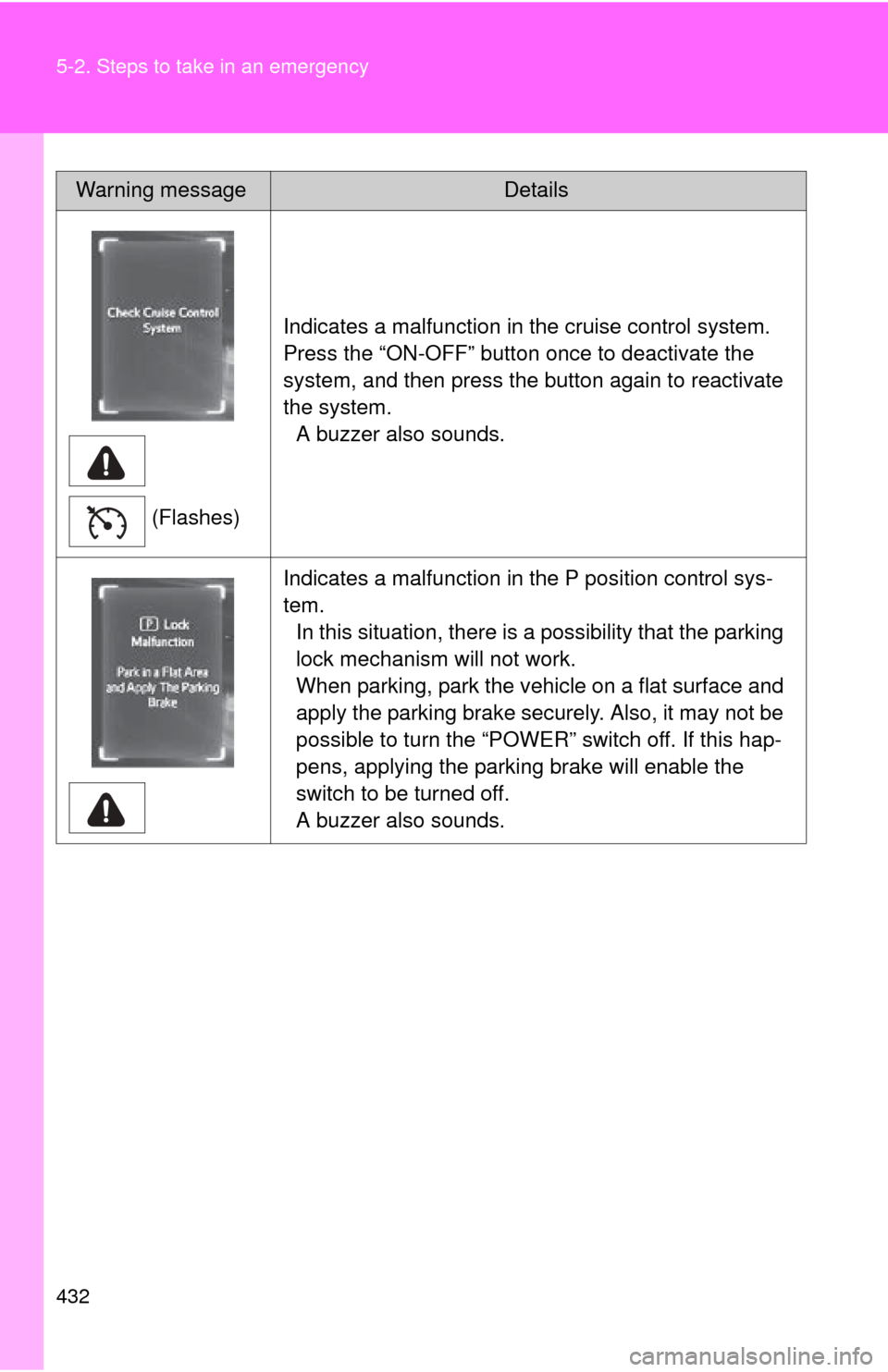
(Flashes)Indicates a malfunction in the cruise control system.
Press the “ON-OFF” button once to deactivate the
system, and then press the button again to reactivate
the system.
A buzzer also sounds.
Indicates a malfunction in the P position control sys-
tem. In this situation, there is a possibility that the parking
lock mechanism will not work.
When parking, park the vehicle on a flat surface and
apply the parking brake securely. Also, it may not be
possible to turn the “POWER” switch off. If this hap-
pens, applying the parking brake will enable the
switch to be turned off.
A buzzer also sounds.
Warning messageDetails
Page 438 of 520

438 5-2. Steps to take in an emergency
Indicates that the park-
ing brake is still
engaged. flashes and a
buzzer sounds to indi-
cate that the parking
brake is still engaged
(with the vehicle having
reached a speed of 3
mph [5 km/h]). Release the parking
brake.
Indicates that the
washer fluid level is low. Add washer fluid.
Due to the amount of
charge remaining in the
traction battery being
high, power regener-
ated through regenera-
tive braking is reduced. Apply the brake pedal
as needed to slow
down.
(Flashes) The driver's door is
opened when the
transmission is out of
P with the EV system
on.
Push the P position
switch.
Warning messageDetailsCorrection procedure
Page 442 of 520

442 5-2. Steps to take in an emergency
Once
(Flashes)An open door
has been
closed and the
“POWER”
switch has been
turned twice to
the ACCES-
SORY mode
from off.
Press the
“POWER”
switch
while
depress-
ing the
brake
pedal.
(Flashes)Indicates that
the steering
lock has not
released within
3 seconds of
pressing the
“POWER”
switch.
Press the
“POWER”
switch
again while
turning the
steering
wheel with
the brake
pedal
depressed.
Interior
buzzerExterior buzzerWarning messageDetailsCorrection procedure
Page 447 of 520

5
When trouble arises
447
5-2. Steps to take in an emergency
If you have a flat tire
A puncture caused by a nail or screw passing through the tire
tread can be repaired temporarily using the emergency tire punc-
ture repair kit. (The kit contains a bottle of sealant. The sealant
can be used only once to temporarily repair one tire without
removing the nail or screw from the tire.) Depending on the dam-
age, this kit cannot be used to repair the tire. (P. 450)
After temporarily repairing the tire with the kit, have the tire
repaired or replaced by your Toyota dealer. Repairs conducted
using the emergency tire puncture repair kit are only a temporary
measure. Have the tire repaired and replaced as soon as possi-
ble.
■ Before repairing the tire
●Stop the vehicle in a safe pl ace on a hard, flat surface.
● Set the parking brake.
● Push the P position switch.
● Stop the EV system.
● Turn on the emergency flashers.
Page 462 of 520
462 5-2. Steps to take in an emergency
CAUTION
■Do not drive the vehicle with a flat tire
Do not continue driving with a flat tire.
Driving even a short distance with a flat tire can damage the tire and the
wheel beyond repair.
Driving with a flat tire may cause a circumferential groove on the side
wall. In such a case, the tire may explode when using a repair kit.
■Caution while driving
●Store the repair kit in the luggage compartment.
Injuries may result in the event of an accident or sudden braking.
●The repair kit is exclusively only for your vehicle.
Do not use repair kit on other vehicles, which could lead to an accident
causing death or serious injury.
●Do not use repair kit for tires that are different size than the original
ones, or for any other purpose. If the tires have not been completely
repaired, it could lead to an accident causing death or serious injury.
■Precautions for use of the sealant
●Ingesting the sealant is hazardous to your health. If you ingest sealant,
consume as much water as possible, and then immediately consult a
doctor.
●If sealant gets in eyes or adheres to skin, immediately wash it off with
water. If discomfort persists, consult a doctor.
■When fixing the flat tire
●Stop your vehicle in a safe and flat area.
●Do not touch the wheels or the ar ea around the brakes immediately
after the vehicle has been driven.
After the vehicle has been driven, the wheels and the area around the
brakes may be extremely hot. Touching these areas with hands, feet or
other body parts may result in burns.
●Connect the valve and hose securely with the tire installed on the vehi-
cle. If the hose is not properly con nected to the valve, air leakage may
occur as sealant may be sprayed out.
●If the hose comes off the valve while inflating the tire, there is a risk
that the hose will move abruptly due to air pressure.