maintenance TOYOTA RAV4 EV 2014 1.G User Guide
[x] Cancel search | Manufacturer: TOYOTA, Model Year: 2014, Model line: RAV4 EV, Model: TOYOTA RAV4 EV 2014 1.GPages: 521, PDF Size: 7.44 MB
Page 339 of 521
338 4-1. Maintenance and care
■Caring for leather areas
Toyota recommends cleaning the interior of the vehicle at least twice a year
to maintain the quality of the vehicle's interior.
■ Shampooing the carpets
There are several commercial foaming-type cleaners available. Use a
sponge or brush to apply the foam. Rub in overlapping circles. Do not use
water. Wipe dirty surfaces and let them dry. Excellent results are obtained by
keeping the carpet as dry as possible.
■ Seat belts
Clean with mild soap and lukewarm water using a cloth or sponge. Also
check the belts periodically for excessive wear, fraying or cuts.
CAUTION
■Water in the vehicle
●Do not splash or spill liquid in the vehicle, such as on the floor. Doing so
may cause electrical components etc. to malfunction or catch fire.
● Do not get any of the SRS components or wiring in the vehicle interior wet.
( P. 155)
Electrical malfunction may cause the airbags to deploy or not function
properly, resulting in death or severe injury.
■ Cleaning the interior (esp ecially instrument panel)
Do not use polish wax or polish cleaner. The instrument panel may reflect off
the windshield, obstructing the driver 's view and leading to an accident,
resulting in death or serious injury.
Page 340 of 521

339
4-1. Maintenance and care
4
Maintenance and care
NOTICE
■
Cleaning detergents
●Do not use organic substances such as benzene or gasoline, acidic or
alkaline solutions, dye, bleach or other detergent. Doing so may discolor
the vehicle interior or cause streaks or damage to painted surfaces.
● Do not use polish wax or polish cleaner. The instrument panel's or other
interior part’s painted surface may be damaged.
■ Preventing damage to leather surfaces
Observe the following precautions to avoid damage to and deterioration o\
f
leather surfaces:
●Remove any dust or dirt from leather surfaces immediately.
● Do not expose the vehicle to direct sunlight for extended periods of time.
Park the vehicle in the shade, especially during summer.
● Do not place items made of vinyl, plastic, or containing wax on the uphol-
stery, as they may stick to the leather surface if the vehicle interior heats
up significantly.
■ Water on the floor
Do not wash the vehicle floor with water.
Vehicle systems such as the audio system may be damaged if water comes
into contact with electrical components such as the audio system above or
under the floor of the vehicle. Water may also cause the body to rust.
■ Cleaning the inside of the rear window
●Do not use glass cleaner to clean the rear window, as this may cause
damage to the rear window defogger heater wires or antenna. Use a cloth
dampened with lukewarm water to gently wipe the window clean. Wipe the
window in strokes running parallel to the heater wires or antenna.
● Be careful not to scratch or damage the heater wires or antenna.
Page 341 of 521
340
4-2. Maintenance
Maintenance requirements
■Repair and replacement
It is recommended that genuine Toyota parts be used for repairs to ensure
performance of each system. If non-Toyota parts are used in replacement or
if a repair shop other than a Toyota dealer performs repairs, confirm the war-
ranty coverage.
To ensure safe and economical driv ing, day-to-day care and regular
maintenance are essential. It is the owner’s responsibility to perform
regular checks. Toyota recommen ds the following maintenance:
■General maintenance
General maintenance should be performed on a daily basis.
This can be done by yourself or by a Toyota dealer.
■ Scheduled maintenance
Scheduled maintenance should be performed at specified inter-
vals according to the maintenance schedule.
For details about maintenance items and schedules, refer to the
“Scheduled Maintenance Guide” or “Owner’s Manual Supplement”.
■Do-it-yourself maintenance
You can perform some maintenance procedures by yourself.
Please be aware that do-it-yourself maintenance may affect war-
ranty coverage.
The use of Toyota Repair Manuals is recommended.
For details about warranty coverage, see the separate “Owner’s
Warranty Information Booklet” or “Owner’s Manual Supplement”.
Page 342 of 521
341
4-2. Maintenance
4
Maintenance and care
■
Allow inspection and repairs to be performed by a Toyota dealer
● Toyota technicians are well-trained specialists and are kept up to date
with the latest service information. They are well informed about the
operations of all systems on your vehicle.
● Keep a copy of the repair order. It proves that the maintenance that has
been performed is under warranty coverage. If any problem should arise
while your vehicle is under warranty, your Toyota dealer will promptly
take care of it.
CAUTION
■If your vehicle is not properly maintained
Improper maintenance could result in serious damage to the vehicle and
possible serious injury or death.
■ Handling of the 12-volt battery
●Oils and fluids contained in vehicles as well as waste produced by compo-
nent wear contain or emit chemicals known to the State of California to
cause cancer and birth defects or other reproductive harm. Avoid expo-
sure and wash any affected area immediately.
● 12-volt battery posts, terminals and related accessories contain lead and
lead compounds which are known to cause brain damage. Wash your
hands after handling. ( P. 362)
Page 343 of 521
342
4-2. Maintenance
General maintenance
Motor compartment
ItemsCheck points
12-volt battery Check the connections.
(P. 362)
Brake fluid Is the brake fluid at the correct
level? (
P. 361)
Motor/traction battery coolant Is the coolant at the correct level?
(P. 357)
Heater coolant Is the coolant at the correct level?
(P. 359)
Condenser/radiators The condenser and radiators
should be free from foreign
objects. (
P. 360)
Washer fluid Is there sufficient washer fluid?
(P. 365)
Listed below are the general maintenance items that should be per-
formed at the intervals specified in the “Owner's Warranty Informa-
tion Booklet” or “Owner’s Manual Supplement/Scheduled
Maintenance Guide”. It is recommended that any problem you notice
should be brought to the attention of your Toyota dealer or qualified
service shop for advice.
Page 344 of 521
343
4-2. Maintenance
4
Maintenance and care
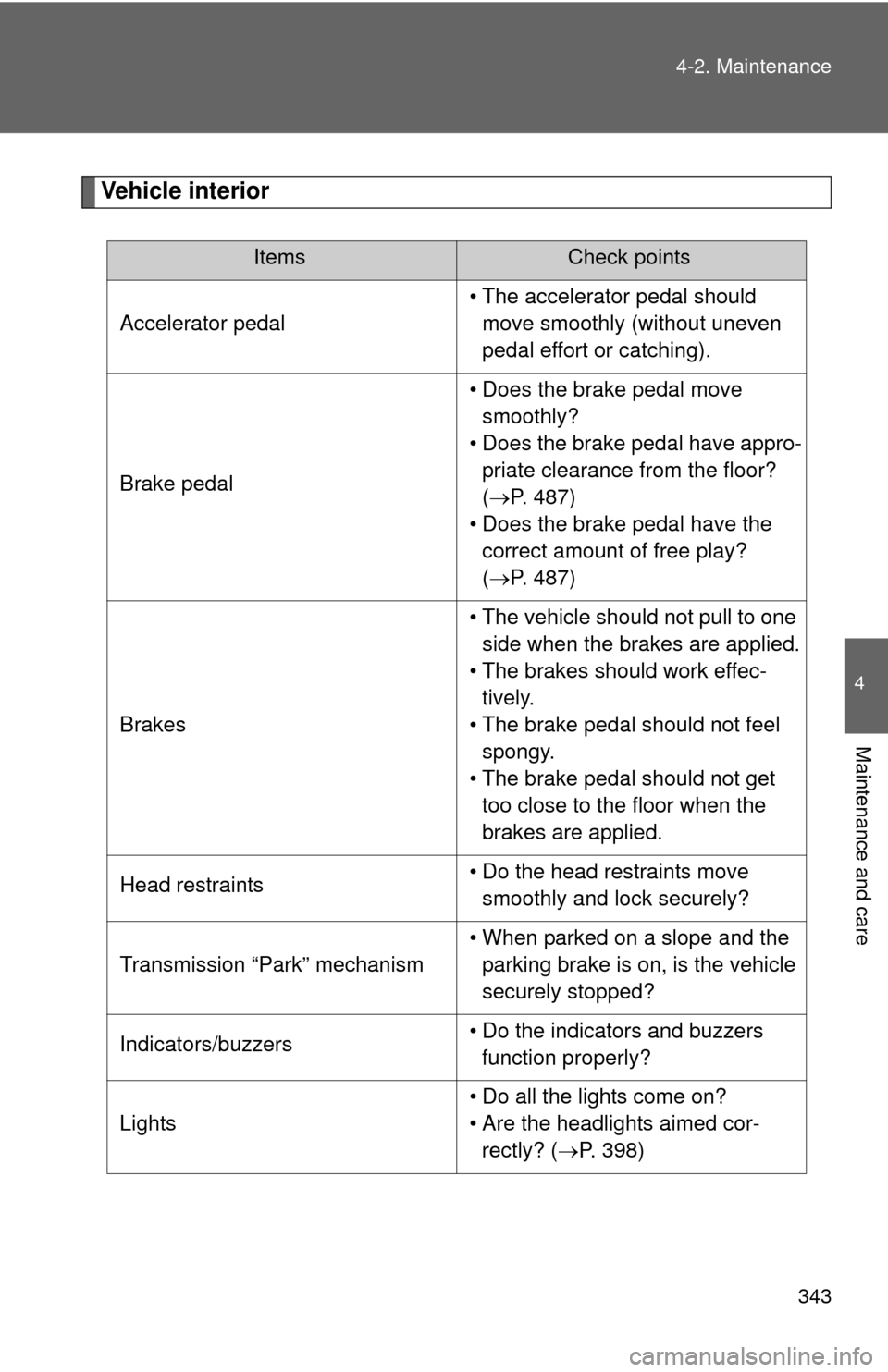
Vehicle interior
ItemsCheck points
Accelerator pedal • The accelerator pedal should
move smoothly (without uneven
pedal effort or catching).
Brake pedal • Does the brake pedal move
smoothly?
• Does the brake pedal have appro- priate clearance from the floor?
(P. 487)
• Does the brake pedal have the correct amount of free play?
(P. 487)
Brakes • The vehicle should not pull to one
side when the brakes are applied.
• The brakes should work effec- tively.
• The brake pedal should not feel spongy.
• The brake pedal should not get too close to the floor when the
brakes are applied.
Head restraints • Do the head restraints move
smoothly and lock securely?
Transmission “Park” mechanism • When parked on a slope and the
parking brake is on, is the vehicle
securely stopped?
Indicators/buzzers • Do the indicators and buzzers
function properly?
Lights • Do all the lights come on?
• Are the headlights aimed cor-
rectly? ( P. 398)
Page 345 of 521

344 4-2. Maintenance
Parking brake• Does the parking brake lever
move smoothly?
• When parked on a slope and the parking brake is on, is the vehicle
securely stopped?
Seat belts • Do the seat belts operate
smoothly?
• The seat belts should not be dam- aged.
Seats • Do the seat controls operate
properly?
Steering wheel • Does the steering wheel rotate
smoothly?
• Does the steering wheel have the correct amount of free play?
• There should not be any strange sounds coming from the steering
wheel.
ItemsCheck points
Page 346 of 521
345
4-2. Maintenance
4
Maintenance and care
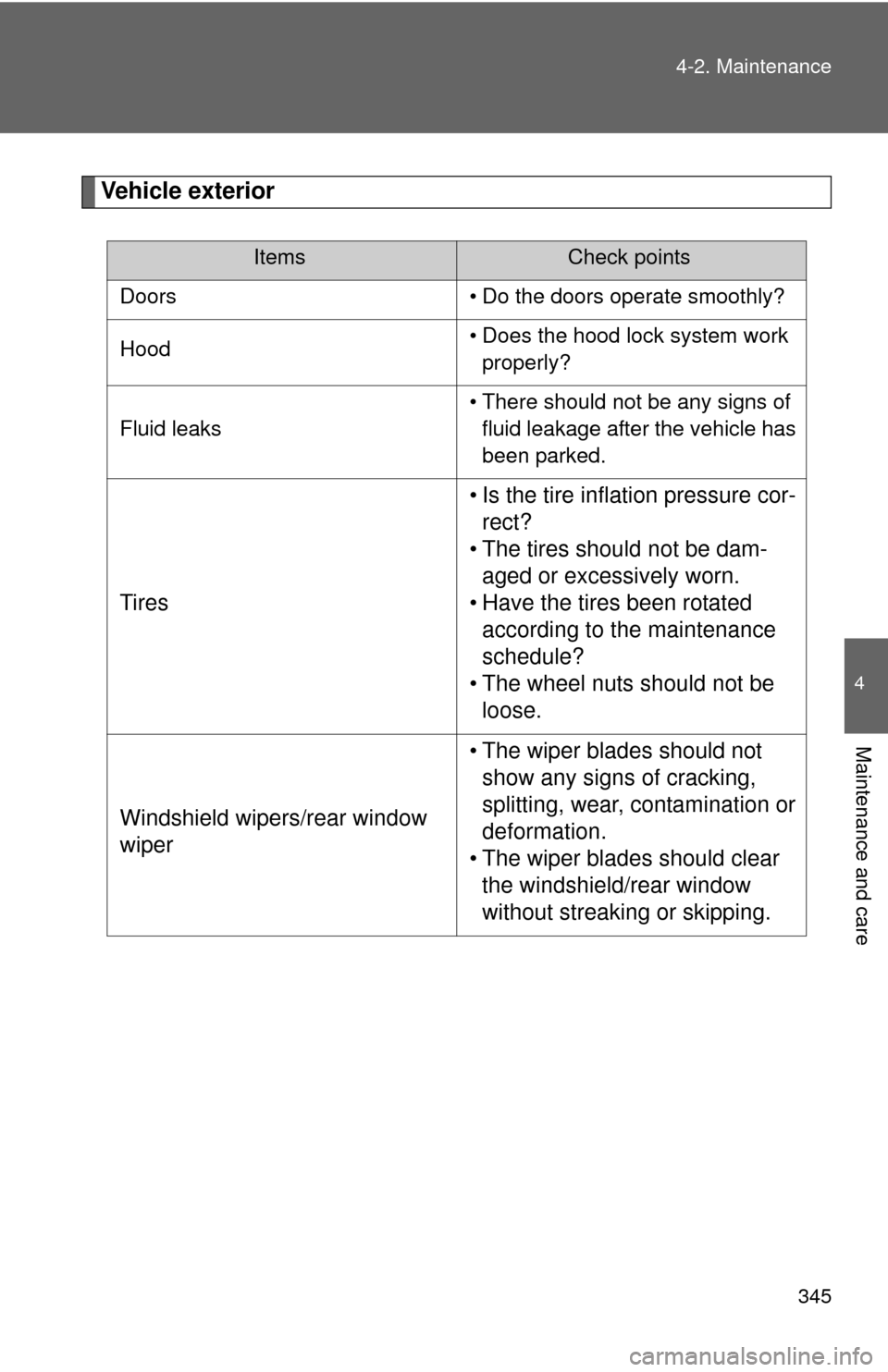
Vehicle exterior
ItemsCheck points
Doors • Do the doors operate smoothly?
Hood • Does the hood lock system work
properly?
Fluid leaks • There should not be any signs of
fluid leakage after the vehicle has
been parked.
Tires • Is the tire inflation pressure cor-
rect?
• The tires should not be dam- aged or excessively worn.
• Have the tires been rotated according to the maintenance
schedule?
• The wheel nuts should not be loose.
Windshield wipers/rear window
wiper • The wiper blades should not
show any signs of cracking,
splitting, wear, contamination or
deformation.
• The wiper blades should clear the windshield/rear window
without streaking or skipping.
Page 347 of 521
346
4-3. Do-it-yourself maintenance
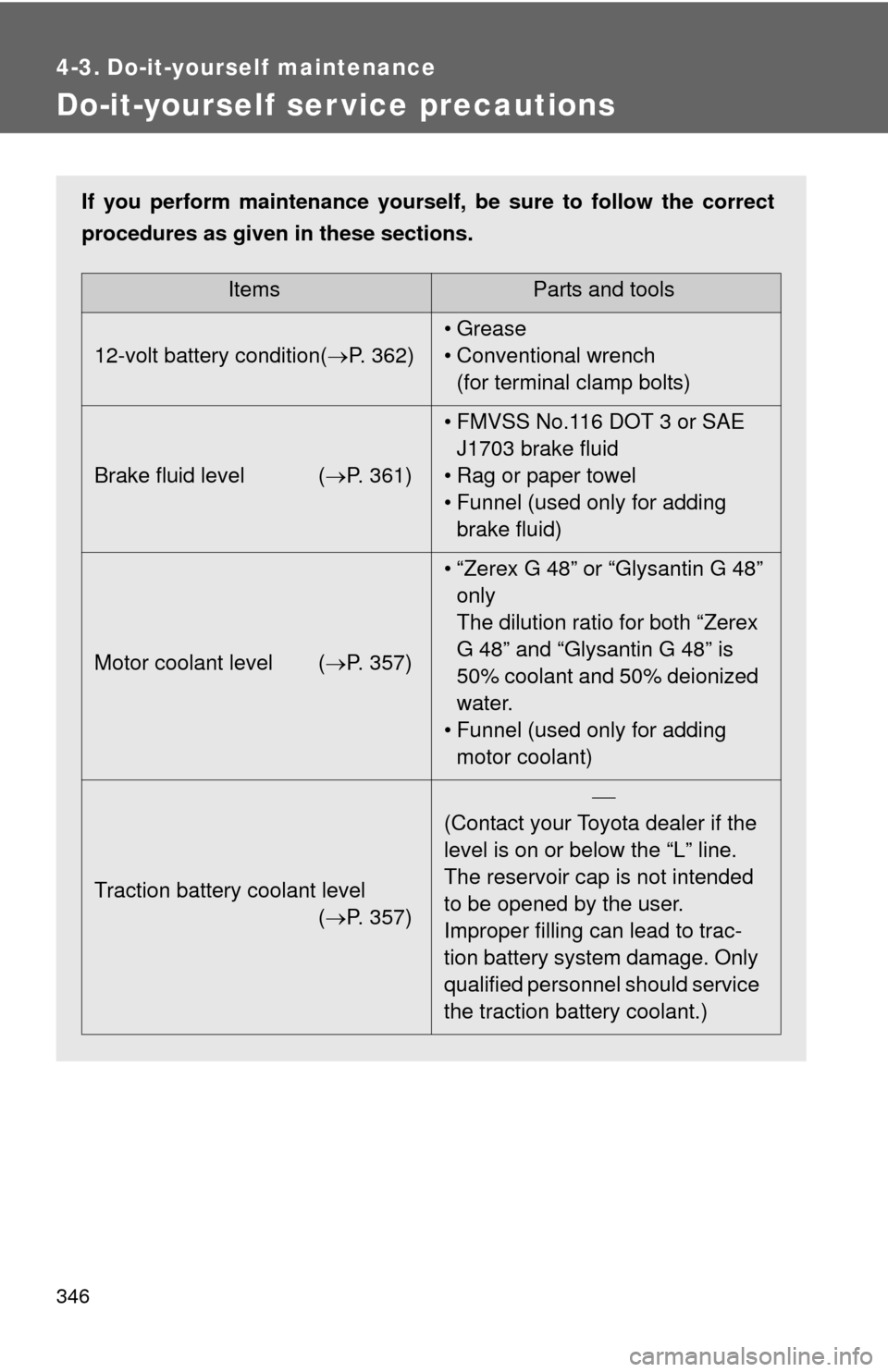
Do-it-yourself ser vice precautions
If you perform maintenance yourself, be sure to follow the correct
procedures as given in these sections.
ItemsParts and tools
12-volt battery condition( P. 362) • Grease
• Conventional wrench
(for terminal clamp bolts)
Brake fluid level ( P. 361)• FMVSS No.116 DOT 3 or SAE
J1703 brake fluid
• Rag or paper towel
• Funnel (used only for adding brake fluid)
Motor coolant level ( P. 357)• “Zerex G 48” or “Glysantin G 48”
only
The dilution ratio for both “Zerex
G 48” and “Glysantin G 48” is
50% coolant and 50% deionized
water.
• Funnel (used only for adding motor coolant)
Traction battery coolant level (P. 357)
(Contact your Toyota dealer if the
level is on or below the “L” line.
The reservoir cap is not intended
to be opened by the user.
Improper filling can lead to trac-
tion battery system damage. Only
qualified personnel should service
the traction battery coolant.)
Page 348 of 521
347
4-3. Do-it-yourself maintenance
4
Maintenance and care
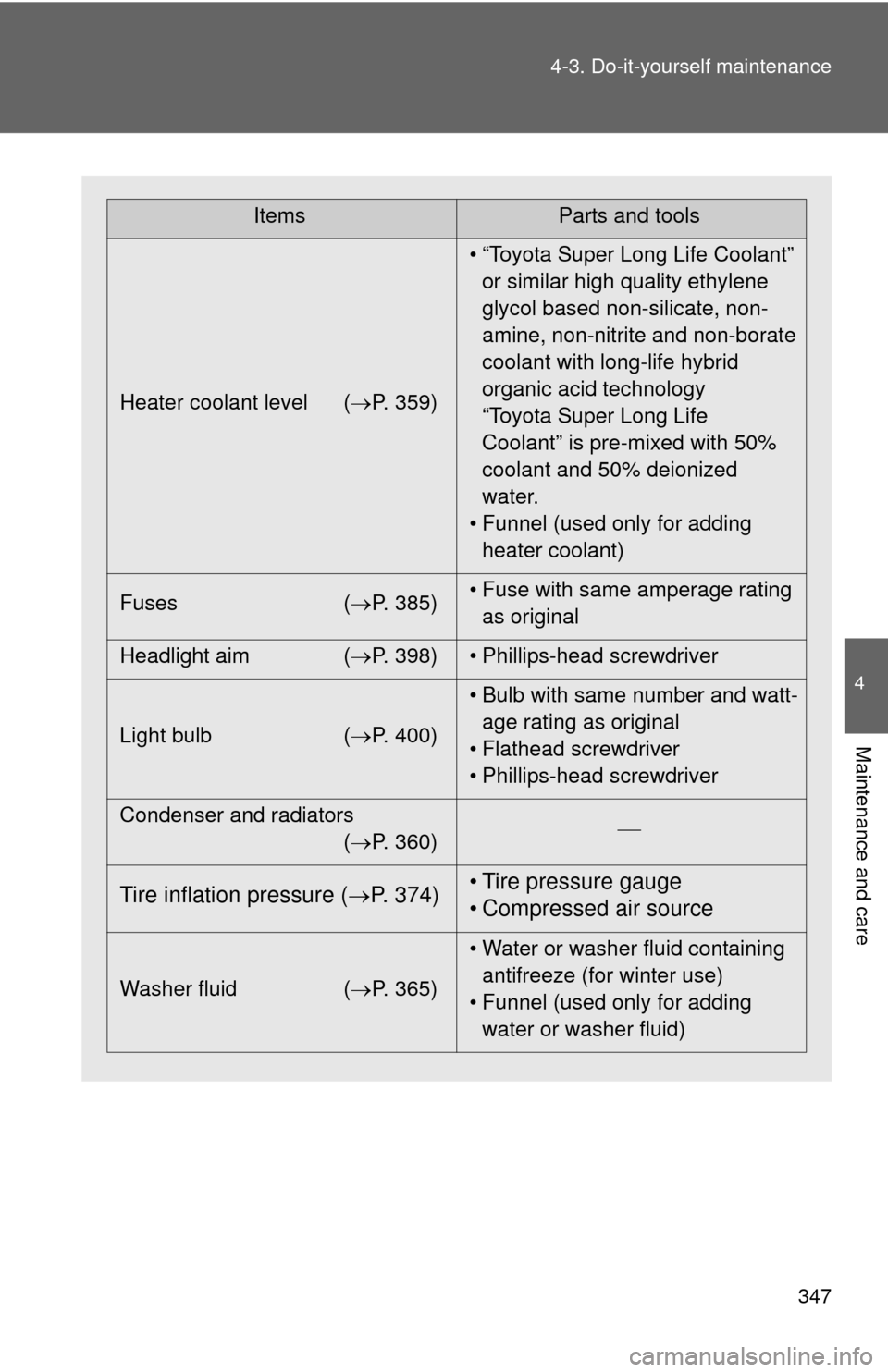
ItemsParts and tools
Heater coolant level ( P. 359)• “Toyota Super Long Life Coolant”
or similar high quality ethylene
glycol based non-silicate, non-
amine, non-nitrite and non-borate
coolant with long-life hybrid
organic acid technology
“Toyota Super Long Life
Coolant” is pre-mixed with 50%
coolant and 50% deionized
water.
• Funnel (used only for adding heater coolant)
Fuses ( P. 385)• Fuse with same amperage rating
as original
Headlight aim ( P. 398) • Phillips-head screwdriver
Light bulb ( P. 400)• Bulb with same number and watt-
age rating as original
• Flathead screwdriver
• Phillips-head screwdriver
Condenser and radiators (P. 360)
Tire inflation pressure (
P. 374) • Tire pressure gauge
• Compressed air source
Washer fluid
(P. 365) • Water or washer fluid containing
antifreeze (for winter use)
• Funnel (used only for adding water or washer fluid)