tire size TOYOTA RAV4 EV 2014 1.G User Guide
[x] Cancel search | Manufacturer: TOYOTA, Model Year: 2014, Model line: RAV4 EV, Model: TOYOTA RAV4 EV 2014 1.GPages: 521, PDF Size: 7.44 MB
Page 426 of 521
5
When trouble arises
425
5-2. Steps to take in an emergency
CAUTION
■Maintenance of the tires
Each tire, including the spare (if provided), should be checked monthly
when cold and inflated to the inflation pressure recommended by the
vehicle manufacturer on the vehicle
placard or tire inflation pressure
label (tire and load information label). (If your vehicle has tires of a differ-
ent size than the size indicated on the vehicle placard or tire inflation
pressure label [tire and load information label], you should determine the
proper tire inflation pr essure for those tires.)
As an added safety feature, your vehicle has been equipped with a tire
pressure monitoring system (TPMS-ti re pressure warning system) that
illuminates a low tire pressure telltal e (tire pressure warning light) when
one or more of your tires is significantly under-inflated. Accordingly,
when the low tire pressure telltale (tire pre ssure warning light) illumi-
nates, you should stop and check your tires as soon as possible, and
inflate them to the proper pressure. Driving on a significantly under-
inflated tire causes the tire to overheat and can lead to tire failure.
Under-inflation also reduces fuel effi ciency (for electric vehicles, traction
battery efficiency) and tire tread lif e, and may affect the vehicle's han-
dling and stopping ability.
Please note that the TPMS (tire pressure warning system) is not a sub-
stitute for proper ti re maintenance, an d it is the driver's responsibility to
maintain correct tire pressure, even if under-inflation has not reached the
level to trigger illu mination of the TPMS low ti re pressure telltale (tire
pressure warning light).
Page 462 of 521
5
When trouble arises
461
5-2. Steps to take in an emergency
■Emergency tire puncture repair kit
●The sealant stored in the emergency tire puncture repair kit can be
used only once to temporarily repair a single tire. If the sealant has
been used and needs to be replaced, purchase a new bottle at your
Toyota dealer. The compressor is reusable.
●The sealant can be used when the outside temperature is from
-40°F (-40°C) to 140°F (60°C).
●The repair kit is exclusively designed for the size and type of tires
originally installed on your vehicle. Do not use it for tires that are a dif-
ferent size than the original ones, or for any other purposes.
●The sealant has a limited lifespan. The expiration date is marked on
the bottle. The bottle of sealant should be replaced with a new bottle
before the expiration date. Contact your Toyota dealer for replace-
ment.
●If the sealant gets on your clothes, it may stain.
●If the sealant adheres to a wheel or the surface of the vehicle body,
the stain may not be removable if it is not cleaned at once. Immedi-
ately wipe away the sealant with a wet cloth.
●During operation of the repair kit, a loud operation noise is produced.
This does not indicate a malfunction.
●Do not use to check or to adjust the tire pressure.
Page 463 of 521
462 5-2. Steps to take in an emergency
CAUTION
■Do not drive the vehicle with a flat tire
Do not continue driving with a flat tire.
Driving even a short distance with a flat tire can damage the tire and the
wheel beyond repair.
Driving with a flat tire may cause a circumferential groove on the side
wall. In such a case, the tire may explode when using a repair kit.
■Caution while driving
●Store the repair kit in the luggage compartment.
Injuries may result in the event of an accident or sudden braking.
●The repair kit is exclusively only for your vehicle.
Do not use repair kit on other vehicles, which could lead to an accident
causing death or serious injury.
●Do not use repair kit for tires that are different size than the original
ones, or for any other purpose. If the tires have not been completely
repaired, it could lead to an accident causing death or serious injury.
■Precautions for use of the sealant
●Ingesting the sealant is hazardous to your health. If you ingest sealant,
consume as much water as possible, and then immediately consult a
doctor.
●If sealant gets in eyes or adheres to skin, immediately wash it off with
water. If discomfort persists, consult a doctor.
■When fixing the flat tire
●Stop your vehicle in a safe and flat area.
●Do not touch the wheels or the ar ea around the brakes immediately
after the vehicle has been driven.
After the vehicle has been driven, the wheels and the area around the
brakes may be extremely hot. Touching these areas with hands, feet or
other body parts may result in burns.
●Connect the valve and hose securely with the tire installed on the vehi-
cle. If the hose is not properly con nected to the valve, air leakage may
occur as sealant may be sprayed out.
●If the hose comes off the valve while inflating the tire, there is a risk
that the hose will move abruptly due to air pressure.
Page 489 of 521
488 6-1. Specifications
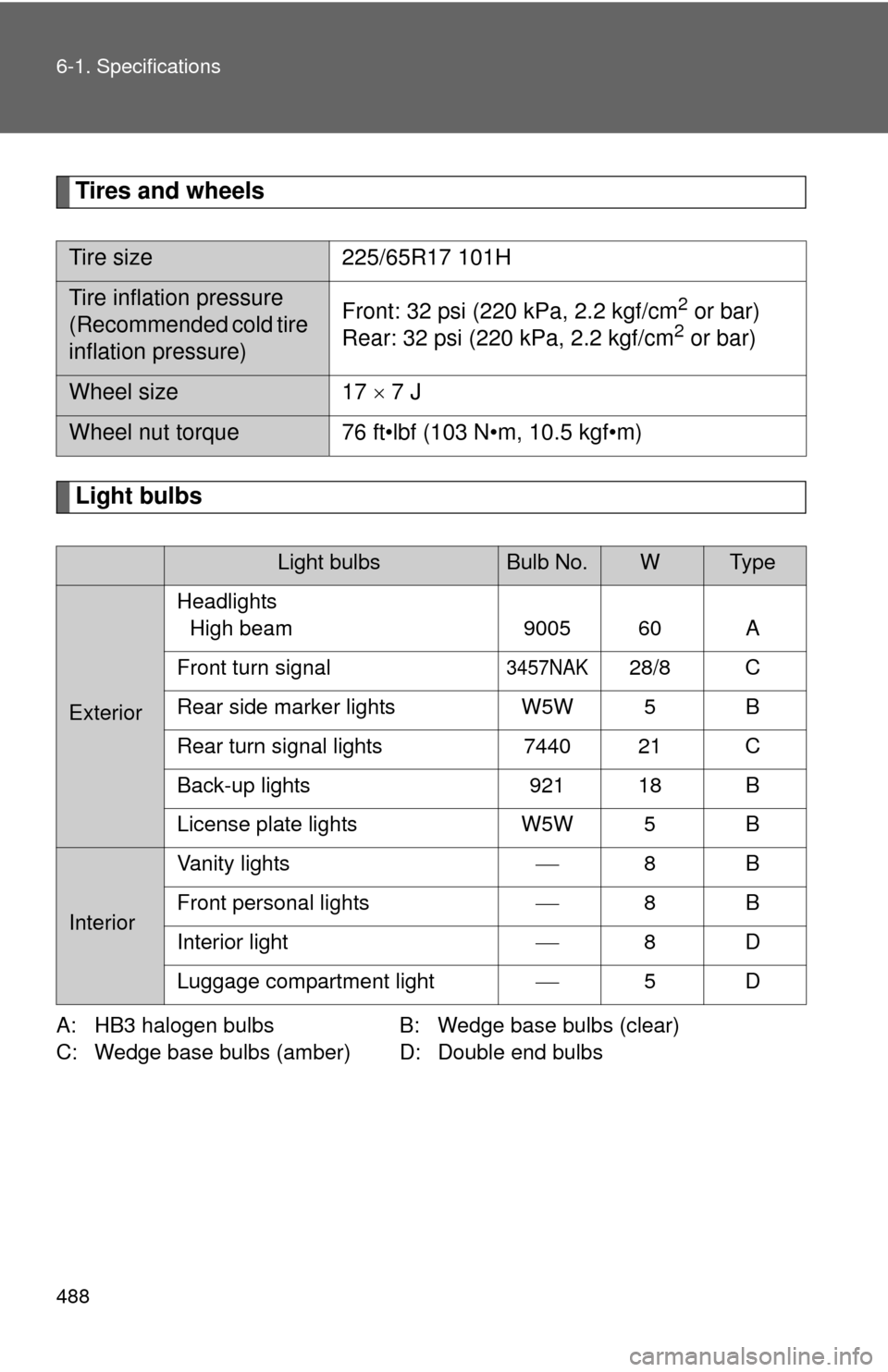
Tires and wheels
Light bulbs
A: HB3 halogen bulbsB: Wedge base bulbs (clear)
C: Wedge base bulbs (amber) D: Double end bulbs
Tire size 225/65R17 101H
Tire inflation pressure
(Recommended cold tire
inflation pressure)Front: 32 psi (220 kPa, 2.2 kgf/cm2 or bar)
Rear: 32 psi (220 kPa, 2.2 kgf/cm2 or bar)
Wheel size 17 7 J
Wheel nut torque 76 ft•lbf (103 N•m, 10.5 kgf•m)
Light bulbsBulb No.WTy p e
Exterior Headlights
High beam 9005 60 A
Front turn signal
3457NAK28/8 C
Rear side marker lights W5W 5 B
Rear turn signal lights 7440 21 C
Back-up lights 921 18 B
License plate lights W5W 5 B
Interior Vanity lights
8B
Front personal lights 8B
Interior light 8D
Luggage compartment light 5D
Page 490 of 521
489
6-1. Specifications
6
Vehicle specifications
Tire infor mation
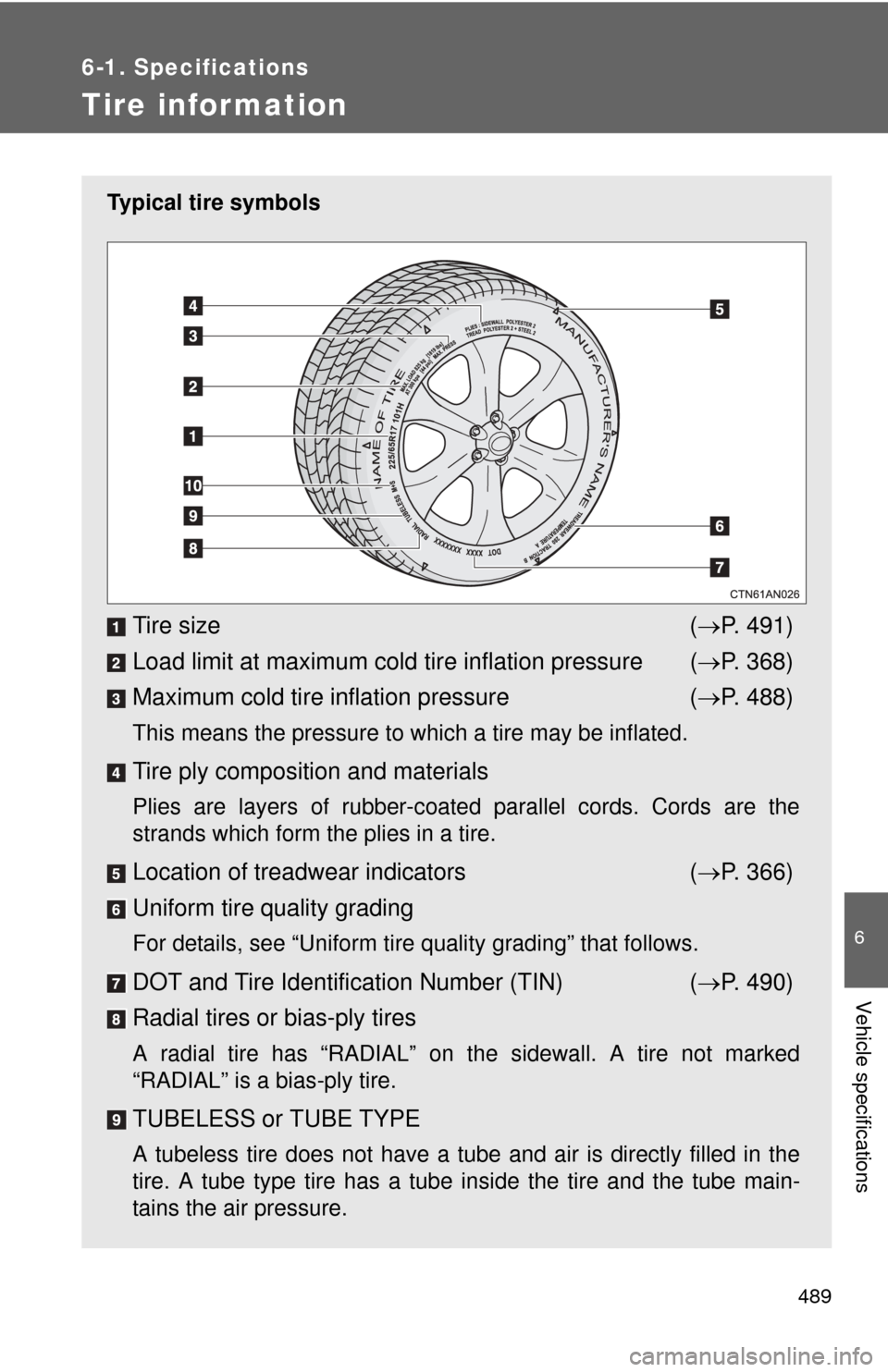
Typical tire symbols
Tire size( P. 491)
Load limit at maximum cold tire inflation pressure ( P. 368)
Maximum cold tire in flation pressure ( P. 488)
This means the pressure to which a tire may be inflated.
Tire ply composition and materials
Plies are layers of rubber-coated parallel cords. Cords are the
strands which form the plies in a tire.
Location of treadwear indicators ( P. 366)
Uniform tire quality grading
For details, see “Uniform tire quality grading” that follows.
DOT and Tire Identification Number (TIN) ( P. 490)
Radial tires or bias-ply tires
A radial tire has “RADIAL” on the sidewall. A tire not marked
“RADIAL” is a bias-ply tire.
TUBELESS or TUBE TYPE
A tubeless tire does not have a tube and air is directly filled in the
tire. A tube type tire has a tube inside the tire and the tube main-
tains the air pressure.
Page 491 of 521
490 6-1. Specifications
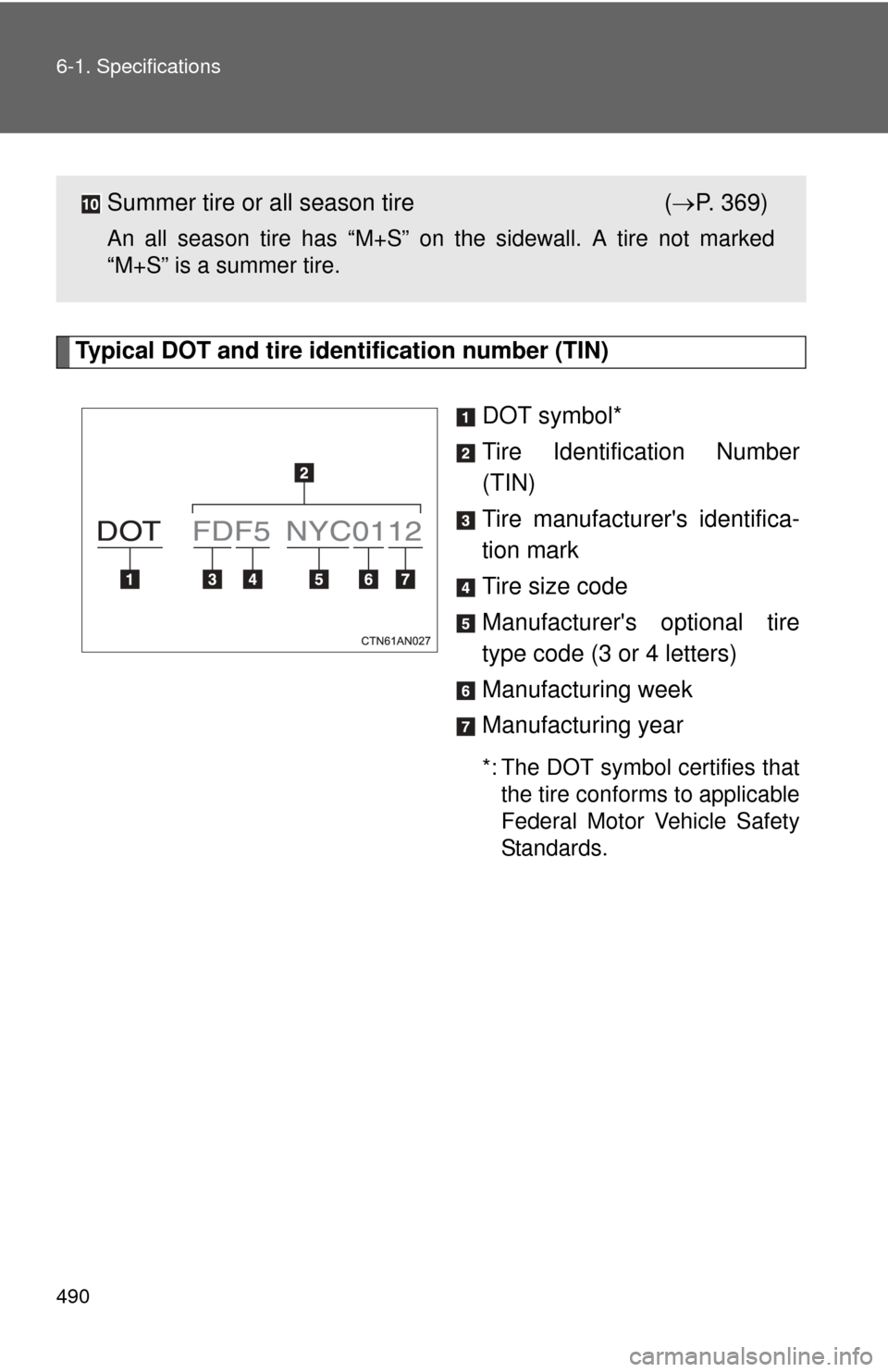
Typical DOT and tire identification number (TIN)DOT symbol*
Tire Identification Number
(TIN)
Tire manufacturer's identifica-
tion mark
Tire size code
Manufacturer's optional tire
type code (3 or 4 letters)
Manufacturing week
Manufacturing year
*: The DOT symbol certifies thatthe tire conforms to applicable
Federal Motor Vehicle Safety
Standards.
Summer tire or all season tire ( P. 369)
An all season tire has “M+S” on the sidewall. A tire not marked
“M+S” is a summer tire.
Page 492 of 521
491
6-1. Specifications
6
Vehicle specifications
Tire size
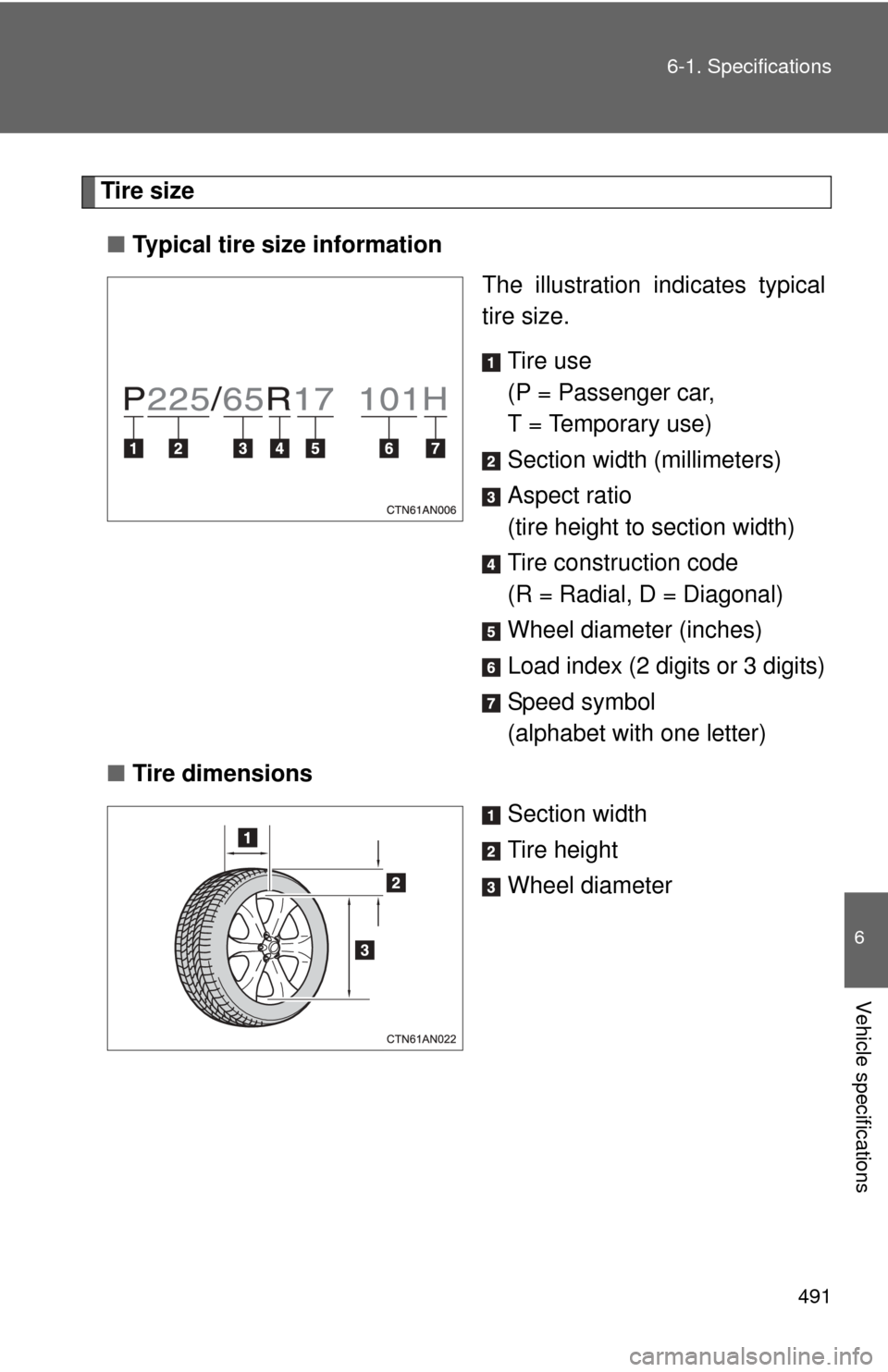
■ Typical tire size information
The illustration indicates typical
tire size.
Tire use
(P = Passenger car,
T = Temporary use)
Section width (millimeters)
Aspect ratio
(tire height to section width)
Tire construction code
(R = Radial, D = Diagonal)
Wheel diameter (inches)
Load index (2 digits or 3 digits)
Speed symbol
(alphabet with one letter)
■ Tire dimensions
Section width
Tire height
Wheel diameter
Page 496 of 521
495
6-1. Specifications
6
Vehicle specifications
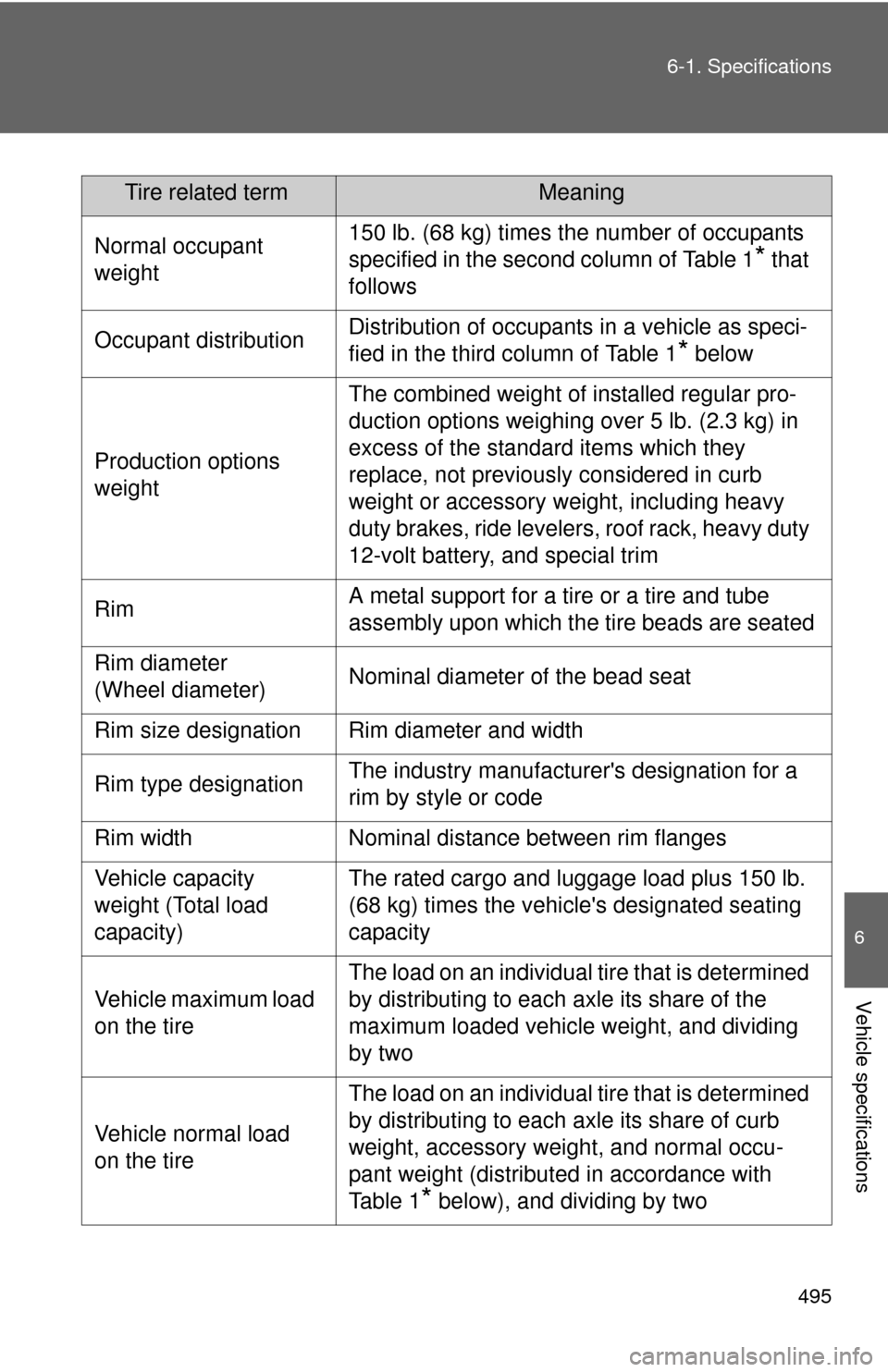
Tire related termMeaning
Normal occupant
weight 150 lb. (68 kg) times the number of occupants
specified in the second column of Table 1
* that
follows
Occupant distribution Distribution of occupants in a vehicle as speci-
fied in the third column of Table 1
* below
Production options
weight The combined weight of installed regular pro-
duction options weighing over 5 lb. (2.3 kg) in
excess of the standard items which they
replace, not previously considered in curb
weight or accessory weight, including heavy
duty brakes, ride levelers, roof rack, heavy duty
12-volt battery, and special trim
Rim A metal support for a tire or a tire and tube
assembly upon which the tire beads are seated
Rim diameter
(Wheel diameter) Nominal diameter of the bead seat
Rim size designation Rim diameter and width
Rim type designation The industry manufacturer's designation for a
rim by style or code
Rim width Nominal distance between rim flanges
Vehicle capacity
weight (Total load
capacity) The rated cargo and luggage load plus 150 lb.
(68 kg) times the vehicl
e's designated seating
capacity
Vehicle maximum load
on the tire The load on an individual tire that is determined
by distributing to each axle its share of the
maximum loaded vehicle weight, and dividing
by two
Vehicle normal load
on the tire The load on an individual tire that is determined
by distributing to each axle its share of curb
weight, accessory weight, and normal occu-
pant weight (distributed in accordance with
Ta b l e 1
* below), and dividing by two
Page 517 of 521
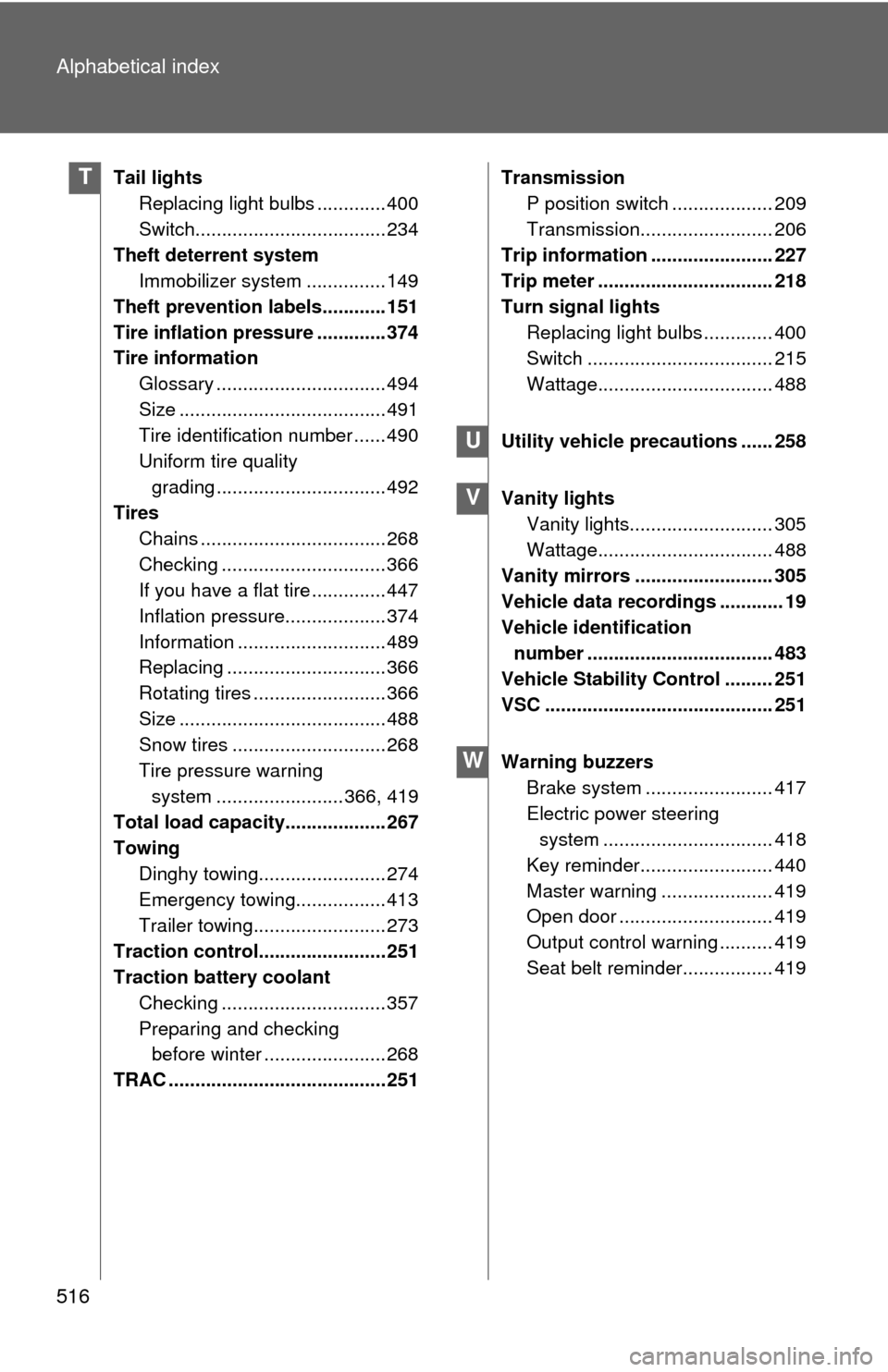
516 Alphabetical index
Tail lightsReplacing light bulbs ............. 400
Switch.................................... 234
Theft deterrent system Immobilizer system ............... 149
Theft prevention labels............ 151
Tire inflation pressure ............. 374
Tire information Glossary ................................ 494
Size ....................................... 491
Tire identification number ...... 490
Uniform tire quality grading ................................ 492
Tires
Chains ................................... 268
Checking ............................... 366
If you have a flat tire .............. 447
Inflation pressure................... 374
Information ............................ 489
Replacing .............................. 366
Rotating tires ......................... 366
Size ....................................... 488
Snow tires ............................. 268
Tire pressure warning system ........................ 366, 419
Total load capacity................... 267
Towing
Dinghy towing........................ 274
Emergency towing................. 413
Trailer towing......................... 273
Traction control........................ 251
Traction battery coolant Checking ............................... 357
Preparing and checking before winter ....................... 268
TRAC ......................................... 251 Transmission
P position switch ................... 209
Transmission......................... 206
Trip information ....................... 227
Trip meter ................................. 218
Turn signal lights Replacing light bulbs ............. 400
Switch ................................... 215
Wattage................................. 488
Utility vehicle precautions ...... 258
Vanity lights Vanity lights........................... 305
Wattage................................. 488
Vanity mirrors .......................... 305
Vehicle data recordings ............ 19
Vehicle identification number ................................... 483
Vehicle Stability Control ......... 251
VSC ........................................... 251
Warning buzzers Brake system ........................ 417
Electric power steering system ................................ 418
Key reminder......................... 440
Master warning ..................... 419
Open door ............................. 419
Output control warning .......... 419
Seat belt reminder................. 419T
U
V
W