flat tire TOYOTA RAV4 PHEV 2021 User Guide
[x] Cancel search | Manufacturer: TOYOTA, Model Year: 2021, Model line: RAV4 PHEV, Model: TOYOTA RAV4 PHEV 2021Pages: 666, PDF Size: 161.28 MB
Page 445 of 666
443
5
5-5. Using the driving support systems
Driving
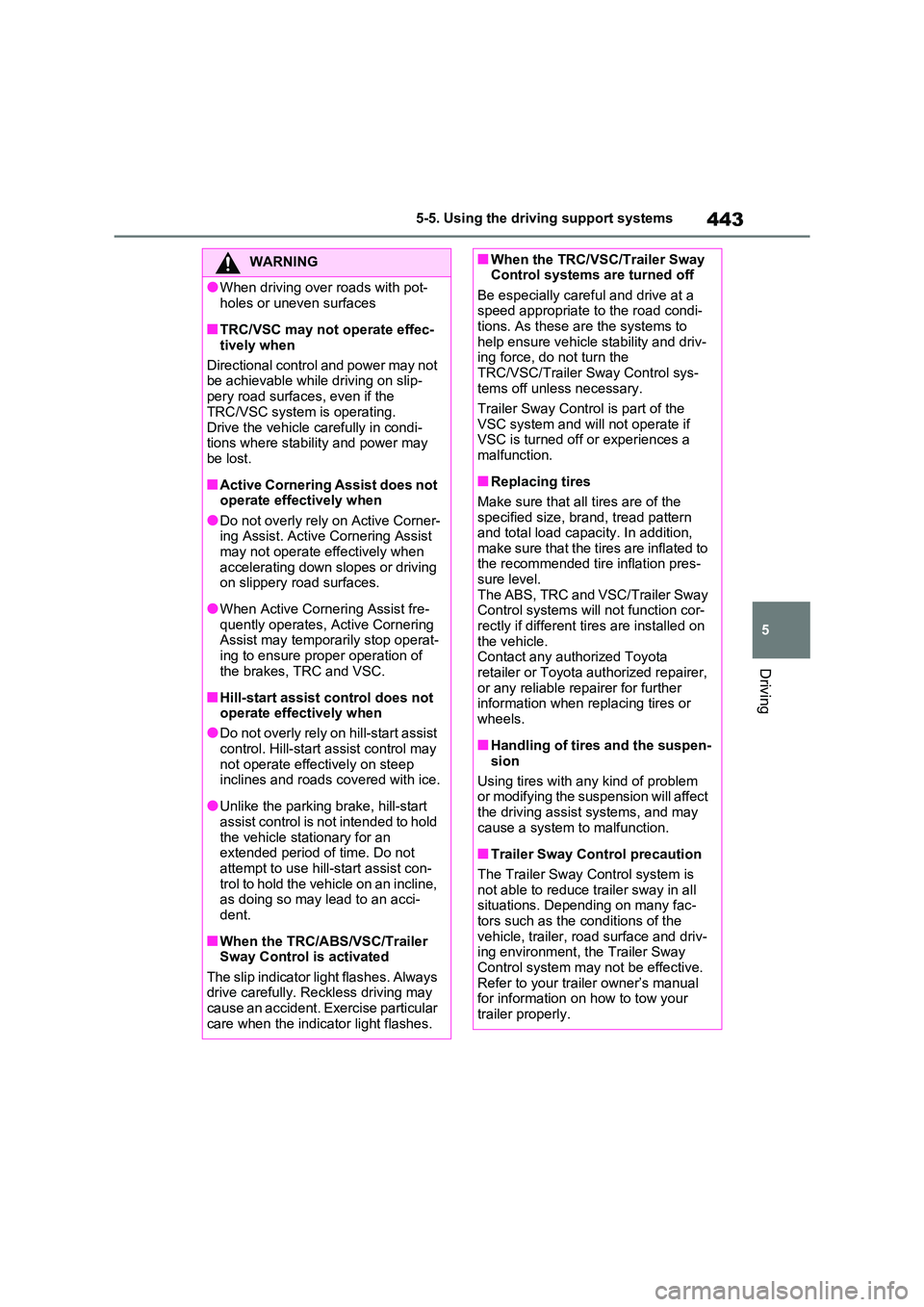
WARNING
●When driving over roads with pot -
holes or uneven surfaces
■TRC/VSC may not operate effec -
tively when
Directional control and power may not be achievable while driving on slip -
pery road surfaces , even if the
TRC/VSC system is operating.
Drive the vehicle carefully in condi - tions where stabilit y and power may
be lost.
■Active Cornering Assist does not
operate effectively when
●Do not overly rely on Active Corner - ing Assist. Active Cornering Assist
may not operate effectively when
accelerating down slopes or driving on slippery road surfaces.
●When Active Cornering Assist fre - quently operates, Active Cornering
Assist may temporarily stop operat -
ing to ensure prop er operation of the brakes, TRC and VSC.
■Hill-start assist control does not operate effectively when
●Do not overly rely on hill-start assist
control. Hill-start assist control may not operate effectively on steep
inclines and roads covered with ice.
●Unlike the parking brake, hill-start
assist control is not intended to hold
the vehicle stationary for an extended period of time. Do not
attempt to use hill-start assist con -
trol to hold the vehicle on an incline, as doing so may lead to an acci-
dent.
■When the TRC/ABS/VSC/Trailer
Sway Control is activated
The slip indicator light flashes. Always drive carefully. Reckless driving may
cause an accident. Exercise particular
care when the indicat or light flashes.
■When the TRC/VSC/Trailer Sway Control systems are turned off
Be especially careful and drive at a
speed appropriate t o the road condi- tions. As these ar e the systems to
help ensure vehicl e stability and driv-
ing force, do not turn the TRC/VSC/Trailer Sway Control sys -
tems off unle ss necessary.
Trailer Sway Control is part of the VSC system and will not operate if
VSC is turned off or experiences a
malfunction.
■Replacing tires
Make sure that all tires are of the specified size, brand, tread pattern
and total load capac ity. In addition,
make sure that the tires are inflated to the recommended tire inflation pres -
sure level.
The ABS, TRC and VSC/Trailer Sway Control systems will not function cor -
rectly if different ti res are installed on
the vehicle. Contact any authorized Toyota
retailer or Toyota a uthorized repairer,
or any reliable repairer for further information when replacing tires or
wheels.
■Handling of tires and the suspen -
sion
Using tires with any kind of problem or modifying the suspension will affect
the driving assist systems, and may
cause a system to malfunction.
■Trailer Sway Control precaution
The Trailer Sway C ontrol system is not able to reduce tr ailer sway in all
situations. Depending on many fac -
tors such as the conditions of the
vehicle, trailer, road surface and driv - ing environment, the Trailer Sway
Control system may not be effective.
Refer to your traile r owner’s manual for information on how to tow your
trailer properly.
Page 489 of 666
7
487
7
Maintenance and care
Maintenance and care
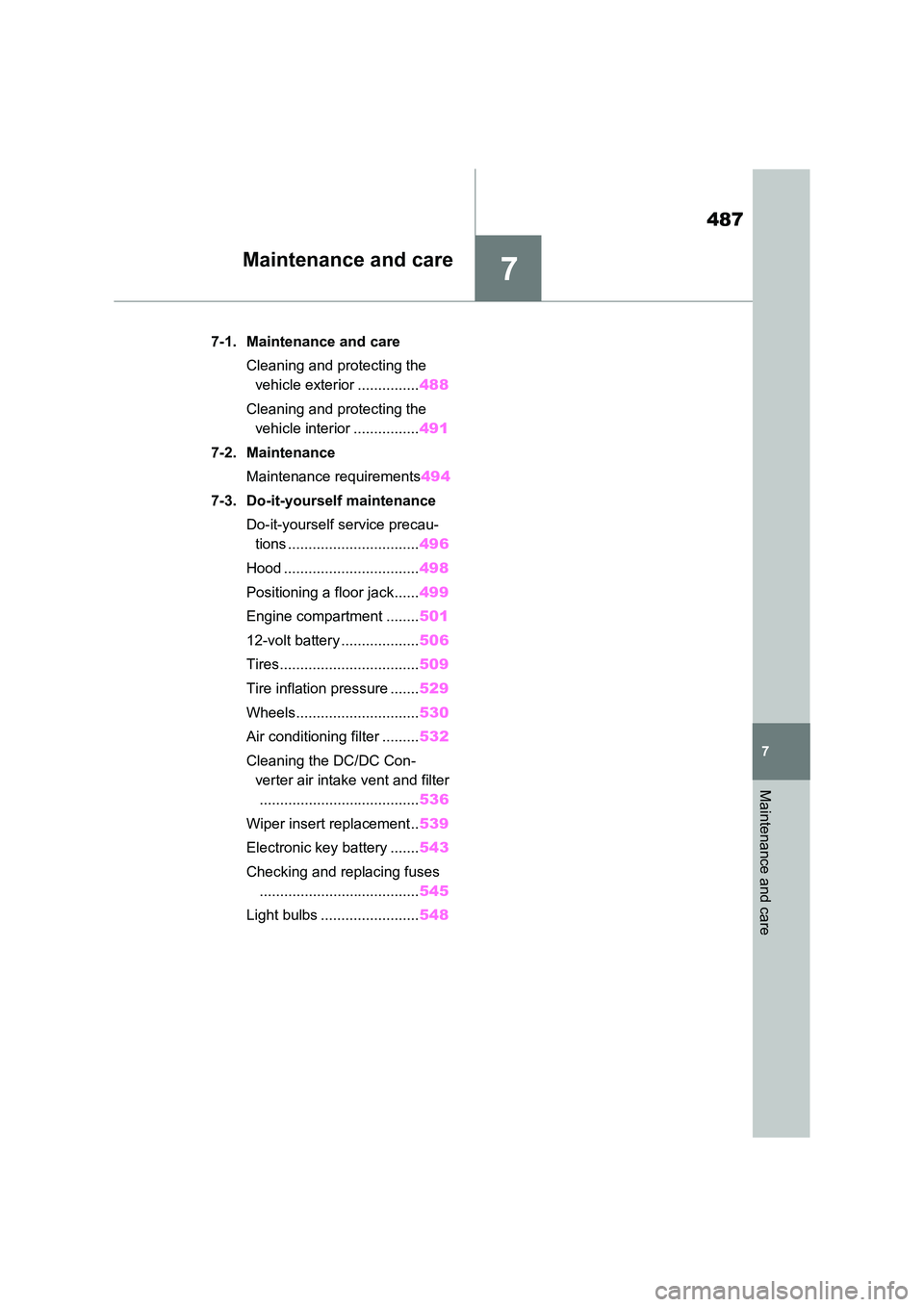
7-1. Maintenance and care
Cleaning and protecting the
vehicle exterior ............... 488
Cleaning and protecting the
vehicle interior ................ 491
7-2. Maintenance
Maintenance requirements 494
7-3. Do-it-yourself maintenance
Do-it-yourself service precau -
tions ................................ 496
Hood ................................. 498
Positioning a floor jack ...... 499
Engine compartment ........ 501
12-volt battery ................... 506
Tires.................................. 509
Tire inflation pressure ....... 529
Wheels.............................. 530
Air conditioning filter ......... 532
Cleaning the DC/DC Con -
verter air intake vent and filter
....................................... 536
Wiper insert replacement .. 539
Electronic key battery ....... 543
Checking and replacing fuses
....................................... 545
Light bulbs ........................ 548
Page 497 of 666
495
7
7-2. Maintenance
Maintenance and care
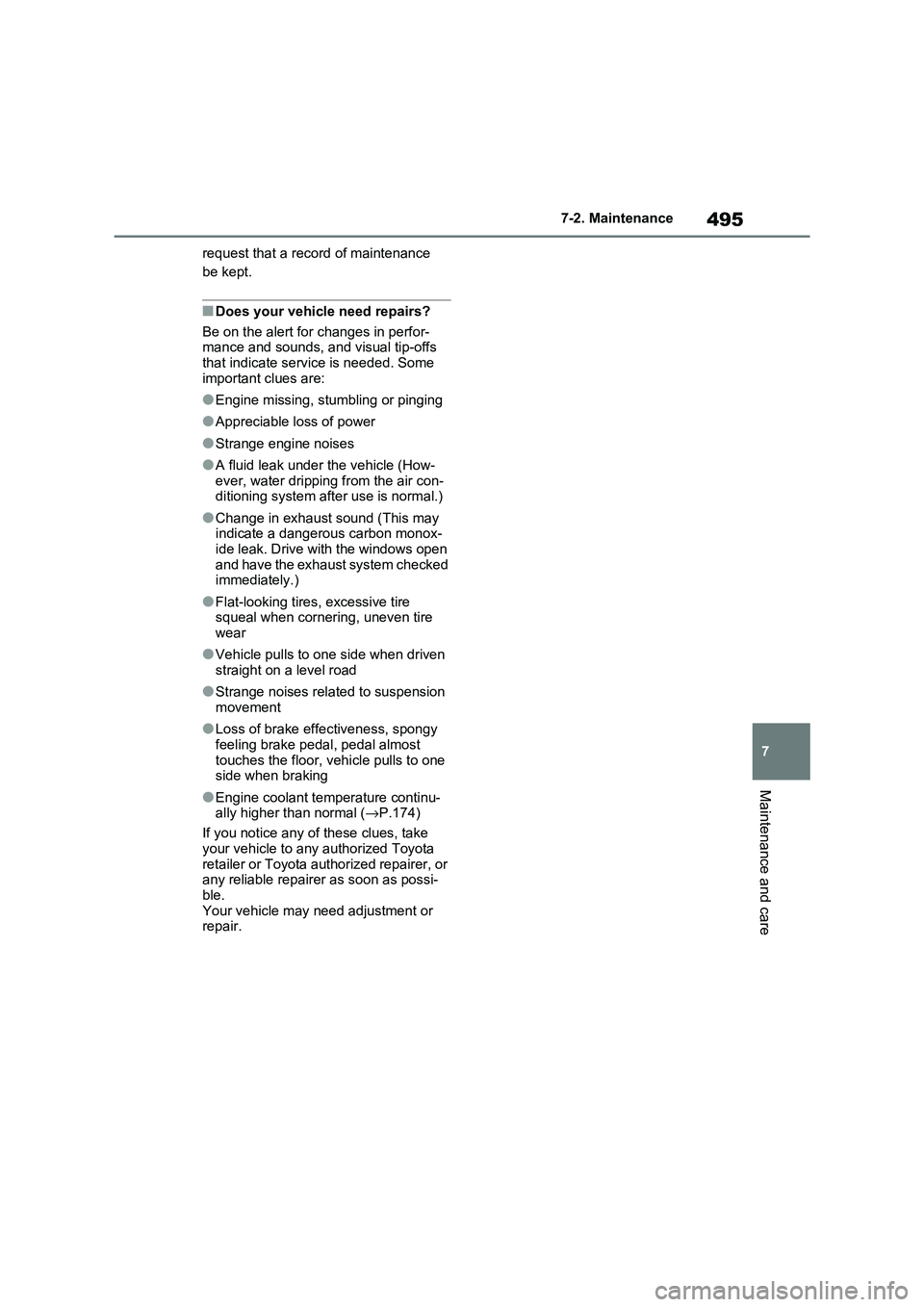
request that a record of maintenance
be kept.
■Does your vehicle need repairs?
Be on the alert for changes in perfor - mance and sounds, a nd visual tip-offs
that indicate service is needed. Some
important clues are:
●Engine missing, stumbling or pinging
●Appreciable loss of power
●Strange engine noises
●A fluid leak under the vehicle (How-
ever, water dripping from the air con - ditioning system after use is normal.)
●Change in exhaust sound (This may indicate a dangerous carbon monox -
ide leak. Drive with the windows open
and have the exhau st system checked immediately.)
●Flat-looking tires, excessive tire squeal when cornering, uneven tire
wear
●Vehicle pulls to one side when driven
straight on a level road
●Strange noises related to suspension
movement
●Loss of brake effectiveness, spongy
feeling brake pedal, pedal almost
touches the floor, vehicle pulls to one
side when braking
●Engine coolant temperature continu -
ally higher than normal ( →P.174)
If you notice any of these clues, take
your vehicle to any authorized Toyota
retailer or Toyota authorized repairer, or any reliable repair er as soon as possi-
ble.
Your vehicle may need adjustment or repair.
Page 498 of 666
4967-3. Do-it-yourself maintenance
7-3.Do-it-yourself maintenance
Do-it-yourself service
precautions
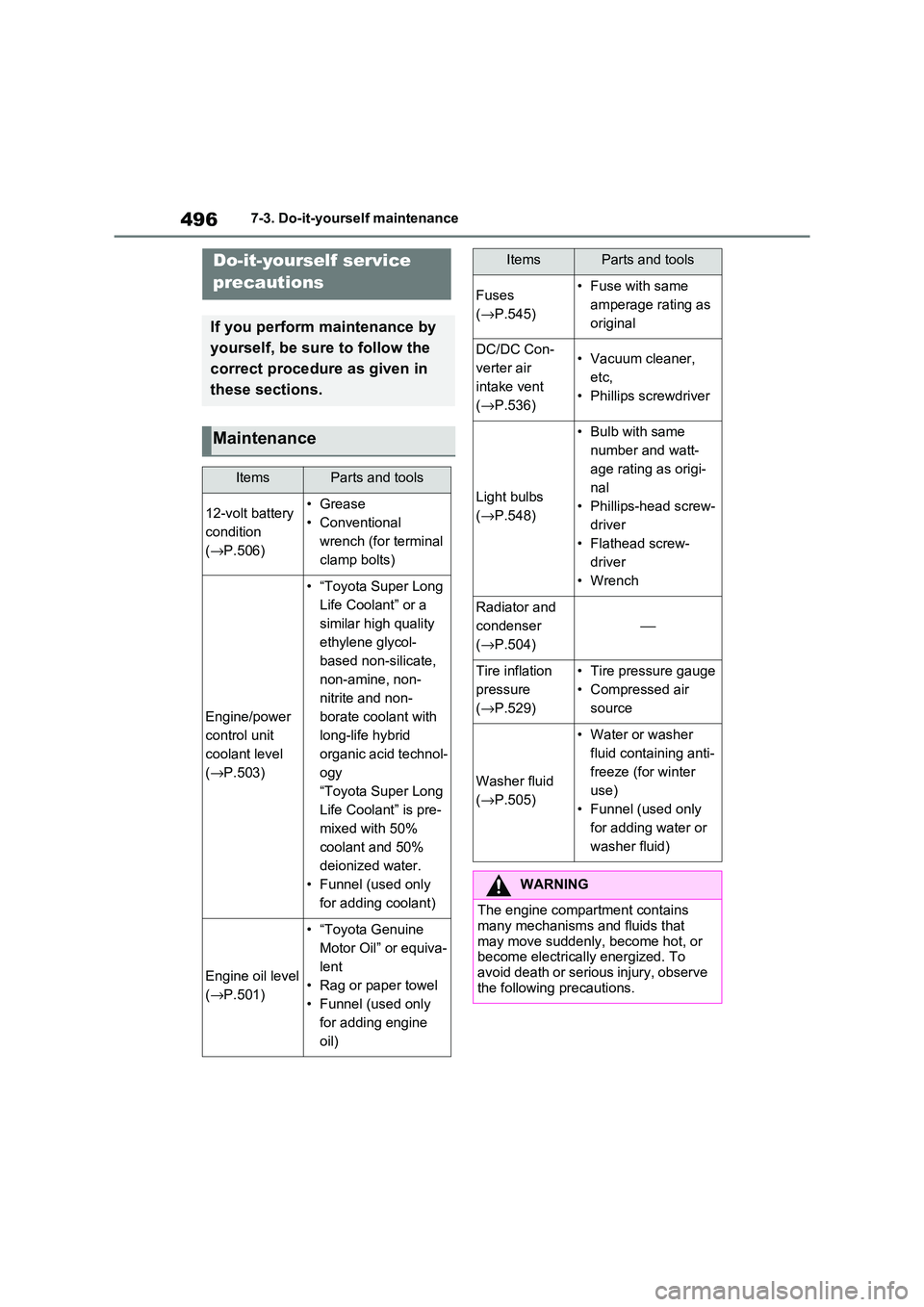
If you perform maintenance by
yourself, be sure to follow the
correct procedure as given in
these sections.
Maintenance
ItemsParts and tools
12-volt battery
condition
( →P.506)
•Grease
• Conventional
wrench (for terminal
clamp bolts)
Engine/power
control unit
coolant level
( →P.503)
• “Toyota Super Long
Life Coolant” or a
similar high quality
ethylene glycol-
based non-silicate,
non-amine, non-
nitrite and non-
borate coolant with
long-life hybrid
organic acid technol -
ogy
“Toyota Super Long
Life Coolant” is pre -
mixed with 50%
coolant and 50%
deionized water.
• Funnel (used only
for adding coolant)
Engine oil level
( →P.501)
• “Toyota Genuine
Motor Oil” or equiva -
lent
• Rag or paper towel
• Funnel (used only
for adding engine
oil)
Fuses
( →P.545)
• Fuse with same
amperage rating as
original
DC/DC Con -
verter air
intake vent
( →P.536)
• Vacuum cleaner,
etc,
• Phillips screwdriver
Light bulbs
( →P.548)
• Bulb with same
number and watt -
age rating as origi -
nal
• Phillips-head screw -
driver
• Flathead screw -
driver
• Wrench
Radiator and
condenser
( →P.504)
⎯
Tire inflation
pressure
( →P.529)
• Tire pressure gauge
• Compressed air
source
Washer fluid
( →P.505)
• Water or washer
fluid containing anti -
freeze (for winter
use)
• Funnel (used only
for adding water or
washer fluid)
WARNING
The engine compartment contains
many mechanisms and fluids that may move suddenly, become hot, or
become electrically energized. To
avoid death or serious injury, observe the following precautions.
ItemsParts and tools
Page 512 of 666
5107-3. Do-it-yourself maintenance
molded into the sidewall of each tire.
Replace the tires if the treadwear indi -
cators are showing on a tire.
■When to replace your vehicle’s
tires
Tires should be replaced if:
●The treadwear indicators are showing on a tire.
●You have tire damage such as cuts, splits, cracks deep enough to expose
the fabric, and bulges indicating inter -
nal damage.
●A tire goes flat repeatedly or cannot
be properly repaired due to the size or location of a cut or other damage.
If you are not sure, consult with any
authorized Toyota retailer or Toyota authorized repairer, or any reliable
repairer.
■Tire life
Any tire over 6 y ears old must be checked by a qualified technician even if
it has seldom or never been used or
damage is not obvious.
■If the tread on snow tires wears down below 4 mm (0.16 in.)
The effectiveness of t he tires as snow
tires is lost.
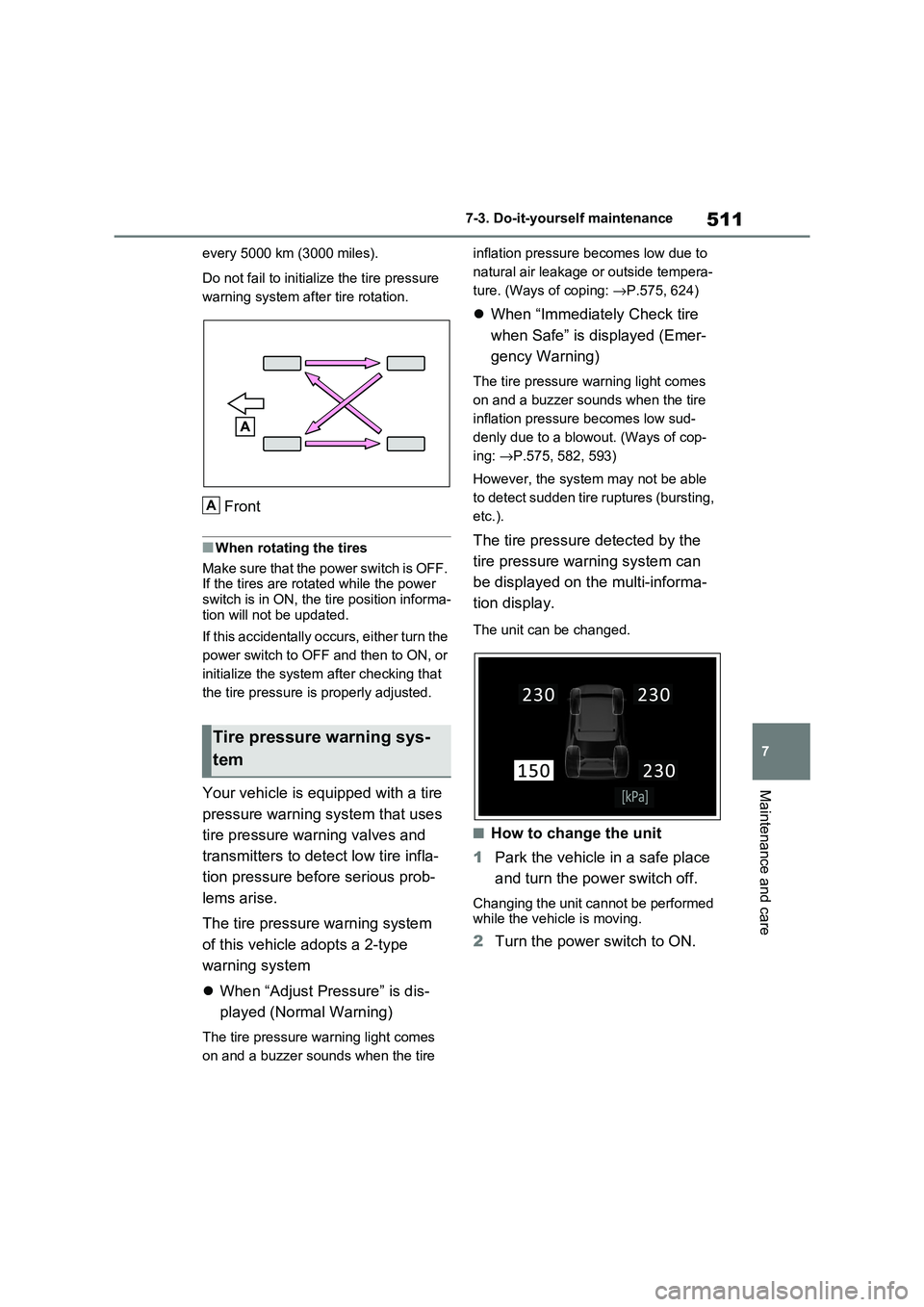
Rotate the tires in the order shown.
To equalize tire wear and help extend
tire life, Toyota re commends that tire
rotation is carried out approximately
WARNING
■When inspecting or replacing tires
Observe the following precautions to
prevent accidents. Failure to do so may cause damage
to parts of the driv e train as well as
dangerous handling c haracteristics, which may lead to an accident result -
ing in death or serious injury.
●Do not mix tires of different makes, models or tread patterns.
Also, do not mix tires of remarkably
different treadwear.
●Do not use tire sizes other than those recommended by Toyota.
●Do not mix differently constructed tires (radial, bias-belted or bias-ply
tires).
●Do not mix summer, all season and
snow tires.
●Do not use tires that have been
used on another vehicle.
Do not use tires if you do not know how they were used previously.
●Vehicles with compact spare tire: Do not tow if your vehicle has a
compact spare tire installed.
●Vehicles with emergency tire punc -
ture repair kit: Do not tow anything
if a tire that has been repaired using the emergency tire puncture repair
kit is installed. The load on the tire
may cause unexpec ted damage to the tire.
NOTICE
■Driving on rough roads
Take particular care when driving on
roads with loose sur faces or potholes. These conditions may cause losses in
tire inflation pressure, reducing the
cushioning ability of the tires. In addi - tion, driving on rough roads may
cause damage to the tires them -
selves, as well as the vehicle’s wheels and body.
■If tire inflation pressure of each tire becomes low while driving
Do not continue drivi ng, or your tires
and/or wheels may be ruined.
Tire rotation
Page 513 of 666
511
7
7-3. Do-it-yours elf maintenance
Maintenance and care
every 5000 km (3000 miles).
Do not fail to initial ize the tire pressure
warning system after tire rotation.
Front
■When rotating the tires
Make sure that the power switch is OFF. If the tires are rotated while the power
switch is in ON, the tire position informa -
tion will not be updated.
If this accidentally occurs, either turn the
power switch to OFF and then to ON, or
initialize the system after checking that
the tire pressure is properly adjusted.
Your vehicle is equi pped with a tire
pressure warning system that uses
tire pressure warning valves and
transmitters to detect low tire infla -
tion pressure before serious prob -
lems arise.
The tire pressure warning system
of this vehicle adopts a 2-type
warning system
When “Adjust Pressure” is dis-
played (Normal Warning)
The tire pressure warning light comes
on and a buzzer sounds when the tire
inflation pressure becomes low due to
natural air leakage or outside tempera-
ture. (Ways of coping: →P.575, 624)
When “Immediately Check tire
when Safe” is displayed (Emer -
gency Warning)
The tire pressure warning light comes
on and a buzzer sounds when the tire
inflation pressure becomes low sud -
denly due to a blowout. (Ways of cop -
ing: →P.575, 582, 593)
However, the system may not be able
to detect sudden tire ruptures (bursting,
etc.).
The tire pressure detected by the
tire pressure warning system can
be displayed on the multi-informa -
tion display.
The unit can be changed.
■How to change the unit
1 Park the vehicle in a safe place
and turn the power switch off.
Changing the unit cannot be performed while the vehicle is moving.
2 Turn the power switch to ON.
Tire pressure warning sys-
tem
A
Page 514 of 666
5127-3. Do-it-yourself maintenance
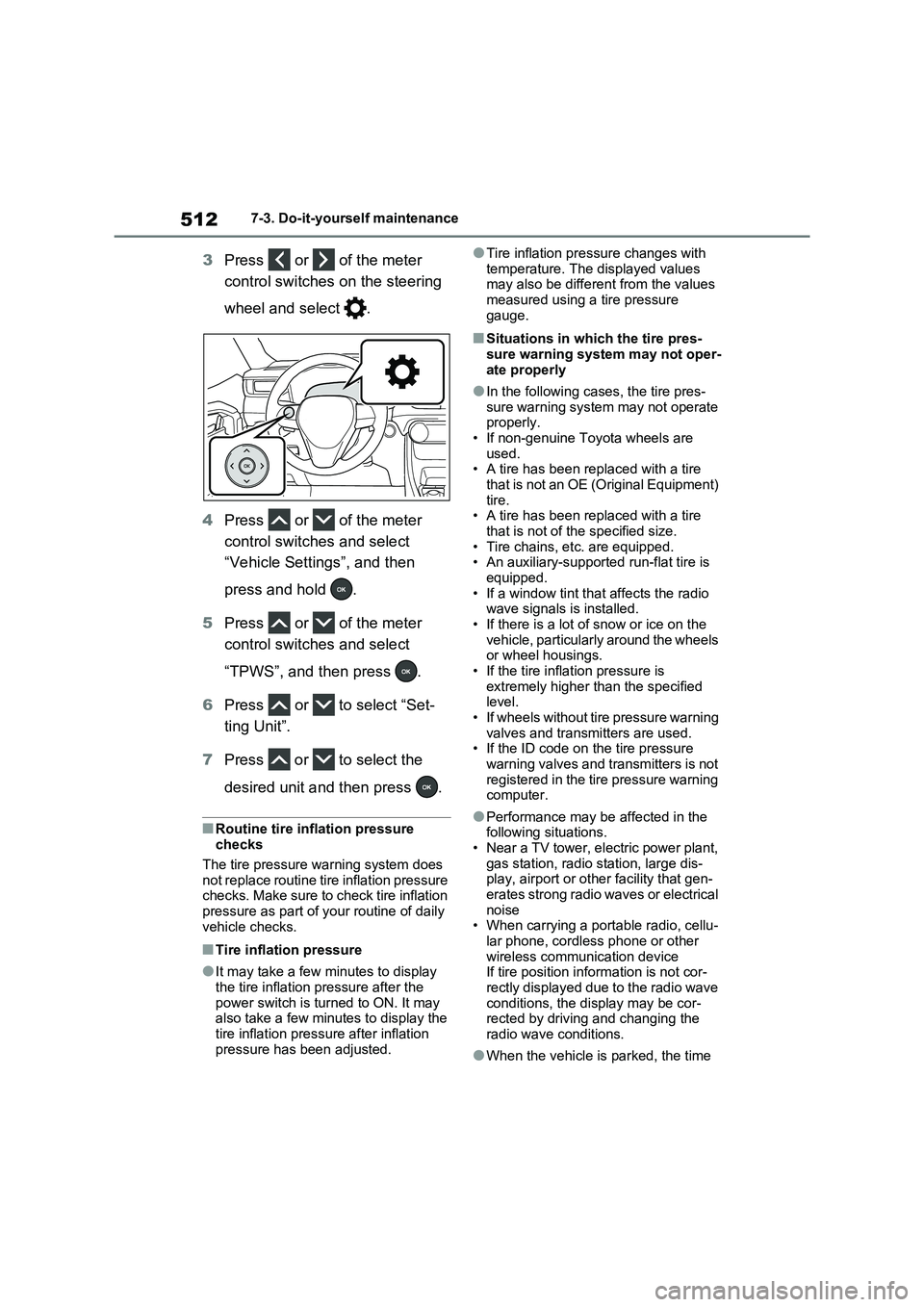
3Press or of the meter
control switches on the steering
wheel and select .
4 Press or of the meter
control switches and select
“Vehicle Settings”, and then
press and hold .
5 Press or of the meter
control switches and select
“TPWS”, and then press .
6 Press or to select “Set-
ting Unit”.
7 Press or to select the
desired unit and then press .
■Routine tire inflation pressure checks
The tire pressure w arning system does
not replace routine tire inflation pressure checks. Make sure to check tire inflation
pressure as part of your routine of daily
vehicle checks.
■Tire inflation pressure
●It may take a few minutes to display
the tire inflation pressure after the
power switch is turned to ON. It may also take a few minutes to display the
tire inflation pressu re after inflation
pressure has been adjusted.
●Tire inflation pre ssure changes with
temperature. The displayed values may also be different from the values
measured using a tire pressure
gauge.
■Situations in which the tire pres - sure warning system may not oper -
ate properly
●In the following cases, the tire pres -
sure warning system may not operate
properly. • If non-genuine Toyota wheels are
used.
• A tire has been r eplaced with a tire that is not an OE (Original Equipment)
tire.
• A tire has been r eplaced with a tire that is not of the specified size.
• Tire chains, etc. are equipped.
• An auxiliary-supporte d run-flat tire is equipped.
• If a window tint tha t affects the radio
wave signals is installed. • If there is a lot of snow or ice on the
vehicle, particularly around the wheels
or wheel housings. • If the tire inflation pressure is
extremely higher t han the specified
level. • If wheels without tire pressure warning
valves and transmitters are used.
• If the ID code on the tire pressure warning valves and transmitters is not
registered in the tire pressure warning
computer.
●Performance may be affected in the
following situations. • Near a TV tower, electric power plant,
gas station, radio station, large dis -
play, airport or ot her facility that gen- erates strong radio waves or electrical
noise
• When carrying a port able radio, cellu-
lar phone, cordless phone or other wireless communication device
If tire position information is not cor -
rectly displayed due to the radio wave conditions, the display may be cor -
rected by driving and changing the
radio wave conditions.
●When the vehicle is parked, the time
Page 515 of 666
513
7
7-3. Do-it-yours elf maintenance
Maintenance and care
taken for the warning to start or go off
could be extended.
●When tire inflation pressure declines
rapidly for example when a tire has burst, the warning may not function.
■Warning performance of the tire
pressure warning system
The warning of the tire pressure warning
system will change i n accordance with
the conditions under which it was initial - ized. For this reaso n, the system may
give a warning even if the tire pressure
does not reach a low enough level, or if the pressure is higher than the pressure
that was adjusted to when the system
was initialized.
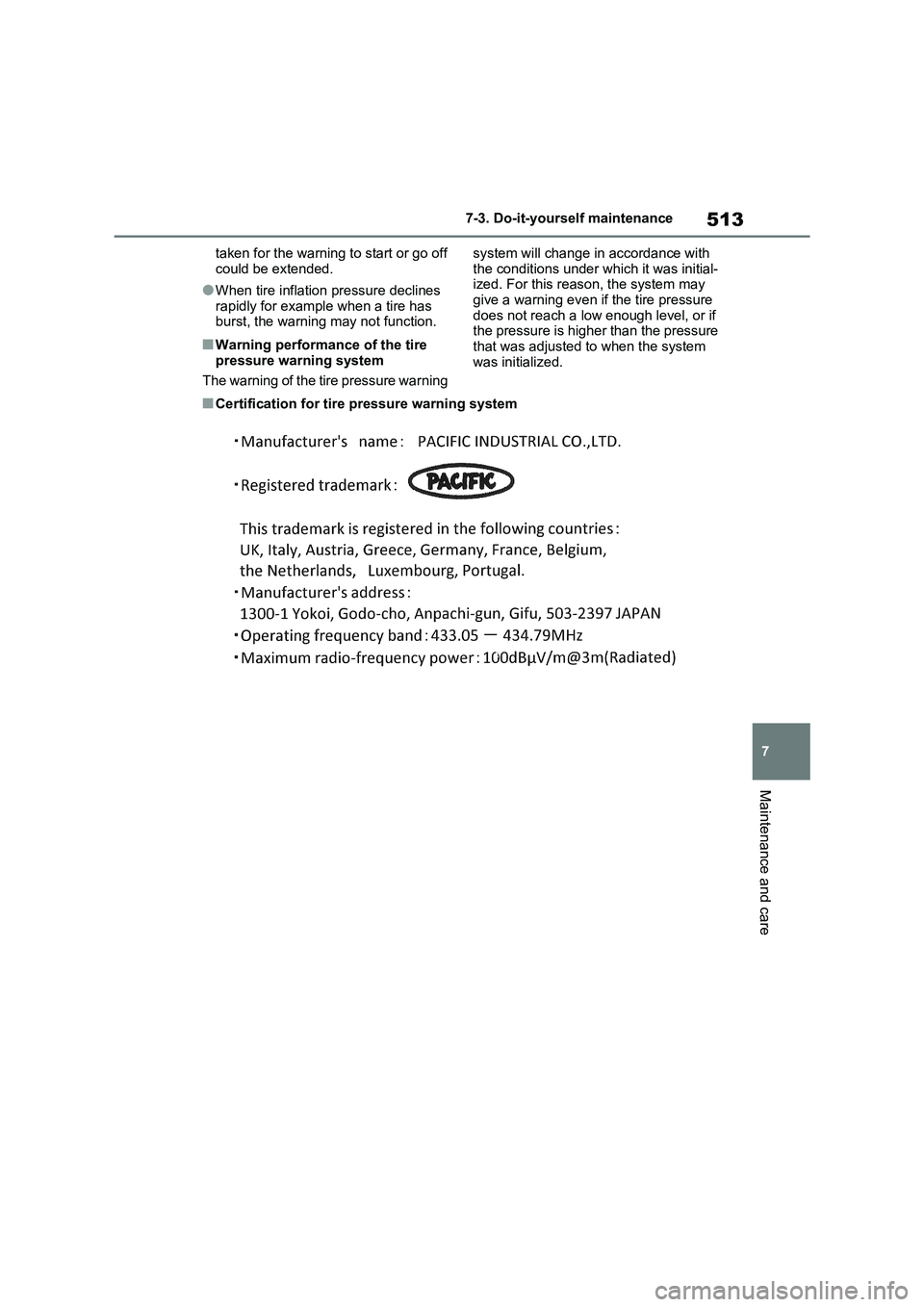
■Certification for tire pressure warning system
Page 525 of 666
523
7
7-3. Do-it-yours elf maintenance
Maintenance and care
(→P.525)
■When replacing the tires and
wheels
If the ID code of the tire pressure warn -
ing valve and transm itter is not regis-
tered, the tire pre ssure warning system will not work properly. After driving for
about 10 minutes, the tire pressure
warning light blinks for 1 minute and stays on to indicate a system malfunc-
tion.
■The tire pressure warning sys -
tem must be initialized in the
following circumstances:
When rotating the tires.
When changing the tire.
After registering the ID codes.
( →P.525)
When changing between two
registered wheel sets.
When the tire pressure warning
system is initialized, the current tire
inflation pressu re is set as the
benchmark pressure.
■How to initialize the tire pres -
sure warning system
1 Park the vehicle in a safe place
and stop the hybrid system for
20 minutes or more.
Initialization cannot be performed while the vehicle is moving.
NOTICE
■Repairing or replacing tires,
wheels, tire pressure warning valves, transmitters and tire
valve caps
●When removing or fitting the wheels, tires or the tire pressure
warning valves and transmitters,
contact any auth orized Toyota retailer or Toyota authorized
repairer, or any reliable repairer as
the tire pressure warning valves and transmitters may be damaged
if not handled correctly.
●Make sure to install the tire valve
caps. If the tire v alve caps are not
installed, water could enter the tire pressure warning valves and the
tire pressure warning valves could
be bound.
●When replacing tire valve caps, do
not use tire valve caps other than those specified.
The cap may become stuck.
■To avoid damage to the tire pres- sure warning valves and trans -
mitters (vehicles without spare
tire)
When a tire is repa ired with liquid
sealants, the tire pressure warning
valve and transmitter may not operate properly. If a liquid sealant is used,
contact any authorized Toyota retailer
or Toyota authoriz ed repairer, or any reliable repairer or other qualified ser -
vice shop as soon as possible. Make
sure to replace the tire pressure warn - ing valve and transm itter when repair-
ing or replacing the tire. ( →P.511,
531)
Initializing the tire pressure
warning system
Page 526 of 666
5247-3. Do-it-yourself maintenance
2Adjust the tire inflation pressure
to the specified cold tire inflation
pressure level. ( →P.624)
Make sure to adjust the tire pressure to
the specified cold tire inflation pressure level. The tire pressure warning system
will operate based o n this pressure
level.
3 Start the hybrid system.
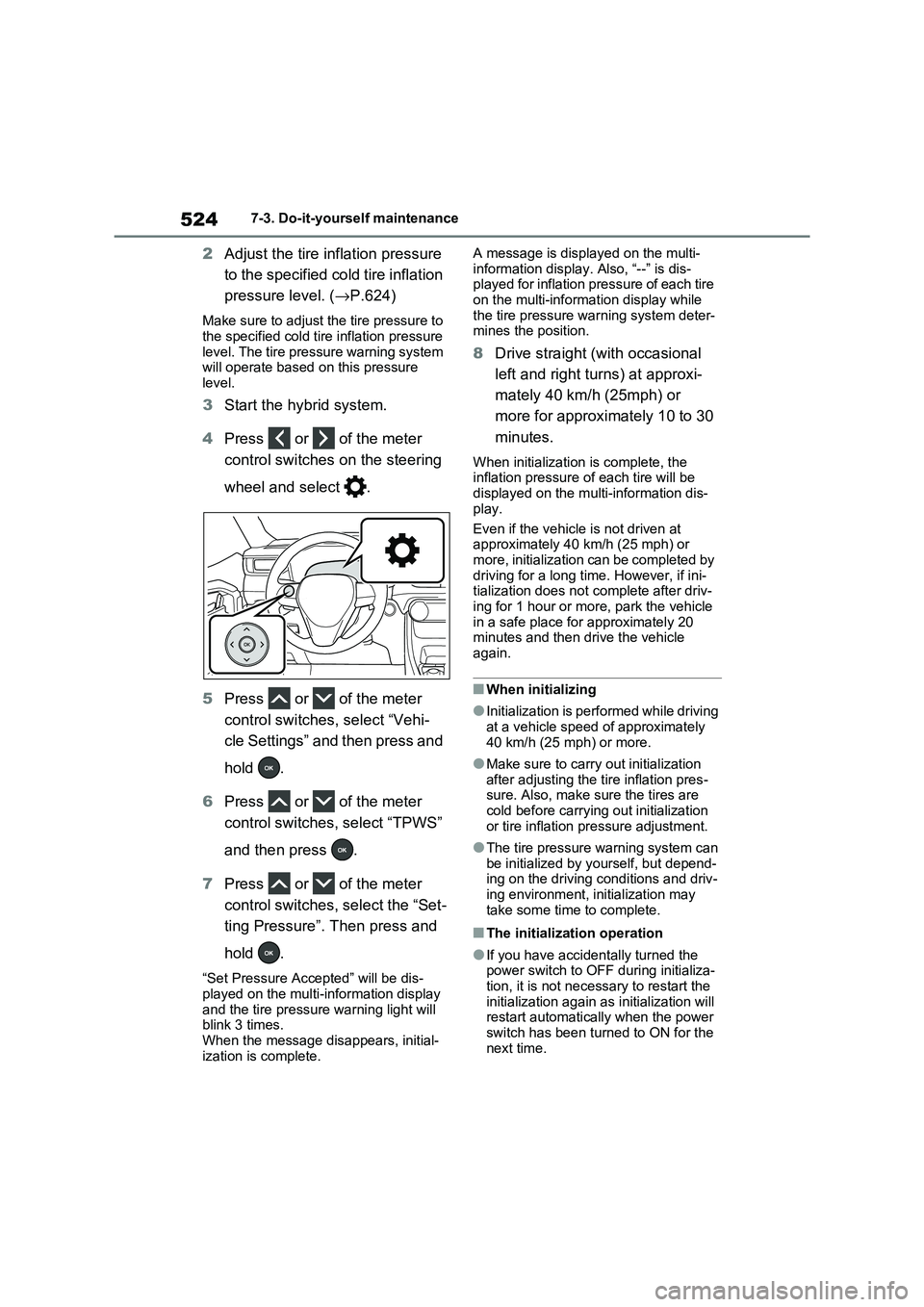
4 Press or of the meter
control switches on the steering
wheel and select .
5 Press or of the meter
control switches, select “Vehi -
cle Settings” and then press and
hold .
6 Press or of the meter
control switches, select “TPWS”
and then press .
7 Press or of the meter
control switches, select the “Set -
ting Pressure”. Then press and
hold .
“Set Pressure Accepted” will be dis -
played on the multi-information display
and the tire pressure warning light will blink 3 times.
When the message disappears, initial -
ization is complete.
A message is displayed on the multi-
information display. Also, “--” is dis - played for inflation pressure of each tire
on the multi-informat ion display while
the tire pressure w arning system deter- mines the position.
8 Drive straight (with occasional
left and right turns) at approxi -
mately 40 km/h (25mph) or
more for approximately 10 to 30
minutes.
When initialization is complete, the inflation pressure of each tire will be
displayed on the multi-information dis -
play.
Even if the vehicle is not driven at
approximately 40 k m/h (25 mph) or
more, initialization can be completed by driving for a long time. However, if ini -
tialization does not complete after driv-
ing for 1 hour or mor e, park the vehicle in a safe place for approximately 20
minutes and then drive the vehicle
again.
■When initializing
●Initialization is performed while driving at a vehicle speed of approximately
40 km/h (25 mph) or more.
●Make sure to carry out initialization
after adjusting the tire inflation pres -
sure. Also, make s ure the tires are
cold before carrying out initialization or tire inflation pressure adjustment.
●The tire pressure warning system can be initialized by yourself, but depend -
ing on the driving conditions and driv -
ing environment, initialization may take some time to complete.
■The initialization operation
●If you have accident ally turned the power switch to OFF during initializa -
tion, it is not necessary to restart the
initialization again as initialization will restart automatically when the power
switch has been tu rned to ON for the
next time.