pressure TOYOTA RAV4 PHEV 2021 User Guide
[x] Cancel search | Manufacturer: TOYOTA, Model Year: 2021, Model line: RAV4 PHEV, Model: TOYOTA RAV4 PHEV 2021Pages: 666, PDF Size: 161.28 MB
Page 310 of 666
3085-1. Before driving
■Tire information
●Increase the tire inflation pressure to
20.0 kPa (0.2 kgf/cm2 or bar, 3 psi) greater than the recommended value
when towing. ( →P.624)
●Increase the air pressure of the trailer
tires in accordance with the total
trailer weight and according to the val - ues recommended by the manufac -
turer of your trailer.
■Safety checks before towing
●Check that the maximum load limit for
the towing hitch/bracket and hitch ball
is not exceeded. Bear in mind that the coupling weight of the trailer will add
to the load exerted on the vehicle.
Also make sure tha t the total load exerted on the vehi cle is within the
range of the weight limits. ( →P.309)
●Ensure that the trailer load is secure.
●Supplementary outside rear view mir- rors should be added to the vehicle if
the traffic behind c annot be clearly
seen with standard mirrors. Adjust the extending arms of these mirrors on
both sides of the vehicle so that they
always provide maxi mum visibility of the road behind.
Trailer towing
Your vehicle is designed pri -
marily as a passenger carry -
ing vehicle. Towing a trailer
will have an adverse effect on
handling, performance, brak -
ing, durability, and fuel con -
sumption. Your safety and
satisfaction depend on the
proper use of correct equip -
ment and cautious driving hab -
its. For your safety and the
safety of others, do not over -
load the vehicle or trailer.
To tow a trailer safely, use
extreme care and drive the
vehicle in accordance with the
trailer’s characteristics and
operating conditions.
Toyota warranties do not apply
to damage or malfunction
caused by towing a trailer for
commercial purposes.
Ask your local authorized
Toyota retailer or Toyota
authorized repairer, or any reli -
able repairer for further details
before towing, as there are
additional legal requirements
in some countries.
WARNING
Follow all the instructions described in
this section.
Failure to do so could cause an acci - dent resulting in death or serious
injury.
■Trailer towing precautions
When towing, make sure that none of
the weight limits are exceeded.
( →P.309)
■To avoid accident or injury
●Vehicles with compact spare tire: Do not tow a trailer when the com -
pact spare tire is installed on your
vehicle.
●Vehicles with emergency tire punc -
ture repair kit: Do not tow a traile r when the tire
installed is repa ired with the emer-
gency tire puncture repair kit.
Page 312 of 666
3105-1. Before driving
Weight of the trailer itself plus the trailer
load should be within the maximum
towing capacity. Exceeding this weight
is dangerous. ( →P.618)
When towing a trailer, use a friction
coupler or friction st abilizer (sway con-
trol device).
Permissible drawbar load
Allocate the trailer load so that the
drawbar load is g reater than 25 kg
(55.1 lb.) or 4% of the towing capacity.
Do not let the draw bar load exceed the
indicated weight. ( →P.618)
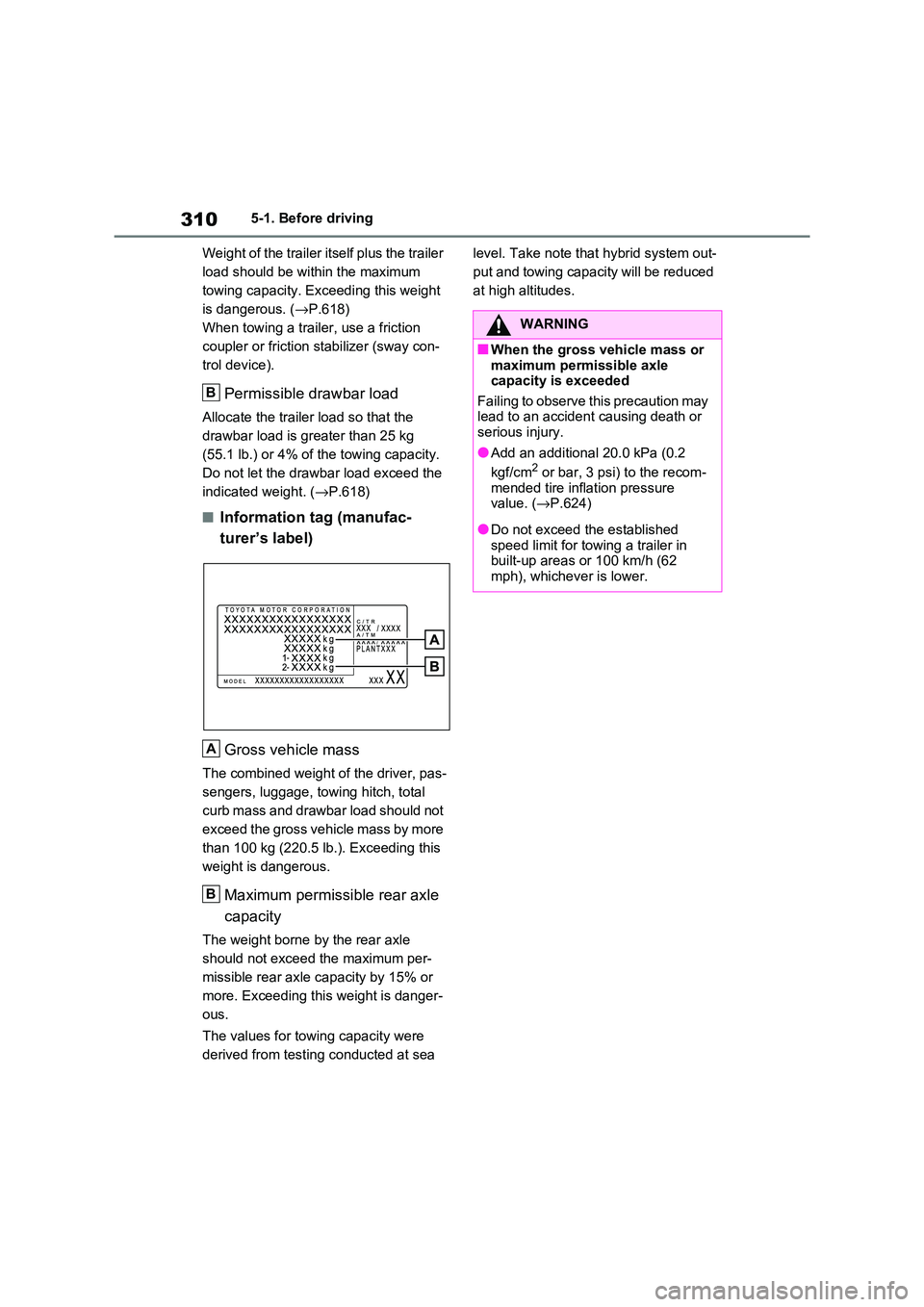
■Information tag (manufac-
turer’s label)
Gross vehicle mass
The combined weight of the driver, pas -
sengers, luggage, towing hitch, total
curb mass and drawbar load should not
exceed the gross vehicle mass by more
than 100 kg (220.5 lb.). Exceeding this
weight is dangerous.
Maximum permissible rear axle
capacity
The weight borne by the rear axle
should not exceed the maximum per -
missible rear axle capacity by 15% or
more. Exceeding this weight is danger -
ous.
The values for towing capacity were
derived from testing conducted at sea
level. Take note t hat hybrid system out-
put and towing capacity will be reduced
at high altitudes.
B
A
B
WARNING
■When the gross vehicle mass or
maximum permissible axle capacity is exceeded
Failing to observe this precaution may
lead to an accident causing death or
serious injury.
●Add an additional 20.0 kPa (0.2
kgf/cm2 or bar, 3 psi) to the recom -
mended tire inflation pressure
value. ( →P.624)
●Do not exceed the established
speed limit for towing a trailer in built-up areas or 100 km/h (62
mph), whichever is lower.
Page 357 of 666
355
5
5-5. Using the driving support systems
Driving
*: If equipped
The system can detect the follow -
ing:
Vehicles
Bicyclists
Pedestrians
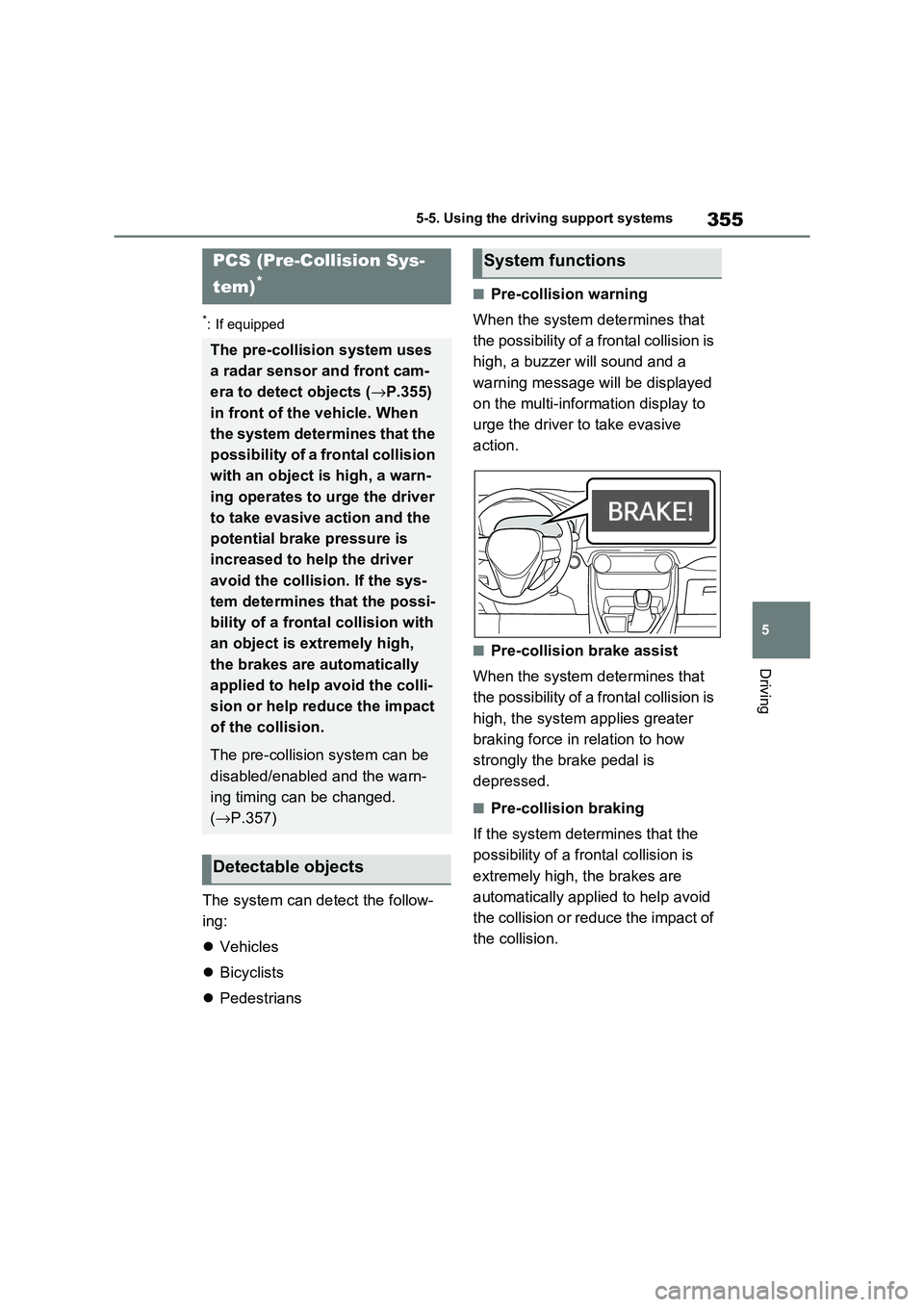
■Pre-collision warning
When the system determines that
the possibility of a frontal collision is
high, a buzzer will sound and a
warning message wil l be displayed
on the multi-information display to
urge the driver to take evasive
action.
■Pre-collision brake assist
When the system determines that
the possibility of a frontal collision is
high, the system applies greater
braking force in relation to how
strongly the brake pedal is
depressed.
■Pre-collision braking
If the system determines that the
possibility of a fr ontal collision is
extremely high, the brakes are
automatically applied to help avoid
the collision or reduce the impact of
the collision.
PCS (Pre-Collision Sys-
tem)*
The pre-collision system uses
a radar sensor and front cam -
era to detect objects ( →P.355)
in front of the vehicle. When
the system determines that the
possibility of a fr ontal collision
with an object is high, a warn -
ing operates to urge the driver
to take evasive action and the
potential brake pressure is
increased to help the driver
avoid the collision. If the sys -
tem determines that the possi -
bility of a fronta l collision with
an object is extremely high,
the brakes are automatically
applied to help avoid the colli -
sion or help reduce the impact
of the collision.
The pre-collision system can be
disabled/enabled and the warn -
ing timing can be changed.
( →P.357)
Detectable objects
System functions
Page 363 of 666
361
5
5-5. Using the driving support systems
Driving
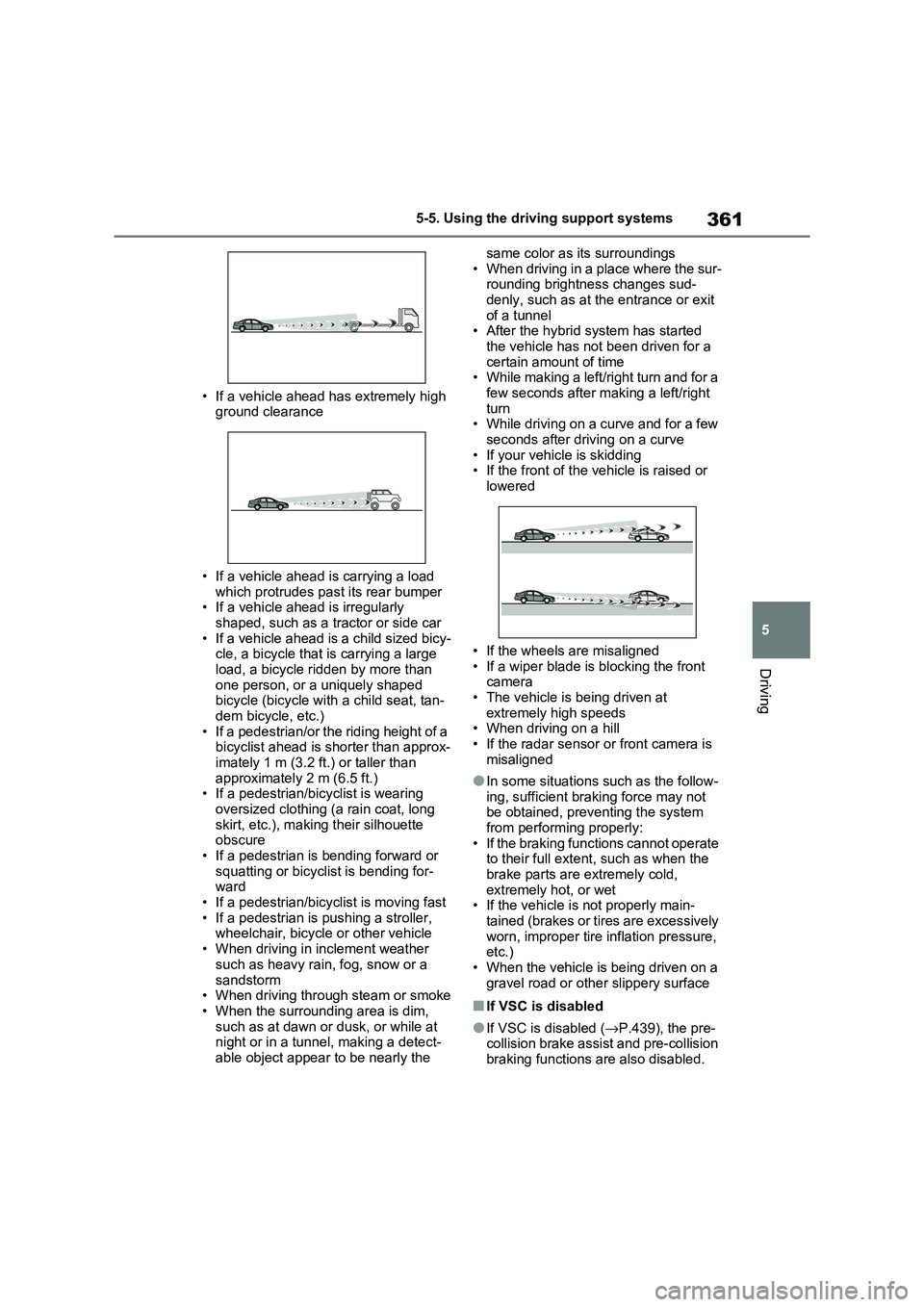
• If a vehicle ahead has extremely high
ground clearance
• If a vehicle ahead is carrying a load
which protrudes pa st its rear bumper • If a vehicle ahead is irregularly
shaped, such as a tractor or side car
• If a vehicle ahead is a child sized bicy - cle, a bicycle that is carrying a large
load, a bicycle ridden by more than
one person, or a uniquely shaped bicycle (bicycle with a child seat, tan-
dem bicycle, etc.)
• If a pedestrian/or the riding height of a bicyclist ahead is shorter than approx -
imately 1 m (3.2 ft.) or taller than
approximately 2 m (6.5 ft.) • If a pedestrian/bi cyclist is wearing
oversized clothing (a rain coat, long
skirt, etc.), maki ng their silhouette obscure
• If a pedestrian is bending forward or
squatting or bicyclist is bending for - ward
• If a pedestrian/bicy clist is moving fast
• If a pedestrian is pushing a stroller, wheelchair, bicycle or other vehicle
• When driving in inclement weather
such as heavy rain , fog, snow or a
sandstorm • When driving through steam or smoke
• When the surrounding area is dim,
such as at dawn or dusk, or while at night or in a tunnel, making a detect -
able object appear to be nearly the
same color as its surroundings
• When driving in a place where the sur - rounding brightness changes sud -
denly, such as at the entrance or exit
of a tunnel • After the hybrid system has started
the vehicle has not been driven for a
certain amount of time • While making a left/right turn and for a
few seconds after making a left/right
turn • While driving on a curve and for a few
seconds after driving on a curve
• If your vehicle is skidding • If the front of the v ehicle is raised or
lowered
• If the wheels are misaligned
• If a wiper blade is blocking the front
camera • The vehicle is being driven at
extremely high speeds
• When driving on a hill • If the radar sensor or front camera is
misaligned
●In some situations such as the follow -
ing, sufficient braking force may not
be obtained, preventing the system from performing properly:
• If the braking functions cannot operate
to their full extent, such as when the brake parts are extremely cold,
extremely hot, or wet
• If the vehicle is not properly main - tained (brakes or ti res are excessively
worn, improper tire i nflation pressure,
etc.)
• When the vehicle is being driven on a gravel road or other slippery surface
■If VSC is disabled
●If VSC is disabled (→P.439), the pre- collision brake assist and pre-collision
braking functions are also disabled.
Page 365 of 666
363
5
5-5. Using the driving support systems
Driving
WARNING
■Before using LTA system
●Do not rely sole ly upon the LTA
system. The LTA system does not automatically drive the vehicle or
reduce the amount of attention that
must be paid to the area in front of the vehicle. The driver must always
assume full responsibility for driving
safely by paying careful attention to
the surrounding conditions and operating the stee ring wheel to cor-
rect the path of t he vehicle. Also,
the driver must take adequate breaks when fatigued, such as from
driving for a long period of time.
●Failure to perform appropriate driv -
ing operations and pay careful
attention may lead to an accident, resulting in death or serious injury.
●When not u sing the LTA system, use the LTA switch to turn the sys -
tem off.
■Situations unsuitable for LTA
system
In the following situations, use the LTA switch to tu rn the system off.
Failure to do so may lead to an acci -
dent, resulting in death or serious injury.
●Vehicle is driven on a road surface which is slippery due to rainy
weather, fallen snow, freezing, etc.
●Vehicle is driven on a snow-cov -
ered road.
●White (yellow) lines are difficult to
see due to rain, snow, fog, dust,
etc.
●Vehicle is driven in a temporary
lane or restricted lane due to con - struction work.
●Vehicle is driven in a construction zone.
●A spare tire, tire chains, etc. are equipped.
●When the tires have been exces - sively worn, or when the tire infla -
tion pressure is low.
●When tires of a size other than
specified are installed.
●Vehicle is driven in traffic lanes
other than that highways and free -
ways.
●When your vehicle is towing a
trailer or during emergency towing
■Preventing LTA system malfunc -
tions and operations performed by mistake
●Do not modify the headlights or
place stickers, etc. on the surface of the lights.
●Do not modify the suspension etc. If the suspension etc. needs to be
replaced, contact any authorized
Toyota retailer or Toyota authorized repairer, or any reliable repairer.
●Do not install or place anything on the hood or grille. Also, do not
install a grille guar d (bull bars, kan-
garoo bar, etc.).
●If your windshield needs repairs,
contact any autho rized Toyota retailer or Toyota authorized
repairer, or any reliable repairer.
■Conditions in which functions
may not operate properly
In the following situ ations, the func- tions may not operate properly and
the vehicle may depart from its lane.
Drive safely by always paying careful
attention to your surroundings and operate the steering wheel to correct
the path of the vehicle without relying
solely on the functions.
Page 367 of 666
365
5
5-5. Using the driving support systems
Driving
■Lane departure alert function
When the system determines that
the vehicle might depart from its
lane or course*, a warning is dis -
played on the multi-information dis -
play, and either a warning buzzer
will sound or the steering wheel will
vibrate to alert the driver.
When the warning buzzer sounds or
the steering wheel vibrates, check the
area around your vehicle and carefully
WARNING
●The vehicle is driven in an area
without white (yellow) lines, such as
in front of a tollg ate or checkpoint, or at an intersection, etc.
●The white (yellow) lines are cracked, “Raised pavement
marker” or stones are present.
●The white (yellow) lines cannot be seen or are difficu lt to see due to
sand, etc.
●The vehicle is driven on a road sur -
face that is wet due to rain, pud -
dles, etc.
●The traffic lines are yellow (which
may be more difficult to recognize than lines that are white).
●The white (yellow) lines cross over a curb, etc.
●The vehicle is driven on a bright surface, such as concrete.
●If the edge of the road is not clear or straight.
●The vehicle is driven on a surface that is bright due t o reflected light,
etc.
●The vehicle is driven in an area
where the brightness changes sud -
denly, such as at the entrances and exits of tunnels, etc.
●Light from the hea dlights of an oncoming vehicle, the sun, etc.
enters the camera.
●The vehicle is driven on a slope.
●The vehicle is driven on a road which tilts left or right, or a winding
road.
●The vehicle is driven on an
unpaved or rough road.
●The traffic lane is excessively nar -
row or wide.
●The vehicle is ext remely tilted due to carrying heavy luggage or having
improper tire pressure.
●The distance to the preceding vehi -
cle is extremely short.
●The vehicle is moving up and down
a large amount due to road condi-
tions during drivi ng (poor roads or road seams).
●When driving in a t unnel or at night with the headlights off or when a
headlight is dim due to its lens
being dirty or it being misaligned.
●The vehicle is s truck by a cross-
wind.
●The vehicle is affected by wind from
a vehicle driven in a nearby lane.
●The vehicle has just changed lanes
or crossed an intersection.
●Tires which differ by structure, man -
ufacturer, brand or tread pattern are used.
●Snow tires, etc. are equipped.
●The vehicle is b eing driven at
extremely high speeds.
Functions included in LTA
system
Page 418 of 666
4165-5. Using the driving support systems
■The system can be operated when
●The power switch is in ON.
●Toyota parking assist-sensor function is on.
●The vehicle speed is less than about 10 km/h (6 mph).
●The shift lever is in other than P.
■If “Clean Parking Assist Sensor” is
displayed on the multi-information display
A sensor may be covered with ice,
snow, dirt, etc. Rem ove the ice, snow, dirt, etc., from the sensor to return the
system to normal.
Also, due to ice forming on a sensor at low temperatures, a warning message
may be displayed or the sensor may not
be able to detect an object. Once the ice melts, the system will return to normal.
If a warning message is displayed even
if the sensor is cle an, there may be a sensor malfunction. Have the vehicle
inspected by any a uthorized Toyota
retailer or Toyota authorized repairer, or any reliable repairer.
WARNING
●The area directly under the bum -
pers is not detected.
Thin posts or objects lower than the sensor may not be detected when
approached, even if they have been
detected once.
■When to disable the function
In the following situations, disable the
function as it may operate even though there is no possibility of a colli -
sion.
●The vehicle is equipped with a com - mercial fender pole, wireless
antenna or fog lights.
●The front or rear bumper or a sen -
sor receives a strong impact.
●A non-genuine Toyota suspension
(lowered suspension, etc.) is
installed.
●Towing eyelets are installed.
●A backlit license plate is installed.
●When using an automatic car wash
■When using the Toyota parking
assist-sensor
In the following situations, the system
may not function correctly due to a
sensor malfunction, etc. Have the vehicle checked by any authorized
Toyota retailer or Toyota authorized
repairer, or any reliable repairer.
●The Toyota parki ng assist-sensor
operation display flashes or shows continuously, a nd a beep sounds
when no objects are detected.
●If the area around a sensor collides
with something, or is subjected to
strong impact.
●If the bumper or grille collides with
something.
●If the display flashes or is displayed continuously and a buzzer does not
sound, except when the mute func -
tion has been turned on.
■Notes when washing the vehicle
Do not apply intensiv e bursts of water or steam to the sensor area.
Doing so may result in the sensor
malfunctioning.
●When using a high pressure
washer to wash the vehicle, do not spray the sensors directly, as doing
so may cause a sensor to malfunc -
tion.
●When using steam to clean the
vehicle, do not direct steam too close to the sensors as doing so
may cause a sensor to malfunction.
Page 428 of 666
4265-5. Using the driving support systems
■The Parking Support Brake func- tion (static object) will operate
when
The function will operate when the
PKSB OFF indicator is not illuminated ( →P.170, 171) and all of the following
conditions are met:
●Hybrid system outpu t restriction con-
trol
• The Parking Support Brake is enabled.
• The vehicle speed is approximately 15
km/h (9 mph) or less. • There is a static object in the traveling
direction of the v ehicle and approxi-
mately 2 to 4 m (6 to 13 ft.) away. • The Parking Support Brake deter -
mines that a stronger-than-normal
brake operation is n ecessary to avoid a collision.
●Brake control• Hybrid system outpu t restriction con-
WARNING
●If the area around a radar sensor is
subjected to an im pact, the system
may not operate properly due to a sensor malfunction. Have the vehi -
cle inspected by any authorized
Toyota retailer or Toyota authorized repairer, or any reliable repairer.
■Handling the suspension
Do not modify the suspension, as changes to the height or inclination of
the vehicle may pr event the sensors
from detecting objects correctly or cause the system to not operate or
operate unnecessarily.
■If the Parking Support Brake
function (static objects) operates
unnecessarily, such as at a rail - road crossing
In the event that the Parking Support
Brake function (sta tic objects) oper- ates unnecessarily, such as at a rail-
road crossing, brake control will be
canceled after appr oximately 2 sec- onds, allowing you to proceed forward
and leave the area, brake control can
also be canceled by depressing the brake pedal. Depressing the acceler -
ator pedal after brake control is can -
celed will allow you to proceed forward and leav e the area.
■Notes when washing the vehicle
Do not apply intensive bursts of water
or steam to the sensor area.
Doing so may resul t in the sensor malfunctioning.
●When using a high pressure washer to wash the vehicle, do not
spray the sensors directly, as doing
so may cause a sensor to malfunc - tion.
●When using steam to clean the vehicle, do not direct steam too
close to the sensors as doing so
may cause a sensor to malfunction.
■When to disable the Parking Sup - port Brake
In the following situations, disable the
Parking Support Brake as the system may operate even t hough there is no
possibility of a collision.
●When inspecting t he vehicle using
a chassis roller, chassis dynamo or
free roller
●When loading the vehicle onto a
boat, truck or other transport vessel
●If the suspension has been modi -
fied or tires of a size other than specified are installed
●If the front of the vehicle is raised or lowered due to the carried load
●When equipment that may obstruct a sensor is instal led, such as a tow-
ing eyelet, bumper protector (an
additional trim st rip, etc.), bicycle carrier, or snow plow
●When using an autom atic car wash
Page 440 of 666
4385-5. Using the driving support systems
■ECB (Electronically Con-
trolled Brake System)
The electronically controlled sys -
tem generates braking force corre -
sponding to the brake operation
■ABS (Anti-lock Brake System)
Helps to prevent wheel lock when
the brakes are applied suddenly, or
if the brakes are applied while driv -
ing on a slippery road surface
■Brake assist
Generates an increased level of
braking force after the brake pedal
is depressed when the system
detects a panic stop situation
■VSC (Vehicle Stability Control)
Helps the driver to control skidding
when swerving suddenly or turning
on slippery road surfaces.
■VSC+ (Vehicle Stability Con -
trol+)
Provides cooperative control of the
ABS, TRC, VSC and EPS.
Helps to maintain directional stabil -
ity when swerving on slippery road
surfaces by controlling steering per -
formance.
■Trailer Sway Control
Helps the driver t o control trailer
sway by selectively applying brake
pressure for individual wheels and
reducing driving torque when trailer
sway is detected.
■TRC (Traction Control)
Helps to maintain drive power and
prevent the drive wheels from spin -
ning when starting the vehicle or
accelerating on slippery roads
■Active Cornering Assist (ACA)
Helps to prevent t he vehicle from
drifting to the outer side by perform -
ing inner wheel brake control when
attempting to acc elerate while turn-
ing
■Hill-start assist control
Helps to reduce the backward
movement of the vehicle when
starting on an uphill
■EPS (Electric Po wer Steering)
Employs an electric motor to
reduce the amount of effort needed
to turn the steering wheel
Driving assist systems
To keep driving safety and per -
formance, the following sys -
tems operate aut omatically in
response to various driving sit -
uations. Be aware, however,
that these sys tems are supple-
mentary and should not be
relied upon too heavily when
operating the vehicle.
Summary of the driving
assist systems
Page 447 of 666
445
5
5-6. Driving tips
Driving
5-6.Driving tips
Use fluids that are appropriate to
the prevailing outside tempera-
tures.
• Engine oil
• Engine coolant
• Power control unit coolant
• Washer fluid
Have a service technician
inspect the condition of the 12-
volt battery.
Have the vehicle fitted with four
snow tires or purchase a set of
tire chains for the front tires.
Ensure that all tires are the same size
and brand, and that chains match the
size of the tires.*
*: Tire chains cannot be mounted on
vehicles with 235/55R19 tires.
Winter driving tips
Carry out the necessary prepa -
rations and inspections before
driving the vehicle in winter.
Always drive the vehicle in a
manner appropriate to the pre -
vailing weather conditions.
Pre-winter preparations
WARNING
■Driving with snow tires
Observe the following precautions to reduce the risk of accidents.
Failure to do so may result in a loss of
vehicle control and cause death or serious injury.
●Use tires of the specified size.
●Maintain the recommended level of air pressure.
●Do not drive at speeds in excess of the speed limit or the speed limit
specified for the snow tires being
used.
●Use snow tires on all, not just some
wheels.
■Driving with tire chains (except
235/55R19 tires)
Observe the following precautions to
reduce the risk of accidents.
Failure to do so may result in the vehi - cle being unable to be driven safely,
and may cause death or serious
injury.
●Do not drive in excess of the speed
limit specified for the tire chains being used, or 50 km/h (30 mph),
whichever is lower.
●Avoid driving on bumpy road sur -
faces or over potholes.
●Avoid sudden acceleration, abrupt
steering, sudden br aking and shift-
ing operations that cause sudden engine braking.
●Slow down sufficiently before enter - ing a curve to ensure that vehicle
control is maintained.
●Do not use LTA (Lane Tracing
Assist) system (if equipped).
NOTICE
■Repairing or replacing snow tires
Request repairs or replacement of snow tires from any authorized
Toyota retailer or Toyota authorized
repairer, or any reliable repairer or legitimate tire retailers.
This is because the removal and
attachment of snow tires affects the operation of the tire pressure warning
valves and transmitters.